Category Archives: Culture

The Jordan River today

Today we returned to the Jordan Valley (Roman Perea) to a site designated Bethany Beyond the Jordan in the country of Jordan. Enough evidence was presented to easily convince various religious orders to build new churches in the area. The site on the west bank of the Jordan that I visited in 1967 has been closed to the general public since June of 1967 I think.

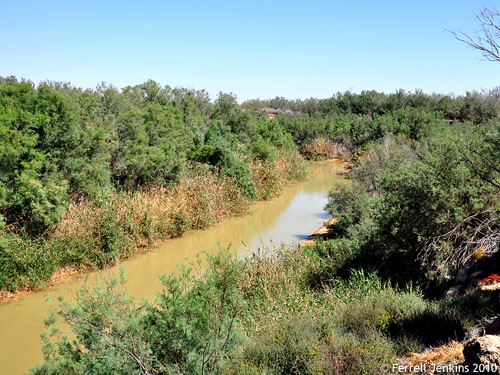
You will see by the photo that I made this morning that the river is extremely low. Just last evening I read the article from The Jerusalem Post by way of the Bible Places Blog about the study that says the river will be dry by next year.

Jordan River at Bethany Beyond the Jordan. Photo by Ferrell Jenkins.

Jordan River at Bethany Beyond the Jordan. Photo by Ferrell Jenkins.

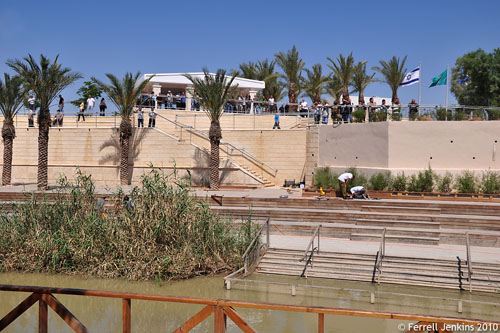
Now that Jordan is seeing many tourists come to the eastern side of the river, Israel is preparing to open the site on the western side of the river. There were several people on the Israel side today where construction continues.

Jordan River Baptism Site in Israel and Jordan. Photo by Ferrell Jenkins.

Jordan River Baptism Site in Israel and Jordan. Photo by Ferrell Jenkins.

In spite of the fact that the river water is reported to be mostly sewage, several were being baptized, or dipping themselves, in the water when we were there.

These things took place in Bethany beyond the Jordan, where John was baptizing. (John 1:28 NAU)

We also visited Mount Nebo and Madaba before traveling south about 4 hours to Petra for the night.

Early farming sites uncovered in Syria

The Syrian Department of Archaeology and Museums reports excavations of some farming communities on the Euphrates River in northern Syria dating back to the 10th millennium B.C.

Assistant Director of the Syrian Department of Archaeology and Museums Thaer Yerte said excavations at the site revealed information about the communities that settled on the banks of the Euphrates, uncovering two different areas that include three communal buildings and dozens of circular houses built from limestone and paved with pebbles from the river.

The structures contained various flint tools such as blades, knives, sickles, arrow tips and hatchets, tools used for leatherwork and crafting straw mats, stone mills and pestles, pottery fragments and animal bones and horns, Yerte added.

He pointed out that the first communal building in the site contains a circular hole in the ground 15 meters deep with a diameter of 12 meters, with a clay terrace inside the building containing limestone blocks decorated with engravings of animals, geometrical shapes and the sun. The floor is made of clay tiles painted with lime, while the ceiling is supported by wooden pillars.

The second communal building is circular with a diameter of 7 meters, consisting of five chambers with a square stone support pillar in its center. It contained flint and stone tools, stone pottery, a flint figurine representing a mother goddess, a clay figurine representing a half-human half-animal creature, and ox horns.

The complete article may be read here.

The area in northern Syria and southeastern Turkey along the Euphrates River is known as Paddan-aram in the book of Genesis. This area served as home for several of the biblical patriarchs. See Genesis 25:20; 28:2,5-7; 31:18; 33:18; 35:9,26; 46:15).

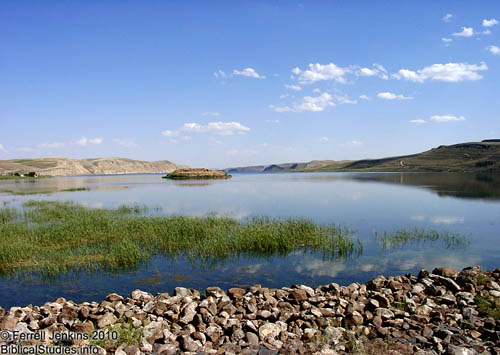
Today’s photo of the Euphrates River was made in northern Syria about 25 miles south of the border with Turkey.

The Euphrates River in northern Syria. Photo by Ferrell Jenkins.

The Euphrates River in northern Syria. Photo by Ferrell Jenkins.

Practical uses of potsherds

Once pottery is broken it appears to be useless. The prophet Jeremiah, prior the Babylonian destruction of Jerusalem, was told by the LORD to buy a piece of pottery. Follow the story:

The LORD told Jeremiah, “Go and buy a clay jar from a potter. Take with you some of the leaders of the people and some of the leaders of the priests. Go out to the part of the Hinnom Valley which is near the entrance of the Potsherd Gate. Announce there what I tell you. (Jeremiah 19:1-2 NET)

Eventually, he was to break the clay jar.

The LORD continued, “Now break the jar in front of those who have come here with you. Tell them the LORD who rules over all says, ‘I will do just as Jeremiah has done. I will smash this nation and this city as though it were a potter’s vessel which is broken beyond repair. The dead will be buried here in Topheth until there is no more room to bury them.’ (Jeremiah 19:10-11 NET)

Broken pottery is clay that has been formed and fired before being broken. David described his weakened condition using an analogy to potsherds:

The roof of my mouth is as dry as a piece of pottery; (NET), or “my strength is dried up like a potsherd” (Psalm 22:15 ESV)

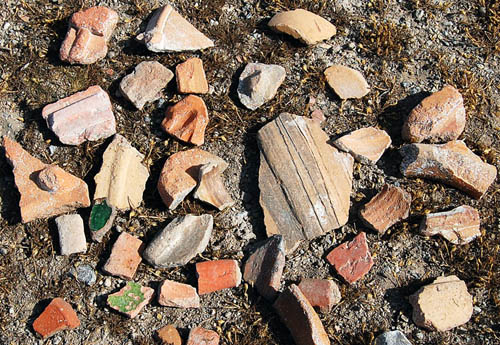
Collected potsherds on the surface of Derbe. Photo by Ferrell Jenkins.

Collected potsherds on the surface of Derbe. Photo by Ferrell Jenkins.

The pottery is now potsherds, sherds, or shards. Is there any practical use for it? Yes.

  • Scraping sores. “Job took a shard of broken pottery to scrape himself with while he was sitting among the ashes.” (Job 2:8 NET)
  • Taking fire from the hearth, or scooping water from a cistern (Isaiah 30:14). This would require a shard from a larger jar.
  • Writing material. When the potsherd is used as a writing surface it is called an ostracon (plural is ostraca). We have some famous examples such as the Lachish Letters, the lots at Masada, the Arad ostraca, Samaritan ostraca, et al.

In Nebuchadnezzar’s vision of the future, the “toes of the feet were partly of iron and partly of clay [pottery, NAU]” (Daniel 2:42). I could have told him this would not work. “Iron does not mix with clay [pottery, NAU]” (Daniel 2:43).

If we move to modern times, there is another practical use for potsherds.

  • Archaeological dating. Potsherds are an indicator of the chronological periods during which a tell was occupied. Flinders Petrie, working at Tell el-Hesi in 1890, observed the relationship between the various layers of the tell and the pottery found in each layer.

Potsherds, sherds, and shards

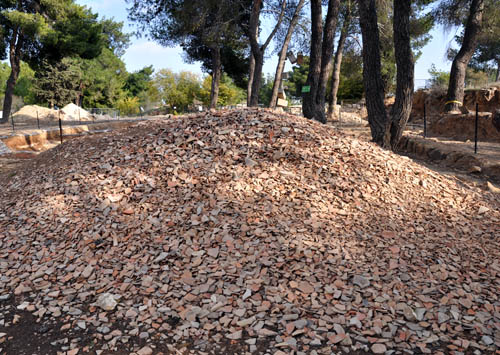
Pottery is the most durable of things discovered during an archaeological dig. Even when the pottery is broken it endures, and can be useful for some purposes. The pieces of broken pottery are called potsherds, sherds, or shards.  Visit any archaeological site and you will see a pile of broken pottery. The largest pile I recall seeing is at Ramat Rachel between Jerusalem and Bethlehem.

A pile of potsherds at Ramat Rachel. Photo by Ferrell Jenkins.

A pile of potsherds at Ramat Rachel. Photo by Ferrell Jenkins.

Cities of biblical times likely had a common place to dump broken pottery. In the days of Jeremiah, Jerusalem had a gate known as the Potsherd Gate.

Go out to the part of the Hinnom Valley which is near the entrance of the Potsherd Gate. Announce there what I tell you. (Jeremiah 19:2 NET)

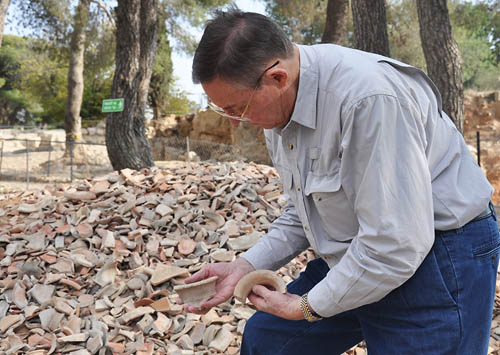
Looking through the pottery shards at Ramat Rachel.

Ferrell Jenkins looking at a rim and a handle at Ramat Rachel. Photo: Leon Mauldin.

Is there any use for this broken pottery? Answer to follow…

Did someone say “Free”?

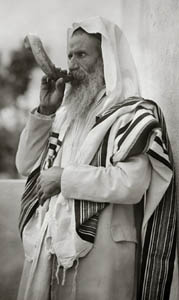
Yemenite Rabbi blowing shofar.

Yemenite Rabbi blowing shofar.

Todd Bolen is giving away a PowerPoint presentation, and the associated jpg images, of Jewish People in the Early 1900s. These photos are part of the The American Colony and Eric Matson Collection that Todd has made available.

We have recommended the entire collection here.

For the free presentation or the images, click here. The photo to the right is a miniature of one showing a Yemenite Rabbi blowing a shofar. It dates to between 1934 and 1939. Shofar is the Hebrew word often translated trumpet (2 Kings 9:13) or ram’s horn (Leviticus 25:9) in English versions of the Bible.

Robbers arrested for digging up archaeological site

Illegal digging of archaeological sites is a problem in many countries. Israel reports that at 150 robbers are caught each year. Thievery has been a special problem in Iraq. I have seen archaeological mounds in Turkey with evidence of fresh digging.

Ron Friedman of The Jerusalem Post reports on a recent case in which four men were arrested at a site near Moshav Zechariya. The headline says the men were arrested near Beit Shemesh [Beth-shemesh]. Zechariya is about 6-7 miles south of Beit Shemesh.

The Antiquities Authority revealed on Tuesday that officers from its Unit for the Prevention of Antiquities Robbery arrested four men from Rahat who were allegedly attempting to rob an archeological site near Beit Shemesh on Saturday. The unit’s inspectors caught the men digging a large hole uncovering a network of underground passages in their search for buried treasure they believed to be hidden there.

The men were arrested on the spot and taken by members of the Border Police to the Jerusalem central police station for interrogation. When brought before a judge, the suspects denied the charges and were released on NIS 50,000 bail. The Antiquities Authority spokeswoman said that an indictment charging the men with damaging an archeological site and unlawful digging in an archeological site – offenses that carry five- and three-year sentences, respectively – will be issued in the coming days.

The site where the arrests took place holds the remnants of 3,000 years of habitation, dating back to the days of the First Temple. The site, which was also populated in the Byzantine period 2,000 years ago and during the Crusades 900 years ago, features remains of a fortified wall, various structures, graves and a network of underground caves and tunnels. The alleged robbers destroyed structure walls, and their aggressive digging caused irrecoverable damage to multiple archeological levels.

Amir Ganor, who heads the antiquities robbery prevention unit, was on hand during the arrest and said the damage done by the men was irreversible.

Ganor’s comment about the value of archaeological sites is significant:

Archeological sites belong to the whole public and are human heritage assets. Digging up a site causes irreversible damage. Anything removed from it is taken out of the human inventory. No length of time in prison can make up for or correct the damage that is done to the site. Harming ancient sites is like ripping pages from the cultural history books of the land and its people.

You may read the article in its entirety here.

HT: Joseph I. Laurer

Temples made by man

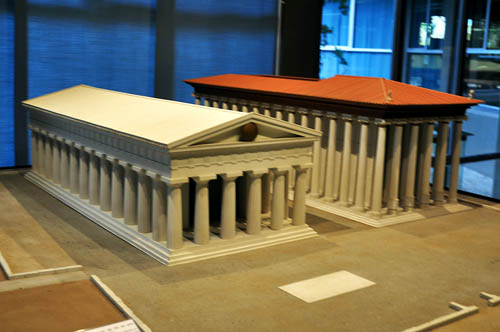
Any Greek or Roman city we visit is surely to have ruins of a theater and a temple. Both Greek and Roman theaters remain at Syracuse (Acts 28:12).The Paoli Orsi Regional Archaeological Museum displays a model of the Temple of Athena (left; 480 B.C.) and the Temple of Artemis (right; 520 B.C.).

Temple models at Syracuse, Sicily, archaeological museum.

Model of Temple Athena and Temple of Artemis. Syracuse. Photo by Ferrell Jenkins.

The Apostle Paul had to contend with this in every Roman city he visited. At Athens he said,

The God who made the world and everything in it, being Lord of heaven and earth, does not live in temples made by man, nor is he served by human hands, as though he needed anything, since he himself gives to all mankind life and breath and everything. (Acts 17:24-25 ESV)

He reminded the Corinthians, who lived in a city filled with temples,

For although there may be so-called gods in heaven or on earth–as indeed there are many “gods” and many “lords”– yet for us there is one God, the Father, from whom are all things and for whom we exist, and one Lord, Jesus Christ, through whom are all things and through whom we exist. (1 Corinthians 8:5-6 ESV)

Solomon’s temple in Jerusalem, as well as the later temples built by Zerubbabel and Herod, were made with hands. Paul certainly knows this. But he also knows what Solomon said about the same subject:

“But will God indeed dwell on the earth? Behold, heaven and the highest heaven cannot contain you; how much less this house that I have built! (1 Kings 8:27 ESV)

Read the full account of the building and dedication of the temple in 1 Kings 6-8. The temple was a place of worship, but it was not to be the object of worship.

Jesus taught His disciples to pray like this: “Our Father in heaven, hallowed be your name” (Matthew 6:9).

Perfume of pure nard

Shortly before His death, Jesus went to Bethany. The event we are considering today took place at the home of Simon the Leper, but Mary, Martha, and Lazarus, His friends, were present.  On this occasion Mary anointed the feet of Jesus with perfume of pure nard.

Mary therefore took a pound of expensive ointment made from pure nard, and anointed the feet of Jesus and wiped his feet with her hair. The house was filled with the fragrance of the perfume. (John 12:3 ESV)

The Greek word for perfume is muron, and the word for nard is nardos. Our word myrrh comes from muron. While it might be used of a specific type of fragrance, in this place it is probably used in the general sense of perfume. Nard (or spikenard) is “a fragant oil derived from the root and spike (hair stem) of the nard plant which grows in the mountains of northern India” (Brown, Anchor Bible, I:448). Mary anointed His feet. The parallel accounts are Matthew 26:6-13 and Mark 14:3-9. This act is to be told wherever the gospel is preached. This took place in the house of Simon the leper. The account in Luke 7:36-50 took place in Galilee and is different.

The Eretz Israel Museum at Tel Aviv University has one entire building devoted to glassware. I was especially interested in a large collection of perfume bottles from the first century A.D.

Perfume Bottles at Eretz Israel Museum at Tel Aviv University

First Century A.D. Perfume Bottles at Eretz Israel Museum. Photo by Ferrell Jenkins.

The museum sign associated with this collection identifies these bottles as “Free-blown vessels of colored opaque and translucent glass, probably produced in the same centers.”

Jesus enters Jerusalem (The Lexham English Bible)

Last evening I downloaded The Lexham English Bible, which Logos is giving away to Logos Libronix users. Information here. The Lexham Bible is available free in several popular formats here. I decided to share this text about Jesus’ entry into Jerusalem in preparation for His death. Notes have been removed. The note are an important part of The Lexham Bible, but you may read those when you download your own copy.

And when they drew near to Jerusalem and came to Bethphage at the Mount of Olives, then Jesus sent two disciples, 2 saying to them, “Go into the village before you, and right away you will find a donkey tied and a colt with her. Untie them“bring them to me. 3 And if anyone says anything to you, you will say, ‘The Lord needs them,’ and he will send them at once.” 4 Now this took place so that what was spoken through the prophet would be fulfilled, saying,
5 “Say to the daughter of Zion,
‘Behold, your king is coming to you,
humble and mounted on a donkey,
and on a colt, the foal of a pack animal.’”
6 So the disciples went and did just as Jesus directed them, 7 and brought the donkey and the colt and put their cloaks on them, and he sat on them. 8 And a very large crowd spread their cloaks on the road, and others were cutting branches from the trees and spreading on the road. 9 And the crowds who went ahead of him and the ones who followed were shouting, saying,
“Hosanna to the Son of David!
Blessed is the one who comes in the name of the Lord!
Hosanna in the highest heaven!”
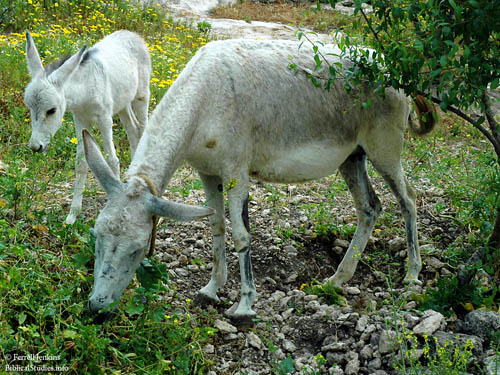
Donkey and Colt at Nazareth Village. Photo by Ferrell Jenkins.

Donkey and Colt at Nazareth Village. Photo by Ferrell Jenkins.

The late William Hendriksen makes these comments about this important event.

However, he also shows the crowds what kind of Messiah he is, namely, not the earthly Messiah of Israel’s dreams, the One who wages war against an earthly oppressor, but the One who came to promote and establish “the things that make for peace” (Luke 19:42), lasting peace: reconciliation between God and man, and between a man and his fellow man. Accordingly, Jesus enters Jerusalem mounted on a colt, the foal of an ass, an animal associated not with the rigors of war but with the pursuits of peace, for he is the Prince of Peace (Isa. 9:6).

But the people in general, their minds filled with earthly ideas concerning the Coming One, did not understand or appreciate this. In hailing him as the Messiah, the people were right; the Pharisees, chief priests, and scribes (Matt. 21:15, 16; Luke 19:39, 40) were wrong. But in expecting this Messiah to reveal himself as a political, earthly Messiah the Hosanna shouters were as wrong as were their leaders. Those who in every way rejected Jesus were committing a crime, but those who outwardly “accepted” and cheered him were also doing him a gross injustice, for they did not accept him for what he really was. Their tragic mistake was committed with dire results for themselves. (William Hendriksen, New Testament Commentary : Exposition of the Gospel According to Matthew, 760)

The fish of ancient Egypt and Ashkenazi Jews

A human interest story by Stephen Gabriel Rosenberg draws a connection between the fish eaten by the Israelites in ancient Egypt and the fish eaten by Ashkenazi Jews today during Passover (Pesach). The Ashkenazi Jews of Israel and America are those who descended from Jews living along the Rhine River in Germany. Because of their movement to other areas, we think of them as having come from central and eastern Europe. Non-Ashkenazi Jews are known as Sephardic Jews. We typically think of them as having lived in the Iberian peninsula and Yemin, among other places.

Rosenberg paints a fascinating history of the gefilte fish which is eaten on the Passover and as the Sabbath (Shabbat) afternoon meal. He cites the work of the late George Freudenstein of Riverdale, New York. He calls Freudenstein “an eminent nutritional scientist and Hebrew scholar.  Freudenstein was chief chemist of the Jewish food giant Rokeach for 50 years and also an ardent talmudist.”

IN ANCIENT Egypt fish was a staple diet for the workers, and that included the Hebrew slaves. Not satisfied with the manna, they complained to Moses, “We remember the fish that we ate in Egypt for nothing” (Numbers 11:5) and the Egyptian sources confirm that Rameses II, perhaps the pharaoh of the Exodus, gave his workers a free allowance of 10 kilos of salted fish each month. Under his descendent Rameses III, around 1150 BCE, it is recorded that the grave diggers requested an increase in this generous amount to compensate them for their heavy and unpleasant work.

In spite of the hot climate, Nile fish could be preserved by drying and salting, as evidenced by the discovery of a warehouse of dried fish at the Sun Temple of El-Amarna, in central Egypt.

Freudenstein quotes a German Egyptologist, who claims that the composition of the fish in the Nile Delta has hardly changed over the last five millennia and that there are 30 species still active from ancient times. These include carp, pike and mullet, and the species of Nile mullet is exactly the one that is in use for today’s gefilte fish, at least as produced by Rokeach.

Let it be noted that we do not concur that Rameses II was the Pharaoh of the Exodus, but that is for another time. Rosenberg’s fascinating article, “In praise of gefilte fish,”  may be read in its entirety here in the Jerusalem Post. We learn that Secretary of State Hillary Clinton “is engaged in diplomatic moves” to resolve a USA export/Israel import issue dealing with the gefilte.

We noted that the ancient Israelites longed for the fish of Egypt (Numbers 11:5). After the return from exile in Babylon, Nehemiah informs us that the men of Tyre sold imported fish in Jerusalem.

The people from Tyre who lived there were bringing fish and all kinds of merchandise and were selling it on the Sabbath to the people of Judah– and in Jerusalem, of all places! (Nehemiah 13:16 NET)

Our photo today shows the Nile River immediately south of Cairo where it divides to go around the islands, such as Roda Island, in the river. Fishermen get ready to go out for the day’s catch.
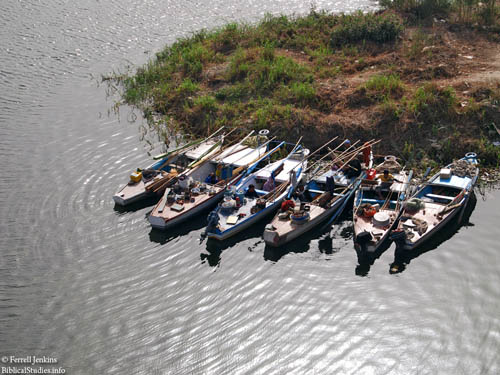
The Nile River near Cairo. Photo by Ferrell Jenkins.

The Nile River near Cairo where the river goes around the islands that are visible in the city. Photo by Ferrell Jenkins.

HT: Joesph I. Lauer