Category Archives: Culture

Four sorts of men (and women)

Recently while browsing through my folders on the book of Proverbs I ran across an article with a quotation about four sorts of men. I see that the quotation is attributed to different sources, but it is usually called an Arabian proverb.

There are four sorts of men:

  • He who knows not and knows not he knows not: he is a fool — shun him.
  • He who knows not and knows he knows not: he is simple — teach him.
  • He who knows and knows not he knows: he is asleep — wake him.
  • He who knows and knows he knows: he is wise — follow him.

There are several penetrating statements about the wise man in the book of Proverbs. Here are a few of the references.

A wise man will hear and increase in learning, And a man of understanding will acquire wise counsel, (Proverbs 1:5 NAU)

Do not reprove a scoffer, or he will hate you, Reprove a wise man and he will love you. (Proverbs 9:8 NAU)

Give instruction to a wise man and he will be still wiser, Teach a righteous man and he will increase his learning. (Proverbs 9:9 NAU)

Do you see a man wise in his own eyes? There is more hope for a fool than for him. (Proverbs 26:12 NAU)

Bible Land Food display to teach children

During a recent series of lessons on Daily Life in Bible Times I presented some material on the foods of Bible times. I emphasized that the foods ancient Israel had were those suitable to the terrain in which they lived — predominantly the mountains. One of the major biblical references about the foods is Deuteronomy 8:7-9.

 For the LORD your God is bringing you into a good land, a land of brooks of water, of fountains and springs, flowing forth in valleys and hills; a land of wheat and barley, of vines and fig trees and pomegranates, a land of olive oil and honey; a land where you will eat food without scarcity, in which you will not lack anything; a land whose stones are iron, and out of whose hills you can dig copper.  (Deuteronomy 8:7-9 NAU)

Later I learned that one of the ladies had prepared a Bible Land Food display to show the children during their Bible classes. I requested that Angel Sizemore allow me to use this material here. Here is her brief account.

— • —

After the September weekend lectures you presented at Centreville (Virginia) church of Christ, I had an idea for my class.  (I am teaching the 3rd & 4th graders this quarter). I thought that many of them may not have known what some of the food items you mentioned looked or tasted like. My family already eats most all of the items you mentioned, so I already had them in my kitchen. I had samples of several things cut up so they could taste them.

I showed the food to my own class first; then went over to the 5th & 6th grade class to show them; and finally to the little ones in the 1st & 2nd grade class. It was a HUGE hit with the children of all ages! I have heard from several of their parents that their kids really enjoyed it, and a couple of them had to scour the produce sections looking for their kid’s new favorite foods (like dates and pomegranates!).

Anyway, thank you for helping me to learn so much, and for inspiring me to teach more about it to our own little ones.

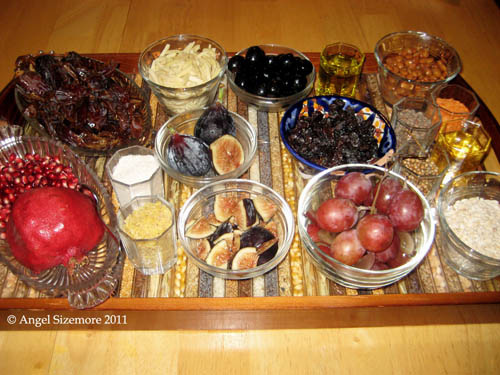
Bible Land Foods display by A. Sizemore. Ferrell's Travel Blog.

Bible Land Foods display by A. Sizemore.

Angel provided a list of the foods on the tray. (Click on the photo for a larger image.)

Foods included:
  • Dates — some whole and some cut up so they could taste it
  • Almonds — slivered
  • Black olives
  • Olive oil
  • Lentils — some dry brown and red lentils, and cooked brown lentils to taste
  • Coriander seed — threw that in because of the description of manna
  • Honey
  • Barley
  • Red grapes — some cut up so they could eat them
  • Raisins
  • Figs — some whole and some cut up so they could taste it
  • Cracked wheat [we also spoke of barley]
  • Whole wheat flour
  • Pomegranate — half of a fruit intact, some seeds so they could taste it
  • Cheese — not pictured but added to display — made with mix of goat/sheep milks
The kids enjoyed tasting everything, even stuff I didn’t intend for them to eat (like the raw lentils and olive oil)!
— • —
Note: Most of these foods have been discussed on the Travel Blog. Just use the search box to locate the posts. I have found that the search works best if you use only a single word. Try fig instead of figs. Try wheat instead of cracked. You will find coriander though I did not mention it in the lesson in Virginia.
Thanks to Angel for allowing us to share this wonderful teaching aid with our readers.

Jebel Musa — the traditonal Mount Sinai

If you have followed this blog for several months you may recall that I had a group leaving Egypt the evening before the Egyptian Revolution began on January 25, 2011. Five members of our party had made arrangements to visit the Sinai peninsula, including a visit to Jebel Musa, the traditional Mount Sinai, following the tour.

The group of five left for Sinai on the morning of January 25 with no knowledge of the situation in Cairo. After one night at Saint Catherine and a visit to Saint Catherine’s Monastery three of the tours members (a couple from Indiana and a single man from Florida) returned to Cairo. The couple went directly to the airport and departed that evening. I am not sure that they had any indication of a problem in Cairo. The younger man had made arrangements to visit Abu Simbel and some other places in Egypt that we had not visited during the tour. My wife and I continued through the Sinai to Taba and crossed into to Israel at Eilat.

The single man, Michael Lusk, was the only member of our party to climb to the top of Jebel Musa. Michael was anxious to get up early and make the two and one half hour climb to the top in time for the sunrise. I don’t recall the temperature that morning, but it was cool at the hotel during the night and early morning. When I climbed the mountain in April of 1986 I wore jeans over pajamas, an undershirt covered by a T-shirt, a flannel shirt, and the thick jacket. By the way, Michael made it out of Egypt on the last Delta flight to leave after the Revolution began. He left his hotel early due to the curfew and spent all night in the airport awaiting the flight.

When I asked Michael, a former student, if he would allow me to run a few of his photos here, he was pleased to do so. This first photo shows Jebel Musa (the Mountain of Moses), traditional Mount Sinai. A small building can be seen on top of the mountain just to the right of center. There has been a small chapel on the summit of the mountain since the 4th century A.D. A church was built here by Emperor Justinian (early 6th century A.D.) and a new chapel was built on the ruins in 1934.

It was here, according to the 1500 year old tradition, that Moses met the LORD and received the Ten Commandments.

The LORD came down on Mount Sinai, to the top of the mountain; and the LORD called Moses to the top of the mountain, and Moses went up. (Exodus 19:20 NAU)

This photo would have been made on the return from the top. Note the camel and rider in the bottom right of the photo.
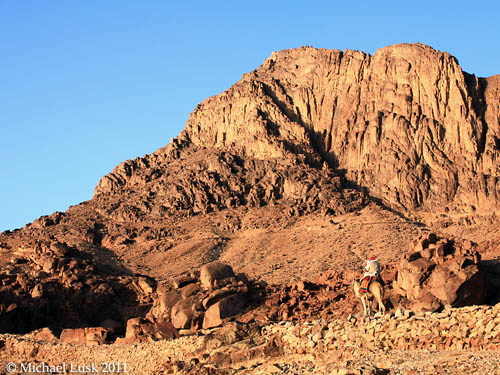
Jebel Musa, traditional Mount Sinai. Photo by Michael Lusk.

Jebel Musa, traditional Mount Sinai. Photo by Michael Lusk.

The next photo shows one of the camel drivers (leaders) waiting for someone to hire him to take them back to the monastery. It is possible to hire the camel to take you up the winding slope to where the 3,000 granite steps begin. Notice also his heavy clothing for the cold January nights.
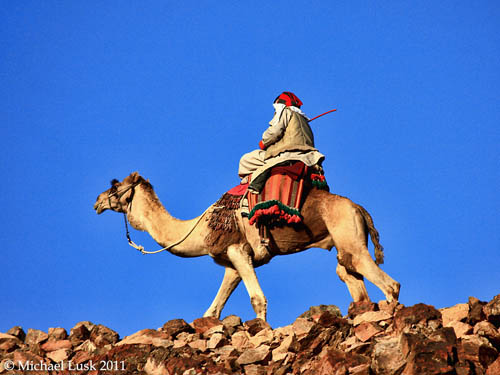
A camel waiting to take a tired walker back to the monastery. Photo by Michael Lusk.

A camel waiting to take a tired walker back to the monastery. Photo by Michael Lusk.

Seven hundred and fifty steps below the summit one comes to a site called Elijah’s Basin. This, according to the tradition, is where the prophet Elijah came when he fled from the wrath of Jezebel after the defeat of the prophets of Baal. Here, the prophet received instructions from the LORD to return and complete his work.

So he arose and ate and drank, and went in the strength of that food forty days and forty nights to Horeb, the mountain of God. (1 Kings 19:8 NAU)
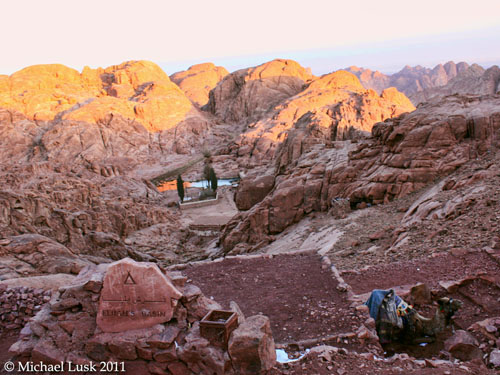
Elijah's Basin on Mount Sinai. Photo by Michael Lusk.

Elijah's Basin on Mount Sinai. Photo by Michael Lusk.

This photo shows the morning light beginning to illuminate portions of the mountain peaks. In the basin you will see some snow. I think the red (orange) glow may be caused by the light striking the area.

In a future post we will share, thanks to Michael, the sunrise from the summit.

The water system at Gezer

Water is necessary for life. Much has been learned about the provisions made for water in the cities of the biblical world. We know about the tunnels dug to bring water into the city at Hazor, Megiddo, Gibeon and Jerusalem, and about the well at Lachish.

For many years we have known about the water tunnel at Gezer. Now, as a result of the current Gezer Water System Expedition, new information is coming to light about the water system there. This project is a joint effort of New Orleans Baptist Theological Seminary and the Israel Nature and Parks Authority.

I appreciate this comment by Dan Warner, associate professor of Old Testament and Archaeology at NOBTS:

“The research at Gezer is important to Baptists because of our commitment to understand the Bible within its historical context,” Warner said. “Any information we can gain to give better insights into the cultures of the biblical world helps us interpret the Bible.

“Most think of the Canaanites as an old, rustic culture — not so,” Warner noted. “Digging the water system took great technical and hydraulic skill. This was a very advanced and sophisticated culture that had pronounced impact in biblical times.”

A news release from NOBTS says,

It is believed the Canaanites cut the massive tunnel around the time of Abraham using flint tools. Measuring nearly 13 feet wide by 24 feet high at the opening and stretching 150 feet into the ground at a 38 degree slope, the Gezer tunnel is the largest ancient water system ever unearthed.

Late in the last week of the 2011 dig, the NOBTS team found the natural cave at the end of the massive rock-hewn water system — the prime objective of this season’s dig. It is believed that the system’s original water source is located in or near the opening of the cave.

Two reports on the recent work may be read here. Here is one of the photos available with the reports.

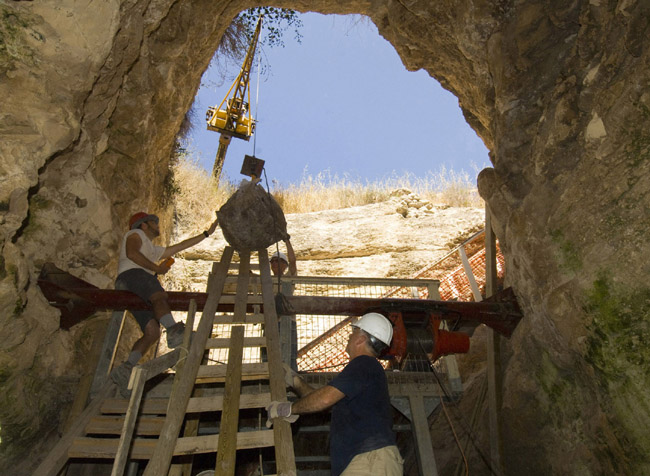
Gezer Water System

Excavating the Gezer Water System. Photo by Art Beaulieu. Courtesy BP & NOBTS.

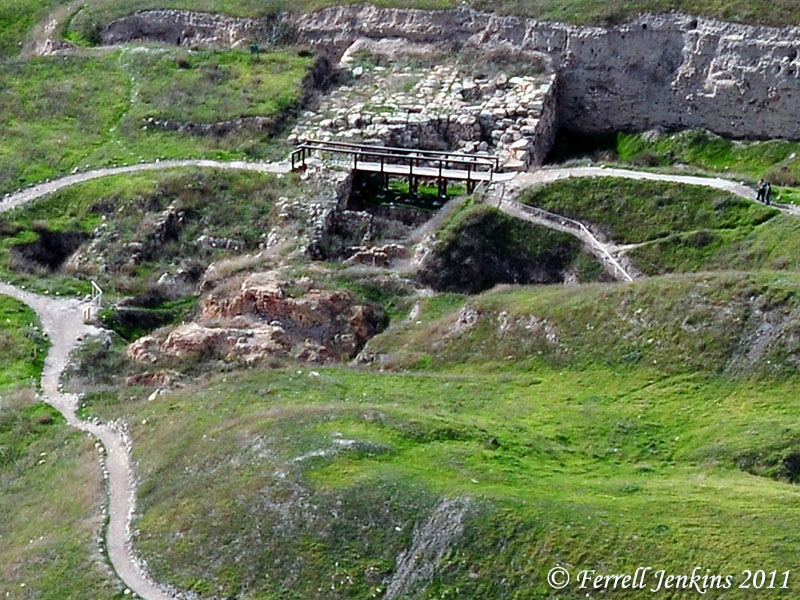
The photo below is an aerial shot that I made in December, 2009. This shows the massive Canaanite wall and the entrance to the water system to the right of center in the photo. The path goes down into the shaft that is now being excavated.

Aerial view of the Canaanite Wall and Water System at Gezer. Photo by Ferrell Jenkins.

Aerial view of the Canaanite Wall and Water System at Gezer. Photo by Ferrell Jenkins.

We included an aerial photo of Tel Gezer suitable for use in presentations here. From that same post we summarized the biblical information about Gezer.

  • The king of Gezer fought against Joshua and the Israelites during the conquest (Joshua 10:33; 12:12).
  • Gezer was allotted to Ephraim (Joshua 16:3).
  • Gezer became a city of the Levites (Joshua 21:21). It was designated as a city of refuge (1 Chronicles 6:67).
  • Israel failed to drive out the Canaanites who lived in Gezer (Joshua 16:10; Judges 1:29).
  • By the time of David the Philistine seem to be living at Gezer (2 Samuel 5:25; 1 Chronicles 14:16; 20:4).
  • Pharaoh, king of Egypt, captured Gezer, burned it, and gave it as a dowry to his daughter, Solomon’s wife (1 Kings 9:16).
  • Solomon (re)built the cities of Hazor, Megiddo, and Gezer (1 Kings 9:15-17).

The excavators are looking for volunteers for the 2012 season. This provides a good chance to do the kind of work you hire someone else to do at home. 🙂

Update: I failed to call attention to the web site of the Center for Archaeological Research at NOBTS here, and Can You Dig It? archaeology blog here. Under PHOTOS you will find a large gallery of photos and videos of the recent excavation.

HT: Joseph Lauer

The fig and the sycamore fig

A friend (he really is) on Facebook left this comment about yesterday’s post.

is the fig of the Bible the same as what we call figs? They used a fig dresser; we don’t.

He seems to be thinking of the fig mentioned in Amos 7:14.

Then Amos answered and said to Amaziah, “I was no prophet, nor a prophet’s son, but I was a herdsman and a dresser of sycamore figs. (Amos 7:14 ESV)

Other English versions use the terms grower, tender, or took care of. Amos tended the sycamore fig — the ficus sycomorus.

The question results from some confusion in translating the various biblical words into English. According to Fauna and Flora of the Bible, the fig we showed yesterday is the ficus carica. The fig mentioned in Amos 7:14 is the ficus sycomorus.

The sycamore fig growing in the lowlands at Neot Kedumim. Photo by Ferrell Jenkins.

The sycamore fig growing in the lowlands at Neot Kedumim. Photo by Ferrell Jenkins.

The description of the ficus sycomorus in Fauna and Flora of the Bible says,

The sycamore tree belongs to the Nettle family, like the mulberry and fig trees. It grows in many places in Palestine, especially in the plain, from Gaza to Jaffa and Haifa, and in the Jericho valley.…

The leaves are evergreen and heart-shaped, and the fruit looks like figs, but its taste is unpleasant. However, it was eaten by poor people, and Amos (7:14) was a gatherer of sycamore fruit. The Hb. [Hebrew] verb may indicate the way the sycamore fruits were eaten, so that the proper translation may not be ‘gatherer of sycamore fruit’, or ‘cultivator’, but ‘one who nips (with a nail or with iron) the fruits to make them edible’.

See more about the Sycamore fig and Zaccheus here.

Don’t underestimate the donkey

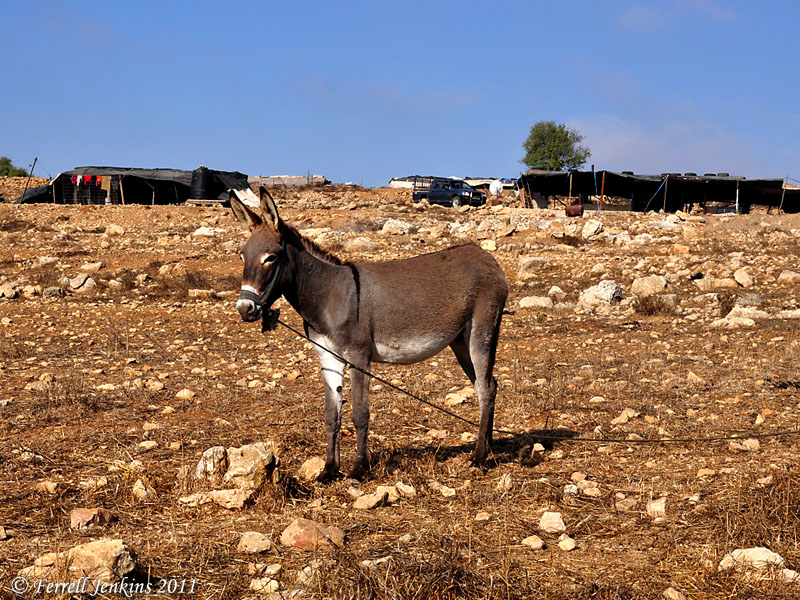
Yesterday when our driver was trying to locate the way to el-Jib (= Gibeon) we passed an area in the territory of Benjamin where someone, presumably a Bedouin, had two tents, some small fields, a truck, and a donkey tethered out front.

Donkey and Bedouin Tents Near Gibeon. Photo by Ferrell Jenkins.

Donkey and Bedouin Tents Near Gibeon. Photo by Ferrell Jenkins.

There are many biblical references to the donkey. I will list just one for now. The importance of the donkey is seen in the Ten Commandments. The neighbor’s donkey is not to be coveted. Most urban dwellers of today would never think of doing that. But in Bible times the donkey was used in the fields, carried heavy loads, provided transportation for the owner, and supplied fertilizer for some crops.

“You shall not covet your neighbor’s house; you shall not covet your neighbor’s wife, or his male servant, or his female servant, or his ox, or his donkey, or anything that is your neighbor’s.” (Exodus 20:17 ESV)

Today was a slow day — finalizing some matters and packing to return home. Resting a little, too.  Ready to begin the long flight back home in a short time. Did I complete the “bucket list” for this trip? Not quite. Probably completed about 80% of it. Well that leaves some places to begin with for the next trip. Like my friend Larry often says, “Life is good!”

Evidence suggests Qarqur (Qarqar) continued when other civilizations saw a period of collapse

Archaeologists from the University of Arkansas “have found evidence for the continuity of civilization across a time period when civilizations throughout the Middle East and elsewhere were collapsing. Their work occurred at Tell Qarqur, an important archeological site in the Orontes River Valley in northwestern Syria.” (I typically use the Anglicized spelling Qarqar.)

“This new evidence shows the survival of a city through this tumultuous period about 4,000 to 4,200 years ago,” said Jesse Casana, associate professor of anthropology. “Our discovery offers a rare glimpse of what cultures were during this transitional time and challenges ideas about the reasons for the collapse in the first place.”

The end of the third millennium B.C. — roughly 2200 to 2000 B.C. — is often described as a dark age because this period experienced the collapse of many major states, including the Akkadian Empire in Mesopotamia, Old Kingdom Egypt and the Harappan culture of the Indus Valley. Major cities and small towns across the Middle East that had been occupied for centuries were suddenly abandoned, leaving a gap in the archaeological and historical record.

Read the full news release here. Several photos from the album may be seen at Live Science here.

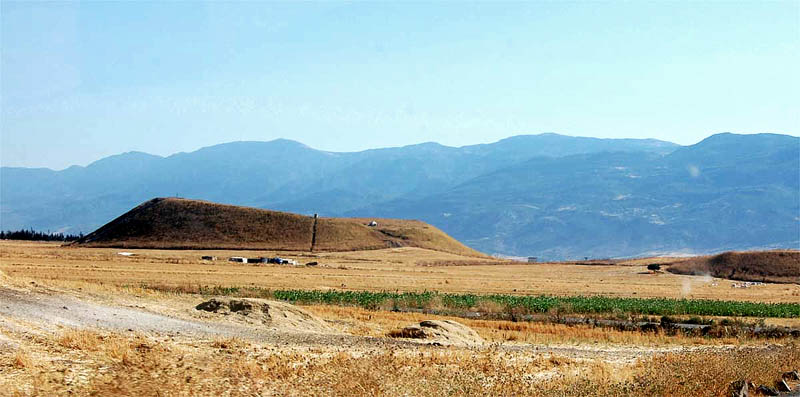
Matt McGowan, science and research communications officer at the University of Arkansas, has kindly granted permission for us to use this photo. It shows Tell Qarqur from the east. Qarqur is located in the Orontes River Valley in northwestern Syria.

Qarqur from the east. Photo by Prof. Casana, courtesy University of Arkansas.

You will see an archaeological trench cut in the side of the tell. This allows the excavators to go down to bedrock and get a slice of every civilization that occupied the site.

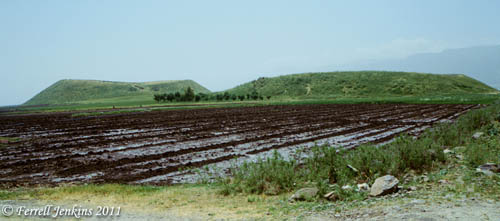
Notice a portion of a second mound on the right of the image. I had the opportunity to visit the area in 2002 during early May. At that time the fields were wet and the tells were green.

Tell Qarqar. Photo by Ferrell Jenkins, May, 2002.

Tell Qarqar. Photo by Ferrell Jenkins, May, 2002.

The Assyrian Empire ruled the ancient near east from the battle of Qarqar (853 B.C.) till the battle of Carchemish (605 B.C.) when they were defeated by the Babylonians. Nineveh had fallen seven years earlier. This was the time of the Divided Kingdom period in Israelite history, and Assyria had contact with a numerous biblical kings. Ahab, for example, fought against the Assyrians at Qarqar. Qarqar is north of Hammath (Hama). Both are on the Orontes River.

For a photo of the other side of the tell now being excavated, click here.

Finds from the excavation are said to be displayed in a museum at Hama. In light of the recent unrest in Syria, I suspect there won’t be many visitors there for a while.

HT: Joseph Lauer

Monday meandering — August 8

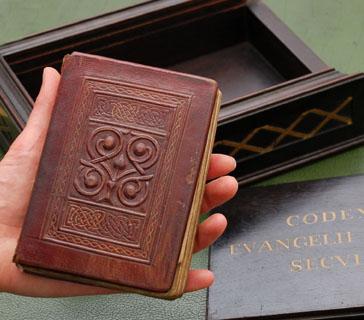
St Cuthbert Gospel. © British Library Image.

St Cuthbert Gospel. Copyright British Library Image.

British Library launches a campaign to raise $14.3 million for a 1300 year old copy of the Gospel of John. St. Cuthbert’s Gospel is said to be Europe’s oldest book. The Latin book is also called the Stonyhurst Gospel.

Information about the small bound book may be read here. The British Library has a nice video about the book, including clear images, may be viewed here. (HT: Paleojudaica).

Latin works such as this one play an important role in the history of the English Bible.

……

Wood used in the Roman siege of Masada came from other areas, according to a study by scientists at the University of Haifa.

First, the researchers examined the amount of wood that exists today in the Judean Desert and in the wadi deltas in the vicinity of Masada, and thereby were able to estimate the amount and types of wood that the desert could supply. Next, they calculated the amount of timber and firewood that would have been needed for the inhabitants of Masada, from 150 BCE, when it was a small fortress, through the Herodian period, when the fortress as we know it was constructed, and up to the siege, which ended in 73 CE. According to the researchers, in those times, timber was mostly used for construction, heating and cooking. Based on accepted evaluations of wood consumption for these purposes in traditional societies, on the conservatively estimated number of Masada inhabitants in each time period, the harsh climatic conditions in the desert and Masada’s topography, the researchers were able to conclude that by the time the Romans arrived at Masada and began their siege (73 CE), the entire area was void of timber and firewood, due to 2,220 years of massive exploitation of the immediate environment up to that point. The Romans would have had no choice but to import wood from other areas for their weapon machinery, ramparts and basic living requirements.

The brief report may be read here. (HT: Joseph Lauer)

……

C. S. Lewis and the Devil. John A. Murray has a fascinating article on “C. S. Lewis and the Devil” in The Wall Street Journal. Read the complete article here. Here is a small excerpt.

As Lewis explained, “There is no uncreated being except God. God has no opposite. . . . The proper question is whether I believe in devils. I do. That is to say, I believe in angels, and I believe that some of these, by the abuse of their free will, have become enemies to God. . . . Satan, the leader or dictator of devils, is the opposite, not of God, but of Michael.”

In his original preface written from Magdalen College at Oxford on July 5, 1941, Lewis warned of what he called “the two equal and opposite errors into which our race can fall about the devils.” One error “is to disbelieve in their existence. The other is to believe and to feel an excessive and unhealthy interest in them.” Lewis concluded that the devils “are equally pleased by both errors, and hail a materialist or a magician with the same delight.”

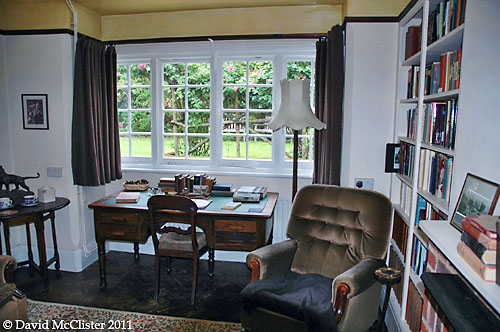
Dr. David McClister, Bible professor at Florida College, visited Oxford during his summer break. He shares one of his photos of Lewis’s study at the Kilns.

C. S. Lewis Study at the Kilns. Photo by David McClister.

C. S. Lewis Study at the Kilns. Photo by David McClister.

No wonder Lewis accomplished so much. No phone. No computer. If you are a fan of any of Lewis’s work, you might enjoy our earlier photos and info here.

HT: Bible X.

Two-horned altar found at Tel es-Safi/Gath

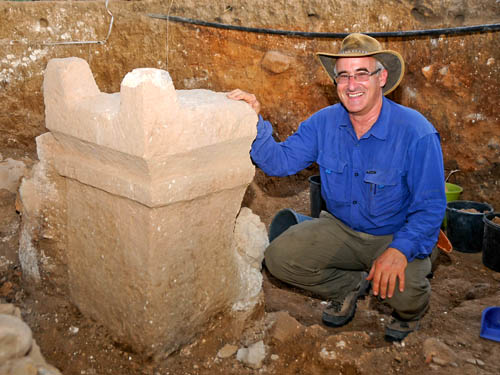
Prof. Aren Maeir says, “The news is out! A large stone altar in Area D” at Tel es-Safi/Gath. The unusual altar measures 50 x 50 x 100 cm. For ametric [new word] Americans that is 19.69 x 19.69 x 39.37 inches.

Read more at the Tell es-Safi/Gath blog here.

Prof. Aren Maeir with the two-horned altar at Gath. Photo courtesty of A. Maeir.

Prof. Aren Maeir with the two-horned altar at Gath. Photo courtesty of A. Maeir.

The info below is a brief summary of the brief summary from Maeir’s post. There are several high-resolution photos, including the one we have used here, with his post.

Maeir says this is the earliest altar found from Philistia. Remember that Gath is one of the cities of ancient Philistia (1 Samuel 6:17). The altar, made of one block of stone, is one of the largest found in Israel after the one at Beersheba (made of many pieces), and another found out of context at Ekron.

Perhaps the most interesting thing about this altar is that it has two horns instead of four. Maeir says,

This is VERY interesting, since this may very well confirm a theory put forward by our team member Louise Hitchcock that there is a connection between the Minoan/Cypriote “Horns of Consecration” and the horned altars – perhaps brought by the Philistines.

The dimensions of the altar are identical in proportion to the altar in the biblical tabernacle (1 x 1 x 2 cubit) (Exodus 30:2).

The back part of the altar may have been built into a structure behind it.

There is no evidence of burning on the altar.

Read more at the Tell es-Safi/Gath blog here. Other photos at the Foundation Stone web site here. Maeir will be on the LandMinds radio show Wednesday.

HT: Joseph I. Lauer

Unique golden bell found in Jerusalem drain

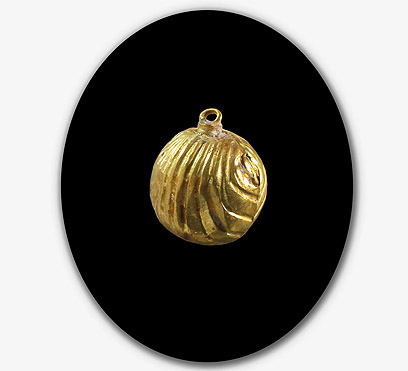
Arutz Sheva (Israel National News.com) reports that archaeologists have “discovered a rare gold bell with a small hook at its end.”

The directors of the excavation on behalf of the Antiquities Authority, archaeologists Eli Shukron and Professor Ronny Reich of Haifa University, said after the finding, “The bell looked as if it was sewn on the garment worn by a man of high authority in Jerusalem at the end of the Second Temple period.

“The bell was exposed in the city’s main drainage channel of that period, between the layers of dirt that had been piled on the floor of the channel,” they continued. “This drainage channel was built and hewn west to the Western Wall of the Temple Mount and drained the rainfall in the different parts of the city, through the City of David and the Shiloah Pool to the Kidron valley.”

The excavation area, above the drain, is located in the main street of Jerusalem which rose from the Shiloah Pool in the City of David. In this street an interchange was built through which people entered the Temple Mount. The remains of this interchange are what is known today as Robinson’s Arch. Archaeologists believe that the eminent man walked the streets of Jerusalem in the area of Robinson’s Arch and lost the golden bell which fell off his outfit into the drain beneath the street.

The full news report may be read here.

Golden bell found in Jerusalem drain. Photo: ynet.co.il.

Golden bell found in Jerusalem drain. Photo: IAA.

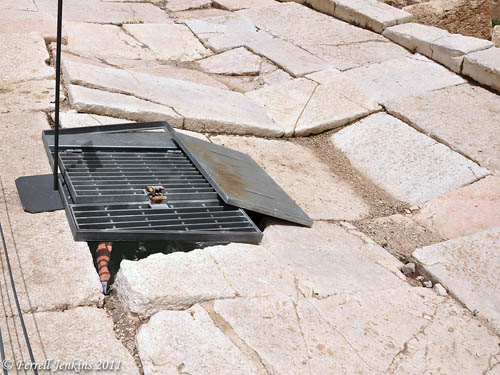
The best I can tell from the description of the location is that it is near the area of Robinson’s Arch. We saw workmen at the northern end of the drainage channel about which we have reported earlier (here) during our visit to the area in May. I understand that eventually the channel will be open all the way from the A.D. 70 street below Robinson’s Arch to the Pool of Siloam. I have lightened the area under the grill so you can see the workman’s arm.

Opening in A.D. 70 street below Robinson's Arch. Photo by Ferrell Jenkins.

Opening in A.D. 70 street below Robinson's Arch. Photo by Ferrell Jenkins.

I note in the news report that the archaeologists did not rule out the possibility that this bell might have belonged to one of the high priests. Actually, one can not rule out much of anything with so little information. My first thought almost simultaneously was the bells on the garments of the high priest and a woman’s jewelry. Note the earlier discovery of jewelry here.

The adornment of the priestly garment is described in Exodus.

“You shall make on its hem pomegranates of blue and purple and scarlet material, all around on its hem, and bells of gold between them all around:  a golden bell and a pomegranate, a golden bell and a pomegranate, all around on the hem of the robe. (Exodus 28:33-34 NAU)

Jim Davila, at Paleojudaica, comments wisely on the suggestion that this bell might have belonged to a priest or a man of high authority:

Well, maybe. On the one hand it is true that the only references to golden bells in the Hebrew Bible are to bells on the vestments of the high priest (Exodus 28:33-34; 39:25-26). On the other hand, first, the only other mention of bells (a different Hebrew word) refers to horses’ trappings (Zechariah 14:20). Presumably, bells were used in many other contexts, so our sample of cultural allusions is limited. But, you say, what about golden bells? Well, second, Isaiah 3:16-18 refers to bangles that the rich women of Jerusalem wore on their ankles and which “tinkled” or made some kind of bangle noise. These ladies clearly had lots of jewelery and finery (cf. also vv. 19-23), so it seems entirely likely that they sometimes wore bells as jewelry and that some of those bells might well have been made of gold. And we know that Second-Temple-era ladies in Jerusalem had very nice gold earrings. So this bell need not have come from “a man of high authority.”

The Christian Standard Bible translation of Isaiah 3:16 is vivid:

The LORD also says: Because the daughters of Zion are haughty, walking with heads held high and seductive eyes, going along with prancing steps, jingling their ankle bracelets, (Isaiah 3:16 CSB)

HT: Joseph Lauer