Category Archives: Culture

The Antikythera Shipwreck and “Danger at sea”

The following post appeared in part on this blog June 4, 2012. I am repeating some of it for the benefit of those who missed it, and because it provides some complementary information for the study of Acts 27. A few changes have been made to make it more useful in connection with the Acts study.

The Antikythera Shipwreck is a special exhibition at the Athens (Greece) National Museum which is scheduled to run from April 2012 to April 2013.

The Ship and the Treasures

The shipwreck off the eastern coast of Antikythera is dated to 60-50 BC, a period during which maritime trade and transportation of works of Greek art from the Eastern Mediterranean to Italy flourished. Its cargo dates from the 4th to the 1st century BC. The ship was a freighter of about 300 tons capacity and was sailing towards Italy.

Bronze and marble sculpture luxurious glass vessels and golden jewellery, a large amount of pottery and bronze couches formed part of its cargo. Amongst these the famous “Antikylhera Mechanism” still contributes an enormous amount to our knowledge of ancient Greek technology and astronomy. All the finds recovered from the shipwreck bear witness to the aesthetic preferences of their orderers or potential purchasers but, above all, they reflect the new phenomenon of art trade, the first in the history of the West civilization.

The Mechanism

Constructed in the second half of the second century BC, the Mechanism comprises gears, scales, axles, and dials. The inscriptions on the surface of the Mechanism refer to astronomical and calendar calculations, while the inscriptions on its metal protective plates contain instructions for its use. The Antikythera Mechanism is the earliest preserved portable astronomical calculator. It displayed the positions of the Sun, the Moon and most probably the five planets known in antiquity. It was used to predict solar and lunar eclipses, it kept an accurate calendar of many years, and displayed the date of Pan-Hellenic games (Olympia, Nemea, Isthmia, Delphi and Dodona.

We had visited Thera (aka Santorini) during our Aegean cruise. Antikythera (“opposite Kythera”) is a Greek island between Crete and the Peloponnese (where Corinth is located). This area is north of where Paul’s ship encountered the storm that drove it off course (Acts 27:8-16).

In the earlier post I included two of the sculptures being transported on the ship. Go here to see those photos. I will share some different photos today.

One display case deals with the “Self-Sufficient Microcosm.” In addition to cargo, there were a few human skeletal remains on the ship. Those who traveled by sea often had to take their own food supplies on board with them. It is thought that olives and snails were part of the daily diet. There were stones “for grinding seeds, liquefying vegetables and herbs, and stirring liquids.”

A manually operated quern was used for grinding grain.
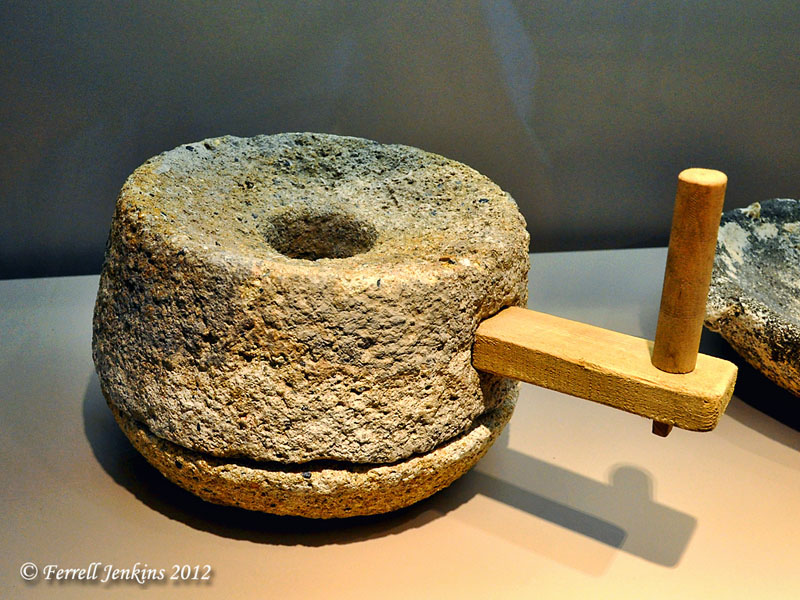
Manually operated quern for grinding grain. Photo by Ferrell Jenkins.

Manually operated quern for grinding grain. Photo by Ferrell Jenkins.

Salted meat and fish, as well as olives, and wine could be stored for transport in amphorae and other containers. This display shows some of the amphorae as they might have been scattered on the sea bed.

Amphorae used for transporting goods. Photo by Ferrell Jenkins.

Amphorae used for transporting goods. Photo by Ferrell Jenkins.

Many of the sculptures found with the ship wreckage are encrusted with sea organisms. Be sure to see the previous post. There was one marble statue of a boy. The sign accompanying the sculpture says,

The boy is depicted nude and half bent-over with his head raised. The upper part of his torso leans sharply forward.

Some believe that this young man was preparing for wrestling. Others think he was a pancratiast (one who participated in both wrestling and boxing). Notice that the left side of the statue (our view on the right) is covered with sea organisms. The right side seems to have been buried in sediment on the sea bed, and thus protected.
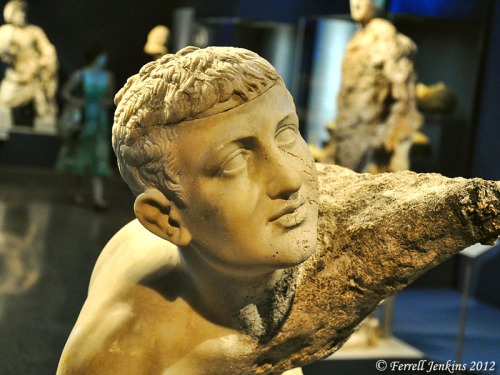
Statue of a boy from the Antikythera shipwreck. Photo by Ferrell Jenkins.

Statue of a boy from the Antikythera shipwreck. Photo by Ferrell Jenkins.

Numerous bronze pieces are displayed. I especially like the one known as “The Antikythera Philosopher.” See the previous article.

We typically think of ships from the Roman period, and earlier, staying near the shore (coasters). This was certainly true of many of the sea journeys of the Apostle Paul (Acts 20:5, 13-16; 27:5-7).

Greek archaeologists announce here the discovery of two Roman-era shipwrecks in water nearly a mile deep. Sailing to Italy required leaving the safety of the nearby shore for deep waters. Such was true of Paul’s journey to Rome after leaving Crete (Acts 27).

Paul spoke of the dangers at sea in his second letter to the Corinthians (11:24-29) about A.D. 55.

  • Three times I was shipwrecked.
  • A night and a day I was adrift at sea.
  • He mentioned “Danger at sea.”

The Malta shipwreck is the only one recorded in Acts, and it occurred after the writing of 2 Corinthians. Hughes mentions at least nine voyages between Acts 9 and 18. Paul says three of these ended in shipwreck. Hughes says there were at least another nine voyages between the writing of 2 Corinthians and the Malta shipwreck (The Second Epistle to the Corinthians, NICNT, 410-411).

At least some of the ships used by Paul were grain ships (Acts 27:38), but there may have been other cargo on some of them.

If you visit Athens between now and April 2013, be sure to take some time for The Antikythera Shipwreck.

Turkey wants British Museum to return sculptures from the Mausoleum of Halicarnassus

According to an article in The Guardian (here), the town of Bodrum in Southwest Turkey wants the British Museum to return several priceless sculptures once associated with the Mausoleum of Halicarnassus in the 4th century B.C.

Human rights legislation that has overturned the convictions of terrorists and rapists could now rob the British Museum of sculptures created for one of the seven wonders of the ancient world.

A Turkish challenge in the European court of human rights will be a test case for the repatriation of art from one nation to another, a potential disaster for the world’s museums.

Halicarnassus is where Mausolus built a gigantic tomb in honor of himself. Leon Mauldin and I visited the site earlier in the year. You may read about our visit (with photos) here. It became known as one of the Seven Wonders of the Ancient World.

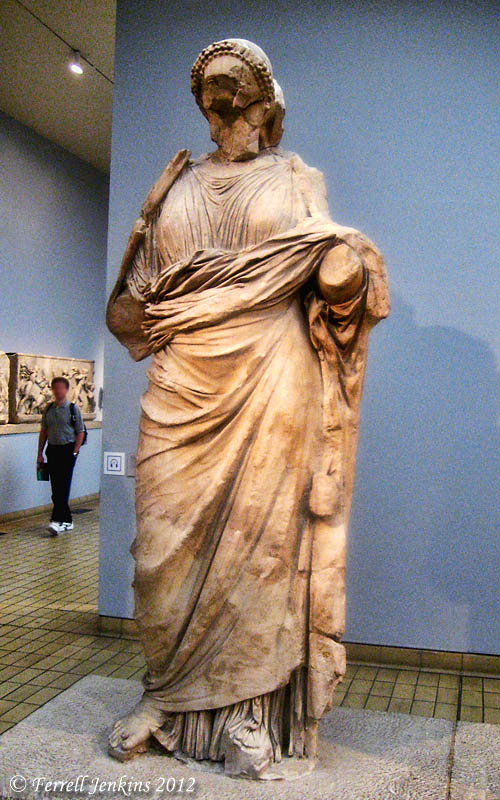
Two of the sculptures that the town of Bodrum wants returned are through to be of Mausolus and Artemisia, his wife. Here is a photo of the marble statue thought to be Mausolus.

Statue of Mausolus in British Museum. Photo by Ferrell Jenkins.

Statue of Mausolus in British Museum. Photo by Ferrell Jenkins.

The next statue is usually identified as Artemisia, wife of Mausolus.

Statues from the Mausoleum of Maussollos - Marble, About 350 B.C

Statue from Halicarnassus, usually identified as Artemisia, the wife of Mausolos. Photo by Ferrell Jenkins.

Another reason to visit the British Museum soon, or Turkey later.

HT: Jack Sasson

Acts 25 — Photo Illustrations — Coins of the Rulers

We continue our look at the three chapters describing Paul’s stay at Caesarea Maritima — Acts 24-26. Three civil rulers are mentioned in these chapters. They are known not only from Luke’s account, but in the writings of Josephus.

Rapske says that Caesarea “was the administrative seat of the Roman procurators of Palestine.” He adds that in the time of the Flavians it became a Roman Colony (The Book of Acts in its First Century Setting; Vol. 3, The Book of Acts and Paul in Roman Custody, 155).

After the Romans occupied “Palestine” the Jews had both a religious and a secular tax to pay. The procurators (prefects) were responsible for collecting the taxes for Rome. Coins were minted by various procurators, including Felix and Festus. I have chosen one example from each to show the type of coin current in their time.

Antonius Felix — A.D. 52-59.

Felix is described as a hegemon in the Greek New Testament. Major English versions use the term governor (Acts 23:24, 26; 24:2, 22, 24, 25, 27; 25:14). Hemer says that hegemon is a general word to describe a ruler, “the formal Latin title of these governors of Judaea being procurator or praefectus” (The Book of Acts, 128).

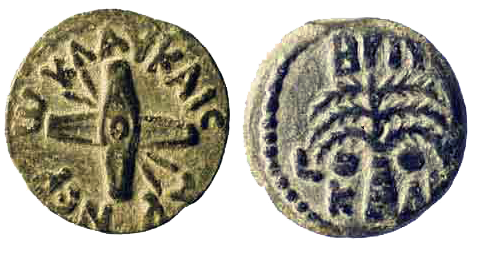
The obverse (head) of the coin of Felix shows two oblong shields and two spears. The inscription is translated “Nero Claudius Caesar–son of Claudius. The reverse (tail) shows a “six-branched palm tree bearing two bunches of dates” with a Greek inscription above and below (Hendin, Guide to Biblical Coins (1987), 117).

Coin of Roman Procurator Felix.

Coin of Roman Procurator Felix.

Porcius Festus — A.D. 59-61.

Porcius Festus followed Felix as governor or procurator. He is mentioned in each of the three chapters we are discussing. Paul had been left in custody by Felix, and Festus seems to be pleased to get the advice of King Agrippa when he visited Caesarea.

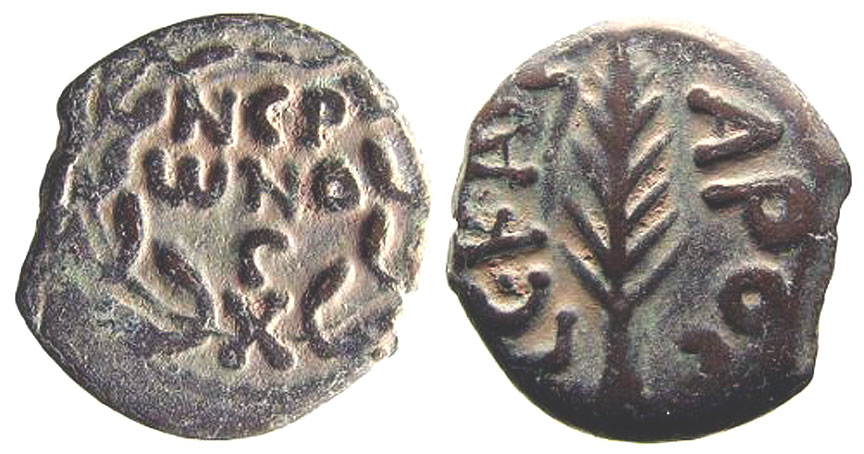
The coin of Festus, struck in A.D. 58, bears a Greek inscription within a wreath on the obverse. At the bottom is an X. The inscription reads NER ONO C (Nero). The reverse shows a palm branch with a Greek inscripton KAIC APOC (Caesar). The date LE means year five (Hendin, 118).

Coin of Porcius Festus.

Coin of Roman Procurator Porcius Festus.

Herod Agrippa II — A.D. 48-70.

Herod Agrippa II was the son of Herod Agrippa I, the grandson of Herod the Great (Acts 12:1, et al.). Agrippa II was the tetrarch of Chalcis and of northern territories. Chalcis was the small but beautiful territory between the Lebanon and Antilebanon mountains. Later he was granted the territories that had been controlled by Philip and Lysanias. Agrippa lived until the end of the first century, and minted coins even to the time of the Roman Emperor Domitian (A.D. 81-96).

According to Hendin, the obverse shows a laureate bust of Domitian facing right. The inscription around it reads DOMITIAMOC KAICAP (Domitian Caesar). The reverse shows Nike standing right. One foot is resting on a helmet. She is writing on a shield that is resting on her knee. The inscription reads ETO KZBA AΓPIΠΠA (Year 27 of King Agrippa). The coin was struck in A.D. 83. (I do not know how best to harmonize the dates associated with the reign of Agrippa II.)

Coin of Herod Agrippa II with image of Domitian. Struck A.D. 83.

The coin above is copied from FORVM ANCIENT COINS.


I have only the original edition of Hendin’s Guide to Biblical Coins, but recommend the newer fifth edition of his book in the event that you have a genuine interest in Biblical coins. From my limited collecting experience, I can say that it is both fascinating and educational.

Maintaining control of a tour group

Occasionally I am asked if I ever have any trouble with individual tour members during a tour. The same might be asked about students in a class. After 45 years of directing tours I would have to say that there have been a few people who have given some problems for me or other tour participants. If they give trouble to others, that becomes a problem for me.

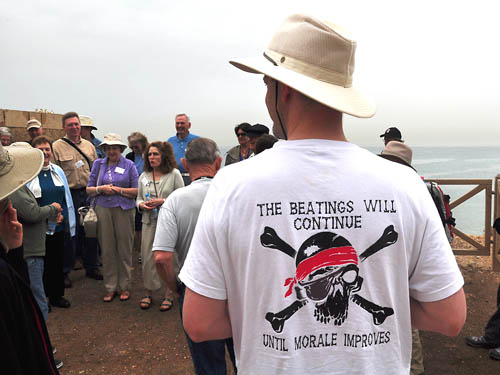
Mark, one of my friends, showed up on the first full day of touring with a T-shirt that I suppose he thought might help.

Dealing with trouble during a tour.

One tour member wanted everyone to improve their behavior. Photo by Ferrell Jenkins.

Really, the serious problems have been few and far between. I have become friends with some wonderful people through the years.

The advice of wisdom always works.

A soft answer turns away wrath, but a harsh word stirs up anger. (Proverbs 15:1 ESV)

Thanksgiving today and everyday

Paul’s letter to the saints at Colossae emphasizes that thanksgiving should be a part of continual prayer to God.

Continue steadfastly in prayer, being watchful in it with thanksgiving. At the same time, pray also for us, that God may open to us a door for the word, to declare the mystery of Christ, on account of which I am in prison– that I may make it clear, which is how I ought to speak. (Colossians 4:2-4 ESV)

The wonderful thing about our national day of Thanksgiving is that it is an 0pportunity for families to be together and reflect on the blessings of life. I trust that your day will be a good one.

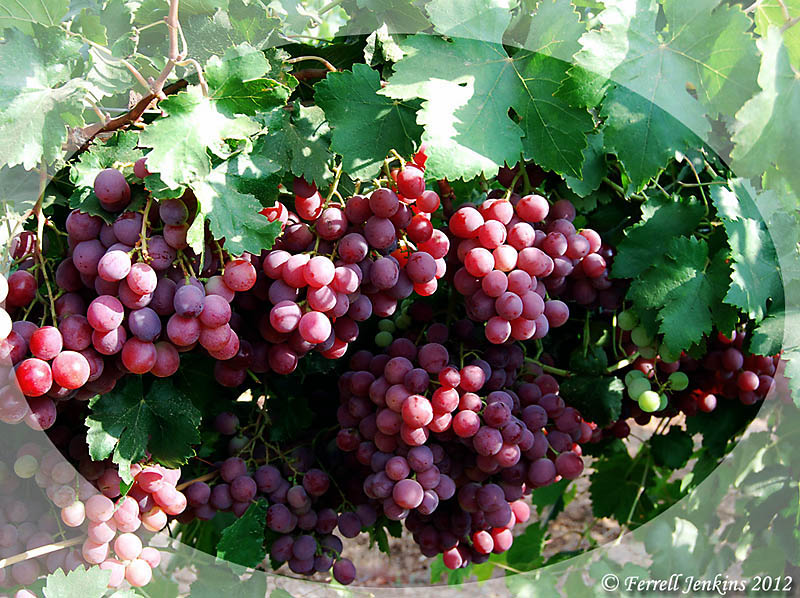
Abundance of the Vineyards at Lachish. Photo by Ferrell Jenkins.

The Abundance of the Vineyards at Lachish. Photo by Ferrell Jenkins.

ETS Plenary Sessions Online

Charles Savelle reports that the video of the plenary sessions at the recent ETS meeting are available online here Individual links are listed below. Zondervan Academic, the provider of the videos, includes advertising that you may skip to get directly to the lecture.

The general theme of the 2012 annual meeting was Caring for Creation. In these four lectures you will find four competent scholars presenting differing views on a subject that is important to each of us.

Calvin Beisner “Creation Care and Godly Dominion: The Search for a Genuinely Biblical Earth Stewardship”

Russell Moore “Heaven and Nature Sing: How Evangelical Theology Can Inform the Task of Environmental Protection, and Vice-Versa”

Richard Bauckham “Reading the Bible in the Context of the Ecological Threats of our Time”

Douglas J. Moo “Biblical Theology and Creation Care”

HT: Charles Savelle @ Bible X

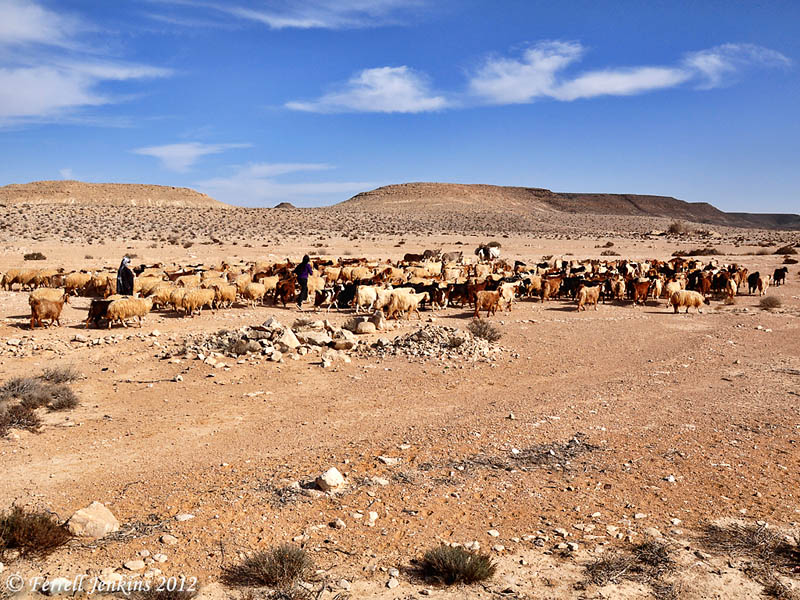
He “guided them in the wilderness like a flock.”

The Psalmist describes the LORD’S care for His people under the figure of a shepherd and his sheep.

But He led forth His own people like sheep And guided them in the wilderness like a flock;  He led them safely, so that they did not fear; But the sea engulfed their enemies.  So He brought them to His holy land, To this hill country which His right hand had gained. (Psalm 78:52-54 NAU)

Shepherds south of Avedat in the Wilderness of Zin. Photo by Ferrell Jenkins.

Shepherds south of Avedat in the Wilderness of Zin. Photo by Ferrell Jenkins.

The photo above was made a few miles south of Avedat, Israel, in the Wilderness of Zin. The Israelites lived in this wilderness (or desert) prior to entry into the land that the LORD promised to the seed of Abraham (Genesis 12:7).

Veterans Day and the Memphis Belle

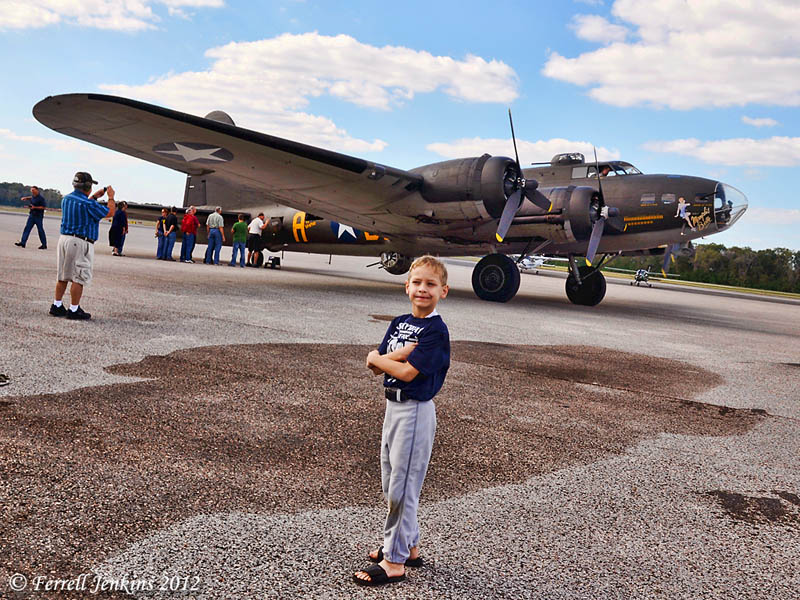
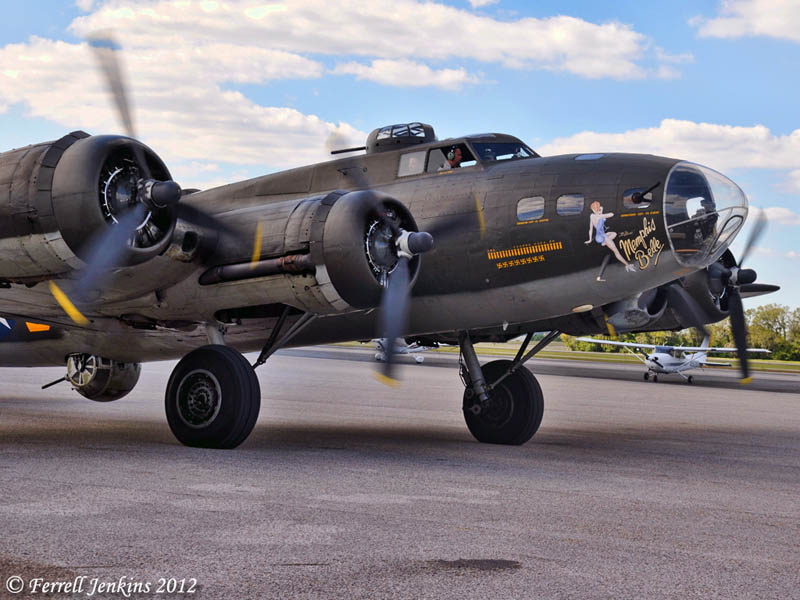
The Memphis Belle, a B-17 bomber built in 1945, is at the Tampa Executive Airport near us Saturday and Sunday. A recent promotional article at TBO.com tells some about the significance of the plane.

“The B-17 is the iconic World War II bomber,” he said. Between 1935 and 1945, nearly 13,000 B-17s were built.

“About 4,300 of them went down and each carried a 10-man crew,” he said. “We are quite honored to fly this airplane.”

Our grandson had a baseball game near us Saturday morning. At lunch I told him about the Memphis Belle. I told him that Grandmother and I were about his age when the plane was built, and that I would like for him to see it.

It was a beautiful day in Tampa, and we enjoyed seeing the B-17 land and take off while we were at the airport.

Passengers line up to take a short $450 ride on the Memphis Belle. Photo by Ferrell Jenkins.

Passengers line up to take a ride on the Memphis Belle. Photo by Ferrell Jenkins.

An older gentleman who was a gunner on the B-17 during WWII was among the visitors at the airport while we were there. There may have been others.

Memphis Belle - B-17 - at Tampa Executive Airport. Photo by Ferrell Jenkins.

Memphis Belle – B-17 – at Tampa Executive Airport. Photo by Ferrell Jenkins.

Seeing the Memphis Belle was a good reminder of the historic importance of the B-17 “flying fortress” in the history of our country, and of the men who have served.

This plane was featured in the 1990 movie by the same name.

Portions of Bond 007 Skyfall filmed in Turkey

An article at MI6 (here) about the Istanbul premier of Skyfall mentions Turkish sites used in the film.

Turkey has felt a noticeable increase in tourist enquiries. “Skyfall” showcases the famous rooftops and the Grand Bazaar of Istanbul, as well as the more rural and rugged landscapes of southern Turkey as the film’s second unit shot extensively in Adana.

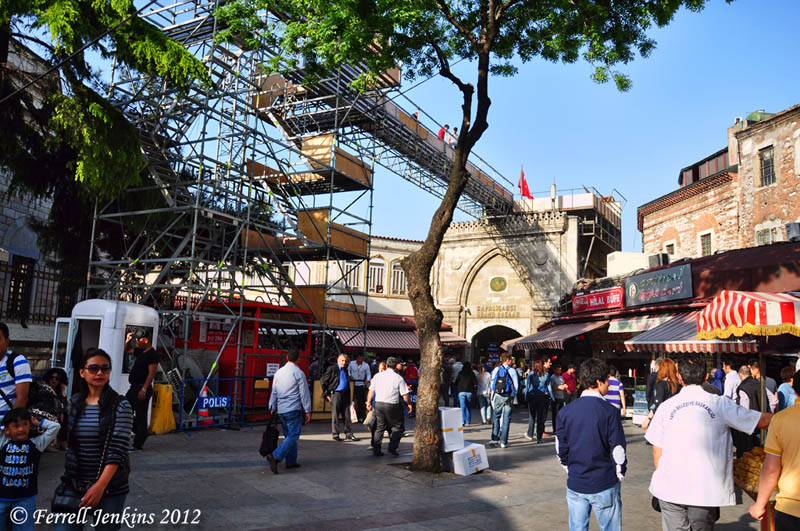
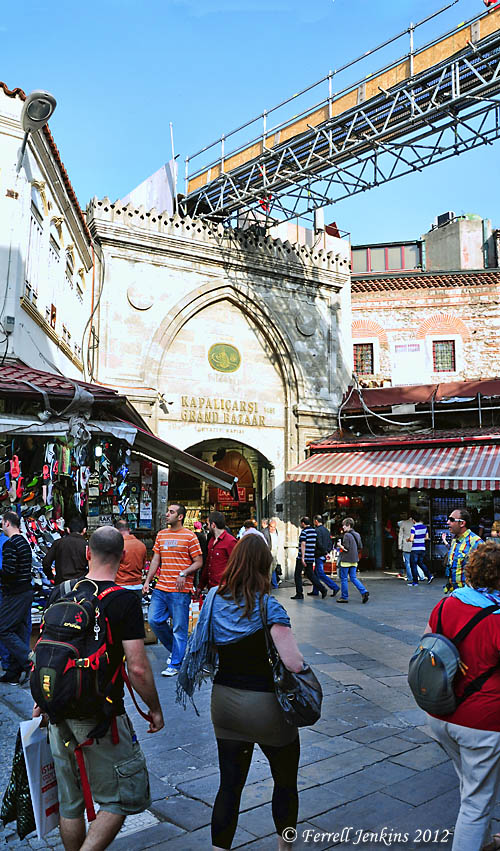
Almost every group that visits Turkey makes a stop in Istanbul. On our recent Steps of Paul and John Tour we also made a brief visit to the Grand Bazaar. At one entry to the Bazaar the scaffolding was in place for the filming of some of the scenes in the new Bond 007 Skyfall movie.

Istanbul Grand Bazaar set for the Bond 007 Skyfall movie. Photo by Ferrell Jenkins.

Istanbul Grand Bazaar set for the Bond 007 Skyfall movie. Photo by Ferrell Jenkins.

One of the reasons many people have enjoyed the Bond movies is for the opportunity to see many beautiful and exotic places that served as settings.

Skyfall scaffolding above the Grand Bazaar in Istanbul. Photo by Ferrell Jenkins.

Adana is located about 30 miles east of Tarsus, the native home of the Apostle Paul in the region of Cilicia.

But Paul said, “I am a Jew of Tarsus in Cilicia, a citizen of no insignificant city; and I beg you, allow me to speak to the people.” (Acts 21:39 NAU)

Reformation Day

October 31 is known as Reformation Day because it was on this day in 1517 that Martin Luther posted Ninety-Five Theses on the door of the Castle Church in Wittenberg, Germany. The Ninety-Five Theses were issues that Luther thought should be debated by the theologians. These questions were brought about due to the sale of indulgences and general corruption within the Roman Catholic Church.

The term Protestant was not used to describe those who aligned themselves with Luther for another 12 years, but the Protestant movement can be dated the the event at Wittenberg.

There are many issues on which I would differ with Luther, but I admit that I admire the man and the stand that he took against practices of his day which were departures from the Apostolic doctrine.

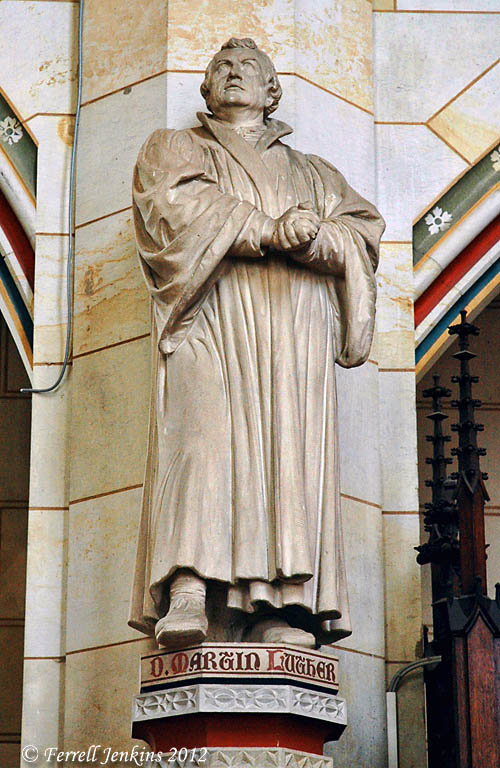
This statue of Luther stands in the Castle Church in Wittenberg, Germany. The official name of the town is Lutherstadt Wittenberg.

Statue of Martin Luther in the Wittenberg Castle Church. Photo by Ferrell Jenkins.

Statue of Martin Luther in the Wittenberg Castle Church. Photo by Ferrell Jenkins.

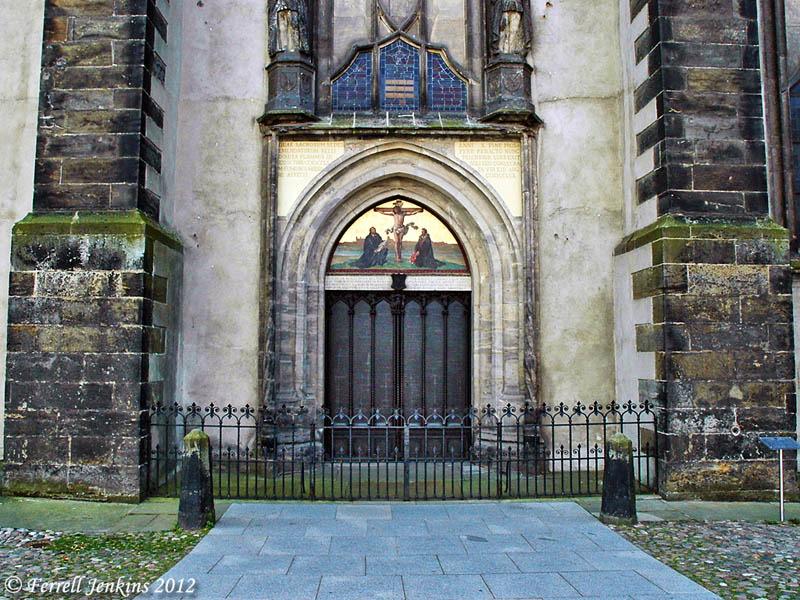
The original door of the church was destroyed by fire in 1760. Doors covered with bronze plaques with the Ninety-Five Theses on them were installed in 1858. The door of the church is pictured below.

Door of the Castle Church in Wittenberg. Photo by Ferrell Jenkins.

Door of the Castle Church in Wittenberg. Photo by Ferrell Jenkins.

Free Book. Those who use Logos Bible Software may download a copy of the Ninety-Five Theses under the title Disputation of Doctor Martin Luther on the Power and Efficacy of Indulgences. For information click here.

Interested in the Reformation? If you have interest in Church History and the place of the Reformation within it, you might enjoy this post on “The background of the Protestant Reformation,” or posts on Zwingli, Tyndale and Knox (and here), Heinrich Bullinger, St. Andrews, and Savonarola.

HT: HMcK