Category Archives: Church History

First century church (building) found?

Several blogs have noted the report of a claim out of Jordan than a first century church has been found. The Jordan Times report by Rula Samain follows:

AMMAN – Lying underneath Saint Georgeous Church in Rihab, Mafraq, is what archaeologists describe as the first Christian church in the world.

“We have uncovered what we believe to be the first church in the world, dating from 33 AD to 70 AD,” said Archaeologist Abdul Qader Hussan, head of the Rihab Centre for Archaeological Studies.

The discovery was “amazing”, Hussan told The Jordan Times.

“We have evidence to believe this church sheltered the early Christians: the 70 disciples of Jesus Christ,” the scholar said.

The early Christians, described in the mosaic inscription on St. Georgeous floor as “the 70 beloved by God and Divine”, are said to have fled from Jerusalem during the persecution of Christians, to the northern part of Jordan, particularly to Rihab, he added.

Citing historical sources, the expert said the 70 lived and practised their rituals in secrecy in this underground church.

We believe that they did not leave the cave and lived until the Christian religion was embraced by Roman rulers.

“It was then when St. Georgeous was built,” said Hussan.

Saint Georgeous is believed to be the oldest “proper” church in the world, built in 230 AD. This status is only challenged by a church unearthed in Aqaba in 1998, also dating back to 3rd century.

The findings in the graveyard near the cave offer valuable clues, according to Hussan.

“We found pottery items that date back from the 3rd to 7th century,” he added. The findings show that the first Christians and their offshoot continued living in the area till the late Roman rule.

“Going down a few steps into the cave, one would see a circle shape area, believed to be the apse, and several stone seats for the ecclesiastics,” he added.

Archimandrite Nektarious, Bishop Deputy of the Greek Orthodox Archdiocese, described the discovery of the cave as an “important milestone for Christians all around the world”.

“The only other cave in the world similar in shape and purpose is in Thessalonica, Greece,” the bishop said in an interview in Amman.

The cave also embraces the living place of the first Christians. “A wall with an entrance is the only partition separating the altar from the living area,” Hussan said.

There is also a deep tunnel, which is believed to have led the 70 Christians to their source of water, the archaeologist added.

Officials in Mafraq say they will capitalise on the discovery to further promote the area.

Governor Zeid Zreiqat, who noted Rihab is rich in unique archaeological sites, said that together with the new discovery, these sites can be invested to attract religious tourism.

“We are working on developing Rihab to become a major tourist attraction in the near future,” he told The Jordan Times.

So far, 30 churches have been discovered in Rihab,” Hussan said. It is also believed that Jesus Christ and the Virgin Mary have passed through this area, he added.

Are you excited about this discovery? Note that the report claims that the St. Geogeous Church “is believed to be the oldest proper church in the world, built in 230 AD.” The new discovery seems to have been a cave under the third century church. We must await further information on the inscription about the 70 disciples of Jesus.

There are several things in this report that arouse suspiction. Who were the 70 disciples? Were they the 70 of Luke 10:1-12? What rituals did they practice in secret? The church dates from 33 AD to 70 AD, yet they stayed in the cave until Christianity was embraced by the Roman government (early 4th century).

The pottery is said to date from the 3rd to the 7th century. Did the first century residents of the cave church leave no pottery? Do you really think a first century church had circular shaped seats for the clergy? (This is stated in the caption under a photo with the article.) We have no historical evidence for this clergy-laity distinction until well into the 2nd century.

We are told that the city of Mafraq will “capitalize on the discovery to further promote the area” and to help it become a major tourist attraction.

An MSNBC report cites Thomas Parker, of the University of North Carolina-Raleigh, as saying that this information should be greeted with a degree of caution. Read it here.
Philadelphia, the church with an open door

Philadelphia is located about 30 miles southeast of Sardis in the valley of the Cogamis, a tributary of the Hermus. The city is built on the slope of Mount Tmolus overlooking a fertile valley. Philadelphia was in the province of Lydia in Western Asia Minor.

Philadelphia stood at the place where the borders of Mysia, Lydia, and Phrygia met. “It was characteristically a border town” (Barclay). This position made it the gateway to the East. Ramsay says,

“the Imperial Post-Road of the first century, coming from Rome by Troas, Pergamum and Sardis, passed through Philadelphia and went on to the East; and thus Philadelphia was a stage on the main line of Imperial communication” (The Letters to the Seven Churches 395).

The site of ancient Philadelphia is now covered by the Turkish agricultural town of Alashehir which has a population of about 20,000. Alashehir (Red City) is named for the volcanic earth in the area (Blaiklock 122). The plain is filled with vineyards. If Philadelphia were not a Biblical city very few tourists would put forth the effort to visit it.

According to Hemer, the location had one great disadvantage.

“It lies perilously close to the region known as the Catacecaumene (“the burnt land”) of Lydia, a hilly tract to the northeast which contained volcanic cones which had been active in recent geological time. And the whole area lies in the Anatolian fault system. Philadelphia was peculiarly liable to earthquake” (Hemer, “Unto the Angels of the Churches,” Buried History 11 (1975), 166).

Trench says, “No city of Asia Minor suffered more, or so much, from violent and often recurring earthquakes.” In A.D. 17 there was a destructive earthquake in the region which affected 12 cities. Sardis suffered worst, but Philadelphia is also mentioned. The cities were exempted from direct taxation and Tiberius provided personal funds for relief (Tacitus. Annals. 2.47).

Ramsay, who spent much time in Asia, reports that “the first great shock of earthquake is not so trying to the mind as the subsequent shocks, even though less severe, when these recur at intervals during the subsequent weeks and months….” Colin J. Hemer visited Philadelphia in 1969 just a few days after an earthquake (172-73). The people would leave the city and go out into the open fields and live in tents. When all danger was passed, and they did the necessary rebuilding, they would go back into the city. Strabo reports this in A.D. 20 (Ramsay), and Hemer provides a photograph of people living in tents outside their houses in 1969.

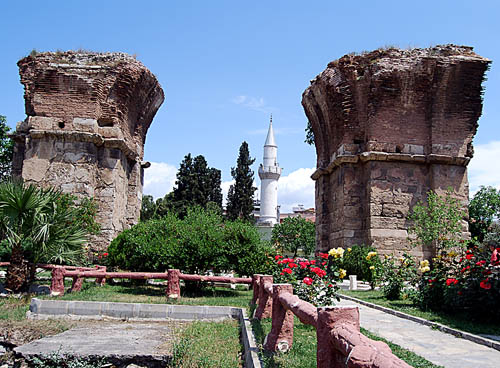
Our photo shows the ruins of the Byzantine church. Local tradition says this building served as a cathedral dedicated to St. John the Theologian. In Turkey the minaret is positioned to be in almost every tourist photo.

Toward the end of the first century the Lord sent a letter to the church at Philadelphia (Revelation 1:11; 3:7-13). The Lord commended the church with these words:

Behold, I have put before you an open door which no one can shut, because you have a little power, and have kept My word, and have not denied My name. Revelation 3:8

The historical credibility of the Gospel of John

Over at Parchment and Pen, Dan Wallace has written on “The Gospel of John and Historical Realibility – Part 1. Already I am looking forward to Part 2+. Wallace says,

In 1844, the Tübinger Jahrbuch published an essay by F. C. Baur to the effect that John’s Gospel should be dated no earlier than AD 160, and probably closer to 170.

Everyone who has studied New Testament introduction knows that this view was dominant for nearly a century. Wallace tells what rocked Baur’s view:

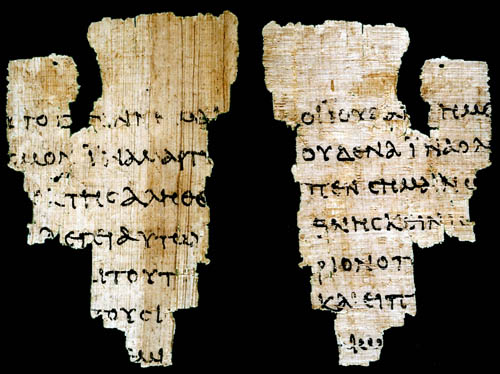
Ninety years after Baur first published his thesis on John, a young doctoral student studying at Manchester University came across a scrap of papyrus in the John Rylands Library. Colin H. Roberts was intrigued by the papyrus fragment, which had been excavated decades earlier from rubbish heaps in Egypt. It was only 2 & ½ inches by 3 & ½ inches, but its importance far outweighed its size. Roberts immediately recognized it as a fragment of John’s Gospel—chapter 18, verses 31 to 33 on one side, and chapter 18, verses 37 and 38 on the other, to be exact. He sent the photographs of the fragment to three of the leading papyrologists in Europe. Each one reported independently that this fragment should be dated, on paleographical grounds, between AD 100 and AD 150. A fourth scholar disagreed, arguing that the fragment should be dated in the 90s of the first century!

This tiny fragment of John’s Gospel rocked the scholarly near-consensus on the date of John, for it is impossible for a copy to be written before the original text is produced. It effectively sent two tons of German scholarship to the flames. As one wag put it, “This manuscript must have been written when the ink on the original text was barely dry.”

A number of years ago, while leading a tour of the British Isles, I called the Rylands Library at the University of Manchester to ask if I could see the Rylands Fragment. After being assured that I could, I took the train from York to Manchester. At the time, the little fragment was between two pieces of glass taped around the edge. There is only one piece of the fragment, but the image below (from a library slide) shows both sides.

We think the Gospel of John was written by John in Ephesus sometime during the 80s, but this manuscript is thought to have originated in Egypt between A.D. 100 and 150 (or earlier?). This is a small illustration of the rapid spread and copying of the Gospel.

The John Rylands Library has a page devoted to the fragment here.

Thessalonica in Macedonia

The Capsis hotel in Thessalonica was our home for two nights. Wednesday we used our time visiting the city. Thessalonica (called Thessaloniki now) is in biblical Macedonia. The area is still known as Macedonia, but is not to be confused by the modern country by that name. It is marked on maps of Greece as FYROM (former Yugoslav Republic of Macedonia). I know too little about the dispute to make any comments.

Paul came to Thessalonica on his second journey (A.D. 50-53; Acts 17). He wrote two letters to the church at Thessalonica while he was at Corinth. Aristarchus, a Macedonian of Thessalonica accompanied Paul on the voyage to Rome (Acts 27:2). When Demas forsook Paul he went to Thessalonica (2 Timothy 4:10).

I went to the Archaeological Museum of Thessalonica thinking I would jump in, make a few shots of some items I had need of and then move along. In fact, I found a new (since my last visit in 2001) museum with wonderful educational exhibits, nice displays, and great lighting.

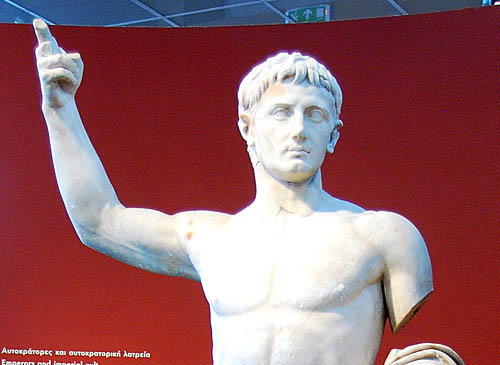
There is an impressive full-length statue of the Emperor Augustus (30 B.C. to A.D. 14). Augustus was emperor at the time of the birth of Jesus (Luke 2:1). Here is a photo of the top portion of the statue. This gives some indication of the wonderful lighting in the museum. This photo was made without flash.

On the display around the statue of the emperor there is a statement about the cult of the emperor. In our travels in Asia Minor (western Turkey) we saw many evidences that the admiration of the emperor grew into worship of the emperor as a divine being. This placed a real burden on the Christians of the time. It is this type of tribulation that the book of Revelation addresses.

The cult of the emperor was both an instrument of imperial policy progaganda and a means for the transmission of Roman culture. The image of the emperor gives a concrete form to the abstract idea of the Empire. Whether a full-lenth statue [as this one] of a bust, it makes his presence felt everywhere; in outoor and indoor spaces, in fora, in villas, and in libraries.

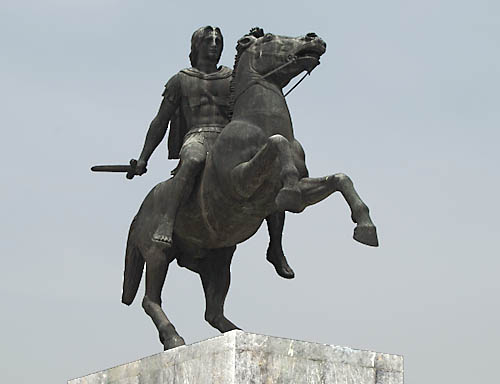
Elizabeth and I walked down by the harbor to see the colossal statue of Alexander the Great on his horse, ready to go into battle with sword drawn. We must put Alexander of Macedon among the most influential people of world history. His conquest of the areas we know as the Bible world continue to influence us till this day. He left his mark with the introduction of the oikumene concept of one world and the introduction of Greek culture and language. The Hebrew scriptures were translated into Greek in Alexandria beginning about 280 B.C. The New Testament was written in Greek. Even Paul, the Hebrew of Hebrews (Philippians 3:5), could speak Greek (Acts 21:37).

We visited the Arch of Galerius on the modern Via Egnatia, one of the main streets of Thessalonca. I made a few photos in the Roman agora before we rushed to get our bags packed to fly back to Athens.

By the time we arrived at our hotel, near the airport we had both decided that we were too tired to try to go to Delphi today. From our hotel room we are enjoying the beautiful view of a small town surrounded by mountains draped by blue sky with white clouds.

Titus was left in Crete

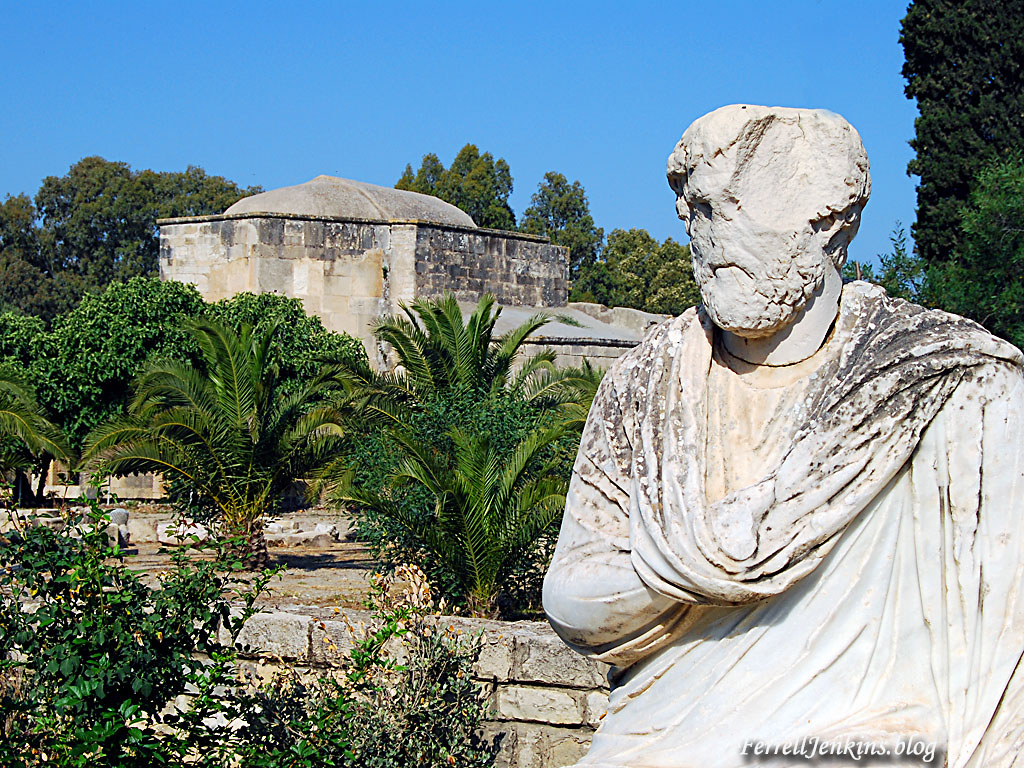
Paul left Titus in Crete to set in order what was lacking in the churches, and appoint elders in every city (Titus 1:5). This indicates that Paul visited Crete with Titus and left Titus there. It is difficult to fit this into the information we know about Paul’s life, but likely came after the first Roman imprisonment. Tradition has it that Titus was the first bishop of Gortyn. There we saw the ruins of the Basilica of St. Titus (4th to 8th centuries). Here is one of the photos from this site was was on the main road from Heraklion to Fair Havens.

The back of the basilica of Titus at Gortyna, Crete. Roman statue in foreground. Photo by Ferrell Jenkins.

The back of the basilica of Titus at Gortyna, Crete. Roman statue in foreground. Photo by Ferrell Jenkins.

This photo shows the back of the basilica because the front was in the shadows. One of our tour members was looking at the photo. I said, “We could say that this Roman statue is of Titus.” She said, “It looks as if he has a splitting headache.”

Hierapolis and Aphrodisias

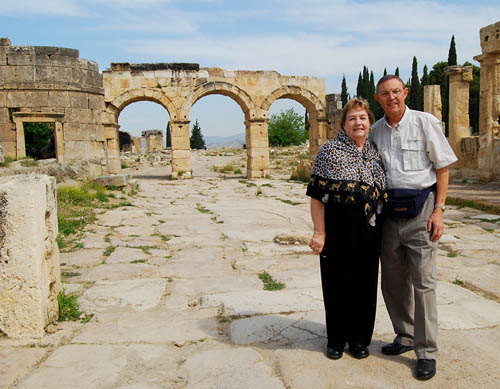
This morning we visited Hierapolis, a city famous for its hot mineral springs and terraced travertine formations. Tradition associates this city with Philip. It is not clear whether Philip the apostle, or Philip the evangelist is intended. A colonnaded street and the Arch of Domitian (emperor A.D. 81-96) was erected by Julius Frontinus, proconsul of Asia about A.D. 82-83. The book of Revelation was written about the time of Domitian’s death.

Elizabeth and I have been traveling some of these roads together since 1967.

Papias (about A.D. 60 to A.D. 130) was a disciple of the apostle John and a companion of Polycarp. Fragments of his writings about the apostles survive in Irenaeus and Eusebius. He is said to have been Bishop of Hierapolis. Eusebius (active about A.D. 185), tells us that Papias wrote as follows:

Matthew also issued a written Gospel among the Hebrews in their own dialect, while Peter and Paul were preaching at Rome, and laying the foundations of the Church. After their departure, Mark, the disciple and interpreter of Peter, did also hand down to us in writing what had been preached by Peter. Luke also, the companion of Paul, recorded in a book the Gospel preached by him.

Afterwards, John, the disciple of the Lord, who also had leaned upon His breast, did himself publish a Gospel during his residence at Ephesus in Asia. (Euseius, Against Heresies III.1.1)

Paul commended Epaphras for his labor on behalf of all of the churches of the Lycus River valley.

For I testify for him that he has a deep concern for you and for those who are in Laodicea and Hierapolis. (Colossians 4:13).

On the way to the Aegean coast we visited the fabulous new excavations at Aphrodisias. The National Geographic Society sponsored the excavations here for about 30 years. Many of the items from the Roman time are well preserved. These include the Roman stadium, the temple of Aphrodite, the odeon, the baths, and some marvelous sculp­tures in the Museum.

Tonight we are at Kusadasi, the Turkish resort town on the Aegean. Our hotel is about 12 miles from the ancient site of Ephesus which we hope to see tomorrow.

Izmir (Smyrna of the Book of Revelation)

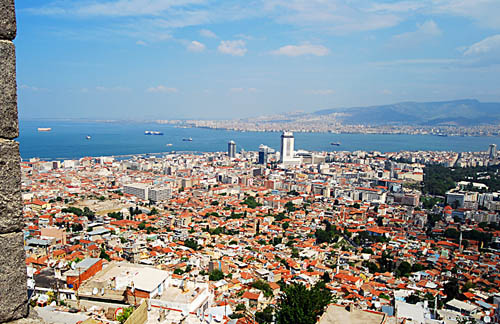
This morning we flew from Istanbul to Imzir, Turkey’s second largest city. Our sightseeing included Mount Pagos with its magnificent view of the city and harbor. Most of the ancient city of Smyrna is buried underneath the modern buildings. A portion of the Agora (marketplace) of Smyrna has been unearthed in the past. Houses have been demolished the a large area adjoining the agora, and preparations are being made for additional excavations. This will be exciting to watch.

There are two important archaeological museums in Izmir. We made short visits to each of them. In the older museum we saw the likeness of Flavius Damianus, an imperial priest under Emperor Septimius Severus, wearing a diadem. This provides an impressive image of the place of emperor worship in Asia Minor in the days following the writing of the book of Revelation.

And to the angel of the church in Smyrna write: ‘The first and the last, who was dead, and has come to life, says this: ‘I know your tribulation and your poverty (but you are rich), and the blasphemy by those who say they are Jews and are not, but are a synagogue of Satan. ‘Do not fear what you are about to suffer. Behold, the devil is about to cast some of you into prison, so that you will be tested, and you will have tribulation for ten days. Be faithful until death, and I will give you the crown of life. ‘He who has an ear, let him hear what the Spirit says to the churches. He who overcomes will not be hurt by the second death.’ (Revelation 2:8-11).

Domitian, a hated emperor

One coin at a time is Brett Telford’s blog about coins. He has a marvelous photo of a silver Tetradrachm showing the image of Domitian. It was struck in Tarsus about A.D. 93-95. Please take a look.

Telford says,

The portrait reveals an emperor weary from insecurity and suspicion of conspiracy in the later years of his reign. His gaze bears witness to the demons that incited his paranoia. Domitian’s reign of terror began at around AD 93 and lasted until his death in AD 96… about the same time that this coin was struck.

After an interesting discussion of Ethelbert Stauffer’s theory that the titles of Domitian equal 666, Telford comments on the coincidence that this coin was minted at Tarsus, home of the apostle Paul.

This coin isn’t without its own Biblical reference. Tarsus, the city in which this coin was minted, was the birthplace of the Apostle Paul. Isn’t it ironic then, that a coin of the purported Biblical “Beast” was struck in the very city that brought us the most notable of early Christian missionaries.

Previously I have called attention to my books on Revelation. I failed to mention another brief publication about Domitian. Several years back Arthur M. Ogden and I wrote a series of exchanges. This publication, Did Domitian Persecute Christian? is available free in PDF at BibleWorld.

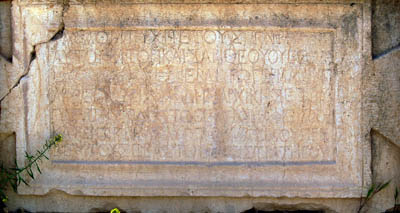
I have seen various inscriptions on which the name of Domitian has been scratched off. It means that he was a person of damnable memory. Recently on our trip to Jerash in Jordan we saw two inscription discovered when the theater was being restored. Here is a photo of one of them.

The inscription, which dates to the year A.D. 90/91, bears the title of the Emperor Domitian, but his name has been erased. The emperor is said to be the son of “divine (theou) Vespasian.” At the moment I can’t put my hands on it, but I recall that a translation of both inscriptions is included in the Newsletter of the American Schools of Oriental Research, Oct., 1974. Inscriptions like this definitely need to be in a controlled environment rather than outside in the weather.

On our upcoming Steps of Paul and John tour the name of Domitian will be used often.

HT: Georg S. Adamsen, Revelation Resources.

Book of Enoch on Display

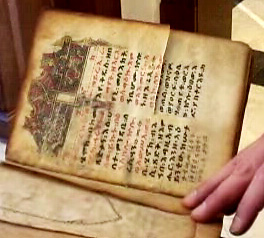
The book of Enoch has received some attention in the news today. The Courier-Journal reports that a printed copy of Enoch was recently purchased by a collector, and is being placed on display at the Remnant Trust in Jeffersonville, Indiana. The article includes a nice video with good images of the book.
Book of Enoch at Remnant Trust, Jeffersonville, Indiana.

Enoch was originally written in Hebrew or Aramaic by Jews, and some ancient fragments of it have been found near the Dead Sea. But the oldest complete versions are in the ancient Ethiopian language of Ge’ez because Ethiopian Christians are the only enduring church group that revered the book as Scripture.

James C. VanderKam, a professor of Hebrew Scriptures at Notre Dame University and a leading expert on the Book of Enoch, has inspected the book on loan to the trust and estimates that it’s probably one of the five oldest manuscripts of the work.

“We don’t have very many that go back that far,” said VanderKam, who is co-author of an English translation of Enoch and is working on a commentary. VanderKam estimated that the text was about 500 years old because its script and contents are similar to a manuscript of that age in the British Museum. Specialists in Ethiopian script could make a more specific determination, he said.

Enoch is mentioned in Luke’s genealogy of Jesus (Luke 3:37). The writer of the epistles to the Hebrews says,

By faith Enoch was taken up so that he would not see death; AND HE WAS NOT FOUND BECAUSE GOD TOOK HIM UP; for he obtained the witness that before his being taken up he was pleasing to God (Hebrews 11:5 NASB).

The most interesting mention of Enoch in the New Testament is the quotation from the book in the little letter of Jude. In the midst of a litany of charges against “certain persons” who had crept in unnoticed among the Christians to whom he writes, he says,

It was also about these men that Enoch, in the seventh generation from Adam, prophesied, saying, “Behold, the Lord came with many thousands of His holy ones, to execute judgment upon all, and to convict all the ungodly of all their ungodly deeds which they have done in an ungodly way, and of all the harsh things which ungodly sinners have spoken against Him.” (Jude 1:14-15 NASB).

The book of Enoch was not considered one of the canonical books of the Hebrew Bible (Old Testament) by the Jews, but Jude seems to think it expressed the truth about what will happen to false teachers. In the same way, Paul quoted pagan poets whose work expressed the truth he was seeking to express (Acts 17:28).

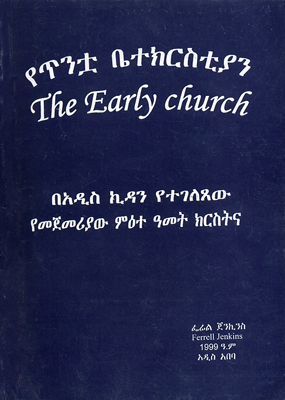
For several weeks I have been looking for an excuse to mention that my book, The Early Church, is now available in the Amharic language. All distribution is being done by Christians in Ethiopia, and I have no copies for distribution.

The Early Church by Ferrell Jenkins in Amharic, used by Christian in Ethiopia.

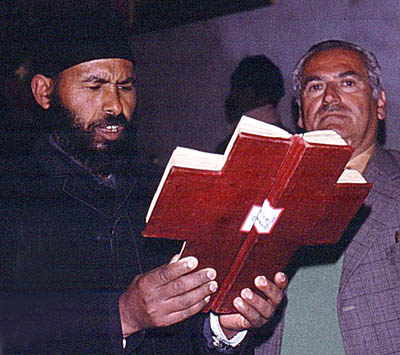
Ethiopians, sometimes called Abyssinians, have a small chapel adjoining the Church of the Holy Sepulcher in Jerusalem. There they sometimes show a portion of the Gospels prepared in the shape of a cross. One of my guides used to ask the Ethiopian to read to us from Amharic. This photo was made in 1977.

Ethiopian reading the gospel in Jerusalem. Photo by Ferrell Jenkins, 1977.

Bethlehem and the birth of Jesus

The media is giving its usual Christmas Eve attention to Bethlehem today. The New Testament teaches that Jesus was born in Bethlehem of Judea in the days of Herod the king (Matthew 2:1). The month, day, and year of the birth of Jesus is not stated in the New Testament. We do have some historical information that helps with the date, but not precise information is available (Luke 2).
Do we know the place of the birth of Jesus in Bethlehem? About A.D. 160 Justin Martyr said, “when the child was born in Bethlehem, since Joseph could not find a lodging in that village, he took up his quarters in a certain cave near the village” (Dialogue With Trypho, 78). Near the middle of the third century Origen said that the cave where Jesus was born was being shown and that even the enemies of the faith were talking of it. Jerome was a resident of Bethlehem from A.D. 386 until his death in A.D. 420. He tells how the birthplace of Jesus, the place of the crucifixion and the tomb where Jesus had lain were defiled from the time of Hadrian to the reign of Constantine. The Church of the Nativity now stands at this spot. Of this location, Dalman says:

No one could discern in this former rocky chamber the place of the Nativity. The altar at the east end was perhaps not erected originally to designate the exact spot, although the background of the grotto would make it probable. Here also is the only remarkable feature in it, namely a small adjoining room which contains in the right wall a low niche resembling a manger (Sacred Sites and Ways, 38).

Typical of so many, this site has enjoyed its share of fanciful speculations. Tradition locates the spot where the adoration of the Magi took place and a projection in the background is taken to be the table at which the Virgin ate with the Magi. Like so much speculation, these overlook the fact that the gospel account represents the Magi as arriving at some time after the birth of Jesus and that they found the child with Mary in a “house.” The Wise Men may have had a fast means of transportation, but one should not forget that they traveled by plain, not plane; they came not from the east side of town, but from the East.
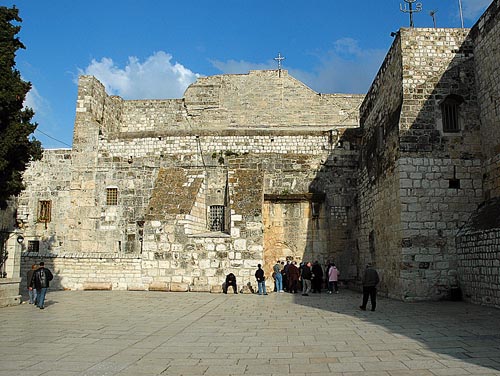
This photo shows the exterior of the Church of Nativity in Bethlehem.

Bethlehem - The Church of Nativity

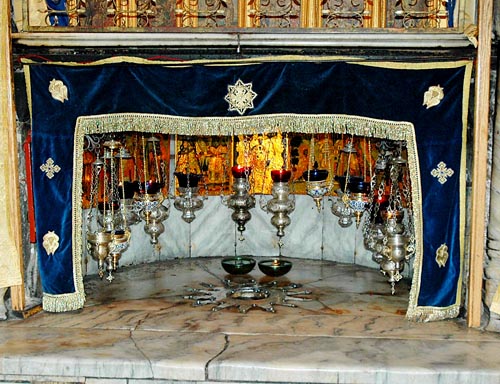
The Church of the Nativity has a long history. It is now a Greek Orthodox church. Underneath the altar is the Grotto of the Nativity where it is said that Jesus was born. Maybe, maybe not. A silver star was set in the marble pavement in 1717. The Latin inscription, “HIC DE VIRGINE MARIA JESUS CHRISTUS NATUS EST.” The translation: “Here Jesus Christ was born of the Virgin Mary.”

Bethlehem - The Church of Nativity - Star in the Grotto of the Nativity

Among the confusion of the date of the birth of Jesus, and the lack of New Testament authority for a church celebration on a certain day, let us not forget that the eternal Word became flesh, and dwelt among men in order to bring salvation to those who obey Him through his death upon the cross (John 1:1, 14; Luke 19:10).

“Although he was a son, he learned obedience through what he suffered. And being made perfect, he became the source of eternal salvation to all who obey him.” – Hebrews 5:8-9, ESV