Category Archives: Church History

St. Paul’s Bay in Malta

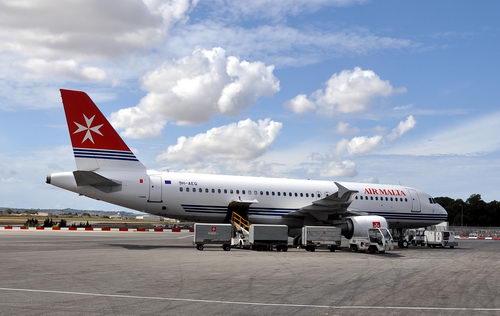
We said goodbye to our group early this morning at the Rome airportas they prepared to depart for the USA. Elizabeth and I went to another terminal to wait for our noon flight to Malta.This was my first time to fly Air Malta. The planes bear the distinctive Maltese Cross on the tail.Malta is renowned for its association with the 12th century Knights of Malta (also know as the Knghts of Rhodes, and the Knights of St. John). They were also called the Hospitalers. I think they built the first hospital in Jerusalem at a site now near the Church of the Holy Sepulcher.

Air Malta planes display the Maltese Cross. Photo by Ferrell Jenkin in Malta.

Air Malta planes display the Maltese Cross. Photo by Ferrell Jenkin in Malta.

Malta is a popular resort and is still in the high season. We are staying at a hotel on the southern side of St. Paul’s Bay. My purpose in coming here is to photograph possible sites associated with Paul’s shipwreck.

After we had safely reached shore, we learned that the island was called Malta.  2 The local inhabitants showed us extraordinary kindness, for they built a fire and welcomed us all because it had started to rain and was cold. (Acts 28:1-2).

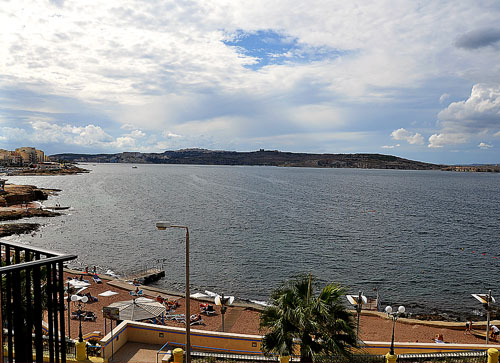
This is one of the first photos I made from our hotel balcony.

View of St. Paul's Bay. Photo by Ferrell Jenkins.

View of St. Paul's Bay. Photo by Ferrell Jenkins.

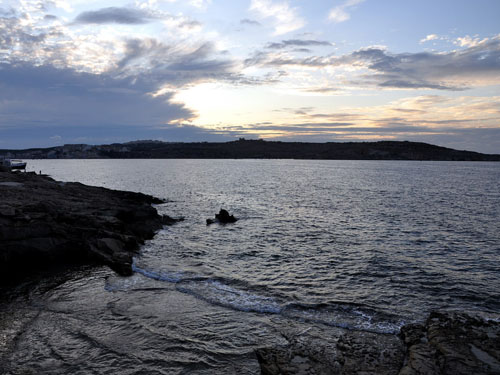
The next photo was made at sunset and shows a portion of the rocky coast even in an area now filled with shops and seaside restaurants.

The rugged coast of St. Paul's Bay at Sunset. Photo by Ferrell Jenkins.

The rugged coast of St. Paul's Bay at Sunset. Photo by Ferrell Jenkins.

Vatican City and the Vatican Museum

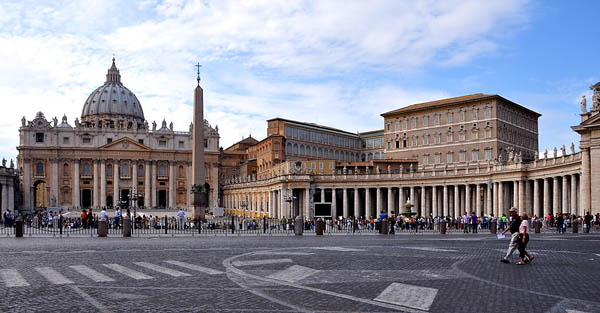
We had a busy day Saturday in Rome. In the morning we visited St. Peter’s Basilica in Vatican City. Vatican is an independent state within Italy. This is the largest church building in the world. Thousands of people visit it each day. There probably isn’t anyone who reads this blog who had not been here or seen photos or video of the building and its art treasures.

St. Peter's basilica in Vatican City. Photo by Ferrell Jenkins.

St. Peter's basilica in Vatican City. Photo by Ferrell Jenkins.

St. Peter’s is located on the site of Nero’s Circus. Nero’s persecution of Christians was in his circus, A.D. 64.  (Tacitus, Annales, XV, 44).

St. Peter’s was financed through the sale of indulgences in the 16th century. The reaction to this practice was an important factor in the Reformation Movement. Dr. Dan Petty explains a little about Martin Luther’s role.

Doctrinal Issues and Religious Authority. The immediate issue that prompted Martin Luther to post his 95 propositions for debate in 1517 was the abuse of the Roman Catholic system of indulgences. The doctrine of indulgences, first formulated in the thirteenth century, was associated with the sacrament of penance and the doctrine of purgatory. While the sacrament was believed to provide forgiveness of sin and eternal punishment, it was thought that there was a temporal satisfaction that the repentant sinner must fulfill in this life or in purgatory. The indulgence was a document that one could purchase for a sum of money that would free him from the temporal penalty of sin. The excess merits of Christ and the saints were believed to be stored up in a heavenly “treasury of merit” which the pope could draw from on behalf of the living.  In 1517 the Dominican Johann Tetzel was selling a special plenary indulgence (promising complete forgiveness of all sin) to raise money for the church. Half of the money was to be given to Archbishop Albert, to whom the pope had given a special dispensation to hold two offices. The rest would help finance the completion of Saint Peter’s cathedral in Rome. Luther’s protest initially was against what he saw as the abuse of the system of indulgence. It was also a challenge to the papal authority that made such abuses possible.

After the visit to St. Peter’s we went to the Vatican Museum. I broke away from the group to make some photos in the Roman section of the museum. Tremendous crowds visit this museum. I have been here several times since my first visit in 1967, and I have never seen the crowds worse than today.

In the afternoon the group went to the catacombs, I took leave to return to the hotel and continue work on my lesson for the Sunday service at La Chiesa di Christo, via Sannio 69 (Roma).

Learning the Bible in the Middle Ages

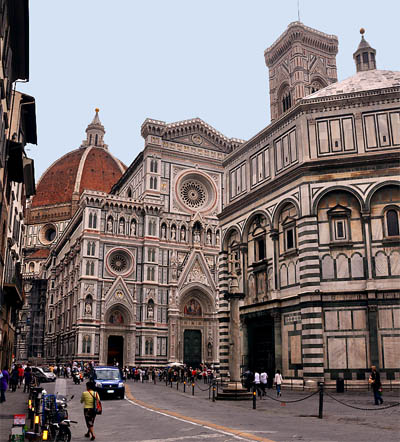
Duomo, Baptistery, and Campanile. Photo by Ferrell Jenkins.

The Cathedral (or Duomo) of Florence is of the Gothic style and dates to the 12th century A.D. The church, along with the baptistery, and the campanile (bell tower) have been designated a UNESCO World Heritage Site. The bronze baptistery doors, often designated as the Gates of Paradise, was designed by Lorenzo Ghiberti in the early 1400s. The gates we see today are reproductions.

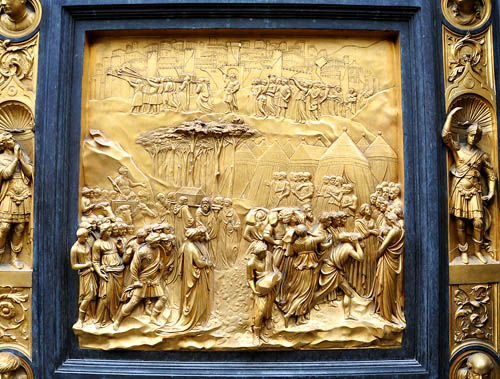
In the Middle Ages Bibles were not available to the common people. One of the ways the Bible was taught was through the stained glass windows, wood carvings, and cast works such as the doors of the baptistery. The panel in the photo below shows the Israelites crossing the Jordan, and the capture of Jericho (Joshua 3-6). Remember that for the Western World those were the Dark Ages.

Baptistery panel showing capture of Jeriocho. Photo by Ferrell Jenkins.

There is more that should be said about Florence, but we arrived in Rome last evening. Today and tomorrow will be filled with activity in Rome.

Be careful where you start a fire

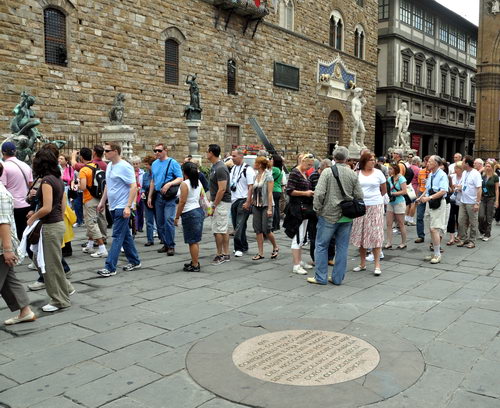
Piazza della Signoria in Florence with Savonarola marker showing. Photo by Ferrell Jenkins.

Piazza della Signoria in Florence with Savonarola marker showing. Photo by Ferrell Jenkins.

Yesterday morning I visited the Piazza della Signoria in Florence, Italy. I think many people walk through this Piazza to get to the Uffizi Gallery and never notice the plaque about Savonarola. Sometimes groups of people were standing on the plaque. When it was clear, one man walked up and said to his companions “Who’s that?” The group walked on without an answer.

Daniel M. Madden says,

In the lovely Piazza della Signoria, the political forum of Florence in all ages, Savonarola arranged a huge bonfire in 1497 so that penitents won over by his words could do away with their wigs, perfumes, lotions, powers and other accouterments of an easy way of life. He himself was burned to death in the same piazza a year later as a heretic. The spot where he died is marked with a plaque. It is not far from the copy of Michelangelo’s statue of “David.” (A Religious Guide to Europe)

One may say anything he wishes as long as he does not step on the toes of those in authority. Jesus faced this problem when He dealt with the Jewish leaders in Jerusalem.

“If we let him go on like this, everyone will believe in him, and the Romans will come and take away both our place and our nation.” (John 11:48 ESV)

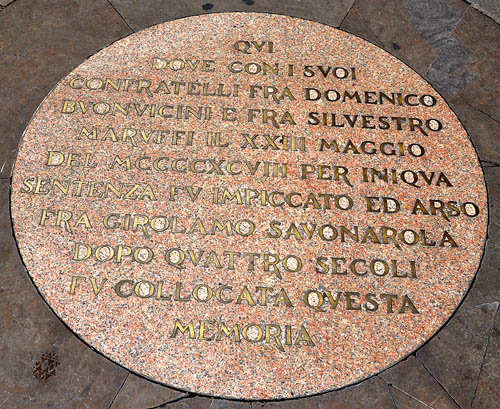
Here is a closeup of the plaque marking the spot where Savonarola died.

Plaque marking spot where Savonarola died. Photo by Ferrell Jenkins.

Plaque marking spot where Savonarola died. Photo by Ferrell Jenkins.

The background of the Protestant Reformation

Dr. Dan Petty, chair of Biblical Studies at Florida College, gave me permission to post some of his information about the Reformation Movement on the blog. Dan has some other material on church history at Lessons on Line. The following section, without indentation, is by Dr. Petty.

-o-o-o-o-

The Protestant Reformation began in 1517, when Martin Luther posted his Ninety-five Theses in Wittenberg, Germany. The background of the movement is complex. The movement was conditioned by political, social, economic, moral and intellectual factors. But it was above all a religious movement led by men interested in a genuine reform of Christianity.

The Decline of Papal Power
The rise of national monarchies in the thirteenth through the fifteenth centuries came at the expense of the power of the papacy. This fact is illustrated by Pope Boniface VIII’s struggle with the king of France, which resulted in the pope’s humiliation and untimely death in 1303. The papacy was subsequently located in Avignon, France for an approximately seventy-year period known in history as the Avignon Papacy or the Babylonian Captivity of the Papacy (1303-77). During that time the papacy was dominated by the French monarchy. Efforts to restore the papacy to Rome at first only resulted in a division, known as the Great Schism. Rival popes claimed legitimacy until the situation was finally resolved in 1417.

Such scandalous affairs in the highest leadership of the Roman Catholic Church led to increasing corruption and a loss of confidence in the church. Many questioned the absolute authority claimed for the pope. Others increasingly called for a reform of the church in “head and members.”

Moral Corruption in the Leadership of the Church
The years leading up to the Protestant Reformation were also plagued by moral corruption and abuse of position in the Roman Catholic Church. The priesthood was guilty of several abuses of privilege and responsibility, including simony (using one’s wealth or influence to purchase an ecclesiastical office), pluralism (holding multiple offices simultaneously) and absenteeism (the failure to reside in the parish where they were supposed to minister). The practice of celibacy which was imposed by the church on  the priesthood was often abused or ignored, leading to immoral conduct on the part of the clergy. Secular-minded, ignorant priests corrupted their position by neglect or abuse of power.

During the fifteenth century the worldliness and corruption in the church reached its worst. The problem of corruption reached all the way to the papacy.

Among those who spoke out for a reform of the church was the Dominican Giralamo Savonarola (1452-1498) of Florence, Italy. This fiery preacher spoke out against the corrupt morals of the city’s leaders and the abuses of the papacy. The people were won over to Savonarola’s cause in Florence, but because of religious rivalries and political circumstances, the movement was short-lived. Savonarola was hanged and burned for heresy in 1498.

-o-o-o-o-

Here is a photo of the Piazza della Signoria in Florence, Italy. This is where Savonarola preached and died. In the next post we will show a photo of the plaque marking the place where Savonarola was martyred in 1498.
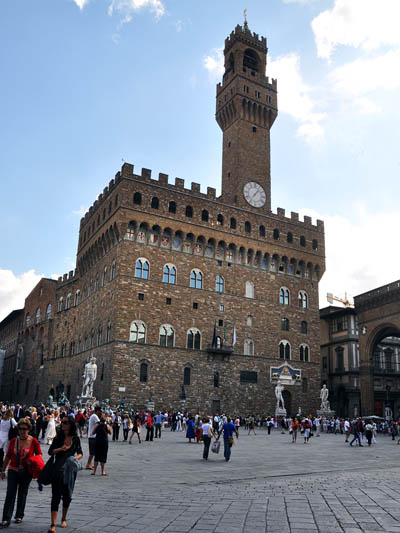
Piazza della Signoria in Florence, Italy. Photo by Ferrell Jenkins.

Piazza della Signoria in Florence, Italy. Photo by Ferrell Jenkins.
Venice and Mark

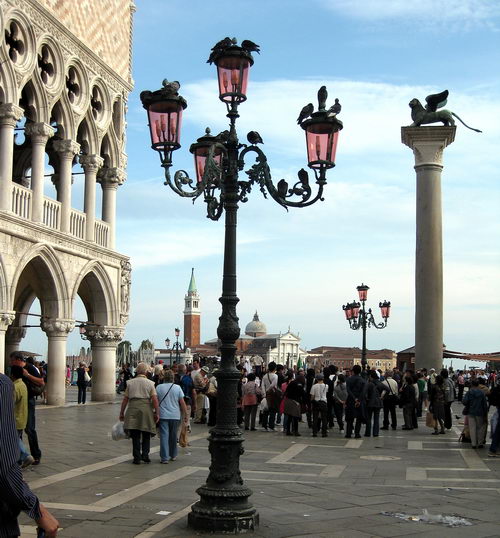
This view shows one corner of the Doge’s palace and the columns with the lion representing Mark the Evangelist. (Some of us would simply say Mark, the writer of the gospel that bears his name.) The buildings visible in the distance are across the Grand Canal.

Note the pigeons resting on the lamp post. There are now fewer pigeons in the Square than in the past because the city has quit feeding then.

Doges Palace and view from St. Mark's Square. Photo by Ferrell Jenkins.
Doges Palace and view from St. Mark's Square. Photo by Ferrell Jenkins.
St. Mark’s Cathedral and Square is one of the best known tourist attractions in the world. The building is of the Byzantine style, but the liturgy is Roman Catholic. Madden explains how a Byzantine building happens to be in Italy.

The Byzantine style of St. Mark’s Cathedral bespeaks the maritime past of the Venetian republic, and its long range interests in the eastern Mediterranean, the Mare Nostrum of the Romans (A Religious Guide to Europe, 298).

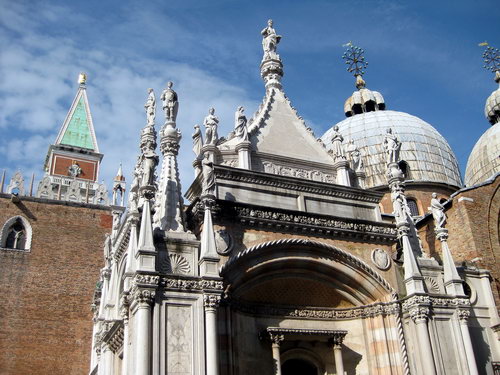
Clock Tower and the Domes of St. Mark's. Photo by Ferrell Jenkins.
Clock Tower and the Domes of St. Mark's. Photo by Ferrell Jenkins.
It is alleged by some that the body (or relics) of St. Mark the Evangelist were brought to Venice in the 9th century B.C. by Venetian merchants.

Today we traveled from Venice to Florence. It rained most of that time. By the time we reached Florence we had some clearing. At the moment it is bright outside.

Everyone in the group is doing well.

Heinrich Bullinger, successor to Zwingli

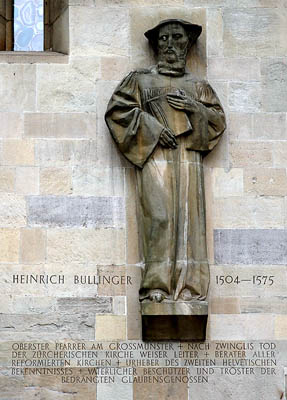
Upon the untimely death of Zwingli, Heinrich Bullinger (A.D. 1504- 1575)  became pastor of the Gossmunster in Zurich. He is not as well known as other leaders of the early Reformation, but was a significant thinker and writer.  This statue of Bullinger is attached on the wall of the Grossmunster to the right of the entry.

Heinrich Bullinger. Photo by Ferrell Jenkins.Statue of Bullinger. Photo by Ferrell Jenkins.
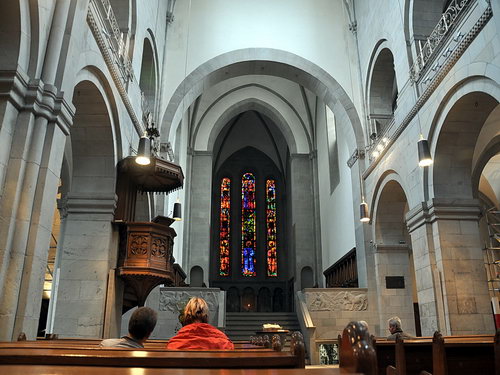
In the days of Zwingli the altars and images were removed from the Grossmunster in Zurich. The interior of the building has been restored to its orignal Romanesque appearance.

Interior of the Grossmunster in Zurich. Photo by Ferrell Jenkins.

Interior of the Grossmunster in Zurich. Photo by Ferrell Jenkins.

Take a look at Sacred Destinations if you would like to see some more information about the Grossmunster and good photos of sites in Zurich.

Third Man of the Reformation

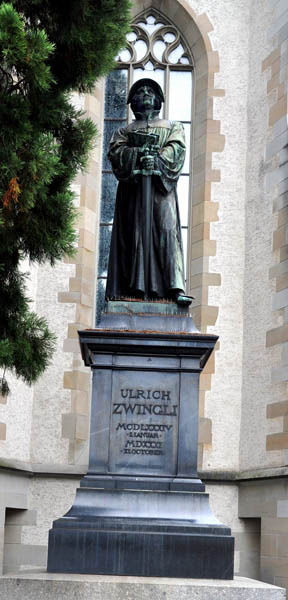
Ulrich (or Huldrich) Zwingli was born January 1, 1484, about 50 days after the birth of Martin Luther. Zwingli is sometimes called the “third man of the Reformation” after Luther and Calvin (Jean Rilliet, Zwingli: Third Man of the Reformation).

Zwingli Statue in Zurich. Photo by Ferrell Jenkins.

Zwingli Statue in Zurich. Photo by Ferrell Jenkins.

Zwingli was born in a small town in eastern Switzerland. His family was able to provide a good education for him. He first attended the University of Vienna and then the University of Basel. Dr. Dan Petty describes one of the influences that led him away from Catholicism.

“His education brought him into contact with humanistic studies and he became an ardent admirer of Erasmus of Rotterdam. This emphasis tended to lead Zwingli away from the Scholastic theology of medieval Catholicism, and toward the study of the Bible.”

Church historians have described the difference between Zwingli and Luther in their respective attitude about the silence of the Scriptures.

“While Luther was disposed to leave untouched what the Bible did not prohibit, Zwingli was more inclined to reject what the Bible did not enjoin” (George P. Fisher, The Reformation, 145).

“Luther said we may do what the Bible does not forbid. Zwingli said what the Bible does not command we may not do, and on that account he gave up all images and crosses in the churches.  In this respect he was like the Iconoclasts.  Organs in church also were given up. The Lutherans loved to sing around the organ. The Zwinglians, if they sang at all, did so without any instrument” (Roland H. Bainton, The Church of Our Fathers, 143-144).

The Zurich city council called Zwingli to serve at the cathedral there. Darrell Turner, in a Religious News Service article commemorating Zwingli’s 500th birthday in 1984, said:

“His first Sunday in the pulpit of Zurich’s Grossmuenster Cathedral was also Zwingli’s 35th brithday. He shocked his listeners by announcing that instead of following the prescribed liturgy, he would preach through the Gospel of Matthew on a weekly basis.”

That was a simple. unique, and powerful things for Zwingli to do. Folks don’t like you messing with the order of service, as many a young minister has learned. But there was much more involved here. Zwingli was making a break from what Rome prescribed to be done. Going back to the Bible is always a noble thing.

Perhaps we can post more later about Heinrich Bullinger, the successor to Zwingli, in Zurich.

Group arrives safely in Switzerland

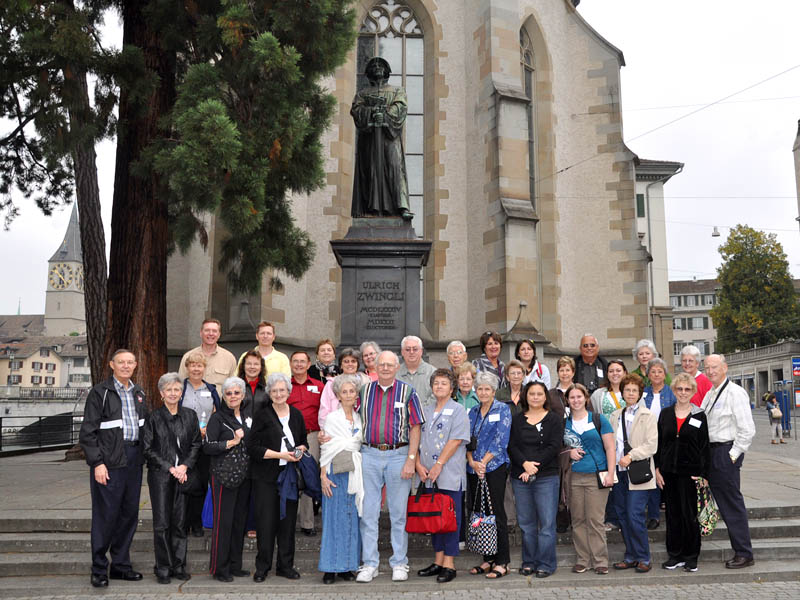
We arrived on time this morning after an all night flight from Atlanta to Zurich. As soon as we got out luggage, with three or four bags missing, we went to downtown Zurich to visit the statue of Ulrich Zwingli at the Wasserkirche (Water Church), the Grossmünster (the great cathedral where Zwingli preached in the early 15th century), and a few other sites in the downtown area of the city.

After our guide presented some of the history of the political and religious conditions in Switzerland in the early 15th century, I took the opportunity to talk about the work and beliefs of Zwingli as an early leader of the Reformation Movement. More in a later post.

Ferrell Jenkins Tour Group at the Zwingli Statue in Zurich.

Ferrell Jenkins Tour Group at the Zwingli Statue in Zurich.

The steps there seemed like a good place to line up the group for a photo. If you think you know someone in the group you may click on the photo for a larger image. This wasn’t our “official” tour photo with banner, etc., and some of the ladies didn’t much like the idea of the photo being posted. I think they look nice after being up all night. How about you?

The Greek side of Istanbul

Today’s Zaman has an interesting article about Greeks in Istanbul. The article discusses mainly a few Greek remains to be seen in the city and some information about remaining Greek Orthodox churches.The article is interesting because of the historical developments and conflicts between Greek and Turks. The note about the Serpentine Column caught my attention.

Being approximately 2,500 years old, the Serpentine Column is said to be İstanbul’s oldest remaining Greek monument. Erected to honor the triumph of the Greeks over the Persians at Plataea, it originally stood at Delphi (both ancient cities on Greek ground) and was moved to İstanbul in 324 B.C. by Constantine the Great to mark the declaration of the new capital city of the then-founded Roman Empire under the name of Constantinople. The originally eight-meter-high piece was made up of three intertwined serpents which supported a golden bowl. The bowl is believed to have been lost or stolen when the city was sacked during the Fourth Crusade. Some say the heads were hit and cut off by a drunken nobleman in the 17th century but one of them can still be seen in the İstanbul Archaeology Museum. The rest of the column can be found today at the Hippodrome in the Sultanahmet quarter.

There is a serious mistake in the article. The Serpentine Column was originally erected at Delphi in 479 B.C., but it was placed in the hippodrome of Constantinople by Constantine in 324 A.D.

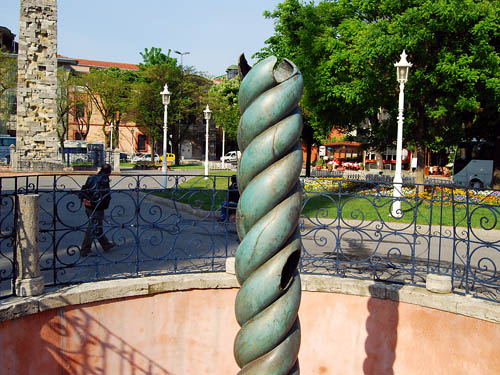
Here is a photo of the bronze Serpentine Column as it stands in the hippodrome.

Serpentine Column in Istanbul. Photo by Ferrell Jenkins.

Bronze Serpentine Column in Istanbul. Photo by Ferrell Jenkins.

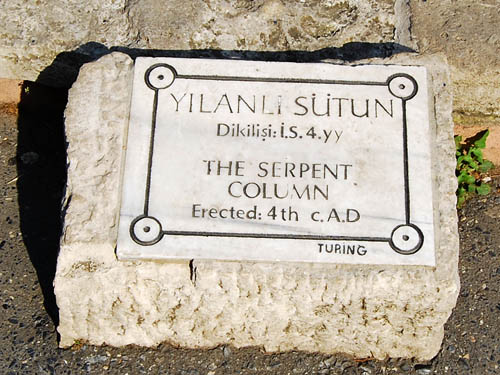
A sign marking the Serpentine Column indicates that the column was erected in the 4th century A.D. That is the date when Constantine had it erected in the hippodrome, but the column dates to the 5th century B.C.

Sign marking the Serpentine Column. Photo by Ferrell Jenkins.

Read the full  Today’s Zaman article here.

HT: Biblical Paths.