Category Archives: Church History

Monday meandering — August 8

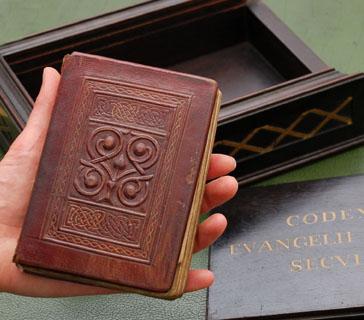
St Cuthbert Gospel. © British Library Image.

St Cuthbert Gospel. Copyright British Library Image.

British Library launches a campaign to raise $14.3 million for a 1300 year old copy of the Gospel of John. St. Cuthbert’s Gospel is said to be Europe’s oldest book. The Latin book is also called the Stonyhurst Gospel.

Information about the small bound book may be read here. The British Library has a nice video about the book, including clear images, may be viewed here. (HT: Paleojudaica).

Latin works such as this one play an important role in the history of the English Bible.

……

Wood used in the Roman siege of Masada came from other areas, according to a study by scientists at the University of Haifa.

First, the researchers examined the amount of wood that exists today in the Judean Desert and in the wadi deltas in the vicinity of Masada, and thereby were able to estimate the amount and types of wood that the desert could supply. Next, they calculated the amount of timber and firewood that would have been needed for the inhabitants of Masada, from 150 BCE, when it was a small fortress, through the Herodian period, when the fortress as we know it was constructed, and up to the siege, which ended in 73 CE. According to the researchers, in those times, timber was mostly used for construction, heating and cooking. Based on accepted evaluations of wood consumption for these purposes in traditional societies, on the conservatively estimated number of Masada inhabitants in each time period, the harsh climatic conditions in the desert and Masada’s topography, the researchers were able to conclude that by the time the Romans arrived at Masada and began their siege (73 CE), the entire area was void of timber and firewood, due to 2,220 years of massive exploitation of the immediate environment up to that point. The Romans would have had no choice but to import wood from other areas for their weapon machinery, ramparts and basic living requirements.

The brief report may be read here. (HT: Joseph Lauer)

……

C. S. Lewis and the Devil. John A. Murray has a fascinating article on “C. S. Lewis and the Devil” in The Wall Street Journal. Read the complete article here. Here is a small excerpt.

As Lewis explained, “There is no uncreated being except God. God has no opposite. . . . The proper question is whether I believe in devils. I do. That is to say, I believe in angels, and I believe that some of these, by the abuse of their free will, have become enemies to God. . . . Satan, the leader or dictator of devils, is the opposite, not of God, but of Michael.”

In his original preface written from Magdalen College at Oxford on July 5, 1941, Lewis warned of what he called “the two equal and opposite errors into which our race can fall about the devils.” One error “is to disbelieve in their existence. The other is to believe and to feel an excessive and unhealthy interest in them.” Lewis concluded that the devils “are equally pleased by both errors, and hail a materialist or a magician with the same delight.”

Dr. David McClister, Bible professor at Florida College, visited Oxford during his summer break. He shares one of his photos of Lewis’s study at the Kilns.
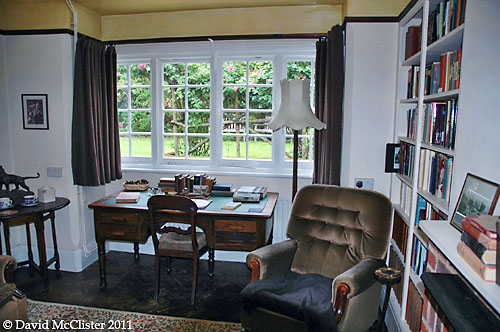
C. S. Lewis Study at the Kilns. Photo by David McClister.

C. S. Lewis Study at the Kilns. Photo by David McClister.

No wonder Lewis accomplished so much. No phone. No computer. If you are a fan of any of Lewis’s work, you might enjoy our earlier photos and info here.

HT: Bible X.
Where at Caesarea did Herod Agrippa die?

In response to our recent post on the theater at Caesarea Maritima (here), a friend asks, “I was wondering, do you put any stock in Todd Bolen’s contention that the Agrippa I death event happened in the sea side amphitheater, rather than in the theater?”

Boy, am I embarrassed. It is great to have knowledgeable friends, though. I read Todd’s insightful article at The Bible and Interpretation site in July 2010. I was impressed with the article and intended to call attention to it on this blog. For a variety of reasons I failed to get to it, and then let it slip my mind.

The Bolen article challenges Josephus’s location for the place of Herod Agrippa’s death. Here is the synopsis of the argument.

The death of Herod Agrippa I occurred in Caesarea according to both Josephus and the book of Acts. Josephus writes that the king was in the theater when the crowd hailed him as a god and he was struck down. Details in Josephus’s account, however, indicate that the episode occurred in the city amphitheater next door to the temple where the emperor was worshipped.

The article is already too concise and well documented for me to recount the arguments. Bolen believes “that Josephus’s designation of the location was inaccurate. Analysis of his account indicates that the amphitheater, rather than the theater, was the setting for Herod’s public address.” There are four indications showing the Josephus was inaccurate.

  1. The time of day.
  2. The occasion of Agrippa’s death.
  3. An encounter between Pilate and a large crowd a decade earlier.
  4. Josephus’s imprecise use of terms designating buildings of entertainment.

The article may be read in its entirety here. Several informed comments have been added by readers. There are several nice aerial photos with identifications.

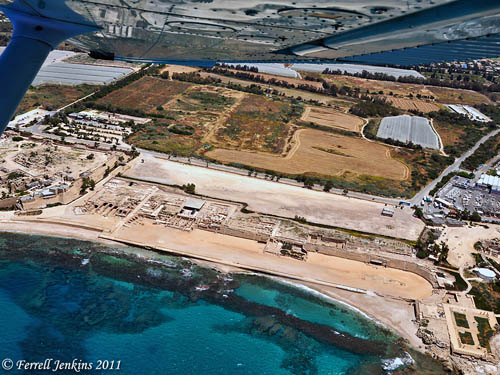
The photo below shows the amphitheater (commonly called the hippodrome) running parallel with the coastline. I note that Murphy-O’Connor refers to this as the “Herodian amphitheatre.” At the right (south) bottom of the photo you will see the upper level of what he calls the “Palace of the Procurators.” The Roman theater, which is pictured in our previous post, is to the right of this scene.

Caesarea amphitheater (hippodrome). Photo by Ferrell Jenkins.

Caesarea amphitheater (hippodrome). Photo by Ferrell Jenkins.

Along the top of the photo, under the wing of the plane, is the later amphitheater (or hippodrome) dating to the late Roman period. A line of trees provides a good outline of the structure.

Here in 306 the emperor Maximinus had Christian martyrs executed before him. Its stones were robbed out when Christianity suppressed such bloody and brutal entertainment. (Murphy-O’Connor, The Holy Land, 5th ed., 248)

The Herodian harbor is located to the left (north) of this photo.

Tabgha on the Sea of Galilee

Sacred Destinations describes Tabgha in these words:

Tabgha (also spelled Tabhka) is not a city, but a small area on the northwest shore of the Sea of Galilee, not far from Capernaum. In ancient times, Tabgha was known as Heptapegon – “Place of the Seven Springs.” These seven springs produce warm water, which increases the production of algae in this part of the lake, which attracts more fish. Fisherman have thus flocked to Heptapegon for thousands of years.

By the 4th century AD, Heptapegon had become a popular place for Byzantine pilgrims to rest and have their picnics, thanks to its shady trees and excellent fishing. It is probably not coincidence that two of the three pilgrimage destinations in this relate to abundant food: the miracle of the loaves and fishes during Jesus’ Galilean ministry and a lakeside fish breakfast after Jesus’ resurrection.

For more information read here. Sacred Destination is a nice site to use in locating brief info about biblical sites in Israel and other countries.

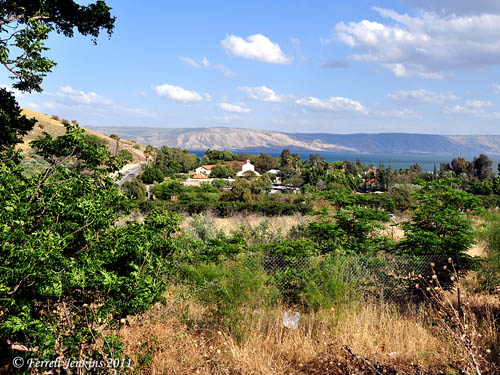
Today we spent some time again in the Hula Valley. This time on the ground instead of in the air. As we returned to Tiberias we noted that the air around the Sea of Galilee had cleared considerably since this morning. A wonderful scene presented itself as we approached Tabgha.

The view in our photo shows the church at Tabgha from the North West. Look carefully and you will see the Northeastern portion of the Sea of Galilee, the shore, and the biblical area known as Bashan. In New Testament times the region was known as the land of the Gerasenes.

Then they sailed to the country of the Gerasenes, which is opposite Galilee. (Luke 8:26 ESV)

Then all the people of the surrounding country of the Gerasenes asked him to depart from them, for they were seized with great fear. So he got into the boat and returned. (Luke 8:37 ESV)

Tabgha on the NW corner of Sea of Galilee. Photo by Ferrell Jenkins.

Tabgha on the NW corner of Sea of Galilee. Photo by Ferrell Jenkins.

The mosaics of the Antakya Museum

Yesterday’s post about Antakya, Turkey (biblical Antioch of Syria, Acts 11), was highly popular. We had more than 1400 hits. Thanks for your interest. We hope you will find other entries of interest as well.

Take a look at the two good comments on the previous post. One from Balagebalogh calls attention to the mosaics from Antakya that are in the Baltimore Museum of Art and to his illustration of Antioch, and another from TBrinley calling attention to the mosaics in the Antakya Museum. I haven’t had the opportunity to visit the Baltimore museum, but I have been to the Antakya Museum a few times.

I thought I would share just one of the many mosaics displayed in the Antakya Museum. These mosaics typically date to the fourth or fifth century as I recall. (I am away from home and do not have access to my usual sources.)

Our photo shows a beautifully preserved mosaic displayed on a large wall. I am taking the liberty of copying info about it from Sacred Destinations, a site we have recommended before. Regarding this mosaic the site says,

Detail of mosaic from the floor of the 5th-century Bath of Apolausis, a small suburban bath uncovered in the Antioch excavations on the slopes of Mount Silpios, east of the city. The woman depicted in the middle is Soteria (Salvation) who formed a pair with Apolausis (Enjoyment). Soteria and Apolausis were minor deities who had the power to deliver people from danger and were popularly associated in late antiquity with baths, whose warm waters could give pleasure and soothe pain. Antakya Museum.

Antakya Museum mosaic displayed on wall. Photo by Ferrell Jenkins.

Antakya Museum mosaic displayed on wall. Photo by Ferrell Jenkins.

Beautiful, isn’t it? Turkey is filled with similar mosaics. I recall especially those from Zeugma displayed in the Gaziantep Museum.

Antioch of Syria, or is that Turkey?

Antioch of Syria on the Orontes River was founded by Seleucus I Nicator in 300 B.C. Antioch became a Roman city in 64 B.C. and capital of the new province of Syria. It became the third largest city of the Roman Empire after Rome and Alexandria.

After Jerusalem, Antioch was the second great center of Christianity in New Testament times and where the disciples of Christ were first called Christians (Acts 11:19-30; 13:1-3; 14:26-28; 15:1-41; 18:22-23; Gal. 2).

Antioch is now called Antakya and is part of the HatayProvince of Turkey, but is near the border with Syria. The area became part of Turkey in 1939.

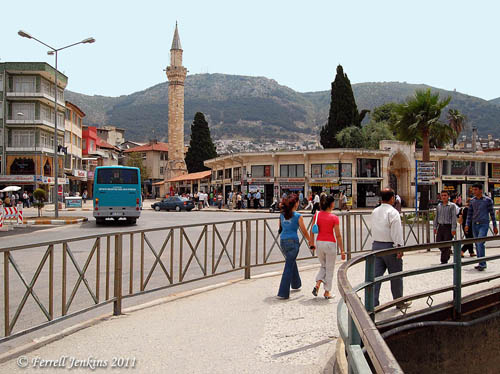
The photo below was made from the bridge crossing the Orontes River with a view east toward Mount Silipius. Click on the photo for an image suitable for use in presentations.

Antakya, Turkey. Antioch of Syria of the New Testament. Photo by Ferrell Jenkins.

View east toward Mount Silpius from the Orontes River. Photo by Ferrell Jenkins.

A church called the Cave Church of St. Peter honors Peter’s visit to the city (Gal. 2). This is a late Roman Catholic addition to the city, having become a Catholic church in 1946. Not the best choice, I think. Peter’s association with Antioch did not turn out too well. At first he ate with the new Gentile converts, but under pressure from James of Jerusalem played the hypocrite and withdrew from the Gentiles.

But when Cephas came to Antioch, I opposed him to his face, because he stood condemned. For before certain men came from James, he was eating with the Gentiles; but when they came he drew back and separated himself, fearing the circumcision party. And the rest of the Jews acted hypocritically along with him, so that even Barnabas was led astray by their hypocrisy. (Galatians 2:11-13 ESV)

I suggest you read Galatians 1 and 2, for a more complete account of this event.

From here the great journeys of Paul to take the Gospel to the Gentile world began (Acts 13:1-2).

Could the ancient metal books be more Kinderhook Plates?

The late Dr. James D. Bales, one of the founding members of the Evangelical Theological Society, and long-time Professor of Christian Doctrine at Harding University, wrote The Book of Mormon? in 1958 (Rosemead, CA: Old Paths Book Club). In this book he tells the story of the Kinderhook Plates.

The Kinderhook Plates were concocted by a few citizens of Kinderhook, Illinois, to demonstrate that the Mormon leader Joseph Smith was not able to read ancient plates like those he claimed to have read in the production of the Book of Mormon.

Bales explains the background of the fraud:

The following is found in Times and Seasons (IV:186-187, May 1, 1843). We quote it as we copied it from the Millennial Star. “On the 16th of April last a respectable merchant by the name of Robert Wiley, commenced digging in a large mound near this place: he excavated to the depth of ten feet and came to rock; about that time the rain began to fall, and he abandoned the work. On the 23rd he and quite a number of the citizens with myself, repaired to the mound, and after making ample opening, we found plenty of rock the most of which appeared as though it had been strongly burned; and after removing full two feet of said rock, we found plenty of charcoal and ashes; also human bones that appeared as though they had been burned; and near the eciphalon a bundle was found that consisted of six plates of brass, of a bell shape, each having a hole near the small end, and a ring through them all, and clasped with two clasps, the ring and clasps appeared to be of iron, very much oxidated. The plates appeared first to be copper, and had the appearance of being covered with characters. It was agreed by the company that I should cleanse the plates. Accordingly, I took them to my house, washed them with soap and water, and a woolen cloth; but, finding them not yet cleansed, I treated them with dilute sulphuric acid which made them perfectly clean, on which it appeared that they were completely covered with hieroglyphics that none as yet have been able to read. Wishing that the world might know the hidden things as fast as they come to light, I was induced to state the facts, hoping that you would give it an insertion in your excellent paper; for we all feel anxious to know the true meaning of the plates, and publishing the facts might lead to the true translation. They were found, I judged, more than twelve feet below the surface of the top of the mound.

“I am. most respectfully, a citizen of Kinderhook,

W. P. Harris, M. D.”

Nine citizens of Kinderhook signed a statement certifying the truthfulness of the statement by Dr. Harris.

Smith agreed that he would translate the plates if they were first submitted to some learned societies for translation. Eventually, after no one was able to translate the Plates,  Smith translated them. According to Bales, he said,

I have translated a portion of them, and find they contain the history of the person with whom they were found. He was a descendant of Ham, through the loins of Pharaoh, King of Egypt, and that he received his kingdom from the Ruler of Heaven and earth” (Millennial
Star, XXI:41. Extract from Smith’s diary, dated Monday, May 1, 1843).” (Bales, 92-93).

Bales also cites the testimony of the famous Egyptologist James H. Breasted.

James H. Breasted, Orientalist, Historian, Egyptologist, and Professor of Egyptology in the University of Chicago — from 1905 and a number of years thereafter — stated in a letter of R. B. Neal, on April 20, 1914 that the “Kinderhook Plates are, of course, childish forgeries, as the scientific world has known for years.” (Bales, 98)

You may see facsimiles of the Kinderhook Plates in the Salt Lake City Messenger, October, 1981) here, and at a Mormon apologetic site here.

When I first saw the photographs of the ancient lead codices we wrote about in the previous post, I immediately thought of the Kinderhook Plates.

But, maybe I am wrong! Time will tell, and I will be delighted to change my mind.

This should be a good one for April 1.

Lead books or lead balloons?

In the past 24 hours I have received a couple of Emails about the “new” “ancient” lead codices. The best photos I have seen are in the Mail Online here. The account from Yahoo News is here. Put a few words in Yahoo or Google and you will have numerous links.

First Impressions. My first impression, based on the limited information, is that this may be another of those spectacular claims with no substance. I was busy with appointments earlier today and was delighted when I had time to check the blogs to see that Todd Bolen had written a good summary of information at the Bible Places Blog here. There is no reason for me to try to rehash this material. I urge you to take a look at Todd’s summary. He says, “Personally I am inclined to believe that this find is genuine.” My first inclination leans the other way. I know it is not much of a argument, but this report lacks the “ring of truth.” I remember that F. F. Bruce said that second thoughts are best. With more information my thoughts may change. Let’s be patient.

The Sealed Book in Revelation. There is no reason at this point to  link these lead books with the sealed book of Revelation 5-7. Revelation is an apocalyptic book of symbols. Other ancient sealed books have been found in modern times. Examples: some of the Elephantine papyri, a papyrus document from Wadi Daliyeh near Jericho had seven seals still in place (Jenkins, Studies in the Book of Revelation, 18).

Jim Davila has posted numerous notes about the lead codices at Paleojudaica over the past few weeks. Follow all of Todd Bolen’s links and you will know about as much as can be known for the moment.

Bauckham on the Gospels as Histories

Last Wednesday I went to the Reformed Theological Seminary near Orlando to hear a lecture by Prof. Richard Bauckham. Bauckham was the speaker for the annual Kistemaker Academic Lecture Series. His general topic was The Gospels as Histories: What sort of history are they? I suspect that he was reading chapters that will eventually be published in a new book.

I found Bauckham, Professor Emeritus at St. Andrews University, difficult to understand during the lecture because of the his accent, but I was able to keep up with the general thread of his argument.

If you would like a little taste of Bauckham’s argument about Jesus and the Eyewitnesses I suggest you watch this short video by StJohnsNottingham (other interesting videos also available).

I was delighted to pick up a copy of Jesus and the Eyewitnesses: The Gospels as Eyewitness Testimony at the bookstore and have it autographed by Prof. Bauckham.

Richard Bauckham signs a book. Photo by Ferrell Jenkins.

Richard Bauckham autographs a book. Photo by Ferrell Jenkins.

Order Jesus and the Eyewitnesses from Amazon.
Jesus and the Eyewitnesses: The Gospels As Eyewitness Testimony

Bauckham’s material speaks clearly to the common misconception that the “Church” compiled the Gospels decades, even centuries, after Jesus lived.

Bethlehem — home of David and Jesus

A little more than two years ago we wrote about Bethlehem as the birthplace of Jesus here. We will follow the example of Paul, Peter and Jude to remind our readers of some things we already know (Romans 15;15; 1 Corinthians 4:17; 2 Timothy 2:14; 2 Peter 1:12; Jude 1:5; et al.).

  • During the Patriarchal period the town we know as Bethlehem was called Ephrath (Genesis 48:7; 35:9-27).
  • Later, as part of the territory allotted to the tribe of Judah, it was the home of Ruth and Boaz and became the birthplace and early home of David (1 Samuel 17:12, 15).
  • The town was sometimes called the “city of David” (Luke 2:4, 11), but is most famous as the birthplace of Jesus (Micah 5:2; Luke 2:4-15; Matthew 2:1-16).

When one visits the Bible lands today he must realize that 2,000 years of history, involving both repeated building and the destruction of what has been built, has left nothing to remind one of the original place where Jesus was born. Justin Martyr (ca. A.D. 160) said Joseph “took up his quarters in a certain cave near the village.” Origen (mid-third century) said the cave where Jesus was born was being shown and even the enemies of the faith were talking of it. Jerome, a resident of Bethlehem (A.D. 386-420), tells how the birthplace of Jesus and other places associated with the ministry of Jesus were defiled from the time of Hadrian to the reign of Constantine. The Church of the Nativity now stands at this spot.

This photo shows the exterior of the Church of the Nativity.

Exterior of the Church of the Nativity, Bethlehem. Photo by Ferrell Jenkins.

Exterior of the Church of the Nativity, Bethlehem. Photo by Ferrell Jenkins.

My wife saved a portion of our local paper for me last Sunday. The headline says, “Peace swells Bethlehem tourism.” All of the town’s hotel rooms are booked solid for Christmas. Last year 70,000 visited Bethlehem for Christmas, but the number is expected to be “up strongly” this year.

If you have more interest in learning about the origin of the celebration of Christ, take a look here. A more detailed study of the historical aspects of the celebration is available in PDF here.

Hadrian’s arch in Athens

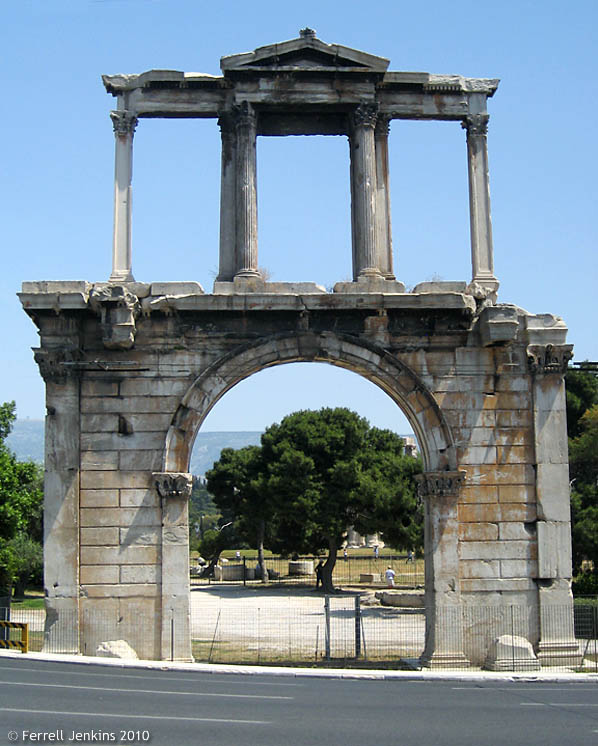
The Roman emperor Hadrian (A.D. 117-138) left arches in many cities he visited. The arch in Athens marks the entry to the Temple of Zeus. Rant and Reddish describe the arch:

The imposing Arch of Hadrian was constructed in honor of the emperor following the completion of the temple [to Zeus], and Hadrian himself walked through it to attend the dedication of the temple in 131 C.E. The western side of the arch (toward the old city) carries the inscription “This is Athens, the city of Theseus.” The inscription on the eastern side of the arch facing the temple (and toward a section of Athens that had been newly renovated by Hadrian) states, “This is the city of Harrian and not of Theseus. (A Guide to Biblical Sites in Greece and Turkey, 33)

To get a photo like this one requires some good footwork. The arch faces one of the busiest streets in Athens, but one must move out into the street between cars to get an unobstructed view.

Arch of Hadrian in Athens. Photo by Ferrell Jenkins.

Arch of Hadrian in Athens. Photo by Ferrell Jenkins.

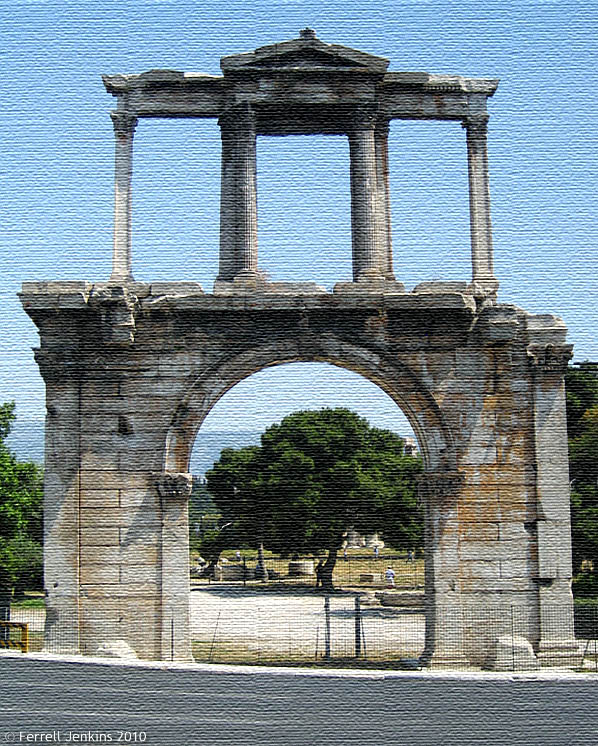
Photoshop, and some other photo editing programs, provide the opportunity to manipulate photos in unusual ways. Here is the same photo textured as if it were painted on canvas.

Arch of Hardrian on canvas. Photo by Ferrell Jenkins.

Arch of Hadrian on canvas. Photo by Ferrell Jenkins.

The fourth major persecution of the church by the Roman Empire came in the days of Hadrian.