Category Archives: Books

Monday meandering — August 1

My upgrade to BibleWorks 9 arrived about a week ago. I am enjoying getting acquainted with some of the new features and resources. For information see here.
Bible Works 9

Mark Hoffman has given a sort of pre-review at his Biblical Studies and Technology Tools website here. Hoffman was a beta tester for the new version.

Hoffman also talks about Logos for Android here. As a user of Logos (Libronix) I was delighted to see this beta app for the Android. I am enjoying access to many of the Logos books and have downloaded a couple of significant volumes.

Carl Rasmussen, author of Zondervan’s Atlas of the Bible, recently visited a well preserved portion of the Caesarea aqueduct. But it is not the portion of the aqueduct that most tourists see immediately north of Caesarea. This portion is about 3 miles north-northwest of Caesarea. Nice photos included on his HolyLandsPhoto blog here.

Carl also reports that a new paved road now goes directly to Yodfat (Jotapata). This is an improvement over the hour long walk to the site. See here. He visited Qumran, caves 1 and 11. See here.

Since I wrote the two paragraphs above there is a new post about the Middle Bronze I Age tombs (2200-2000 B.C.) located about 16 miles northeast of Jerusalem at Dhahr Mirzbaneh (east of Ein Samiya). Click here.

These three posts by Prof. Rasmussen include photos with a link to additional photos at his Holy Land Photos site.

The Center for the Study of New Testament Manuscripts (CSNTM) announces that they have added Free Audio and Video at iTunes U.

The Center for the Study of New Testament Manuscripts (CSNTM) has always been committed to helping others understand the reliability of our New Testaments, the history of translations, the study of the text, and significant figures who have made this possible.

Beginning today, CSNTM is making a series of videos concerning New Testament manuscripts, textual criticism, history of the New Testament, and expert commentary on key verses available as a free download on iTunes U.

Featured in the videos are interviews and footage shot around the world of important people involved in the work of the Center. Dr. Daniel B. Wallace will also be featured as he explains important aspects in the study of the text of the New Testament.

CSNTM homepage is here. The direct link to the series on Biblical Criticism at iTunes U is here. Inexpensive way to get a great education. Daniel Wallace does a superb job with these presentations. Take some time to listen and study.

Dr. Wallace will debate Bart D. Ehrman at SMU in Dallas Saturday October 1 on the subject Can We Trust the Text of the New Testament? There is a charge for admission, but perhaps this material will be available later on audio/video. Info here.

Pilate delivered Jesus to be crucified

About 1968 I was speaking in Lethbridge, Alberta (Canada), on Christian Evidences (or Apologetics). At the close of the lessons one of the attendees said, “I would believe, except for all of the contradictions in the Bible.” Already I had learned that “all of the contradictions” were too big for me to handle at one time. I said, “Name two.” He said, “There is no record of Pontius Pilate outside the New Testament.”

Pilate is mentioned no less than 56 times in the New Testament. Most of the references are in the Gospels (Matthew, Mark, Luke, and John). There are four references in Acts (3:13; 4:27; 13:28), and one in 1 Timothy 6:13.

I charge you in the presence of God, who gives life to all things, and of Christ Jesus, who testified the good confession before Pontius Pilate, (1 Timothy 6:13 NAU)

Except for Luke 3:1 and 13:1, the references in the Gospels are clustered in the final chapters of each book, the section dealing with the crucifixion of Jesus (Matthew 27; Mark 15; Luke 23; John 18-19).

I have no idea why one would think that having no external reference to a person named in the Bible would mean that the Bible was not true.

In fact, there are many literary references to Pilate outside the New Testament. A quick computer check shows at least 21 references to Pilate in Josephus (Antiquites and Jewish Wars).

Note this brief paragraph by Gary R. Habermas from The Historical Jesus: Ancient Evidence for the Life of Christ, page 221.

After suffering persecution (Gospel of Truth) and as a result of his teachings (Lucian), Jesus was put to death (Gospel of Thomas, Treatise on Resurrection). He died at the hands of Roman procurator Pontius Pilate (Tacitus), who crucified him (Josephus, Talmud, Lucian, Gospel of Truth, Acts of Pilate) during the reign of Emperor Tiberius (Tacitus, Phlegon).

And there is much more in Habermas’ book about Pilate, as well as in other secondary sources that point to the primary sources.

Pilate is well attested on Roman coins. Many coins were minted during the reign of Pontius Pilate as Prefect of Judea under the Roman Emperor Tiberius. Check Jean Philippi Fontanille’s Menorah Coin Project here. Scroll down to Pilate, click on one of the coin images and you will be able to spend as much time as you can afford in one day learning about the coins of Pilate. Fontanille is author of The Coins of Pontius Pilate (Marco Polo Monographs series)

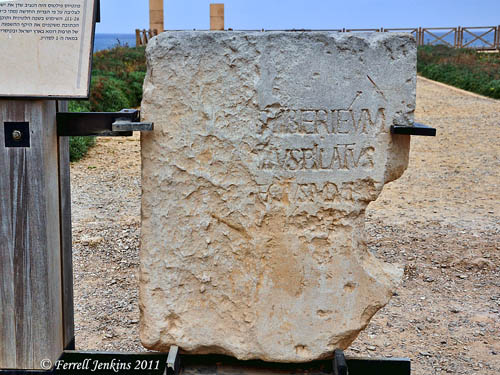
I was able to say to the skeptic in Lethbridge that an inscription bearing the name of Pilate had been found at Caesarea Maritima in 1961. The photo below shows a replica of the inscription which was found in the excavation of the Roman theater. The original is in the Israel Museum. A large copy suitable for use in teaching presentations is available by clicking on the image.

Pilate Inscription (Replica) at Caesarea Maritima. Photo by Ferrell Jenkins.

Pilate Inscription (Replica) at Caesarea Maritima. Photo by Ferrell Jenkins.

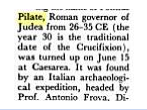
In an earlier post I mentioned that this inscription was found June 15, 1961. A reader who is doing research on Pilate asked about the specific date. As I began to look at various books dealing with archaeology, I noted that all I have looked at only mention the year 1961. In 1976 I self-published a book called The Book and the Land (now OP) primarily for use by persons joining my tours to the Bible Lands. Since that time I have thoroughly and continuously updated the material in connection with various tours. In those works, beginning in 1976, I cited The Israel Digest, a publication that I received for several years. I usually clipped the pages I was interested in and filed them. I spent several hours recently going through a multitude of folders without locating that particular page. However, I have had some success.

Israel Digest snippet mentioned Pilate Inscription.

Israel Digest, 1961.

A snippet view of a volume containing The Israel Digest for 1966 is available at Google Books here. Fortunately it contains a snippet showing the date that the Italian Expedition, headed by Prof. Antonio Frova, discovered the inscription. Click on the 1961 book and then search for Pilate. The digitized original is said to be from Indiana University.

Well, I know that most readers do not have this kind of curiosity, but I can’t avoid it. I like to know precisely where a writer or speaker got his info when he makes an unusual claim. We owe it to our readers and listeners.

Perhaps someday, if I live long enough, I will find the folder with the complete article.

Oh, and by the way, the guy in Lethbridge never mentioned the second “contradiction.”

Lead books or lead balloons?

In the past 24 hours I have received a couple of Emails about the “new” “ancient” lead codices. The best photos I have seen are in the Mail Online here. The account from Yahoo News is here. Put a few words in Yahoo or Google and you will have numerous links.

First Impressions. My first impression, based on the limited information, is that this may be another of those spectacular claims with no substance. I was busy with appointments earlier today and was delighted when I had time to check the blogs to see that Todd Bolen had written a good summary of information at the Bible Places Blog here. There is no reason for me to try to rehash this material. I urge you to take a look at Todd’s summary. He says, “Personally I am inclined to believe that this find is genuine.” My first inclination leans the other way. I know it is not much of a argument, but this report lacks the “ring of truth.” I remember that F. F. Bruce said that second thoughts are best. With more information my thoughts may change. Let’s be patient.

The Sealed Book in Revelation. There is no reason at this point to  link these lead books with the sealed book of Revelation 5-7. Revelation is an apocalyptic book of symbols. Other ancient sealed books have been found in modern times. Examples: some of the Elephantine papyri, a papyrus document from Wadi Daliyeh near Jericho had seven seals still in place (Jenkins, Studies in the Book of Revelation, 18).

Jim Davila has posted numerous notes about the lead codices at Paleojudaica over the past few weeks. Follow all of Todd Bolen’s links and you will know about as much as can be known for the moment.

The pot may be calling the kettle black

KLY Website - Dutch society for Old Testament Studies.The Dutch society for Old Testament study (OTW), after ten years of planning and work, has put online a research project to “elucidate the names of utensils in biblical Hebrew making methodical use of partially new approaches.”

The new web site, KLY, is written in the Dutch language, but there is an introduction in English. Here is a portion of it:

The problem with identifying utensils in the Hebrew Bible is that their common everyday use made it superfluous to provide detailed descriptions of the vessels or implements in written form. Everyone knew from experience what was meant. As a result dictionaries of biblical Hebrew often have to content themselves with non-descript generalizations like “bowl”, “jar”, “pot”, “knife”. Mostly the shape and purpose of a given utensil can not be established on the basis of context alone because the number of occurrences is too low. Archaeology has brought to light large quantities of pottery and implements, but in many cases we do not know which word in ancient Hebrew was used for the object unearthed.

Meanwhile the possibilities for resolving such problems have increased dramatically. Not only archaeology, but also comparative linguistics, iconography, anthropology, improved understanding of the ancient versions of the Bible have enhanced our chances to come closer to the precise nature of the objects.

Some knowledge of Hebrew will be helpful, but English-only readers will be able to go to the KLY database, click on a Hebrew letter, and see the terms considered with the English usage. From there you can move to the dictionary entry on the term. The entries are in Hebrew and English. Distribution of each term in the Torah (Law), Nebiim (Nevi’im, prophets), and Ketubim (Writings) is given.

As a future project, an English Index could make this an extremely valuable  project for many more readers.

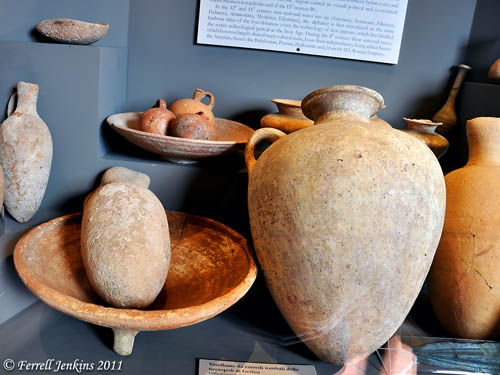
MB2 Pottery from Jericho. Vatican Museum. Photo by Ferrell Jenkins.

MB2 Pottery from Jericho. Vatican Museum. Photo by Ferrell Jenkins.

It would be possible for an energetic person to download all of the PDF entries and compile them into one document. This would make for easy searching.

If our Dutch friends and colleagues miss the English idiom used as a title for this blog, the definition is given here.

Idiom Meaning — Accusing a person of a misdemeanour whilst the accuser is guilty of the same thing.

I am using the title to suggest we may be using the wrong term for certain biblical pots and pans. The KLY Database of Utensils in the Hebrew Bible will help us not to make the mistake again.

Thanks for the help.

: J.P. van de Geissen, Aantekeningen bij de Bijbel

Bauckham on the Gospels as Histories

Last Wednesday I went to the Reformed Theological Seminary near Orlando to hear a lecture by Prof. Richard Bauckham. Bauckham was the speaker for the annual Kistemaker Academic Lecture Series. His general topic was The Gospels as Histories: What sort of history are they? I suspect that he was reading chapters that will eventually be published in a new book.

I found Bauckham, Professor Emeritus at St. Andrews University, difficult to understand during the lecture because of the his accent, but I was able to keep up with the general thread of his argument.

If you would like a little taste of Bauckham’s argument about Jesus and the Eyewitnesses I suggest you watch this short video by StJohnsNottingham (other interesting videos also available).

I was delighted to pick up a copy of Jesus and the Eyewitnesses: The Gospels as Eyewitness Testimony at the bookstore and have it autographed by Prof. Bauckham.

Richard Bauckham signs a book. Photo by Ferrell Jenkins.

Richard Bauckham autographs a book. Photo by Ferrell Jenkins.

Order Jesus and the Eyewitnesses from Amazon.
Jesus and the Eyewitnesses: The Gospels As Eyewitness Testimony

Bauckham’s material speaks clearly to the common misconception that the “Church” compiled the Gospels decades, even centuries, after Jesus lived.

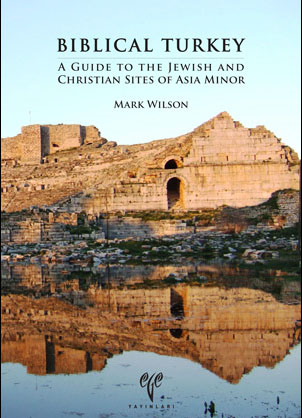
Mark Wilson’s book on Biblical Turkey

Mark Wilson’s book on Biblical Turkey: A Guide to the Jewish and Christian Sites of Asia Minor is now available through Amazon. Use this Amazon link to order.
Biblical Turkey: A Guide to Jewish and Christian Sites of Asia Minor

A little over two months ago I started a post about Wilson’s book, intending to write a brief review. I see now that A. D. Riddle has written a review over at the Bible Places Blog. I direct our readers to that post for more info about the book.

Since 2003 we have had A Guide to Biblical Studies in Greece and Turkey by Fant and Reddish. Now we have a book by Mark Wilson that is superior in several ways. Wilson includes sites not mentioned by Fant and Reddish, and his book contains an abundance of color photos. Every person who plans a trip to Turkey to visit Biblical sites should study both books.

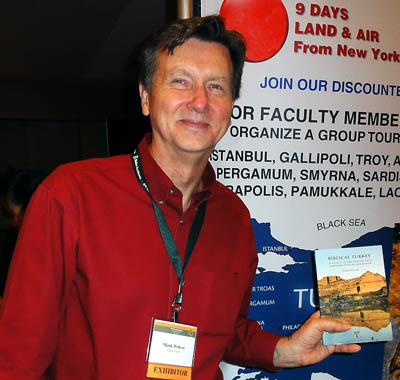
Dr. Wilson proudly displayed his book at the SBL meeting in Atlanta last November. Mark loves Turkey and its biblical sites. For several years he has spent at least half his time studying and exploring in Turkey. If you wish to know about the biblical sites of Turkey, you will enjoy this book.

Mark Wilson shows his new book at SBL in Atlanta. Photo by Ferrell Jenkins.

Mark Wilson shows his book at SBL in Atlanta. Photo by F. Jenkins.

Dr. Wilson spoke to one of my groups in Izmir in 2008. See here.

Prof. Anson F. Rainey — 1930-2011

Word comes today of the passing of Prof. Anson F. Rainey. He was Emeritus Professor of Ancient Near Eastern Cultures and Semitic Linguistics, Tel Aviv University. He taught in some of the most prestigious programs both in Israel and the United States.

One might disagree with his conclusions, but you never went away wondering about his position.

A list of his publications and teaching positions may be found at the website of the Department of Archaeology at Tel Aviv University here.

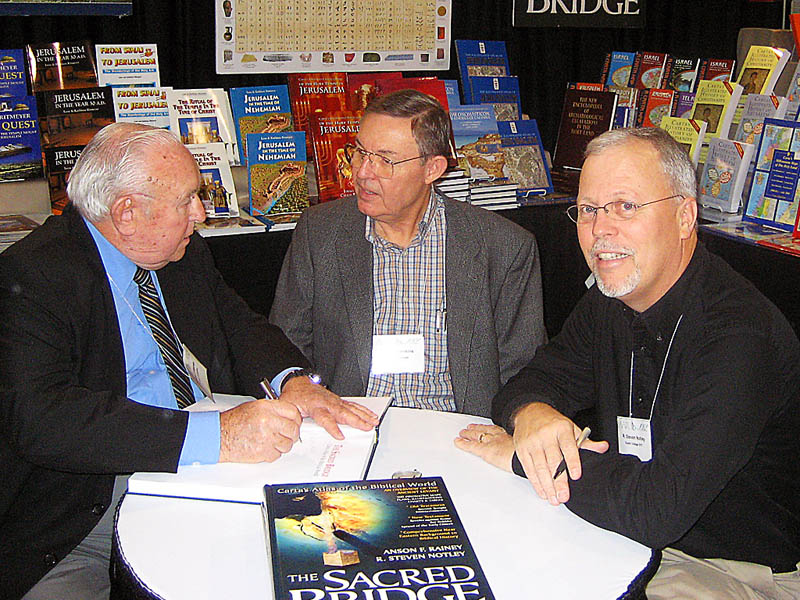
I am delighted to have an autographed copy of The Sacred Bridge. In the general category of Bible Atlases it stands in a field by itself as the most thorough and comprehensive. Todd Bolen said the book is “probably the most important work of historical geography ever written” while admitting that it is over the head of most students, and sometimes his own. See here and here.

Anson Rainey, Ferrell Jenkins, and Stephen Notley at SBL, 2006.

Anson Rainey, Ferrell Jenkins, and Stephen Notley at SBL, 2006.

HT: Joseph I. Lauer

Here and there — Tuesday 12/28/2010

Roman Soldier Photos. We have used a few photos by J. P. vd Giessen of the Roman Festival, Nijmegen, Netherlands. Jan Pieter informs me that he is  now making these photos available for everyone to view. He has a total of 480 images available here. In fact, all of the photos that have appeared on his blog are available in the Gallery. Check his Dutch language Aantekeningen bij de Bijbel blog.

Bible Reading Schedule. Mark Roberts is making his 2011 Five Day Bible Reading Schedule available free in PDF for individuals and churches who wish to use it. This program allows the reading of the entire Bible or just the New Testament during the year. Details available as the Bible Class Materials web site here. Notice the Quick Links on the right. Check the other available materials while you are there.

Other Bible Reading Plans. The ESV online site displays the ESV text, the study notes, maps, charts, and other resources. Look to the right top of the page at the word DEVOTIONS. There you will see a pull down menu with Reading Plans. There about a dozen, including a Chronological plan. Your chosen plan may be downloaded for printing. You may use one of the plans with your own version of choice.

Water in a dry and weary land

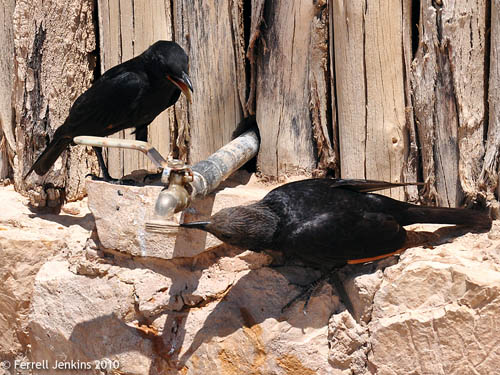
These Tristram’s Grackles, or Tristram’s Starlings, at Masada are trying to get a drop of water from one of the faucets supplying the tourists with lukewarm water during their visit to the site.

Tristram's Grackles at Madada. Photo by Ferrell Jenkins.

Tristram's Grackles at Madada. Photo by Ferrell Jenkins.

Henry B. Tristram wrote The Natural History of the Bible in 1868. In 1884 he wrote Fauna and Flora of Palestine.

A bird commonly seen at Masada, along the shore of the Dead Sea, is named for Tristram. The black bird has some distinctive orange feathers, as you can see in the bird on the right.

Psalm 63 is said to be “A Psalm of David, when he was in the wilderness of Judah.”

O God, you are my God; earnestly I seek you; my soul thirsts for you; my flesh faints for you, as in a dry and weary land where there is no water. (Psalm 63:1 ESV)

Attention: Logos users. Please read and help.

Logos Bible Lands collectionIf you use Logos software you are probably aware of pre-publication specials, and community pricing. Please read what Todd Bolen has written here about the Travel Through Bible Lands Collection. Then, help us get enough orders for community pricing to get these books at a reasonable price. I would really like to have the volumes by Tristram.