Category Archives: blog

Memorial Day 2012

Memorial Day, originally called Decoration Day, is a day of remembrance for those who have died in our nation’s service. There are many stories as to its actual beginnings, with over two dozen cities and towns laying claim to being the birthplace of Memorial Day. (Memorial Day History)

When I was a kid, growing up in the American South, the day we now call Memorial Day was called Decoration Day. Families went to the local cemeteries to clean up the grave sites of relatives and leave fresh flowers. If it was known that there were no family members left in the community, those graves also were cleaned. I don’t recall when I first began to hear, or think, that the day was intended to honor those fallen in war.

Like many holidays, the original purpose has changed. Memorial Day, Independence Day, Labor Day, Christmas, Easter, and other holidays, have become times for picnics, trips, vacations, and assorted non-related practices. Every holiday has become a time for stores to have sales.

I like the idea of Memorial Day. I am pleased to join in the remembrance of troops fallen in battle, and all of the dead who have played a significant role in my life.

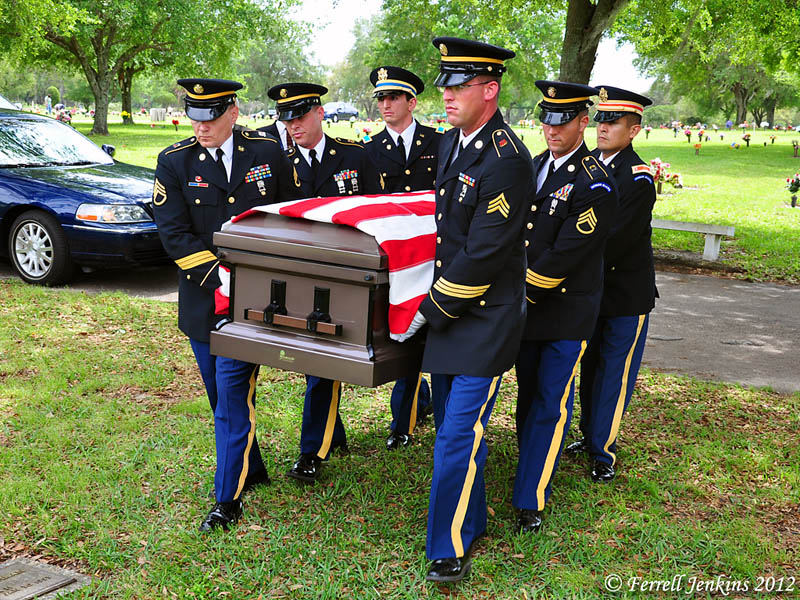
The photo below is one I made at the funeral of a long-time friend, earlier this year.

Military Honor Guard Funeral of B. R. Baker. Photo by Ferrell Jenkins.

Military Honor Guard Service for Barney Ross Baker, SSGT, U.S. Army (Retired), Tampa, Florida, March 31, 2012. Photo by Ferrell Jenkins.

The beginning comments are repeated from 2010 and 2011.

On the Black Sea coast of Turkey

We did a lot of traveling today. Drove from Patara to Antalya to make our flight. Arrived at Samsun on the Black Sea coast of Turkey (Roman Pontus).

The flight from Istanbul was delayed quite a bit. Then when we arrived in Samsun one of the bags was missing. It was my snack bag. Doesn’t sound too serious, but for a person with hypoglycemia it is a serious imposition. Bag has been located and we hope to have it tomorrow morning.

That’s it for tonight. Thanks for checking by.

P.S. several people are writing me, and apparently expecting that I am home and should answer immediately. Wish they read the blog.

From Cyprus to Pamphylia

Today we took a flight from Ercan Airport in the Turkish Republic of Cyprus to Turkey. Flying from Greece to Cyprus it was necessary to fly to Larnaca on the southern coast. Flights from Larnaca do not go to Turkey, and flights from Ercan do not go to Greece. Let’s put that aside for now.

The flight from Cyprus to Antalya (biblical Attalia) took about 45 minutes. I thought some about how Paul, Barnabas, and John Mark made their way from Paphos on Cyprus to Perga in Pamphylia (a few miles from the Antalya airport). The distance in a straight line is 185 miles. Here is Luke’s account of the journey.

Now Paul and his companions set sail from Paphos and came to Perga in Pamphylia. And John left them and returned to Jerusalem,  but they went on from Perga and came to Antioch in Pisidia.  (Act 13:13-14a ESV)

There are impressive Hellenistic and Roman ruins at Perga. Most of the Roman structures date to the second century A.D. This is where John Mark turned back from the work (Acts 13:13-14; 15:37-39). The text indicates that Perga was only a beginning point for work further north. On his return from the first journey, Paul spent some time preaching here (Acts 14:25).

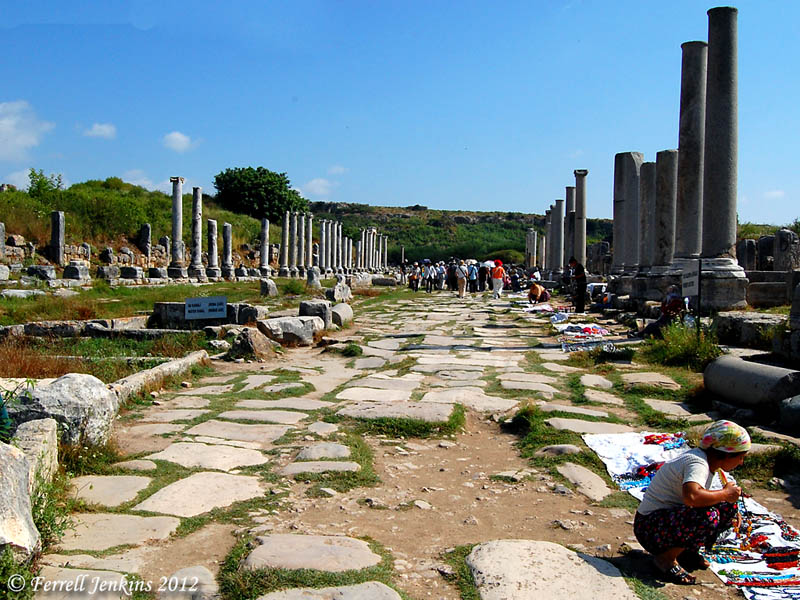
Our plans do not include revisiting sites that we have recently visited, but here is a photo of the North-South street in the Agora of Perga. The view is toward the fountain at the head of the street. A local vendor spreads out her jewelry on the ancient street.

Perga in Pamphylia. N-S street in the Agora with a view toward the fountain. Photo by Ferrell Jenkins.

N-S street in the Perga agora with view toward the fountain. Photo by Ferrell Jenkins.

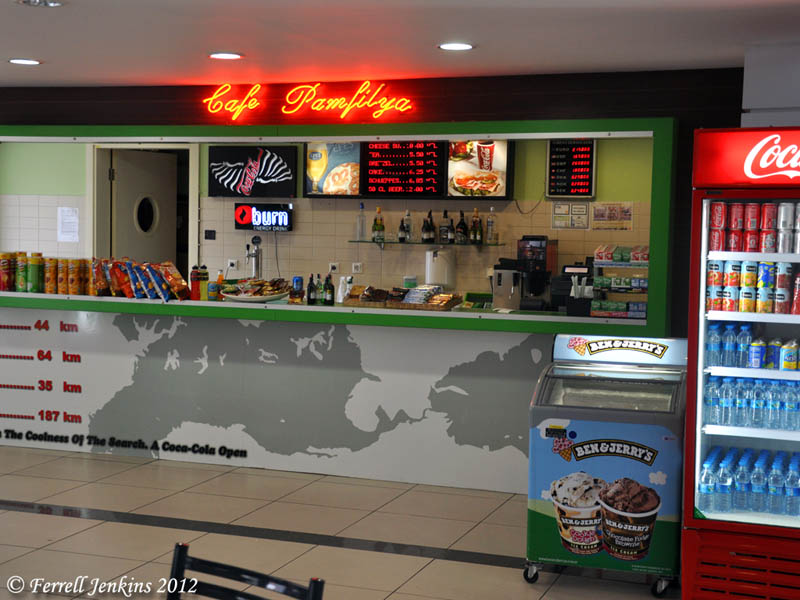
When we arrived at the Antalya International Airport I soon realized that we had come to the right place. The snack stand was named Cafe Pampilya. How appropriate.

Cafe Pamfilya in the Antalya International Airport. Photo by Ferrell Jenkins.

Cafe Pamfilya in the Antalya International Airport. Photo by Ferrell Jenkins.

Tonight we are staying on the Mediterranean Sea on the west side of Antalya (Acts 14:25). Antalya is the modern name for Attalia which served as the port of entry from Egypt and Syria to the interior of Asia. From here Paul sailed back to Antioch (Acts 14:25).

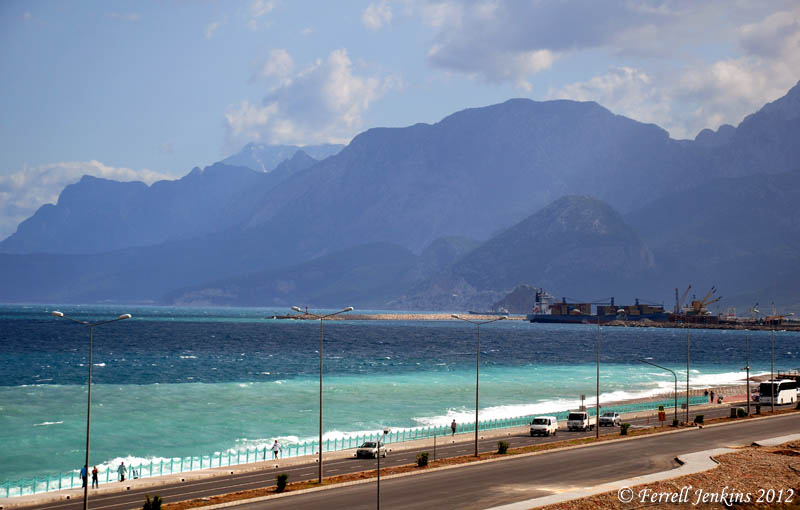
We have a nice view of the Lycian Mountains from our hotel balcony. Tomorrow we plan to drive along the coast to Myra (Acts 27:5) and other points west.

Lycian Mountains west of Antalya, Turkey. Photo by Ferrell Jenkins.

Lycian Mountains west of Antalya, Turkey. Photo by Ferrell Jenkins.

Two week ago when I was in Turkey with the group, it was about 5-7 degrees warmer than usual. Today it has rained and the wind is cool.

A post I wrote about Perga and Attalia in 2007, in the early days of this blog, may be read here.

No Joke: free and nearly free

Todd Bolen, in his Weekend Roundup at the Bible Places Blog, calls attention to a couple of books that I wanted to mention while there is still time.

The first is a free Kindle ebook — Walk the Land: A Journey on Foot Through Israel. This couple in their early 50s followed the 600-mile Israel National Trail from the border of Egypt to the border of Lebanon. It was a 42 day trek. I don’t know how long the book will be available at this price. Act quickly.

The second is one of the Fabulous Friday Specials at Christianbook.com. Through Monday evening you can get the Zondervan Atlas of the Bible, by Carl Rasmussen, for $14.99 (with typical postage and handling, I suppose).

Monday Meandering — March 19

Greatest Finds. The Israel Ministry of Foreign Affairs has compiled a list of the “Greatest archeological finds in Israel” here with links. Places include Masada, Megiddo, Beit Guvrin-Maresha, Ashkelon, the City of David, Hazor, Dan, Herodion, Khirbet Qeiyafa, and Tel es-Safi (Gath), and others.

The Scale of the Universe 2 here. Fascinating. Requires Flash. Reminds me of two Biblical references.

 When I look at your heavens, the work of your fingers, the moon and the stars, which you have set in place,  4 what is man that you are mindful of him, and the son of man that you care for him? (Psalm 8:3-4 ESV)

For by him all things were created, in heaven and on earth, visible and invisible, whether thrones or dominions or rulers or authorities– all things were created through him and for him.  And he is before all things, and in him all things hold together.  (Colossians 1:16-17 ESV)

Marine Life in the Corinthian Gulf here. Beautiful photos.

The Acrocorinth. Wonderful, clear view of the mountain above ancient Corinth here. Carl Rasmussen has posted several other nice photos of Corinth recently.

A history of the Roman Empire in 75 seconds here.

The Burnt House. The headline in the Jerusalem Post read “House in Old City as Titus left it.” Leen Ritmeyer includes this and another news article, along with his reconstruction of the Burnt House here.

Geopolitics of Israel. Every student of Bible geography will enjoy the analysis of the geopolitics of Israel by the Stratfor Global Intelligence here.

2,000-year-old Israeli date palm. Has it been trumped by a 32,000-year-old Russian flower? Tom Powers provides some links about the palm which is now about 8 feet tall, here.

HT: Aren Maeir; NT Resources Blog; Corinthian Matters; Luke Chandler’s Blog; Bible Places Blog.

Earliest evidence of a New Testament verse in stone

In two previous posts we have mentioned the so-called Tomb of Absalom in the Kidron Valley here and here. We noted that the horizontal inscription on the south side of the monument reads,

This is the tomb of Zacharias, martyr, very pious priest, father of John.

We know from Luke 1 that Zacharias was a priest and the father of John (the Baptist). Whether the monument was actually used as the tomb of Zacharias is a matter of conjecture, but the inscription does show what the common belief in the 4th century A.D. about Zacharias and John.

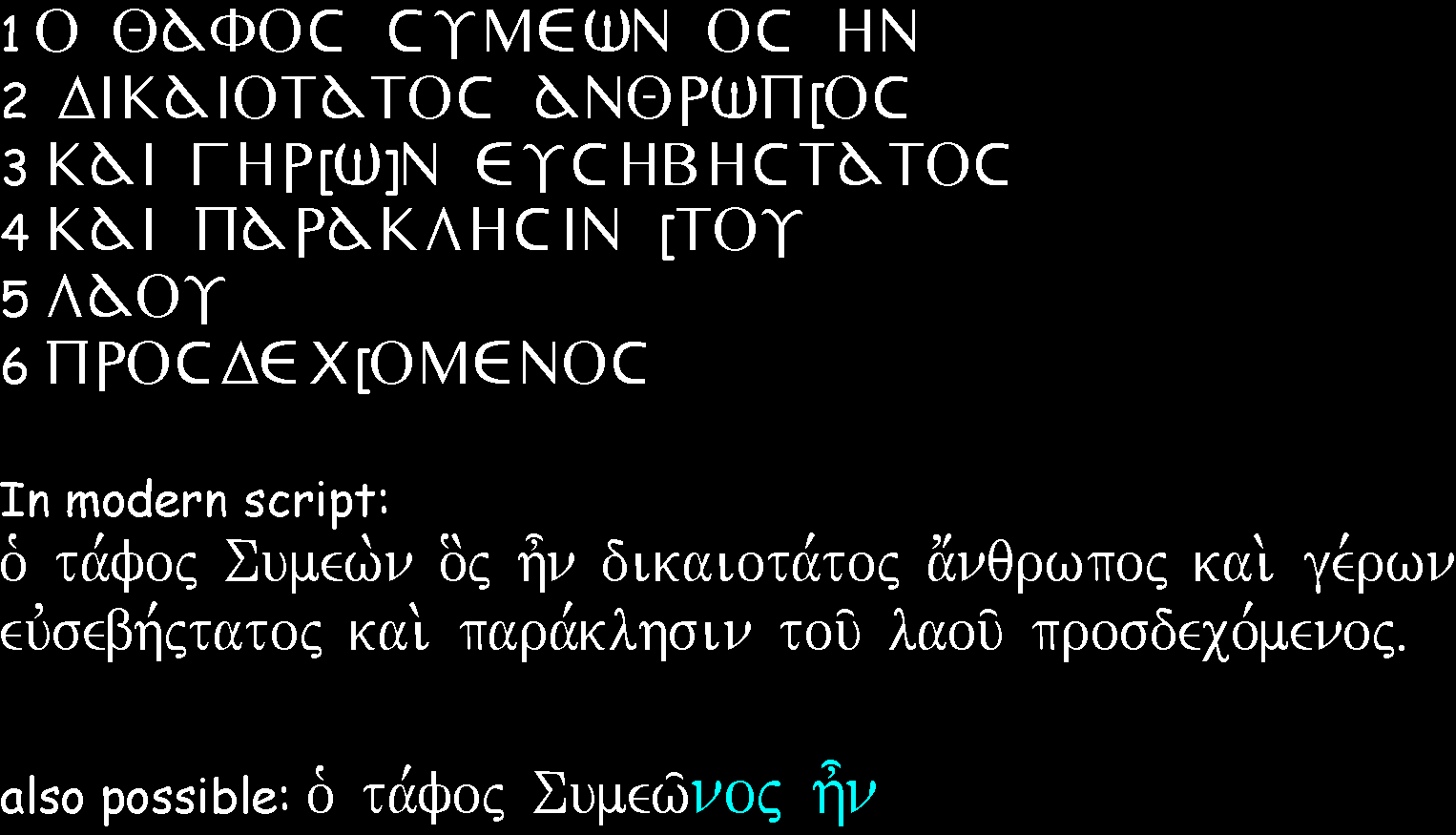
We noted that there are two inscriptions on the Absalom monument. The horizontal inscription is the one mentioned above. The vertical inscription is the one we wish to mention in this post. (In fact, there is a third inscription consisting of a cross and the words “The nephesh.”)

The long vertical inscription consists of the five lines in Greek. Puech translates them as follows,

The tomb of Simeon who was
a very just man
and a very devout el(der)
and (who was) waiting for
the consolation of
the people.

After considerable study, the scholars thought it was clear “that the scribe had engraved the main part of a verse from a gospel, Luke 2:25.” The drawing below shows the six lines of the inscription and the same in modern Greek. Click on the image for a larger, clearer one.
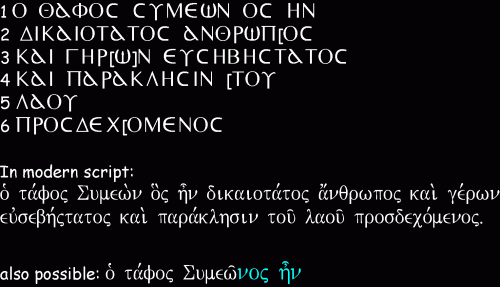
Inscription on south side of Absalom Monument.

Inscription on south side of Absalom Monument.

Luke 2:25 is part of the account of the presentation of Jesus in the Temple by Mary. Verse 25 reads,

And there was a man in Jerusalem whose name was Simeon; and this man was righteous and devout, looking for the consolation of Israel; and the Holy Spirit was upon him. (Luke:25 NAU)

The word Israel is changed in the inscription to read people.

Puech and Zias comment about the use of Luke 2:25 in the stone inscription.

So, the inscriptions on the tomb bear witness to the written traditions from the Byzantine period as well as those of the early church fathers. Moreover, the inscription from the Gospel of Luke is identical to that found in the Codex Sinaiticus, dated to the second quarter of the fourth century, prior to a correction according to the text of the Codex Vaticanus (εὐσεβὴς prima manu instead of εὐλαβὴς) around the middle of the sixth century, thus showing that the local Palestinian text was widely accepted as authoritative by the early church of Palestine….

Thus this inscription is the earliest evidence for a New Testament verse engraved in stone, and it fits Palestinian tradition (Puech and Zias 2004: 572).

Most of my information comes from Near Eastern Archaeology, Dec. 2005.

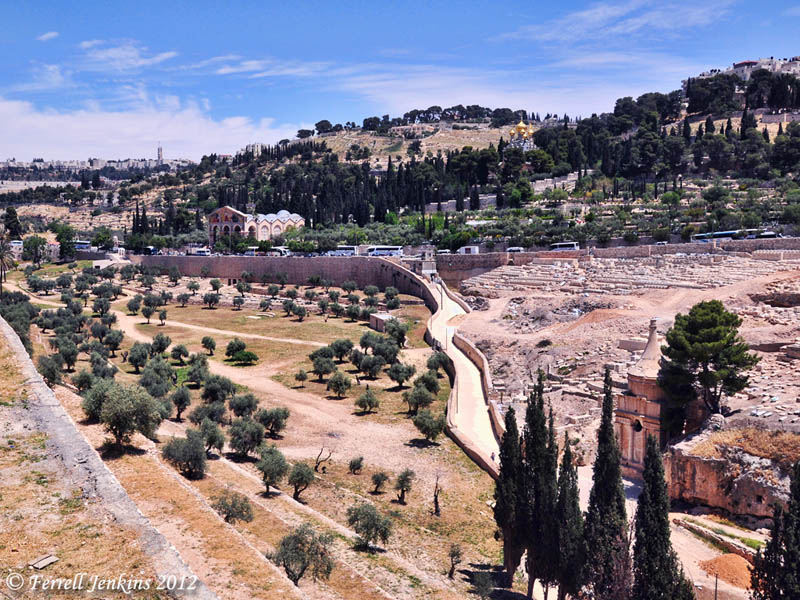
The photo below shows the Kidron Valley. The Mount of Olives is visible in the upper right of the photo. The tomb of Absalom is visible in the lower right. The view is to the northeast. The low hill with buildings in the distant left is Mount Scopus.
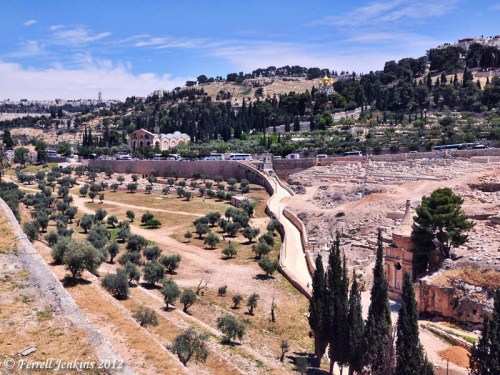
View of Kidron Valley from SE corner of Temple Mount. Photo by Ferrell Jenkins.

View of Kidron Valley from SE corner of Temple Mount. Photo by Ferrell Jenkins.

One never knows where the next significant discovery will be made.

The New Leaf (for a New Year)

There have been several searches of this blog in recent days looking for the poem below. I think it is worth bringing it forward from January 4, 2009.

The New Leaf

He came to my desk with quivering lip –
The lesson was done.
“Dear Teacher. I want a new leaf he said,
“I have spoiled this one.”
I took the old leaf, stained and blotted
And gave him a new one, all unspotted,
And into his sad eyes smiled;
“Do better now, my child!”

I went to the Throne with a quivering soul –
The old year was gone.
“Dear Father, hast Thou a new leaf for me?”
“I have spoiled this one.”
He took the old leaf, stained and blotted
And into my sad heart smiled:
“Do better now, my child!”

This poem has been among my sermon notes for many years. It is one of those numerous good illustrations that have come down to us from Anonymous or Author Unknown.

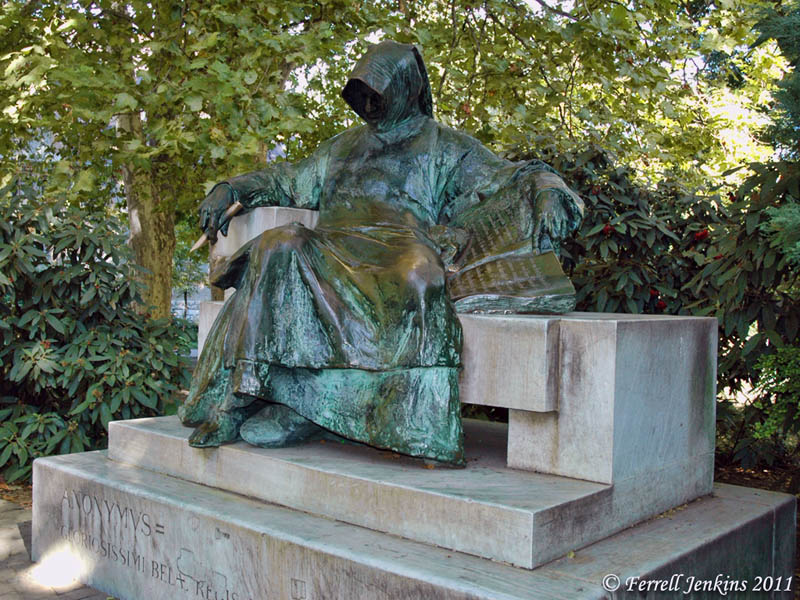
In Budapest, Hungary, near the entrance of Vajdahunyad Castle, there stands a statue of Anonymous by Miklos Legeti. The statue commemorates a 12th or 13th century unknown chronicler of one of the several rulers named King Bela.

Statue of Anonymous in Budapest. Photo by Ferrell Jenkins.

Statue of Anonymous in Budapest. Photo by Ferrell Jenkins.

Note. Don’t use this as an excuse for using other people’s material without attribution.

2011 in review — according to WordPress

The WordPress.com stats helper monkeys prepared a 2011 annual report for this blog.

Here’s an excerpt:

London Olympic Stadium holds 80,000 people. This blog was viewed about 270,000 times in 2011. If it were competing at London Olympic Stadium, it would take about 3 sold-out events for that many people to see it.

Click here to see the complete report.

Personal Note: Thanks to the readers who keep me going. You are literally scattered all over the earth. Your interest is appreciated. We are thankful for anyone who has been instructed or encouraged.

Please forgive our failure to answer all of the requests for info and photos. We do as many as we can, but to borrow from and paraphrase Jesus, “Sufficient unto the day are the Emails thereof.”

Was Jesus born in winter?

One of my readers left a comment on facebook saying the Bible indicates that Jesus was “born in winter.” She added, “That could be anytime between mid-October and mid-March.” Another reader said, ” I didn’t know the Bible said he was born in winter — I know shepherds were grazing their sheep when he was born…does this happen in winter in that part of the world?”

I am not aware of any suggestion in the Bible regarding the time of the year when Jesus was born. Luke tells us that shepherds were out in the field at the time.

And in the same region there were shepherds out in the field, keeping watch over their flock by night. (Luke 2:8 ESV)

Some writers have suggested that the birth was not likely in December. They say that shepherds did not watch flocks by night during December. In my outline study about Christmas, available here, I have a quotation by the late Dr. William Arndt, (of Bauer, Danker, Arndt, Gingrich fame) replying to this suggestion:

“Scholars have pointed out that the considerably lower altitude of the field may not be without significance, but may explain why even in winter shepherds would not find these fields too cold for their flocks.”  (From the Nile to the Waters of Damascus, p. 52)

In fact, when I first began traveling to Israel and Jordan in the mid-60s it was common for Bedouin shepherds to move with the seasons. In the summer we would see them in the mountains of Lebanon. In winter months they would move to warmer, desert areas. Today, we find many Bedouin shepherds watching their sheep on the eastern slopes year round, including the winter months.

The temperature around Jerusalem and Bethlehem is fairly temperate in the winter. Only a small amount of rain falls on the eastern slopes of the central mountain range. Both Jerusalem and Bethlehem are located on this ridge. We have written about the watershed ridge here and here.

The average monthly temperature for Jerusalem ranges from 47° to 56°. Rain can make it chilly.

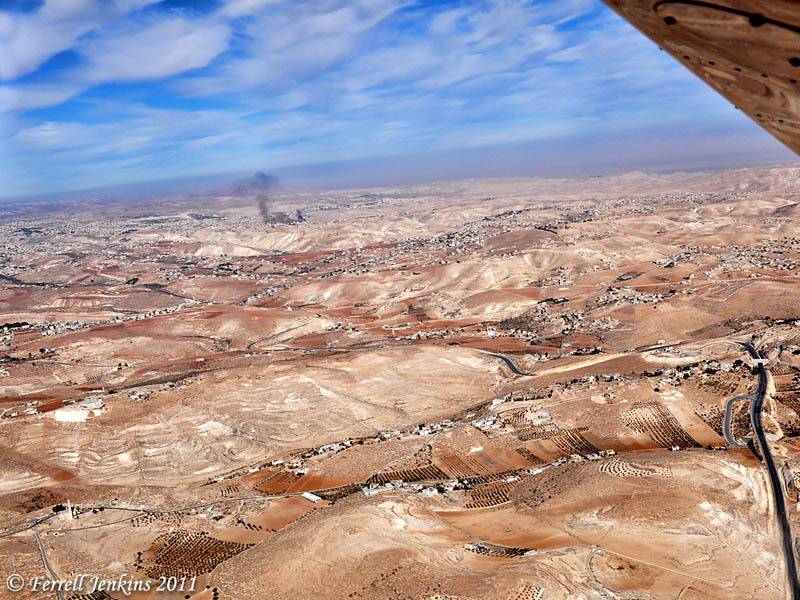
The photo below provides an aerial view from over the Herodium (about 3 miles east of Bethlehem). This illustrates the terrain where shepherds might care for their flocks.

View east toward the Dead Sea and the the land of Moab in Jordan from over the Herodium. Photo by Ferrell Jenkins.

View east toward the Dead Sea and the the land of Moab in Jordan from over the Herodium. Photo by Ferrell Jenkins.

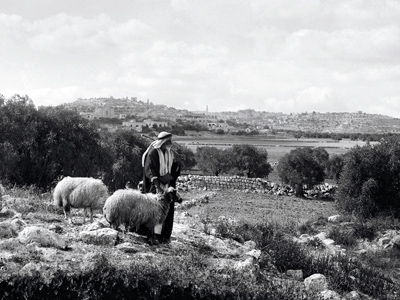
The American Colony and Eric Matson Collection of photos includes some photos of shepherds with their flocks in the Bethlehem area on Christmas day. (Information about the collection is available at LifeintheHolyLand.com.) The photo below was made sometime between 1898 and 1946. It was taken either by the American Colony Photo Department or its successor, the Matson Photo Service.

Shepherds with sheep on Christmas day. Bethlehem on the ridge. Photo: LifeintheHolyLand.com.

Shepherds with sheep on Christmas day. Bethlehem is on the ridge. Photo: LifeintheHolyLand.com.

I am not saying that Jesus was born in December. Only that the common misunderstanding about Bethlehem winters is based on our lack of knowledge about the local terrain.

Dead Sea Scrolls exhibition in Times Square, New York

Are you traveling to New York in the next few months? The Dead Sea Scrolls: Life and Faith in Biblical Times exhibition at the Discovery Times Square building in New York City is worth a visit.

Gordon Franz, a Bible teacher and archaeologist, has written about the exhibition on his Life and Land blog here. Gordon is known to the regular readers of this blog. We have called attention to several of his articles, especially those about “cracked pot archaeology.”

In addition to giving the details about the exhibition and how to get a $5 discount on your ticket, Franz tells you how to access his 39-page guide which he has written specifically from a Christian perspective. Actually, it should be helpful for any serious student of the Bible.

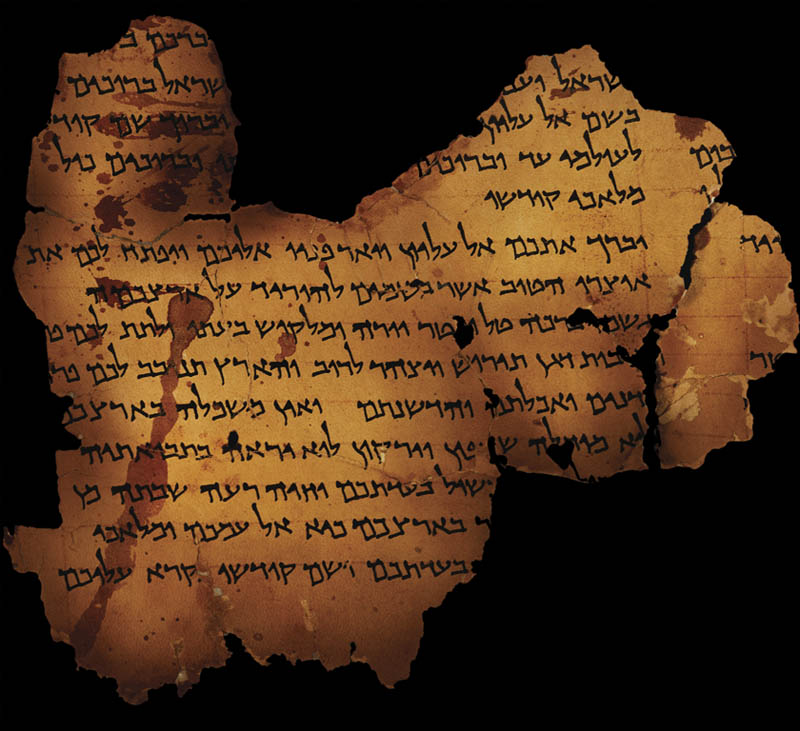
War Scroll displayed at the Discovery Times Square in New York City.

War Scroll displayed at the Discovery Times Square in New York City.

This exhibition is much more than a few fragments of the Dead Sea Scrolls. Artifacts, ossuaries, pottery, lamps, seals, and a stone from the wall build around the Temple Mount are included among the 500 items on display. The exhibition is on loan from the Israel Antiquities Authority. The exhibition runs until April 15, 2012. After that it moves to Philadelphia’s Franklin Institute for a few months beginning in May.

Dead Sea Scrolls - Life and Faith in Biblical Times display

Dead Sea Scrolls - Life and Faith in Biblical Times display.

If you have the opportunity to visit this exhibition, you should read Gordon’s guide written from a Christian perspective. His guide will be helpful to anyone interested in Bible life and times, even if you don’t get to visit the exhibition. The link to the guide is located at his Life and Land website here.

Thanks to Gordon Franz for giving me a heads-up on his guide.