Category Archives: blog

Reading the Blogs

Charles Savelle (Bible X) tells about his enjoyable afternoon at Southwestern Baptist Theological Seminary to visit the Dead Sea Scrolls and the Bible Exhibit (Fort Worth).  He describes the entire visit, step by step, including a list of “the scroll fragments and other manuscripts and Bibles” including a list of the Biblical verses included in the scroll fragments. A Qumran simulated dig is part of the exhibit. Charles includes a a hi-res photo of himself standing in a nice replica of a mikvah (ritual bath) at Qumran. Read the complete report here. The exhibit runs through January 13, 2013.

I enjoyed lunch with Charles one day at the recent ETS annual meeting. I find his Bible X blog helpful.

Luke Chandler reports here that a different Dead Sea Scrolls Exhibit is now open at the Cincinnati Museum Center. This exhibit includes about “600 biblically-related artifacts on loan from the Israel[i] Antiquities Authority.” Read more here. This exhibit which runs through April, 2013, has already been in New York and Philadelphia. Check our link to the New York exhibition here. The 39 page guide to the exhibit by Gordon Franz is still available.

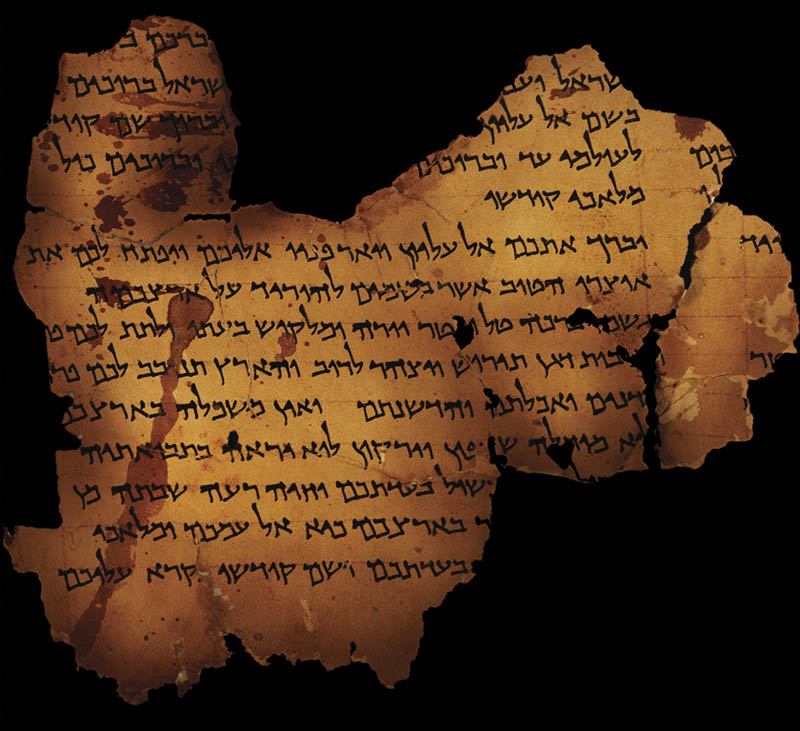
The War Scroll displayed at the Cincinnati Museum.

The War Scroll displayed at the Cincinnati Museum Center.

Luke also comments on a recent comment by Dr. William Dever regarding the lack of evidence for the “Low Chronologyhere.

It was only yesterday that I came caught up with a post by Seth Rodriquez (Wild Olive Shoot)  written the day after the U.S. presidential election. He has some important words for those who may have been disappointed in the outcome of the election. See here.

Acts 17 — Photo Illustrations

Paul came to Thessalonica on his second journey (A.D. 50-53; Acts 17).

Now when they had passed through Amphipolis and Apollonia, they came to Thessalonica, where there was a synagogue of the Jews. (Acts 17:1 ESV)

Thessalonica (called Thessaloniki now) is in biblical Macedonia. The area is still known as Macedonia, but is not to be confused with the modern country by that name. It is marked on maps of Greece as FYROM (former Yugoslav Republic of Macedonia). I know too little about the dispute to make any comments.

Paul wrote two letters to the church at Thessalonica while he was at Corinth. Aristarchus, a Macedonian of Thessalonica accompanied Paul on the voyage to Rome (Acts 27:2). When Demas forsook Paul he went to Thessalonica (2 Timothy 4:10).

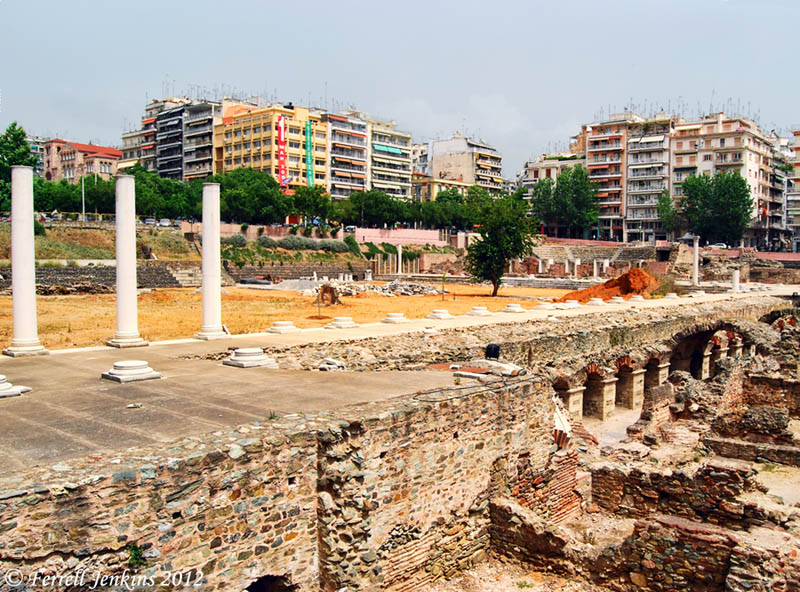
The photo below shows excavated ruins of the 2nd-3rd century A.D. Roman Forum in the center of the modern city of Thessalonica. Fant and Reddish comment on the Forum:

Extensive, ongoing excavations are being conducted in this area. Likely the same site was the location for the Hellenistic agora as well. The forum originally covered two extensive terraces. The forum originally covered two extensive terraces. The one to the north contained a large courtyard surrounded on four sides by two-story stoas; to the rear of the stoa on the east side stood the odeion, originally a theater for music and performances, later converted into an arena for gladiatorial contests. (A Guide to Biblical Sites in Greece and Turkey, 137).

Roman forum in the center of Thessalonica. Photo by Ferrell Jenkins.

Roman Forum in the center of Thessalonica. Photo by Ferrell Jenkins.

I think if you click on the photo to enlarge it, you will see the odeion to the right of the image.

There are several posts about Thessalonica on this blog. Just put the word Thessalonica in the Search Box. You will also find posts about Amphipolis, Berea, and Athens.

Camels figure prominently in the life of Isaac

When Abraham’s servant went from Canaan to far-away Mesopotamia to arrange a bride for Isaac, he took ten camels with him. These camels figure prominently in the account in Genesis 24.

Then the servant took ten of his master’s camels and departed with all kinds of gifts from his master at his disposal. He journeyed to the region of Aram Naharaim and the city of Nahor. (Genesis 24:10 NET)

The Hebrew Aram Naharaim of the text is often translated Mesopotamia in English versions.

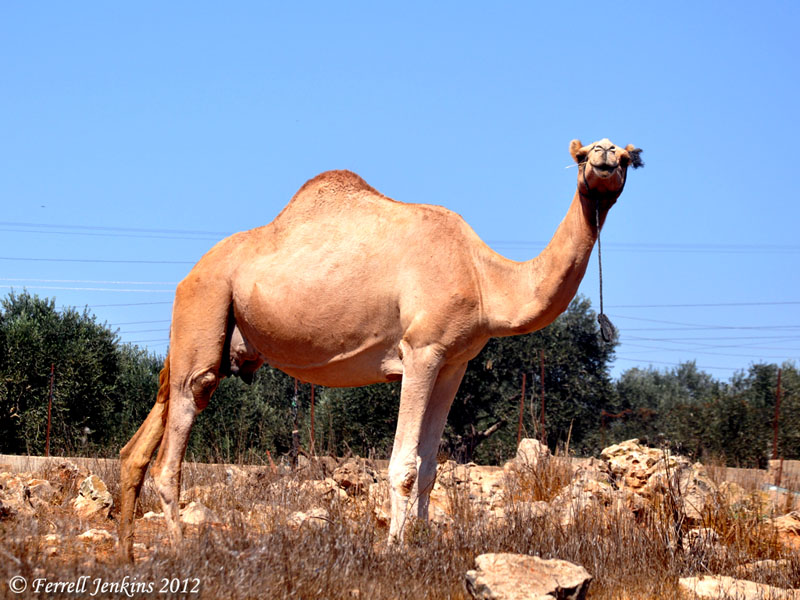
Yesterday I saw a nursing camel with her big “baby” as we drove north from Jerusalem toward Shiloh. This was a little east of the main north-south highway. I took the photo to share with my grandson, but I thought I would share it with you also.

A camel in the West Bank near the edge of the wilderness. Photo by Ferrell Jenkins.

A camel in the West Bank near the edge of the wilderness. Photo by Ferrell Jenkins.

Today we traveled south from Jerusalem past Bethlehem, Hebron, and into the Negev. We went west to the site of Gerar and Wadi Gerar. Later I will try to prepare some of the photos from these regions for the blog.

Traveling in Israel

This afternoon we arrived in Israel. My first tour was in 1967, a few weeks before the Six-Day War when Jerusalem was in Jordan. The traditional site of the baptism of Jesus by John the Baptist was easily accessible.  That changed after the War, and we had no access to the River until Jordan opened a site thought to be the location of Bethany Beyond the Jordan (John 1:28). By 2006 we were able to visit the site.

Last year (2011) Israel opened access to the river, by special permission, on the west side. I understand the site is now open to anyone who wishes to visit.

Then Jesus came from Galilee to the Jordan to John, to be baptized by him.  John would have prevented him, saying, “I need to be baptized by you, and do you come to me?”  But Jesus answered him, “Let it be so now, for thus it is fitting for us to fulfill all righteousness.” Then he consented.  And when Jesus was baptized, immediately he went up from the water, and behold, the heavens were opened to him, and he saw the Spirit of God descending like a dove and coming to rest on him;  and behold, a voice from heaven said, “This is my beloved Son, with whom I am well pleased.” (Matthew 3:13-17 ESV)

The River Jordan at the Israel-Jordan border north of the Dead Sea. Photo by Ferrell Jenkins.

Jordan River at the traditional site of the baptism of Jesus. Photo by Ferrell Jenkins.

This will be my eightieth foreign tour to direct in these past 46 years. Not all of these have been to Israel, but I’ve led tours to the land so central in the Biblical story almost annually except for those years when political conditions made it impossible. Occasionally there was a second tour the same year. I have made numerous personal study trips in addition to the tours I lead. I’m still learning, and still making efforts to see places I have not yet visited. Last year I spent about six weeks in the country.

Through this blog I have tried to share a little bit of information and a few of the photos I have accumulated. Over the next two or three weeks I hope to share a bit of the excitement of this tour.

Tell your friends about the blog.

At least three blogs are being written about the tour. You might enjoy them, especially if you know someone traveling with us.

Steven Braman — Braman’s Wanderings
http://bramanswanderings.wordpress.com

Barry Britnell — Exploring Bible Lands
http://exploringbiblelands.com

Trent and Rebekah Dutton
http://www.trentandrebekah.com

Our flight from New York was delayed due to bad weather in New York and connecting cities. We were too late to visit Joppa today. Trent and Rebekah Dutton arrived in Israel yesterday. I see they have already posted some information about Joppa.

Tonight all 39 tour members are settled on the Mediterranean coast at Netanya, Israel. Looking forward to a great day of learning tomorrow.

Kinneret Bot

https://si0.twimg.com/profile_images/283752039/kinneret_reasonably_small.jpgWhile doing some searching for information I came across an interesting account on Twitter. Kinneret Bot is a computer that tweets “the water level of Lake Kinneret/the Sea of Galilee, Israel.” You can get to KB here.

Thursday the water level was 211.67m below sea level. For most Americans that is 694.46 feet below sea level. We reported the level of the lake November, 2010, at 701.71 ft. below sea level. This shows considerable improvement, but it is nearly three months before much rain can be expected.

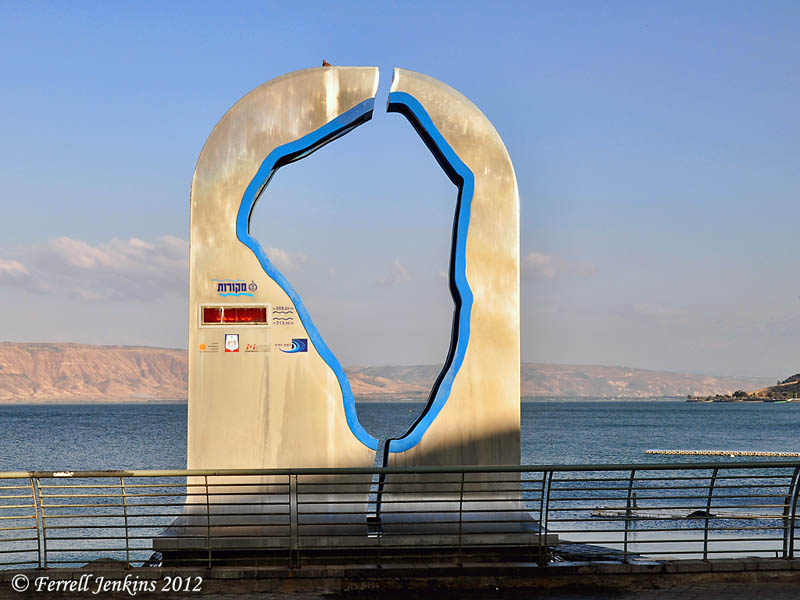
I enjoy visiting the pier at Tiberias on the Sea of Galilee. The gauge that measures the level of the Sea is a nice attraction. The view that we captured in this photos shows the southeastern shore of the Sea.

Gauge on the pier at Tiberias showing level of Sea of Galilee. Photo by Ferrell Jenkins.

Gauge on the pier at Tiberias showing level of Sea of Galilee. Photo by Ferrell Jenkins.

The Sea of Galilee is also called the Sea of Tiberias by the Gospel of John.

After these things Jesus went away to the other side of the Sea of Galilee (or Tiberias). (John 6:1 NAU)

After these things Jesus manifested Himself again to the disciples at the Sea of Tiberias, and He manifested Himself in this way. (John 21:1 NAU)

Update: Sorry that the link to Kinneret Bot was incorrect. Refresh your browser and check again. Thanks JG.

Another Giveaway by Bible Places Blog

Bible Places Blog is giving away a 6-DVD set featuring 36 half-hour lectures by Dr. Jodi Magness on The Holy Land Revealed. You have two (maybe three) chances to win. Be warned. I have entered this time!

Click here for details.

Header: The view from Adullam

The header we have chosen to use today shows a view of the Judean shephelah south from Adullam. The photo is a panorama of three images.

The cave of Adullam is associated with David. When he left Gath he went to Adullam before sending his parents to Moab for safety.

So David left there and escaped to the cave of Adullam. When his brothers and the rest of his father’s family learned about it, they went down there to him. (1 Samuel 22:1 NET)

In fact, David spent much time at Adullam. I suggest you read the entire account in 2 Samuel 23:13ff.

For more information on Adullam, and a photo of the cave associated with David, click here.

Some thoughts on Father’s Day 2012

About three years ago I wrote a personal post on the occasion of the 30th anniversary of my father’s death. I wanted to share this with new readers who might find it interesting and encouraging.

B. M. JenkinsIt took me about six months to get over being downcast after his death. It wasn’t that I did not not have hope. There were two major factors. (1) It was just the sense of loss that I felt. I could recall our time together, but we would no longer be able to talk and discuss matters of common interest. (2) I began to think of my life. If I lived only to the age of 65 what would I do with these few remaining years? Even though I have passed 65 by several years, I still think about this question.

My father was an intelligent man, but not a formally educated man. He finished the eighth or ninth grade, but he knew how to work and make sound financial decisions for his family. My father spent my earliest years living on the farm where my grandfather was a share-cropper. It was hard on farms in those post-depression years. My father was a good mechanic and carpenter. In 1943 he drove about 60 miles each week from Harvest, Alabama, to Tullahoma, Tennessee. There was some type of building project in progress. After his death I found a receipt showing that he had earned about $13 for the week. From that he paid his gas expenses, stayed in a boarding house for four nights, and paid 13 cents in Old-Age Benefits. This program, now called Social Security, was set up by the Federal government in 1937 to provide retirement benefits. He evidently had enough left to provide whatever store-bought food, and other things, our family needed.

My paternal grandfather was named Joseph Frank. My grandmother was named Mary Magdalene. They had 12 children, and each of them was given a Bible name. My father’s name was Bartholomew (Matthew 10:3). He had no middle name, so he just made up the middle initial when he needed a middle name. His friends called him B.M., or Barley, or Bolly. And, yes, he had brothers named Philip, Thomas, James, Matthew, and John. He had sisters named Ruth, Mary Magdalene, Eunice, Naomi, and Elizabeth. One sibling died young. Only three [two] are still living. My grandfather heard my second sermon. (It was the same as my first one.)

Most of the members of this family had a spirit of independence and entrepreneurship. Several of them ran small businesses and none of them ever got involved with “big business.”

My Father set a good spiritual example for his family. Sometime when I was between six and ten we walked about two miles on a country road to meet with other Christians to worship. One Sunday morning some family members drove up about the time we were to leave for church. They had come from across the county to see us. My Dad invited them to go to church with us. When they demurred, he told them to make themselves at home until we got back. The next time they came in the afternoon.

Dad served for a short time as an elder in a local church, but when the others began to advocate practices he thought were wrong, he resigned and began to worship with brethren who thought as he did.

Perhaps I should somehow relate this post to travel. I was able to take my mother to the Bible lands twice after my Father’s death. About the time I told them that I was going a third time [more than 40 years ago], my Dad said, “Don’t you think you have been enough?” I wish he could have gone with me.

He taught me a lot. I think of him almost daily.

As a father shows compassion to his children, so the LORD shows compassion to those who fear him.   For he knows our frame; he remembers that we are dust. (Psalm 103:13-14 ESV)

Did Paul’s ship dock at Perga or Attalia?

My friend and former student Darryl Smelser left a good comment regarding Perga for a post here. I thought I would elevate it to an entire post.

You point out that “Paul, Barnabas, and John Mark made their way from Paphos on Cyprus to Perga in Pamphylia,” which of course is correct. But as Perga is a bit inland from the sea, and Attalia was/is a port, I have pretty much assumed that as they traveled from Cyprus, the three men arrived *first at Attalia* and then went to Perga, and so toward Galatia. Why would not Luke have mentioned Attalia? I suppose the omission is due to the fact that in this part of the journey neither Attalia nor Perga were important to be mentioned, except for the fact that it was in Perga that John Mark turned back; thus it wins a mention. Does that seem to be sound reasoning to you? Would any ship delivering goods to Perga have ported at Attalia, or was there a closer port?

I think we can give no absolute answer to this question. Here is what I know about it.

Look at a good modern atlas of Turkey (Köy Köy Türkiye Yol Atlasi), and you will see the Aksu Cay (the ancient Cestrus River) about 3 miles east of Perga. Attalia (modern Antalya) is farther to the west.

Mark Wilson says,

Strabo (14.6.2) states that the Cestrus was navigable at this time and a road apparently linked the river with Perga. The city was 6 mi/10 km from the Mediterranean and linked to the coast via a road to its port at Magydus (Lara). (Biblical Turkey, 99).

Wilson continues in a sentence that seems to have a typo,

Perga was the port of entry Mark in Asia Minor for Paul, Barnabas, and John on their first journey (Acts 13:13). (100).

My first suggestion is that the word Mark somehow got moved from after John, to the line above. If so, then the sentence should be read as follows:

Perga was the port of entry in Asia Minor for Paul, Barnabas, and John Mark on their first journey (Acts 13:13).

Fant and Reddish say,

In ancient times Perga apparently had a port on the river, which was navigable, thus allowing the city to benefit commercially from the river. (Biblical Sites in Greece and Turkey, 265).

The Dictionary of the Apostolic Church (J. Hastings) recently became available through Logos community pricing. James Strahan says,

Paul and Barnabas were twice at Perga in their first missionary tour. In their outward journey they landed at the river-harbour and went up to the city (Ac 13:13).

The Roman Gate at Perga in Pamphylia. Photo by Ferrell Jenkins.

The Roman Gate at Perga in Pamphylia. Photo by Ferrell Jenkins.

Another Milestone — One Million Hits

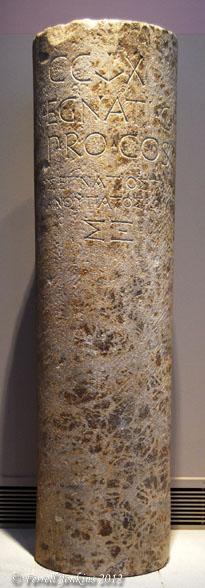
Milestone from the Via Egnatian. Thessalonica Museum. Photo by Ferrell Jenkins.

Milestone from the Via Egnatian displayed in the Thessaloniki Museum. Photo by Ferrell Jenkins.

A few minutes ago the counter on this blog indicated that we have reached one million hits since beginning the blog about five years ago.

This is not much compared to many secular web sites, or even some biblioblogs, but I am pleased with the results over these years.

Ferrell’s Travel Blog was begun to keep friends and family of our tour members informed about the progress of a tour in 2007. Had I realized it was to become a regular part of my life, averaging more than 1100 hits a day, I would have named it differently. But I didn’t, and here we are.

Thanks for following the blog. I am especially pleased when Bible class teachers write to tell me they are using the material in their Bible classes.

I have enjoyed the contact with some well-informed people who have taken time to communicate with me regarding the subjects I write about. Thanks to all who have taken the time to leave a comment on the blog, in person, by Facebook, or by Email.

We celebrated becoming half a millionaire November 21, 2010, here.

Some days I think of discontinuing the blog; other days I don’t.

The photo of the milestone from the Via Egnatian, a Roman road used by the Apostle Paul, seems appropriate today.