Category Archives: blog

Subscribe to the BiblePlaces Newsletter

Perhaps many of our readers already follow Todd Bolen’s BiblePlaces Blog and receive his BiblePlaces Newsletter. But there may be a few who do not receive the Newsletter.

The most recent BiblePlaces Newsletter was distributed Tuesday. It includes some featured BiblePlaces Photos under the title “Never Been There Before!” One would think that Dr. Bolen, who lived and taught ten years or more in Israel, and visited the country other times, would have already visited all of the places where Bible events took place. It doesn’t work that way. In the current BiblePlaces Newsletter he takes us to some places he had never been to…

  • Kerioth, possible hometown of Judas Iscariot
  • …see a Canaanite Wall in Hebron
  • the location of the Praetorium entrance in Jerusalem
  • Ramah, the hometown of the prophet Samuel
  • the tomb of Joseph
  • the Wadi Farah

After fifty years of traveling to Israel half of these are now on my bucket list. With each Newsletter you receive free high resolution photos and a free PowerPoint presentation.

Not on the list to receive the Newsletter, and missed this valuable one? Todd has given me permission to share the link to this Newsletter. Click here. At the bottom of the page you will have an opportunity to sign up to receive it whenever it is published (usually several times a year).

I don’t recall when I first began to use the Pictorial Library of Biblical Lands (PLBL), but I do recall the first time I met Todd Bolen. It was in Jerusalem in 2005. Leon Mauldin and I had made our way from the City of David to Gihon Spring. Todd and his students from the Master’s College IBEX program in Israel were helping clean out some of the area and working on the pottery. We had made prior arrangement to meet. It was about lunch time so Todd took his students on a tour of the area known as the tombs of the kings, down to the place where the Kidron and Hinnom valleys join, and to the site of En Rogel. He invited us to go along and visit as we walked.
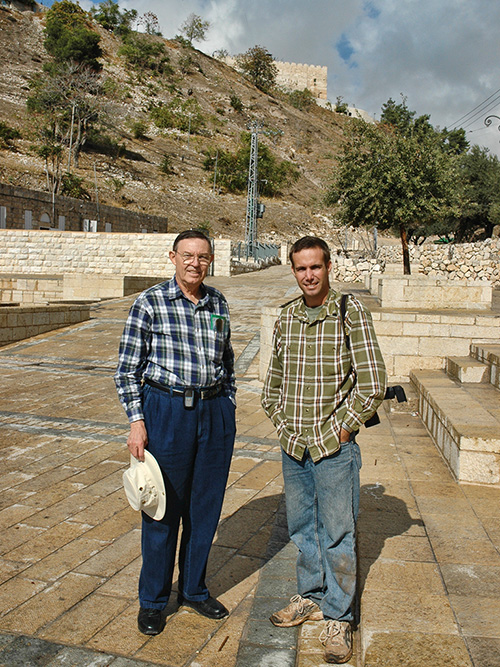
Ferrell Jenkins and Todd Bolen at the plaza in front of Gihon Spring. The "Pinnacle" of the Tempe (the south east corner) may be seen in the distance.

Ferrell Jenkins and Todd Bolen at the plaza in front of Gihon Spring. The “Pinnacle” of the Tempe (the south east corner) may be seen in the distance. Photo by Leon Mauldin.

Leon snapped this photo of us. I see that Todd has aged a bit since then. We have had several occasions for short visits since that time, and I am delighted to say that BiblePlaces licenses my photos for publication.

If you teach the Bible you need the PLBL. You may buy the entire set, or begin with a few volumes covering areas you are now teaching. For complete information visit BiblePlaces.com.
Some repair photos at the Holy Sepulcher

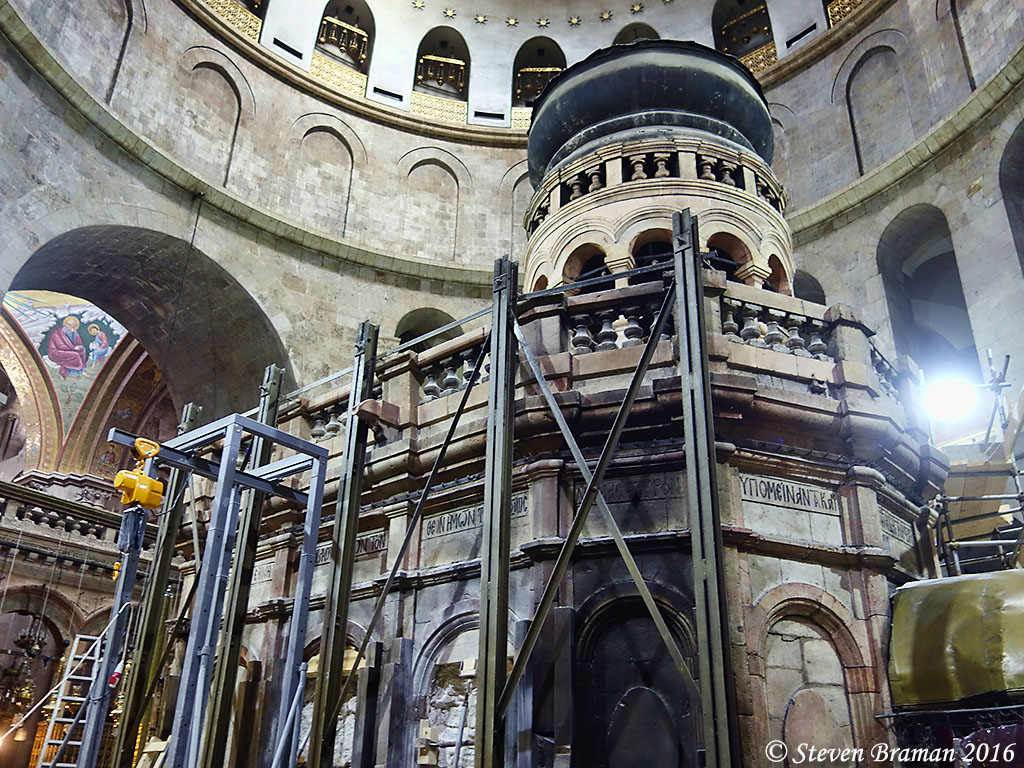
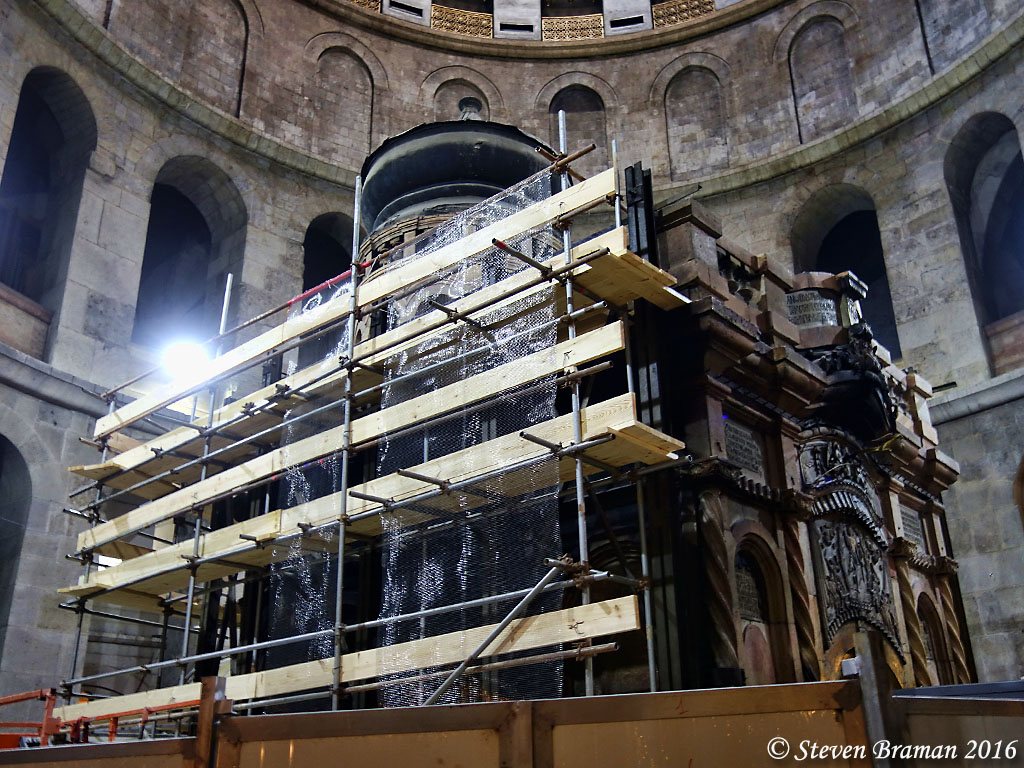
In the last post we mentioned the long-needed repair of the shrine (edicule) in the Holy Sepulcher, the traditional site of the tomb in which Jesus was placed after the crucifixion.

One of my traveling friends, Steven Braman, just returned from the excavation at Lachish. He offered to send some photos he made within the Holy Sepulcher on June 24th. I am sharing two of these with our readers.

Shrine of the Holy Sepulcher under repair June 24, 2016.

Shrine of the Holy Sepulcher under repair June 24, 2016.

Repair of the shrine of the Holy Sepulcher, June 24, 2016.

Repair of the shrine of the Holy Sepulcher, June 24, 2016.

Tim Blamer, one of our readers, left this comment.

I was there last week. The scaffolding and construction is quite extensive now. Any peace and tranquility that was in the church is now overwhelmed by the sound of construction and heavy equipment moving around. People could still go in to view the tomb, but it’s clear something major is being done.

Thanks to Steven and Tim. I never observed much “peace and tranquility” in the church.

A level of interest never imagined for the blog

Sometime earlier today while our group was driving through the Shephelah (low land, or hill country) of Israel the stats for this blogged rolled over past two million (2,000,000). When I first started the blog, just to inform folks back home that those traveling with me were doing well, I was pleased with 70 or 80 hits a day. I don’t know how reliable these statistics are, but they sound nice.

Thanks for readers who check in from time to time and find something useful here.

As a small token of my thanks I am sharing a photo I made yesterday morning among the ruins in the Old City of Jerusalem near Dung Gate.

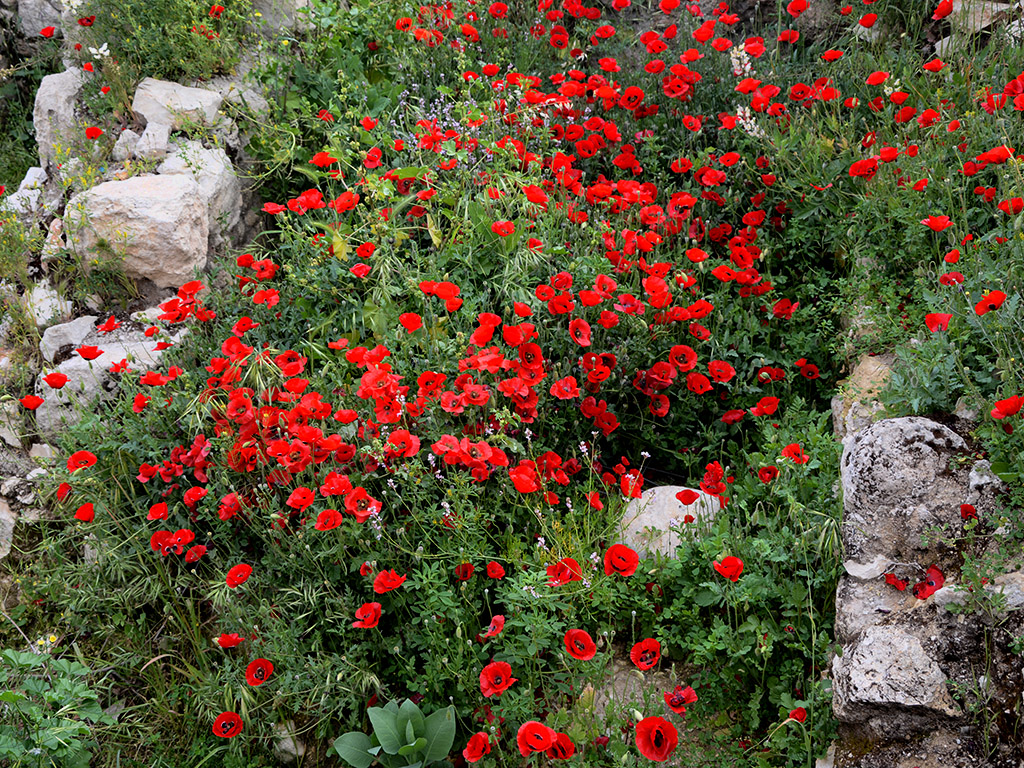
Flowers growing among the ruins in the Old City of Jerusalem near Dung Gate. Photo by Ferrell Jenkins.

Flowers growing among the ruins in the Old City of Jerusalem near Dung Gate. Photo by Ferrell Jenkins.

Many readers will think of the statement of Jesus:

Consider the lilies, how they grow: they neither toil nor spin, yet I tell you, even Solomon in all his glory was not arrayed like one of these. (Luke 12:27 ESV)

The NET Bible uses the term flowers instead of lilies. A Translator’s Note says,

Traditionally, “lilies.” According to L&N [Louw-Nida] 3.32, “Though traditionally kri,non has been regarded as a type of lily, scholars have suggested several other possible types of flowers, including an anemone, a poppy, a gladiolus, and a rather inconspicuous type of daisy.” In view of the uncertainty, the more generic “flowers” has been used in the translation.

I observe that Bauer (Arndt-Gingrich-Danker) comments:

in this connection the principal opinions include the autumn crocus, Turk’s cap lily, anemone, or gladiolus, but the data do not permit certainty. Perh. Jesus had no definite flower in mind, but was thinking of all the wonderful blooms that adorn the fields of Galilee.

Enjoy the beauty and think of God’s care for you. A larger image is available by clicking on the photo.

Books for self and others #3 – books by David E. Graves

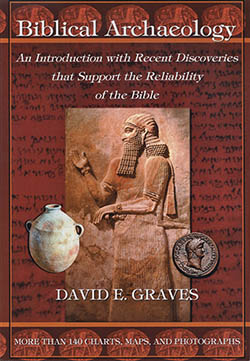
David E. Graves sent me two of his recent books. The first to mention is Biblical Archaeology: An Introduction with Recent Discoveries that Support the Reliability of the Bible. I like the subtitle: An Introduction with Recent Discoveries that Support the Reliability of the Bible. This is a large paperback of 375 pages, published in 2014.
  1. Introduction to Biblical Archaeology
  2. Archaeology and Biblical Manuscripts
  3. Genesis
  4. Exodus and Conquest
  5. United and Divided Monarchy
  6. The Gospels
  7. Acts and Epistles
  8. Revelation

Graves, Biblical ArchaeologyBiblical Archaeology includes more than 140 charts, maps and photographs (all in black and white), a glossary, extensive bibliography and index.

Dr. Graves holds a Ph.D. from the University of Aberdeen, has been involved in teaching the Bible and archaeology for more than 30 years. He has participated in archaeological digs for several years.

This book will not please the person who wants a slick paper, large print book filled with color photos. It will be extremely helpful to the person who would like to have a thorough survey of Biblical Archaeology.

Key Themes of the New Testament: A Survey of Major Theological Themes is a 2014 paperback of 441 pages. Here are the chapters:
  1. Kinds of Literature
  2. Birth and Early Years of Jesus
  3. Ministry of Jesus
  4. The Death of Jesus
  5. Resurrection and Ascension
  6. The Founding of the Church
  7. The Formation of the Church
  8. The Development of the Church
  9. The Future of the Church
  10. Conclusion

This book covers so comprehensive that one is bound to disagree with a point here and there. Points that I observed gave me opportunity to think and expand my thinking. The book is available in Kindle format for about half the price. Graves also has a similar book dealing with the Old Testament themes.

David maintains Deus Artefacta, a blog about issues like those discussed in these books.

I provided five photos for this book, and two for the book on archaeology.

Antiquities “dealer” arrested with 3000+ coins

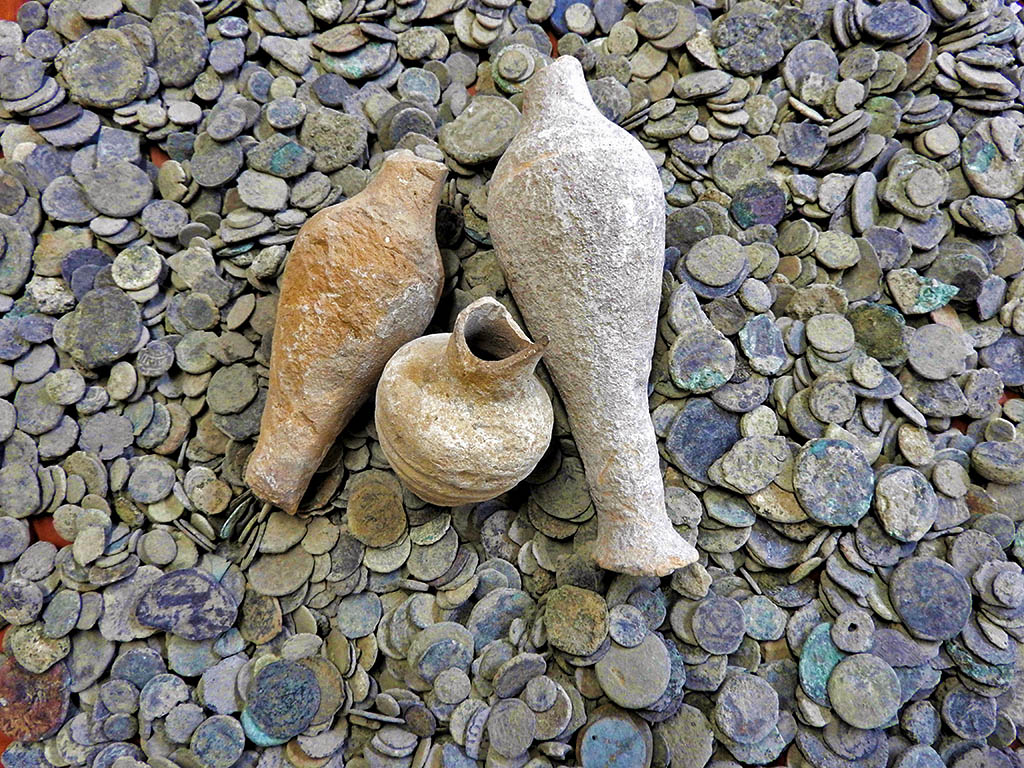
Earlier this week the Israel Antiquities Authority and the Police arrested a man living near Beit Shean (Bethshan) with some pottery and more than 3000 coins that he was illegally trying to sell. One report says the coins dated from the Roman period, the Bar Kochba revolt, the Byzantine period, and the Muslim period. The Roman coins included some from the time of the Roman destruction of Jerusalem in A.D. 70. These coins bear the title “Judaea Capta.”

Pottery and coins confiscated by the Israel Antiquities Authority near Beit Shean, Nov. 24, 2015. Photo: IAA.

Pottery and coins confiscated by the Israel Antiquities Authority near Beit Shean, Nov. 24, 2015. Photo: IAA.

The unnamed “dealer” had been digging up the coins and pottery in fields in the vicinity of Beit Shean. For additional information about Beit Shean see our post here.

There are legitimate dealers in antiquities, but there are others who take advantage of unsuspecting buyers. Many antiquities are destroyed by those who do not appreciate the value of the artifacts.

For a copy of the IAA Hebrew press release go here. For an informative English article with several photos see the article in The Times of Israel here.

HT: Joseph Lauer

A miscellany of topics

In the past few weeks I have been occupied trying to get some out-of-print material ready for reprint. Occasionally I read something that I think should be shared. Take a look at these.

Ephesus Museum Open. Carl Rasmussen reports on his HolyLandPhotos’Blog that the Ephesus Museum in Seljuk is open after being closed for renovation.

Gentile References in Matthew. Charles Savelle presents a list of “Gentile References in Matthew” at BibleX.

Bible Places Blog. Todd Bolen’s Weekend Roundups have been extremely helpful the past couple of weeks. See here for the most current one.

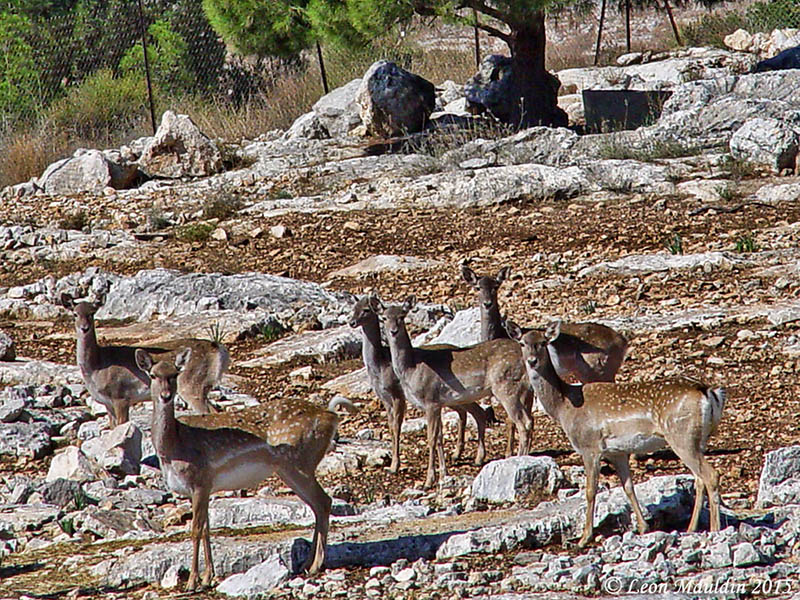
The Fallow Deer. Shmuel Browns writes about how the Fallow Deer was reintroduced into Israel from Iran. Fascinating story with photos here. Browns does not say where he made his photos, but mentions that some of the deer were taken to Neot Kadumim. When Leon Mauldin and I visited Neot Kedumim in 2005 the deer there were young. I note that they are not as gray as those in Shmuel’s photos. Perhaps the age accounts for the difference.

Young fallow deer at Neot Kedumim. Photo by Leon Mauldin.

Young fallow deer at Neot Kedumim. Photo by Leon Mauldin.

Using Maps in Bible Study. Wayne Stiles writes about “The Value of Using Maps in Your Bible Study” here.

Mount Gilboa. The Times of Israel carries an article here with beautiful photos, of the Gilboa Mountains and the wildflowers growing there in the winter and spring.

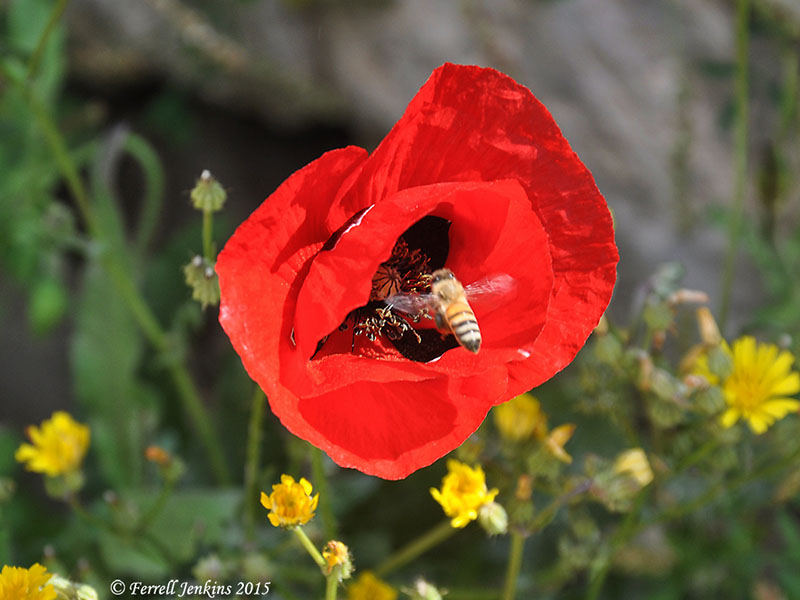
A poppy and a bee at the Pool of Bethesda, Jerusalem. Photo by Ferrell Jenkins.

A poppy and a bee at the Pool of Bethesda, Jerusalem. Photo by Ferrell Jenkins.

Responding to Newsweek. Darrell L. Bock has two more responses here to the Newsweek article on The Bible.

How Many Saviors? Amazon has Ronald Nash’s Is Jesus the Only Savior? available in Kindle format for $1.99 for a limited time. This book can be very helpful in this time of emphasis on pluralism and inclusivism.
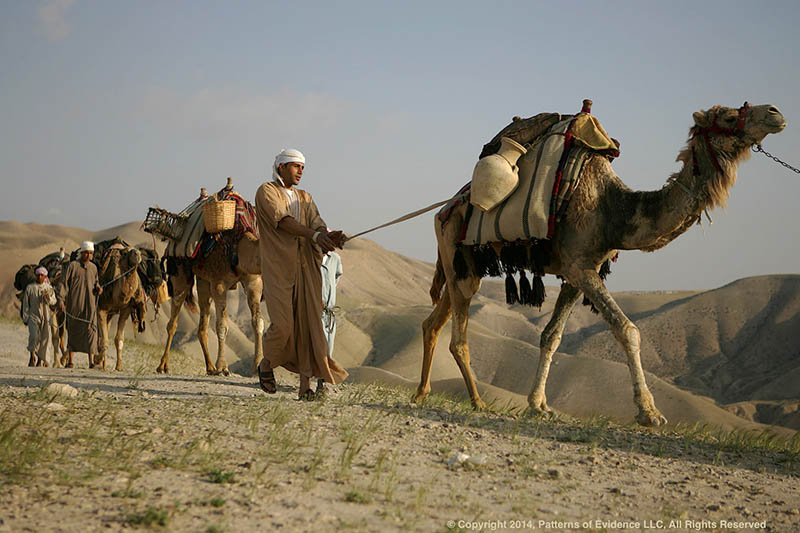
The Exodus. Last Friday I heard Gretchen Carlson’s interview with filmmaker Tim Mahoney on Fox News. It was the first I had heard of the film Patterns of Evidence: Exodus. The film is debuting Monday, January 19 at select theaters nationwide.

A wide variety of scholars are interviewed in the film, including Charles Aling, Manfred Bietak, John Bimson, Israel Finkelstein, James K. Hoffmeier, David Rohl (who has advanced a revised chronology ancient Egypt and Palestine),
Bryant Wood, and others.

For info on the film and places it will be shown see Patterns of Evidence: The Exodus. Here is the trailer.

A few nice photos are available for download.

From Patterns of Evidence.

From Patterns of Evidence.

You are on your own to see/hear and evaluate.

Added Note (Jan. 19, 2015). Todd Bolen calls attention to a review of the film by Larry Largent. This review confirms my suspicions that the flim was an effort to push a revised chronology. Take a look at this review at Biblical Remains.

Another sunset photo on the Sea of Galilee

In response to our recent post on Sunset from En Gev on the Sea of Galilee here, Randy Myers tried to post an image of a photo he made of a sunset on the Sea of Galilee about two weeks ago.

I contacted Randy and asked permission to post his photo on the blog. It is a beautiful photo with Tiberias in the shadows. The bird in flight adds a really nice touch.

Sunset on the Sea of Galilee. Photo by Randy Myers.

Sunset on the Sea of Galilee. Photo by Randy Myers.

Much of the activity of Jesus during His earthly ministry involved the Sea of Galilee and the various ports on its shore. Here is one example.

After Jesus healed a man with a withered hand on the Sabbath, the Pharisees and the Herodians made a plan to destroy Him.

Jesus withdrew with his disciples to the sea, and a great crowd followed, from Galilee and Judea and Jerusalem and Idumea and from beyond the Jordan and from around Tyre and Sidon. When the great crowd heard all that he was doing, they came to him. (Mark 3:7-8 ESV)

Randy, thanks for sharing this photo with us.


Following the Blogs

Available today only in Kindle format: How We Got the Bible by Neil Lightfoot. This is not the only book you need on this subject, but it is a good beginning source.
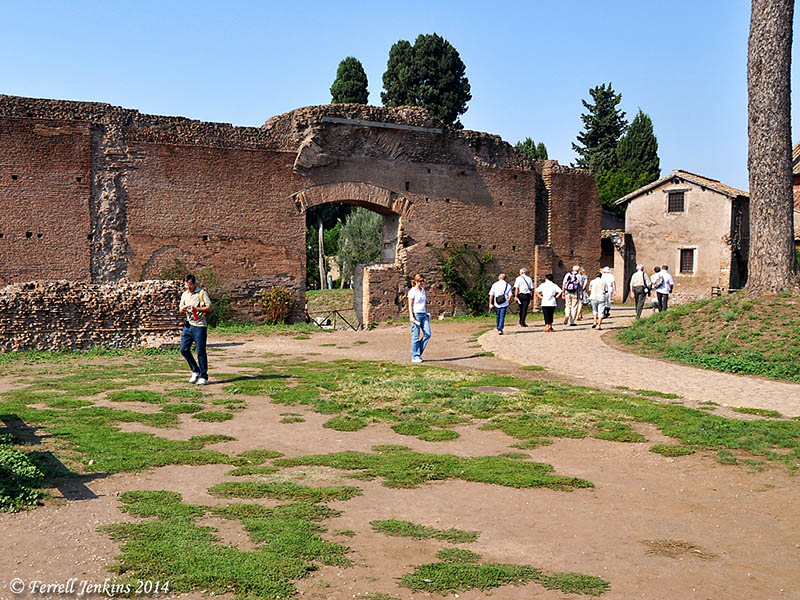
Todd Bolen’s Bible Places Blog is the best source for keeping up with news and recent materials related to Bible Places. I am a fan of the Weekend Roundup, with links to a variety of helpful materials. Today’s post reports that that rooms of Emperor Augustus on the Palatine Hill in Rome are now open to the public. Read here.

House of Augustus on the Palatine Hill, Rome. Photo by Ferrell Jenkins.

House of Augustus on the Palatine Hill, Rome. Photo by Ferrell Jenkins.

Charles Savelle provides a regular flow of links to helpful tools for serious Bible teachers and students at his BibleX (Bible Exposition). He recently pointed us to material on the Didache, The Dating of Deuteronomy and the Suzerain-Vassal Treaty Forms, and The Importance of Biblical Geography. I check this site regularly.

I enjoy following Bible Lands Explorer, the blog of Mark Ziese. Mark is a unique writer. His most recent post points us to a Brazilian newspaper for which he provided photos of the Jesus Trail. You may not be able to read the Portuguese newspaper, but there is a nice slide show of Mark’s photos.

Reading Acts. The blog by Phillip J. Long has some helpful articles for Bible students. Check some of these recent posts:

Ancient History Encyclopedia. This is a nice site including an encyclopedia that is primarily intended for high school level. Includes Index, Timeline, Maps, Photos, Videos, etc. Check the article on Roman Roads here.

ePlace. Research materials provided by Asbury Theological Seminary. Includes TREN collection of professional conference papers, dissertations, et al.

The Journal of Inductive Biblical Studies. This journal is built on the well-known work of Kuist, Traina, and others who wrote on Inductive Bible Study.

Daily Dose of Greek. Sign up for a 2-minute video Daily Dose of Greek by Rob Plumber, professor of Greek and New Testament at Southern Baptist Seminary.

Mark Hoffman, Biblical Studies and Technological Tools, recently posted two helpful lists of Greek lexical forms. Click here.

Resources to Help You Defend the Deity of Jesus. A list of resources by J. Warner Wallace, author of Cold Case Christianity.

HT: Brooks Cochran

July 4th at Lachish

In the previous post I mentioned that several former students and friends are participating in the dig at Tel Lachish this year.

Six years ago on this day I wrote about Lachish on July 4th, 1980. Since we have many more readers now I think it appropriate to re-post that entry here.

— • —

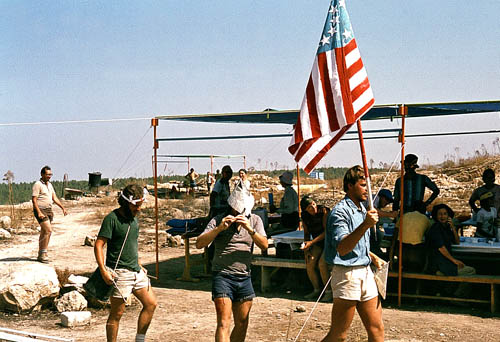
On July 4, 1980, I was participating in the excavation at Tel Lachish in Israel along with three of my colleagues from Florida College (James Hodges, Phil Roberts, and Harold Tabor). There were sizable numbers of participants from Israel, United States, Australia, South Africa, and Germany. In addition to the hard work out in the sun, we had some fun. On the morning of July 4th a few of the guys got an American flag and put together a drum and bugle corp and marched across the tel. Note especially the plastic bucket being used as a drum in this photo.

"Parade" at Tel Lachish, July 4, 1980

“Parade” at Tel Lachish, July 4, 1980

Lachish is identified with Tell ed-Duweir, located in the shephelah (lowlands) of Judah about 30 miles south west of Jerusalem. It is mentioned in Scripture during the period of the conquest (Joshua 10, 12, 15). Lachish served as one of the Judean store cities during the period of the kingdom Judah. Many of the LMLK jar handles have been found here. The city fell both to the Assyrians and the Babylonians.

Excavations were carried out by the British between 1932 and 1938 under the direction of J. L. Starkey. Starkey was murdered in 1938 while en route to the opening of the Palestine Archaeological Museum (later the Rockefeller Museum) in Jerusalem. Professor Yohanan Aharoni of Tel Aviv University excavated the “Solar Shrine” in 1966 and 1968. A new excavation was begun in 1973 under the auspices of The Institute of Archaeology of Tel Aviv University and The Israel Exploration Society. Dr. David Ussishkin served as the director until 1994.

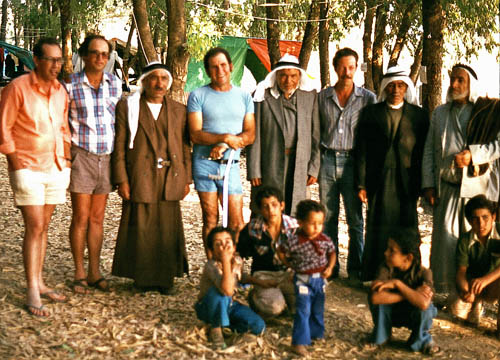
One afternoon while we were in our tented camp a short distance from the tel, a bus load of Arabs from Jordan arrived. They had once lived in the area, prior to the founding of the State of Israel. Some of the older men had worked with Starkey. This photo which I took shows four of the Arab men and three of the Israeli archaeologists, along with one American. See if you recognize Gabriel Barkay, Richard Whitaker, Adam Zertal, and David Ussishkin.

https://ferrelljenkins.blog/wp-content/uploads/2008/07/lachish_arab-visit_07-1980-t.jpg

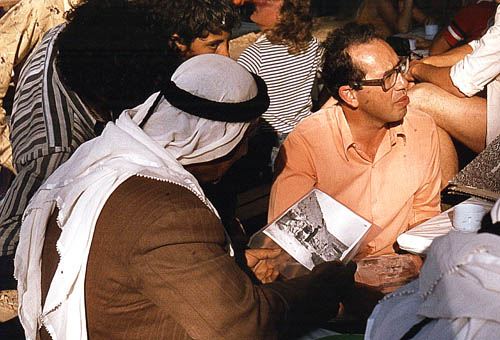
The Arab men enjoyed seeing the old photos from the Starkey excavations and pointing out themselves as much younger men. I think you will see Ussishkin’s head to the left of the Arab, and Barkay on the right.

https://ferrelljenkins.blog/wp-content/uploads/2008/07/lachish_07-1980_arab-visit-photos-t.jpg

Update (July 6, 2008). Todd Bolen, at BiblePlaces.com has commented on this blog under the title Reminiscences of Lachish. He says he heard Gabriel Barkay tell about this event, but he includes some additional information that I did not know, including the name of the village where the Arabs previously lived.

The town of Qubeibe was leveled by the Israeli military in the 1960s and the stones of the village, probably many taken from the ruins of Lachish, were sold to building contractors.  Who knows but some ancient inscription was unknowing transferred from Lachish to Qubeibe and is now part of a wall in the area?

I recall that Richard Whitaker was the one best able to converse in Arabic.

Regarding the Visualizing Isaiah series

The response to the Visualizing Isaiah series has been good by my estimation. Numerous readers have written that they enjoyed/profited by the series. Several bloggers have linked to the series and a few have re-blogged almost all of them to their readers.

This was an ambitious project. First, there was the responsibility to understand Isaiah well enough to make appropriate comments. Second, the selection of good photos was quite a task. I often looked through photos from various Bible sites and/or several museums with Ancient Near Eastern collections to locate what I thought was the right image. Some chapters offered numerous possibilities; others were a bit more difficult.

Hopefully I will be able to continue the series later. At this time I must take a break because I will be traveling in the Bible world most of May. I do plan to post something most days to indicate where I am traveling.

I trust that the Isaiah series has illustrated how you can enhance your study and teaching with visuals. You may say, “but I haven’t been to all of those places.” But you can search this blog for illustrations. Some time back we provided illustrations for the entire book of Acts. You can go to your Pictorial Library of Bible Lands collection and find the photos you need. Or, search the Bible Places Blog, or the Holy Land Photos’ Blog, or the vast collection at Holy Land Photos, or David Padfield’s collection here.

For my next series, I plan to select a shorter book such as Philemon or Jude.

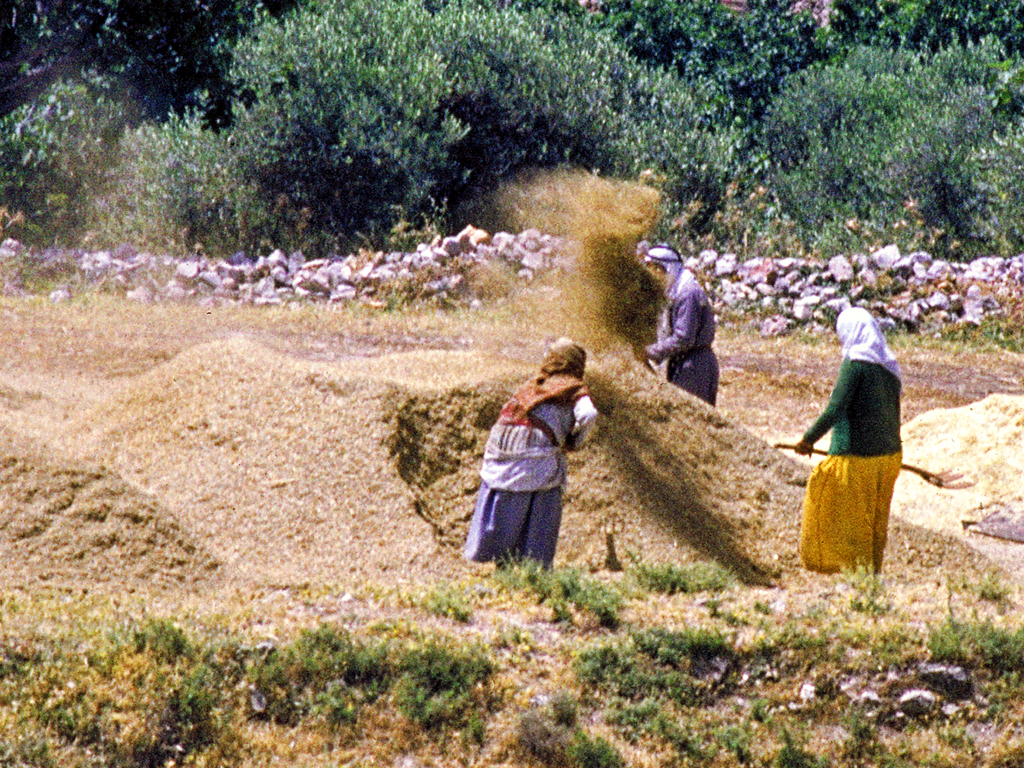
Just in case some of you are looking ahead to Isaiah 41, I will include an image to help with verses 15-16.

Behold, I make of you a threshing sledge, new, sharp, and having teeth; you shall thresh the mountains and crush them, and you shall make the hills like chaff; you shall winnow them, and the wind shall carry them away, and the tempest shall scatter them. And you shall rejoice in the LORD; in the Holy One of Israel you shall glory.  (Isaiah 41:15-16 ESV)

Winnowing at Shechem. Photo by Ferrell Jenkins.

Winnowing at Shechem. Photo by Ferrell Jenkins.