Category Archives: Biblical Studies

Biblical Studies Info Page

Biblical Studies Information Page. For the past ten years I have maintained the Biblical Studies Info Page here. The site was established under another name about four years earlier, then transferred to my own domain. While there are some articles posted there, the site is mostly a series of links to material that I consider worthwhile, especially for the person who has a limited number of sources available in his/her own library. I have fewer hits now than I did several years ago. I think one major reason is that people use search engines such as Google and Yahoo.

Let me suggest that there is still a value to using the Biblical Studies Info Page. The material is divided into several categories which are noted on the left side of the home page. The Links page is of primary interest to readers associated with churches of Christ. The Bible Places category can be very helpful if one is looking for information on biblical sites. (Incidentally, to my knowledge this page was online a few months prior to the highly popular Bibleplaces.com.)
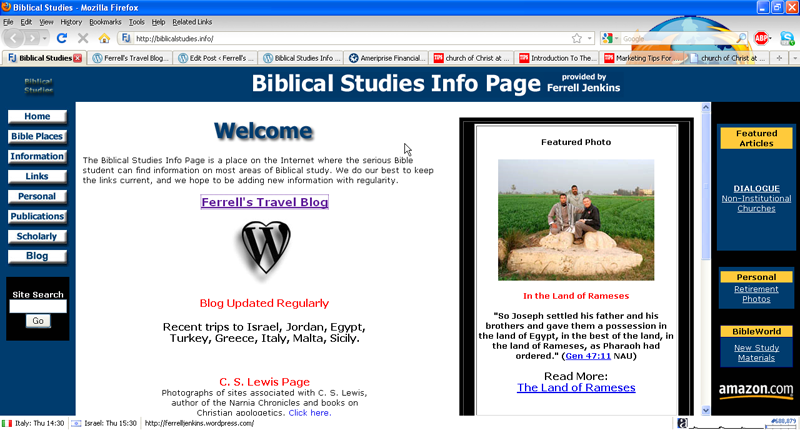
Biblical Studies Info Page

Front page of the Biblical Studies Info Page.

Probably the most important category is marked Scholarly. This page is not scholarly in the sense of doctoral dissertation’s are scholarly (or should be!). I envisioned it as a page of material that a “lay” person could read and be able to have some confidence in. Sometimes there are two links to differing views on a subject. I intend for people to think, examine, and draw their own conclusions. The categories within the page are important: Apologetics, Culture; Archaeology & the Bible; Bible Study Software & Tools; Bibles Available Online; Biblical Backgrounds; Biblical Criticism: Manuscripts & Translations; Blogs and News Pertaining to Biblical Studies; Books; Church History; Documenting Your Online Research; Evangelism; Greek Studies; Judaism; Maps of Bible Lands; Museums and Traveling Exhibits; New Testament Background; Old Testament Materials; Patristics; Periodicals: Scholarly Journals; Photos and Art; Resource Indices; Restoration Movement (history); Study Materials: Online; Theology.

A Video Surprise

By surprise one day I received an Email from Tony Eldridge, a young author and book marketing expert. Tony writes a blog filled with good tips for people who have books to promote. Begin with his home page here, and move on to the blog.

What surprised me was that Tony had prepared a short video explaining the value of the Biblical Studies Info Page for members of the church where he is a member. You might enjoy his introductory video here. He also reviews other web sites that he considers helpful to Bible students.

Our thanks to Tony.

About 30,000 Dead Sea Scrolls to be put online

The Israel Antiquities Authority announced today a partnership with Google R&D Center in Israel to make the Dead Sea Scrolls available online. The project will be called the Leon Levy Dead Sea Scrolls Digital Project because the major lead gift is from the Leon Levy Foundation. Here are some excepts from the IAA press release.

A major lead gift from the Leon Levy Foundation, with additional major funding from the Arcadia Foundation and the support of Yad Hanadiv Foundation, will enable the Israel Antiquities Authority to use the most advanced and innovative technologies available to image the entire collection of 900 manuscripts comprising c. 30,000 Dead Sea Scrolls fragments in hi-resolution and multi spectra and make the digitized images freely available and accessible to anyone anywhere in the world on the internet. This is the first time that the collection of Scrolls will be photographed in its entirety since the 1950’s.

The IAA announced this morning that it is collaborating with the Google R&D center in Israel in this milestone project to upload not only all of the digitized Scrolls images but also additional data online that will allow users to perform meaningful searches across a broad range of data in a number of languages and formats, which will result in unprecedented scholarly and popular access to the Scrolls and related research and scholarship and should lead to new insights into the world of the Scrolls.

The innovative imaging technology to be used in the project has been developed by MegaVision, a U.S. based company, and will be installed in the IAA’s laboratories in early 2011. The MegaVision system will enable the digital imaging of every Scroll fragment in various wavelengths in the highest resolution possible and allow long term monitoring for preservation purposes in a non-invasive and precise manner. The images will be equal in quality to the actual physical viewing of the Scrolls, thus eliminating the need for re-exposure of the Scrolls and allowing their preservation for future generations.  The technology will also help rediscover writing and letters that have “vanished” over the years; with the help of infra-red light and wavelengths beyond, these writings will be brought “back to life”, facilitating new possibilities in Dead Sea Scrolls research.

Uploading the images to the internet will be achieved with the assistance of Google-Israel and will be accompanied by meta-data including transcriptions, translations and bibliography.

According to Shuka Dorfman, IAA General Director, “we are establishing a milestone connection between progress and the past to preserve this unique heritage for future generations. At the end of a comprehensive and profound examination we have succeeded in recruiting the best minds and technological means to preserve this unrivaled cultural heritage treasure which belongs to all of us, so that the public with a click of the mouse will be able to freely access history in its fullest glamour. We are proud to be embarking on a project that will provide unlimited access to one of the most important archaeological finds of the 20th Century, crucial to Biblical studies and the history of Judaism and early Christianity. We are profoundly grateful to Shelby White and the Leon Levy Foundation for their lead major gift and to the Arcadia Foundation for its major gift to this project.”

The IAA press release with a link to several photographs is available here.

IAA photo from the pilot project in St. Paul

IAA photo from the pilot project in St. Paul

If you thought the Dead Sea Scrolls had not been made public, take a look at this sentence from the News Release:

This is the first time that the collection of Scrolls will be photographed in its entirety since the 1950’s.

HT: Joseph Lauer

Here and there in Jerusalem

Today we visited the Temple Mount, presently the site of the Dome of the Rock and the Al-Aksa Mosque. This site is thought to be the place where Abraham made preparations to offer Isaac.

He said, “Take your son, your only son Isaac, whom you love, and go to the land of Moriah, and offer him there as a burnt offering on one of the mountains of which I shall tell you.” (Genesis 22:2 ESV)

The temple of the LORD was constructed by Solomon on Mount Moriah.

Then Solomon began to build the house of the LORD in Jerusalem on Mount Moriah, where the LORD had appeared to David his father, at the place that David had appointed, on the threshing floor of Ornan the Jebusite. (2 Chronicles 3:1 ESV)

The Babylonians destroyed Solomon’s temple in 586 B.C. After the Jews returned from Babylonian Exile, the temple was rebuilt. In the days of Herod the Great the temple was virtually reconstructed beginning in about 20 B.C. (John 2:20). The temple was destroyed by the Romans in 70 A.D.

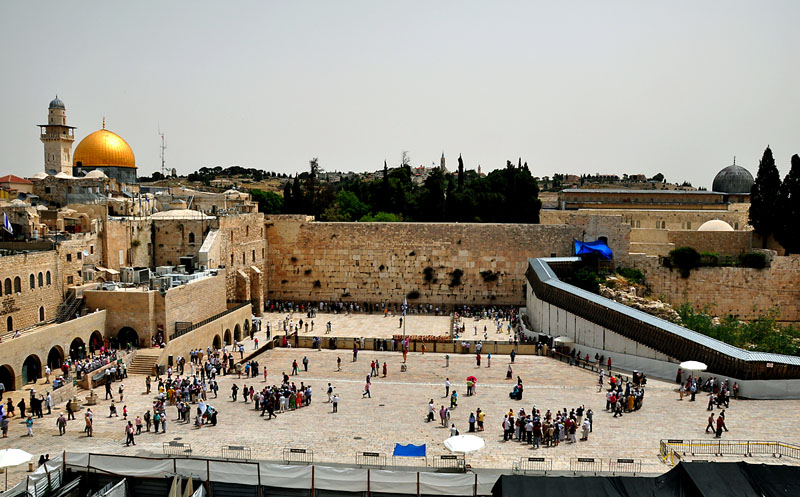
The photo today shows the Western Wall which served as the retaining wall built by Herod the Great around the Temple Mount. On the temple platform you will see the Dome of the Rock and the Al-Aksa Mosque. The Mount of Olives is in the distance to the east of Jerusalem.

Western Wall Plaza. Photo by Ferrell Jenkins.

Western Wall Plaza. Photo by Ferrell Jenkins.

Click on the photo for a larger image.

We visited several other sites in the Old City of Jerusalem, the Shrine of the Book and the Second Temple Model at the Israel Museum.

Jodanian students work at Umm Qais

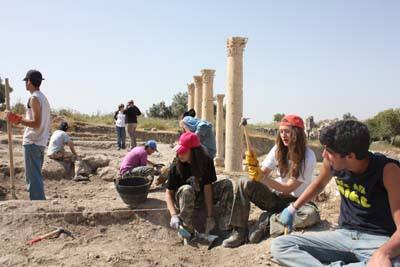
Jordanian students from the International Academy Amman spent a week excavating at Umm Qais. The full article may be read in The Jordan Times here.

Students from the International Academy in Amman work at Um Qais. Photo by Taylor Luck, Jordan Times.

Students from the International Academy in Amman work at Um Qais. Photo by Taylor Luck, Jordan Times.

Umm Qais (a common spelling) is the site of Gadara, one of the cities of the Decapolis. Mendel Nun discovered 16 ancient ports around the Sea of Galilee, including one for the city of Gadara. He describes Gadara:

Gadara, the most magnificent of the Hellenistic towns that circled the Sea of Galilee, was located on the heights of Gilead above the Yarmuk River. The marine suburb and the city’s harbor were located on the southeastern shore of the lake, at Tel Samra (now Ha-on Holiday Village). In form, Gadara’s harbor resembles that of Sussita—a closed basin with an opening to the south—but it is much larger and more luxurious. The central breakwater is 800 feet long and its base 15 feet wide. The promenade was 650 feet long, built with finely chiseled stones, only one of which remains. The 150-foot-wide basin covered an area of 3 acres.

This harbor is superior to the one at Sussita not only because of its size but also because of its facilities. At the center of the promenade are the remains of a tower. Ruins of a large structure—probably the building of the harbor administration—are scattered on the ground near the harbor gate.

Gadara’s maritime character is attested by its coins, which depicted ships of war for some 250 years. The city’s harbor at Tel Samra was almost certainly not only an anchorage for ships. Second-century coins from Gadara commemorate the Naumachia—naval battle games performed for the inhabitants of Gadara. Until recently, researchers assumed that these games took place on the Yarmuk River, which flows into the Jordan just south of the Sea of Galilee; but this does not seem likely, and no remains of a facility of this kind have been found at this site. The large harbor basin at Tel Samra, however, with its 1,600-foot-long combined promenade and breakwater, would surely have been more suitable to accommodate the throngs of spectators as they arrived. In addition, Gadara’s harbor must have been used by thousands of visitors to the famous baths at Hamat Gader, located 5 miles southeast of the sea. The ancient Roman road connecting Beth Shean and Sussita passed near Tel Samra, and the road to Hamat Gader branched off this road. (Mendel Nun. “Ports of Galilee.” Biblical Archaeology Review 25:04; July/Aug 1999)

From Umm Qais (Gadara) one has a great view of the Sea of Galilee and the Yarmuk River valley. We are told that Jesus visited the region of Decapolis.

Then he returned from the region of Tyre and went through Sidon to the Sea of Galilee, in the region of the Decapolis. (Mark 7:31 ESV)

The Gospel of Matthew informs us about the healing by Jesus of two demon-possessed men in the country of the Gadarenes (Matthew 8:28). Mark puts this event in the country of the Gerasenes (Mark 5:1-20). Luke adds that they “sailed to the country of the Gerasenes, which is opposite Galilee” (Luke 8:26).

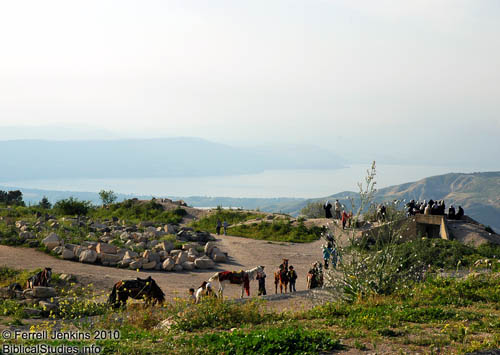
The photo below was made in the late afternoon when citizens of the local Jordanian village came out to enjoy the view. The view across the Sea is not clear, but you can see the entire western coast line. In the right foreground you can see a bunker used by the Jordanians in recent wars in the region. The hill directly across from the bunker is the beginning of the Golan Heights. Prior to 1967 this was in Syria. The Yarmuk River flows into the Jordan River south of the Sea of Galilee. All of the significant rivers of Jordan that flow into the Jordan River have dams on them, thus decreasing the amount of water flowing into the Jordan.

Late afternoon view of the Sea of Galilee from Umm Qais. Photo by Ferrell Jenkins.

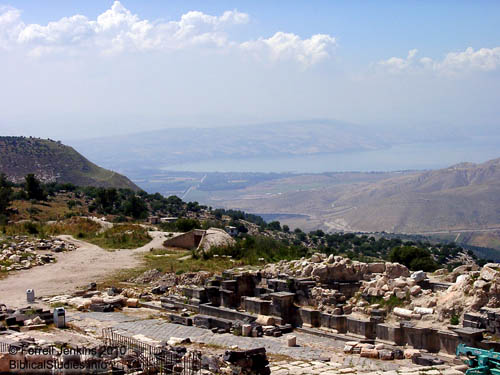
The next photo was made in 2002. It shows a portion of the nymphaeum (attractive water fountain) and the Yarmuk Valley.

The Sea of Galilee from Umm Qais (Gadara). Photo by Ferrell Jenkins.

The Sea of Galilee from Umm Qais (Gadara). Photo by Ferrell Jenkins.

Todd Bolen posted a beautiful, clear photo that also shows the Yarmuk River valley and the nymphaeum here. Note that the nymphaeum had undergone some reconstruction when his photo was made.

HT: Joseph Lauer

BiblioBlogger rankings for March

The Top 50 BiblioBlogger rankings for March are posted here. Thanks to our readers for moving us into 10th place. This list is based on the Alexa traffic rank.

Witherington and Crossan on the Message of Jesus

Last week I attended The Greer-Heard Point-Counterpoint Forum in New Orleans. The forum is briefly described by Paul F. South, NOBTS Communications:

Two of the world’s best-known religious scholars will dialog at New Orleans Baptist Theological Seminary on a question that has sparked debate for some 2,000 years: What did Jesus really teach?

John Dominic Crossan and Ben Witherington III will be the featured speakers at the  2010 Greer-Heard  Point-Counterpoint  Forum, Feb. 26 and 27 at Leavell Chapel.

The event marks the seminary’s sixth Greer-Heard Point-Counterpoint Forum. The Forum is designed to provide a venue in which a respected evangelical scholar and a respected non-evangelical scholar discuss critical issues in religion, science, philosophy, or culture.

Audio CDs, MP3, or DVDs are available for all of the previous forums at a reasonable rate. Go here and click on STORE. The most recent forum (The Message of Jesus) is not on the list, but it is available. I think you can find a contact link somewhere on the page.

In addition to Witherington and Crossan, the other speakers were Darrell Bock, Craig Evans, Amy Jill Levine, and Stephen J. Patterson. Perhaps you recognize these names as representing both liberal and conservative perspectives on Jesus.

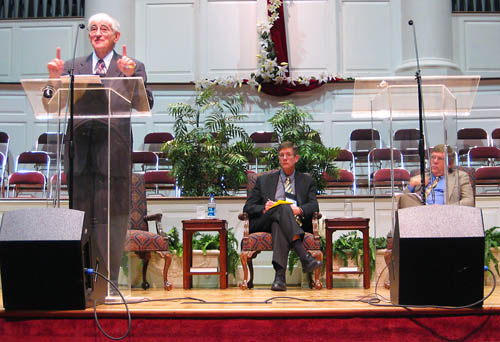
Crossan speaks while Witherington (R) waits his turn. Photo by Ferrell Jenkins.

Crossan (L) speaks while Witherington (R) waits his turn. Photo by Ferrell Jenkins.

He does not say so, but I think Ben Witherington III has posted his paper on his Bible and Culture blog here. It is a little difficult to read. Copy the document and save it in your word processor and it will be easier to read.

All of the speakers are distinguished scholars who have spent a great deal of their academic life writing on the general theme of Jesus Studies.

Biblioblog rankings for February

The Biblioblog rankings for February are posted at Free Old Testament Audio Website Blog here. Our rankings, based on the Alexa numbers, is 12 in the list of 362 blogs. Thanks to each of you for coming our way.

2009 summary of tech tools for Bible study

At the Biblical Studies Info Page (under Scholarly/Blogs) I keep links to two sources specializing in technology and Bible study. These are Biblical Studies and Techological Tools and Tyndale Tech.

Mark Hoffman has posted a  2009 Review of Biblical Studies and Tech Tools here.

Move evidence of Babylonian-Egyptian contacts

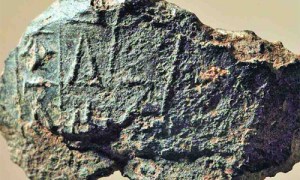
Austrian Times reports here on the discovery of a Babylonian seal impression at Tell el-Dab’a in Egypt.

Austrian archaeologists have found a Babylonian seal in Egypt that confirms contact between the Babylonians and the Hyksos during the second millennium B.C.

Irene Forstner-Müller, the head of the Austrian Archaeological Institute’s (ÖAI) branch office in Cairo, said today (Thurs) the find had occurred at the site of the ancient town of Avaris near what is today the city of Tell el-Dab’a in the eastern Nile delta.

The Hyksos conquered Egypt and reigned there from 1640 to 1530 B.C.

She said a recently-discovered cuneiform tablet had led archaeologists to suspect there had been contact between the Babylonians and the Hyksos.

Forstner-Müller added that Manfred Bietak had begun archaeological research on the period of Hyksos dominance at the remains of a Hyksos palace at Avaris in 1966.

Babylonian seal impression.

Babylonian seal impression.

Earlier in the year we reported on the discovery of a Babylonian tablet at Tell el-Dab’a here.

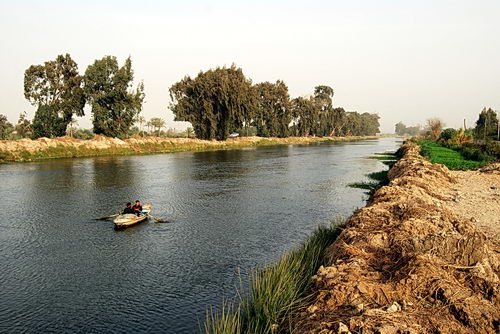
The report  says the Austrian plan to build a museum in the area. A more complete report in Die Presse says they also have plans to restore the river. The Pelusiac branch of the Nile once flowed by this ancient site. Below is a photo of the canal which often follows the course of the Pelusiac.

A canal where the Pelusiac branch of the Nile once flowed. Photo by F. Jenkins.Canal along the Pelusiac Branch of the Nile near Tell el-Dab’a. Photo by FJ.

Tell el-Dab’a is in the eastern Nile Delta. In Biblical times it was known as the Land of Goshen, and served as the home of the Israelites.

“Hurry and go up to my father, and say to him, ‘Thus says your son Joseph, “God has made me lord of all Egypt; come down to me, do not delay. “You shall live in the land of Goshen, and you shall be near me, you and your children and your children’s children and your flocks and your herds and all that you have. “There I will also provide for you, for there are still five years of famine to come, and you and your household and all that you have would be impoverished.” (Genesis 45:9-11 NAU)

These new findings might shed some light on the plausibility of Achan finding a garment from Shinar (Babylon) at Jericho (Joshua 7).

HT: Biblical Paths

Buying the best Bible Software

Logos_iconAs time permits I am trying to catch up on some of the blogs that I follow. I see that C. Michael Patton has a post at Parchment and Pen (I love that title) on “The Other Best Bible Software.” He is talking about Logos Bible Software. The other one he reviewed earlier is BibleWorks 8. Michael says he uses both. So do I.

Every young preacher should stop buying junk, ready-mixed pabulum, and get some real tools. Another advantage is that you will have no books to loan! Read Patton’s review here.

You will find some comments about the free software that so many preachers and teachers use.

The earlier review about BibleWorks 8 is here.

David Instone-Brewer, Tyndale Tech, has also written recently about Logos Libronix 3 here.

Morris Proctor is an (the?) authorized trainer for Logos Bible Software. His Tips and Tricks are helpful. You might also find a helpful note at the Logos Blog.

You will also find notes about both of these programs at Biblical Studies and Technological Tools.

Recently I wrote here about the problem of having to use Pradis to have access to Zondervan publications. In recent weeks, Zondervan and Logos announced that Zondervan books will be available from Logos. Good news. Now we must wait to see have much (or little?) we will have to pay for the conversion of the programs we already have.

Do your best to present yourself to God as one approved, a worker who has no need to be ashamed, rightly handling the word of truth. (2 Timothy 2:15 ESV)

Make every effort to present yourself before God as a proven worker who does not need to be ashamed, teaching the message of truth accurately. (2 Timothy 2:15 NET)