Category Archives: Biblical Studies

The Annual Meetings # 2 (NEAS)

Attending the annual meetings of professional organizations allows one to keep up with the latest scholarly efforts of various scholars. When I was teaching I attended sessions dealing with the subjects I was teaching. I have always attended sessions dealing with archaeology because these help be to keep abreast of the field. On my tours, I am often able to tell the guides about discoveries that they have not yet learned about.

Some affiliated smaller organizations meet under the auspices of the larger one. The NEAS (Near East Archaeological Society) meets with ETS. I attended most of the sessions of the NEAS. Let me give you some idea about what I heard.

Charles Ailing, Did Moses Learn His Monotheism From Akhenaten? Mostly likely not. According to the Biblical chronology, Moses was earlier than Akhenaten.

Douglas Petrovich, Identifying the Tower of Babel and (Re-)Locating the Site of Its Construction. He suggested Eridu. Doug began his paper with a prayer in which he said, “Thank you for the thrill of learning, and thank you for the truth.”

Randall Price reported on “the Final Season of Excavation on the Qumran Plateau.” I did not hear his presentation about the search for Noah’s Ark. Seth Rodriquez looked at how archaeology provides insights into Psalm 144.

Morten Jensen, from Denmark, spoke about “Religious Motivation in the Archaeological Record of First-century Israel.” A paper on Metallurgy was read for a scholar who was unable to arrive from Germany.

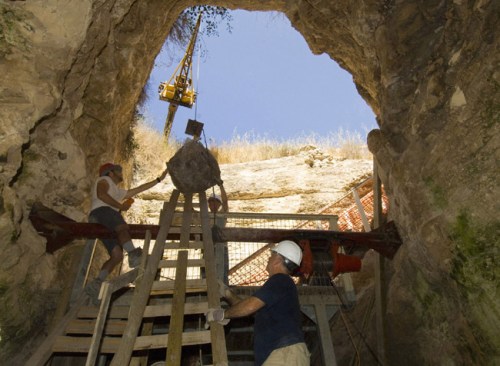
We had two presentations by excavators at Gezer. Steven Ortiz spoke about the recent excavations. Daniel Warner spoke about the fabulous new find of the Gezer Water System. See our earlier report on this water system here.

Gezer Water System

Excavating Gezer Water System. Photo: Art Beaulieu. Courtesy BP & NOBTS.

The sessions last about three hours and have at least five presenters in each. One session was devoted to Wheaton College’s Contribution to Biblical Archaeology from Joseph P. Free to the Present. Alfred J. Hoerth, who served as chair of the department of archaeology, spoke of the contributions from Free to the present. Other speakers, all of whom attended and/or taught at Wheaton included Daniel Master (Ashkelon), John Monson, and Tom Davis. This was an extremely worthwhile session.

Free is known for his book about archaeology, but also for his excavation of the biblical site of Dothan. One interesting tidbit: Free purchased the tell of Dothan from the Jordanian landowner. I think this would be impossible today.

Dothan is known as the place where Joseph’s brothers sold him into slavery (Genesis 37:12-36).

Perhaps I can get to a few comments about the SBL meeting after I return home.

ETS Plenary Sessions Online

Charles Savelle reports that the video of the plenary sessions at the recent ETS meeting are available online here Individual links are listed below. Zondervan Academic, the provider of the videos, includes advertising that you may skip to get directly to the lecture.

The general theme of the 2012 annual meeting was Caring for Creation. In these four lectures you will find four competent scholars presenting differing views on a subject that is important to each of us.

Calvin Beisner “Creation Care and Godly Dominion: The Search for a Genuinely Biblical Earth Stewardship”

Russell Moore “Heaven and Nature Sing: How Evangelical Theology Can Inform the Task of Environmental Protection, and Vice-Versa”

Richard Bauckham “Reading the Bible in the Context of the Ecological Threats of our Time”

Douglas J. Moo “Biblical Theology and Creation Care”

HT: Charles Savelle @ Bible X

Reformation Day

October 31 is known as Reformation Day because it was on this day in 1517 that Martin Luther posted Ninety-Five Theses on the door of the Castle Church in Wittenberg, Germany. The Ninety-Five Theses were issues that Luther thought should be debated by the theologians. These questions were brought about due to the sale of indulgences and general corruption within the Roman Catholic Church.

The term Protestant was not used to describe those who aligned themselves with Luther for another 12 years, but the Protestant movement can be dated the the event at Wittenberg.

There are many issues on which I would differ with Luther, but I admit that I admire the man and the stand that he took against practices of his day which were departures from the Apostolic doctrine.

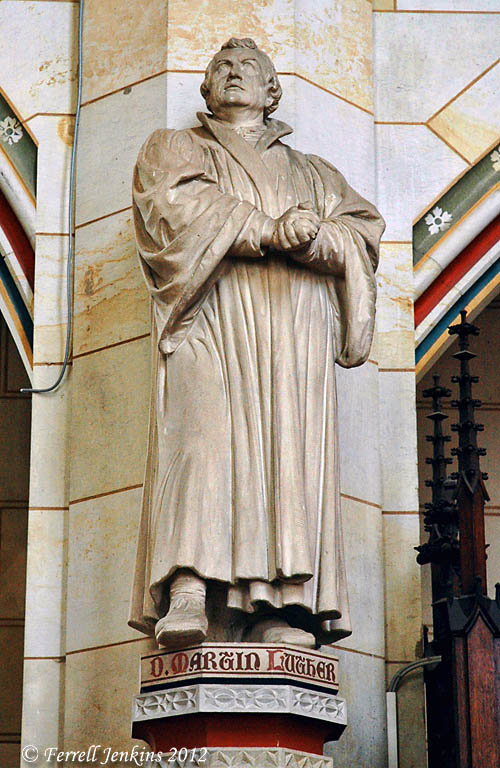
This statue of Luther stands in the Castle Church in Wittenberg, Germany. The official name of the town is Lutherstadt Wittenberg.

Statue of Martin Luther in the Wittenberg Castle Church. Photo by Ferrell Jenkins.

Statue of Martin Luther in the Wittenberg Castle Church. Photo by Ferrell Jenkins.

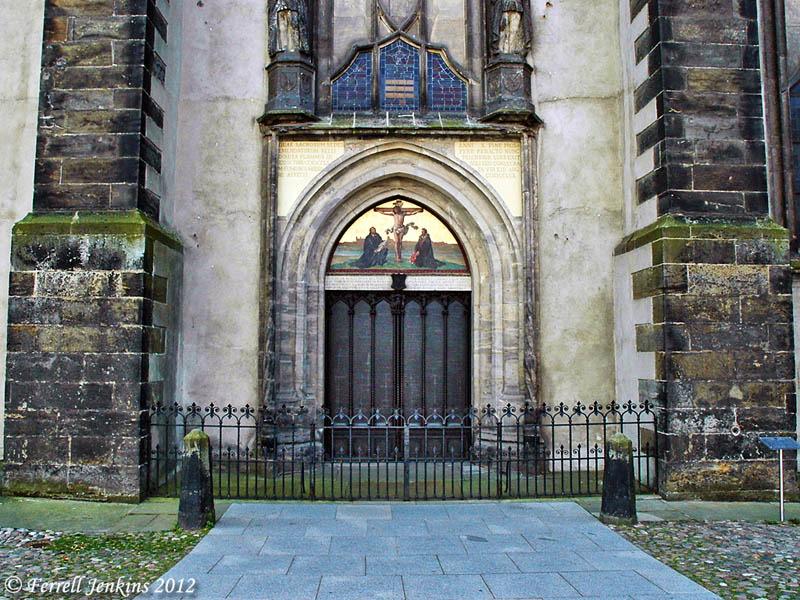
The original door of the church was destroyed by fire in 1760. Doors covered with bronze plaques with the Ninety-Five Theses on them were installed in 1858. The door of the church is pictured below.

Door of the Castle Church in Wittenberg. Photo by Ferrell Jenkins.

Door of the Castle Church in Wittenberg. Photo by Ferrell Jenkins.

Free Book. Those who use Logos Bible Software may download a copy of the Ninety-Five Theses under the title Disputation of Doctor Martin Luther on the Power and Efficacy of Indulgences. For information click here.

Interested in the Reformation? If you have interest in Church History and the place of the Reformation within it, you might enjoy this post on “The background of the Protestant Reformation,” or posts on Zwingli, Tyndale and Knox (and here), Heinrich Bullinger, St. Andrews, and Savonarola.

HT: HMcK

“You could feel the wheels turning”

Obituaries for Frank Moore Cross (1921–2012) are beginning to appear in various sources. William Yardley writes in The New York Times about Cross:

Dr. Cross studied culture, religion and politics of the period in which the Hebrew Bible, or Old Testament, was written and revised, and he traced the ways different nations and cultures had translated its early texts. He also traced the evolution of ancient script and developed expertise in dating documents by the slightest shifts in writing style.

“That we know that a particular scroll comes from 100 B.C. and not 50 A.D. is almost entirely due to the study of the scripts and their development that he worked out,” Mr. Machinist said. “That may seem like a trivial point, but if you don’t have a sense of when these texts are dated, you have no sense of their historical importance.”

Once, several colleagues said, after carbon dating confirmed dates that he had established through script analysis, Dr. Cross joked that he was happy to hear that his script studies had validated the practice of carbon dating.

The article mentions the study habits of Dr. Cross.

Dr. Cross often sequestered himself in his study at home until late into the night.

“He was very intense, and we would just kind of tiptoe by the study,” Ms. Gindele [one of his daughters] recalled. “My mother liked to say you could feel the wheels turning and not to bother him.”

The full article may be read here.

Hershel Shanks, editor of Biblical Archaeology Review, writes here about the life and influence of Cross under the title, “The End of an Era.”

Jim Davila, who wrote a dissertation under Cross, offers some interesting reminiscences here.

HT: Jack Sasson and Joseph Lauer

Wallace: Fifteen Myths about Bible Translation

Prof. Daniel B. Wallace discusses “Fifteen Myths about Bible Translation.” Wallace is a well known and respected scholar dealing with issues pertaining to the Greek language and Textual Criticism.

Wallace says,

Perhaps the number one myth about Bible translation is that a word-for-word translation is the best kind.

Whatever your current level of knowledge about Bible translations, you are sure to learn something from these “Fifteen Myths” even if you don’t agree with all of them.

Read the full article here.

HT: BibleX

The archaeologist who lost his head

July 30th was the 70th anniversary of the death of Sir Flinders Petrie.

On [July 30, 2012] the Israeli Antiquities Authority conducted an unusual memorial service, to mark the 70th anniversary of the death of the British archaeologist and Egyptologist Flinders Petrie. Only one of the people who attended the ceremony at the Protestant Cemetery on Jerusalem’s Mount Zion, Israeli archaeologist Shimon Gibson, had ever met the deceased – or at least his head. In 1989, while Gibson was working at the Palestine Exploration Fund in London, he was contacted by the Royal College of Surgeons. “They asked me,” Gibson said at the ceremony, “to help identify a head preserved in a jar. They weren’t sure it belonged to Petrie,” Gibson related.

Gibson explains how he was able to identify Petrie’s head.

Petrie was born in England in 1853 and died in Jerusalem in 1942. His headless body was buried in the Protestant Cemetery on Mount Zion. He is widely regarded as the progenitor of modern archaeology. He laid the foundations for Egyptology, the study of ancient Egypt, and was the first biblical archaeologist in Palestine.

The story of how it came to be that Petrie’s body is in Jerusalem, and his head in London, is explained briefly in the Haaretz article here.

Petrie is sometimes described at the “father of archaeology.” He is noted for his discovery of the Merneptah Stele in Egypt. This is the stele that contains the name of Israel. For the importance of the stele to biblical studies, see here.

But Petrie’s most important contribution to archaeology is the knowledge that pottery can be used to date the layers of a tell (archaeological mound).

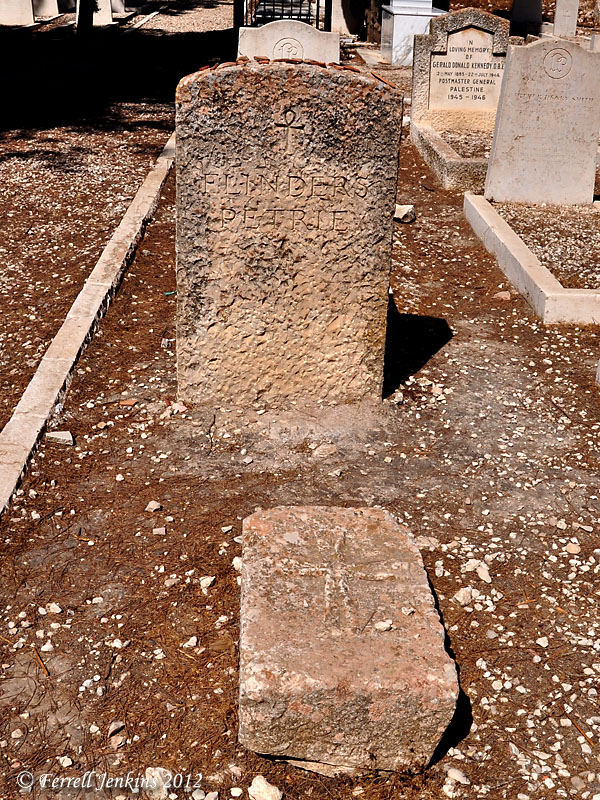
Today I visited the Jerusalem Protestant Cemetery to see the tomb of Petrie, as well as several other well-known persons of the past. Here is a photo of Petrie’s grave marker.

Grave marker for Flinders Petrie in Jerusalem Protestant Cemetery. Photo by Ferrell Jenkins.

Grave stone for Flinders Petrie, Jerusalem Protestant Cemetery. Photo: Ferrell Jenkins.

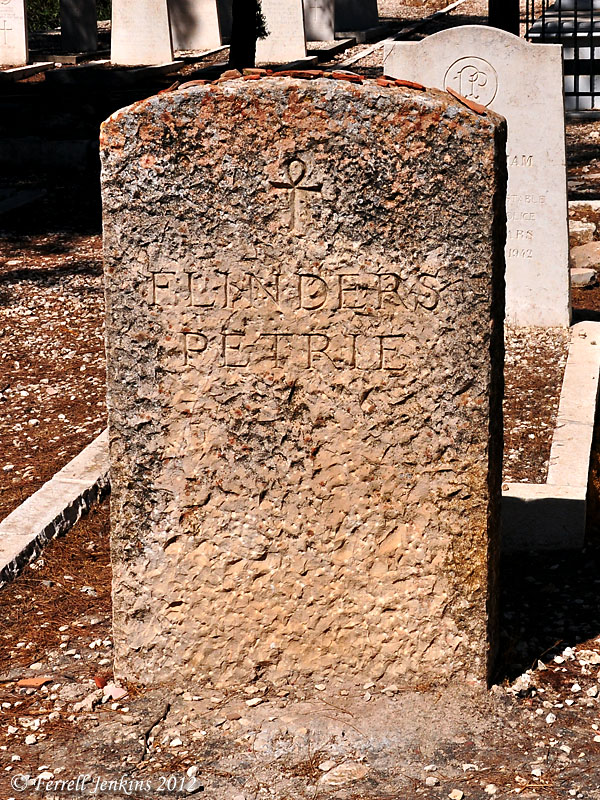
Besides the simplicity of the marker — only his name, there are two other things I find interesting. There is an ankh symbol (the life symbol) from ancient Egypt above the name. When Jews visit a tomb, small stones are left to show respect. Instead of stones, this marker has potsherds, pieces of broken pottery, on the top of it. I suspect that these were left by the visitors on the anniversary of his death.

Flinders Petrie Grave in Jerusalem. Photo by Ferrell Jenkins.

Close up of Petrie’s grave marker in Jerusalem. Photo by Ferrell Jenkins.

In another post, perhaps later, I plan to tell you about some of the other persons of interest who are buried in the same cemetery

Eisenbrauns 2012 Mug announced

Scholarly book publisher Eisenbrauns announces the Eisenbrauns 2012 Mug.

Eisenbrauns 2012 Mug

Eisenbrauns 2012 Mug
A Hittite Proverb

Eisenbrauns, Forthcoming June 2012
14 ounces, Hittite and English
Ceramic
Your Price: $7.50
www.eisenbrauns.com/item/EISMUG2012

If you want to know what the Hittite proverb says, click on the link to Eisenbrauns.

Just something on the lighter side for you to enjoy while I make my way across the Atlantic.

The James Ossuary verdict. Does it matter?

Shortly after the SBL meeting in Toronto (November, 2002), I presented a lecture on the subject and posted similar material on Bible World here. The material I have posted in the past two days, and this one, has been posted at Bible World since December 18, 2002. Only minor changes have been made to correct tenses, mention dead links, etc.

Below are the questions I asked in my study, and the conclusions I drew, in 2002. This was when the issue was still a matter of scholarly discussion. No criminal forgery charges had been made at the time.

— • —

Several important questions should be asked about this ossuary. These questions will help us draw some conclusions.

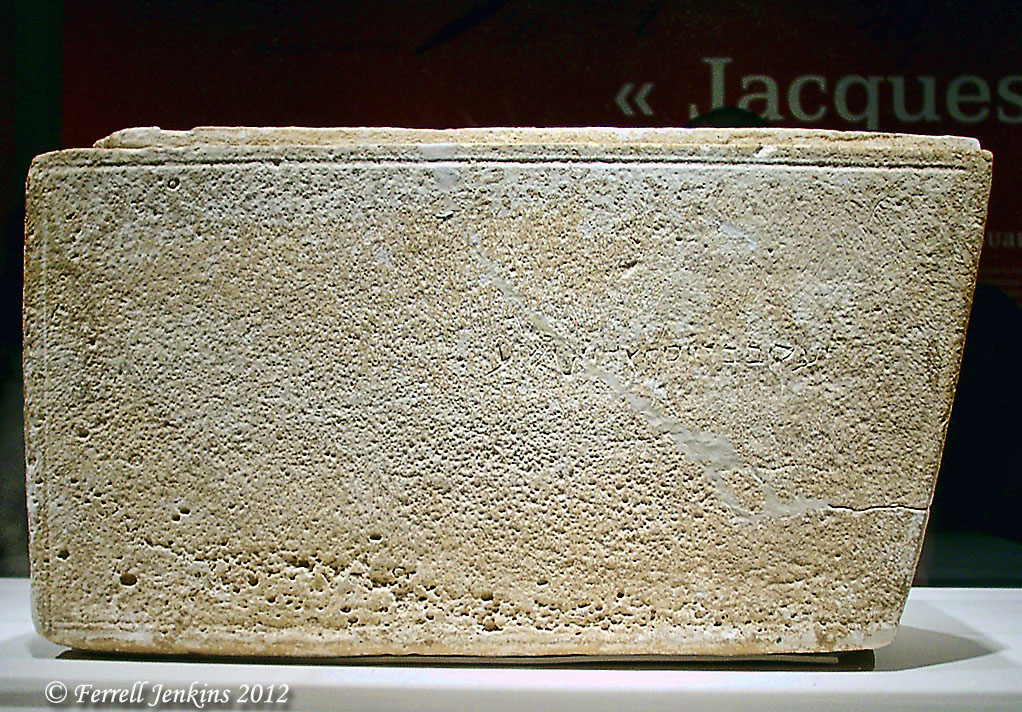
Did the ossuary originate in first century Jerusalem? The evidence indicates that it did. The Geologic Survey of Israel has certified that the limestone is typical of that quarried in Jerusalem during the first and second centuries A.D. The patina in the inscription contains no modern elements, and there is no indication of the use of a modern tool on the ossuary. André Lemairé thinks this type of ossuary can be dated between 20 B.C. and A.D. 70.

James Ossuary at the Royal Ontario Museum - Nov. 22, 2002.

James Ossuary at the Royal Ontario Museum -2002. Photo by Ferrell Jenkins.

Is the inscription authentic? The shape of certain of the letters indicates that the Aramaic inscription belongs to the last decades before the destruction of Jerusalem in A.D. 70. This is the exact period, according to Josephus, when James was killed. Some scholars have suggested that the inscription may have been written by two different hands. Lemairé sees no reason to draw this conclusion. After the panel discussion [at the SBL meeting in Toronto] the ossuary was examined by Frank Moore Cross and Joseph Fitzmeyer, both experts in the Aramaic of this period. According to Oded Golan, in an interview with the Discovery Channel  [the link is no longer active], they believe the inscription was written by one hand.

Is this the James of Galatians 1:19 and Acts 15? Is the James mentioned on the ossuary the James of the New Testament (Acts 15; Gal. 1:19)? In first century Jerusalem many people bore the names James, Joseph, and Jesus. When we consider the combination of relationships (son of, brother of), the number of possibilities goes down dramatically. The exact size of the population is uncertain. Lemairé estimated a maximum population of 80,000. Based on ossuary inscriptions of the period, Lemairé first suggested that about 20 people could be called “James son of Joseph brother of Jesus.” Golan says that Professor Camil Fuchs, head of Tel Aviv University’s Department of Statistics and Operations Research in the School of Mathematical Sciences, estimates on the basis of a highly complex statistical analysis that “only one person could be ‘James son of Joseph brother of Jesus,’ and that is the man who was known as James the Just, a leader in the early church and the brother of Jesus Christ” (Paddey, Patricia L. “Ossuary’s Owner Reveals New Research.” http://www.biblenetworknews.com (23 Nov. 2002; this link is no longer active). I think the combination of relationships makes it highly probable that this is the ossuary of the James of Acts 15, but we may never know for certain.

Does it matter? If the inscription is authentic, it is another of the many archaeological confirmations of Biblical characters. We already know of Caiaphas, Pilate, Erastus, et al. It is another example of the historicity of the New Testament. It provides the earliest inscriptional evidence of Jesus. If the inscription is not authentic then it is just an ordinary limestone bone box, but one that has caused multitudes to discuss Jesus and the New Testament. Let us use it as an opportunity to discuss Jesus with those who do not know Him.

Please keep in mind that the New Testament documents, all of which date to the first century, provide the evidence that Jesus is the Christ, the Son of God (John 20:31).

Now Jesus did many other signs in the presence of the disciples, which are not written in this book; but these are written so that you may believe that Jesus is the Christ, the Son of God, and that by believing you may have life in his name. (John 20:30-31 ESV)

The Current Situation (2012). Today, and in the months to come, the reaction to this court decision will likely be along this line. Those who “knew” that the ossuary inscription was a fake, still think it is a fake. Those who thought the full inscription is genuine, still think it is genuine. Those who did not know whether the inscription was genuine or a fake still do not know. That is where I stand.

Additional Links of Interest.

Herschel Shanks, Bible History Daily, here.

Eric Meyers’ reaction on the ASOR Blog here.

Christopher Rollston, here.

The James Ossuary Exhibition in Toronto

Biblical Archaeology Review cover above the James Ossuary.The existence of an ossuary bearing an Aramaic inscription, “Ya’akov bar Yosef akhui diYeshua” [James the son of Joseph the brother of Jesus] was announced at a press conference conducted by Hershel Shanks, editor of Biblical Archaeology Review, October 21, 2002. In the feature article of the November-December issue of Biblical Archaeology Review, Professor Andre Lemairé gives details about the ossuary and its inscription. An ossuary was used to house the bones of the deceased after the decay of the body. An ossuary need be only as large as the longest bones. The ossuary under consideration is about 20 inches long, 12 inches high, and 10 inches wide. They were commonly used by the Jews for secondary burial in the first century A.D.

The James Ossuary was placed on display at the Royal Ontario Museum in Toronto, Canada, from November 15th through December 29, 2002. It was displayed in a third floor room by itself in a well-lighted case. The walls of the room were filled with information about James, ossuaries, Jewish burial customs, and the James ossuary. The ossuary was cracked in transit from Israel to Canada but was been restored by the museum staff. The ROM has a good selection of material from the ancient Mediterranean world. The exhibition of the James Ossuary was arranged to coincide with the annual meetings of the American Schools of Oriental Research, the American Academy of Religion, and the Society of Biblical Literature. About eight thousand professors of religion and Biblical studies from around the world attend these meetings.

“No Ordinary Box of Bones”

The Society of Biblical Literature (SBL) planned a special session under the title “No Ordinary Box of Bones” for a learned discussion about the ossuary. The panel included the following scholars:

André Lemairé, the epigrapher from the Sorbonne who recently published the ossuary inscription in the Biblical Archaeology Review.

John Painter, author of a book on James, from Charles Stuart University in Australia.

Steve Mason, a Josephus scholar, from York University, Toronto. He put the quotation about James in Josephus in its proper context.

Eric Meyers, an archaeologist and scholar of Judaism at Duke University.

Hershel Shanks, editor of Biblical Archaeology Review.

Adele Reinhartz, of Wilfred Laurier University, served as chair of the panel.

Lemairé summarized the material from his BAR article. He responded to some recent charges that the second half of the inscription [brother of Jesus] is different from the first part [James the son of Joseph]. Evidence from paleography places the Aramaic inscription near the middle of the first century AD, prior to AD 70.

Eric Myers, a former president of ASOR, stated that he had concern about the existence of such a panel in light of the fact that the ossuary was “looted” and sold on the illegal antiquities market. He said the owner had been questioned by the police in Israel about the ossuary.
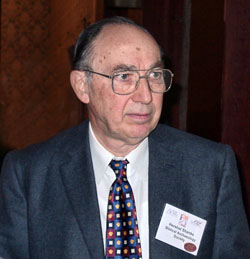
Herschel Shanks at SBL in Toronto, 2002.

Herschel Shanks in Toronto, 2002.

Herschel Shanks took exception to several statements made by Myers. Shanks publishes artifact which belong to private collectors. Both Shanks and Lemairé emphasized that the Dead Sea Scrolls fall into the same category. Shanks said there are good collectors and bad collectors. Good collectors allow their material to be published and share it with the world. Bad collectors keep their artifacts in their basements for personal enjoyment.

Mason put the quotation about James from Josephus in proper historical context. Josephus was dealing with the character of High Priests and mentioned, incidentally, that one of the people put to death was the brother of Jesus, the so-called Christ.

The quotation from Josephus, perhaps written in the last decade of the first century A.D., reads this way:

…when, therefore, Ananus was of this disposition, he thought he had now a proper opportunity [to exercise his authority]. Festus was now dead, and Albinus was but upon the road; so he assembled the Sanhedrin of judges, and brought before them the brother of Jesus, who was called Christ, whose name was James, and some others, [or some of his companions]; and, when he had formed an accusation against them as breakers of the law, he delivered them to be stoned: (Ant 20:200)

Painter mentioned the tradition that the throne of James (as Bishop of Jerusalem) and his burial in the Church of Saint James, an Armenian church in Jerusalem. He also cited other traditions about the death and burial of James from Clement of Alexandria, Hegesippus, and Eusebius.

A portion of the quotation from Eusebius, from the early 4th century A.D., reads,

These things are related at length by Hegesippus, who is in agreement with Clement. James was so admirable a man and so celebrated among all for his justice, that the more sensible even of the Jews were of the opinion that this was the cause of the siege of Jerusalem, which happened to them immediately after his martyrdom for no other reason than their daring act against him.

Josephus, at least, has not hesitated to testify this in his writings, where he says, “These things happened to the Jews to avenge James the Just, who was a brother of Jesus, that is called the Christ. For the Jews slew him, although he was a most just man.” (Ecclesiastical History 2 23:19-20)
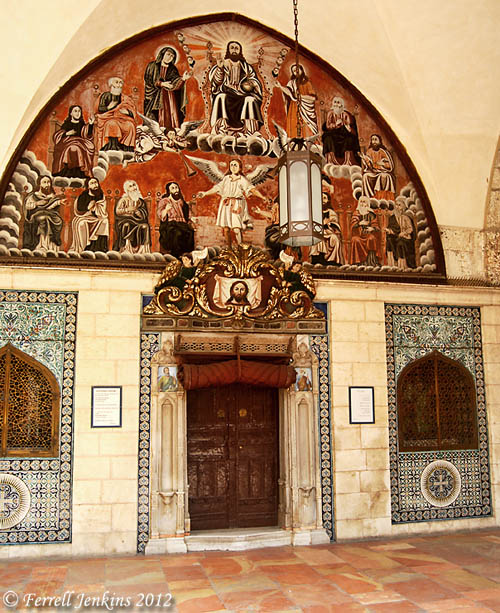
Entrance to St. James Cathedral in the Armenian Quarter of Jerusalem. Photo by Ferrell Jenkins.

Entrance to St. James Cathedral in the Armenian Quarter in the Old City of Jerusalem. Photo by Ferrell Jenkins.

When the panelists finished their presentations, time was allowed for only two or three questions from the audience of about 800 persons. I was seated directly in front of the podium about 4 or 5 rows from the front and rose to ask the first question. The owner of the ossuary, Mr. Oded Golan, was present for the session. I stated that we would like to hear him say how long the ossuary had been in his possession and whether the inscription was on it when he obtained it. Mr. Golan went to the platform and stated that he obtained the ossuary in the 1970s and that the inscription was on it when he obtained it. He is 51 years of age, and has been collecting ossuaries and other antiquities since he was 8 years old. He stated that one item from his collection had been published by the late Yigael Yadin.
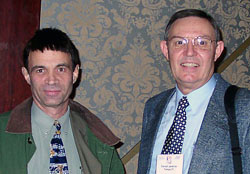
Oden Golan and Ferrell Jenkins at SBL, Toronoto, 2002.

Oden Golan and Ferrell Jenkins at SBL, Toronoto, 2002.

It may sound strange to Americans that a young boy would be collecting ossuaries and other antiquities. We must remember that ancient artifacts are everywhere in Israel (and the West Bank) and that archaeology is a sort of past-time for many people who live there. As a boy growing up in north Alabama I picked up Indian arrowheads from the cotton fields. I have visited several homes in which the host would bring out numerous boxes of artifacts that they had collected from Indian mounds.

Well, I trust this will give our readers a little perspective on the initial presentation of the James Ossuary. You may read more about the trial which has been going on since December, 2004, here.

Visual illustrations for Daniel 8

In Daniel’s vision of a ram and a male goat we are given a glimpse of the two world empires following Babylon — the Medo-Persian Empire and the Alexandrian (or Hellenistic/Grecian) Empire.

Daniel sees a ram.

I raised my eyes and saw, and behold, a ram standing on the bank of the canal. It had two horns, and both horns were high, but one was higher than the other, and the higher one came up last. (Daniel 8:3 ESV)

Ram at Socoh. Photo by Ferrell Jenkins.

A ram. With horns like that it is easy to see who is boss. Photo by Ferrell Jenkins.

In apocalyptic literature the visions take liberty with reality. It would require an artist to draw the ram and the male goat exactly as Daniel saw them.

Then Daniel sees a male goat.

As I was considering, behold, a male goat came from the west across the face of the whole earth, without touching the ground. And the goat had a conspicuous horn between his eyes. (Daniel 8:5 ESV)

A male goat in Gilead (modern Jordan). Photo by Ferrell Jenkins.

A male goat in Gilead (modern Jordan). Photo by Ferrell Jenkins.

The interpretation is easier for us than it was for Daniel before Gabriel gave him an understanding of the vision (vs. 15-16).

As for the ram that you saw with the two horns, these are the kings of Media and Persia.  And the goat is the king of Greece. And the great horn between his eyes is the first king.  (Daniel 8:20-21 ESV)

It will not be difficult to find other uses for photos of the ram and the male goat in Bible lessons (e.g., Genesis 15:9; Leviticus 23:19; 16:5)