Category Archives: Bible Study

The Executable Preacher

Mark Copeland, over at Executable Preacher, has been kind enough to mention Ferrell’s Travel Blog. Mark and his wife were among my early students. He has preached for years at Fortune Road in Kissimmee, FL. Anyone visiting the Disney/Universal area should look up these brethren. I keep a link to both Fortune Road and Executable Preacher at the Biblical Studies Info Page under Links.

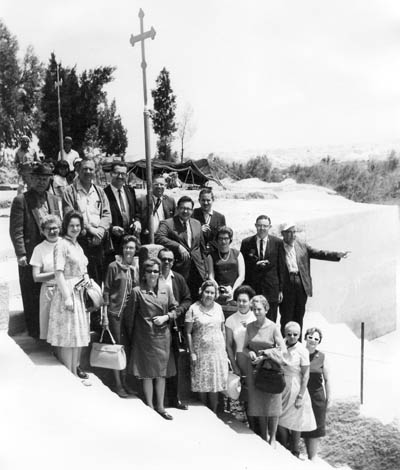
Mark mentions that his father-in-law, Steve Hudgins, was on one of my earliest tours. It fact, it was the first one in 1967. If you know Steve you can locate him in the photo of that group at the Jordan River in our post of September 4. For many years Steve supplied the pens and travel bags that we distributed to tour members. He also painted many of the banners that we used in the group photos.

Thanks, Mark. If there are any readers here that do not visit your blog with regularity, I hope that will do so now. I miss it when you go too long without writing. The page should be of interest to preachers, elders, and Bible teachers generally.

The Middle East Conflict and the Bible

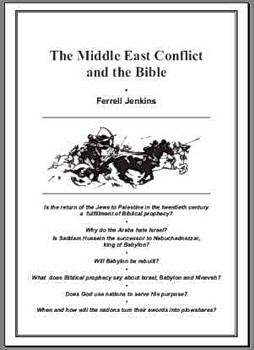
Shortly before the first Gulf War I pulled together some of the material I had prepared about various problem associated with the Middle East conflict and the Bible. After going through several printings I allowed Mark Roberts to put the material for sale online at BibleClassMaterial.com. A single copy may be purchased, or a church may secure a license to use the material in classes. Take a look.

The Middle East Conflict and the Bible by Ferrell Jenkins

The book deals with the Arab-Israeli problem, whether the modern state of Israel is in fulfillment of Bible prophecy, and other important issues. There is also material about Iraq and Islam. At the BibleClassMaterial website you will find more details about the content.

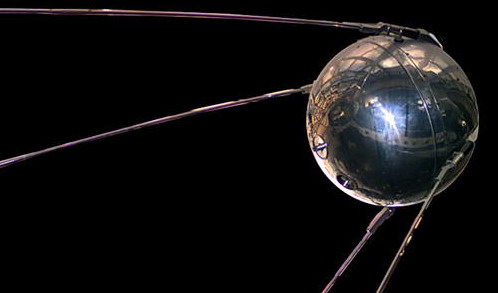
A Remembrance: Sputnik I launched 50 years ago today

The NASA web page says,

History changed on October 4, 1957, when the Soviet Union successfully launched Sputnik I. The world’s first artificial satellite was about the size of a basketball, weighed only 183 pounds, and took about 98 minutes to orbit the Earth on its elliptical path. That launch ushered in new political, military, technological, and scientific developments. While the Sputnik launch was a single event, it marked the start of the space age and the U.S.-U.S.S.R space race.

Read more details on the NASA web site.

If you have forgotten the sound transmitted by Sputnik as it passed overhead, listen to a short WAV file on the NASA site.

Sputnik I - 1957

Having completed four years of college at Florida Christian College (now Florida College) in Temple Terrace, FL, a few months earlier I had moved to preach in Auburn, Kentucky. A college friend was spending the summer preaching in nearby Morgantown. Elizabeth and I drove up to visit him. My recollection of the town at that time is that there were businesses on only one side of the square (meaning across from the county court house). Lawson informed us that many of the people there believed that the whole thing about Sputnik was some kind of a trick. Nothing was up there, according to them. Later, when astronauts walked on the moon, there were some in numerous places who said it was all filmed in the Arizona desert.After Russia began manned, tethered space walks, one of the atheistic astronauts is reported to have said that he walked in space, but did not see God. Someone suggested that if he had cut his tether he might have seen God. In the intervening years we have learned so much about the expanding universe that it difficult to countenance the ignorance and arrogance of men claiming to know there is no God.

Space exploration has probably benefited each of us in many ways through the developments and products we now use. There currently seems to be a common view that the program is going to eventually prove once and for all that all this universe is a product of naturalistic, chance evolution. Not so fast.

Dr. Robert Jastrow, an astronomer, who admitted that he was an agnostic in religious matters, wrote:

“It is really very surprising that the labors of the astronomers, studying the Universe through their telescopes, should have brought them to the conclusion that the world had a beginning. Scientists feel more comfortable with the idea of a Universe that has existed forever, because their thinking is permeated with the idea of cause and effect. They believe that every event that takes place in the world can be explained in a rational way as the consequence of some previous event. If there is a religion in science, this statement can be regarded as its main article of faith. But the latest astronomical results indicate that at some point in the past the chain of cause and effect terminated abruptly. An important event occurred–the origin of the world–for which there is no know cause or explanation” (Until the Sun Dies. 1977. 27).

“A sound explanation may exist for the explosive birth of our Universe, but if it does, science cannot find out what the explanation is. The scientist’s pursuit of the past ends in the moment of creation; the origin of the world is a fact that he can never hope to explain” (Until the Sun Dies. 1977. 28).

In another book, Dr. Jastrow said,

“Now we see how the astronomical evidence leads to a biblical view of the origin of the world. All the details differ, but the essential element in the astronomical and biblical accounts of Genesis is the same, the chain of events leading to man commenced suddenly and sharply, at a definite moment in time, in a flash of light and energy” (God and the Astronomers. 2nd ed. 1992. p. 14).

Here are a few helpful comments regarding the origin of the universe.

The Psalmist David said,

“The heavens declare the glory of God, and the sky above proclaims his handiwork” (Psalm 19:1 ESV).

The writer of the Epistle to the Hebrews says,

“For every house is built by someone, but the builder of all things is God” (Hebrews 3:4 NET).

Paul expressed the value of the natural creation even to men who do not have the light of propositional revelation (the gospel, Romans 1:16).

“For since the creation of the world His invisible attributes, His eternal power and divine nature, have been clearly seen, being understood through what has been made, so that they are without excuse” (Romans 1:20 NASBu).

Today is Yom Kippur

Today is Yom Kuppur, the Day of Atonement, for those who follow the Mosaic system. Information may be found in Leviticus 16 (NET Bible) in the Old Testament (Hebrew Bible). If you would like to read a modern Jewish description of the day read Judaism 101.

Christians who follow the New Testament believe that the Mosaic system has been removed and superseded by the gospel of Christ. Various New Testament writers have spoken on these matters. Here are a few significant references: Ephesians 2:14-16; Colossians 2:11-14; 2 Corinthians 3. Three entire New Testament epistles are devoted to discussions of the subject: Romans, Galatians, Hebrews. Hebrews 9:22-28 indicates that the offering of Christ is a one-time event, and sufficient to cover the sins of man.

Notice a few comments.

Hebrews 10:1-4 For the Law, since it has only a shadow of the good things to come and not the very form of things, can never, by the same sacrifices which they offer continually year by year, make perfect those who draw near. 2 Otherwise, would they not have ceased to be offered, because the worshipers, having once been cleansed, would no longer have had consciousness of sins? 3 But in those sacrifices there is a reminder of sins year by year. 4 For it is impossible for the blood of bulls and goats to take away sins (NASB).

Contrast this with the great proclamation of John the Baptist in the Gospel of John 1:29: “Behold, the Lamb of God who takes away the sin of the world”

Last year Todd Bolen posted a blog, with photos, of some residents of Jerusalem who “In the absence of a temple and the blood sacrifices that provide atonement for sins, some Jews today observe a sacrificial ceremony with a chicken.” You can find the full post here. I learned of a similar annual practice (not associated with Judaism) on a visit to Nepal a few years ago. Didn’t work before; won’t work now.

The Reformation and Restoration in Scotland

For those with an interest in Church History, Scotland provides many links. Scotland was influenced by the work of both Martin Luther and John Calvin, who were already advancing the Reformation principles in the early part of the 1500s. Sixteenth century Scottish leaders, who began their work a few years later, included George Wishart and John Knox.

Those of us with a background in the Restoration Movement in America find ourselves in agreement with many of the principles of the Reformation, but not with all of them. Thomas and Alexander Campbell came to America from Northern Ireland. In that area the people “were predominantly Anglo-Scottish in blood and Protestant in religion” (West). Thomas Campbell came to America in 1807. In 1808, when Alexander set out for America he was shipwrecked on the rugged shores of Scotland. Alexander entered Glasgow University where his father has studied earlier. He studied Greek, Logic, and Experimental Philosophy. He came in contact with several independent movements and was especially influenced by James and Robert Haldane. John Glas and Robert Sandeman influenced the young Campbell also. Their churches were congregational in government with a plurality of elders and deacons. They rejected human creeds, advocated weekly observance of the Lord’s Supper. See West, The Search for the Ancient Order, I:36-52.

In America, Barton W. Stone and the Campbells rejected the Calvinistic doctrines of inherited depravity, the direct operation of the Holy Spirit, etc. They determined that the New Testament was the standard of authority for Christians, and that baptism for forgiveness of sins is immersion. Infants did not need to be baptized because they are not sinners.

Writings of some of the Restoration leaders are available online at the Restoration Movement Page.

King James VI (James Stuart) of Scotland was King of Scots, King of England, and King of Ireland. He “authorized” the translation of the Bible that we still know as the King James Bible (1611). King James was born in Edinburgh Castle. The finished product was largely the work of William Tyndale whose New Testament was printed in 1525. His work on the Old Testament was completed by Miles Coverdale and the entire English Bible was first printed in 1535. Tyndale was strangled and burned at the stake in 1536. A nice time line on the Reformation can be studied at the Friends of Tyndale page.

Prior to the work of Tyndale in Scotland, Martin Luther was pushing the Reformation in Germany. Zwingli was at work in eastern Switzerland., and John Calvin was working with Theodore Beze in Geneva, Switzerland.

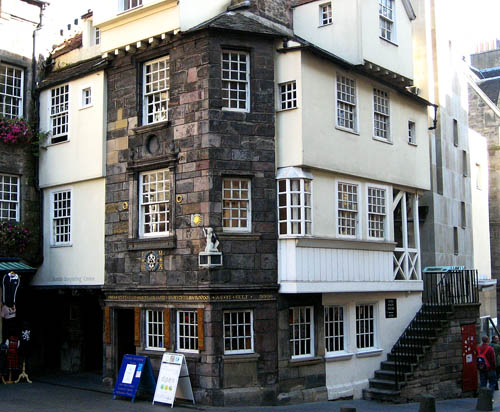
This beautiful and sunny morning I visited the John Knox house in Edinburgh. It is a house dating to the time of Knox and has been sparsely furnished in period furniture. It serves as a museum of the work of Knox. There are several printed volumes (including the Geneva Bible) of the time on display. The Knox house is located on the Royal Mile.

John Knox House, Edinburgh, Scotland.

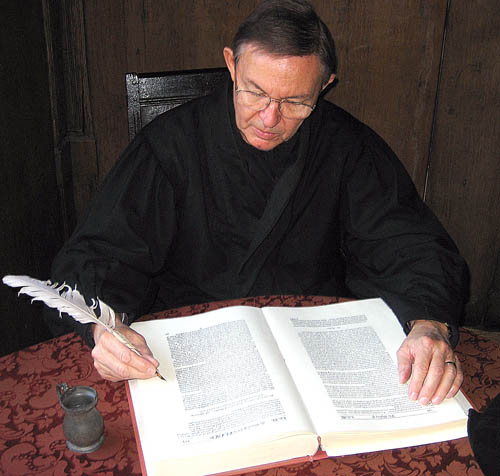
This modern scribe, sitting at a table in the Knox house, is thinking about correcting some of the Calvinistic ideas advanced by Knox.

Modern Scribe in the John Knox House in Edinburgh.

I believe these men failed in some regards, but I am grateful for the work they did to bring us this far. To paraphrase the words of Bernard of Clairvaux, “If we can see further it is because we are standing on the shoulders of giants.”

“Let us therefore, as many as are perfect, have this attitude; and if in anything you have a different attitude, God will reveal that also to you; however, let us keep living by that same standard to which we have attained. Brethren, join in following my example, and observe those who walk according to the pattern you have in us.” – The Apostle Paul, Philippians 3:15-17.

A cold, but enjoyable weekend in Inverness

Yesterday was Saturday, the Sabbath, the day of rest of the ancient Israelites (Ex. 20:8).. Today is Sunday, the Lord’s Day (Rev. 1:10; Acts 20:7). This day commemorates the resurrection of the Lord Jesus Christ. Christians of New Testament times gathered on this day to worship the Lord.

To a Floridian it has been cold here in Inverness, Scotland. Yesterday morning it was about 44 degrees. The forecast for this morning is 42, with a high of 50 for the day. The rain and wind makes it even colder in the northeast of Scotland. It is not raining at the moment and the wind is calm.

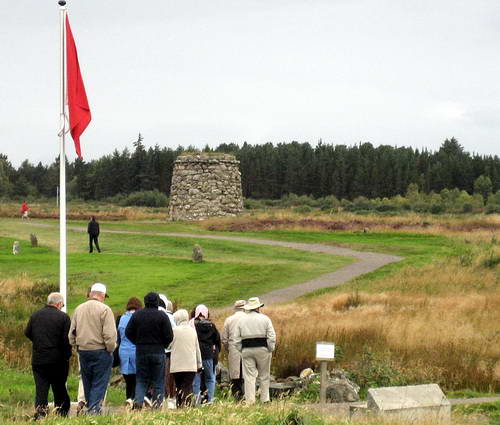
Yesterday we went to a famous battlefield nearby called Culloden. Here in 1746 the Jacobites (those who favored the kings named James) were defeated by the Government Army. This was the last battle fought on British soil.

Culloden Battlefield, Inverness, Scotland. Photo by Ferrell Jenkins.

Later we made the perfunctory stop at a woolen mill. Actually, many of the folks on the tour enjoy this. It gives them a chance to pick up a souvenir. Not everyone is looking at the clothing, as this picture of Herbert shows.

Gold at the Woolen Mill

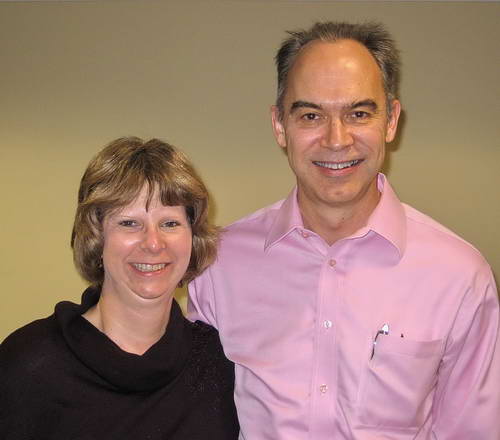
The weather was much better today. It was still cold, but the wind was calm even during periods of showers. Tim and Ann Byers, now living in Aberdeen, came to worship with us. It was a pleasure to see them. Both had been among my students at Florida College. Tim is now on work assignment in Scotland. He has produced a computer program called Everyone’s Guide to the Bible. I suggest you look into this good program. The web site is http://christianfriendssoftware.com. Here is a photo of Tim and Ann that I made this morning. They joined us for the afternoon sightseeing and we had a good visit.

Tim and Ann in Scotland.

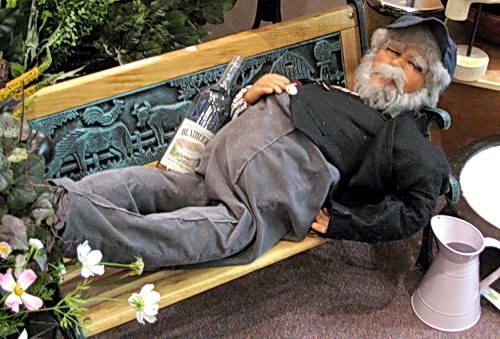
In the afternoon we went a few miles from Inverness to the Spreyside Heather center where we enjoyed a nice lunch. They even had jewelry made from heather. After that we continued to Cairngorm Mountains and took the funicular railway to near the top. The highest peak of the mountain, the highest in the UK, is 4,296 feet above sea level. Haze covered the top of the mountain, but we enjoyed the train ride and a cup of hot chocolate at the restaurant. There were some neat displays at the Spreyside Heather center. I suspect this one below illustrates the danger of Scotch Whiskey.

Scotch Whiskey. Display at the Spreyside Heather Center. Photo by Ferrell Jenkins.

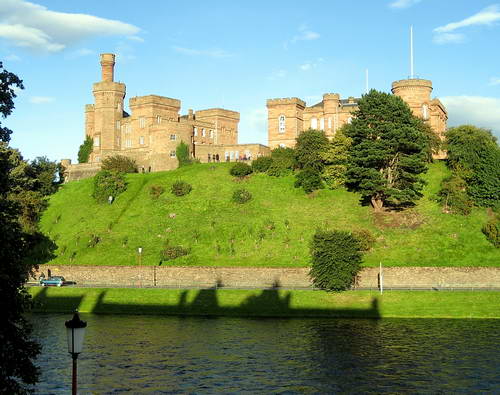
Our hotel in Inverness is situated directly across from the Inverness Castle. It is a fairly new construction that serves as the town center (city hall, etc.). The river in the foreground is the Ness River. It flows east from Loch Ness to the North Sea.

Inverness Castle. Photo by Ferrell Jenkins.

Tomorrow we leave early for St. Andrews and Edinburgh. Thanks for dropping by.

Stirling Castle, Loch Lomond, Inveraray, and Oban

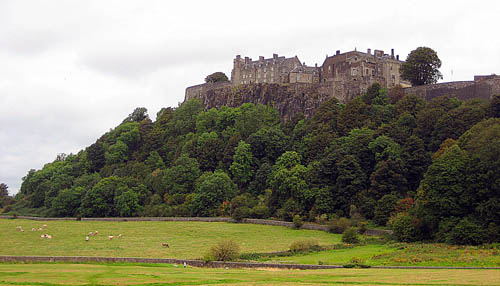
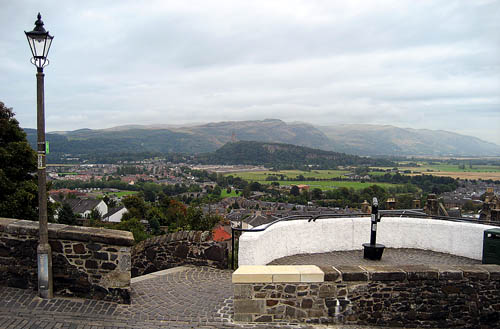
This morning we visiting Stirling Castle and its lovely gardens. The castle was home to most of the King Jameses. The castle looks down upon Bannockburn, Scotland’s proudest battleground where, in 1314, Robert the Bruce secured Scotland’s independence when he defeated the English. The photo below illustrates that the castle rises high above the plain and served as a suitable place for a fortress.

Stirling Castle

From Stirling Castle we are able to see the William Wallace monument at Abbey Craig. This monument recalls Wallace’s defeat of the English at Stirling Bridge in 1397.

Wallace Monument at Abbey Craig

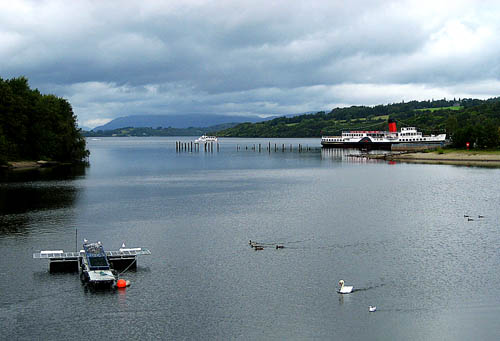
We stopped for lunch on the shore of Loch Lomond. Today we had some nice periods of sunshine, as this photo shows.

Loch Lomond. Photo by Ferrell Jenkins

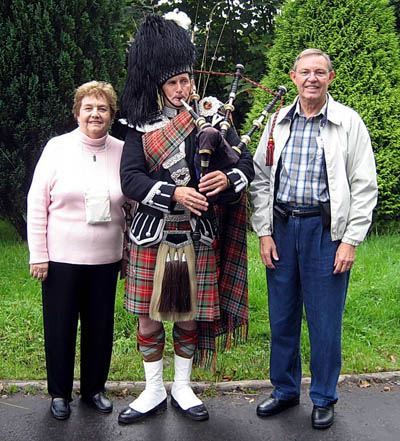
In the afternoon we made a short stop in the tiny town of Inveraray. Elizabeth and I had out photo made with a bagpiper.

Ferrell and Elizabeth and a Scottish Bagpiper at Inveraray.

Tonight we are staying at Oban, a seaport on the firth of Lorn. This small city is called the Gateway to the Isles.

Weeping for the Jordan

“Weeping for the Jordan” is the title of a short news item in Christianity Today, Sept., 2007, p. 17. The article from the RNS says the lower portion of the Jordan River “is so polluted that the World Monuments Fund (WMF) has designated it an Endangered Cultural Heritage Site.”

We often point out to audiences that the Jordan has much less water flowing through it now than it did even 50 years ago. This is because Israel uses much of the water of the Jordan and its tributaries for water and agricultural irrigation. Jordan has dams on the Yarmuk and Jabbok rivers, tributaries from the east.

There is not full agreement among scholars, but many believe that the site where Jesus was baptized by John is a few miles north of the Dead Sea. In 1967 I was able to visit that site. Since the 1967 war it has not been possible for tourists to visit there. A few years back a site was excavated in Jordan that has been claimed to be Bethany Beyond the Jordan (Jn. 1:28).

The CT article points out that the Jordan River is “highly polluted with sewage and agricultural runoff” near Bethany Beyond Jordan, but that some tourists do not realize this and wade in the water.

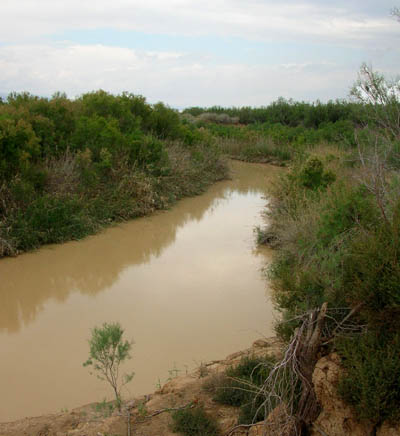
In 2006 I was able to take my group to Bethany Beyond Jordan and visit the Jordan River. Here is one of the photos made at that time.

Jordan River at Bethany Beyond the Jordan.

We are hopeful of visiting this site again in 2008. Perhaps it is in the area where John did some of his baptizing (cf. Jn. 10:40). The Israelites crossed the Jordan somewhere near here (Josh. 3), and the prophets Elijah and Elisha crossed in the opposite direction near here (2 Kings 3).

This photo was made on the West side of the Jordan River, in the country of Jordan, in 1967. This is directly across from the Bethany Beyond Jordan site.

1967 Bible Land Group led by Ferrell Jenkins and William E. Wallace.

The photo was made on or about May 5, 1967. Notice the attire. Women wore hosiery and other items to help their body hold an ideal shape. Most men wore a coat, and many wore ties on the plane and throughout the entire trip, even in hot weather. Some hotels would not allow a man in the dining room unless he was wearing a coat. Were these the good old days?

Tours information for 2008 now posted

We have now posted details about our tours for 2008 at tours.biblicalstudies.info. Our tours are primarily intended for members of churches of Christ. We understand the Bible study habits of these folks and we build the tours to meet their needs. Our tours are study tours; not simply vacation travel. We emphasize the land, the biblical events, and the archaeology of the sites visited. The tours are under my personal direction. We have been directing tours since 1967. The two tours for 2008 are number 71 and 72. Take a look.

Hezekiah’s Tunnel

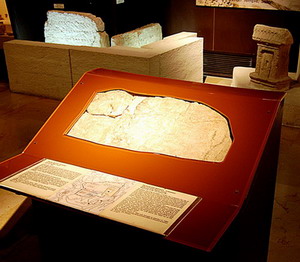
In Istanbul we visited the Palestine Room at the Istanbul Archaeological Museum. There we saw the stone inscription, sometimes called the Siloam Inscription, which was taken from Hezekiah’s tunnel in Jerusalem during the Ottoman period. Recently I posted an article about Hezekiah’s Tunnel at BiblicalStudies.info, along with several photographs of the tunnel. This tunnel, built by the King of Judah about 710 B.C., is mentioned in 2 Kings 20:20.

The photo below shows the inscription in its case in Istanbul. There is some recent talk indicating that this inscription might be returned to Jerusalem.

Hezekiah’s Tunnel (Siloam) Inscription