Category Archives: Bible Study

Visiting the Judean Hills

We were able to visit several sites in the Judean Hills yesterday. Many of them were in the territory of the Israelite tribe of Dan.

Zorah was the birthplace of Samson. The biblical record says,

And the Spirit of the LORD began to stir him in Mahaneh-dan, between Zorah and Eshtaol.  (Judges 13:25)

Both of these towns are within an area now designated a forested park land.

When the Ark of the Covenant was returned by the Philistines on a cart pulled by milk cows, it came into the Zorek Valley near Beth Shemesh (1 Samuel 6). The ark was later taken to Kiriath-jearim before being moved to Jerusalem by David (2 Chronicles 1:4). We visited all of these sites.

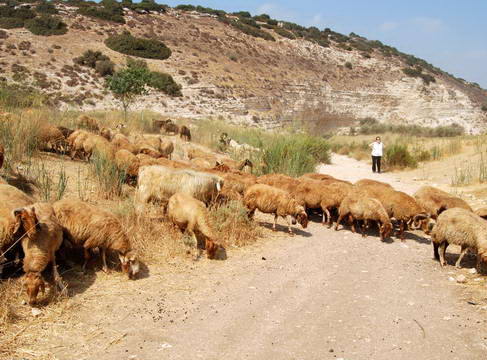
We also visited the sites around the Valley of Elah where young David met Goliath the Philistine from Gath in a decisive battle (1 Samuel 17). While we were in the process of picking up five smooth stones for our grandson, Drew, a shepherd drove a flock of sheep across the brook. You can see from the photo that Elizabeth and I were separated for a while.

Elizabeth and I were temporarily separated in the brook of Elah by a flock of sheep. Photo by Ferrell Jenkins.

Elizabeth and I were temporarily separated in the brook of Elah by a flock of sheep. Photo by Ferrell Jenkins.

Understand that the brook (nachal) of Elah has water in it only during the rainy season. We also visited Tell es-Safi, thought to be the site of Gath, one of the major Philistine cities and the home of Goliath. The excavator, Aren Maeir, has a marvelous aerial photo of the top of the tell posted at the Tell es-Safi/Gath blog. We did not have time to climb to the top, but maybe we can get back to it another day.

Did Zoroastrianism influence Christianity?

There are many subjects on which I would enjoy commenting, but I have determined to keep this Blog as a travel blog pertaining primarily to biblically related sites. And, I don’t have time to take care of another blog.

We had a comment on The Persian background of Iran that needs some comment. Our reader says,

And incidentally, there’s much more of Iran in the bible. The original “apple” was actually a pomegranate — which comes from Iran, for example. Mithraism, a Persian religion, was the basis for the celebtration of Christmass. The whole concept of hell and heaven and angles was introduced from Zoroastrianism into Judaism and then Christianity.

The Bible does not speak of an “apple” in the Garden of Eden. In Genesis 3:3 and 3:6 we are told that Adam and Eve had been told not to eat “from the fruit of the tree which is in the middle of the garden.” The fruit was good for food. Earlier, in Genesis 1:29 we are told that God gave man “every tree which has fruit yielding seed, it shall be food for you.” The Hebrew words are the same for fruit, tree, and food in both Genesis 1 and Genesis 2. We certainly do not know that the fruit was pomegranate.

The issue of whether Judaism and Christianity have borrowed some basic concept from Zoroastrianism is debatable. Notice the comment by Lewis and Travis in Religious Traditions of the World (Zondervan, 1991).

The relation between Zoroastrianism and the chief monotheistic religions, Judaism, Christianity, and Islam, is debated. Part of the problem is due to the fact that the collection of Zoroastrian teaching was not completed until the fourth century C.E. [A.D.], leaving in some doubt who may have influenced whom in such matters as angels, resurrection, and eschatology. (57)

If one takes the New Testament as the complete and final revelation of the will of God for man, as I do, any changes in doctrine after New Testament times must be considered as departures from the faith. The argument goes something like this:

  • The New Testament is the completed revelation of the mind of God to man (Ephesians 3:1-7; 1 Corinthians 2:6-13; Ephesians 4:5; Jude 1:3; Romans 1:16; I Corinthians 1:21, et al.). The Scripture is the inspired word of God (2 Timothy 3:16-17).
  • Jesus is God (John 1:1; Hebrews 1:8; Colossians 1:15-17). He became flesh (John 1:14). He died on the cross for the sins of mankind (1 Corinthians 1:23; 2:2, 8; 15:3-4; Hebrews 9:28; Acts 2:36; 4:10).
  • The Bible warns about going beyond this teaching (1 John 4:1; Galatians 1:6-8; 2 John 1:9-11).

It is true that Mithraism was a significant competitor of Christianity in the second century Roman Empire. It was one of the favorite mystery religions of the Roman soldiers. At Caesarea Maritima on the Mediterranean coast, in one of the substructures of a public building, evidence has been found indicating that one of the vaults served as a Mithraeum in the early 2nd century A.D.
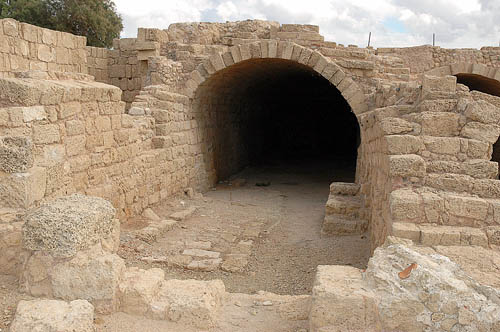
Building at Caesarea Maritima converted to a Mithraeum in the early 2nd century A.D. Photo by Ferrell Jenkins.

Building at Caesarea Maritima converted to a Mithraeum in the early 2nd century A.D. Photo by Ferrell Jenkins.

Christmas, as a religious holiday, is not known in the New Testament. In this case we must say that later Christianity borrowed aspects of it from pagan sources. See my article on The Truth About Christmas here for more details.

If you are interested in a complete study about the relation between Persia and the Bible, I suggest Edwin M. Yamauchi’s Persia and the Bible with foreword by Donald J. Wiseman) Baker, 1990.

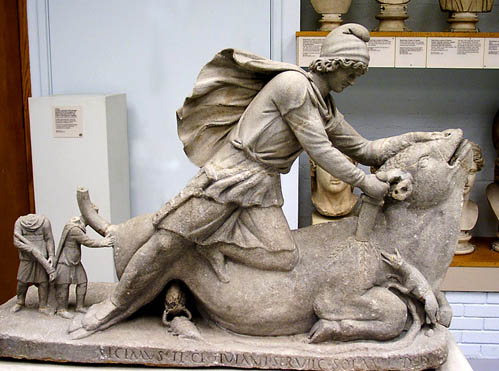
Yamauchi tells us that “the central cult image of Mithraism was the statue of the tauroctony or depiction of Mithras slaying the bull.” He says over 500 representations of this image have been found. Here is one I photographed in the Britism Museum.
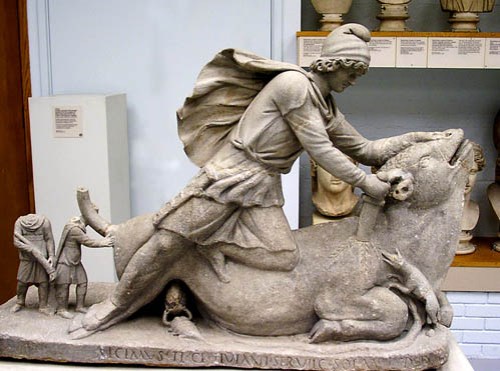
The Sun-god Mithras slaying a bull. Photo by Ferrell Jenkins in the British Museum.

The Sun-god Mithras slaying a bull. Photo by Ferrell Jenkins in the British Museum.
The Persian background of Iran

The August, 2008, issue of National Geographic has a good article on the Ancient Soul of Iran. The emphasis is on the rich Persian history of the area. The article is online at ngm.com. The article includes many of those fabulous NG photographs. Most of them were shot in low light to evoke the past glory of Iran. There are more photos at the website than in the magazine. You might be able to buy a copy of the magazine at your local bookseller.

Iran is the only major area of the Bible world that I have been unable to visit. Maybe that will change within the next few years. Marguerite Del Giudice says,

In fact, the first thing people said when I asked what they wanted the world to know about them was, “We are not Arabs!” (followed closely by, “We are not terrorists!”

The article features the people of Iran, and not the government. There are some interesting comments on the influence of Zoroastrianism’s teaching.

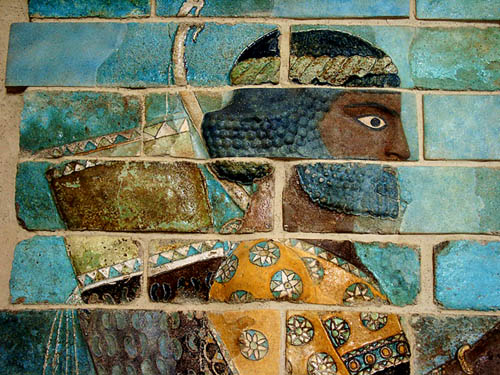
Many of the great museums of the world have ancient Persian artifacts. This is especially true of the Louvre, the British Museum, and the Oriental Institute of the University of Chicago. Here is a photo from the Louvre of one of the Persian archers.

Archer from the Palace of Darius in the Louvre. Photo by Ferrell Jenkins.

Archer from the Palace of Darius in the Louvre. Photo by Ferrell Jenkins.

The Persians played a significant role in the Restoration of the Judeans to their land after the Babylonian Exile. Here are a few highlights.

  • Cyrus, who conquered Babylon, allowed the Jews to return to their land in 536 B.C. See 2 Chronicles 36, and compare the Cyrus Cylinder (in the British Museum).
  • Darius I allowed the Jews to rebuild the temple in Jerusalem (520-516 B.C.; Ezra 6:1-5).
  • Xerxes is the Ahasuerus of the book of Esther.
  • During the reign of Artaxerxes I, the second group of Jews return under the leadership of Ezra (458 B.C.). Nehemiah returned to rebuild the walls of Jerusalem (444 B.C.).

Video introduction to the ESV Study Bible

Here is a promotional video about the ESV Study Bible which is to be released October 15th

I think the maps and drawings will make this Bible especially useful for Bible students who want to put their study into a geographical and historical setting.

Summary of the blogs

Over at the Biblical Studies Info Page, under Scholarly, then Blogs, I keep a list of several blogs that I regularly check. Here is a brief summary of some current items you might find of interest.

Todd Bolen calls attention to the continuation of the Western Wall excavations here. This excavation is on the extreme western side of the Western Wall plaza.

Aren Maer gives a wrap-up of the recent excavations at Gath (Tell es-Safi) here.

Ben Witherington includes a seminar paper by one of his doctoral students in review of Barth Ehrman’s Lost Christianities here. This has to do with the formation of the canon.

Mark Copeland has posted good photographs of 299 Sermon Charts pained by Steve Hudgins here. Steve pained a few charts for me, and some of my tour banners, years back. This shows the type of visual aids that some of us used. It was before flannel boards, opaque projections, overhead projections, and PowerPoint. The biggest problem is that the audience knew when we were only half finished! I doubt any of you will want to use a chart like this now, but you can get some great ideas for sermon starters, put them in PowerPoint, and see if they will gel.

Claude Mariottini has called attention to the problem of Fake Degrees, even among ministers and professors of biblical studies, here. Every now and then I see some preacher who wouldn’t know how to write a research paper advertising himself as Dr. So-and-so. Shameful.

Restricting information

China has been in the news a lot in the past years. Most recently we have seen them assuring us they could resolve a severe pollution problem within weeks. Then there were all of those toys containing lead. One day we told our little grandson to take something from his mouth that he had picked up off the floor. He said, “Why, was it made in China?” We heard that the media in China to cover the Olympics would have free access to the Internet, but then certain sites were blocked.

More serious than all of this are those matters pertaining to human rights and the restriction of religious rights. In 1986 we carried a few Bibles into the country and gave them to individuals or left them where they might be picked up. Several friends who have visited China, or lived there for short periods, have mentioned the restrictions and the secrecy under which Christians meet for study of the Bible and the worship of Christ.

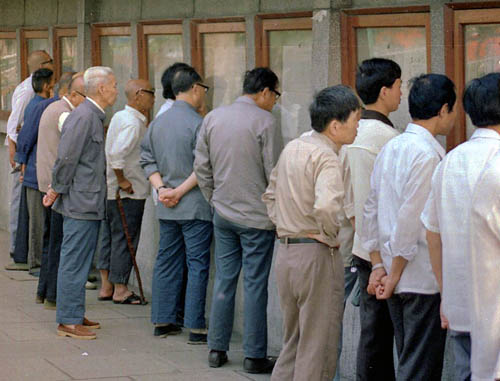
Here is a photo I made in 1986 in one of the cities we visited. The only news the people got was what the government posted for them. Such censorship is deplorable whether in China or elsewhere. It is based on fear. I was in Bangkok when I learned of the Tiananmen Square protests of 1989. The next few days in Hong Kong I saw marches protesting what was happening in mainland China. Several people had copies of newspaper reports about the incident. They wanted us to fax or mail them to their friends in China.

Men lined up to read the news in China in 1986. Photo by Ferrell Jenkins.

Men lined up to read the news in China in 1986. Photo by Ferrell Jenkins.

We hope the time will come when the people of China will have free access to the Bible and all other information so readily available to those who live in freedom.

Tutankhamum and the World of the Pharaohs

The premier exhibition of Tutankhamum and the World of the Pharaohs is current open in Vienna. Maybe you will not be able to get to Vienna, but there are some wonderful photos on line. The exhibit web page is here.

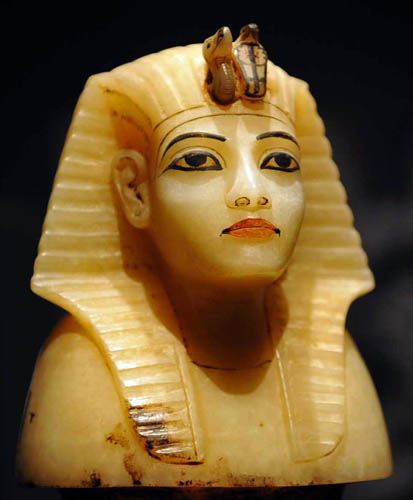
To get to the photos click on the English (UK) flag at the top of the page. (Pay attention. This will not work on the German page.) Then click on Press and Media. The photo here shows the top of one of the canopic jars in the the King Tut tomb. This jar, made of alabaster, was used to store one of the major organs of the body. Click on the photo for a larger image.

The top of a canopic jar from the tomb of Tutanhkamum. Photo by Sandro Vannini.

The top of a canopic jar from the tomb of Tutanhkamum. Photo by Sandro Vannini.

Howard Carter discovered the intact tomb of King Tut in 1922. Tut lived between 1341 and 1323 B.C. This is about a century after Moses was in Egypt if we depend on the dates given in certain Old Testament references like 1 Kings 6:1.

Now it came about in the four hundred and eightieth year after the sons of Israel came out of the land of Egypt, in the fourth year of Solomon’s reign over Israel, in the month of Ziv which is the second month, that he began to build the house of the LORD.

The fourth year of Solomon’s reign would have been about 966 B.C.

When one sees the wealth represented in the tomb of King Tut he must be impressed with the statement made by the writer of Hebrews regarding the treasures of Egypt.

By faith Moses, when he had grown up, refused to be called the son of Pharaoh’s daughter, choosing rather to endure ill-treatment with the people of God than to enjoy the passing pleasures of sin, considering the reproach of Christ greater riches than the treasures of Egypt; for he was looking to the reward. (Hebrews 11:24-26 NASB)

The ESV Study Bible

Quite a bit of attention is being given to the forthcoming (October 15) English Standard Version Study Bible. Dr. Leen Ritmeyer has served as archaeological and architectural editor for the new study Bible. On his blog he calls attention to two interviews with Justin Taylor, Project Director and Managing Editor of the ESV Study Bible.

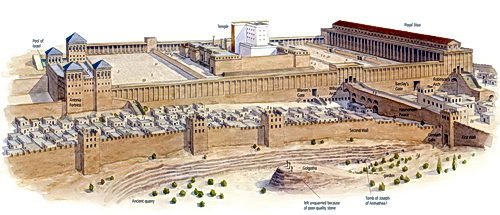
The first interview is “What Did Calvary Look Like?” Evidence for the Church of the Holy Sepulcher and the Garden Tomb is summarized. Golgotha on this drawing is now the site of the Church of the Holy Sepulcher.

Drawing showing Golgotha.

Drawing showing Golgotha.

The second interview is “What Did Jesus’ Tomb Look Like?”

If you teach the Bible you will want to download the large drawings associated with these interviews. Some sample pages in PDF (Introductions to Luke, Revelation, and Psalms) are available for download here.

Taylor explains the high quality of these drawings (“paintings”):

Using Dr. Ritmeyer’s extensive research and new drawings, we then turned to the illustration firm Maltings Partnership (in Derby, England) to produce the final, full-color paintings. We knew of Maltings’ superb work from their reconstruction drawings in the DK Travel Guides and the National Geographic Traveler guides. We could not be happier with the final results.

New study material online (including Español)

Over at BibleWorld I have posted the following items including Español el material de estudio de la Biblia.:

  • La Authoridad Biblica (under Foreign Language Materials). This book is for class or individual study.
  • Introduction to the Prophets. (This, and the other items below, are under Old Testament Studies.) Brief introductory outline showing the role of the prophets in Israel.
  • Analysis of the Book of Isaiah. This is the analysis by George L. Robinson.
  • Comparison of Kings of Israel, Judah, and Foreign Rulers. Helpful chart with dates for all rulers.

One you get to BibleWorld click on the Download Study Material in PDF link. Then scroll to the material you would like to take a look at and download if you wish.

Here is the link to BibleWorld.

CUIL – new search engine

My search engine of choice is Google. Occasionally I use one of the other popular ones. Now another one comes along claiming to be the world’s biggest search engine. They say they have already indexed over 120 billion web pages. I see that some of the technical articles are critical of CUIL (pronounced COOL). My approach to this sort of thing is to try it for yourself and see if it provides good results. I can’t say that I am immediately attracted to Cuil, but it will probably improve. When I entered my name [isn’t that what you do?] a lot of the posts on this blog came up.

Cuil is an old Irish word for knowledge. For knowledge, ask Cuil.

To get directly to the search page go here. To read about CUIL go here.