Category Archives: Bible Study

Decorations from Herod’s tomb

Joseph I. Lauer calls attention to a photo-essay of the announcement of the discovery of Herod’s tomb at the Herodium. This essay dates back to May 10, 2007, but there may be new readers who have not seen this. Check here.

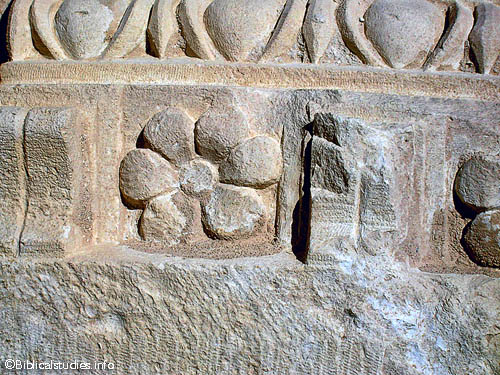
Shortly after the announcement, Elie Ben Meir, a guide/friend of mine in Israel, shared a few of his photos made at the Herodium on June 24, 2007. I had intended to publish, with his permission, some of these earlier but overlooked it. You might enjoy these closeup of some of the stone decorations found at the site.

Herodium tomb ornament. Photo by Elie Ben Meir.

Herodium tomb ornament. Photo by Elie Ben Meir.

Notice the beautiful carvings.

Decoration of Herod's tomb at the Herodium. Photo by Elie Ben Meir.

Decoration of Herod's tomb at the Herodium. Photo by Elie Ben Meir.

I found Leen Ritmeyer’s post about the passing of Prof. Netzer interesting. Check it here.

Herod the Great was the “king of Judea” from 37 to 4 B.C. Near the close of his reign Jesus was born in Bethlehem.

After Jesus was born in Bethlehem of Judea in the days of King Herod, wise men from the east arrived unexpectedly in Jerusalem, (Matthew 2:1 CSB)

Archaeologist Netzer dies after fall

The Jerusalem Post reported here this afternoon that Prof. Netzer succumbed to the injuries sustained during his fall at the Herodium.

Renowned archaeologist Ehud Netzer died of his wounds at the Hadassah Ein Kerem hospital in Jerusalem Thursday night, days after he fell during an excavation.

On Monday Prof. Netzer was hospitalized in critical condition after a wooden railing he leaned on gave way, at the Herodion archeological site in the West Bank.

Jim West was kind enough to leave a comment on our blog this  morning once he was certain that Prof. Netzer had died.

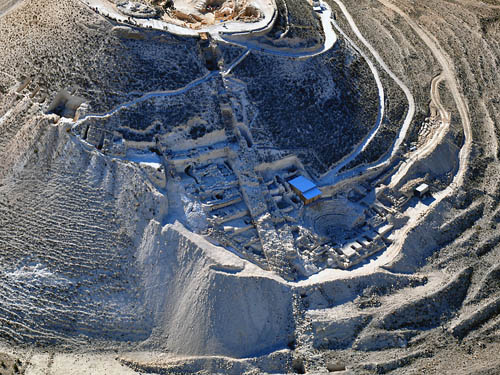
Recently we discussed here some of the work at the Herodium. Below I am including a closer view of the area where Prof. Netzer was working. This aerial photo shows a clear view of the theater. The roofed structure covers the royal theater box.

The Herodium excavation. Photo by Ferrell Jenkins, Dec. 15, 2009.

The Herodium excavation. Photo by Ferrell Jenkins. Dec. 15, 2009.

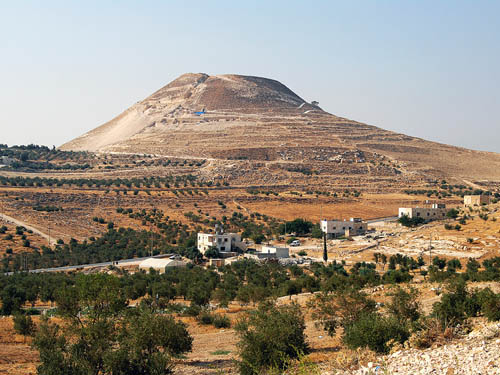
Without the determination of Ehud Netzer the north side of the Herodium would still look like the view below, and we would still be wondering about the location of Herod’s burial place.

The Herodium from the north. Photo by Ferrell Jenkins, Aug. 23, 2008.

The Herodium from the north. Photo by Ferrell Jenkins, Aug. 23, 2008.

The Herodium is located a few miles east of Bethlehem, the birthplace of Jesus (Matthew 2).

Cenchrea — a port used by Paul and Phoebe

Cenchrea is located a few miles east of Corinth on the Saronic Gulf, an arm of the Aegean Sea. In the time of the Apostle Paul Cenchrea was considered the eastern port of Corinth. It was here that Paul had his hair cut before sailing for Syria.

Paul, having remained many days longer, took leave of the brethren and put out to sea for Syria, and with him were Priscilla and Aquila. In Cenchrea he had his hair cut, for he was keeping a vow. (Acts 18:18 NAU)

Our photo provides a view of the port and the northern breakwater.

The port of Cenchrea with view toward the northern breakwater. Photo by Ferrell Jenkins.

Port of Cenchrea with view toward the northern breakwater. Photo by Ferrell Jenkins.

Cenchrea was the home of Phoebe, who was a servant of the church there. Cenchrea would have been one of the unnamed churches “in the whole of Achaia” (2 Corinthians 1:1).

I commend to you our sister Phoebe, who is a servant of the church which is at Cenchrea; that you receive her in the Lord in a manner worthy of the saints, and that you help her in whatever matter she may have need of you; for she herself has also been a helper of many, and of myself as well. (Romans 16:1-2 NAU)

I think we may safely conclude that Phoebe sailed from this port to Rome with the epistle Paul write to the saints at Rome about A.D. 57.

Except for the port, little is to be seen of ancient Cenchrea. Some underwater excavations have taken place. Perhaps at a later time we will call attention to some of the discoveries.

Click on the image if you would like to have a copy of the photo suitable for use in teaching Acts, Romans, or the life and ministry of Paul.

Murex is not the only source of purple

Royal purple dye was made from the secretion of the Murex snail, typically found along the eastern Mediterranean coast, especially near Tyre.

In New Testament times (the first century A.D.), several cities in Asia Minor were noted as producers of dye. Colossae and Thyatira were located inland, far away from the Sea. These, and other cities of the region, made purple from the madder root.

Madder root, a source of purple in Turkey. Photo by Ferrell Jenkins.

Madder root, a source of purple in Turkey. Photo by Ferrell Jenkins.

The three colors shown in the yarn below come from the madder root. The darker color on the right might more closely resemble royal purple.

Yarn dyed with madder root. Photo by Ferrell Jenkins.

Yarn dyed with madder root. Photo by Ferrell Jenkins.

Thyatira was noted as a great center for the wool trade and for its dyeing industry. Lydia, the first convert of the gospel in Europe, was a native of Thyatira (in Asia). She seems to have represented this industry in Philippi. One inscription, found at Philippi in 1872, honored from among the purple dyers a man named Antiochus who was a “native of Thyatira” (Meinardus, St. John, 93).

The purple dye used around Thyatira was evidently a vegetable dye from the madder root which grew in abundance in the region. Hemer says that the madder root “was still cultivated in the district at least until the end of the last century.” The pigment is commonly called Turkey red. In addition to the colors shown in the yarn above, I am told by the Turkish carpet sellers that the “red” in this beautiful Turkish carpet comes from the madder root.

Carpet made from yarn made from the madder root. Photo by Ferrell Jenkins.

Carpet using yarn made from the madder root. Photo by Ferrell Jenkins.

Now when you read about Lydia as a seller of purpose you should think of the dye made from the madder root, or from the dyed products.

A woman named Lydia, a dealer in purple cloth from the city of Thyatira, who worshiped God, was listening. The Lord opened her heart to pay attention to what was spoken by Paul. (Acts 16:14 CSB)

Murex is the source of Royal Purple

From 1967 to 1975 I took a group to Lebanon each year except one. Tyre was always an important stop on the tour. Tour members were interested in understanding the prophecies of Ezekiel and the historical context associated with both the Babylonian king Nebuchadnezzar and Alexander the Great.

It was possible in the early days to find Murex shells like the two I have included in the photograph below. Click on the image for a larger photo suitable for use in teaching.

Murex shells collected at Tyre. Photo by Ferrell Jenkins.

Murex shells collected at Tyre. Photo by Ferrell Jenkins.

There are different species of the Murex. A display in the British Museum mentions Purpura haemastoma, Murex trunculus, and Murex brandaris. I think the shells above are Murex trunculus. If a reader knows otherwise, please leave a comment. The Museum sign says,

The prized purple dye, for which the Phoenicians were renowned, came from a gland of the murex snail. Each snail yielded only a drop of yellow liquid which darkened to purple on exposure to light. Processing required slow simmering for almost two weeks. Up to 60,000 snails were needed for a pound of dye. Different tints were achieved by varying the amounts of extract from different species.

Patricia M. Bikai writes about the value of Royal Purple and the legend about the discovery of it.

Royal Purple had an enormous value, worth as much as 10 to 20 times its weight in gold (Born 106-11, 124-128).

According to legend, Royal Purple was discovered by Melkart (Hercules), the city-god and king of Tyre, when he and the nymph Tyros were walking along the Phoenician shore with their dog. The dog, playing with a large Murex, bit into it and it stained his mouth purple. Melkart then dyed a robe with it and gave it to Tyros. (Bikai in Martha Sharp Joukowsky, ed., The Heritage of Tyre, 68)

The citizens of the island city of Tyre remember the history of their city. On my last visit in 2002 I noticed a sign announcing the opening of the Murex cafe. I wonder if they have wifi.

Murex Cafe at Tyre, Lebanon. Photo by Ferrell Jenkins.

Murex Cafe at Tyre, Lebanon. Photo by Ferrell Jenkins.

Purple was the royal color in ancient times. The prophet Ezekiel mentions blue and purple as symbolic of Tyre.

Your sail was made of fine embroidered linen from Egypt, and served as your banner. Your awning was of blue and purple fabric from the coasts of Elishah. (Ezekiel 27:7 CSB)

The great harlot of Revelation 17 is clothed in purple.

The woman was dressed in purple and scarlet, adorned with gold, precious stones, and pearls. She had a gold cup in her hand filled with everything vile and with the impurities of her prostitution. (Revelation 17:4 CSB)

Scroll down two or three posts to read more about Phoenicias and purple.

About 30,000 Dead Sea Scrolls to be put online

The Israel Antiquities Authority announced today a partnership with Google R&D Center in Israel to make the Dead Sea Scrolls available online. The project will be called the Leon Levy Dead Sea Scrolls Digital Project because the major lead gift is from the Leon Levy Foundation. Here are some excepts from the IAA press release.

A major lead gift from the Leon Levy Foundation, with additional major funding from the Arcadia Foundation and the support of Yad Hanadiv Foundation, will enable the Israel Antiquities Authority to use the most advanced and innovative technologies available to image the entire collection of 900 manuscripts comprising c. 30,000 Dead Sea Scrolls fragments in hi-resolution and multi spectra and make the digitized images freely available and accessible to anyone anywhere in the world on the internet. This is the first time that the collection of Scrolls will be photographed in its entirety since the 1950’s.

The IAA announced this morning that it is collaborating with the Google R&D center in Israel in this milestone project to upload not only all of the digitized Scrolls images but also additional data online that will allow users to perform meaningful searches across a broad range of data in a number of languages and formats, which will result in unprecedented scholarly and popular access to the Scrolls and related research and scholarship and should lead to new insights into the world of the Scrolls.

The innovative imaging technology to be used in the project has been developed by MegaVision, a U.S. based company, and will be installed in the IAA’s laboratories in early 2011. The MegaVision system will enable the digital imaging of every Scroll fragment in various wavelengths in the highest resolution possible and allow long term monitoring for preservation purposes in a non-invasive and precise manner. The images will be equal in quality to the actual physical viewing of the Scrolls, thus eliminating the need for re-exposure of the Scrolls and allowing their preservation for future generations.  The technology will also help rediscover writing and letters that have “vanished” over the years; with the help of infra-red light and wavelengths beyond, these writings will be brought “back to life”, facilitating new possibilities in Dead Sea Scrolls research.

Uploading the images to the internet will be achieved with the assistance of Google-Israel and will be accompanied by meta-data including transcriptions, translations and bibliography.

According to Shuka Dorfman, IAA General Director, “we are establishing a milestone connection between progress and the past to preserve this unique heritage for future generations. At the end of a comprehensive and profound examination we have succeeded in recruiting the best minds and technological means to preserve this unrivaled cultural heritage treasure which belongs to all of us, so that the public with a click of the mouse will be able to freely access history in its fullest glamour. We are proud to be embarking on a project that will provide unlimited access to one of the most important archaeological finds of the 20th Century, crucial to Biblical studies and the history of Judaism and early Christianity. We are profoundly grateful to Shelby White and the Leon Levy Foundation for their lead major gift and to the Arcadia Foundation for its major gift to this project.”

The IAA press release with a link to several photographs is available here.

IAA photo from the pilot project in St. Paul

IAA photo from the pilot project in St. Paul

If you thought the Dead Sea Scrolls had not been made public, take a look at this sentence from the News Release:

This is the first time that the collection of Scrolls will be photographed in its entirety since the 1950’s.

HT: Joseph Lauer

Replica Phoenician ship completes 20,000 mile voyage

A replica of a 600 B.C. Phoenician ship has almost completed 20,000 miles and two years at sea.

The replica Phoenician ship, captained by British explorer Philip Beale, has completed the circumnavigation of Africa – a voyage made by Phoenicians in 600 BC. With up to 16 crew members on any one leg the replica vessel has welcomed sailors from all corners of the globe.

The voyage has presented Captain Beale and his international crew with many challenges including losing one of the ship’s rudders in the Red Sea, the threat of piracy off the Somali coast and gale force weather conditions around the Cape of Good Hope. At the end of the expedition the ship will have visited 14 countries – each time sparking interest in the achievements of ancient Phoenician mariners.

The successful completion of the voyage is of enormous significance to historians and archaeologists as it proves that the Phoenician vessels were capable of sailing around the African continent – something that has been the cause of much speculation over centuries.

The ship will complete its voyage  at Arwad, Syria, where it was built.

Phoenician Ship under sail in the North Atlantic. Courtesy Phoenicia Ship Expedition.

Phoenician Ship under sail in the North Atlantic. Courtesy Phoenicia Ship Expedition.

For more information read the short article in the Gibraltar Chronicle here. A web site about the expedition is available at Phoenicia.

The prophet Ezekiel foretold the fall of the ancient Phoenician city of Tyre. I suggest you read the entire account in Ezekiel 26-28. Notice especially these verses about the effect that the fall of Tyre had on other nations and merchants.

The ships of Tarshish traveled for you with your merchandise. So you were filled and heavily laden in the heart of the seas. “Your rowers have brought you out into the high seas. The east wind has wrecked you in the heart of the seas. Your riches, your wares, your merchandise, your mariners and your pilots, your caulkers, your dealers in merchandise, and all your men of war who are in you, with all your crew that is in your midst, sink into the heart of the seas on the day of your fall.

At the sound of the cry of your pilots the countryside shakes, and down from their ships come all who handle the oar. The mariners and all the pilots of the sea stand on the land and shout aloud over you and cry out bitterly. They cast dust on their heads and wallow in ashes; they make themselves bald for you and put sackcloth on their waist, and they weep over you in bitterness of soul, with bitter mourning. In their wailing they raise a lamentation for you and lament over you: ‘Who is like Tyre, like one destroyed in the midst of the sea? (Ezekiel 27:25-32 ESV)

For a larger image of the photo suitable for use in teaching click on the photo above.

HT: PaleoJudaica.

Still not using Logos Bible Software?

From time to time I am requested to spend some time with a younger preacher (intern/trainee). I always ask if he is using Logos Bible Software. But, I find many older preachers who seem to know nothing of the program. A little over a year ago I commented on buying Bible software here. I said,

Every young preacher should stop buying junk, ready-mixed pabulum, and get some real tools. Another advantage is that you will have no books to loan!

The thing that stirred me up today is the eNewsletter I received from Rejoice Christian Software. They are offering the Essential IVP Reference Collection 3.0 for $89.95 through October 23. They say this is a saving of 88% off the print list price.

The collection includes over 12,000 pages including…

  • Dictionary of Jesus and the Gospels
  • Dictionary of Paul and His Letters
  • Dictionary of the later NT and its Developments
  • Dictionary of New Testament Background
  • IVP Bible Background Commentary: Old Testament
  • IVP Bible Background Commentary: New Testament
  • New Bible Dictionary (2nd ed.)
  • New Bible Commentary: 21st Century Ed.
  • Dictionary of Biblical Imagery
  • New Bible Atlas
  • New Dictionary of Biblical Theology
  • New Dictionary of Theology
  • And several other works.

Did I mention that you can buy the Thomas Nelson Bible Study Library for $29.95? I am not saying that any of these books are the best, but I am sure they will be useful.

If you look up the Essential IVP Reference Collection at Rejoice Christian Software it shows a retail price of $190, with their price being $115. The special this week is $89.95, but you must order here. You will probably pay $3 or $4 for shipping. Give up some frivolity for the next few weeks and get this set of books.

Did I mention that you can search the entire collection at one time?

The watershed ridge

Those who study Bible geography learn about the extension of the Lebanon Mountains that runs south through Upper Galilee, Lower Galilee, the mountains of Samaria, and the mountains of Judea. Every mountain ridge has a right side and a left side. The ridge of the central mountain route in Israel provides the watershed to the east and the west.

St. Andrew’s (Scottish) Church sits on the watershed ridge in Jerusalem. When you travel from the west side of the old city of Jerusalem crossing the Hinnom Valley on the way south to Bethlehem and Hebron, you pass the watershed ridge and St. Andrew’s Church on your right. The Menachem Begin Heritage Center Museum and the Church sit up above the road and are lost to view as you watch the traffic.

This view, showing the east side of the watershed ridge, looks north to the Church.
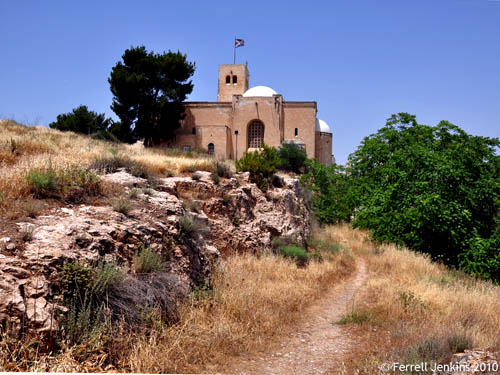
The watershed ridge in Jerusalem. Photo by Ferrell Jenkins.

The watershed ridge in Jerusalem. Photo by Ferrell Jenkins.

St. Andrew’s Church has an interesting history which is described briefly.

St Andrew’s Church, Jerusalem, was built as a memorial to the Scottish soldiers who were killed fighting the Turkish Army during World War I, bringing to an end Ottoman rule over Palestine. It is a congregation of the Church of Scotland. (Wikipedia)

A cornerstone on the Church indicates that the stone was laid on May 7, 1927, by Field Marshal the Viscount Allenby in commemoration of the liberation of Jerusalem on December 9, 1917. We have a photo of the liberation here. Another plaque in the Church indicates that King Robert Bruce wished for his heart to be buried here.

Before his death Bruce required Sir James Douglas to carry his heart to Jerusalem, in redemption of his unfulfilled vow to visit the Holy City. Accordingly Sir James set out, bearing with him the embalmed heart. On his way he fell fighting the Moors in Spain. The heart was recovered and found its resting-place at Melrose, while the body rests at Dunfermline, Scotland. (Vilnay, Israel Guide 1978, 87)

The barren hill on which the Church is built is called Bible Hill.
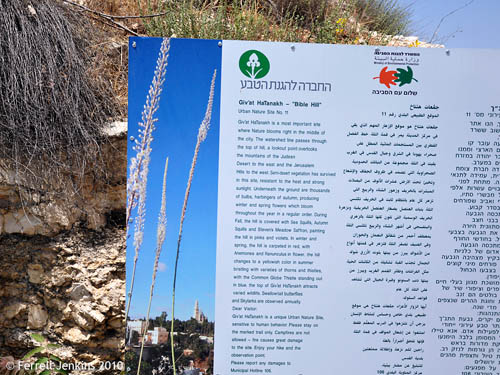
Sign marking Bible Hill, the watershed ridge in Jerusalem. Photo by Ferrell Jenkins.

Sign marking Bible Hill, the watershed ridge in Jerusalem. Photo by Ferrell Jenkins.

This hill marks a portion of the boundary of the biblical tribe of Judah. Notice the reference to “the top of the mountain.”

Then the boundary goes up by the Valley of the Son of Hinnom at the southern shoulder of the Jebusite (that is, Jerusalem). And the boundary goes up to the top of the mountain that lies over against the Valley of Hinnom, on the west, at the northern end of the Valley of Rephaim. (Joshua 15:8 ESV)

In another post we hope to show you more photos of the watershed ridge and the view on each side of it from this same location. Meanwhile, take a look at several photos of the Church, and a satellite view of the area at Bible Walks.

Report on Khirbet Qeiyafa — the Elah Fortress

Luke Chandler has participated in the excavation at Khirbet Qeiyafa the past two summers. Recently he posted two brief articles on some of the discoveries during the past summer. Read here and here.

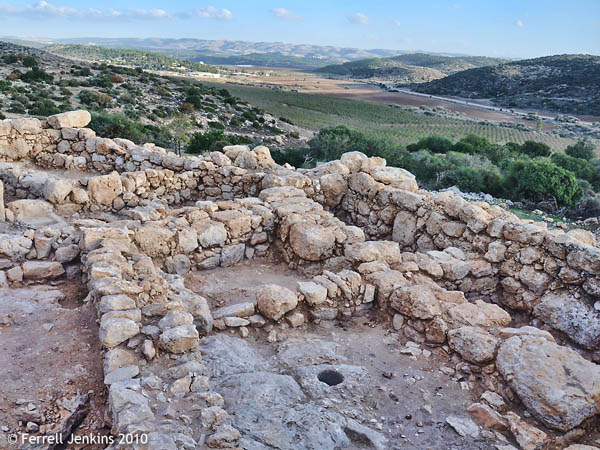
This area is associated with the events of 1 Samuel 17 (David and Goliath).

View to southeast over Elah Valley from Khirbet Qeiyafa. Photo by F. Jenkins.

View to southeast over Elah Valley from Khirbet Qeiyafa. Photo by Ferrell Jenkins.