Category Archives: Bible Study

Looting of Museums in Egypt

Dr. Zawi Hawass, the head man over antiquities in Egypt, has posted a statement on his web site. He had to fax it to someone in Italy so they could post it on his web site in London. The Internet is down in Egypt.

If you are interested, read here.

HT: Bible Places Blog.

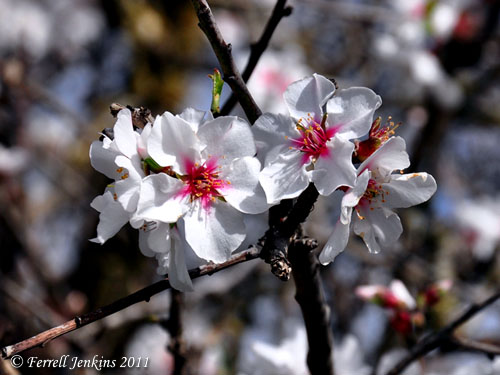
Almond trees in blossom

Friday evening we stayed in Beersheba. Friday night and Saturday (the Jewish Sabbath) is a time when many Jewish families stay in a hotel. I think we were the only Goyim (non-Jews) in the hotel. Beersheba does not attract many tour groups for overnight stays.

We made a side trip into the Shephelah with brief stops here and there. Near the Valley of Elah, on the east side of Azekah we saw a few almond trees in full blossom.

Almond tree in bloom near Azekah. Photo by Ferrell Jenkins.

Almond tree in bloom near Azekah. Photo by Ferrell Jenkins.

Jacob ordered his sons to take some of the best products of the land of Canaan, including almonds, to the man in Egypt (Joseph).

Then their father Israel said to them, “If it must be so, then do this: take some of the best products of the land in your bags, and carry down to the man as a present, a little balm and a little honey, aromatic gum and myrrh, pistachio nuts and almonds. (Genesis 43:11 NAU)

The blooms of the almond are beautiful.

Almond blossoms near Azekah. Photo by Ferrell Jenkins.

Almond blossoms near Azekah. Photo by Ferrell Jenkins.

The lampstand for the tabernacle was to have cups shaped like almond flowers.

On the lampstand there were four cups shaped like almond flowers with buds and blossoms, (Exodus 37:20 NET)

The LORD demonstrated his choice of Aaron as high priest in this way:

On the next day Moses went into the tent of the testimony– and the staff of Aaron for the house of Levi had sprouted, and brought forth buds, and produced blossoms, and yielded almonds! (Numbers 17:8 NET)

Life in the wilderness of Zin

Yesterday we drove north from Eilat to Beersheba (Be’er Sheva). Beersheba, the ancient home of the patriarch Abraham, is the heart of the Negev (the Southland in some English versions).

In the wilderness of Zin, where the ancient Israelites wandered (Numbers 33:36), we saw two female shepherds bringing their large flock of sheep and goats across the main highway 40. This photo shows them after they had crossed the highway on their way to their community of Bedouin. We saw the tents in the distance a little further south.

If you can not see the photo click here.

Sheep in the Wilderness of Zin. Photo by Ferrell Jenkins.

Sheep in the Wilderness of Zin. Photo by Ferrell Jenkins.

The wilderness of Zin included Kadesh Barnea and was the southern boundary for the tribe of Judah.

The land allotted to the tribe of Judah by its clans reached to the border of Edom, to the Wilderness of Zin in the Negev far to the south. (Joshus 15:1 NET)

We enjoyed a Big Mac at the McDonald’s at Avdat, an important town along the Nabatean spice route between Petra and Gaza.

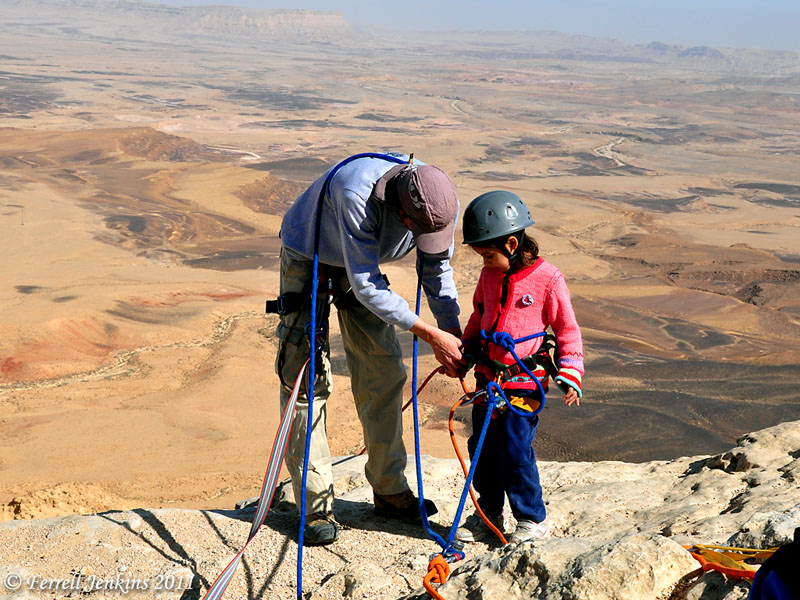
We continued along the way north to Makhtesh Ramon Crater. This crater, about fifty miles south of Beersheba, is said to be the largest crater in the world. We went to the observation point to take a look at the crater. Several people were preparing to rappel the cliff. The most interesting one was a little girl who was not quite six years old. After watching her be instructed in how to handle the rope, we saw her begin down the cliff. We went down to a lower point to see her. By the time we got there she was almost at the bottom and was being helped by (possibly) her mother who had come down before her.

(I am having a little problem uploading photos. If the photo below does not show, click here link to see it.)

Young girl gets ready to rappel at Makhtesh Ramon Crater. Photo by Ferrell Jenkins.

Young girl gets ready to rappel at Makhktesh Ramon Crater. Photo by Ferrell Jenkins.

Traveling across the Sinai Peninsula

Over the past two days my wife and I have traveled through the Sinai Peninsula. We left Cairo Tuesday morning and traveled somewhat along the traditional route of the Israelites in the wilderness to Jebel Musa (Mount Sinai/Horeb).

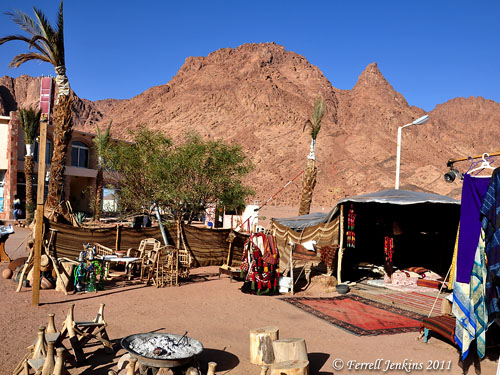
Tuesday night we stayed at the Morganland Hotel near Saint Catherine’s Monastery. This photo was made Wednesday morning from the hotel grounds.

View of the granite mountains of Sinai. Photo by Ferrell Jenkins.

I am reminded of the stanza in Deborah’s song:

The mountains trembled before the LORD, the God of Sinai; before the LORD God of Israel. (Judges 5:5 NET)

After visiting Saint Catherine’s Monastery, we continued east to the Gulf of Aqaba/Eilat to Tabah, Egypt. Then, moving north, we crossed into Israel at Eilat. We were traveling in a van. The trip from Sinai to Tabah took more than 2 and 1/2 hours, but by the time we cleared all of the customs things in Egypt and Israel it took a total of 4 hours.

We enjoyed the two weeks in Egypt, but delighted to be in Israel again.

Sunset on the Suez Canal and Lake Timsah

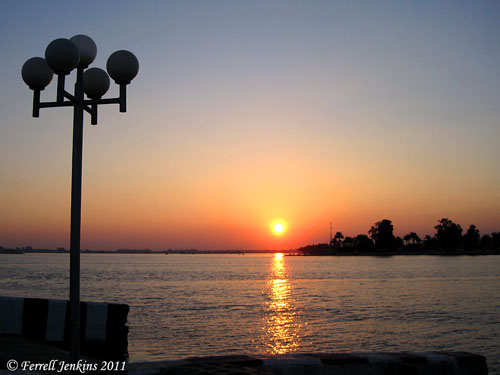
Our photo today was made from the Asia side of the Suez Canal. The view is west toward Africa. At this point the Suez Canal cuts through Lake Timsah.

Sunset over Lake Timsah and the Suez Canal. Photo by Ferrell Jenkins.

Sunset over Lake Timsah and the Suez Canal. Photo by Ferrell Jenkins.

Some scholars have suggested that the crossing by the Israelites as they left Egypt may have been in the area around Lake Timsah (through, south or north of it). Other suggestions include a site in the vicinity of Lake Ballah or the Great Bitter Lake for the crossing.

Read the biblical account in Exodus 13.

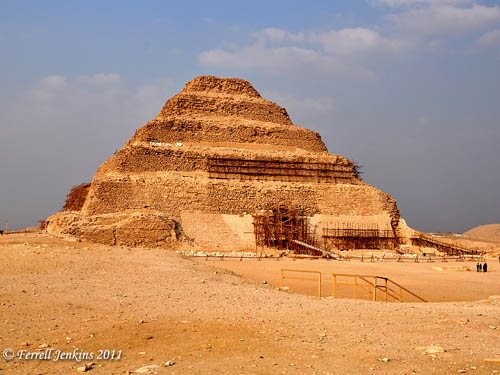
The Step Pyramid of Zoser at Saqqara

Yesterday afternoon our group visited Memphis and Saqqara. Saqqara is significant because it is the location of of the oldest freestanding stone building in the world. The architect of this structure was the vizier and physician Imhotep. Zoser reigned about 2600 B.C.

Hachette World Guide on Cairo, Alexandria and Environs, describes the pyramid in these terms:

The Step Pyramid is formed of six unequal sections and is not, in the strict sense, a pyramid tat all. The plan is not square, but oblong in the S-W sense, and the summit is formed by a terrace (also oblong) and not by a Pyramidion. The dimensions of the base are approximately 397 feet by 357 feet. The present height of the Pyramid is 193 feet. It would originally have been some 196 feet. The verticle slope of the steps is on an average of some 16°, the horizontal [slope is] 22°.

Many of the structures of ancient Egypt are in need of repair, and many are being repaired. I noticed scaffolding on all sides of the pyramid.

Step Pyramid of Zoser at Saqqara. Photo by Ferrell Jenkins.

The Step Pyramid of Zoser at Saqqara. Photo by Ferrell Jenkins.

This pyramid, as well as the great pyramids of Giza, was built long before the time of the  biblical characters who visited Egypt — Abraham, Joseph, Jacob, et al.

Traveling in the land of Goshen

We spent the entire day traveling in Egypt’s eastern delta region, known in the Bible as the land of Goshen. The photo below shows a typical scene of flat, fertile, black land with lush vegetation, cattle, some sheep, and canals.

Typical scene in the land of Goshen.

Typical scene in the land of Goshen. Photo by Ferrell Jenkins

This is the land where Joseph placed his family when they came to Egypt for food.

You will live in the land of Goshen, and you will be near me– you, your children, your grandchildren, your flocks, your herds, and everything you have. I will provide you with food there because there will be five more years of famine. Otherwise you would become poor– you, your household, and everyone who belongs to you.”‘ (Genesis 45:10-11 NET)

No photographs in the Valley of the Kings

On the west bank of the Nile River across from Luxor and Karnak lies the Valley of the Kings where the Pharaoh’s of the New Kingdom Period of Egyptian history are buried. There are no pyramids during this periods, but at least sixty four tombs are known in the Valley of the Kings. Our group visited two or three.

Some archaeological work is being done in the West Bank of the Nile, but mostly we observed restoration work by local Egyptians.

One disappointment was that photographs were not allowed in the Valley of the Kings. Two years ago when we were here photography was allowed in the Valley, but not in the tombs. Some of our tour members were fined for using their cameras and cell phones. This year one is not even allowed to enter through the security check with a camera. My older photos from the Valley of the Kings have just become more valuable!

One thing I have learned in traveling to Egypt repeatedly since 1967 is that the rules change frequently. The traveler to foreign countries must always remember that it may be different on a second visit, or from the way a friend told you, or the way the book said.

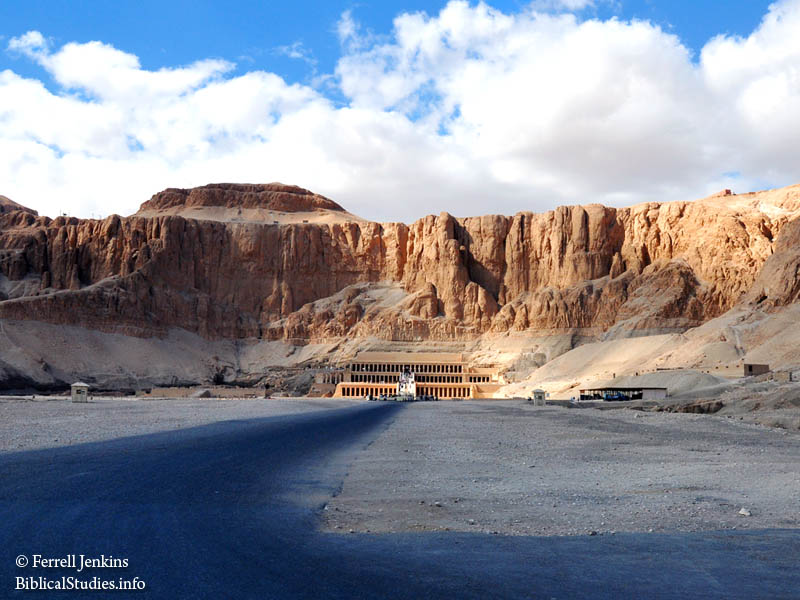
We were allowed to make photographs in the Valley of the Queens. Here is a photo of the Temple of Queen Hatshepsut.
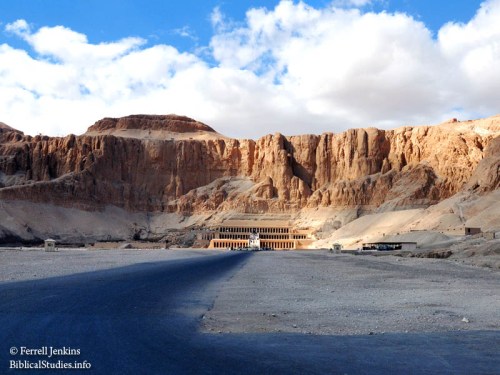
Temple of Queen Hatshepsut. Photo by Ferrell Jenkins.

The Temple of Queen Hatshepsut. Photo by Ferrell Jenkins.

Some conservative scholars identify Hatshepsut with the young daughter of  Pharaoh who drew baby Moses from the Nile. Notice these words from Dr. Bryant Wood:

Moses and the Rulers of Egypt
In order to avoid the death decree. Moses’ mother placed the infant Moses in a watertight basket and “put it among the reeds along the bank of the Nile” (Ex 2:3). Pharaoh’s daughter discovered the three-month-old baby when she “went down to the Nile to bathe” (Ex 2:5). It is possible that this was the later-to-be-famous queen Hatshepsut (see front cover; Hansen 2003). According lo the Bible, then, the Egyptian royal family maintained a residence in Rameses, close to the Nile River, at the time of Moses’ birth in the carry  [sic; early? c. 1504-1483] 18th Dynasty.
After Moses was nursed by his mother (Ex 2:7–9), Pharaoh’s daughter look him into the royal palace and gave him the name Moses, “because I drew him out of the water” (Bible and Spade (2008) Volume 21 (Ephrata, PA: Associates for Biblical Research, 2008). vnp.21.1.20).

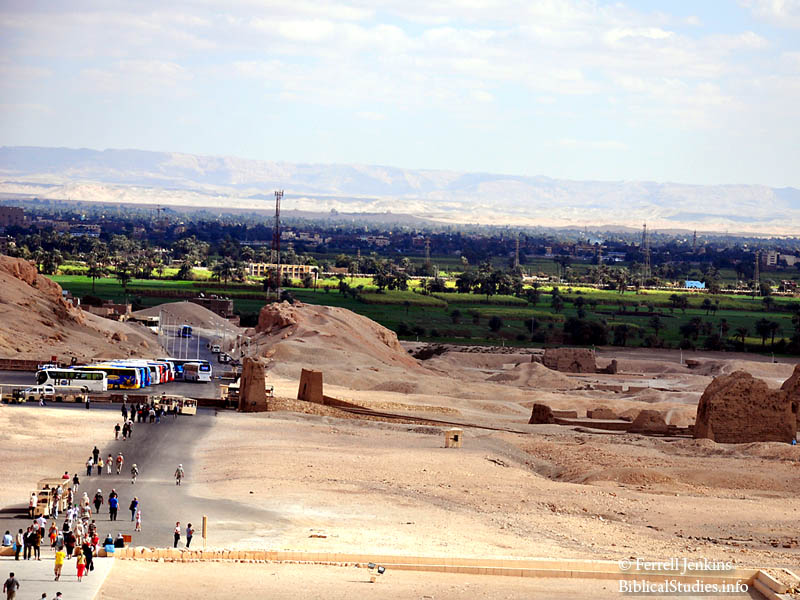
From the temple one has a magnificent view to the east across the Nile Valley. That’s it. The Nile Valley, the fertile land on each side of the Nile River is a narrow strip.
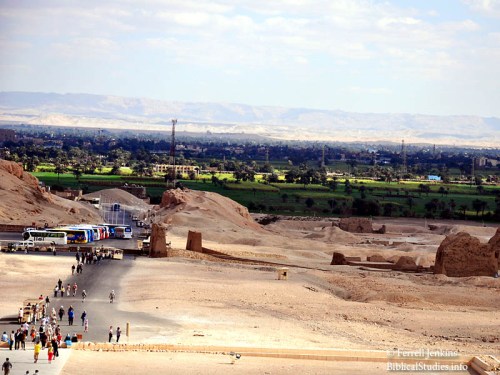
The Nile Valley from the Temple of Queen Hatsheput. Photo by Ferrell Jenkins.

The Nile Valley from the Temple of Queen Hatsheput. Photo by Ferrell Jenkins.

P.S. If you would like to see some photos from the Valley of the Kings, check this earlier post here.

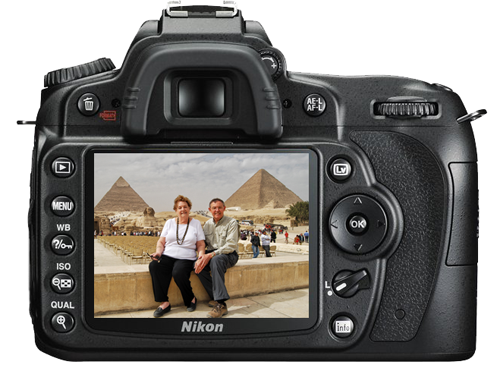
Group photo at the Pyramids

The first day of a tour is always a bit tiring. Travelers are getting over jet lag. In spite of that we had a good day with a visit to the Egyptian Museum and the great pyramids of Giza. The weather today was cool, but in the afternoon the sky cleared and provided a nice view. You can even detect the eastern ridge of the Nile Valley in the background.

At the moment I am having difficulty uploading the photo, and I am running out of time on my $28 investment. The entire Dashboard of WordPress is different from anything I have seen before.

Tomorrow we rise early and take a flight to Luxor. I will try to upload the photo from another place. Sorry.


Traveling to Egypt

The first biblical reference to Egypt is in Genesis 12:10.

There was a famine in the land, so Abram went down to Egypt to stay for a while because the famine was severe. (Genesis 12:10 NET)

Untold multitudes of people have traveled to Egypt before and after the time of Abram, and for a variety of reasons — to find food, to find refuge, to conquer, to search for treasures, to study history, to make photographs, naming just a few. Our purpose in going to Egypt is not only to enjoy the culture of Egypt, but to study the history at it relates to biblical history. In the next couple of weeks we will try to highlight some of these things. We hope you will travel with us through this blog.

We may not be able to post every day, and due to the time change, it may be at an unusual time of the day. Our non-stop flight is scheduled to depart from New York in less than two hours. The flight takes about 11 hours.