Category Archives: Bible Study

Libya and the Bible — more than you think

UNESCO: respect historical sites in Libya

According to an article in M & C here, UNESCO has called for Libyan and allied forces to protect six specified historical sites in Libya.

Libya’s sites on the World Heritage List include the archaeological site of Cyrene, which was established as a Roman province in 74 BC; and the site of Leptis Magna, which was founded in the first millennium BC.

Cyrene is located near Al Bayda in eastern Libya.

The Biblical Connection

When Jesus was being led to the place of crucifixion, Simon of Cyrene was compelled to bear his cross. He was the father of Alexander and Rufus, to people apparently known to Mark’s audience (Mark 15:21).

As they were going out, they found a man from Cyrene named Simon, whom they forced to carry his cross. (Matthew 27:32 NET)

The fifth station of the cross along the traditional Via Dolorosa in Jerusalem marks the spot where Simon took up the cross. Photos of the Catholic chapel at the spot may be viewed at Holy Land Photos here. Just search for Cyrene. Or check the photos at Bible Walks here.

  • Jews from the district of Libya around Cyrene were present in Jerusalem on Pentecost (Acts 2:10).
  • Some men from Cyprus and Cyrene were responsible for the first preaching to Gentiles at Syrian Antioch (Acts 11:20).
  • Lucius of Cyrene was one of the prophets or teachers at Antioch (Acts 13:1).

Galen Frysinger has a collection of older photos of Cyrene on his website here.

Ioannis Logiotatidis has some of the best photos I have found for Cyrene. He has kindly granted permission for me to share a couple of these with our readers. Both of are the Temple of Zeus. This temple was built originally in the 5th century B.C., but has been destroyed and rebuilt several times over the centuries.
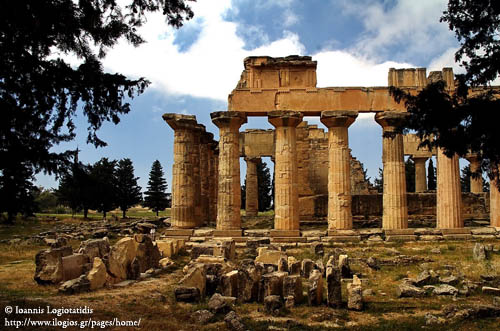
Temple of Zeus at Cyrene, Libya. Photo by Ioannis Logiotatidis.

Temple of Zeus at Cyrene, Libya. Photo by Ioannis Logiotatidis.

Check out more of Ioannis’ newer artistic photographs at his web site here.
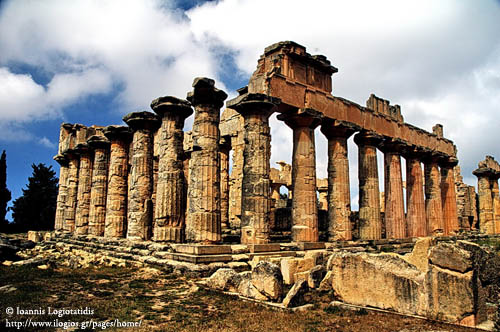
Temple of Zeus at Cyrene, Libya. Photo by Ioannis Logiotatidis.

Temple of Zeus at Cyrene, Libya. Photo by Ioannis Logiotatidis.

You may notice a strong resemblance between this temple and the Temple of Apollo at Corinth.

The Alexander (son of Simon) Ossuary

Sukenik and Avigad discovered an ossuary in 1941 bearing the inscription “Alexander (son) of Simon.”

Tom Powers, a guide in Israel, has written two articles about the ossuary for BAR. You may access them here. He concludes in the second article that this ossuary could be the ossuary of both Alexander and Simon.

Another article about ossuaries and Jesus contains photographs and a brief mention of the Alexander-Simon ossuary. Click here.

Paul’s Shipwreck on the Voyage to Rome

Libya is not mentioned, but the Syrtis is mentioned in the account of Paul’s voyage to Rome.

Running under the lee of a small island called Cauda, we managed with difficulty to secure the ship’s boat. After hoisting it up, they used supports to undergird the ship. Then, fearing that they would run aground on the Syrtis, they lowered the gear, and thus they were driven along. (Acts 27:16-17 ESV)

You will notice that the Syrtis Major and the Syrtis Minor are located on the Mediterranean coast of Libya. This was a dangerous place for a ship in a storm.

Gordon Franz recently posted an article asking “Why were the sailors afraid of the Syrtis Sands?” here.

In the map below you will note the location of Cyrene. Simon had a long trip to Jerusalem. Notice also the location of the Syrtis Major in relation to the suggested route of Paul’s ship. Click on the map for a clearer image. (I am still struggling to learn the Bible Mapper program and how to export maps.)

Paul's Voyage to Rome. Map by BibleMapper.
Paul's Voyage to Rome. Map by BibleMapper.
The pot may be calling the kettle black

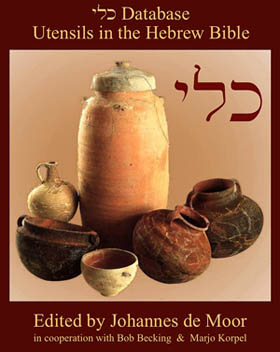
KLY Website - Dutch society for Old Testament Studies.The Dutch society for Old Testament study (OTW), after ten years of planning and work, has put online a research project to “elucidate the names of utensils in biblical Hebrew making methodical use of partially new approaches.”

The new web site, KLY, is written in the Dutch language, but there is an introduction in English. Here is a portion of it:

The problem with identifying utensils in the Hebrew Bible is that their common everyday use made it superfluous to provide detailed descriptions of the vessels or implements in written form. Everyone knew from experience what was meant. As a result dictionaries of biblical Hebrew often have to content themselves with non-descript generalizations like “bowl”, “jar”, “pot”, “knife”. Mostly the shape and purpose of a given utensil can not be established on the basis of context alone because the number of occurrences is too low. Archaeology has brought to light large quantities of pottery and implements, but in many cases we do not know which word in ancient Hebrew was used for the object unearthed.

Meanwhile the possibilities for resolving such problems have increased dramatically. Not only archaeology, but also comparative linguistics, iconography, anthropology, improved understanding of the ancient versions of the Bible have enhanced our chances to come closer to the precise nature of the objects.

Some knowledge of Hebrew will be helpful, but English-only readers will be able to go to the KLY database, click on a Hebrew letter, and see the terms considered with the English usage. From there you can move to the dictionary entry on the term. The entries are in Hebrew and English. Distribution of each term in the Torah (Law), Nebiim (Nevi’im, prophets), and Ketubim (Writings) is given.

As a future project, an English Index could make this an extremely valuable  project for many more readers.

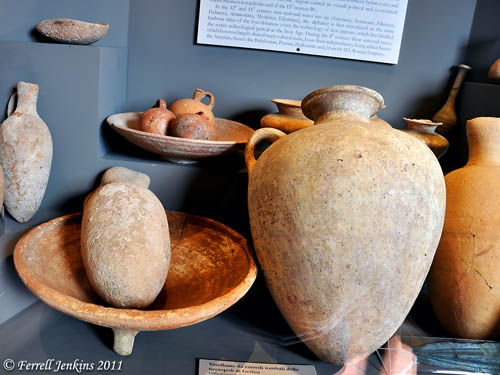
MB2 Pottery from Jericho. Vatican Museum. Photo by Ferrell Jenkins.

MB2 Pottery from Jericho. Vatican Museum. Photo by Ferrell Jenkins.

It would be possible for an energetic person to download all of the PDF entries and compile them into one document. This would make for easy searching.

If our Dutch friends and colleagues miss the English idiom used as a title for this blog, the definition is given here.

Idiom Meaning — Accusing a person of a misdemeanour whilst the accuser is guilty of the same thing.

I am using the title to suggest we may be using the wrong term for certain biblical pots and pans. The KLY Database of Utensils in the Hebrew Bible will help us not to make the mistake again.

Thanks for the help.

: J.P. van de Geissen, Aantekeningen bij de Bijbel

A grave matter

Ancient burial places create serious problems for archaeologists. Ultra-Orthodox Jews often create a scene at digs when they know or suspect that there may be Jewish tombs in the area.

The cemeteries of the Holy Land have become a ground for religious and political skirmishes. Leen Ritmeyer reported on fake Arab tombs near the Temple Mount here.

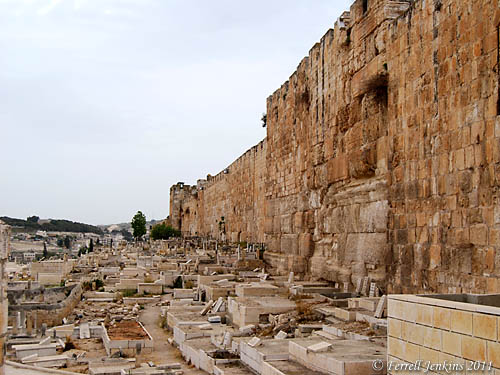
Muslim tombs have been on the eastern wall of the Old City for a long time. This photo was made looking south from outside the Lion’s Gate (or St. Stephens’ Gate). Perhaps every reader knows that this is across the Kidron Valley from the Mount of Olives which we mentioned in the previous post.

Muslim Cemetery along the East Wall of the Old City near Lion's Gate. Photo by Ferrell Jenkins.

Muslim Cemetery along the Eastern Wall of the Old City of Jerusalem near Lion's Gate. Photo by Ferrell Jenkins.

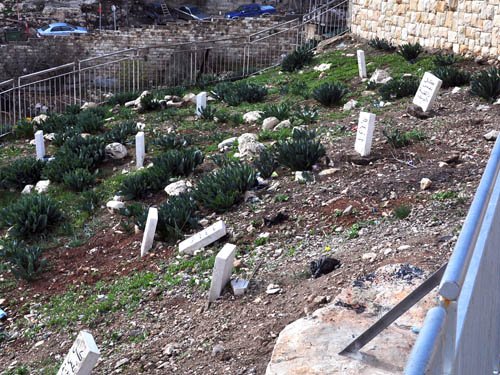
In early February I noticed a large number of new tombstones with Arabic inscriptions in a small plot above the Pool of Siloam. Suspicious, to say the least.

New Tombstones above the Pool of Siloam. Photo by Ferrell Jenkins.

New Tombstones above the Pool of Siloam. Photo by Ferrell Jenkins.

Later, if not sooner, all of these matters will become obvious.

“Do not marvel at this; for an hour is coming, in which all who are in the tombs will hear His voice, and will come forth; those who did the good deeds to a resurrection of life, those who committed the evil deeds to a resurrection of judgment. (John 5:28-29 NAU)

Cemetery on the Mount of Olives

The Washington Post reports here on US and Israeli efforts to end the desecration of Jewish graves on the Mount of Olives. Both religious and political considerations are mentioned.

It is amazing to view the Mount of Olives and see how much of the mountain is now covered with graves. This aerial view may help you to visualize the situation.The cemetery under discussion is shown in the lower right quarter of this photo.

Jerusalem - the Old City and the Mount of Olives. Photo by Ferrell Jenkins.

Jerusalem - the Old City and the Mount of Olives. Photo by Ferrell Jenkins.

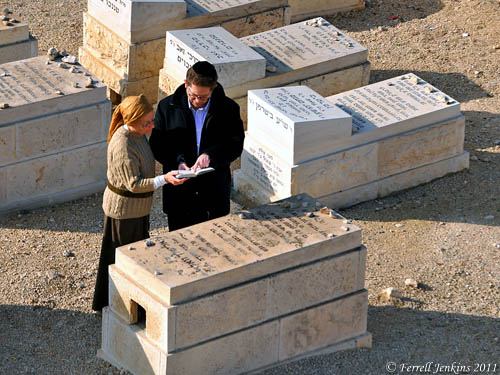
Sometimes when we look at the big picture we miss some important details. The next photo puts a human face and emotion on the situation.

Cemetery on the Mount of Olives. Photo by Ferrell Jenkins.

Cemetery on the Mount of Olives. Photo by Ferrell Jenkins.

At the time of Absalom’s rebellion, David crossed the Mount of Olives as he fled Jerusalem.

But David went up the ascent of the Mount of Olives, weeping as he went, barefoot and with his head covered. And all the people who were with him covered their heads, and they went up, weeping as they went. (2 Samuel 15:30 ESV)

HT: Paleojudaica.

Banias — easternmost source of the River Jordan

The Nahr (River) Banias is the easternmost source of the River Jordan. The source of the Banias is located at a site we know as Caesarea Philippi in the New Testament. It is well known to those who study the ministry of Jesus (Matthew 16:13-19).

Banias is located on the eastern side of the Beka or Hula Valley.  The valley is called the Beka in Lebanon, and a little further south the Hula Valley. The elevation is about 1150 feet above sea level in the foothills of Mount Hermon.

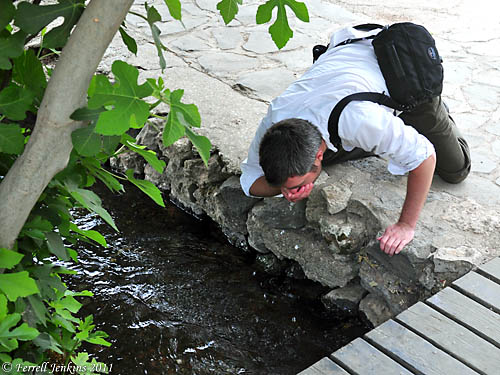
The photo below shows the place where the water emerges from the earth. Perhaps you are reminded of the text from the prophet Jeremiah:

for my people have committed two evils: they have forsaken me, the fountain of living waters, and hewed out cisterns for themselves, broken cisterns that can hold no water. (Jeremiah 2:13 ESV)

Getting a drink at the source. River Banias, Caesarea Philippi.

Getting a drink at the source. River Banias, Caesarea Philippi. Photo by Ferrell Jenkins.

Other posts about this site are listed below. Check them all.

Three other rivers we have recently mention, Flea River, the Senir, and the Dan, join with the Banias to form the River Jordan.

Speaking in North Georgia

The Mountain View Church of Christ, Cumming, Georgia, has invited me to speak on Bible History and Archaeology at the North Georgia Bible Forum in Cumming, Georgia, March 20-25. Stop by if you happen to be in the area. Full details are available here.

Nahal Dan — strongest source of the Jordan

Israel National Parks and Nature Reserves, by Azaria Alon, is a must book for those who plan to visit more than the popular few of the parks and reserves in Israel.  It is published by Carta (Jerusalem), and distributed by Eisenbraun’s in the USA. Click on the link here to go directly to the description and order info.

Here is Alon’s description of the Nahal Dan (Nahr el-Leddan; River Dan):

Nahal Dan is situated in the heart of an area known as “the land of streams and rivers,” and indeed, in the Nahal and along its margins, water and vegetation are present in abundance. The Nahal has a single principal source but it is also fed by dozens of smaller springs. Walking in this environment one has the feeling of springs emerging everywhere. All this water has its origin from the winter snows on Mt. Hermon. The snow melts slowly, seeps into the sponge-like earth of the mountain, and emerges in the foothills. The water flows quietly from the springs, but it continues down an ever-increasing slope, turning into a torrent and generating standing waves and foam. When the stream emerges from the nature reserve, it splits into several rivulets which rejoin when it encounters Nahal Hermon to form the Jordan River.

Nahal Hermon is more commonly known as the Nahr Banias which begins at the site of Caesarea Philippi.

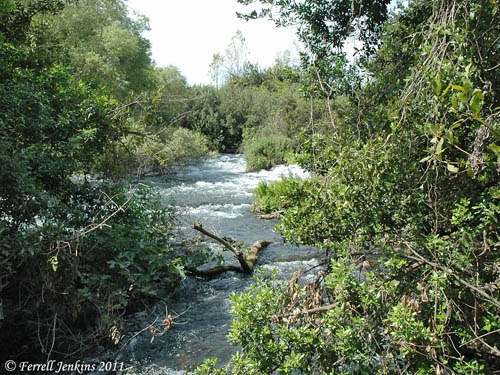
Here is a view of the Nahal Dan within the Tel Dan Nature Reserve.

Nahal Dan in the Tel Dan Nature Reserve. Photo by Ferrell Jenkins.

Nahal Dan in the Tel Dan Nature Reserve. Photo by Ferrell Jenkins.

And here is one of the springs. This one is located immediately below the northwest corner of Tel Dan.

A spring in the Tel Dan Nature Reserve. Photo by Ferrell Jenkins.

A spring in the Tel Dan Nature Reserve. Photo by Ferrell Jenkins.

Dan is Israel’s northernmost city (Judges 18:29).

The flea river: Nahr Bareighit or Nahal Iyon

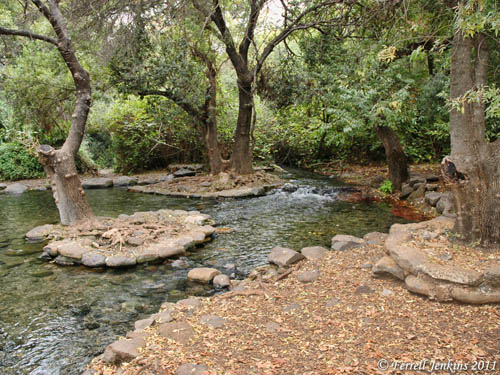
The least known of the sources of the Jordan River is the Nahr Bareighit (flea river) or Nahal Iyon (the name used in Israel). Like the Senir (Hasbani), this river begins in the Beka Valley of Lebanon. It is often overlooked when the sources of the Jordan are named.

Nelson Glueck, The River Jordan, describes the Nahr Bareighit.

The westernmost source of the Jordan is the small mountain stream, Nahr Bareighit. Through a rude gorge, it tumbles down southward from the hilly meadowland of Merj ‘Ayun, which retains in clear part its ancient Biblical name of Ijon (1 Kings 15:20), to add its waters to the formation of the fateful [Jordan] river. The Nahr Bareighit joins the Nahr Hasbani about three quarters of a mile above the point where the Hasbani joins the junction of the Leddan and Banias streams. These last two alone were anciently considered as the sole sources of the Jordan. All found help to form it, and lose their identity in it, as the Jordan starts it flow under its own name.

“Roll, Jordan, roll;
I want to go to heaven when I die
To hear sweet Jordan roll.”

Deni Baly, The Geography of the Bible, devotes a single sentence to this little stream.

The basin of Marj ‘Ayoun to the west is drained by the smaller Bareighit, which leaps over the threshold in a series of charming waterfalls near Metullah and postpones its junction with the Jordan until just before the Huleh marshes. (193)

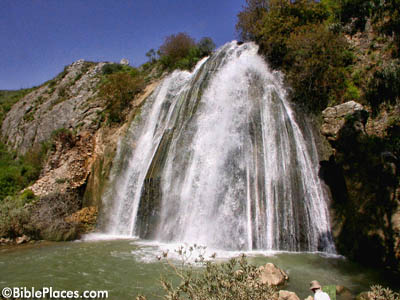
The photo below shows the Iyon Mill Falls. It is one of the beautiful photos of several falls on the river from the Pictorial Library of Bible Lands. Check BiblePlaces.com to purchase the complete set or the DVD of Galilee and the North.

Nahal Iyon Mill Falls. Photo: BiblePlaces.com.

Nahal Iyon Mill Falls. Photo courtesy of BiblePlaces.com.

The Senir, a source of the Jordan River

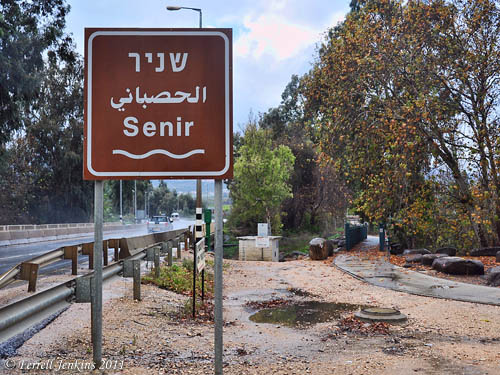
The longest source of the Jordan is the 24-mile-long Nahr Hasbani which begins in the Beka Valley of Lebanon and flows south to join the Jordan. Israel has replaced many of the Arabic names that were commonly used in earlier decades with Hebrew names. The Old Testament says that the Sidonians “call Hermon Sirion, and the Amorites call it Senir” (Deuteronomy 3:9). The river is now designated Senir in Israel.

At the Senir (Hasbani) on Israel Highway 99. Photo by Ferrell Jenkins.

At the Senir (Hasbani) on Israel Highway 99. Photo by Ferrell Jenkins.

Other passages identifying Mount Hermon as Senir are 1 Chronicles 5:23, Song of Solomon 4:8, and Ezekiel 27:5. Nelson Glueck, The River Jordan, calls attention to Psalm 42:6, translating it this way:

O my God, my soul is cast down within me: Therefore am I mindful of thee from the land of the Jordan, and the Hermons” (Psalm 42:6)

The plural of the Hebrew word chermonim is bought out in the English translations by phrases like “peaks of Hermon” or “heights of Hermon.”

Israel Highway 99 runs north east from Kiryat Shmona to the Golan Heights past Tel Dan and Banias (Caesarea Philippi) and two other sources of the Jordan (the River Dan and the River Banias). Because this river begins in the vicinity near Mount Hermon, it is called the Senir.

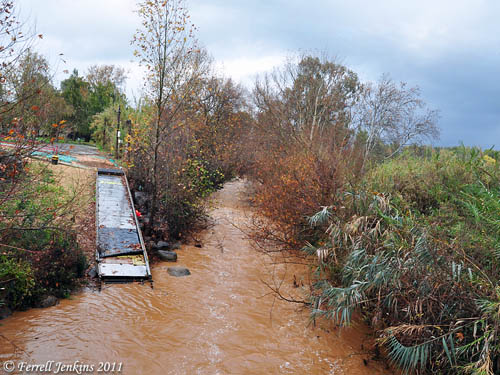
The photo below is the view north from Highway 99.

The Senir River (Hasbani) view north from HWY 99.

The Senir River (Hasbani) view north from HWY 99. Photo by Ferrell Jenkins.

I think the slide on the west side of the river is used to launch kayaks into the river.

Shattered dreams

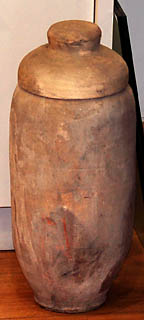
Qumran Replica

Qumran Replica

Back in early February I posted a poll here from Jerusalem asking, “Did Ferrell purchase the Qumran Jar replica?” I may have set a limit on the time frame for voting. There were 101 total votes. Here are the results:

  • Yes — 39.6%
  • Absolutely not — 14.85%
  • No, but he lusted — 45.54%

Drumroll! The answer: Yes, and he had it shipped from the shop to his home in Florida. I guess this says something about polls.

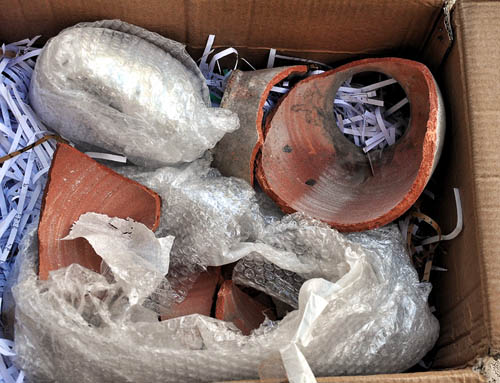
The photo to the right shows the beautiful Qumran Jar replica, like those the Dead Sea Scrolls were stored in for nearly two millennial, as it looked the day I purchased it in Jerusalem. The package arrived at our home about four weeks later. I was delighted to receive it, but when I opened the package this is what I found.

The broken Qumran Jar replica. Photo by Ferrell Jenkins.

The broken Qumran Jar replica. Photo by Ferrell Jenkins.

The manager of the shop at the City of David Visitors Center has been very nice and promises that another jar will be on the way shortly. We had paid about as much for insurance as for the jar.

Perhaps I should take the attitude of a lady guide in Russia about 20 years ago. She was a staunch party loyalist. When some of our ladies asked her about the availability of sugar, she said that it was not available. Then she added, “But we don’t need it.”

Well, I can still get at few biblical lessons from this experience.

Prior to the Babylonian destruction of Jerusalem in 586 B.C. the prophet Jeremiah was instructed to break a jar in the presence of the leaders of the people and of the priests.

The LORD continued, “Now break the jar in front of those who have come here with you. Tell them the LORD who rules over all says, ‘I will do just as Jeremiah has done. I will smash this nation and this city as though it were a potter’s vessel which is broken beyond repair. The dead will be buried here in Topheth until there is no more room to bury them.’ I, the LORD, say: ‘That is how I will deal with this city and its citizens. I will make it like Topheth. (Jeremiah 19:10-12 NET)

If I get sick with boils I can use the potsherds like Job did.

Job took a shard of broken pottery to scrape himself with while he was sitting among the ashes. (Job 2:8 NET)