Category Archives: Bible Places

Wishing you a fruitful and pleasant New Year

The beginning of a New Year gives us an opportunity to correct the mistakes we made in the previous year and try more diligently to do better in the future.

I trust that your New Year will be one of fruitfulness and pleasantness as you seek to honor the Creator of the universe and all men.

A fruit kiosk at the port of Akko (Roman Ptolemais). Photo by Ferrell Jenkins.

A fruit kiosk at the port of Akko (Roman Ptolemais). Photo by Ferrell Jenkins.

1 How blessed is the man who does not walk in the counsel of the wicked, Nor stand in the path of sinners, Nor sit in the seat of scoffers!
2 But his delight is in the law of the LORD, And in His law he meditates day and night.
3 He will be like a tree firmly planted by streams of water, Which yields its fruit in its season And its leaf does not wither; And in whatever he does, he prospers.
4 The wicked are not so, But they are like chaff which the wind drives away.
5 Therefore the wicked will not stand in the judgment, Nor sinners in the assembly of the righteous.
6 For the LORD knows the way of the righteous, But the way of the wicked will perish. (Psalm 1:1-6 NAU)

BiblePlaces List of Top Stories of 2010

Over the past few weeks I have been busy with numerous things other than blogging that I considered important. In the meantime I have followed several blogs to keep up with what’s going on in those areas in which I have interest. I always check Todd Bolen’s BiblePlaces Blog, because it covers the specific areas that we try to cover here.

As the year 2010 comes to an end, Todd has listed what he considered the Top Discoveries of 2010, the Top Technology-Related Stories of 2010, and Losses (deaths). He promises to post other related lists tomorrow.

I suggest you take a look at the lists. We have commented on several of these same stories because we considered them important in assisting Bible students.

Ancient Yarkon fortress with Greek and Assyrian connections?

The American Friends of Tel Aviv University have announced that Tel Aviv University researchers have connected Tel Qadadi, at the mouth of the Yarkon River in Tel Aviv, with the Greek island of Lesbos.

Tel Qudadi, an ancient fortress located in the heart of Tel Aviv at the mouth of the Yarkon River, was first excavated more than 70 years ago — but the final results of neither the excavations nor the finds were ever published. Now, research on Tel Qudadi by archaeologists at Tel Aviv University has unpeeled a new layer of history, indicating that there is much more to learn from the site, including evidence that links ancient Israel to the Greek island of Lesbos.

“The secrets of this ancient fortress are only beginning to be revealed,” Dr. Alexander Fantalkin and Dr. Oren Tal of Tel Aviv University’s Department of Archaeology say. Their new research was recently published in the Palestine Exploration Quarterly and BABESH: Annual Papers on Mediterranean Archaeology.

The release points out that it was thought in the past that the Tel Qadadi fortress was established in the 10th century B.C. by King Solomon.

The establishment of the fortress at Tel Qudadi was understood later as evidence of the existence of a developed maritime policy in the days of the United Monarchy in ancient Israel.

Another view was that the fortress belonged to the 9th century B.C. and should be attributed to the Kingdom of Israel. An amphora from the Greek island of Lesbos in the Aegean is said to provide evidence that the site should now be dated to the late 8th/early 7th century fortress “serving the Assyrian interests in the Levantine coast rather than part of the Israelite Kingdom.”

One could not possibly have anything dating to the time of Solomon within a potsherd’s throw of Tel Aviv University!

Read the entire news release here.

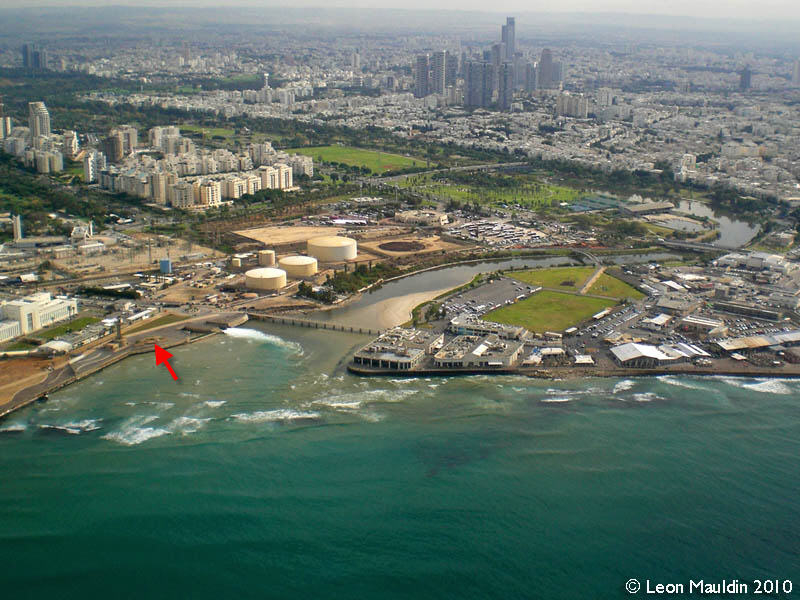
The AFTAU release included a small photo by my friend and co-traveler Leon Mauldin.  Leon has given me permission to post his photo here. It shows the mouth of the Yarkon River as it flows into the Mediterranean Sea. The river begins a few miles inland at the Old Testament site of Aphek (1 Samuel 4:1), known in Roman times as Antipatris (Acts 23:31). Click on the photo for a larger image.

Aerial view of mouth of the Yarkon River at Tel Aviv. Photo by Leon Mauldin.

Aerial view of mouth of the Yarkon River at Tel Aviv. Photo by Leon Mauldin.

The arrow points to the little tel on the north bank of the Yarkon.

There is another lesson in this press release. Scholars, including archaeologist, do not agree and they often change their minds. It is a mistake for one to build an “infallible” case on a fallible premise. We must work with the evidence we have at any given time.

You may see more of Leon’s photos at Leon’s Message Board.

HT: Joseph I. Lauer

Searching for Sodom — in the sea and on the land

The search for the city of Sodom has become as elusive and controversial as the search for Noah’s ark. From Genesis to Revelation the Bible calls attention to the city of Sodom. It is first mentioned in Genesis 10:19; the last reference is in Revelation 11:8. The wickedness and destruction of the city became a symbol of final destruction throughout the Bible. Isaiah spoke concerning Judah and Jerusalem:

If the LORD of hosts had not left us a few survivors, we should have been like Sodom, and become like Gomorrah. (Isaiah 1:9 ESV)

The apostle Paul picks us the same theme in Romans 9:29.

The emphasis on Sodom, and the inability to visit a specific site only heightens the curiosity.

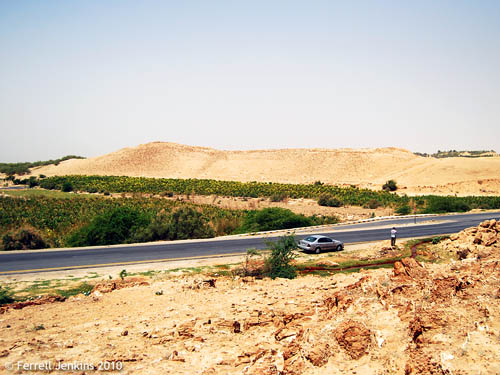
Dr. Steven Collins, Dean, College of Archaeology, Trinity Southwest University, thinks that Tall el-Hammam is the site of Sodom. Info about the excavation project may be located here. Other scholars suggest that Tall el-Hammam is the site of Abel-shittim (Numbers 33:49; Shittim, Numbers 25:1), in the plains of Moab. See Rainey and Notley, The Sacred Bridge, 125. The Israelite spies went out from here to view the promised land, especially Jericho (Joshua 2:1).

Tall el-Hammam in the Jordan Valley of Jordan. Photo by Ferrell Jenkins.

Tall el-Hammam in the Jordan Valley of Jordan. Photo by Ferrell Jenkins.

Earlier in the month the media reported (here, for example) that a Russian team was planning to begin an underwater exploration of the northeast portion of the Dead Sea — that is, on the Jordan side of the Dead Sea.

In the past it has been common for scholars to suggest that Sodom were located in (or at) the southern end of the Dead Sea at Bab edh-Dhra.

The excavation at Tall el-Hammam is now in progress. Dr. David Graves has been working there for several years. He has also been looking for the Roman site of Livius. I wish to call attention to several things Graves has mentioned recently on his Deus Artefacta blog.

  • A video of Dr. Collins setting forth his argument for the location of Sodom and Gomorrah at Tall el-Hammam. Click here.
  • The front team for the current season of excavation. Click here.
  • Someone from the Russian team was to visit Tall el-Hammam.
  • Season Six Begins at Tall el-Hammam video. Click here.
  • Gary Byers, Assistant Dig Director, on December 23 reported more details about the Russian proposal. Read the entire report here. It appears that the Russian team is making claims greater than the reality.

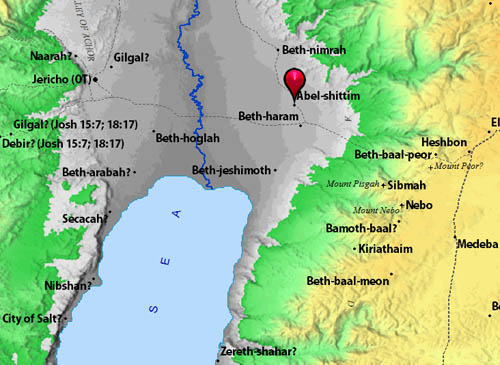
The site marked Abel-Shittim on the map below is known today as Tall el-Hammam. You may see a larger map at BibleAtlas.org.

Site of Abel-Shittim in the Jordan Valley. BibleAtlas.org.

Site of Abel-Shittim in the Jordan Valley. BibleAtlas.org.

I’m not convinced yet, but I’ll continue to watch.

Bethlehem — home of David and Jesus

A little more than two years ago we wrote about Bethlehem as the birthplace of Jesus here. We will follow the example of Paul, Peter and Jude to remind our readers of some things we already know (Romans 15;15; 1 Corinthians 4:17; 2 Timothy 2:14; 2 Peter 1:12; Jude 1:5; et al.).

  • During the Patriarchal period the town we know as Bethlehem was called Ephrath (Genesis 48:7; 35:9-27).
  • Later, as part of the territory allotted to the tribe of Judah, it was the home of Ruth and Boaz and became the birthplace and early home of David (1 Samuel 17:12, 15).
  • The town was sometimes called the “city of David” (Luke 2:4, 11), but is most famous as the birthplace of Jesus (Micah 5:2; Luke 2:4-15; Matthew 2:1-16).

When one visits the Bible lands today he must realize that 2,000 years of history, involving both repeated building and the destruction of what has been built, has left nothing to remind one of the original place where Jesus was born. Justin Martyr (ca. A.D. 160) said Joseph “took up his quarters in a certain cave near the village.” Origen (mid-third century) said the cave where Jesus was born was being shown and even the enemies of the faith were talking of it. Jerome, a resident of Bethlehem (A.D. 386-420), tells how the birthplace of Jesus and other places associated with the ministry of Jesus were defiled from the time of Hadrian to the reign of Constantine. The Church of the Nativity now stands at this spot.

This photo shows the exterior of the Church of the Nativity.

Exterior of the Church of the Nativity, Bethlehem. Photo by Ferrell Jenkins.

Exterior of the Church of the Nativity, Bethlehem. Photo by Ferrell Jenkins.

My wife saved a portion of our local paper for me last Sunday. The headline says, “Peace swells Bethlehem tourism.” All of the town’s hotel rooms are booked solid for Christmas. Last year 70,000 visited Bethlehem for Christmas, but the number is expected to be “up strongly” this year.

If you have more interest in learning about the origin of the celebration of Christ, take a look here. A more detailed study of the historical aspects of the celebration is available in PDF here.

Opportunity to win Pictorial Library

We have repeatedly recommended the Pictorial Library of the Bible Lands. Todd Bolen is giving away two 10-volume sets of this valuable resource. You have until Sunday at 5 p.m. to enter the drawing.

The Pictorial Library is being offered at a 20% discount for the first time. This offer extends through Sunday.

Full details are available at the Bible Places Blog here.

Another shipwreck in the Mediterranean

We see more reports of bad weather in the Mediterranean and the effect it is having on shipping. Note today’s report in Hürriyet, Turkey’s English Daily here.

Stormy weather in Antalya caused a cargo ship to run aground Thursday, leaving one person missing, and may also have contributed to the death of a woman whose body was found in the area.

The vessel, named “Seabright,” had been en route from the Tarsus Port in Adana province to Egypt with a crew of 18 people when it crashed into the rocks in a central part of the Mediterranean province of Antalya, the Anatolia news agency reported Friday.

Did you notice the references to Tarsus and Antalya? This brings to mind the work of the Apostle Paul. Tarsus in Cilicia was the home of Paul (Acts 9:11; 21:39; 22:3). Antalya is identified with Attalia, a coastal city a short distance west of Tarsus (Acts 14:25). Perga, mentioned in the same verse, is nearby.

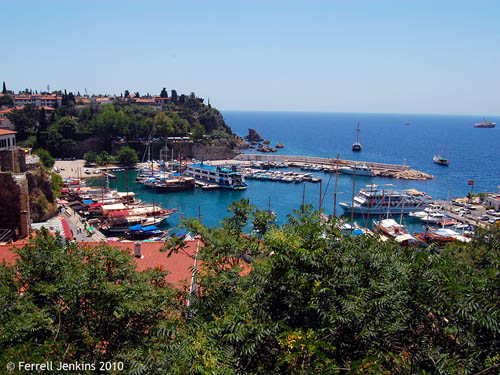
Pleasure harbor at Antalya, Turkey. Photo by Ferrell Jenkins.

Pleasure harbor at Antalya, Turkey. Photo by Ferrell Jenkins.

Mark Wilson writes of Antalya,

The modern city covers the ancient site so few ancient ruins are visible. Those remaining are around the harbor in the old city called Kaleiçi. (Biblical Turkey, 81).

When Paul sailed from Caesarea to Rome his ship went along the southern coast of Asia Minor, modern Turkey. Imagine the effect of this type of storm on a ship dependent on sails for its navigation.

Earlier in the week we noted the effect of dangerous storms in the Eastern Mediterranean. Scroll down for posts about Caesarea, Ashkelon, and Alexandria.

Photos of the Ashkelon statue

London’s Daily Mail Online has posted some great photos of the recovery of the Ashkelon Roman-era statue uncovered by the recent storm which we wrote about here. I see now that the discovery was made a short distance north of the ancient tel. In fact, I recognize the building in the background as the Holiday Inn, 9 Yekutiel Adam Street, Ashkelon.

HT: David Padfield

Caesarea National Park closed due to storm damage

The recent storm in the eastern Mediterranean caused damage to the breakwater at Caesarea and led Israeli authorities to temporarily close the Caesarea National Park. Haaretz reports here.

The head of the Israel Antiquities Authority, Shuka Dorfman, yesterday toured Caesarea National Park to take stock of the damage to the antiquities by last weekend’s storm.

Calling the damage “a national disaster,” Dorfman noted that the breakwater, which was broken in three areas by high waves during the storm, now leaves the antiquities exposed to damage from any future high waves.

Dorfman expressed concern that the storm expected this weekend could further damage the antiquities.

“The damage from the storm is huge all along the coast, from Ashkelon in the south the Acre in the north,” Dorfman said adding that if the situation is not remedied immediately through extensive conservation efforts, erosion of the cliff along the beach would continue until it collapses, leading to “the destruction of many ancient cultural treasures of Israel.”

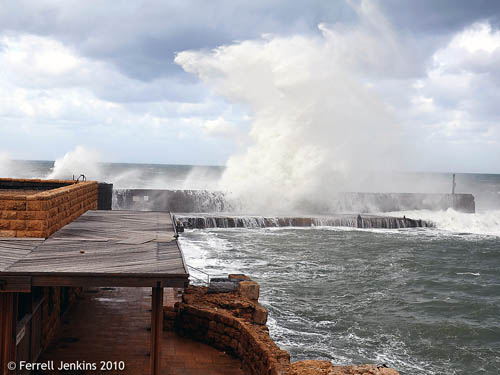
A year ago I wrote about a stormy day at Caesarea Maritima here. I think you might enjoy the photos there. Here is a new one.

High waves at Caesarea Maritima - 12/12/09 - Photo by Ferrell Jenkins.

High waves at Caesarea Maritima - December 12, 2009 - Photo by Ferrell Jenkins.

Caesarea Maritima was a first century Roman capital and seaport. The gospel was first preached to the Gentiles here when Peter came from Joppa to Caesarea to tell Cornelius words by which he could be saved (Acts 10, 11).

Herod the Great built a city on the site of Strato’s Tower and named it Caesarea in honor of Caesar Augustus. It became a center of Roman provincial government in Judea. The city had a harbor and was located on the main caravan route between Tyre and Egypt. This city is called Caesarea Maritima (on the sea) to distinguish it from Caesarea Philippi.

The Apostle Paul used the harbor at Caesarea several times. He was imprisoned here for two years before departing for Rome (Acts 24:27; 27:1).

Storm uncovers beautiful sculpture

The recent storms in the eastern Mediterranean have caused considerable damage along the coast. At Ashkelon, located on Israel’s southern Mediterranean coast, the high waves uncovered a Roman-era statue.
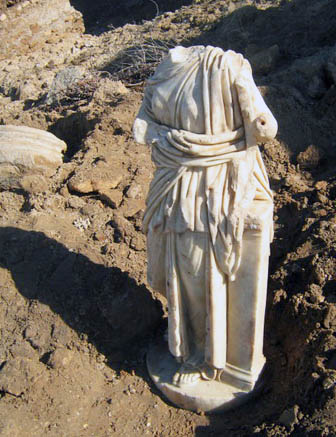
Roman-era statue uncovered by storm at Ashkelon. Photo: IAA.

Roman-era statue uncovered by storm at Ashkelon. Photo courtesy of Israel Antiquities Authority.

France 24 International News reports here,

A massive storm that battered the eastern Mediterranean caused the collapse of a cliff in the southern Israeli city of Ashkelon, revealing a rare Roman-era marble statue, officials said on Tuesday.

“The big storm earlier this week caused the cliff to collapse and a statue from Roman times was found by a passer-by,” said Yoli Schwartz, spokeswoman for the Israel Antiquities Authority.

The white marble statue of a woman, which weighs about 200 kilogrammes (440 pounds) and stands 1.2 metres (nearly four feet) tall, has been removed from the site by the authority, which is studying it, she said.

The statue was missing its head and arms, apparently from earlier damage, but had “delicately carved sandals,” Schwartz told AFP.

The storm that hit the eastern Mediterranean earlier in the week with winds of over more than 100 kilometres per hour (62 miles per hour) whipped up enormous waves, some as high as 12 metres (40 feet), that caused widespread damage.

While the collapse of the cliff in Ashkelon led to the discovery of the statue, the storm also endangered other important archaeological sites along the coast.

The reports I have read do not make it clear if this discovery was made at Tel Ashkelon. The port is mentioned. Damage to archaeological sites, both natural and man-made, are not uncommon. In fact Tel Ashkelon has been severely eroded by the wind and the waves over the years. This photo shows the location of the tel as we look north. Some of the buildings of modern Ashkelon may be seen in the distance.
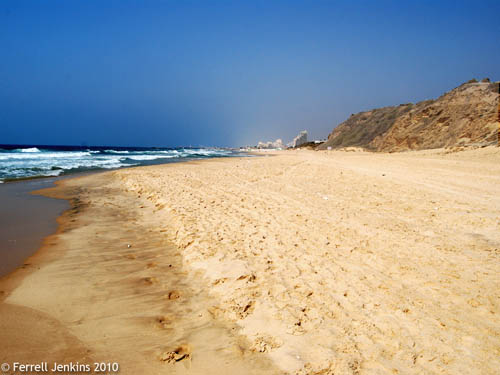
Tel Ashkelon and the Mediterranean Sea. Photo by Ferrell Jenkins.

Ashkelon and the Mediterranean Sea. Photo by Ferrell Jenkins.

Take a look at the erosion in the west side of the tel. Shards of pottery may be seen in the exposed portion of the tel and along the beach. Some shards show evidence of having been repeatedly washed out and in.
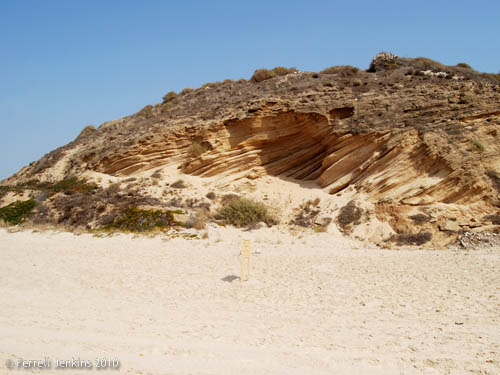
Erosion visible in Tel Ashkelon. Photo by Ferrell Jenkins.

Erosion visible in Ashkelon. Photo by Ferrell Jenkins.

Ashkelon was one of the main cities of the Philistines. The LORD spoke against the Philistine cities through the prophet Jeremiah (ch. 47). These verses caught my attention.

How long will you cry out, ‘Oh, sword of the LORD, how long will it be before you stop killing? Go back into your sheath! Stay there and rest!’ But how can it rest when I, the LORD, have given it orders? I have ordered it to attack the people of Ashkelon and the seacoast. (Jeremiah 47:6-7 NET)

HT: Joseph I. Lauer