Category Archives: Bible Places

The rock of Van in Eastern Turkey

Paul Zimansky, in an article on Rusa II, the seventh century B.C. king of Urartu, describes the extent of the territory:

“The kingdom that Rusa controlled in the second quarter of the seventh century BCE stretched across the mountainous terrain of eastern Anatolia approximately eight hundred miles from east to west and five hundred from north to south” (“An Urartian Ozymandias,” Biblical Archaeologist, June, 1995, 94).

Dr. Oktay Belli says the name Urartu is not an ethnic term but a geographical one meaning “mountainous terrain” (The Capital of Urartu: Van, 20). Prior to the Urartians, this region was the home of the Hurrians.

There is a small museum in Van (unless enlarged since my last visit). Many inscriptions in the cuneiform language which the Urartians borrowed from the Assyrians are displayed. There were several pieces of gold jewelry and works of bronze on exhibit.
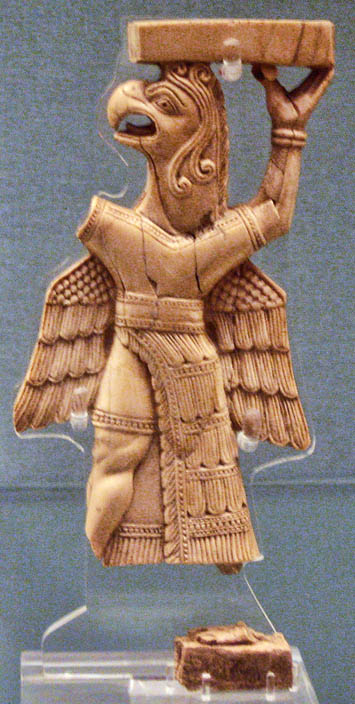
Urartian Ivory. British Museum.

Urartian Ivory. British Museum. Photo by Ferrell Jenkins.

The British Museum displays some Urartian pottery and ivories. The sign under this ivory piece reads,

Ivory objects were prized luxury items throughout the Near East. Some were made in Urartu and elephant tusks are listed by the Assyrians as booty from Urartian temples and palaces.

The photo below shows the castle or rock of Van. It is the site of Tushpa, an ancient city of the Urartians.

The Rock of Van, ancient Tushpa. Photo by Ferrell Jenkins.

The Rock of Van, ancient Tushpa. Photo by Ferrell Jenkins.

Tushpa, the ancient city of the Urartians, was built on this rock, which provides a commanding view over the lake, and at the base of the rock. At the beginning of the 20th century the city of Van was built over the ancient ruins, but was destroyed by the Russians in 1916. The area now is nothing more than a grassy knoll. On the side of the rock and at the top there are inscriptions, the tombs of eighth and ninth century B.C. Urartian kings, and ruins of a temple. A short distance from Van is another site called Toprakkale which marks the Urartian fortress of Rusahinili.

We know that the Assyrians were a threat to the kingdoms of Israel and Judah for about two hundred years. It is impressive to know that they also maintained an active engagement with the kingdom of Urartu closer to home. The distance from Nineveh to Tushpa on Lake Van is about 150 miles in a straight line. Think much further by mountainous road.
Quake survivors plead for tents

With the death toll approaching 300 in Eastern Turkey, a headline from MSNBC says, “Turkish quake survivors plead for tents.” It is easy to locate photos of tent cities set up in the area of the earthquakes. Such is often true even for those whose houses were not destroyed. The fear of after shocks cause people to leave their houses.

One of the first questions we should ask in Bible study is “What did this text mean to the original readers?” Until we know the answer to that question we should not try making applications of our own. Sometimes we fail to understand a text because we do not understand the customs and conditions of the time in which the text was written.

The letters to the Seven Churches of Revelation are especially filled with local allusions to things common in that time and place. The saints at Philadelphia were told that the one who overcomes (conquers) would be made a pillar in the temple of God. Notice the next phrase: “Never shall he go out of it.”

The one who conquers, I will make him a pillar in the temple of my God. Never shall he go out of it, and I will write on him the name of my God, and the name of the city of my God, the new Jerusalem, which comes down from my God out of heaven, and my own new name. (Revelation 3:12 ESV)

Philadelphia was especially noted for volcanoes and earthquakes. We discussed this earlier here. Pillars crumble during earthquakes and people leave their houses to live in tents. The promise in this text is that the one who overcomes will become a pillar in the temple of God and “never shall he go out of it.” This was a wonderful promise to those saints who had suffered from earthquakes on several occasions.

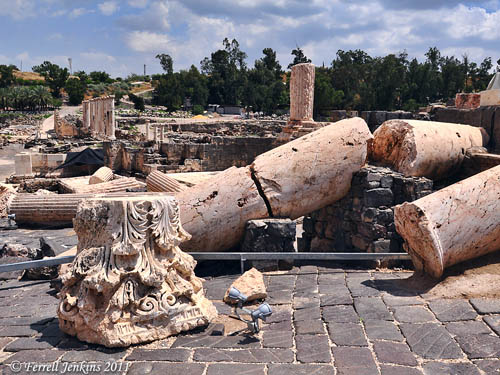
The photo below illustrates the effect of an earthquake on the pillars of temples and other buildings. It was made at Bethshan (Beth-shean) where an earthquake hit the city in 749 A.D.

Columns broken by earthquake at Bethshan. Photo by Ferrell Jenkins.

Columns broken by earthquake at Bethshan. Photo by Ferrell Jenkins.

Earthquake shakes Eastern Turkey — the Land of Ararat

Early Sunday morning we learned that a 7.2 magnitude earthquake hit eastern Turkey around Lake Van. Today this region is occupied mostly by Kurds, but in biblical times it was known as the land of Urartia or Ararat. The region was the area where Noah’s ark is said to have rested after the flood.

and in the seventh month, on the seventeenth day of the month, the ark came to rest on the mountains of Ararat. (Genesis 8:4 ESV)

After the sons of Assyrian king Sennacherib killed him at Nineveh, they escaped to the land of Ararat (2 Kings 19:37; Isaiah 37:38).

The kingdom of Ararat was called to participate in the overthrow of Babylon (Jeremiah 51:27).

Several times we have written about earthquakes in the Bible, and specifically earthquakes in the eastern portion of Turkey. See here and here. We wrote about the planning done by local people for earthquakes here.

Below is another photo made in June, 2007, on the road from Van to Batman. The wooden beams you see in the wall are placed there to help absorb the shock from earthquakes.

Preparing for earthquakes in Eastern Turkey between Van and Batman. Photo by Ferrell Jenkins 2007.

Preparing for earthquakes in Eastern Turkey. Photo by Ferrell Jenkins 2007.

The only photos of yesterday’s earthquake damage that I have seen has been from the cities where the buildings are made of concrete. I wonder how well these country folk have fared in this earthquake.

Not much remains at Capernaum

Capernaum, on the northern shore of the Sea of Galilee, played a significant role in the ministry of Jesus. The town became the Galilean center for the ministry of Jesus.

And leaving Nazareth he went and lived in Capernaum by the sea, in the territory of Zebulun and Naphtali, (Matthew 4:13 ESV)

The aerial photo below was made on approach to Capernaum from the east. The site most visited by tourists may be seen left of the center of the photo. You may recognize the new church and the ruins of the synagogue. This property is owned by the Franciscans. To the right you will see the Greek Orthodox Church and the property they own. Evidence of some excavations may be seen.

There is not much remaining of ancient Capernaum. This is not surprising in light of the pronouncement of Jesus.

And you, Capernaum, will you be exalted to heaven? You will be brought down to Hades. For if the mighty works done in you had been done in Sodom, it would have remained until this day. (Matthew 11:23 ESV)

Aerial View of Capernaum. Photo by Ferrell Jenkins.

Aerial View of Capernaum. Photo by Ferrell Jenkins.

Ritual bath discovered at biblical Zorah

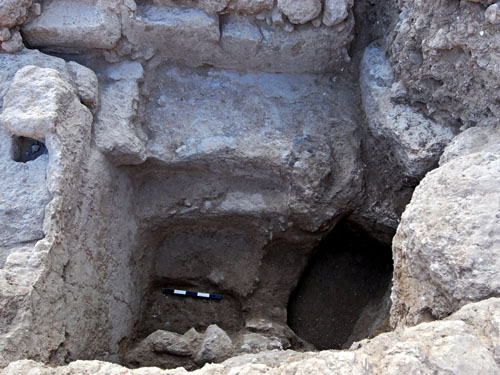
A report today from the Israel Antiquities Authority announces the discovery of a Second Temple Period ritual bath. This means the Herodian Temple that was standing at the time of the ministry of Jesus. Many Bible students think of the Herodian Temple as the Third Temple.

  1. Solomon’s Temple (built about 966 B.C.). Destroyed in 586 B.C. by the Babylonians.
  2. The post-Babylonian Exile temple built 520-516 B.C. This temple fell into decay and was rebuilt and vastly enlarged by Herod.
  3. Herod’s Temple (begun about 19/20 B.C. Destroyed in A.D. 70 by the Romans.

Archaeologist Pablo Betzer, excavation director on behalf of the Israel Antiquities Authority, said,

“This is the first time that any remains dating to the Second Temple period have been exposed in this region. We knew from the Talmud and from non-Jewish sources that on this ridge, as in most of the Judean Shephelah, there was an extensive Jewish community 2,000 years ago that existed until the destruction of the Temple in 70 CE. Yet despite the many surveys and excavations that have been carried out to date no remains from this period have been discovered so far”. According to Betzer the name of the Jewish settlement that the ritual bath belonged to is still unknown.

Second Temple Mikveh from Zorah. Photo by Assaf Peretz, courtesy IAA.

Second Temple Mikveh from Zorah. Photo by Assaf Peretz, courtesy IAA.

Zorah is know to Bible students as the area of Samson’s birth and activity (Judges 13-16). Manoah, Samson’s father, was a Danite from Zorah (Judges 13:2).

Questions about purification were common during the ministry of John and Jesus. This is the “Second Temple” period.

Now a discussion arose between some of John’s disciples and a Jew over purification.  (John 3:25 ESV)

The NET Bible uses the phrase “ceremonial washing” instead of “purification.”

The full press release may be read here.

HT: Bible Places Blog.

Monday Meandering — October 10

More about Paul’s Shipwreck on Malta. Gordon Franz reviews Robert Cornuke’s recent video on the claimed evidence for the shipwreck.  The review is available at the Associates for Biblical Research site here, or Gordon’s Life and Land blog here.

Gordon also exposes the photos purporting to show giant human skeletons from Greece here.

Shiloh. Leon Mauldin wrote about our recent visit to Shiloh here, here, here. The tabernacle was located at Shiloh for many years after ancient Israel came into the promised land. See Joshus 18; 1 Samuel 1-4, et al.

Recent excavations at the base of Tel Shiloh. Photo by Ferrell Jenkins.

Recent excavations at the base of Tel Shiloh. Photo by Ferrell Jenkins.

Jezreel Excavation. A well-trained team of archaeologists, headed by Norma Franklin and Jennie Ebeling, announces renewal of excavations at Jezreel. Details here.

The new website describes the importance of the location of Jezreel.

We are returning to Jezreel because it is an amazing site with a long history that reflects the rich cultural heritage of the area

Perched on the foothills of the Gilboa mountain range it commands an unparelled view over the valley below. The famous sentry site of Megiddo, Biblical Armageddon, lies 15 kms to the west and to the east the renowned city of Bet Shean (Scythopolis).

Reliability of the New Testament Manuscripts. Barry Creamer comments on the “debate between Bart Ehrman and Daniel Wallace on whether the text of the New Testament is trustworthy. Both are world class scholars in textual criticism.” Some interesting comments on the different approach taken by the two textual critics to the problem of no original manuscripts. Read here.

HT:  Bible Place Blog; Bible X.

Lecture on Khirbet Qeiyafa — the Elah Fortress

The Lynn Wood Archaeological Museum announces a lecture by Dr. Michael G. Hasel about Khirbet Qeiyafa, also known as the Elah Fortress.

On Wednesday, October 12, Dr. Michael G. Hasel, professor of Near Eastern Studies and Archaeology at Southern Adventist University, will be sharing  the latest archaeological discoveries from the biblical site of Khirbet Qeiyafa. Recent trends in archaeology have questioned the historicity of David and Solomon’s Kingdom. Since 2009, Southern Adventist University has been uncovering the remains of this city-fortress dating to the time of King David. The discovery of this biblical city is a powerful argument for the reliability of the biblical account. The lecture will be held at 7 p.m. in Lynn Wood Auditorium on the campus of Southern Adventist University, 4960 Industrial Drive, Collegedale, TN. The Lynn H. Wood Archaeological Museum Lecture Series is free and open to the public.

For more information check the Museum website here.

The photo below is one I made in September showing Khirbet Qeiyafa clearly visible on the hill above the Valley of Elah. A copy of the photo suitable for use in teaching is available by clicking on the image.

View of Khirbet Qeiyafa from across the Valley of Elah. Photo by Ferrell Jenkins.

View of Khirbet Qeiyafa from across the Valley of Elah. Photo by Ferrell Jenkins.

It was in the Valley of Elah where the conflict between David and Goliath took place (1 Samuel 17). The brook of Elah lies in the valley below the fortress.

The location of Mount Sinai

Horeb is probably the range of mountains (cf. Exodus 17:6), and Sinai the peak. The terms are used interchangeably in several passages (cf. Acts 7:30,38 with Exodus 3:1ff.). Several sites have been suggested for Mount Sinai. Here are the major ones.

1. Some have suggested the Land of Midian because of what appears to be volcanic action (Exodus 19:18). It is argued that there has been no volcanic activity in the Sinai Peninsula, but that there has been in Midian. The Bible says, “the Lord descended upon it in fire.” This was miraculous activity.

2. Mt. Serbal at Wadi Feiran. There is no plain large enough for the encampment of Israel. This tradition goes back to Eusebius (4th century A.D.).

3. The traditional site is a peak known as Jebel Musa (Mount Moses). The elevation is 7,519 feet. The plain of el-Raha (Arabic for the Rest) at the foot of Jebel Musa has enough water for an encampment of considerable duration. G. Ernest Wright says, “we are left with the traditional location of Mt. Sinai as still the most probable” (20th Century Encyclopedia of Religious Knowledge, 1033). Grollenberg comments more from emotion than from reason:

“A visit to the traditional Mount Sinai suffices to dispel all these doubts. The huge granite formations are an awe-inspiring spectacle. The atmosphere, the light and the colours, the incredible stillness, all conspire to make the scene an unforgettable setting for the meeting of God with man” (Atlas of the Bible, 48).

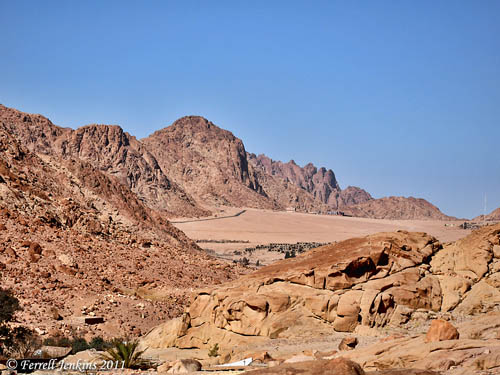
The photo below was made above Saint Catherine’s Monastery with a view toward el-Raha, the Rest.

View of el-Raha, the Rest, at Jebel Musa. Photo by Ferrell Jenkins.

View of el-Raha, the Rest, at Jebel Musa. Photo by Ferrell Jenkins.

4. Some scholars have suggested sites much further north in the Sinai peninsula.

There is no way to know for certain the location of Mount Sinai, but the traditional site fits well with much of the biblical evidence. Rasmussen says the “meeting of Moses and Aaron at the ‘mountain of God’ could well have been this spot (Exod. 4:27)” (Zondervan Atlas of the Bible Revised Edition. 105).

Click on the photo for an image suitable for use in teaching presentations.

“Come up in the morning to Mount Sinai”

After the original tables of stone containing the Ten Commandments written by the finger of God were broken, Moses was told to be ready and “come up in the morning to Mount Sinai.”

Be ready by the morning, and come up in the morning to Mount Sinai, and present yourself there to me on the top of the mountain. (Exodus 34:2 ESV)

The Christian martyr Stephen reminded his audience that Moses received living oracles on Mount Sinai.

He received living oracles to give to us. (Acts 7:38 ESV)

Perhaps this is one of the reasons so many persons put forth the effort to approach the top of a mountain presumed to be Mount Sinai.

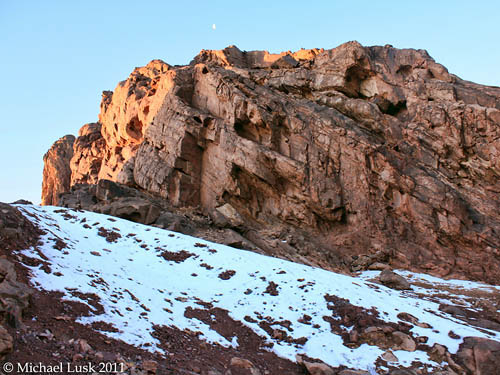
We began telling you about Michael’s trek to the top of the mountain on the morning of January 26, 2011. As he approached the top of the 7,519 feet high Jebel Musa he recorded several instances of snow.

Snow near summit of Jebel Musa, Jan. 26, 2011. Photo by Michael Lusk.

Snow near summit of Jebel Musa, Jan. 26, 2011. Photo by Michael Lusk.

One can never be sure about weather conditions. Reader Beverly Sansom left this comment yesterday:

Yes, we climbed the same mountain in mid-March 2011. Our view of the sunrise was but a sliver due to clouds, but the mountain grandeur was breathtaking. At the top were other Christians singing “How Great Thou Art” in a foreign language. We joined in!

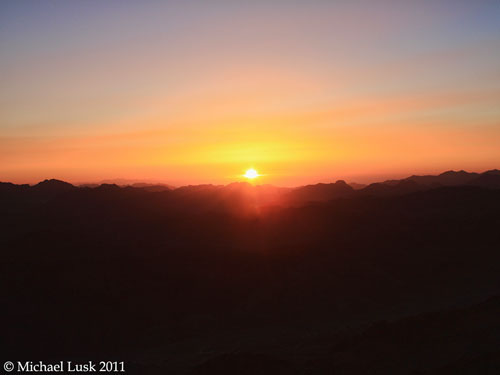
Michael had a good morning from the perspective of a photographer. Here is one of his sunrise photos.

Sunrise from top of Jebel Musa - Traditional Mount Sinai

Sunrise from top of Jebel Musa, January 26, 2011. Photo by Michael Lusk.

Thanks to Michael for sharing these photos with our readers.

Jebel Musa — the traditonal Mount Sinai

If you have followed this blog for several months you may recall that I had a group leaving Egypt the evening before the Egyptian Revolution began on January 25, 2011. Five members of our party had made arrangements to visit the Sinai peninsula, including a visit to Jebel Musa, the traditional Mount Sinai, following the tour.

The group of five left for Sinai on the morning of January 25 with no knowledge of the situation in Cairo. After one night at Saint Catherine and a visit to Saint Catherine’s Monastery three of the tours members (a couple from Indiana and a single man from Florida) returned to Cairo. The couple went directly to the airport and departed that evening. I am not sure that they had any indication of a problem in Cairo. The younger man had made arrangements to visit Abu Simbel and some other places in Egypt that we had not visited during the tour. My wife and I continued through the Sinai to Taba and crossed into to Israel at Eilat.

The single man, Michael Lusk, was the only member of our party to climb to the top of Jebel Musa. Michael was anxious to get up early and make the two and one half hour climb to the top in time for the sunrise. I don’t recall the temperature that morning, but it was cool at the hotel during the night and early morning. When I climbed the mountain in April of 1986 I wore jeans over pajamas, an undershirt covered by a T-shirt, a flannel shirt, and the thick jacket. By the way, Michael made it out of Egypt on the last Delta flight to leave after the Revolution began. He left his hotel early due to the curfew and spent all night in the airport awaiting the flight.

When I asked Michael, a former student, if he would allow me to run a few of his photos here, he was pleased to do so. This first photo shows Jebel Musa (the Mountain of Moses), traditional Mount Sinai. A small building can be seen on top of the mountain just to the right of center. There has been a small chapel on the summit of the mountain since the 4th century A.D. A church was built here by Emperor Justinian (early 6th century A.D.) and a new chapel was built on the ruins in 1934.

It was here, according to the 1500 year old tradition, that Moses met the LORD and received the Ten Commandments.

The LORD came down on Mount Sinai, to the top of the mountain; and the LORD called Moses to the top of the mountain, and Moses went up. (Exodus 19:20 NAU)

This photo would have been made on the return from the top. Note the camel and rider in the bottom right of the photo.

Jebel Musa, traditional Mount Sinai. Photo by Michael Lusk.

Jebel Musa, traditional Mount Sinai. Photo by Michael Lusk.

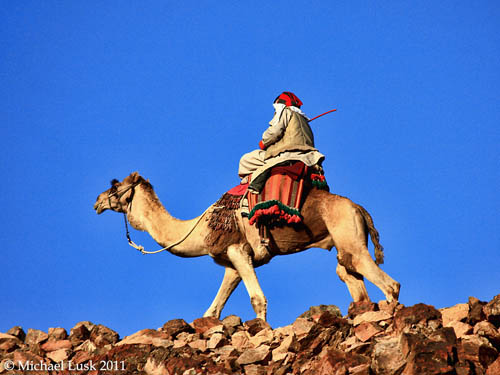
The next photo shows one of the camel drivers (leaders) waiting for someone to hire him to take them back to the monastery. It is possible to hire the camel to take you up the winding slope to where the 3,000 granite steps begin. Notice also his heavy clothing for the cold January nights.

A camel waiting to take a tired walker back to the monastery. Photo by Michael Lusk.

A camel waiting to take a tired walker back to the monastery. Photo by Michael Lusk.

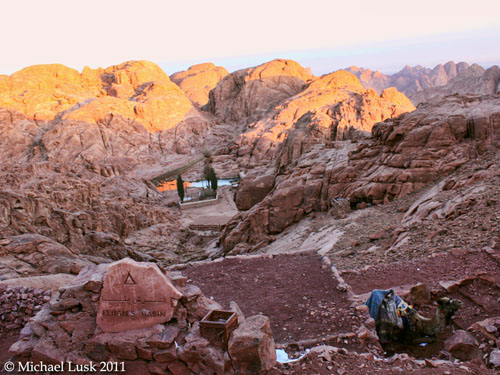
Seven hundred and fifty steps below the summit one comes to a site called Elijah’s Basin. This, according to the tradition, is where the prophet Elijah came when he fled from the wrath of Jezebel after the defeat of the prophets of Baal. Here, the prophet received instructions from the LORD to return and complete his work.

So he arose and ate and drank, and went in the strength of that food forty days and forty nights to Horeb, the mountain of God. (1 Kings 19:8 NAU)

Elijah's Basin on Mount Sinai. Photo by Michael Lusk.

Elijah's Basin on Mount Sinai. Photo by Michael Lusk.

This photo shows the morning light beginning to illuminate portions of the mountain peaks. In the basin you will see some snow. I think the red (orange) glow may be caused by the light striking the area.

In a future post we will share, thanks to Michael, the sunrise from the summit.