Category Archives: Bible Places

Dr. Bryant Wood’s Lectures on Archaeology and the Conquest

Dr. Bryant G. Wood recently presented three lectures on “Archaeology and the Conquest: New Evidence on an Old Problem” for the 2012 William R. Rice Lecture Series. The lectures, and a fourth lecture on Old Testament Archaeological Discoveries, are available in MP3 here.

The four topics available for listening are:

  • Background and Chronology of the Exodus and Conquest.
  • Digging Up the Truth at Jericho.
  • The Discovery of Joshua’s Ai.
  • Great Archaeological Discoveries Related to the old Testament.

Wood is Director of Research at the Associates for Biblical Research, editor of Bible and Spade, and director of the Excavations at Khirbet el-Maqatir (suggested as a possible site for Biblical Ai).

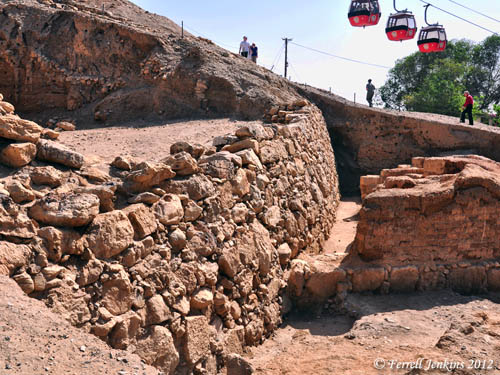
Jericho's Outer Revetment Wall on South End of Tel es-Sultan. Photo by Ferrell Jenkins.

Jericho's Outer Revetment Wall on the South End of Tel es-Sultan. Recent archaeological work at Jericho indicates that mud brick had fallen on houses built against this wall. Wood believes that this evidence fits perfectly with the biblical record in Joshua. Photo by Ferrell Jenkins.

HT: Bible-X

Plants growing in the Sea of Galilee

A member of the Biblical Flora group asks,

I was wondering if anyone knew what kind of water plants grew in the Sea of Galilee. Reeds, seaweeds, water lilies…anything like that?

Here is a slide that I made in June, 1980, at the northeast corner of the Sea of Galilee. I am not aware of the technical names of the plants, but it certainly shows a nice variety. Perhaps some other list member will be able to provide more information.

More recently, much of this area has been cleared for recreational use.

A secluded place on the NE corner of Sea of Galilee. Photo by Ferrell Jenkins.

A secluded place on the NE corner of Sea of Galilee. Photo by Ferrell Jenkins.

When I made this photo I was thinking of the text in Mark which speaks of Jesus and His disciples going by boat to a desert (Greek, eremos) or secluded place.

And they went away in the boat to a desolate place by themselves. (Mark 6:32 ESV)

The reference may be to the land area (cf. Mark 6:35), but it provides a good illustration of the type of place that could be reached by boat.

Those with an interest in Biblical Flora might enjoy being part of the group. Click here for information. J.P. van de Giessen is the list moderator.

Alexander the Great and the Book of Daniel

Josephus, the late first century Jewish historian, records the visit of Alexander the Great to the city of Jerusalem in the 4th century B.C. He recounts how Alexander “went up into the temple” and “offered sacrifice to God.” He says that the Book of Daniel was shown to Alexander. Alexander assumed, as have many commentators since that time, that Daniel was prophesying of Alexander.

Bust of Alexander in the Istanbul Archaeological Museum. Photo by Ferrell Jenkins.

Bust of Alexander in the Istanbul Archaeological Museum. Photo by Ferrell Jenkins.

Here is a portion of the account from the Antiquities of the Jews. Notice especially section 337.

336 And when he had said this to Parmenion, and had given the high priest his right hand, the priests ran along by him, and he came into the city. And when he went up into the temple, he offered sacrifice to God, according to the high priest’s direction, and magnificently treated both the high priest and the priests.
337 And when the Book of Daniel was showed to him {a} wherein Daniel declared that one of the Greeks should destroy the empire of the Persians, he supposed that himself was the person intended; and as he was then glad, he dismissed the multitude for the present; but the next day he called them to him, and bade them ask what favours they pleased of him;
338 whereupon the high priest desired that they might enjoy the laws of their forefathers, and might pay no tribute on the seventh year. He granted all they desired; and when they entreated him that he would permit the Jews in Babylon and Media to enjoy their own laws also, he willingly promised to do hereafter what they desired:  (Ant 11:336-338)

Read Daniel 8 for more details of the conflict between Alexander, who is compared to a male goat, and the Persian king who is likened to a ram.

As I was considering, behold, a male goat came from the west across the face of the whole earth, without touching the ground. And the goat had a conspicuous horn between his eyes. (Daniel 8:5 ESV)

Monday Meandering — March 19

Greatest Finds. The Israel Ministry of Foreign Affairs has compiled a list of the “Greatest archeological finds in Israel” here with links. Places include Masada, Megiddo, Beit Guvrin-Maresha, Ashkelon, the City of David, Hazor, Dan, Herodion, Khirbet Qeiyafa, and Tel es-Safi (Gath), and others.

The Scale of the Universe 2 here. Fascinating. Requires Flash. Reminds me of two Biblical references.

 When I look at your heavens, the work of your fingers, the moon and the stars, which you have set in place,  4 what is man that you are mindful of him, and the son of man that you care for him? (Psalm 8:3-4 ESV)

For by him all things were created, in heaven and on earth, visible and invisible, whether thrones or dominions or rulers or authorities– all things were created through him and for him.  And he is before all things, and in him all things hold together.  (Colossians 1:16-17 ESV)

Marine Life in the Corinthian Gulf here. Beautiful photos.

The Acrocorinth. Wonderful, clear view of the mountain above ancient Corinth here. Carl Rasmussen has posted several other nice photos of Corinth recently.

A history of the Roman Empire in 75 seconds here.

The Burnt House. The headline in the Jerusalem Post read “House in Old City as Titus left it.” Leen Ritmeyer includes this and another news article, along with his reconstruction of the Burnt House here.

Geopolitics of Israel. Every student of Bible geography will enjoy the analysis of the geopolitics of Israel by the Stratfor Global Intelligence here.

2,000-year-old Israeli date palm. Has it been trumped by a 32,000-year-old Russian flower? Tom Powers provides some links about the palm which is now about 8 feet tall, here.

HT: Aren Maeir; NT Resources Blog; Corinthian Matters; Luke Chandler’s Blog; Bible Places Blog.

“Beware the ides of March”

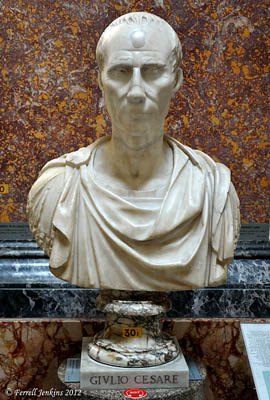
Bust of Julius Caesar in Vatican Museum. Photo by Ferrell Jenkins.

Bust of Julius Caesar in the Vatican Museum. Photo by Ferrell Jenkins.

Shakespeare has the Sootsayer warn Caesar, “Beware the ides of March.” The ides of March was used to describe the 15th of March in the Roman calendar. It was on that day that Julius Caesar was assassinated in 44 B.C. As a result, the expression has come to have a sense of foreboding — a sense that something bad is about to happen.

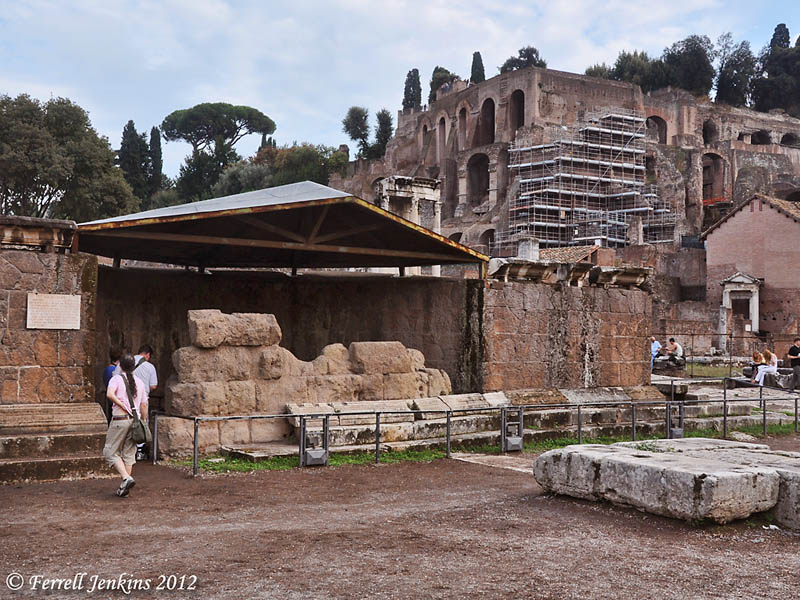
Our photo below shows the place in the Roman Forum where a temple was built to honor Julius Caesar by Augustus in 29 B.C. The deification of rulers was already common in the eastern part of the Empire. This practice would become a serious problem for the Christians of the Roman Empire before the end of the first century A.D., especially those living in Asia Minor. This is one of the issues addressed in the Book of Revelation.

Ruins of the temple erected to Caesar in the Roman Forum. Photo by Ferrell Jenkins.

Ruins of the Temple erected to Caesar in the Roman Forum. Photo by Ferrell Jenkins.

James the Lord’s Brother

In anticipation of the “James Ossuary” verdict which is scheduled to be announced March 14, I decided to provide some background material. First, here is a brief discussion of the identity of James, and his relation to Jesus.

— • —

The name James was a common name in New Testament times. Several people bearing that name are mentioned in the New Testament. Two apostles bore that name: James the son of Zebedee (Matthew 4:21; 10:2), and James the son of Alphaeus (Matthew 10:3). James, the son of Zebedee, and brother of the apostle John, was put to death by Herod Agrippa I before A.D. 44 (Acts 12:1-2). There was also James, the brother of Jesus. Paul refers to him, along with Cephas [Peter] and John as men who were reputed to be pillars among the brethren (Galatians 2:9). Paul identifies James as “the Lord’s brother” in Galatians 1:19.

The New Testament mentions the brothers and sisters of Jesus in Mark 6:3 and Matthew 13:55-56. Roman Catholics make every effort to evade the plain meaning of “brother.” Roman Catholics hold the non-biblical doctrine of the perpetual virginity of Mary. They claim that the brothers of Jesus were really half-brothers or cousins. The inscription on the James ossuary has opened this issue anew, but more about that at another time (see Matthew 1:25). The New Testament indicates that James and the others listed were the uterine brothers of Jesus. James, the Lord’s brother, is generally thought to be the author of the Epistle of James. Jude, another brother of Jesus, wrote a short book in which he says that he is “a bond-servant of Jesus Christ, and brother of James.” This last expression indicates that Jude was not as well known as James.

The brothers of Jesus did not believe in him during His public ministry (John 7:5), but after the resurrection they are mentioned among the disciples (Acts 1:14). Paul informs us that Jesus made an appearance to James (1 Corinthians 15:7). At least some of the brothers of Jesus seem to be preachers of the gospel (1 Corinthians 9:5). It appears that the brothers of Jesus were convinced by the resurrection. James proved to be influential among the brethren both in Jerusalem and in other places (Galatians 2:11-13; Acts 15; 21:17-26). We’ll leave this matter for another time.

Josephus, the Jewish historian, makes a reference to “the brother of Jesus, who was called Christ, whose name was James” (Ant. Xx.9.1). Eusebius, the early church historian, records the martyrdom of “James, the brother of the Lord” in his Ecclesiastical History (2.23). He cites the earlier accounts by Hegesippus, Clement of Alexandria, and Josephus. This would have been shortly after the death of Festus, procurator of Judea, in A.D. 61.

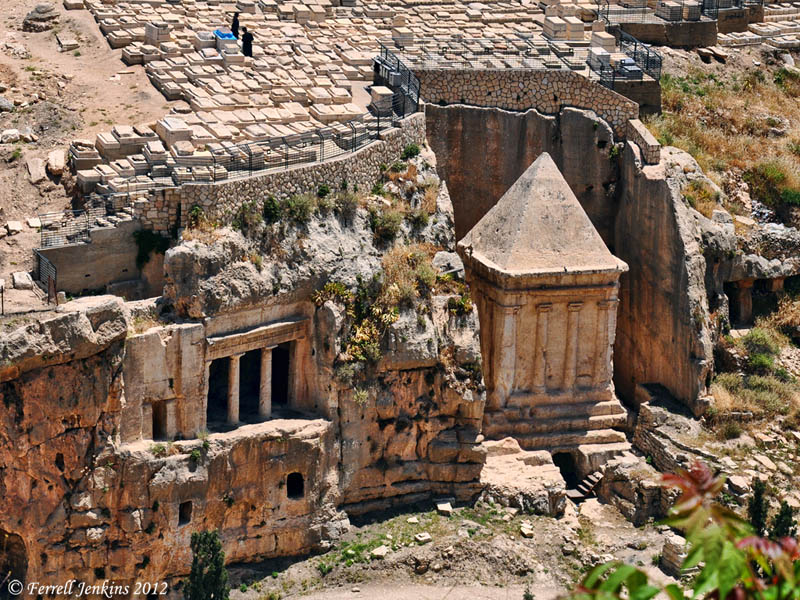
The photo below shows two of the monumental tombs in the Kidron Valley between the Old City of Jerusalem and the Mount of Olives, south of the so-called Tomb of Absalom (see here). Modern Jewish tombs are visible on the slopes of the Mount of Olives above the older monuments.

The tomb on the right is known as the Tomb of Zachariah. The tomb on the left, with a porch and two Doric columns is the Tomb of Beni Hezir from the latter half of the second century B.C. (the Maccabean Period). It is incorrectly identified as the Tomb of James.
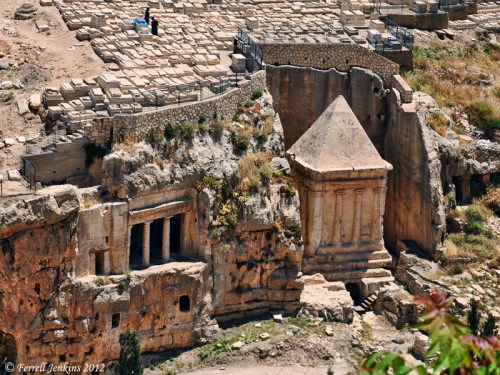
Bene Hezir (traditional James) Tomb and Tomb of Zachariah. Photo by Ferrell Jenkins.

Bene Hezir (traditional James) Tomb and Tomb of Zachariah. Photo by Ferrell Jenkins.

We have pointed out before that many structures have been incorrectly identified with specific biblical characters over the centuries. The tomb identified with James belonged to a priestly family named Hezir. Perhaps this Hezir was a descendant of a priest mentioned in 1 Chronicles 24:15. The name appears again in Nehemiah 10:20. The connection with James was a mistaken idea.

The synagogue at Chorazin

The ancient synagogue at Chorazin has been partially reconstructed. The structure is made of the local basalt (volcanic) stone that is found in the area.

Restored Synagogue at Chorazin. Photo by Ferrell Jenkins.

Restored Synagogue at Chorazin. Photo by Ferrell Jenkins.

Scholars date the synagogue from the second century to the fourth century A.D. Ze’ev Yeivin, the director of archaeological excavations at Chorazin, is cautious in dating the synagogue.

Thus far, I have said very little about dating—always a difficult and sensitive subject.

The synagogue at Chorazin was first built at the end of the third century or the beginning of the fourth century A.D. Probably in the second half of the fourth century, the synagogue, as well as the rest of the town, was partially destroyed by an earthquake.

The town apparently lay in ruins for some time thereafter. The Church father Eusebius, writing at the end of the fourth century, tells us that Chorazin was a destroyed village, apparently in fulfillment of the prediction in the Gospels of Matthew and Luke. (BAR 13:05 (Sep/Oct 1987).

Yeivin comments on one of the most significant discoveries within the synagogue:

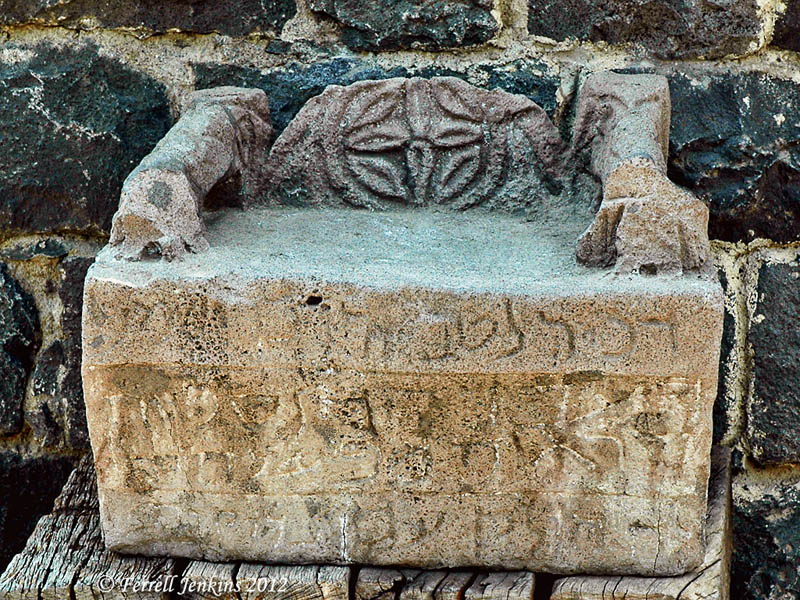
In 1926 a unique stone seat was found near the southern wall of the Chorazin synagogue. Since then it has been called the “Chair of Moses.” The Chair of Moses is a special seat that is used in some synagogues, even today, on certain occasions, usually located near the most important wall, that which faces Jerusalem. (BAR 13:05 (Sep/Oct 1987).

The photo below is of a replica of the Chair (or Seat) of Moses. The original is displayed in the Israel Museum, Jerusalem.

Chorazin Synagogue Chair. Photo by Ferrell Jenkins.

Replica of Chorazin Synagogue Chair. Photo by Ferrell Jenkins.

It may be that Jesus had this type of seat in mind in Matthew 23:2.

“The scribes and the Pharisees sit on Moses’ seat,  so do and observe whatever they tell you, but not the works they do. For they preach, but do not practice.  (Matthew 23:2-3 ESV)

A parallel might be that we should listen to those who teach the Bible from the pulpit, but not follow their example when they do not live according to the Bible.

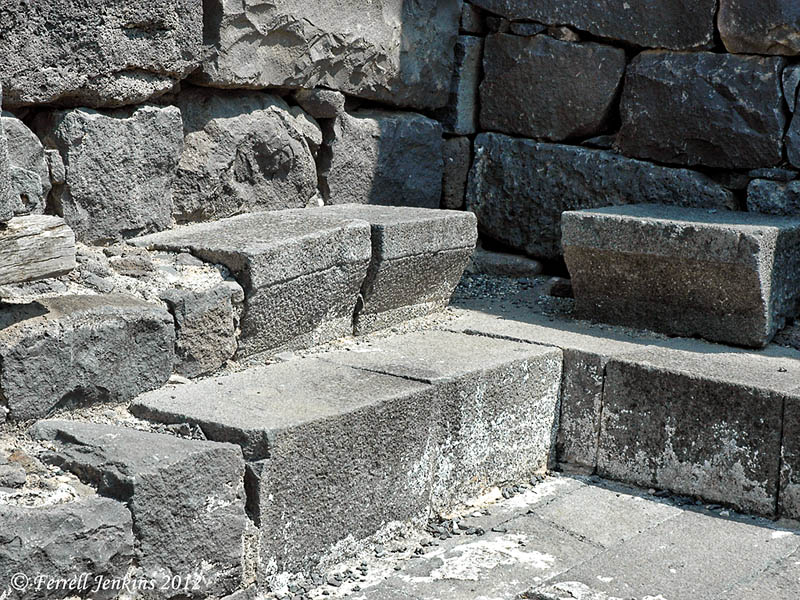
The seating running around the inside walls of the building is typical of what we know from several synagogues.

Chorazin Synagogue Seating - Photo by Ferrell Jenkins.

Chorazin Synagogue Seating. Photo by Ferrell Jenkins.

James uses the Greek word sunagogue to describe the meeting place of early Christians. It is most commonly translated assembly.

My brothers, show no partiality as you hold the faith in our Lord Jesus Christ, the Lord of glory.  For if a man wearing a gold ring and fine clothing comes into your assembly, and a poor man in shabby clothing also comes in,  and if you pay attention to the one who wears the fine clothing and say, “You sit here in a good place,” while you say to the poor man, “You stand over there,” or, “Sit down at my feet,”  have you not then made distinctions among yourselves and become judges with evil thoughts?  (James 2:1-4 ESV)

Whether our meeting place is elaborate or humble, we should not show partiality.

“Woe to you, Chorazin!”

Chorazin (also spelled Chorozain and Korazim) is one of three cities that rejected the message of Jesus, and upon which he pronounced a woe.

 “Woe to you, Chorazin! Woe to you, Bethsaida! For if the mighty works done in you had been done in Tyre and Sidon, they would have repented long ago in sackcloth and ashes. (Matthew 11:21 ESV; cf. Luke 10:13)

BDAG describes the Greek word used here as an “interjection denoting pain or displeasure, woe, alas.”

Murphy-O’Connor describes the location of Chorazin in contrast to Capernaum.

Capernaum with a view is perhaps the most succinct characterization of Chorozain. Both contain synagogues in the midst of an excavated urban area, but sited 3.5 km [2.17 miles] up the slope and 270 m [885 feet] above the Sea of Galilee Chorozain offers a wide perspective over the northern end of the lake. (The Holy Land)

Both Eusebius and Jerome are said to have referred to a desolate place near Capernaum as Chorazin. Dalman describes the area as “a desolate basalt wilderness” (Sacred Sites and Ways 154).

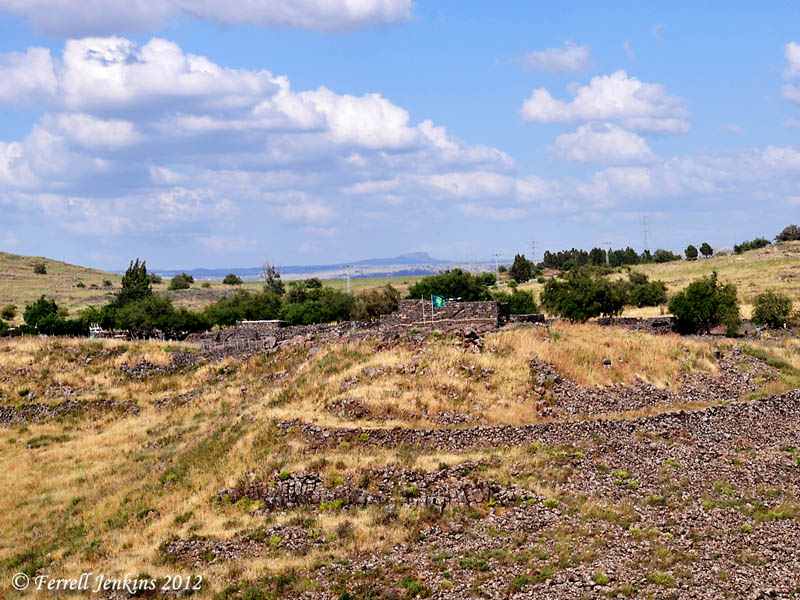
In the photo below you can see the location of Chorazin with a view to the southwest. Mount Arbel is visible in the distance. The Sea of Galilee is below on the left.

Chorazin (Korazim) in the basalt hills north of the Sea of Galilee. Photo by Ferrell Jenkins.

Chorazin is situated in the basalt hills north of the Sea of Galilee. This view is to the SW. Mount Arbel can be seen in the distance. Photo by Ferrell Jenkins.

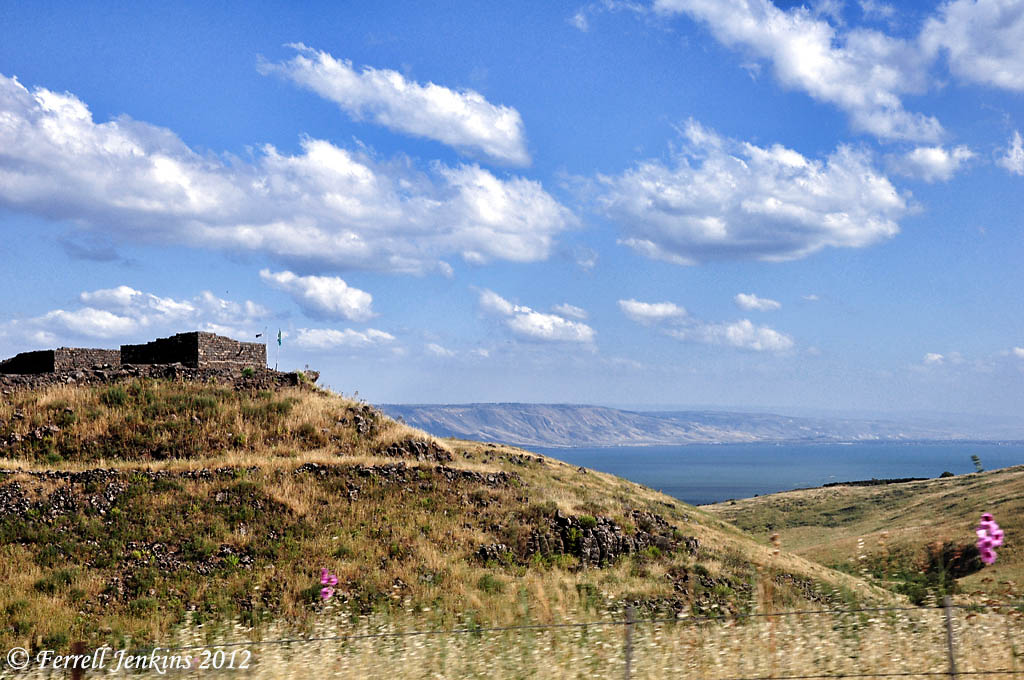
Move a little west of Chorazin and you have a wonderful view of the Sea of Galilee to the southeast. The eastern side of the Sea is clearly visible. A few reconstructed buildings at the site are visible on the hill to the left.

Chorazin and the Sea of Galilee. Photo by Ferrell Jenkins.

Chorazin and the Sea of Galilee. Photo by Ferrell Jenkins.

In a future post we will include a photo of the synagogue at Chorazin.

Our last post about Capernaum, including an aerial photo, may be seen here. Use the search box to locate other references to the site.

Yodfat (= Jotapata) — where Josephus commanded Galilean forces against Rome

Yodfat (or Yodefat) may be better known to English readers as Jotapata. It was here that Josephus, later known as a significant historian of first century Judaism, commanded the Galilean forces against Rome in A.D. 66.

Josephus wrote about the significant battle at Yodfat in his Wars of the Jews (Bk. III:141-339). Yodfat is located about 20 miles inland from Ptolemais (modern Akko) along the main route from Ptolemais to Magdala on the shore of the Sea of Galilee.

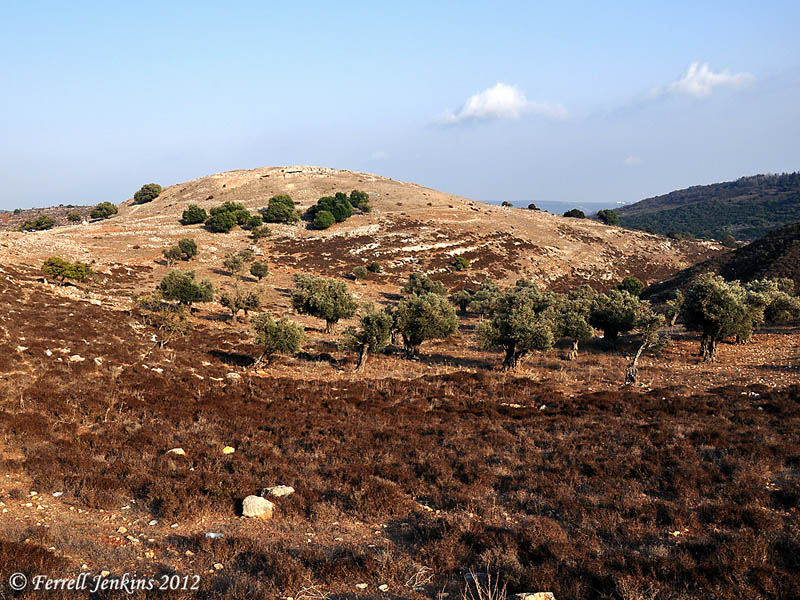
View of Yodfat from the west. Photo by Ferrell Jenkins.

View of Yodfat from the west. Photo by Ferrell Jenkins.

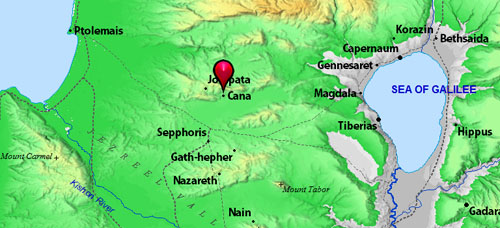
The map below from BibleAtlas shows Nazareth, Sepphoris, [Khirbet] Cana, and Jotapata. Notice that Jotapata and Cana are situated on the north side of the Beit Netofa Valley. A main road ran from Ptolemais to Magdala through the Beit Netofa Valley.

Map showing Nazareth, Sepphoris, Cana, and Jotapata. BibleAtlas.org.

Map showing Nazareth, Sepphoris, Cana, and Jotapata. BibleAtlas.org.

Josephus commanded the rebel Jewish forces who were trying to stop the Roman soldiers from reaching Jerusalem. He took refuge at Yodfat. When it was clear that Rome, under the leadership of Vespasian and his son Titus, had the upper hand, some of the troops committed suicide rather than submit to the Romans. Many of the Jewish rebels were slain, but the life of Josephus was spared when he predicted that Vespasian would eventually become Emperor of the Roman Empire.

Bonnie Rochman reports that bones discovered in 1997 may be those of men who died in the battle with Rome.

Bones from at least 30 people were discovered this past summer in a cistern in the Galilee, giving strong support to Josephus’s account of a bloody battle there between Jews and Romans in 67 A.D. The bones are thought to be the remains of residents of the nearby city of Yodfat, which was besieged by Roman troops en route to Jerusalem to suppress the First Jewish Revolt. The Roman forces captured Yodfat (also written Yodefat and Jotapata and even Iotape) after battling the city’s Jews for 47 days. (Biblical Archaeology Review. 23:06 (Nov/Dec 1997).

Josephus records that 40,000 died in the conflict, and and that 1200 were enslaved. Some scholars believe this number is an exaggeration. Whatever the exact number, it was a significant battle in the Jewish War.

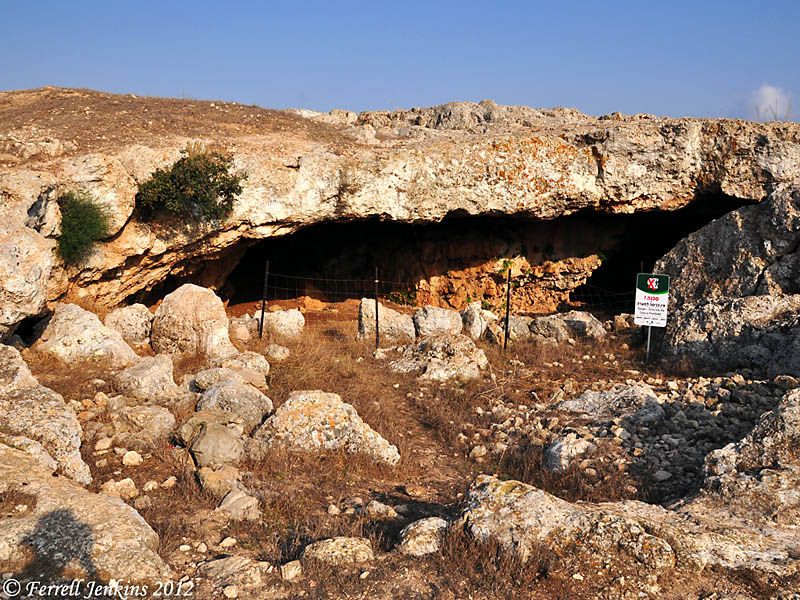
Yodfat differs from the typical tel (archaeological mound). It is mostly a rock, with few remains on the surface. The site is filled with numerous caves in which the Jewish soldiers hid, and cisterns that provided water for them. The photo below shows the entrance to one of the caves on the south side of the site.

One of many caves at Yodfat. Photo by Ferrell Jenkins.

One of many caves at Yodfat. Photo by Ferrell Jenkins.

The Encyclopedia Judaica provides a short summary here about the excavations at Jotapata

Excavations were conducted at the site in 1992 by D. Edwards, M. Aviam, and D. Adan-Bayewitz, revealing remains dating from the Hellenistic period through to medieval times. A fortification wall from the Ptolemaic period was uncovered with three phases of construction evident. To the northwest were the remains of a ramp dating from the time of the Roman siege in 67 C.E. The finds included remains from the battle including ballista balls and iron bow and catapult arrowheads. Rubble walls built at this location seem to have been part of the Jewish preparations prior to the arrival of the Romans. An oil press, pottery kilns, and several ritual baths (mikva’ot) were uncovered. The lower part of the site was reoccupied in the late first or early second centuries C.E., and there were also signs of occupation of medieval date.

Some scholars have identified Jotapata with the Jotbah of 2 Kings 21:19. Jotbah was the birthplace of the mother of the Judean King Amon. The town may be mentioned in the annals of Tiglath-pileser III (New Bible Dictionary; Anchor Yale Bible Dictionary).

The Jerusalem Syndrome

Each year about 50 visitors to Jerusalem have to be taken to a psychiatric ward because they are overcome with what they experience in the Holy City. In the worst cases individuals have come to believe that they are the Messiah, or that they are preparing the way for Him. Psychiatrists call this phenomenon the “Jerusalem Syndrome.”

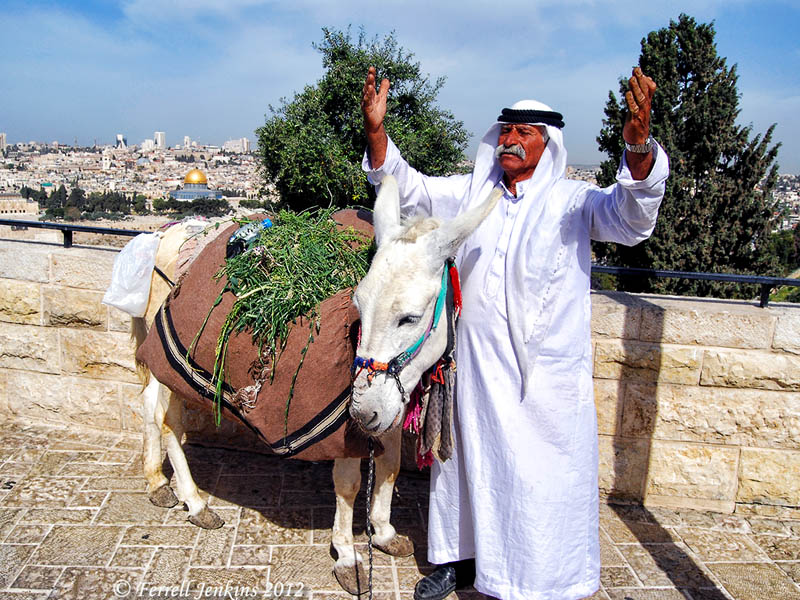
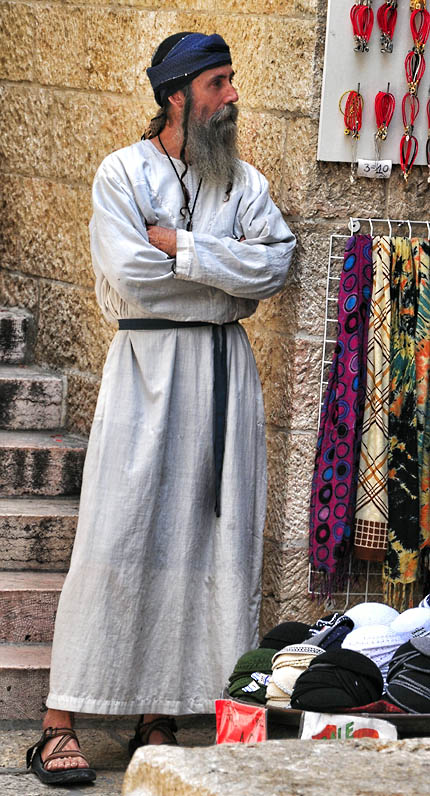
I have no idea who the fellow below thinks he is imitating, but I have dubbed him an “actor” — not someone who has been overcome with the Jerusalem Syndrome. Some might say that he is “John the Baptist, others say Elijah, and others Jeremiah or one of the prophets.” (Matthew 16:14 ESV)

An "actor" on the Mount of Olives. Photo by Ferrell Jenkins.

An "actor" on the Mount of Olives poses as a biblical character. Photo: Ferrell Jenkins.

Wired Magazine recently ran a fascinating article by Chris Nashawaty dealing with the Jerusalem Syndrome. He interviews Dr. Pesach Lichtenberg, head of the men’s division of psychiatry at Herzog Hospital in Jerusalem. Lichtenberg and Nashawaty visit the Old City of Jerusalem in search of a likely prospect for Jerusalem Syndrome. Read the article in its entirety here.

I had been unaware that visitors to Florence, Italy, experience a similar phenomenon when they “are overwhelmed by powerful works of art.” There, it is called Stendhal syndrome after the writer who described it in the early 19th century. Japanese tourists are especially subject to Paris syndrome while visiting the City of Light.

The sights of Jerusalem are truly impressive, and some tourists who tend to be emotional are often brought to tears by what they see and hear.

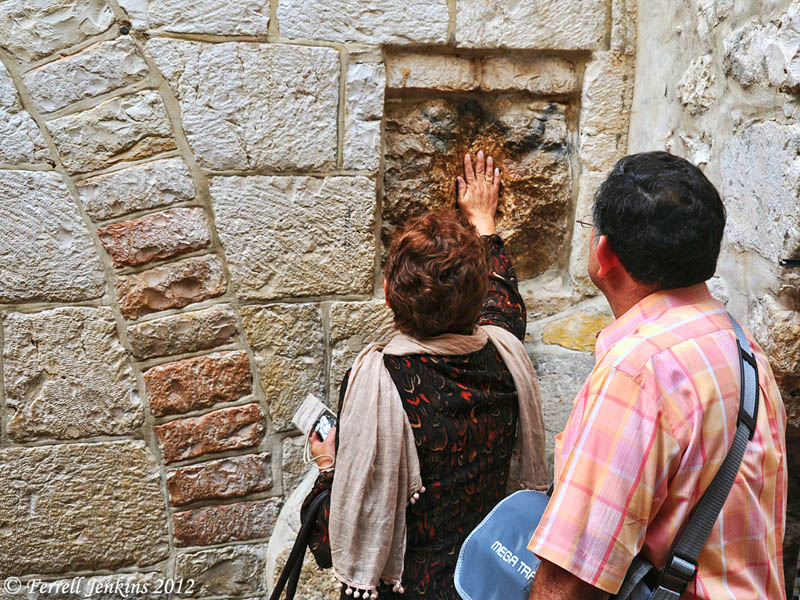
A woman places her hand on a stone at the fifth station of the cross. Photo by Ferrell Jenkins.

A woman places her hand on a stone at the fifth station of the cross. Some say this is a stone touched by Jesus on His way to the crucifixion. Photo by Ferrell Jenkins.

It is not every day that you see someone like this selling jewelery and souvenirs.

Vendor in the Jewish Quarter of Jerusalem. Photo by Ferrell Jenkins.

Vendor in the Jewish Quarter of Jerusalem. Photo by Ferrell Jenkins.

We ran a brief note about the Jerusalem Syndrome about four years ago here.

HT: Either Jack Sasson or Joseph Lauer (perhaps both), but I have misplaced the Email.