Category Archives: Bible Places

Preliminary report on Khirbet Qeiyafa for 2010-2011

A preliminary report for the 2010-2011 archaeological seasons has been published by the Israel Antiquities Authority in Hadashot Arkheologiyot: Excavations and Surveys in Israel. The report is written by  Yossi Garfinkel, Sa‘ar  Ganor  and Michael Hasel.

My photo shows the Iron Age, four-chamber, gate with a view toward Tel Azekah.
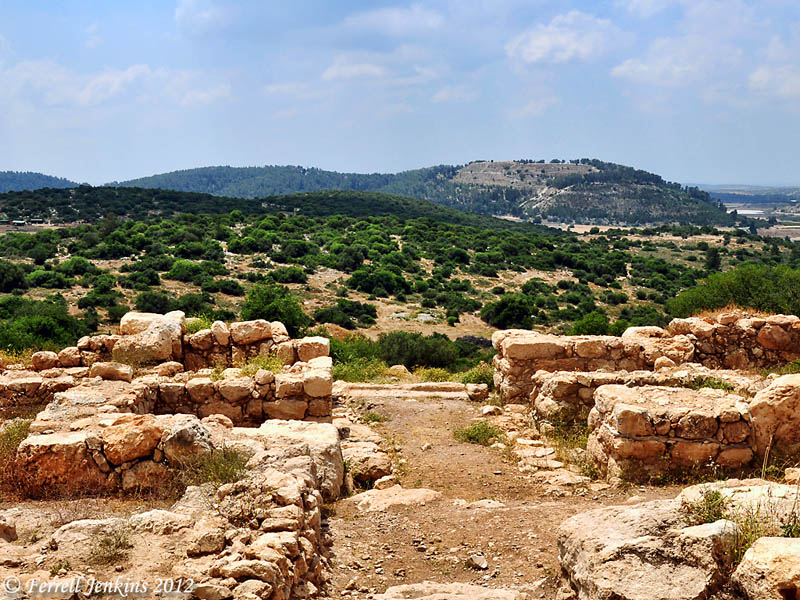
Iron Age Gate view a view toward Azekah. Photo by Ferrell Jenkins. May, 2011.

Iron Age Gate with a view toward Azekah. Photo by Ferrell Jenkins. May, 2011.

The full report with 11 photographs (or plans) is available here. The report concludes,

The excavations at Khirbat Qeiyafa clearly reveal an urban society that existed in Judah already in the late eleventh century BCE. It can no longer be argued that the Kingdom of Judah developed only in the late eighth century BCE or at some other later date.

The current issue of Biblical Archaeology Review (May/June 2012) carries two article relating to the Qeiyafa ostracon. One is by Christopher A. Rollston who asks the question, “What’s the Oldest Hebrew Inscripton?” He responds that each of four inscriptions he considers (Qeiyafa, Gezer calendar, Tel Zayit, and Izbet Shartah) predate Old Hebrew.

The other article is by Gerard Leval. In “Ancient Inscription Refers to Birth of Israelite Monarchy” he summaries the French-language article by “Emile Puech, the senior epigrapher of the prestigious École Biblique et Archaéologique Française in Jerusalem.” Puech draws the following conclusion:

Moreover, the inscription seems to memorialize (or, in Puech’s words, is “a witness to”18) the transition not from one king to another (from Saul to David), but rather from the period of the judges to the monarchy—thus from Samuel and his sons to Saul.19

If Puech is correct, the Qeiyafa Ostracon is the only archaeological artifact referring to Israel’s first king. And it is the earliest non-Biblical confirmation of the establishment of the Israelite monarchy.

Leval’s article is available online at BAR here.

This information is sure to create a lot of discussion.

HT: Joseph I. Lauer; Bible Places Blog.
James Arthur Hodges — 1930 – 2012

James A. Hodges passed from this life April 10, 2012. A native of Jenkins, Kentucky, he was always an inquisitive person who wanted to understand the world around him. He became interested in the ancient world, too. This led him to studies at David Lipscomb College (B.A.), Harding College (M.A.), and the University of Chicago where he earned a Ph.D. in the Department of New Testament and Early Christian Literature. Jim later earned an M.A. degree and the M.I.S. degree from the University of South Florida.

At the University of Chicago in 1970 Jim completed a dissertation on The Building Program of Herod the Great. He taught in the Biblical Studies department at Florida College for a number of years. His last work at FC was as librarian. I can attest that his work in that position was extremely important in the accreditation of the Biblical Studies program to offer a B.A. degree in the field.

In 1980 Florida College agreed to become a sponsor of the Excavations at Tell Lachish, Israel. We recognized that Lachish had been an important city in the history of ancient Israel. Four professors participated in the dig that year. Jim had already been involved in a dig in Israel, as had Harold Tabor. For Phil Roberts and I it was the first time to participate. Jim worked at several other sites over the years.

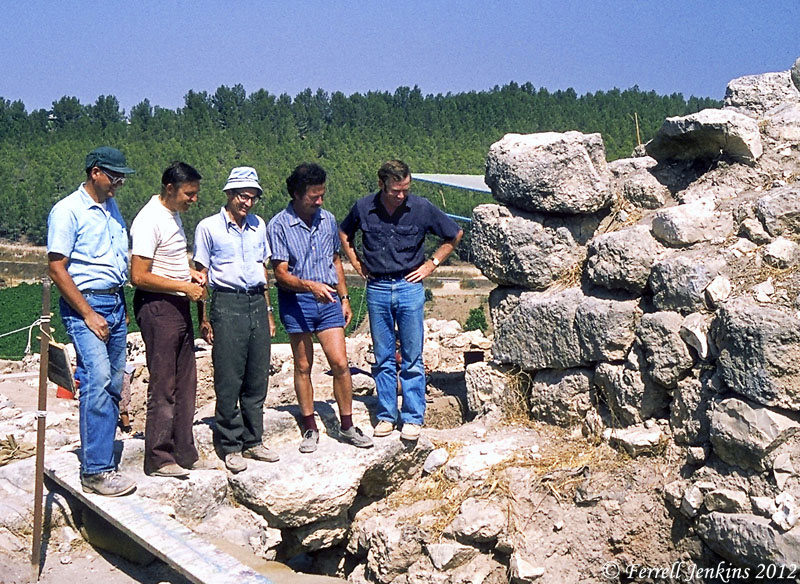
In the photo below from 1980 Jim is in the middle position.

Florida College professors Harold Tabor, Ferrell Jenkins, James Hodges, and Phil Roberts with Prof. David Ussishkin at the Gate of Lachish 1980.

Professor David Ussishkin (second from right) talks about the excavation at the Gate of Lachish with Florida College professors Harold Tabor, Ferrell Jenkins, James Hodges, and Phil Roberts (left to right) in 1980.

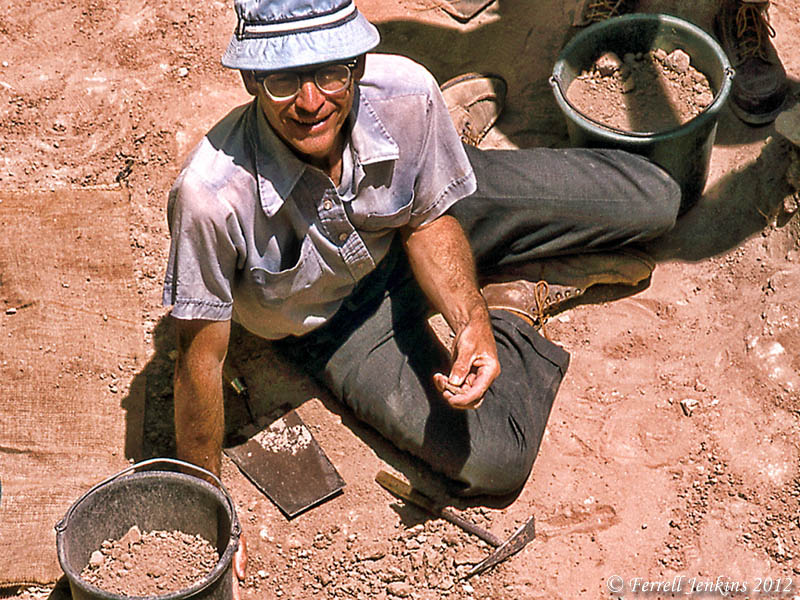
Jim worked in the Section that year. Here is a photo I made of him busy at work.

Dr. James A. Hodges in the Section at Lachish, 1980. Photo by Ferrell Jenkins.

Dr. James A. Hodges in the Section at Lachish, 1980. Photo by Ferrell Jenkins.

Hodges was a quiet and friendly man who sought to follow the example of Christ in his life. I think he was often underestimated by those who did not understand his vast knowledge in Bible, archaeology and Bible history, and the creation-evolution controversy. Several times I have remarked that he was my “go to” man. If I needed some reliable information to get by on until I had time to do a more thorough study, I often called on Jim.

Jim’s hobbies were hiking and fossil collecting. He and Wanda enjoyed traveling throughout the U.S.A. and in various foreign countries. They were part of one of my Israel tours in 1993.

Our condolences are extended to his wife Wanda (Diestelkamp), his children, and other family members.

The pods that the pigs were eating

In the parable of the young prodigal and his older brother, Luke says that when the younger brother ran out of money he would gladly have eaten the pods the pigs were eating.

He was longing to eat the carob pods the pigs were eating, but no one gave him anything. (Luke 15:16 NET)

BDAG says that the word keration (translated pod) in used in the plural “of the fruits of the carob tree, carob pods.” Louw-Nida states that the word is “a diminutive derivative of keras which means horn. They add,

the pod of the carob tree (which closely resembles a small horn.…Carob pods were commonly used for fattening swine and were employed as an article of food by poor people.

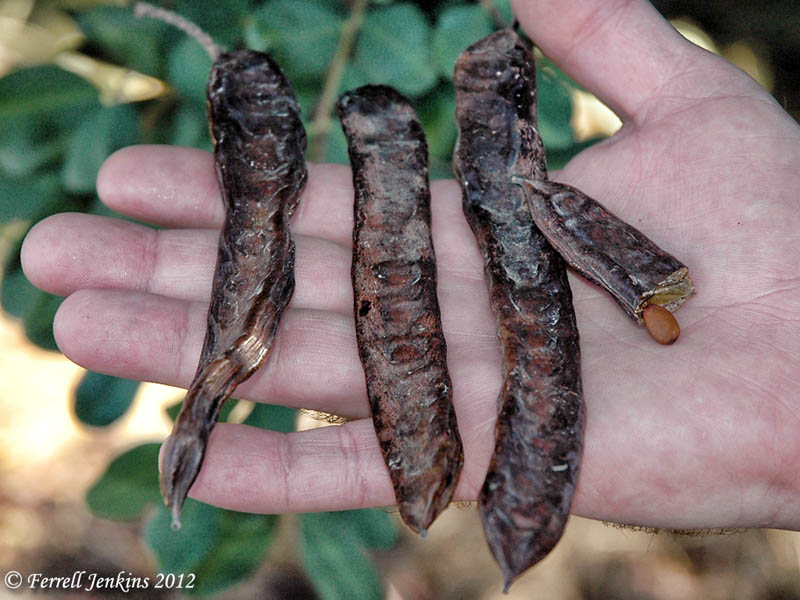
The first photo shows dried pods from the Carob tree.

Carob pods near the Valley of Aijalon. Photo by Ferrell Jenkins.

Carob pods near the Valley of Aijalon. Photo by Ferrell Jenkins.

Some nutritionists suggest that carob is high in protein content and is a good substitute for chocolate.

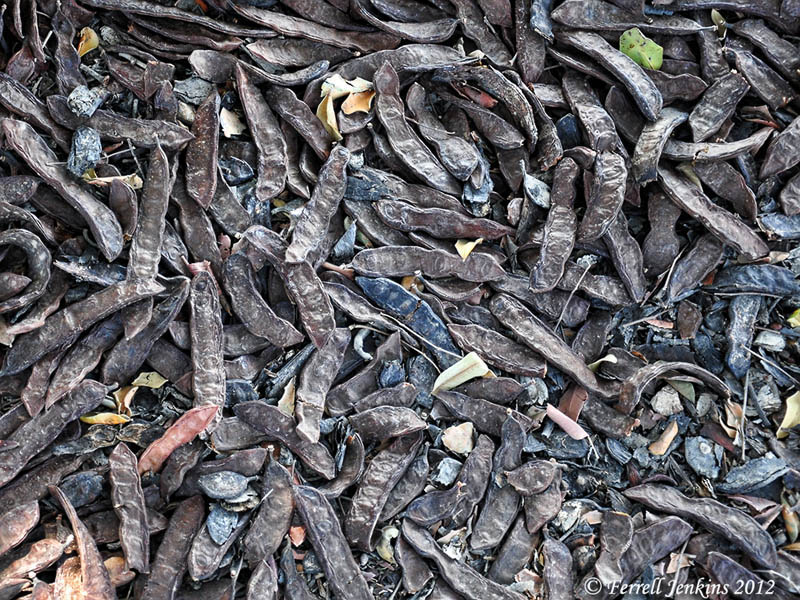
The next photo shows dried pods underneath a Carob tree. Having been brought up on a farm, I can easily image the pigs rooting in these pods to get the best one.

Dried carob pods under a tree at Hazor. Photo by Ferrell Jenkins.

Dried carob pods under a tree at Hazor. Photo by Ferrell Jenkins.

The prodigal son came to himself and headed for home. There is a good lesson in this for each of us when we become too attached to the things of this world (1 John 2:15).

Acco, Achziv, and Rosh Hanikra in the Plain of Acco

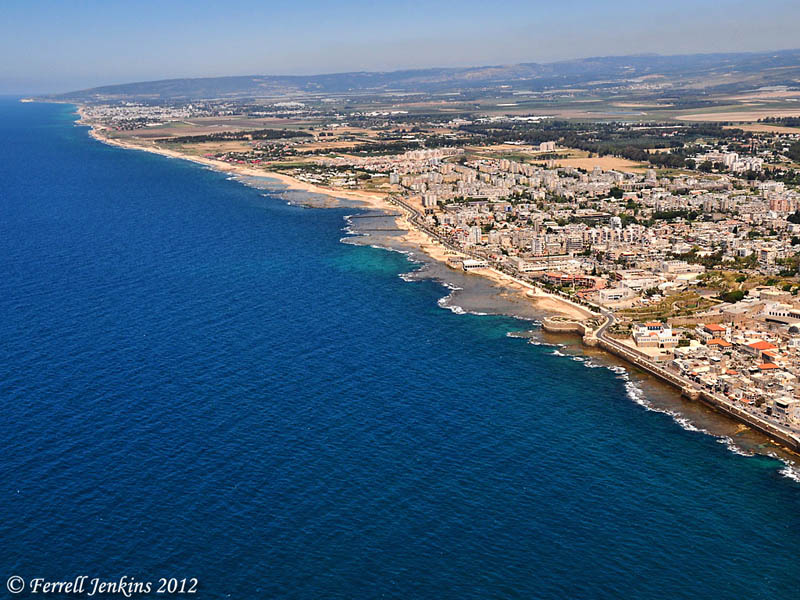
The Plain of Acco runs along the Mediterranean coast from Haifa to Rosh Hanikra and the Ladder of Tyre. The northern portion of the plain is visible in our photo today.

On the right side of the photo you will see the Crusader wall at Acco (Akko, Acre, Ptolemais). Continue along the coast to the north for about 6 miles and you will see a populated area known as Nahariya. Immediately north of Nahariya is the location of Tel Achziv (Achzib, Joshua 19:29; Judges 1:31).

On the left of the photo you see a mountain ridge with a white tip protruding into the sea. That is the Ladder of Tyre and the site of Rosh Hanikra. The Israel/Lebanon border runs along the mountain ridge (West-East).

Click on the photo for a larger image that will allow you to see the features of the plain more clearly.

Aerial View of Plain of Acco (north): from Acco to Achziv to Rosh Hanikra. Photo by Ferrell Jenkins.

The Plain of Acco (north): from Acco to Achziv to Rosh Hanikra. Photo by F. Jenkins.

In ancient times a major international road ran along this coast.

See our previous post about Achziv (here) and the links there to earlier posts about the Plain of Acco.

The 2012 Exploratory Excavation at Tel Achziv “aims to lay the foundation for the understanding of the maritime activity in the site, concentrating on three foci of excavation:”

  1. Excavation of a Roman monumental structure on the coast, connected with an elaborate fish pond (piscina), possibly the remains of a Villa Maritima
  2. An exploration of the possible harbor area, in the vicinity of an artificial rock-cut channel, looking for additional harbor installations
  3. Excavation of the Middle Bronze Age rampart.

Details about the excavation directed by Dr. Gwyn Davies of Florida International University and Assaf Yasur-Landau of the University of Haifa is available here.

Achziv (Achzib) of Asher

The town of Achziv (English Bibles use Achzib) is located on the Mediterranean coast of Western Galilee about 9 miles north of Acco (Akko, Acre = Ptolemais). This is in the northern portion of the Plain of Acco.

Achziv was assigned to the tribe of Asher (Joshua 19:29; Judges 1:31), but Asher was not able to drive out the Canaanite inhabitants of the land.

Asher did not drive out the inhabitants of Acco, or the inhabitants of Sidon or of Ahlab or of Achzib or of Helbah or of Aphik or of Rehob, (Judges 1:31 ESV)

Achziv remained primarily a Canaanite or Phoenician town throughout most of biblical history.

In exchange for cedar and cypress timber and gold, Solomon gave 20 cities in the land of Galilee to Hiram king of Tyre (1 Kings 9:11-13). That portion of western Galilee was called the land of Cabul. This is another indication that this region continued under the influence of the Phoenicians. King Hiram visited the cities but they did not please him.

Sennacherib, king of Assyria (704-681 B.C.), claims in the Taylor and Chicago Prisms to have conquered the cities of Sidon, the mainland city of Tyre, Achziv, and Acco.

In New Testament times Achziv was known as Ecdippa (Ekdippon) (Josephus, JW 1.257).

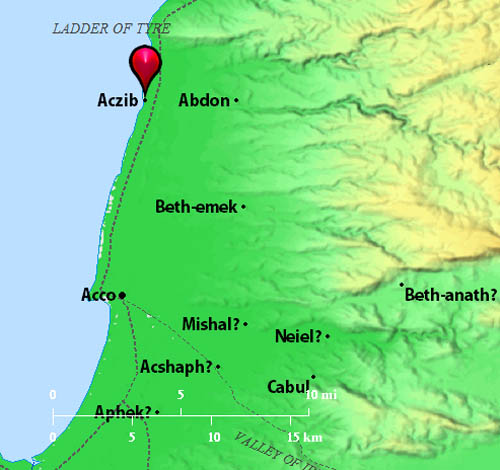
The map below shows the location of Acziv between Acco and the Ladder of Tyre. The Ladder of Tyre is a natural formation that has served as a border between Israel and Lebanon during many historical periods, including the present time.

Aczib on the Mediterranean coast of Western Galilee. BibleAtlas.org.

Achib (Achziv) on the Mediterranean coast of Western Galilee. BibleAtlas.org.

The Crusaders built a fortress at Achzib and named it Casal Imbert. The Mamluk’s captured the site in 1271, and an Arab village remained there until the War of Independence in 1948.

Achziv is built on a sandstone (kurkar) ridge overlooking the Mediterranean Sea. The remaining structures from the Arab period, now part of a National Park, are made from stones of the Crusader fortress.

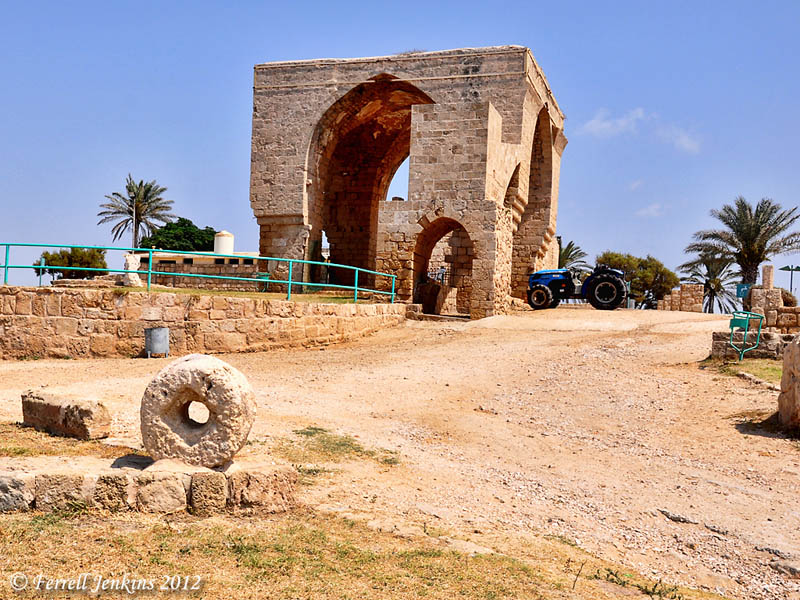
Arab period structures made from stones of the Crusader fortress at Achziv. Photo by Ferrell Jenkins.

Arab period structures made from stones of the Crusader fortress. The Mediterranean Sea is in view when you reach the top of the tel. Photo by Ferrell Jenkins.

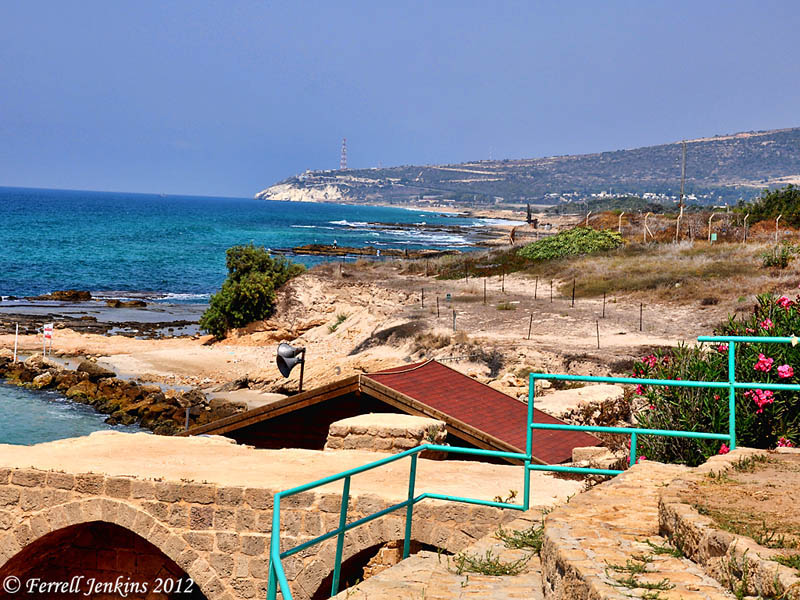
This photo was made from Tel Achziv looking north to Rosh Hanikra and the Ladder of Tyre, a distance of about 4 miles.

The view north from Tel Achziv to Rosh Hanikra. Photo by Ferrell Jenkins.

The view north from Tel Achziv to Rosh Hanikra. Photo by Ferrell Jenkins.

Some artifacts from Achziv are exhibited in the Hecht Museum in Haifa.

For an earlier posts about this region, see here and here.

Journalist accuses Turkey of Archaeology Blackmail

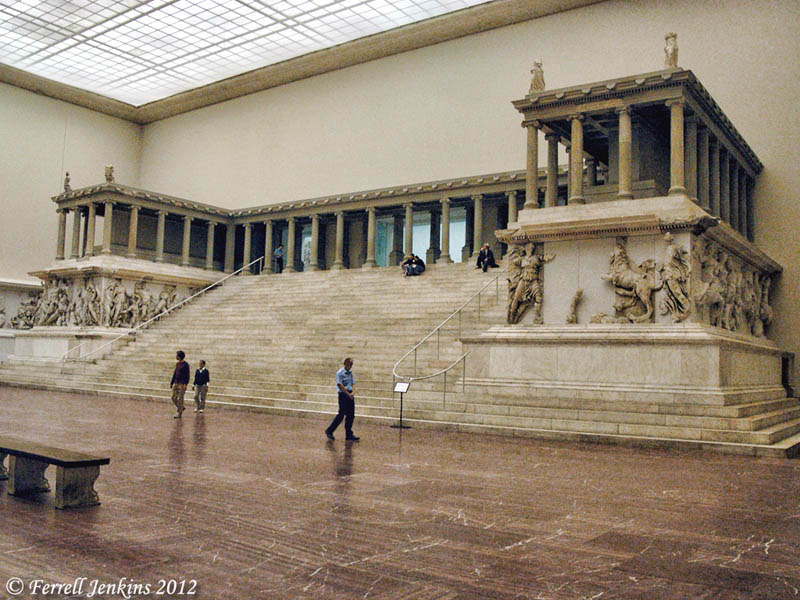
Owen Matthews, writing in Newsweek Magazine and The Daily Beast, says, “Turkey’s government is playing hardball to repatriate archaeological treasures.” He begins with the story of the German road engineer who excavated the Altar of Zeus at Pergamum (Pergamom) and arranged for the structure to be moved to Berlin and reconstructed in the museum there.

The Turkish government is now asking various museums around the world to return artifacts that  were taken from Turkey. Matthews mentions the Metropolitan Museum of Art in New York, the British Museum, and the Boston Museum of Fine Arts, along with others.

The reconstructed Pergamum Altar of Zeus in Berlin. Photo by Ferrell Jenkins.

The reconstructed Pergamum Altar of Zeus in Berlin. Photo by Ferrell Jenkins.

Today 30 young archeologists from all over the world work at Pergamon, uncovering new parts of the ancient city, meticulously recording, photographing, sketching, and cleaning the uncovered artifacts. The dig is considered the finest of its kind in the world. The state-of-the-art iDAI.field computer system for inputting real-time archeological data was pioneered here, along with many techniques for photographing, conserving, and mapping now considered standard across the world. In 2004 a complex of vulnerable newly discovered mosaics was enclosed in a beautiful wood, stone, and steel building designed by award-winning German architects and paid for entirely by the German government. The practice of hauling finds back to the home country was abandoned, of course, more than a century ago—today, all the finds remain in Turkey.

Despite a century of Germany’s investment in the fabric of Pergamon, the local authorities still view the Germans with suspicion. A recent mayor of Bergama ran on a ticket of returning the Altar of Zeus from Berlin, something the ministry itself hasn’t asked for (the paper trail clearly confirms that the altar was legally exported). And the DAI has come under pressure from tourism authorities to spend more resources rebuilding fallen temples to make them more photogenic to visitors rather than meticulously trowelling [sic] through ancient sewers and tombs.

Matthews says the Turkish authorities have decided “to play hardball” with various countries working in Turkey. Considering the remarkable work done by the Germans at Pergamum and Hattusha, the British at Carchemish, the Austrians at Ephesus, to mention just a few examples, this is an unfortunate situation. Read the article in its entirety here.

Turkish archaeologists have done significant work in numerous places throughout the country. But with more than a thousand archaeological sites, cooperation would be better.

Pergamum is the site of one of the churches addressed in the Book of Revelation (the Apocalypse) toward the end of the first century A.D. (Revelation 1:11; 2:12-17).

HT: Jack Sasson

The Via Dolorosa – the way of suffering

The day of the crucifixion of Jesus was an incredible day in history. Early in the morning Jesus was transferred from Caiaphas, the Jewish High Priest, to Pontius Pilate, the Roman military governor. When Pilate learned that Jesus was from Galilee, he sent Him to Herod Antipas. Herod quickly sent Him back to Pilate. Under pressure from the religious leaders, Pilate delivered Jesus to be crucified. The numerous events from the last day prior to the crucifixion of Jesus are recorded in the New Testament (Matthew 26-27; Mark 14-15; Luke 22-23; John 18-19).

As early as Byzantine times Christians began to follow the final steps of Jesus on specified days. Over the centuries many changes were made in the route and the stops. The traditional Via Dolorosa, as known today, was fixed in the 18th century.

Jerome Murphy-O’Connor says,

The Via Dolorosa is defined by faith, not by history. (The Holy Land, 5th edition, 37)

He continues,

The present Way of the Cross has little chance of corresponding to historical reality… (38)

According to tradition, the fifth station of the cross is where Simon of Cyrene (modern Libya) was compelled to bear the cross of Jesus. Some of the stations of the cross are not mentioned in the New Testament, but this one is.

As they led him away, they seized Simon of Cyrene, who was coming in from the country. They placed the cross on his back and made him carry it behind Jesus. (Luke 23:26 NET; cf. Matthew 27:32; Mark 15:21)

Via Dolorosa in Jerusalem. Station V. Simon of Cyrene is compelled to carry the cross of Jesus. Photo by Ferrell Jenkins.

The Via Dolorosa in Jerusalem. Station V. Simon of Cyrene is compelled to carry the cross of Jesus to Golgotha. Photo by Ferrell Jenkins.

Satet — the female god of Elephantine

We noted earlier that there were three major gods worshiped on Elephantine Island and the nearby region — Khnum, Satet, and Anqet. Khnum was the river or water god and was considered the god of the Nile. Satet was his female counterpart.

Her most important role was as the goddess of the inundation (yearly flooding of the Nile). According to myth, on the “Night of the Teardrop” would shed a single tear, which was caught by Satet and poured into the Nile, causing the inundation. (Ancient Egypt Online)

Budge says that at one period,

she must have been regarded as the goddess of the inundation, who poured out and spread over the land the life-giving waters of the Nile, and as the goddess of fertility. (The Gods of Egypt, II:55)

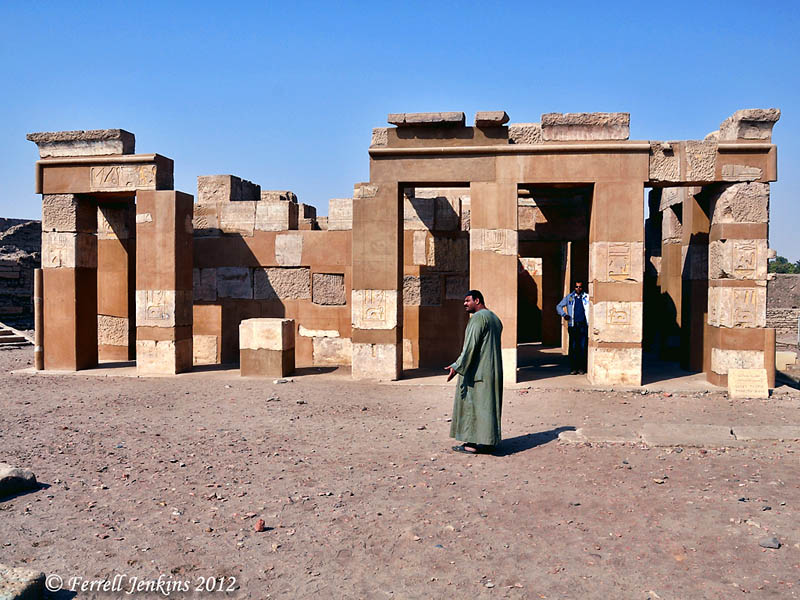
The ruins shown below belong to the Temple of Satet from Egyptian Dynasty XVIII. This was the time of Thutmose III (roughly around 1500 B.C.), during what is designated the New Kingdom Period.

Satet Temple on Elephantine Island. Photo by Ferrell Jenkins.

Satet Temple on Elephantine Island. Photo by Ferrell Jenkins.

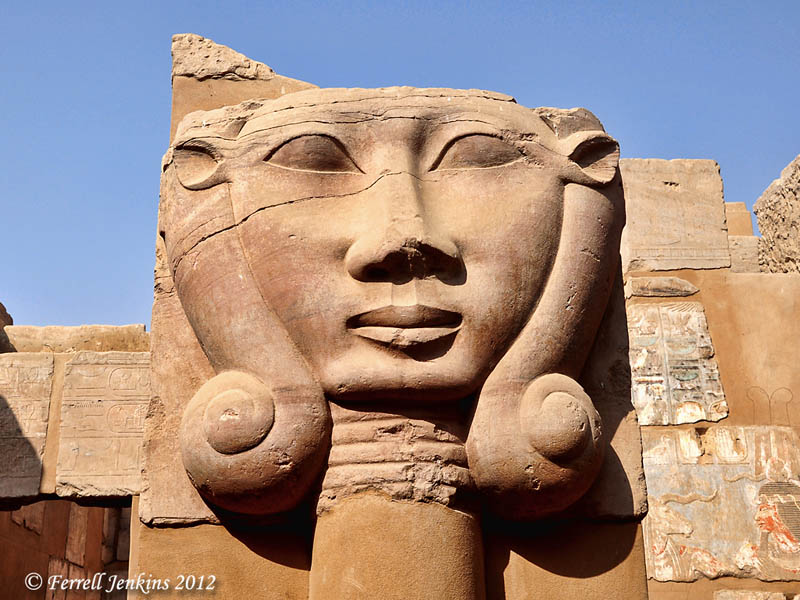
A broken relief of the head of Hathor may be seen in the ruins. Hathor portrayed herself with the head of a cow, with two horns, and a solar disc between the horns. Sometimes she was portrayed in the form of a cow.

Hathor in the Ptolemaic Satet Temple on Elphantine Island. Photo by Ferrell Jenkins.

Hathor in the Satet Temple on Elephantine Island. Photo by Ferrell Jenkins.

Temples honoring Satet continued on the island into the Ptolemaic and Roman periods.

Israel had been warned at the time of the Exodus that they should not return to Egypt.

Only he must not acquire many horses for himself or cause the people to return to Egypt in order to acquire many horses, since the LORD has said to you, ‘You shall never return that way again.’ (Deuteronomy 17:16 ESV)

After the Exile of Judah to Babylon, some of the Judeans who remained in the land of Judah returned to Egypt taking the prophet Jeremiah with them. Jeremiah continued to warn of the dangers of serving the gods of Egypt. In fact, the women of Judah are accused of leading their husbands into worshiping the gods of Egypt (Jeremiah 44).

Elephantine Island

There are numerous ways to describe the location of Elephantine Island. It is an island in the Nile River at Aswan (= Syene in Ezekiel 29:10 and 30:6). Or we might say that the island is located at the first cataract of the Nile.

According to Budge, the earlier name for Elephantine was Abu. One way of writing the name of the island included the drawing of an elephant (E. A. Wallis Budge, The Gods of the Egyptians, II:51).

Various suggestions have been made regarding the origin of the name Elephantine. Some say the smooth rocks of the first cataract remind one of an elephant back. Others say, the island is shaped like an elephant tusk. Or, the island was the center of ivory trading in the past.

A small granite statue of an elephant has been uncovered on the extreme south end of the island. Aswan, you likely recall, was noted for its granite.

Granite Elephant on Elephantine Island, Aswan, Egypt. Photo by Ferrell Jenkins.

Granite Elephant on Elephantine Island, Aswan, Egypt. Photo by Ferrell Jenkins.

In the Septuagint Old Testament and in the New Testament the word elephantinos is translated ivory. You can think of Samaria’s famous beds of ivory, made from the tusks of elephants (Amos 6:4), or the unsold cargoes of the merchants who could no longer trade with the fallen Babylon [Roman Empire] (Revelation 18:12).

Paul spent a night at Cos (Kos)

Paul and his companions, including the physician Luke, made their way from Miletus to Cos (Kos).

And when we had parted from them and set sail, we came by a straight course to Cos, and the next day to Rhodes, and from there to Patara. (Acts 21:1 ESV)

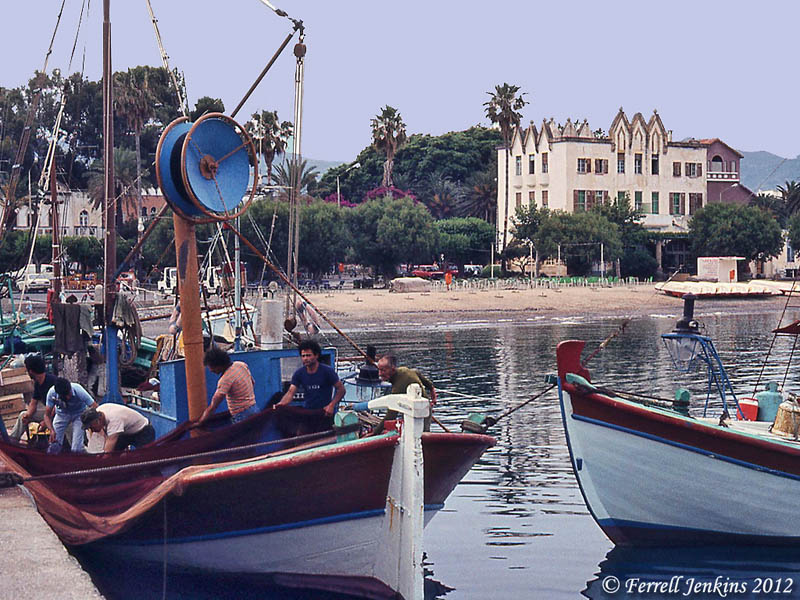
Cos is one of the islands belonging to a group of 12 called the Dodecanese. Patmos is also an island of this group. The Mycenaeans settled Cos in the 15th century B.C. In the centuries to follow the island came under the control of the Persians, the Greeks, and the Romans. In modern times the island has been under Turkish and Italian control, and German occupation. Since 1948 it has been part of Greece. My only visit to Cos was a brief stop en route from Patmos to Rhodes in 1984. Here is one of the photos I made.

The harbor on the Island of Cos in 1984. Photo by Ferrell Jenkins.

The harbor on the Island of Cos in 1984. Photo by Ferrell Jenkins.

In the time of Paul, Cos was noted as the birthplace of Hippocrates, the “father of medicine.” Hippocrates was associated with the Asclepium, ruins of which can still be seen. A Hellenistic gymnasium and some Roman ruins, including portions of a Roman road, may also be seen. There is also an archaeological museum.

Howard F. Vos describes the island with these words:

One of the most beautiful ports of the ancient world, Cos not doubt was most famous as a health resort. It was the site of the first school of scientific medicine and the sanctuary of Asclepius (Esculapius). The island had a healthful climate and hot ferrous and sulfurous springs, which the great Hippocrates (ca 460–377 b.c.), the father of medicine, first used to cure his patients. (The International Standard Bible Encyclopedia, revised.)

James Strahan, in the old Hasting’s Dictionary of the Apostolic Church, says,

It was renowned for its vines and looms, its literature and art, and above all for its temple of Æsculapius and school of medicine, which must have made it especially interesting to St. Luke.

According to Josephus, Herod the Great assisted the people of Cos with grain and other goods. (JW 1:424).

Two Other Good Sources:

Fant, C. E. and M. G. Reddish, A Guide to Biblical Sites in Greece and Turkey.

Wilson, Mark. Biblical Turkey: A Guide to Jewish and Christian Sites of Asia Minor. This book deals with Turkey, but devotes ½ page to Cos as a Sidetrip.