Category Archives: Bible Places

Podcast on Tell es-Safi/Gath excavation

A brief report about the Tell es-Safi/Gath excavation has been posted on the ABC (Australian Broadcasting Company) here. A transcript is included for those who prefer to read.

Prof. Aren Maer has posted a great photo of the tell from ground level.

Tell es-Safi/Gath. Photo by Richard Wiskin.

Tell es-Safi/Gath. Photo by Richard Wiskin.

Check the web site here for a hi-res photo. Gath is the town named as the home of Goliath in the Bible.

Then a champion came out from the armies of the Philistines named Goliath, from Gath, whose height was six cubits and a span. (1 Samuel 17:4 NAU)

I wrote this post yesterday and waited till today to post it. Others have called attention to the podcast since that time.

Aerial views of Gath

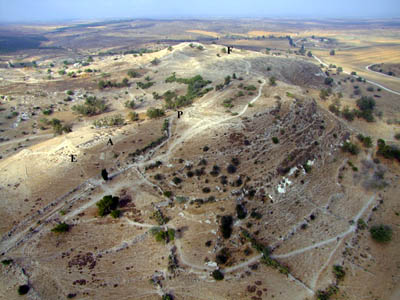
Prof. Aren Maeir has posted a great aerial photo of Tell es-Safi/Gath on his blog here. He also has a photo showing the air balloon with a remote camera used to make the photo. I am taking the liberty to post a small copy of the aerial photo in an effort to encourage you to look at the hi-res one on his blog. In this photo you can see the Mediterranean Sea in the distance. This illustrates clearly the terrain of the Shephelah and the coastal plain (of Philistia). The areas worked this summer are indicated by the letters E, A, P and F.

Aerial view of Tell es-Safi/Gath looking SW.

Aerial view of Tell es-Safi/Gath looking SW. Tell es-Safi/Gath Blog.

Aren promises to offer final reports on the accomplishments of the season shortly. We look forward to those.

Over the years I have encountered people who think ALL of the archaeological work has been done. When you see a large mound like Tell es-Safi/Gath from the air you begin to understand that there is still work to be done.

Here are a few of the interesting things we know about Gath from the Bible:

  • Gath was one of the five major cities of the Philistines (1 Samuel 6:17).
  • The ark of the covenant was brought here by the Philistines after being capture in battle with the Israelites (1 Samuel 5:8).
  • Goliath was from Gath (1 Samuel 17).
  • David once sought refuge from Achish king of Gath (1 Samuel 21).
  • When Saul and Jonathan died, David did not want it to be published among the Philistines. He said, “Tell it not in Gath, Proclaim it not in the streets of Ashkelon, Or the daughters of the Philistines will rejoice, The daughters of the uncircumcised will exult” (2 Samuel 1:20).
  • King Uzziah broke down the wall of Gath, and other Philistine cities, and built Judean cities (2 Chronicles 26:6).

The Dead Sea: A History of Change

The Dead Sea may be the most fascinating body of water on earth. It lies along the Great Rift (Afro-Arabian Rift), and is the lowest body of water on earth. A.D. Riddle and David Parker have created a relief map showing the level of the Dead Sea from 3500 B.C. to the present. The authors explain how they made the map at the site.

Visit the The Dead Sea - a History of Change.

Visit the The Dead Sea - a History of Change.

Click here to see the map. It takes a little while to get acquainted with all the information available on the page. Click the buttons on the right middle of the map page to run the animation. The extent of the water in the Dead Sea changes as the program runs through the centuries. Scroll over one of the names on the map and information appears in the blue box. This is a fascinating program.

Sinkholes on the western shore of the Dead Sea

Several news outlets, include our local Fox News station, ran reports on sinkholes that are developing along the western edge of the Dead Sea. Less water is flowing into the Dead Sea than in previous years. The Fox News report says,

As the Dead Sea recedes, fresh water comes to the dried-up areas in the form of rain, runoff and underground streams. The fresh water soaks into the ground, dissolving the salts that had been deposited there since long before there was a Sodom or a Gomorrah.

Once the salt dissolves, that opens up great underground caves — and the earth comes a-tumblin’ down.

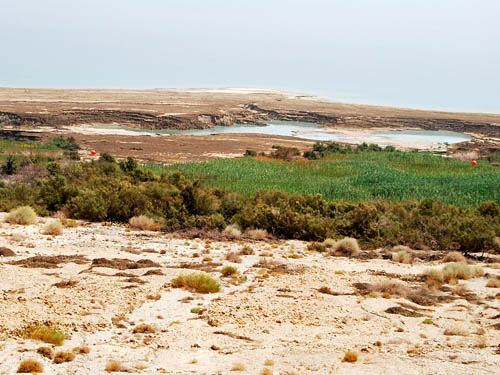
Here is a photo showing one of the sinkholes filled with fresh water. The Dead Sea and the distant mountains of Moab are hidden in the summer haze.

Sinkhole along the western shore of Dead Sea. Photo by Ferrell Jenkins.

Sinkhole along the western shore of Dead Sea. Photo by Ferrell Jenkins.

HT on the map: Biblical Studies and Technological Tools.

Keeping up with the digs

Not many digs this year are keeping the unfortunate, non-participants, informed about what is going on. I miss seeing anything from Dan, Gezer, and Hazor. Nothing new has appeared on the Khirbet Qeiyafa page since the middle of May. Maybe they have fewer workers and time does not permit. Of course, we have had a few notes from our friends who are working there. We had an earlier report on the Mt Zion Excavation.

The one real exception has been the excavation at Tell es-Safi/Gath. Prof. Aren Maer has kept us updated and included some nice photos along the way. Check here and read back through the season.

A 2009 Post season wrap-up on Ashkelon is available here.

Dr. Bryant G. Wood has provided a report here on the season at Khirbet el-Maqatir, a site that he thinks may be biblical Ai.

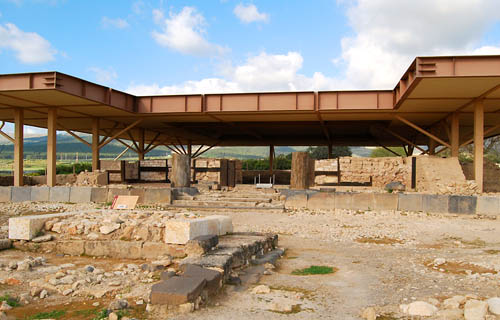
The photo below shows the Palace of the Canaanite Kings of Hazor. The palace which dates from the 14th-13th centuries B.C. (Late Bronze period) is said to be of a ceremonial nature. Excavators are still looking for the administrative palace at some other place on the tel. The palace, like the rest of Hazor, was destroyed by fire. It has been restored in order to give visitors some real insight into the size and function of the building.

The Late Bronze Canaanite Palace at Hazor. Photo by Ferrell Jenkins.

The Late Bronze Canaanite Palace at Hazor. Photo by Ferrell Jenkins.

Gordon Franz has posted an interesting interview with conservator Orna Cohen, the restorer of the palace, on his Life and Land Seminars page here. Orna was responsible for the restoration of the Roman Boat that many visitors to Israel have seen at Nof Ginosaur.

Video on the City of David

The Israel Antiquites Department has released a nice 9-minute video featuring archaeologists Ronnie Reich and Eli Shukron showing some of the highlights of the City of David excavation. The film features the following places:

  • The water system and Warren’s Shaft
  • The Canaanite pool channel
  • Gihon Spring
  • Hezekiah’s Tunnel
  • The Pool of Siloam
  • The Herodian Street
  • The drainage channel

The video runs a little slow on my computer, but if you give it a little time to load it is certainly worth the wait. The link is here.

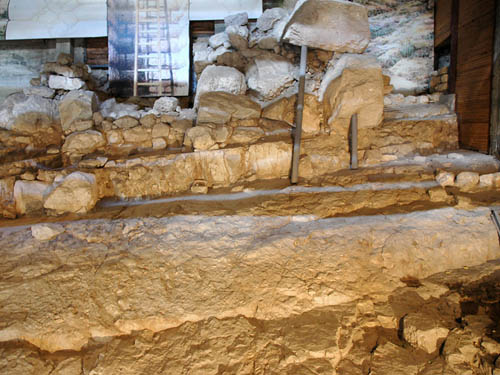
The photo below shows part of two towers that served as a fortification for the protection of Gihon Spring as early as the Canaanite time.

Foundation of the fortification tower at Gihon Spring. Photo by Ferrell Jenkins.

Foundation of the fortification towers at Gihon Spring. Photo by Ferrell Jenkins.

The information sign at the site says,

It was here that a rock-cut pool and the remains of the bases of two towers were located. These towers, built of large stones, constituted part of the fortifications protecting the pool and the spring as early as the Middle Bronze Age (18-15 centuries BCE). The spring water flowed through the channel to a large pool, from which scores of people could draw water simultaneously. The surplus water flowed through a channel to another pool in the south of the city.

This work has been carried out by Reich and Shukron.

HT: Joseph I. Lauer

Life at an archaeological dig can be fun

Luke and Royce Chandler, a couple of friends from Tampa, are participating in the dig at Khirbet Qeiyafa, a site above the Valley of Elah. It is also being called the Elah Fortress. The director of the dig, Prof. Yosef Garfinkel, thinks this is the site of Shaaraim (Joshua 15:36; 1 Samuel 17:52; 1 Chronicles 4:31).

Todd Bolen, of BiblePlaces.com has suggested the site should be identified with Ephes-dammim here, here, and here. Both places, Shaaraim and Ephes-dammim (1 Samuel 17:1) are associated with the conflict between David and Goliath. I will leave all of this for you to study as you wish.

Luke sent me a few photos to share with our readers.
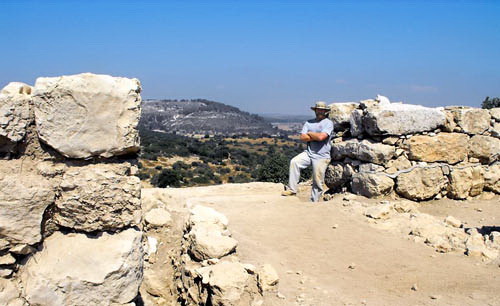
Luke is standing in the "Philistia Gate" with his left foot in the Iron Age threshold. Azekah can be seen in the distance.
Luke is standing in the “Philistia Gate” with his left foot in the Iron Age threshold. Azekah can be seen in the distance.The Valley of Elah is to the left.

Luke reports an interesting incident that happened at the dig last Wednesday.

On this final day in the room, my father leaned his hand against the wall and accidentally caused a stone to fall out onto the ground. Behind where the stone had been, Royce saw a shiny turquoise circle. We called Guy Stiebel, the area archaeologist (also the chief excavator at Masada), to see it. When Guy saw the glass he took a keen interest. It turned out to be a complete ancient glass bottle that had been placed on its side into the wall during construction. Glassware such as this is common in burial locations, but very uncommon in this situation.

Read the full account here. Luke has several photos on his site. He received permission to include a photo of the glass bottle “in situ” (the place where it was found). He has given me permission to share it with our readers.
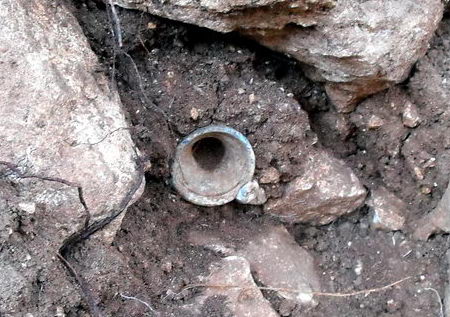
Glass bottle found in a wall at Khirbet Qeiyafa by Royce Chandler. Photo: Luke Chandler.

Glass bottle found in a wall at Khirbet Qeiyafa by Royce Chandler. Photo: Luke Chandler.

In 2008 one of the volunteers uncovered a large potsherd (broken piece of pottery) containing a Hebrew inscription. We are still awaiting a complete translation. We published a photo here.

We appreciate Luke sharing these experiences with us. By the time he and Royce get back home their wives will be expecting them to work in the flower beds!

You might also enjoy reading his account of walking through Hezekiah’s Tunnel (2 Kings 20:20), and seeing his video showing a stone from the Iron Age in the east wall of the Old City of Jerusalem, here.

Breakfast with Jesus

Jesus told the disciples that after His resurrection He would go ahead of them to Galilee (Matthew 26:32). His third appearance to the disciples was on the shore of the Sea of Tiberias (Galilee/Gennesaret).

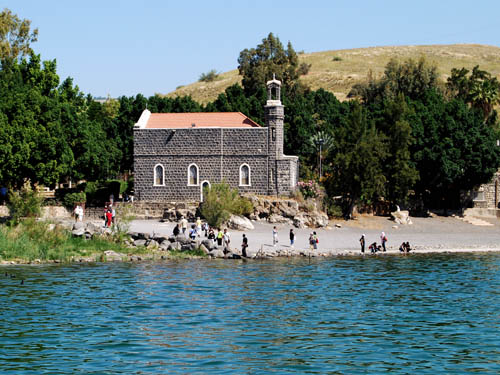
Tradition locates the place of His meeting with the disciples at (or near) Tabgha on the northwest shore of the Sea of Tiberias. The events are recorded in John 21. The disciples had fished during the night and caught nothing. At day break Jesus invited them to “Come and have breakfast.”

The small church, made of the local basalt stone, is called the Church of the Primacy of Peter. Roman Catholics believe Christ promised and conferred the primacy of jurisdiction over the entire church on the Apostle Peter at this time and place (John 21:14-17). Need I say that many do not agree with this interpretation?

The traditional site where Jesus prepared breakfast for the disciples. Photo by Ferrell Jenkins.

The traditional site where Jesus prepared breakfast for the disciples. The building covers what Catholics call the Mensa Christi (the Table of Christ). Photo by Ferrell Jenkins.

Observe in the photo that the shoreline is far from the building. This is because the water level has been extremely low in the past few years. Remnants of a small harbor can be seen beside the building. Mendel Nun, in his well-known article about the 15 man-made harbors around the Sea of Galilee, writes about Tabgha:

In the winter, fishermen from Capernaum worked at Tabgha, where several warm mineral springs attracted musht, popularly called St. Peter’s Fish. (The name Tabgha is a corruption of the Greek for “Seven Springs.”) Today the remains of this small harbor’s breakwater can be seen when the water level is low. Christian tradition ascribes the meeting place of Jesus with his disciples to a prominent rock at the warm springs. From a fisherman’s viewpoint, this is the correct choice. This is the area where musht schools formerly concentrated in the winter and spring. Here Jesus met his disciples for the first—and also the last—time (Luke 5:1–7; John 21:1–8). On this rock, now known as the rock of the primacy of Peter, stands a small modern Franciscan chapel, the Church of the Primacy of Peter. It was built on the foundations of earlier churches, the oldest of which dates from the first half of the fourth century. The altar is built around a stone outcropping known to pilgrims as the Lord’s Table (Mensa Domini), on which Jesus served the disciples after the miraculous draught of fishes (John 21:13). (Nun, Mendel. “Ports of Galilee.” Biblical Archaeology Review. July/August 1999).

I take every step with them

A couple of my friends, Royce and Luke Chandler, are in Israel to participate in the archaeological dig at Khirbet Qeiyafa. The site, overlooking the Valley of Elah, is also called the Elah Fortress. They are spending a few days traveling in Israel prior to joining the dig.

Luke is posting some of his photos and a bit of information about the places on his A Bible, History & Travel Blog. Today he has a great photo of the Jezreel Valley from the Spring of Harod to the Hill of Moreh (Judges 7). Take a look.

The Land of Rameses

Note: Over the past nine years I have contributed nearly 100 articles on Bible places to a magazine published by some of my friends. Normally I do not repeat the material here for several years.  The typesetter made a mistake in the July, 2009, issue of Biblical Insights using the title from the previous issue. Because of this I decided to run the article here with the correct title.

-o-o-o-o-o-o-

For many years scholars identified Rameses with Tanis (San el Hagar). Tanis is often identified with the Zoan which was built seven years after Hebron (Numbers 13:22). As a result of recent excavations in the eastern Nile Delta by Austrian archaeologists under the direction of Manfred Bietak, Rameses is now identified with Tell el-Daba. Tell el-Daba is situated on the eastern side of the ancient Pelusiac branch of the Nile River in the biblical land of Goshen (Gen. 45:10) which is also called the land of Rameses (Genesis 47:11). Rameses was the starting point of the exodus (Ex. 12:37; Num. 33:3,5).

Scholars posit four main proposals for the date of the exodus. (1) Before 2000 B.C. (Anati); (2) 1477 B.C. (Goedicke); (3) about 1450 B.C. (Bimson); (4) 1280 B.C. (popular view). If we believe that 1 Kings 6:1 should be taken seriously, as I do, the date of the exodus would have been about 1446 B.C. Conservative scholars disagree over whether there was a long bondage (430 years), or a short bondage (215 years).

The history of this area should be divided into three periods: pre-Hyksos, Hyksos, and post-Hyksos. The Hyksos were foreign (Canaanite or Asiatic) rulers who lived in the eastern Nile Delta and eventually ruled northern Egypt for some 108 years (c. 1663-1555 B.C.; 15th dynasty). In the pre-Hyksos period the town was known as Rowaty (“the door of the two roads”). During the 15th Dynasty the name was changed to Avaris. The Hyksos made their capital there and retained the name. When the Egyptians ran the Hyksos out of Egypt the name was likely changed to Peru-nefer (“happy journey”). Pharaoh Rameses built a new city at the same location and named it Rameses.

During their stay in the land of Egypt the Israelites built the storage cities of Pithom and Rameses (Exodus 1:11). Pharaoh Rameses II ruled Egypt about 1304 to 1227 B.C. How could the Israelites have built the city of Rameses prior to 1446 B.C. if Pharaoh Rameses was not the ruler of Egypt until nearly 200 years later? Some have suggested that the name Rameses was given to the city by the Hyksos in the 17th century B.C. Perhaps the city was named for a private individual by that name. The most common explanation is that Rameses is the modernization of an obsolete place name. We might say that Caesar crossed the English Channel though it was not known by that name at the time. We say St. Nicholas of Myra was a Turkish bishop, but Turkey did not exist at the time.

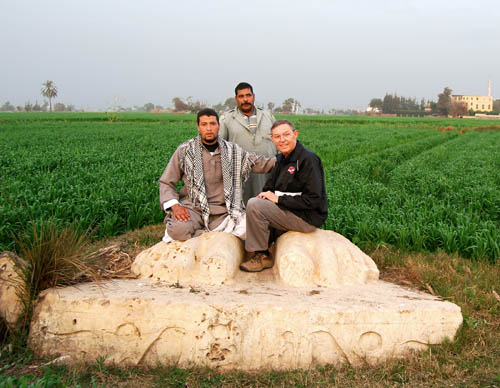
Earlier this year I spent two days in the land of Goshen. My guide gained access to a field in the Tell el-Daba area where we saw remnants of a colossal statue of Pharaoh Rameses II estimated to have been more than 30 feet high. The royal precinct of the city at the time of Moses has also been uncovered at Ezbet Helmi on the bank of the Pelusiac branch of the Nile.

Remnant of a colossal statue of Rameses II at Tell el-Daba in the land of Goshen.

Remnant of a colossal statue of Rameses II at Tell el-Daba in the land of Goshen.

It is incorrect to say that there was no Egyptian building in the delta during the time of Rameses II. The storage city constructed by the Israelites was not known as Rameses when they built it, but by one of the earlier names.

Mount Hermon

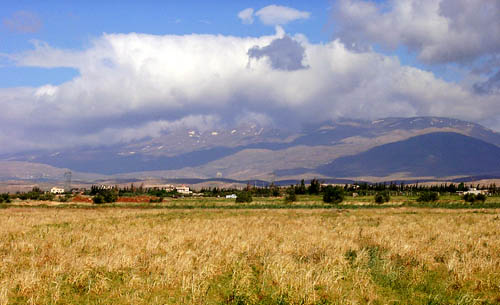
Mount Hermon is the southern end of the Anti-Lebanon mountain range. The mountain is about 20 miles long and has three peaks. At 9,232 feet above sea level it is the highest mountain of Canaan, or Roman Syria, named in the Bible. The mountain now is shared by the countries of Lebanon, Syria, and Israel. The photo below shows mount Hermon from the east, a few miles south of Damascus toward Quneitra. This photo was made the middle of May, 2002. There was more snow on the west side of the mountain in Lebanon than you see here.

View of Mount Hermon from the East. Photo by Ferrell Jenkins 2002.

View of Mount Hermon from the East. Photo by Ferrell Jenkins 2002.

The first biblical reference to Mount Hermon is found in Moses’ account of the Israelite conquest of transjordan (Deuteronomy 3:8). He says that Israel took the land from the hand of two Amorite kings “from the valley of Arnon to Mount Hermon.” The Sidonians, of ancient Phoenicia, called the mountain Sirion, and the Amorites called it Senir (Deuteronomy 3:9). The half-tribe of Manasseh lived in the area of Bashan which is south of Mount Hermon (1 Chronicles 5:23). The Mountain of Bashan is probably a reference to Mount Hermon (Psalm 68:15). Hermon is mentioned in four references in the poetic books of the Old Testament (Psalm 42:6; 89:12; 133:3; Song of Solomon 4:8).

The heavens are yours; the earth also is yours; the world and all that is in it, you have founded them. The north and the south, you have created them; Tabor and Hermon joyously praise your name. (Psalm 89:11-12 ESV)