Category Archives: Bible Places

Thessalonica on the Aegean

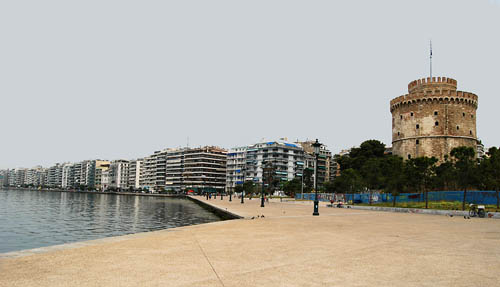
Thessalonica was located on the east-west Egnatian Way. The city was also located on the Bay of Thessalonica on the Aegean Sea. According to the records we have in the Book of Acts and Paul’s Epistles, Paul never used the sea port at Thessalonica.

The waterfront of Thessalonica with the White Tower. Photo by Ferrell Jenkins.

The waterfront of Thessalonica with the White Tower. Photo by Ferrell Jenkins.

The tower, called the White Tower, was built in the 15th century by the Venetians or the Turks. It is probably the best known landmark of the city today.

Persecution of Christians in Thessalonica

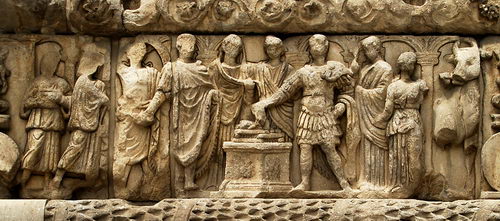
Earlier we posted information about the Arch of Galerius. Galerius was the Roman Emperor from 305 to 311 A.D. The arch was erected in Thessalonica to commemorate his victory over the Persians in 297 A.D. The reliefs on the arch are about this victory.

The most interesting portion of the relief to me is the one showing Galerius offering a sacrifice. The relief has been somewhat defaced, but it appears to me that he is pouring a libation on the altar. To the left, as we view the scene, is the Emperor Diocletian, the father in law of Galerius. The lady on the right is the wife of Galerius, daughter of Diocletian. Note the animal, awaiting his turn to be offered on a larger altar. The altar scene reminds us of the Emperor worship which was prevalent from the close of the first century onward.

Sacrifice scene on the Arch of Galerius in Thessaloniki. Photo by Ferrell Jenkins.

Sacrifice scene on the Arch of Galerius in Thessaloniki. Photo by Ferrell Jenkins.

Diocletian is noted for his decree in 303 A.D. that ordered the burning of all Bibles and church records. This is one reason we have so few manuscripts before the fourth century A.D. Some credit Galerius as the brain back of this decision. He was responsible for considerable persecution of Christians during his reign. This persecution would be that spoken of in the Book of Revelation that we associate with Emperor worship.

The Danish archaeologist Dyggve excavated a Palace, Hippodrome, and Mausoleum belonging to Galerius. He also was able to show that the Arch was part of the complex of buildings (Blue Guide Greece).

The Via Egnatia in Thessalonica

The Egnatian Way was one of the famous Roman roads used by the Apostle Paul in his travels to preach the gospel of Christ (Acts 16-17). F. F. Bruce gives a little history about the ancient road.

When Macedonia became a Roman province in 148 b.c., the Via Egnatia was constructed, running east from Dyrrhachium (modern Durres) and Apollonia (modern Poyani) on the Adriatic to Thessalonica, from which existing roads ran to the main Greek cities. The Via Egnatia was later extended farther to Neapolis (modern Kavalla), the port of Philippi, and later still to Byzantium on the Bosporus. When the Roman province of Asia was formed in 133 b.c., the Via Egnatia (with a short sea-crossing at either end) provided easy communication between Rome and the new province. (The Anchor Bible Dictionary, 6:649).

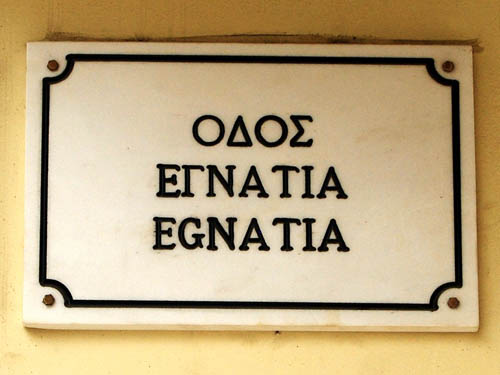
Very few remains from the first century have been exposed in Thessaloniki. Remember that the second largest city of Greece is built over the ancient city. One of the important streets running through the city is named Odos Egnatia (the Egnatian Way). The small street signs in Thessaloniki are located on building rather than on the corner of the street. This makes it difficult for a stranger to drive and read the street signs.

Street marker in Thessaloniki. Photo by Ferrell Jenkins.

Street marker in Thessaloniki. Photo by Ferrell Jenkins.

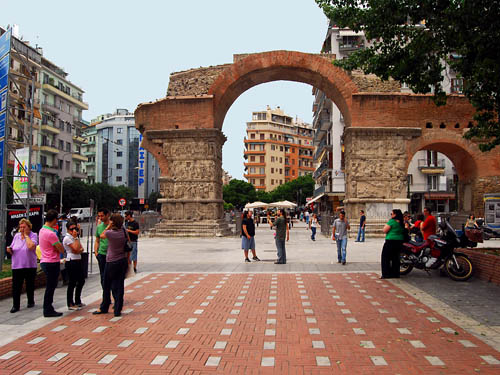
The Via Egnatia runs beside the monumental Arch of Galerius. This arch was built in A.D. 304 to commemorate the emperor’s victory over the Persians in A.D. 297 (Reddish & Fant 136).

Arch of Galerius (early 4th century A.D.). Photo by Ferrell Jenkins.

Arch of Galerius (early 4th century A.D.). Photo by Ferrell Jenkins.

Paul visited Thessalonica during his second journey

Paul came to Thessalonica on his second journey (A.D. 50-53; Acts 17). Paul describes the reception the Thessalonians gave to the gospel in these words:

For they themselves report about us what kind of a reception we had with you, and how you turned to God from idols to serve a living and true God, and to wait for His Son from heaven, whom He raised from the dead, that is Jesus, who rescues us from the wrath to come. (1 Thessalonians 1:9-10 NAU)

The church of the Thessalonians had many questions about the second coming of Christ. Paul addressed these questions in the two letters he wrote to the church from Corinth.

We know little of individuals associated with the church. Jason seems to be one of the earliest converts in Thessalonica (Acts 17:5-9). Aristarchus, a Macedonian of Thessalonica accompanied Paul on the voyage to Rome (Acts 27:2). He was one of the messengers who went with Paul on the return from the third journey (Acts 20:4). When Demas forsook Paul he went to Thessalonica (2 Timothy 4:10).

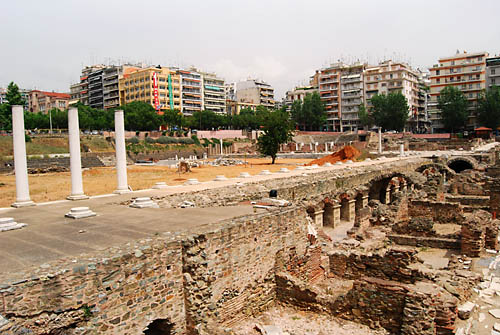
The photo below shows ruins of the Roman Forum in Thessaloniki, the second largest city of Greece. This area of the city was destroyed by a fire in 1917. During preparations for constructing new buildings these ruins were discovered. They date to the second and third century A.D. (See Fant and Reddish, A Guide to Biblical Sites in Greece and Turkey, 137). Perhaps there are older ruins below these. Notice how the modern city is built around the ancient ruins on a higher level. Can you imagine what might be underneath all of those buildings?

Roman Forum at Thessalonica. Photo by Ferrell Jenkins.

Roman Forum at Thessalonica. Photo by Ferrell Jenkins.

A view from Qumran

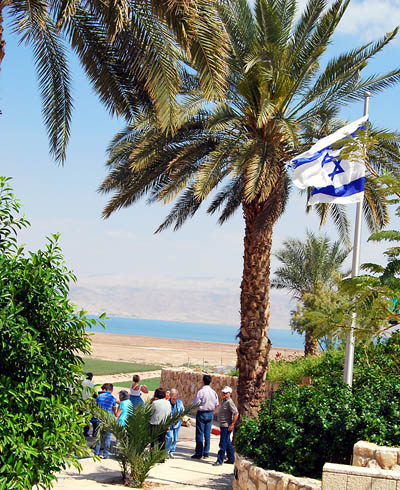
This morning I wanted to share a photo made from Qumran on the western shore of the Dead Sea. Weather conditions were fairly good that day. You can see across the Dead Sea to the mountains of Moab.

View east to the Dead Sea from Quman. Photo by Ferrell Jenkins.

View east across the Dead Sea to Moab. Photo by Ferrell Jenkins.

We associate the land of Moab with Ruth the grandmother of King David.

So Naomi returned, and with her Ruth the Moabitess, her daughter-in-law, who returned from the land of Moab. And they came to Bethlehem at the beginning of barley harvest. (Ruth 1:22)

Luke Chandler on Israel National Radio

We have had several things to say about Luke Chandler and his participation in the archaeological dig at Khirbet Qeiyafa (the Elah Fortress) a few weeks ago. This is because Luke is a friend and a former student. Luke has been interviewed by Gordon Govier on The Book and the Spade program. That interview emphasized the role of volunteers in archaeology.

Willner & Selevan

Willner & Selevan

Now he has been interviewed for the Judean Eve program on Israel National Radio to discuss the use of blogs in reporting on archaeological work. To hear this interview you must look for the program entitled Tell Me About Digs. Click on Part 2 to listen or download the mp3 file. Follow this link for the interview. Luke’s blog may be found at lukechandler.wordpress.com.

There is another interview on the same program with some guy named Herschel Shanks.

Khirbet Qeiyafa is an important site historically because of the part it plays in the account of the conflict between Israel and the Philistines (David and Goliath). See 1 Samuel 17 for the full story.

Video about Sodom

Dr. Steven Collins, Dean, College of Archaeology, Trinity Southwest University, has posted a short video on The Search for Sodom and Gomorrah at YouTube here. Collins is excavating Tall el-Hammam in the Jordan Valley (Transjordan) east of Jericho.

Numerous articles by Dr. Collins about the excavation at Tall el-Hammam have been posted at the Biblical Research Bulletin page.

Gary Byers of ABR has a good summary report on the excavation prior to the 2009 season here.

The Summer 2007 issue of Bible and Spade has an exchange between Dr. Collins and Dr. Bryant G. Wood. Wood holds that the location of Sodom should be on the southern end of the Dead Sea. Both articles are lavishly illustrated.
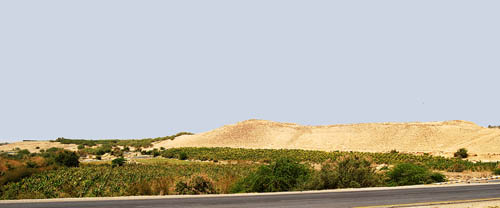
Tall el-Hammam in the Plains of Moab. View toward east. Photo by Ferrell Jenkins 2008.

Tall el-Hammam in Plains of Moab. View toward west. Photo by Ferrell Jenkins 2008.

Other scholars have suggest that Tall el-Hammam is the site of Abel-shittim (Numbers 33:49; Shittim, Numbers 25:1), in the plains of Moab. See Rainey and Notley, The Sacred Bridge, 125. The Israelite spies went out from here to view the land, especially Jericho (Joshua 2:1).

It is now common in Jordan for the old word Tell to be spelled Tall. You know that in Israel the word is Tel. Nothing like consistency.

HT: Dr. David E. Graves at Deus Artefacta.

The last day at Khirbet Qeiyafa

Luke Chandler reports on the last full day of excavation at Khirbet Qeiyafa (the Elah Fortress) here. Several good photos are included with the post. Thanks to Luke for the reports and photos.

I call attention to these reports to give our readers who may not be aware an idea of the difficulty and slowness of an archaeological dig. Information is accumulated over many years. The archaeologists may have some conclusions at the end of the season, but they may change next year as new information comes to light.

Now we must await a full report by the director of the dig. There may be a press relase within the next month or two, but the next step is the presentation at the annual meetings of the American Schools of Oriental Research and the Society of Biblical Literature in November. Maybe a popular article or two will follow. In the background there may be lab studies, calling in of experts in various fields to look at artifacts, etc.

There will likely be more questions than answers. In the years to come other scholars will interact with the conclusion drawn by the excavator. Hopefully this will provide background for a better understanding of the story of David and Goliath (the Israelites and the Philistines).

A unique panorama from Tell es-Safi/Gath

Prof. Aren Maeir has posted a unique panoramic photo by Gal Avraham of Area A at Tell es-Safi/Gath. It appears to be made from at least 7 different photographs. See them here.

Reaching 200,000 hits

Overnight we registered our 200,000th hit on this blog. Our first post was May 2, 2007. Since that time we have covered two trips to Israel, two trips to Turkey, a trip to Greece and the Greek islands, a trip to Egypt, and a trip to Scotland. In addition we have reported on numerous archaeological developments and posted info on many biblical places and customs.

Actually we passed the 200,000 mark more than a week ago. Back in May we reported here on losing 3380 hits on our counter overnight.

Thanks should be extended to several people.

  • Thanks to WordPress for making this wonderful opportunity available at no cost. I would like to encourage everyone who thinks they have something worthwhile to say to get a blog and begin writing.
  • Thanks to our readers. The number has grown consistently in the past two years. We are delighted that you continue to check our blog. It has been fun to watch the increase of the traffic ranking at Alexa.
  • Thanks to everyone who has sent tips about items of interest that you think we should cover. Most of these come from acquaintances by email rather than as comments to the blog.
  • Thanks to Todd Bolen at blog.bibleplaces.com and BiblePlaces.com for his link to our page. Todd has called attention to this page several times and it has helped to increase the number of our readers.
  • Thanks to my wife for proofing many of the posts. I always appreciate her help.
  • Technological thanks to Nikon, Canon, and Adobe PhotoShop.

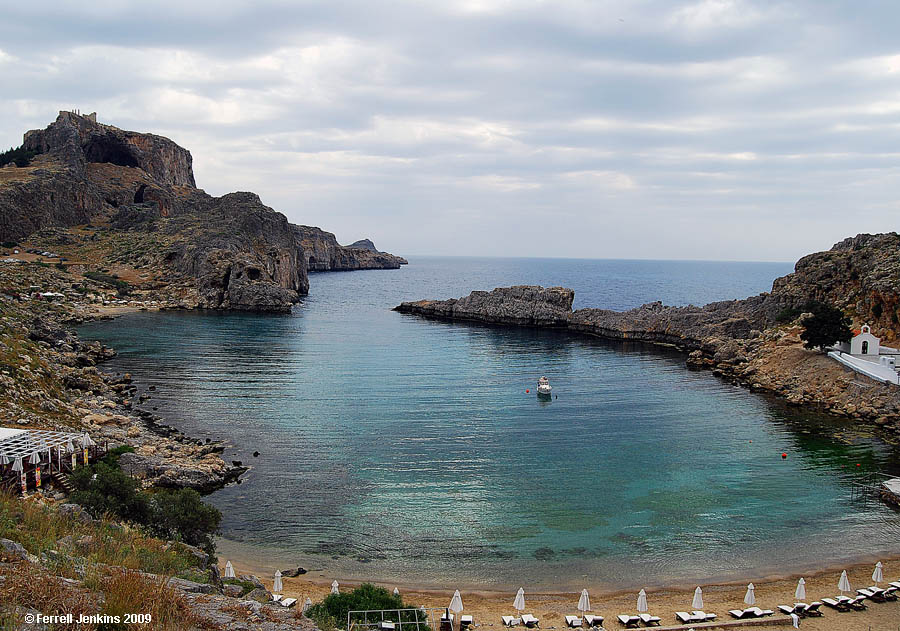
I would like to share a photo that is large enough to be of use to those who use visuals in teaching. This is a picture of St. Paul’s Bay on the island of Rhodes. Click on the photo for a larger image. For information about the place check our post for May 17, 2008.

St. Paul's Bay at Lindos, Rhodes. Photo by Ferrell Jenkins.

St. Paul's Bay at Lindos, Rhodes. Photo by Ferrell Jenkins.