Category Archives: Bible Places

Jerusalem at 3800 feet altitude

In the last post about the aerial photos (January 18) we showed the mountains of Judea as we approached the central mountain ridge. Today’s photo shows the Old City of Jerusalem from about 3800 feet above sea level. The city itself is about 2400 to 2500 feet above (Mediterranean) sea level. The view is looking southeast across the Wilderness of Judea to the mountains of Moab in the Transjordan tableland.

Old City of Jerusalem - view toward SE. Photo by Ferrell Jenkins.

Old City of Jerusalem - view toward SE. Photo by Ferrell Jenkins.

In this photo one can see the proximity of Jerusalem to the Wilderness of Judea. The distance from Jerusalem to the Dead Sea is not more than 20 miles. The elevation drops from about 2600 at the Mount of Olives to (currently) about 1384 feet below sea level at the surface of the Dead Sea. The Transjordan Tableland is about 3000 above sea level.

As the mountains surround Jerusalem, So the LORD surrounds His people From this time forth and forever. (Psalm 125:2 NAU)

Tirhakah (Taharqa) in the British Museum

In two previous posts we have mentioned the statue of Taharqa (English Bible: Tirhakah) recently discovered in Sudan. Tirhakah, king of Cush, is important in Bible study because he is mentioned in 2 Kings 19:9 (= Isaiah 37:9) as befriending Hezekiah, king of Judah.

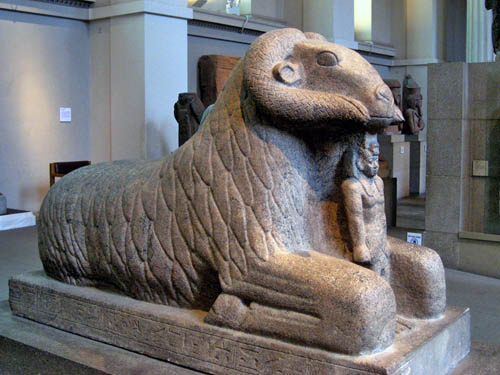
The British Museum displays a beautiful granite statute of Tirhakah showing the king standing under the protection of the god Amun shown as a recumbent ram. The gray granite sculpture, dating to about 675 B.C., was found at Karnak. This granite is typical of the Aswan area.

Tirhakah under the protection of the god Amun. British Museum photo by Ferrell Jenkins.

Tirhakah under the protection of the god Amun. Photo by Ferrell Jenkins.

Tirhakah of Sudan (or Ethiopia, or Cush)?

Our post yesterday reported the discovery of a large statue of Taharqa  (English Bible: Tirhakah) deep in Sudan. Some English versions associate Tirhakah with Ethiopia (NET, NKJV). Other associate him with Cush (NAU, ESV, CSB). The Hebrew word here is Kush (or Cush).

Kenneth A. Kitchen clarifies the terminology:

The region S of Egypt, i.e. Nubia or N Sudan, the ‘Ethiopia’ of classical writers (not modern Abyssinia [Ethiopia]). The name Cush in both Hebrew and Assyrian derives from Egyptian Kš (earlier K’s, K’š), ‘Kush’. Originally the name of a district somewhere between the second and third cataracts of the Nile c. 2000 bc, ‘Kush’ became also a general term for Nubia among the Egyptians, which wider use Hebrews, Assyrians and others took over (G. Posener, in Kush 6, 1958, pp. 39–68). (New Bible Dictionary, 3rd Ed.)

The Theological Wordbook of the Old Testament comments on the term Cush (Ethiopia) as it is used in several Old Testament prophecies.

In several cases, especially in the prophets, Ethiopia is used in parallel construction as a synonym of Egypt (Isa 20:3-5; Ezek 30:4; Nah 3:9). This probably represents the dominance of Ethiopia (or, more precisely, Nubia) over Egypt between 750 and 663 B.C. Terhakah was a notable Nubian pharaoh who tried, unsuccessfully, to block Sennacherib’s westward expansion (2Kings 19:9 ; Isa 37:9). After 663 B. C. Egypt was independent of Nubia (Jer 46:9; Ezek 25:4, 5, 9).

About a year ago I visited a Nubian Village on the banks of the Nile River at the first cataract of the Nile at Aswan. The Nubians at the village originally lived south of Aswan in the ancient territory of Cush. When the new High Dam was built on the Nile the Nubians were moved to other settlements.

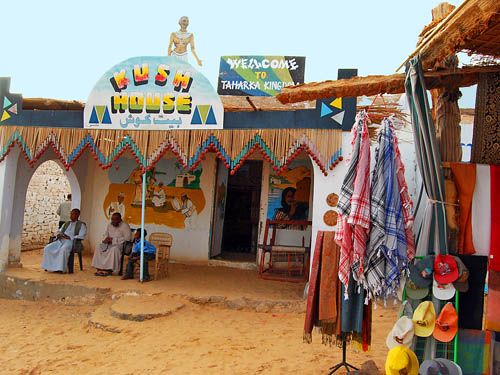
One of the interesting things I observed at the village was a shop of some sort called House of Kush (Cush). A sign on top of the building added “Welcome to Taharka Kingdom.” My point is to show the association between southern Egypt, Cush, and Tirhakah.

House of Kush (Cush) in Nubian Village at Aswan, Egypt. Photo by F. Jenkins.

House of Kush (Cush) in Nubian Village, Aswan, Egypt. Photo by F. Jenkins.

Elah Fortress (Khirbet Qeiyafa) inscription deciphered

The following news release comes from the University of Haifa in Israel.

Most ancient Hebrew biblical inscription deciphered

‘It indicates that the kingdom of Israel already existed in the 10th century BCE, and that at least some of the biblical texts were written hundreds of years before the dates presented in current research.’

Prof. Gershon Galil of the University of Haifa who deciphered the inscription: “It indicates that the Kingdom of Israel already existed in the 10th century BCE and that at least some of the biblical texts were written hundreds of years before the dates presented in current research.”

A breakthrough in the research of the Hebrew scriptures has shed new light on the period in which the Bible was written. Prof. Gershon Galil of the Department of Biblical Studies at the University of Haifa has deciphered an inscription dating from the 10th century BCE (the period of King David’s reign), and has shown that this is a Hebrew inscription. The discovery makes this the earliest known Hebrew writing. The significance of this breakthrough relates to the fact that at least some of the biblical scriptures were composed hundreds of years before the dates presented today in research and that the Kingdom of Israel already existed at that time.

The inscription itself, which was written in ink on a 15 cm X 16.5 cm trapezoid pottery shard, was discovered a year and a half ago at excavations that were carried out by Prof. Yosef Garfinkel at Khirbet Qeiyafa near the Elah valley. The inscription was dated back to the 10th century BCE, which was the period of King David’s reign, but the question of the language used in this inscription remained unanswered, making it impossible to prove whether it was in fact Hebrew or another local language.

Prof. Galil’s deciphering of the ancient writing testifies to its being Hebrew, based on the use of verbs particular to the Hebrew language, and content specific to Hebrew culture and not adopted by any other cultures in the region. “This text is a social statement, relating to slaves, widows and orphans. It uses verbs that were characteristic of Hebrew, such as asah (“did”) and avad (“worked”), which were rarely used in other regional languages. Particular words that appear in the text, such as almanah (“widow”) are specific to Hebrew and are written differently in other local languages. The content itself was also unfamiliar to all the cultures in the region besides the Hebrew society: The present inscription provides social elements similar to those found in the biblical prophecies and very different from prophecies written by other cultures postulating glorification of the gods and taking care of their physical needs,” Prof. Galil explains.

He adds that once this deciphering is received, the inscription will become the earliest Hebrew inscription to be found, testifying to Hebrew writing abilities as early as the 10th century BCE. This stands opposed to the dating of the composition of the Bible in current research, which would not have recognized the possibility that the Bible or parts of it could have been written during this ancient period.
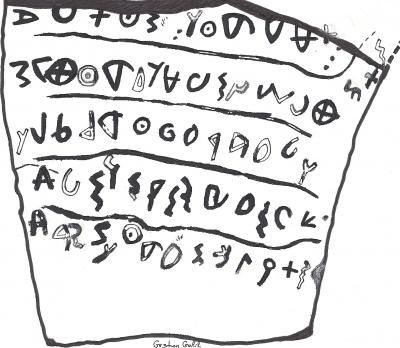
Khirbet Qeiyafa Inscription. Courtesy of the University of Haifa.

Khirbet Qeiyafa Inscription. Courtesy of the University of Haifa.

Prof. Galil also notes that the inscription was discovered in a provincial town in Judea. He explains that if there were scribes in the periphery, it can be assumed that those inhabiting the central region and Jerusalem were even more proficient writers. “It can now be maintained that it was highly reasonable that during the 10th century BCE, during the reign of King David, there were scribes in Israel who were able to write literary texts and complex historiographies such as the books of Judges and Samuel.” He adds that the complexity of the text discovered in Khirbet Qeiyafa, along with the impressive fortifications revealed at the site, refute the claims denying the existence of the Kingdom of Israel at that time.

The contents of the text express social sensitivity to the fragile position of weaker members of society. The inscription testifies to the presence of strangers within the Israeli society as far back as this ancient period, and calls to provide support for these strangers. It appeals to care for the widows and orphans and that the king – who at that time had the responsibility of curbing social inequality – be involved. This inscription is similar in its content to biblical scriptures (Isaiah 1:17, Psalms 72:3, Exodus 23:3, and others), but it is clear that it is not copied from any biblical text.

English translation of the deciphered text:

1′ you shall not do [it], but worship the [Lord].
2′ Judge the sla[ve] and the wid[ow] / Judge the orph[an]
3′ [and] the stranger. [Pl]ead for the infant / plead for the po[or and]
4′ the widow. Rehabilitate [the poor] at the hands of the king.
5′ Protect the po[or and] the slave / [supp]ort the stranger.
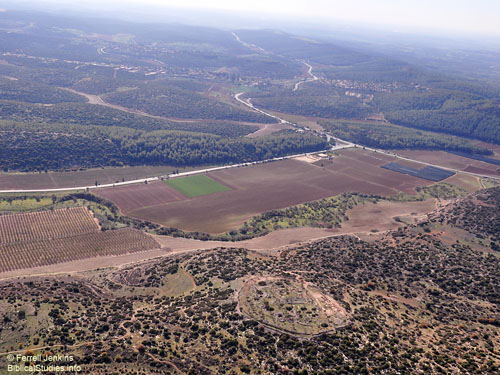
Khirbet Qeiyafa overlooking the Elah Valley. Photo by Ferrell Jenkins.

Khirbet Qeiyafa overlooking the Elah Valley. Photo by Ferrell Jenkins.

HT: Joseph I. Lauer; Eurekalert!.

Comment by Ferrell Jenkins: Not everyone will agree with all of Prof. Galil’s conclusions, but there is much here for study and discussion.

Zorah and the tomb of Samson

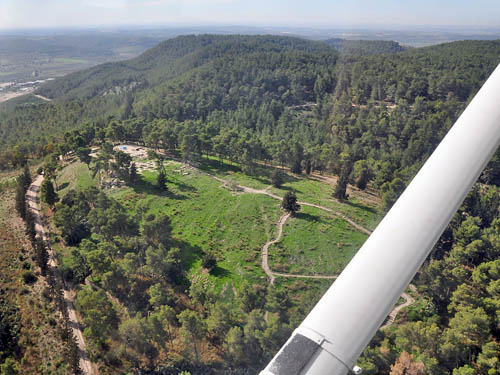
Yesterday we noted the relation between the Sorek Valley and other cities associated with Samson, Zorah and Eshtaol. This photo shows Tel Zorah which is now surrounded by a nice forest.

Aerial view of Zorah. Photo by Ferrell Jenkins.

Aerial view of Tel Zorah near the Sorek Valley. Photo by Ferrell Jenkins.

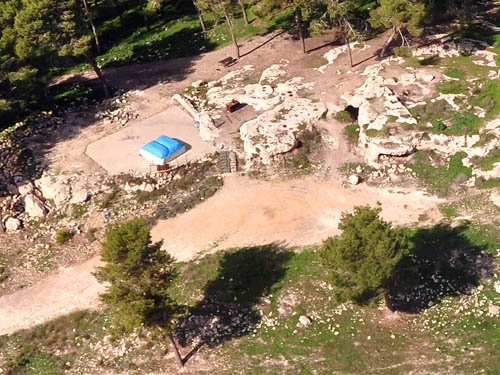
To the left of the tel you will see the Sorek Valley in the haze. In a clearing on the tel you will see something blue. This is a “tomb” dedicated to Samson. In the photo below we have a better view of the “tomb.”

Aerial view of the "tomb of Samson" at Zorah. Photo by Ferrell Jenkins.

Aerial view of the "tomb of Samson" at Tel Zorah. Photo by Ferrell Jenkins.

I have no idea when this “tomb” was erected, but I suspect it is fairly recent. The Bible recounts the death of Samson in one of the Philistine cities and his subsequent burial between Zorah and Eshtaol in the tomb of his father.

Then his brothers and all his father’s household came down, took him, brought him up and buried him between Zorah and Eshtaol in the tomb of Manoah his father. Thus he had judged Israel twenty years. (Judges 16:31 NAU)

Over the Sorek Valley and Beth-shemesh

The Israelites took the ark of the covenant from the tabernacle at Shiloh to the battle field at Ebenezer when they were fighting with the Philistines (1 Samuel 4). The ark was captured by the Philistines and taken to Ashdod, then to Gath, and finally to Ekron before they decided to get rid of it. The ark was returned to Beth-shemesh (Beth Shemesh, Bethshemesh; 1 Samuel 4-6).

Now the people of Beth-shemesh were reaping their wheat harvest in the valley, and they raised their eyes and saw the ark and were glad to see it. The cart came into the field of Joshua the Beth-shemite and stood there where there was a large stone; and they split the wood of the cart and offered the cows as a burnt offering to the LORD. (1 Samuel 6:13-14 NAU)

Our aerial photo today shows a portion of the Sorek Valley. The mound of Beth-shemesh, with its archaeological scarring,  is visible in the lower right corner of the photo. The view here is NE, toward the Judean Mountains. The Sorek River bed is visible curving its way along the far side of the valley.

The Sorek Valley is associated with the account of Samson and Delilah.

After this it came about that he loved a woman in the valley of Sorek, whose name was Delilah. (Judges 16:4 NAU)

Aerial view of Beth Shemesh and the Sorek Valley. Photo by Ferrell Jenkins 2009.

Aerial view of Beth-shemesh and the Sorek Valley. Photo by Ferrell Jenkins 2009.

The sites of Zorah and Eshtaol are located in the foothills of the Judean Mountains among the trees. These sites are associated with Samson.

Then the woman gave birth to a son and named him Samson; and the child grew up and the LORD blessed him. And the Spirit of the LORD began to stir him in Mahaneh-dan, between Zorah and Eshtaol. (Judges 13:24-25 NAU)

The Sorek Valley continues to the left for a few miles toward Timnah, where Samson married a Philistine woman and performed many of his exploits (Judges 14-15).

Searching for Joshua’s Ai: the ABR dig at Khirbet el-Maqatir

Associates for Biblical Research announces plans for their 2010 dig at Khirbet el-Maqatir here. This dig, under the direction of Dr. Bryant Wood, is scheduled for May 19-June 6. Dr. Wood says,

Topography, fortifications, and pottery finds all suggest that Kh. el-Maqatir is a candidate for the Ai of Joshua 7-8.

In the air above Gezer

Gezer is described by William G. Dever, one of the archaeological excavators, as “a site in the foothills of the Judean range.” He continues,

Ancient Gezer has been located at Tell Jezer (Tell el-Jazari), a 33-acre mound 5 miles SSE of Ramleh, … since C. Clermont-Ganneau first made the identification in 1870. Gezer is situated about 750 feet above sea level, on the last of the foothills of the Judean range where it slopes down to meet the Shephelah. It guards one of the most important crossroads in ancient Palestine, where the trunk road leading to Jerusalem and sites in the hills branches off from the Via Maris at the approach of the Valley of Aijalon. It is mentioned not only in the Bible, but in several Egyptian and Assyrian texts. (Anchor Bible Dictionary)

In a previous post (here) we showed the coastal plain. As we approach Gezer, looking east, we see the mountains of Judea. Click on the image for one large enough to use in PowerPoint presentations for classes and sermons. This is our New Year’s gift to our faithful readers.

View of Tell Gezer looking E toward the Judean Mountains. Photo by Ferrell Jenkins.

View of Tell Gezer looking E toward the Judean Mountains. Photo by Ferrell Jenkins

Here are a few things we learn about Gezer from the Bible.

  • The king of Gezer fought against Joshua and the Israelites during the conquest (Joshua 10:33; 12:12).
  • Gezer was allotted to Ephraim (Joshua 16:3).
  • Gezer became a city of the Levites (Joshua 21:21). It was designated as a city of refuge (1 Chronicles 6:67).
  • Israel failed to drive out the Canaanites who lived in Gezer (Joshua 16:10; Judges 1:29).
  • By the time of David the Philistine seem to be living at Gezer (2 Samuel 5:25; 1 Chronicles 14:16; 20:4).
  • Pharaoh, king of Egypt, captured Gezer, burned it, and gave it as a dowry to his daughter, Solomon’s wife (1 Kings 9:16).
  • Solomon (re)built the cities of Hazor, Megiddo, and Gezer (1 Kings 9:15-17).

Blog about Jordan sites

Dr. David Graves writes an infrequent blog called Deus Artefacta. When he does write, the material is worthwhile. David has been participating in the excavation of Tall el-Hammam in the Jordan Valley (Transjordan) east of Jericho for several years. He is working on locating the site of Roman Livias.

Tall el-Hammam in the Jordan Valley. Photo by Ferrell Jenkins 2008.

Tall el-Hammam in the Jordan Valley. Photo by Ferrell Jenkins 2008.

Dr. Steven Collins, Dean, College of Archaeology, Trinity Southwest University, thinks that Tall el-Hammam is the site of Sodom. Info about the excavation may be located here. Other scholars suggest that Tall el-Hammam is the site of Abel-shittim (Numbers 33:49; Shittim, Numbers 25:1), in the plains of Moab. See Rainey and Notley, The Sacred Bridge, 125. The Israelite spies went out from here to view the land, especially Jericho (Joshua 2:1).

The excavation at Tall el-Hammam is now in progress through January 29, 2010. Graves has posted some good photos, and associated information, about Heshbon, Umm Quis [Gadara], and Jerash in the land of Gilead. Before crossing into Jordan he spent some time with the Temple Mount Salvage Operation in Jerusalem, visited Qumran, Masada, and Jericho.

High over Israel

A guide friend in Israel notified me that one of his neighbors was experienced in aerial photography, and asked if I would be interested in going up during the recent trip to Israel. I indicated an interest and we began to work on the details. The pilot, Yoav, had to get permission and clear us with Israeli security well in advance of the flight. The first day we scheduled was scrubbed due to bad weather coming in. The following day was sunny and fairly clear. Certainly it was one of the best weather days we had during the first two weeks of December.

We flew from the Sde Dov Airport. This is a small airport along the Mediterranean coast immediately north of the Yarkon River in Tel Aviv. Arkia Airlines operates here with flights to Eilat, Rosh Pina, and perhaps other places. When we arrived at the airport to meet our friend and the pilot we had to go through strict security even though we had sent all of our passport details in advance. Once that was completed we headed for the plane, a Cessna 172 Skyhawk. Our pilot was well aware of most of the places we wanted to visit. He would tell us to be ready in two minutes, or in 30 seconds, for the best photos. We flew over Gezer, Zorah, Beth Shemesh, the Zorek Valley, Lachish, Jerusalem, the Herodium, Aphek/Antipatris, and lots of terrain in between in two hours and six minutes. I made 1754 photos during that time, filling an 8 gig card and two 4 gig cards. Probably not a Guinness record, but a record for me.

Perhaps over the next few weeks I will be able to share a few of these photos with you. Let’s begin with the Coastal (or Maritime) Plain south of Tel Aviv/Joppa. This area is also referred to as the Plain of Philistia because the Philistines lived in the region in Old Testament times. The Philistine cities of Ashdod, Ashkelon, and Gaza were in the southern coastal plain.

The plain of Philistia may be as much as 20 miles wide as we move further south. This photo gives one some idea of the territory immediately south of Tel Aviv as we fly south east to Gezer. Our altitude here was 800 feet.

The Coastal Plain of Philistia, south of Tel Aviv. Photo by Ferrell Jenkins.

The Coastal Plain of Philistia, south of Tel Aviv. Photo by Ferrell Jenkins.

This region is now an important part of Israel, but in Bible times few Israelites lived in the area.