Category Archives: Bible Lands

A personal note about other traveling bloggers

In recent years it is common for tour members to begin a blog and post their impressions and photos during the tour. I must say that this isn’t always easy. First there is the problem of connecting to the Internet. I have an unlocked air card that has worked with a local data SIM card. This time I am having trouble with it. The rates for the use of the Internet at the Tiberias hotel was $23 a day. Highway robbery! The hotel here in Jerusalem charges $15 a day. Local street robbery!  Then there is the problem of time. I have seen bloggers up until late hours just getting online, preparing photos and writing readable info for friends back home.

The bloggers also lug around expensive computer and photographic equipment in order to accomplish the self-appointed task.

I thought that some of our readers might like to take a look at how these bloggers are handling the matter. A couple of them are using WordPress, and one is using Blogger.

Nick and Erin Smith are blogging at Oh, the Places We Go here. Nick and Erin are a young married couple making their first foreign trip.

Stephen Cook is blogging under the title From Athens to Israel here. Stephen is from Athens, Alabama. Stephen has done some foreign travel before.

All three of these folks are on their first tour of the Bible Lands. Their perspective will reveal the approach of a first time traveler to the area. They are looking forward to using their new knowledge and photos in Bible teaching. And they all come from North Alabama, an area hit by the recent tornadoes that devastated some areas of the South last Wednesday. Fortunately their property was untouched.

Larry Haverstock is blogging under his own name here. This is Larry’s second tour in as many years. He knows exactly why he is here this year. He wishes to gain a deeper understanding of the land and its relation to the Word. He is an experienced minister who already understands exactly how he will use what he is learning.

Former Travelers Back Home Braving the Storms

Olen and Jane Britnell, also from North Alabama, have traveled with us on a number of tours. Jane blogs when she travels. She is not on this tour, but she is blogging again. This time it is about the devastating storms that hit all around them a few days ago. You might enjoy reading this first hand report. She also includes info on Shirley — another personal friend who lost her house in the storm. Shirley has traveled with us on numerous tours, and  is a faithful follower of this blog. The blog, wesurvivedthestorms, is here.
Living springs of water

Today we traveled north from Tiberias on the Sea of Galilee to Hazor. About the time our bus stopped the rain began. We waited a while, but left the bus as soon as the rain let up. This gave an opportunity to visit the gate, the Canaanite palace, and a few other areas before the rain started again. Finally we left and went on to Dan. There we were able to visit the site with only sprinkles.

By this time of the year I had come to expect that major rains (the latter rains, Joel 2:23) would be over, but still delighted to see the rains coming to a land that has suffered drought for a few years.

From Dan we continued to Banias, the site of New Testament Caesarea Philippi. This is the area where Peter confessed Jesus to be the Christ, the Son of the Living God, and where Jesus made the promise to build His church.

Now when Jesus came into the district of Caesarea Philippi, He was asking His disciples, “Who do people say that the Son of Man is?” And they said, “Some say John the Baptist; and others, Elijah; but still others, Jeremiah, or one of the prophets.”  He said to them, “But who do you say that I am?”  Simon Peter answered, “You are the Christ, the Son of the living God.” And Jesus said to him, “Blessed are you, Simon Barjona, because flesh and blood did not reveal this to you, but My Father who is in heaven.  “I also say to you that you are Peter, and upon this rock I will build My church; and the gates of Hades will not overpower it.  “I will give you the keys of the kingdom of heaven; and whatever you bind on earth shall have been bound in heaven, and whatever you loose on earth shall have been loosed in heaven.”  Then He warned the disciples that they should tell no one that He was the Christ. (Matthew 16:13-20 NAU)

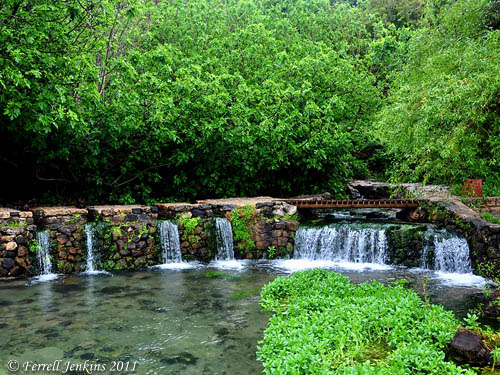
It was still raining some, but I was much impressed with the force of the water today. I have been here on probably every tour since the site has been under Israeli control. I don’t recall ever seeing so much water surging from the earth. This is a good sign, I think.

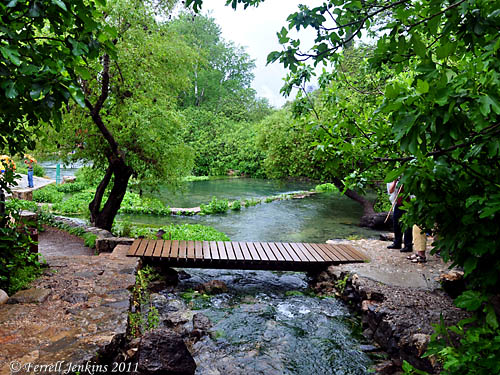
Here is a photo made looking north toward the source of the River Banias, the easternmost source of the Jordan River.

Looking to the source of the Banias River. Photo by Ferrell Jenkins.

Looking to the source of the Banias River. Photo by Ferrell Jenkins.

The photo below shows the same area from the north. Here we are immediately above the outlet of the powerful springs.

River Banias, a source of the Jordan, from the North. Photo by Ferrell Jenkins.

River Banias, a source of the Jordan, from the North. Photo by Ferrell Jenkins.

We got only an occasional glimpse of Mount Hermon to see the patches of snow on it.

Jonah sailed from Joppa

Our group arrived in Israel today except for two persons who were delayed due to a bad weather connection in Detroit. Just learned a few minutes ago that they are on their way via Paris.

We had time to visit Joppa (Yafo) before proceeding to Netanya, along the Mediterranean coast, for overnight.

Joppa is located in the Plain of Sharon and served as the seaport for Jerusalem which is about 35 miles away. The city is now called Jaffa, or Yafo. Joppa was a walled town as early as the reign of Pharaoh Thutmose III (1490-1435 B.C.) who mentions Joppa in his town lists.

Here are a few of the biblical highlights for Joppa.

  • Joppa was assigned to the tribe of Dan, but was not controlled by the Israelites till the time of David (Joshua 19:46).
  • Hiram of Tyre floated cedar from Lebanon to Joppa for Solomon’s Temple (2 Chronicles 2:16).
  • Jonah sought a ship for Tarshish at Joppa to avoid going to Nineveh (Jonah 1:3).
  • Cedars from Lebanon again were floated to Joppa for the rebuilding of the temple (520-516 B.C.; Ezra 3:7). The port of the city is behind St. Peter’s Church.
  • Tabitha (Dorcas) lived in Joppa. When she died the disciples sent for Peter who was a Lydda. He came to Joppa and raised Dorcas (Acts 9:36-42). (Acts 10:6).
  • Peter stayed many days in Joppa with Simon the tanner (Acts 9:43). His house was by the sea (Acts 10:6). A house near the port is shown as the house of Simon, but there is no way to know this with certainty.
  • Peter received the housetop vision and learned that he was to go to Caesarea to preach the gospel to the Gentiles at the house of the Roman centurion Cornelius (Acts 10:23).

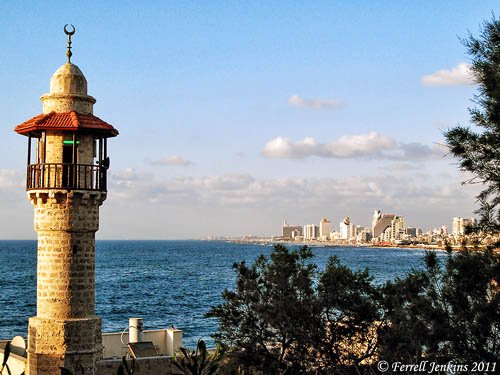
The photo below shows the view of modern Tel Aviv from Joppa. The minaret in the foreground dates to the Turkish period.

View of modern Tel Aviv from Joppa. Photg by Ferrell Jenkins.

View of modern Tel Aviv from Joppa. Photo by Ferrell Jenkins.

“You offspring of vipers…”

When the Pharisees and Sadducees came to John the Baptist for baptism, John said,

”You offspring of vipers! Who warned you to flee from the coming wrath? (Matthew 3:7 NET; cf. Luke 3:7)

Jesus used the same language of the Scribes and Pharisees.

You snakes, you offspring of vipers! How will you escape being condemned to hell? (Matthew 23:33 NET; cf. 12:34)

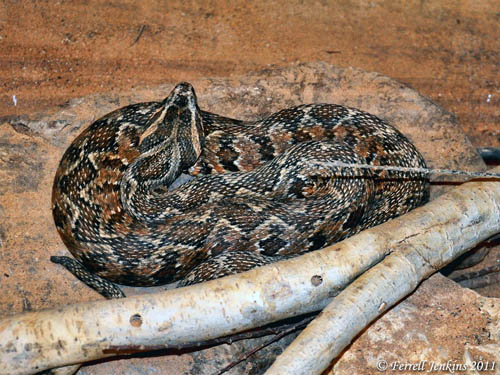
The photo below shows the Palestinian Viper (behind tough plastic!) at the the Hai Bar Animal and Nature Reserve, north of Eilat, Israel.

Palestinian Viper at the HaiBar Reserve near Eilat, Israel. Photo by Ferrell Jenkins.

Palestinian Viper at the HaiBar Reserve near Eilat, Israel. Photo by Ferrell Jenkins.

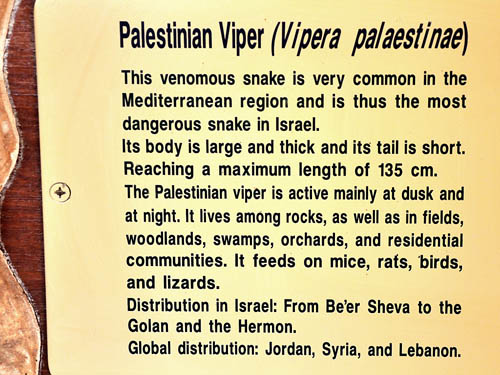
The sign at the Reserve gives some explanation about this poisonous viper.

Description of the Palestinian Viper at HaiBar Reserve.

A visit to Hai Bar is a wonderful experience. The kids will love it, too.

Ancient lands and thousand of years of history

U.S. Army Colonel Doug Wheelock has been posting fabulous photos from space on his Twitter account under the name Astro_Wheels. You must begin a Twitter account in order to see all of the high resolution photos. Several of the photos could be helpful in teaching and understanding the Bible world.

NASA says that Whitlock,

flew aboard the Soyuz TMA-19 spacecraft to serve as an Expedition 24 flight engineer and commander of Expedition 25 on the International Space Station. In 2007, Wheelock visited the station as an STS-120 mission specialist and conducted three spacewalks.

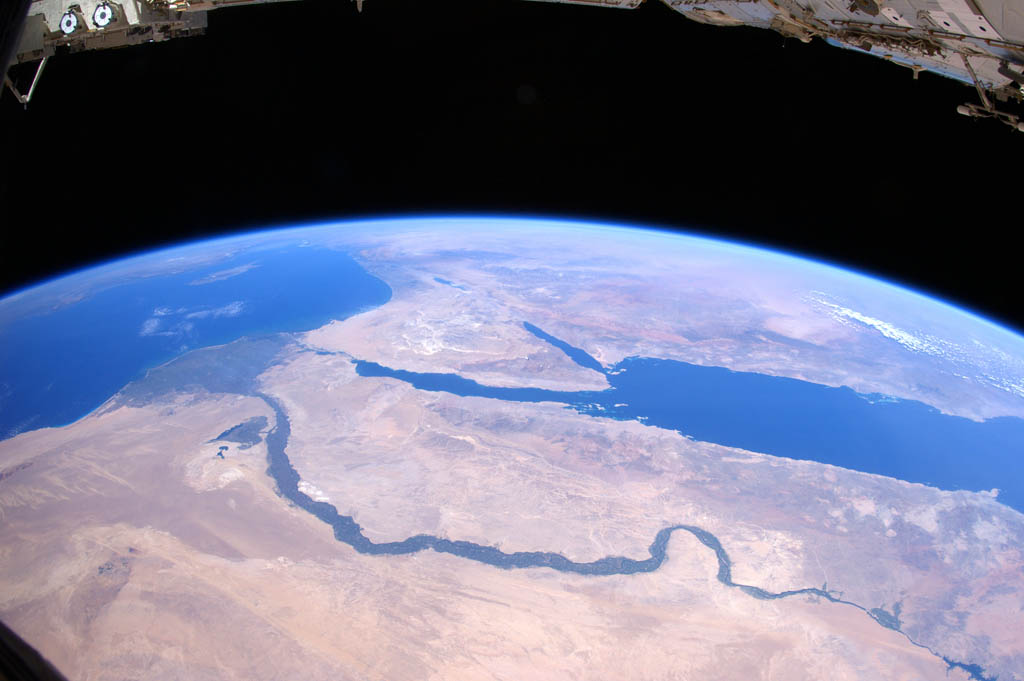
The photo below was made over the Shaara Desert. For the high resolution photo click here.

Over the Sahara Desert from space. Doug Wheelock. NASA.

Over the Sahara Desert from space. Doug Wheelock. NASA.

Here is the description of the photo given by Wheelock on Twitpic:

Over the Sahara Desert approaching ancient lands and thousands of years of history. The Nile River flowing through Egypt past the pyramids of Giza up to Cairo in the delta; the Red Sea, Sinai Peninsula, Dead Sea; Jordan River; and the Sea of Galilee are visible, as are the island of Cyprus in the Mediterranean Sea and Greece coming over the horizon.

It is difficult to see the Sea of Galilee in the small photo, but you can see it if you look at the largest resolution available at the Twitpic site.

Many of Wheelock’s photos are available on various web sties that have taken the time to download and post them. Just search Google for something like “Wheelock space photos.”

Might as well enjoy these photos. If you are a USA citizen you helped pay for them.

HT: John Gresham

Camels in biblical times

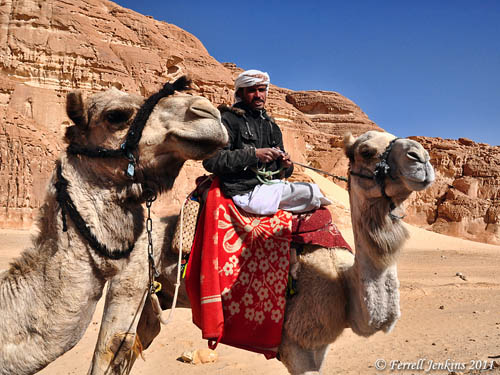
Camels are mentioned in the Bible from the days of Abraham (Genesis 12:16) to New Testament times (Mark 1:6). Recently while traveling in the eastern Sinai peninsula near the Gulf of Aqaba (Eilat) we saw a large number of camels with their riders.

Camels in the Eastern Sinai Peninsula. Photo by Ferrell Jenkins.

Camels in the Eastern Sinai Peninsula. Photo by Ferrell Jenkins.

When the Queen of Sheba visited Jerusalem to quiz Solomon she brought with her a large retinue, with camels carrying valuable gifts for Solomon.

Now when the queen of Sheba heard of the fame of Solomon, she came to Jerusalem to test Solomon with difficult questions. She had a very large retinue, with camels carrying spices and a large amount of gold and precious stones; and when she came to Solomon, she spoke with him about all that was on her heart. Solomon answered all her questions; nothing was hidden from Solomon which he did not explain to her. (2 Chronicles 9:1-2 NAU)

Mark Wilson’s book on Biblical Turkey

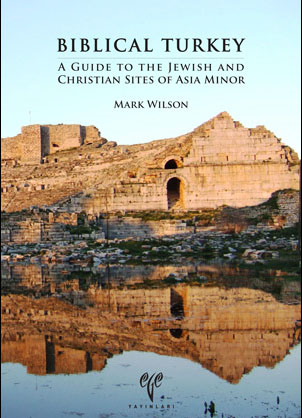
Mark Wilson’s book on Biblical Turkey: A Guide to the Jewish and Christian Sites of Asia Minor is now available through Amazon. Use this Amazon link to order.
Biblical Turkey: A Guide to Jewish and Christian Sites of Asia Minor

A little over two months ago I started a post about Wilson’s book, intending to write a brief review. I see now that A. D. Riddle has written a review over at the Bible Places Blog. I direct our readers to that post for more info about the book.

Since 2003 we have had A Guide to Biblical Studies in Greece and Turkey by Fant and Reddish. Now we have a book by Mark Wilson that is superior in several ways. Wilson includes sites not mentioned by Fant and Reddish, and his book contains an abundance of color photos. Every person who plans a trip to Turkey to visit Biblical sites should study both books.

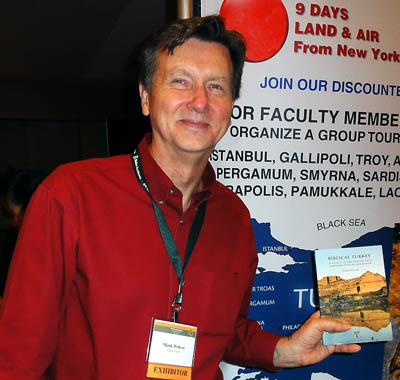
Dr. Wilson proudly displayed his book at the SBL meeting in Atlanta last November. Mark loves Turkey and its biblical sites. For several years he has spent at least half his time studying and exploring in Turkey. If you wish to know about the biblical sites of Turkey, you will enjoy this book.

Mark Wilson shows his new book at SBL in Atlanta. Photo by Ferrell Jenkins.

Mark Wilson shows his book at SBL in Atlanta. Photo by F. Jenkins.

Dr. Wilson spoke to one of my groups in Izmir in 2008. See here.

Almond trees in blossom

Friday evening we stayed in Beersheba. Friday night and Saturday (the Jewish Sabbath) is a time when many Jewish families stay in a hotel. I think we were the only Goyim (non-Jews) in the hotel. Beersheba does not attract many tour groups for overnight stays.

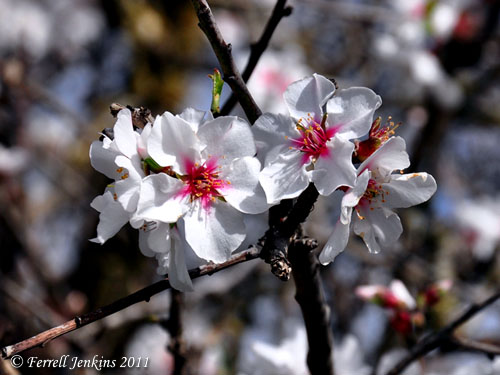
We made a side trip into the Shephelah with brief stops here and there. Near the Valley of Elah, on the east side of Azekah we saw a few almond trees in full blossom.

Almond tree in bloom near Azekah. Photo by Ferrell Jenkins.

Almond tree in bloom near Azekah. Photo by Ferrell Jenkins.

Jacob ordered his sons to take some of the best products of the land of Canaan, including almonds, to the man in Egypt (Joseph).

Then their father Israel said to them, “If it must be so, then do this: take some of the best products of the land in your bags, and carry down to the man as a present, a little balm and a little honey, aromatic gum and myrrh, pistachio nuts and almonds. (Genesis 43:11 NAU)

The blooms of the almond are beautiful.

Almond blossoms near Azekah. Photo by Ferrell Jenkins.

Almond blossoms near Azekah. Photo by Ferrell Jenkins.

The lampstand for the tabernacle was to have cups shaped like almond flowers.

On the lampstand there were four cups shaped like almond flowers with buds and blossoms, (Exodus 37:20 NET)

The LORD demonstrated his choice of Aaron as high priest in this way:

On the next day Moses went into the tent of the testimony– and the staff of Aaron for the house of Levi had sprouted, and brought forth buds, and produced blossoms, and yielded almonds! (Numbers 17:8 NET)

The Step Pyramid of Zoser at Saqqara

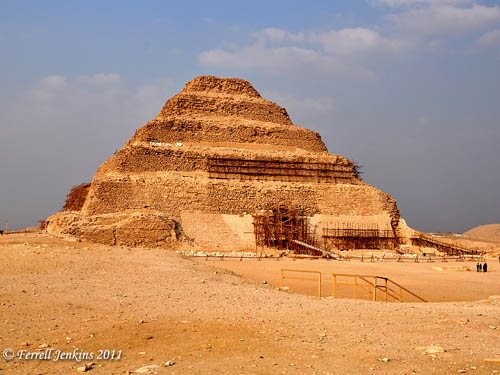
Yesterday afternoon our group visited Memphis and Saqqara. Saqqara is significant because it is the location of of the oldest freestanding stone building in the world. The architect of this structure was the vizier and physician Imhotep. Zoser reigned about 2600 B.C.

Hachette World Guide on Cairo, Alexandria and Environs, describes the pyramid in these terms:

The Step Pyramid is formed of six unequal sections and is not, in the strict sense, a pyramid tat all. The plan is not square, but oblong in the S-W sense, and the summit is formed by a terrace (also oblong) and not by a Pyramidion. The dimensions of the base are approximately 397 feet by 357 feet. The present height of the Pyramid is 193 feet. It would originally have been some 196 feet. The verticle slope of the steps is on an average of some 16°, the horizontal [slope is] 22°.

Many of the structures of ancient Egypt are in need of repair, and many are being repaired. I noticed scaffolding on all sides of the pyramid.

Step Pyramid of Zoser at Saqqara. Photo by Ferrell Jenkins.

The Step Pyramid of Zoser at Saqqara. Photo by Ferrell Jenkins.

This pyramid, as well as the great pyramids of Giza, was built long before the time of the  biblical characters who visited Egypt — Abraham, Joseph, Jacob, et al.

Traveling in the land of Goshen

We spent the entire day traveling in Egypt’s eastern delta region, known in the Bible as the land of Goshen. The photo below shows a typical scene of flat, fertile, black land with lush vegetation, cattle, some sheep, and canals.

Typical scene in the land of Goshen.

Typical scene in the land of Goshen. Photo by Ferrell Jenkins

This is the land where Joseph placed his family when they came to Egypt for food.

You will live in the land of Goshen, and you will be near me– you, your children, your grandchildren, your flocks, your herds, and everything you have. I will provide you with food there because there will be five more years of famine. Otherwise you would become poor– you, your household, and everyone who belongs to you.”‘ (Genesis 45:10-11 NET)