Category Archives: Bible Lands

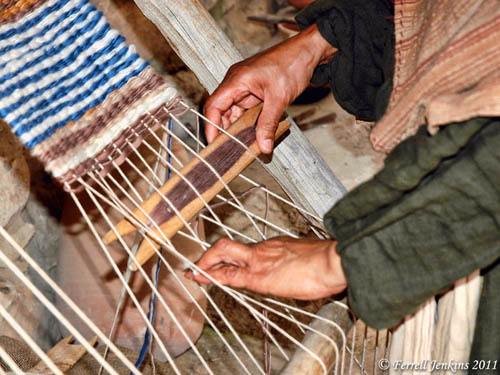
Weaving in Bible times

In describing the work of spinning we quoted from the lavishly illustrated Life in Biblical Israel by King and Stager. Another good book dealing with this sort of material is Daily Life in Biblical Times by Oded Borowski. Borowski’s book is much smaller and has no photos. There are a few black and white diagrams.

Here is how Borowski explains weaving.

The term weaving refers to the production of fabric by interlacing two sets of yarn so that they cross each other at a right angle.… The large numbers of loom weights, spindle whorls, and other weaving tools in domestic contexts indicate that weaving was a major occupation among the Israelites. (page 31)

He says that two kinds of looms were in use. One was horizontal; the other was the upright warp-weighted loom. The large number of loom-weights that have been uncovered in excavations indicate that this was the more common method of weaving.

Weaving was considered a woman’s job. Note the description of the Worthy Woman (or Capable Wife, as some designate her) in Proverbs 31. In the previous post we wrote of the work of spinning.

She stretches out her hands to the distaff, And her hands grasp the spindle. (Proverbs 31:19 NAU)

The same chapter also describes the materials she uses in her work of spinning and weaving.

She looks for wool and flax And works with her hands in delight. (Proverbs 31:13 NAU)

Demonstration of weaving at Nazareth Village. Photo by Ferrell Jenkins.

Demonstration of weaving at Nazareth Village. Photo by Ferrell Jenkins.

A display in the Istanbul Archaeology Museum shows loom weights and spinning tools uncovered at Gezer. I think these would be from the excavations conducted by Clermont-Ganneau between 1870-1873 or that conducted by Macalister between 1902 and 1905 when the Ottoman Empire ruled the land. Many artifacts from that period are in the Istanbul museum.

Tools Used in Weaving. From Gezer. Istanbul Arch. Museum. Photo by Ferrell Jenkins.

Tools Used in Weaving. From Gezer. Istanbul Arch. Museum. Photo by Ferrell Jenkins.

The priestly garments were woven (Exodus 28:39). We recall that Jesus had a undergarment (chiton, tunic) that was seamless, woven in one piece.

Then the soldiers, when they had crucified Jesus, took His outer garments and made four parts, a part to every soldier and also the tunic; now the tunic was seamless, woven in one piece. (John 19:23 NAU)

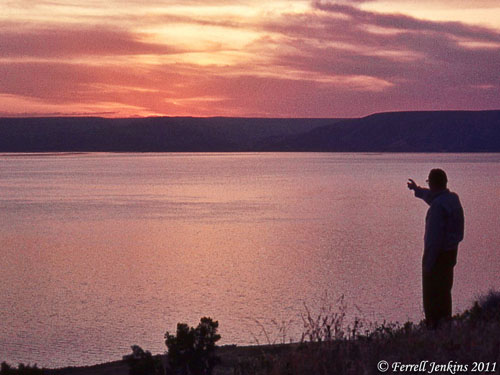
Sunrise on the Sea of Galilee – May 4, 1968

On my second tour to Israel in 1968 my group stayed at the Guberman Hotel in Tiberias. My room mate and I set our alarm for Saturday, May 4, in time to go down the hill to get an unobstructed view of the Sea and the sunrise to the East. This slide was made on Agfachrome.

Sunrise at the Sea of Galilee. May 4, 1968.

Sunrise at the Sea of Galilee - May 4, 1968.

Over the years I have made numerous similar photos. I always think about Jesus meeting His disciples after the resurrection on the shore of the Sea of Galilee and eating breakfast with them.

4 Just as day was breaking, Jesus stood on the shore; yet the disciples did not know that it was Jesus.
5 Jesus said to them, “Children, do you have any fish?” They answered him, “No.”
6 He said to them, “Cast the net on the right side of the boat, and you will find some.” So they cast it, and now they were not able to haul it in, because of the quantity of fish.
7 That disciple whom Jesus loved therefore said to Peter, “It is the Lord!” When Simon Peter heard that it was the Lord, he put on his outer garment, for he was stripped for work, and threw himself into the sea.
8 The other disciples came in the boat, dragging the net full of fish, for they were not far from the land, but about a hundred yards off.
9 When they got out on land, they saw a charcoal fire in place, with fish laid out on it, and bread.
10 Jesus said to them, “Bring some of the fish that you have just caught.”
11 So Simon Peter went aboard and hauled the net ashore, full of large fish, 153 of them. And although there were so many, the net was not torn.
12 Jesus said to them, “Come and have breakfast.” Now none of the disciples dared ask him, “Who are you?” They knew it was the Lord.
13 Jesus came and took the bread and gave it to them, and so with the fish.
14 This was now the third time that Jesus was revealed to the disciples after he was raised from the dead. (John 21:4-14 ESV)

A pretty picture for today

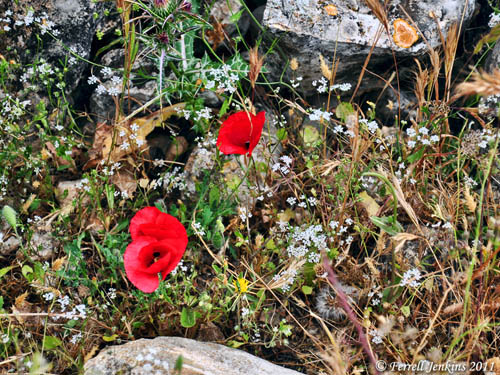
During the spring in Israel the fields and roadsides are filled with little flowers. They often grow among the stones of an ancient site. Our photo below was made May 8 at Khirbet Qeiyafa (the Elah Fortress) overlooking the Valley of Elah.

Flowers of the field at Khirbet Qeiyafa overlooking Elah Valley. Photo by Ferrell Jenkins.

Flowers of the field at Khirbet Qeiyafa overlooking Elah Valley. Photo by Ferrell Jenkins.

Many readers will think of the statement of Jesus:

Consider the lilies, how they grow: they neither toil nor spin, yet I tell you, even Solomon in all his glory was not arrayed like one of these. (Luke 12:27 ESV)

The NET Bible uses the term flowers instead of lilies. A Translator’s Note says,

Traditionally, “lilies.” According to L&N [Louw-Nida] 3.32, “Though traditionally kri,non has been regarded as a type of lily, scholars have suggested several other possible types of flowers, including an anemone, a poppy, a gladiolus, and a rather inconspicuous type of daisy.” In view of the uncertainty, the more generic “flowers” has been used in the translation.

I observe that Bauer (Arndt-Gingrich-Danker) comments:

in this connection the principal opinions include the autumn crocus, Turk’s cap lily, anemone, or gladiolus, but the data do not permit certainty. Perh. Jesus had no definite flower in mind, but was thinking of all the wonderful blooms that adorn the fields of Galilee.

Enjoy the beauty and think of God’s care for you. A larger image is available by clicking on the photo.

Comments on the detestable shepherds in Egypt

A few days ago we wrote in response to the question, “Why were shepherds detestable to Egyptians?”

We get more comments on the posts at Facebook than on the blog itself. Often I wish the (serious) comments were added here. I am going to share some comments made on this post. Christine, a regular reader of the blog and a friend from church, wrote:

“the cattlemen and the sheep herders of the American west were at odds, and I have read that sheep eat roots and all of the grass, ruining the grazing for cattle…could have an economic basis. And I could be wrong.”

Mark T., former student, wrote: “I learned that from reading cowboy books as a teenager. :-) ” [During class? FJ]

Mark B., former tour member, wrote:

“I never thought about the animosities between cattlemen and sheep herders here in the old west and how the sheep tear up the good grass if left to graze too long in one spot. What a great point!”

Listening to the sound tract of Oklahoma would give a tip about the conflict between the cowmen and the farmers. I think the point about the cattlemen and the farmers is a great one to show the conflict that often exists in a society.

However, we must not overlook the point made by John T. Willis that the term livestock includes cattle, sheep, goats, etc. Note the comment.

John T. Willis points out that the term livestock (or cattle; Hebrew, miqneh) is “a comprehensive term including cattle, sheep, goats, and the like” (Genesis in The Living Word Commentary on the Old Testament).

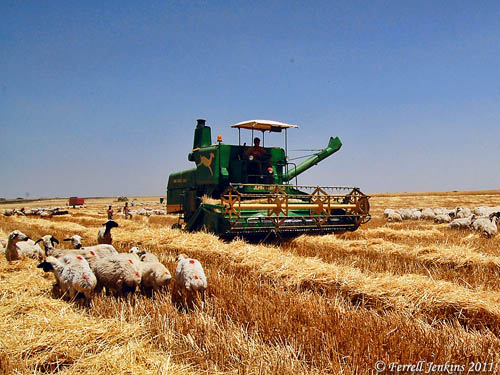
It is common in the Middle East for shepherds to take sheep into a grain field as soon as the harvesting is complete. This could be a real problem if cattle of any kind got into the fields in advance of harvesting. Remember that fences are virtually unknown there.

This photo is one I made in eastern Turkey north of Sanliurfa (and Haran). Even before the combine gets out of the field the shepherds are there with their sheep.

Sheep grazing as a field is being harvested. Photo by Ferrell Jenkins.

Sheep grazing in Eastern Turkey as a field is being harvested. Photo by Ferrell Jenkins.

Recently we posted a photo of sheep grazing in a field that had been harvested in the Shephelah of Israel here.

The rocks of the wild goats (Ibex)

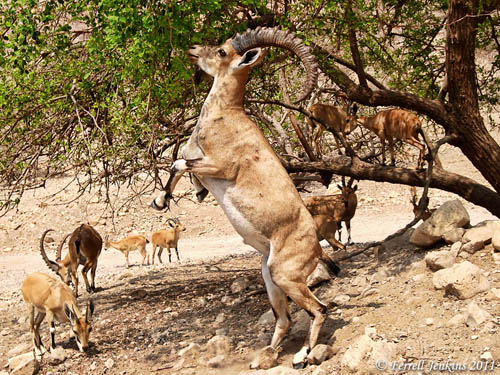
Wild goats (Hebrew ya’el) are mentioned in a few Old Testament passages (1 Samuel 24:2; Job 39:1; Psalm 104:18; Prov. 5:19). This animal is often identified with the Ibex.

The ibex, a type of wild goat, is still found in Southern Palestine, Sinai, Egypt and Arabia; it was known also in ancient times, as is evident from rock carvings. (Fauna and Flora of the Bible, 46).

The wild goats are associated with En Gedi on the shore of the Dead Sea.

Now when Saul returned from pursuing the Philistines, he was told, saying, “Behold, David is in the wilderness of Engedi.” Then Saul took three thousand chosen men from all Israel and went to seek David and his men in front of the Rocks of the Wild Goats. (1 Samuel 24:1-2 NAU)

Our photo below was made at En Gedi.

Ibex at En Gedi. Photo by Ferrell Jenkins.

Ibex at En Gedi. Photo by Ferrell Jenkins.

The Psalmist says the high mountains are for the wild goats.

The high mountains are for the wild goats; The cliffs are a refuge for the shephanim. (Psalm 104:18 NAU)

SourceFlix has put together a nice video showing the Wild Goats (Ibex) at En Gedi.

The Crags of the Wild Goats from SourceFlix on Vimeo.

HT: Dr. Claude Mariottini

Update: Yesterday worked on this post, with the intention of completing it this morning. Early today I had to go to the airport to take a loved one. When I returned I continued working on the post and published it. Just now I decided to check some other blogs. To my surprise, I see that Todd Bolen has posted some fascinating videos of the Ibex fighting. Check it here.

What is that expression about great minds?

Contemplating the power of a single grain

Last Sunday evening I heard a good sermon based on John 12:24-26.

Truly, truly, I say to you, unless a grain of wheat falls into the earth and dies, it remains alone; but if it dies, it bears much fruit. (John 12:24 ESV)

This simple statement by Jesus is followed by a difficult lesson.

Whoever loves his life loses it, and whoever hates his life in this world will keep it for eternal life. If anyone serves me, he must follow me; and where I am, there will my servant be also. If anyone serves me, the Father will honor him. (John 12:25-26 ESV)

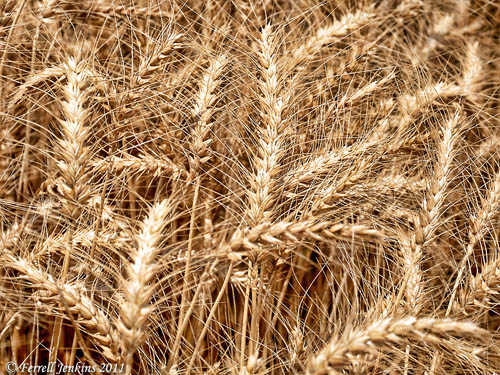
A grain of wheat must fall into the earth and die before it can produce fruit. Depending on the circumstances the grain can produce thirty-, sixty-, or a hundredfold (Matthew 13:8).

Wheat ready for harvest at En Dor. Photo by Ferrell Jenkins.

Wheat ready for harvest at En Dor. Photo by Ferrell Jenkins.

A single grain of wheat must die in order to produce much fruit. Jesus spoke of the necessity of His own death, and taught the tough lesson of giving up one’s life to serve Him.

Note the comment by William Hendriksen.

The illustration was very clear, especially at the moment when it was spoken, not more than a few days before the (religious and) harvest feast of Passover. The kernels or seeds had been entrusted to the soil. As seeds they had died. But by means of this very process of dissolution they had brought forth an abundant harvest. If a seed is not sown, it remains alone, producing no fruit. So also if Jesus does not die, he will remain alone, without spiritual fruit (souls saved for eternity). His death, however, will result in a rich, spiritual harvest. (New Testament Commentary : Exposition of the Gospel According to John).

We have included a larger image suitable for use in teaching. It is available by clicking on the image above.

The khamsin (hamsin) before and after

Yesterday we wrote about the effect of the east wind on Larry’s hike along the Jesus Trail. Here is a brief followup that should be helpful.

Dr. Carl G. Rasmussen, author of Zondervan Atlas of the Bible, also maintains the Holy Land Photos website. He has a series of photos showing the effect of the khamsin (which he spells without the silent k, as hamsin), and the same view with normal visibility. To see these fascinating photos, with additional descriptive info, click here.

Carl now has 3230 photos of 322 biblical sites available on his website. The photos are available for free download in various sizes. Perhaps the most helpful feature to teachers and preachers is that they are available PowerPoint ready. He also discusses “The Transitional Seasons”, with the same beautiful photos, in the Zondervan Atlas of the Bible (rev. ed.) pages 30-31.

Click Zondervan Atlas of the Bible to order this book for $25.20 (free shipping). This is a savings of 37%.

New difficulties on the “Jesus Trail”

We have reported about Larry’s hiking on the “Jesus Trail” from Nazareth to Bethsaida. Larry’s last post was at the end of Day 3. On his trek from Moshav Arbel eastward he encountered a new problem — the strong East winds.

Almost everyone who has visited Israel has learned of the West winds that make their way through the depressions around the Sea of Galilee and create storms on the Sea. Unless you travel in the “transitional season” or in the (dry) summer season you may not have learned about the East wind. This wind is called the sirocco. In Egypt it is known as the khamsin, and in Israel as the sharav.

Denis Baly, The Geography of the Bible (1974 ed., pp. 51-53), explains these winds. He says they occur in the transitional seasons from early April to mid-June (that is now), and from mid-September to the end of October. Baly says,

It is this intense dryness and the fine dust in the air which are so exhausting, for other hot days, though troublesome, do not have the same effect. People with a heart condition, nervous complaints, or sinus trouble are particularly affected, but even the mildest-tempered person is apt to become irritable and to snap at other people for no apparent reason. Tourists find the sirocco especially frustrating, for not only does travel become fatiguing, but the fine yellowish dust which fills the air drains it of all color, blots out all but the immediate vicinity, and makes photography a mockery.

Here is how Larry described his day in an Email to me overnight.

No blog last night because of the storm. I woke to high winds from the east which dusted up the air so badly that photos were mostly useless. Worst part was that it was directly against me and really HOT. Pushing against 20+ mph winds really took the steam out of me. By the end of the day I was utterly exhausted.  Drank my full 3 litres and had good dinners and breakfasts, but energy levels are still very low.

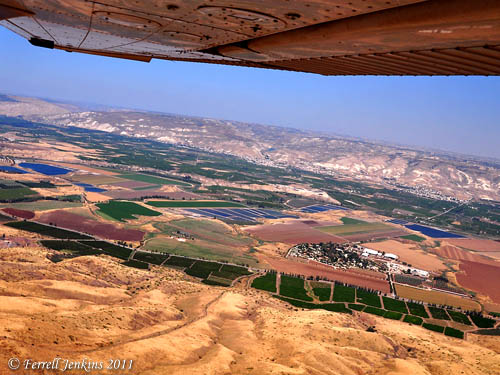
The photo below is one of the aerial shots we made a week ago. It was made while flying over the west shore of the Sea of Galilee, with the view to the west. You can see Mount Arbel and the Wadi Hamam below. The Via Maris runs in this valley which is also called the Valley of the Doves. You will notice two lines of mountains further west.

I am rather sure that this is the route Larry was walking yesterday. Larry has lived in Washington state for many years. I think he is not bothered by the sudden rains, but the intense heat and strong wind from the east may be another matter. I want you to think about the fact that all of the biblical characters from the Patriarchs to Jesus and His disciples encountered conditions similar to these (and worse).

Aerial view of Arbel and the Via Maris. Photo by Ferrell Jenkins.

Aerial view of Arbel, Wadi Hamam, and the Via Maris. Photo by Ferrell Jenkins.

Baly cites several biblical references to the east and south winds that bring in the hot air and the dust storms. He says, “Where the mountains come close to the sea a strong sirocco pours down the slopes like a flood, at 60 miles an hour or more, stirring the sea into a fury.”

By the east wind you shattered the ships of Tarshish. (Psalm 48:7 ESV)

In the prophecy against Tyre, Ezekiel says,

“Your rowers have brought you out into the high seas. The east wind has wrecked you in the heart of the seas. (Ezekiel 27:26 ESV)

Notice Elihu’s comments to Job about the south wind.

Do you know the balancings of the clouds, the wondrous works of him who is perfect in knowledge,  you whose garments are hot when the earth is still because of the south wind?  (Job 37:16-17 ESV)

Jesus also observed the effect of the south wind:

And when you see the south wind blowing, you say, ‘There will be scorching heat,’ and it happens. (Luke 12:55 ESV)

Do you remember Jonah’s problems after enjoying the shade of his plant?

When the sun rose, God appointed a scorching east wind, and the sun beat down on the head of Jonah so that he was faint. And he asked that he might die and said, “It is better for me to die than to live.” (Jonah 4:8 ESV)

Baly calls attention to the effect of the spring siroccos on the crops.

The spring siroccos destroy the winter grass and may damage the crops if they come too soon, and hence they appear constantly in the Bible as a symbol of the impermanence of riches or of human life.

Note these additional references in your own study: Psalm 103:16; Isaiah 40:6-8; Hosea 13:15; Ezekiel 17:10; James 1:11.

When Larry goes back on line I am sure his vivid descriptions of his experience will be well worth reading. Here is the link.

Update: Larry is back in Jerusalem Wednesday evening.

High over Galilee

Today we spent three hours in the air flying from Tel Aviv. Major sites we photographed included Appolonia, Caesarea Maritima, Tel Dor, Haifa, Plain of Acco, Acco, Aphek (in the north), Hazor, Dan, Hula Valley, Jordan Valley, areas around the Sea of Galilee, Beth Shan, Jezreel Valley, and Megiddo.

I made almost 2400 images. Hopefully I will have a few dozen good photos. The one I wish to share tonight shows the Jordan Valley between the Sea of Galilee and Beth Shan. The view is from West to East, looking to Jordan and the mountains of Gilead.

Jordan Valley between Sea of Galilee & Beth Shan. Photo by Ferrell Jenkins.

Jordan Valley between Sea of Galilee & Beth Shan. Photo by Ferrell Jenkins.

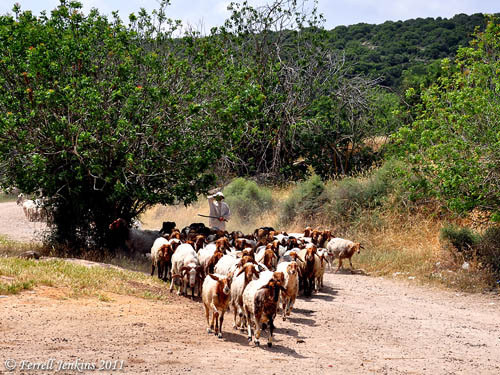
Shepherd with sheep and goats at Socoh

Today we visited sites in the Shephelah (lowlands, foothills, Deuteronomy 1:7). We discussed the importance of the Sorek Valley, Beth Shemesh, Timnah, Eshtaol, Zorah. Think of Samson. We noted the important sites associated with the Valley of Elah: Azekah, Khirbet Queiyafa (the Elah Fortress), and Socoh. Think of David and Goliath.

At Socoh (1 Samuel 17:1) we had one of those nice moments on tour when something unexpected comes along. We saw two shepherds bringing their sheep and goats to water. The photo below is one of several that I made.

Shepherd with sheep and goats at Soccoh. Photo by Ferrell Jenkins.

Shepherd with sheep and goats at Socoh. Photo by Ferrell Jenkins.

I am reminded of the teaching of Jesus about the importance of the shepherd.

When he saw the crowds, he had compassion on them because they were bewildered and helpless, like sheep without a shepherd. Then he said to his disciples, “The harvest is plentiful, but the workers are few. Therefore ask the Lord of the harvest to send out workers into his harvest.” (Matthew 9:36-1 NET)

We also made stops at Lachish and Gath before dinner along the Mediterranean Sea at Joppa, and then heading for the airport.

Our group is scheduled to depart for the USA shortly after midnight. Six tour members are staying over for varying length to pursue additional visits throughout the area.

Thank you for following the blog these past two weeks. I have written less than usual due to the demands of the tour, and this will continue for another week as I spend time in additional study here. Stay with me.