Category Archives: Archaeology

More on the Rapaihu seal and Gath

Jim West has published a letter from Robert Deutsch and a page from a published book by Deutsch and Lemaire, Biblical Period Personal Seals in the Shlomo Moussaieff Collection, showing a seal that “probably belonged to the father of Rapayahu from Jerusalem.”

Read the entire letter and see the seal here.

Aren Maeir also notes a Tell es-Safi/Gath connection with the Rephaim here. He says,

Notice the name Rapaihu – basically it means the Rapa of Yahu. How does that connect to Gath and Safi?

Well, here it is: In the late 9th century BCE, Stratum A3, at Tell es-Safi/Gath (the level which we believe was destroyed by Hazael of Aram, a short 3-4 letter post-firing, incised inscription (as yet not fully published), was found on the body of storage jar, which has preliminarily been read as rpa’. This reading is reminiscent of the connection in the biblical narrative between the Rephaim and the Philistines in general, and the association of the enigmatic yldy hrph (roughly, “the offsprings of the rph) to several figures originating from the city of Gath (e.g., II Sam 21: 16-22).

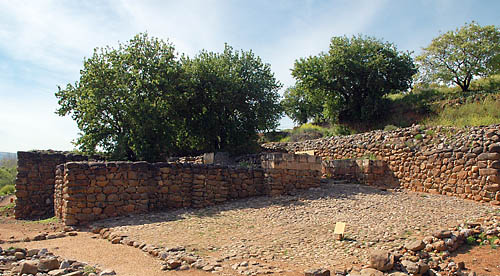
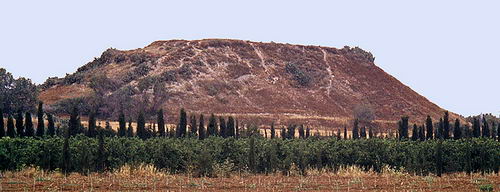
Here is a photo I made of the tell of Gath in 1969 before the area was cluttered with power lines.

Tell Gath in 1969. Photo by Ferrell Jenkins.

The Philistine city of Gath provides us with the memorable statement of David when he mourned for Saul and Jonathan.

“Tell it not in Gath, Proclaim it not in the streets of Ashkelon, Or the daughters of the Philistines will rejoice, The daughters of the uncircumcised will exult” (2 Samuel 1:20 NASB).

Eighth Century B.C. Seal Found in the City of David

The Israel Antiquities Authority reports on the discovery of another seal from the area of the City of David. Read the full account here.

Finds recovered from the excavations in the City of David reveal an interesting development in the ancient world: whereas during the 9th century BCE letters and goods were dispatched on behalf of their senders without names, by the 8th century BCE the clerks and merchants had already begun to add their names to the seals.

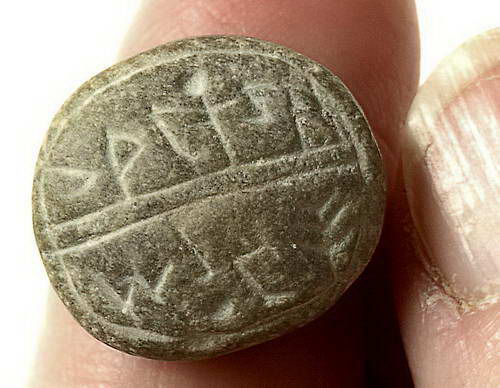
In an excavation the Israel Antiquities Authority is conducting together with the Nature and Parks Authority and the Elad Association, a complete seal bearing an ancient Hebrew inscription with the name of its owner – Raphaihu (ben) Shalem – as well as parts of other seals with writing on it were found.

Here is a nice photo of the seal, courtesy of IAA.

Rephaihu (ben) Shalem seal discovered in the City of David. Courtesy of IAA.

Seals were commonly used during Old Testament times. Jeremiah speaks of sealing and signing a deed (Jeremiah 32:10). Jezebel sealed letters with Ahab’s seal (1 Kings 21:8). Numerous seals bearing the names of biblical characters have been found over the years. It is suggested that this seal belonged to a clerk or merchant of some importance in the 8th century B.C.

Professor Ronny Reich and Eli Shukron are the excavators of the project where this find was made.

HT: BiblePlaces Blog; PaleoJudaica.

March/April edition of BAR online

Biblical Archaeology Review announced today that the entire March/April edition is available online. Certainly this is to gain subscribers. Nonetheless it is a good opportunity for those who have not read the magazine to take a look.

Subjects include an article about a seal bearing the name Jezebel. Does it belong to the wicked Phoenician Queen, wife of Ahab?

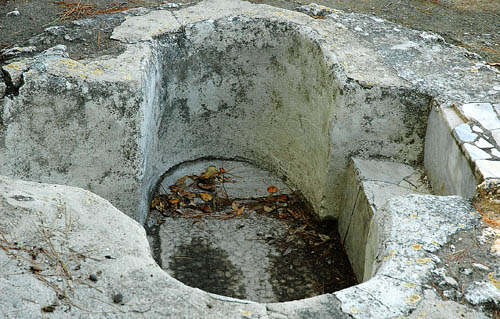
Another article is about Emmaus, or Emmaus-Nicopolis, where Jesus met with some disciples after his resurrection (Luke 24:13ff.). Here is a photo I made of the fifth century baptistry at Emmaus in 2005.

Baptistry in 5th century church at Emmaus. Photo by Ferrell Jenkins.

BAR has a photo of this baptistry, but calls it a “baptismal font.” The article says,

Two steps lead down into the basin where the penitent would stand when the priest poured water over him (the basin is not large enough for total immersion).

Of course, I must disagree with BAR. Many a preacher has baptized in a bathtub or some other small vessel when nothing else was available. In New Testament times baptism was immersion, as the word indicates, and as history records. The first known instance of the pouring of water as a substitute for immersion is the case of Novation in A.D. 251. It may well have been that pouring was practiced by the 5th century at Emmaus, but it is a departure from the New Testament (Romans 6:3-4). Baptism is commonly called a washing in the New Testament (Acts 22:16; 1 Corinthians 6:11; Ephesians 5:26; Titus 3:5; Hebrews 10:22).

Anyway, go online and read these and other articles from the current issue of BAR. Here is the link.

Earthquake Felt in Israel, Syria and Lebanon

The Jerusalem Post reports that an earthquake was felt in Israel last Friday, Feb. 15. Read the full story here.

The earth shook in many parts of Israel at 12:37 p.m. Friday. The quake was felt mainly in coastline cities, including Haifa, Tel Aviv and Nahariya.
The quake, Israel Radio reported, was also felt in Syria and Lebanon. A faded echo of the quake that hit the coast was also felt at the editorial offices of The Jerusalem Post in Jerusalem.
….

The European-Mediterranean Seismological Center said on its Web site that the quake Friday was 5.3 on the Richter scale and that its epicenter was in Lebanon.

The region is long overdue for an earthquake of epic and potentially catastrophic proportions, scientists say.

The Great Rift runs all the way from northern Syria through Lebanon, Israel, the Arabah, and into eastern Africa. In Israel the area is called the Jordan Valley or the Dead Sea Rift, It is not surprising that earthquakes are mentioned frequently in the Bible. The prophet Amos dates his visions to “two years before the earthquake” (Amos 1:1). The earthquake he makes reference to must have been so memorable that everyone would know what he was talking about. Zechariah (14:5) also calls attention to this earthquake in the days of Uzziah king of Judah.

Jesus, in predicting the fall of Jerusalem to the Romans, said, “and in various places there will be famines and earthquakes” (Matthew 24:7; see Luke 21:11).

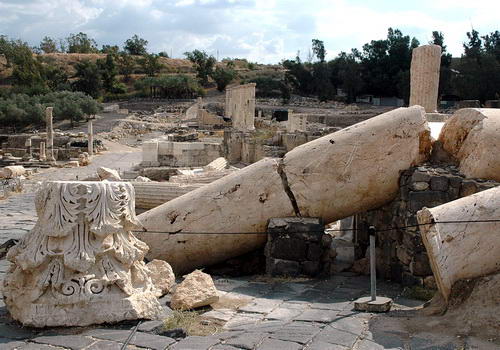
We have a wonderful example of the power of an earthquake in the Jordan Valley at the site of Bethshan [Bet-she’an, Beth-shean], about 25 miles south of the Sea of Galilee. The city was destroyed by an earthquake in A.D. 749. This photo shows the evidence brought to light during recently archaeological excavations in the city.

Earthquake Damage at Bethshan in A.D. 749. Photo by Ferrell Jenkins.

New Excavation Planned for Magdala

The town of Magdala is not mentioned in the Bible, but Mary Magdalene is mentioned a total of 12 times in the four gospels. This place may have been her birthplace or her home. A few late manuscripts mention Magdala (Matthew 15:39 KJV), but earlier manuscripts read Magadan. Magdala is located about 4 miles north of Tiberias on the western shore of the Sea of Galilee.

The Hebrew word Magdala means tower. In New Testament times the city had become Hellenized and bore the Greek name Tarichea because of the importance of the salted-fish industry there. Mendel Nun located a harbor at the site. He says,

“In ancient times, pickled sardines were an important element of diet throughout the countryespecially for those who lived near the lake” (BAR, Nov/Dec 1993).

Josephus had his headquarters at Magdala during the first Jewish Revolt against Rome (A.D. 66-70). He was able to get a group of at least 230 boats to go from Magdala to Tiberias (Jewish Wars 2.635-637). Vespasian attacked the town from the sea and destroyed it.

Archaeological excavations were conducted at Magdala in the early 1970s, on the plot owned by the Franciscan fathers, by Corbo and Loffreda. Biblical Archaeology Review announced (Sept/Oct 2007) that a new excavation will begin under the direction of Franciscan scholar Michele Piccirillo. In recent years entry to the site has been closed. The new excavations are welcomed.

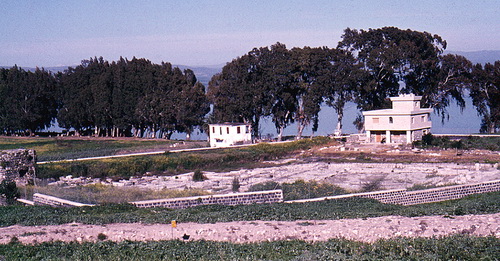
The photo below is one that I made in 1977 of the area overlooking the earlier excavations. A first century mosaic from Magdala showing a boat is on display at Capernaum. Moments after posting this blog I noticed that a report had been issued on new finds at Magdala. You may read the report and see new photos here. It will be exciting over the next few years to watch this ancient town give up its secrets.

Site of Magdala on the western shore of the Sea of Galilee. Photo by Ferrell Jenkins in 1977.

Mazar now reads seal as Shlomit

We mentioned here that a seal found in the “City of David Excavation” in Jerusalem had been read by Prof. Eilat Mazar as Temech. In a comment on that page we noted that she had now changed her mind about the reading.

Today, the Jerusalem Post carried an article about this.

Mazar had originally read the name on the seal as “Temech,” and suggested that it belonged to the family of that name mentioned in the Book of Nehemiah.

But after the find was first reported in The Jerusalem Post, various epigraphers around the world said Mazar had erred by reading the inscription on the seal straight on (from right to left) rather than backwards (from left to right), as a result of the fact that a seal creates a mirror image when used to inscribe a piece of clay.

Several other scholars said the reading should be Shlomit.

Mazar said Monday that she accepted the reading of “Shlomit” on the ancient seal, and added that she appreciated the scholarly research on the issue.

“We are involved in research, not in proving our own opinions,” Mazar said.

Shlomit is the name of a woman mentioned in 1 Chronicles 3:19. Several English versions I checked use the spelling Shelomith. Whether the seal has anything to do with the persons named in the biblical text is unknown.

“From Dan to Beersheba”

The tribe of Dan was assigned territory along the Mediterranean Sea where Joppa and the modern city of Tel Aviv now stand (Joshua 19:40-48). Because the Philistines lived in this territory the Danites found it necessary to move to a new location. A portion of the tribe moved north to the city of Laish at the foot of Mount Hermon and renamed it Dan (Judges 18). This northern city became the northern boundary of Israelite occupation and prompted the expression “from Dan to Beersheba” (Judges 20:1; 1 Kings 4:25).

An Aramaic inscription was found by Professor Avraham Biran at Dan July 21, 1993. The inscription mentions the king of Israel, the “the house of David,” and the Aramean (Syrian) god of storms and warfare, Hadad. The “house of David” is a reference to the southern kingdom of Judah. Two additional pieces of the inscription were found in June, 1994.

This photo show the partially reconstructed Iron Age (Israelite) gate at Dan.

The Iron Age City Gate at Dan. Photo by Ferrell Jenkins.

Does this seal bear the name of a Bible character?

We now have dozens of seals bearing the names of characters mentioned in the Bible, but every new one is interesting. The Jerusalem Post, January 16, 2008, reports the discovery of a seal that it says bears the name of a family of temple servants who were exiled to Babylon in 586 B.C., and then returned to Jerusalem after the exile. The discovery was made by Dr. Eilat Mazar at the City of David Excavation.

The Jerusalem Post:

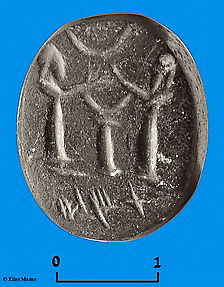
The seal, which was bought in Babylon and dates to 538-445 BCE, portrays a common and popular cultic scene, Mazar said.
The 2.1 x 1.8-cm. elliptical seal is engraved with two bearded priests standing on either side of an incense altar with their hands raised forward in a position of worship.
A crescent moon, the symbol of the chief Babylonian god Sin, appears on the top of the altar.
Under this scene are three Hebrew letters spelling Temech, Mazar said.
The Bible refers to the Temech family: “These are the children of the province, that went up out of the captivity, of those that had been carried away, whom Nebuchadnezzar the king of Babylon had carried away, and came again to Jerusalem and to Judah, every one unto his city.” [Nehemiah 7:6]… “The Nethinim [7:46]”… The children of Temech.” [7:55].
. . .
“The seal of the Temech family gives us a direct connection between archeology and the biblical sources and serves as actual evidence of a family mentioned in the Bible,” she said. “One cannot help being astonished by the credibility of the biblical source as seen by the archaeological find.”

The full article is here.

Seal Discovered by Dr. Eilat Mazar in City of David Excavation.

According to the article, Dr. Mazar reads the inscription as Temech. In many English versions this name is translated as Temah. The Nethinim are mentioned in Nehemiah 7:24 rather than 7:46. See also Ezra 2:53. Other scholars were quick to point out that Mazar had read the inscription left to right, but that seals are normally in the reverse order so that when they are impressed in clay the name reads right to left. Thus the suggestion has been made that the name should be Shelomith. Others have pointed out that there was a Shelomith among the returnees from Babylon (Ezra 8:10).

A warning is in order. There is no way to connect a name on a seal, without additional information such as a title, to a specific person in the Bible. The best one can say is that the name was common to the time of a given event or book. And we are never quite sure if the reporter with a deadline to meet got the comment correct, or placed it in the correct context. In other words, we must await additional, more detailed information. A context for the dating of the seal to a particular year, or span of years, must be provided.

Be patient and wait at least another week (month, year, decade) before using this in your sermon!

Many scholars are critical of Dr. Eilat Mazar and her work in the City of David Excavation. They paint her as a person with an agenda to prove the Bible true, and that she stretches the evidence to fit the theory. If this is true, it is not good. On the other hand, I suspect it is the lack of belief in the veracity of the Bible that prompts some to criticize her every shovel of dirt.

In 2005 Mazar announced the discovery of a clay bulla (the impression of a seal) bearing the inscription, “Yehukal son of Shelemyahu son of Shobi.” The suggestion has been made, and seems legitimate, that this is the name of the “Jehucal the son of Shelemiah” mentioned in Jeremiah 37:3. This bulla is added to several others, published much earlier, of persons named in the book of Jeremiah.

Archaeology has been a wonderful tool for the Bible expositor, but we must be careful not to expect too much from it.

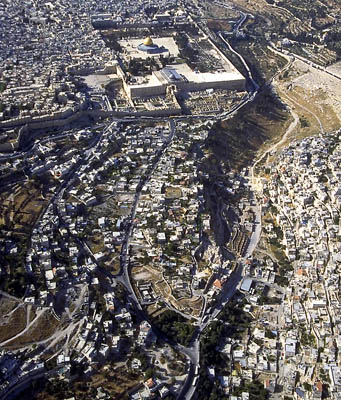
The aerial photo below, which I commissioned a fews years back, shows the area of the Temple Mount to the north (top of photo) and the City of David to the south (bottom of photo).

Aerial View of Jerusalem - Temple Mount and City of David. Photo belongs to Ferrell Jenkins.

HT: Paleojudaica; Todd Bolen; Chris Heard

Selecting a Bible Atlas

A few weeks ago I had a request to recommend a good Bible Atlas. In recent years I have found it difficult to recommend any “good” book unless I have extensive knowledge about the ability of the person making the request, and understand why they need the book. I have more than 15 Bible atlases in my study, and have used others, but no one of them completely satisfies when I get to looking for something special.

Some reader might be thinking, “I have maps in my Bible.” You should either stop reading or continue reading. Maps included in various Bibles can be helpful in seeing a general area, but are of little value in studying details. And, I note that many people have old Bibles that can not have the benefit of the latest research.

So, I have turned to the judgment of someone I trust in this area.

Todd Bolen is Associate Professor of Biblical Studies at the Israel Bible Extension of The Master’s College in Israel. He has been teaching in Israel in the area of biblical archaeology, geography and history for the past ten years, but is currently on leave to continue his studies in the USA. Take a look at his Annotated Bibliography of Selected Books for Israel Studies. Click here.

Among the atlases briefly mentioned are the following:

The Carta Bible Atlas, by Aharoni.
The Moody Atlas of Bible Lands, by Beitzel.
The Holy Land Satellite Atlas, by Cleave.
Student Map Manual: Historical Geography of the Bible Lands, by Monson.
Zondervan NIV Atlas of the Bible, by Rasmussen

Bolen says,

“This [Zondervan NIV Atlas of the Bible] is the atlas to buy to *read* – and therefore is the first choice for a beginning student who can read only one work on the geography of the land. Though the maps are not as extensive or detailed as Macmillan, the text is well-organized, well-written, and trustworthy. The first seventy pages are a geographical overview of the land, region by region. The remaining 130 pages is a historical overview of the lands of the Bible through the biblical periods.”

Bolen also has helpful lists of books on Geography, Old Testament Archaeology, Archaeology Periodicals, Jerusalem Archaeology, New Testament Background, History of Ancient Israel, Modern Israel, et al. The list was last updated October 26, 2007.

On the Bible Places Blog, Bolen comments on “Two New Bible Atlases.” The IVP Atlas of Bible History, by Paul Lawrence, and the Oxford Bible Atlas (4th ed.), by Adrian Curtis.

Here is a review of Carta’s New Century Handbook and Atlas of the Bible. This is an abridgement of The Sacred Bridge. Bolen says,

“Just to be clear, there are many things in this book that I disagree with. If you’re looking for something more conservative, try the NIV Atlas of the Bible, by Carl Rasmussen or the Moody Atlas of Bible Lands, by Barry Beitzel.”

Bolen also has some information on Electronic Maps for Bible Teaching here. Written in 2004, the following works are reviewed or mentioned prominently:

Carta’s Comprehensive Bible Atlas
Bible Maps from Manna
Logos Deluxe Map Set
Nelson’s 3-D Bible Mapbook
Logos Bible Atlas

Below I will list some additional information I have gathered on some other digital sources.

OpenBible.info Bible Atlas (uses satellite photos as the basis of the maps). This includes links to some photos, but many are of no value. Scripture references open to the English Standard Version.

BibleMap. In this program you start with the Bible text to locate places marked on Google satellite maps (photos) or modern road maps. Information from the outdated (1913) International Standard Bible Encyclopedia is also included in the program.

Bible Geocoding claims to contain the location of every identifiable place mentioned in the Bible.

Prof. Mark V. Hoffman writes a blog called Biblical Studies and Technological Tools (From scroll to screen… codex to computer…). Scroll down on the right and click on the label for bible mapping to find information on various digital programs.

American Bible Society has some very nice Interactive Maps in flash format. These would be fine for online study, and it would be great if ABS would make them available in a larger format. The maps require Flash which I was unable to use in Firefox, but I did see the maps in Internet Explorer.

In preaching, and in much teaching, I find that a map showing the general area is adequate for the purpose. I use these various maps in my PowerPoint presentations, but none of these really get at the issue of topography and geography. I use some of the Manna Bible Maps by my friend Matt Hennecke. Scott Richardson, a friend and former student, has prepared some good general purpose Bible Study Maps that I sometimes use in PowerPoint.

For more detailed work I often use the NASA satellite photos and work up maps that will allow me to show not only the place name, but also the terrain and travel routes. Here is an example of what I am talking about.
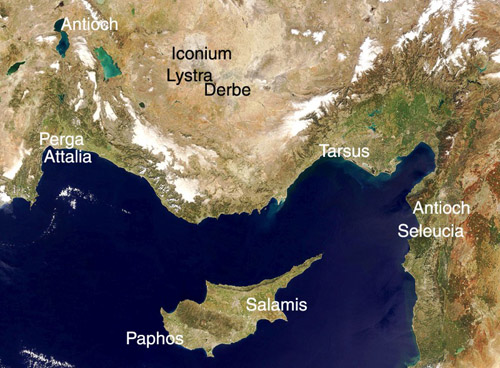
Satellite View of Area of Paul’s First Journey

Even though I note that several preachers seem excited about some of the programs using satellite imagery, I wonder if a person who has not visited the lands of the Bible can really use these to good advantage.

Visit BiblicalStudies.Info, click on Scholarly, then Maps of Bible Lands, for some additional sources of maps. These vary in quality but may be useful for some purposes.

Where did Noah’s Ark land?

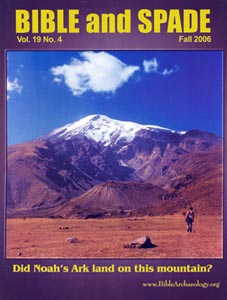
Bible and Spade has made the Fall 2006 issue available in PDF. The entire issue deals with questions of current interest to scholars about the landing of Noah’s Ark. Some recent claims that the ark might have landed in Iran are discussed. The evidence for the two main sites (or regions) in Eastern Turkey are discussed in detail.

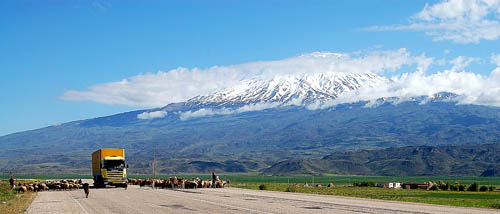
One of the main sites is on, or near, Mount Ararat. The mountain is located just a few miles from the Iranian border in eastern Turkey. Here is a photo I made at Mount Ararat earlier in the summer.

Mount Ararat in Eastern Turkey. Photo by Ferrell Jenkins

The other location is Mount Cudi in southeastern Turkey near the border with Iraq. We were unable to visit this site due to the issues between Turkey and the PKK (very much in the news lately).

The Bible says the ark came to rest on the “mountains of Ararat” (Genesis 8:4). Either of these sites fall within that description.

You may download the Fall 2006 issue of Bible and Spade here in PDF (2.0 MB).

Bible and Spade - Fall 2006

I recommend Bible and Spade. I subscribe and have the back issues in Logos Libronix format for easy searching. Go here for more information about subscribing or securing the back issues. Dr. Bryant G. Wood is the editor of Bible and Spade.