Category Archives: Archaeology

Lachish on July 4th

On July 4, 1980, I was participating in the excavation at Tel Lachish in Israel along with three of my colleagues from Florida College (James Hodges, Phil Roberts, and Harold Tabor). There were sizable numbers of participants from Israel, United States, Australia, South Africa, and Germany. In addition to the hard work out in the sun, we had some fun. On the morning of July 4th a few of the guys got an American flag and put together a drum and bugle corp and marched across the tel. Note especially the plastic bucket being used as a drum in this photo.

Lachish is identified with Tell ed-Duweir, located in the shephelah (lowlands) of Judah about 30 miles south west of Jerusalem. It is mentioned in Scripture during the period of the conquest (Joshua 10, 12, 15). Lachish served as one of the Judean store cities during the period of the kingdom Judah. Many of the LMLK jar handles have been found here. The city fell both to the Assyrians and the Babylonians.

Excavations were carried out by the British between 1932 and 1938 under the direction of J. L. Starkey. Starkey was murdered in 1938 while en route to the opening of the Palestine Archaeological Museum (later the Rockefeller Museum) in Jerusalem. Professor Yohanan Aharoni of Tel Aviv University excavated the “Solar Shrine” in 1966 and 1968. A new excavation was begun in 1973 under the auspices of The Institute of Archaeology of Tel Aviv University and The Israel Exploration Society. Dr. David Ussishkin served as the director until 1994.

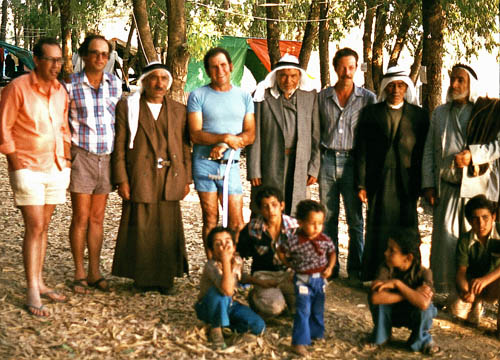
One afternoon while we were in our tented camp a short distance from the tel, a bus load of Arabs from Jordan arrived. They had once lived in the area, prior to the founding of the State of Israel. Some of the older men had worked with Starkey. This photo which I took shows four of the Arab men and three of the Israeli archaeologists, along with one American. See if you recognize Gabriel Barkay, Richard Whitaker, Adam Zertal, and David Ussishkin.
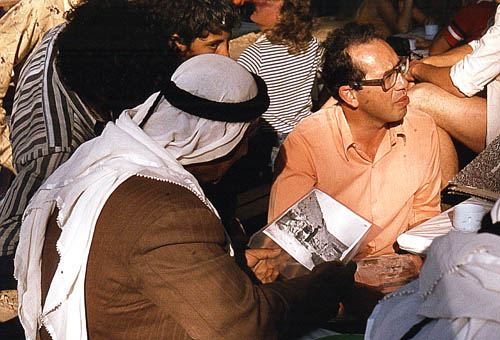
The Arab men enjoyed seeing the old photos from the Starkey excavations and pointing out themselves as much younger men. I think you will see Ussishkin’s head to the left of the Arab, and Barkay on the right.
I thought you might enjoy this little bit of recent history from 28 years ago.

Update (July 6, 2008). Todd Bolen, at BiblePlaces.com has commented on this blog under the title Reminiscences of Lachish. He says he heard Gabriel Barkay tell about this event, but he includes some additional information that I did not know, including the name of the village where the Arabs previously lived.

The town of Qubeibe was leveled by the Israeli military in the 1960s and the stones of the village, probably many taken from the ruins of Lachish, were sold to building contractors.  Who knows but some ancient inscription was unknowing transferred from Lachish to Qubeibe and is now part of a wall in the area?

I recall that Richard Whitaker was the one best able to converse in Arabic.
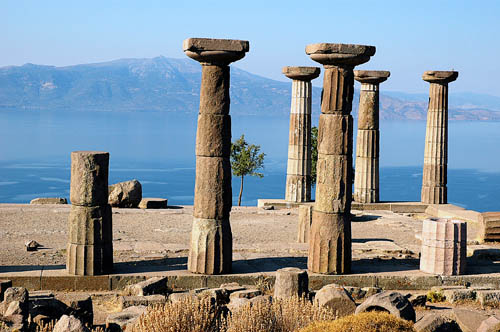
Assos temple to be restored

The current issue of Artifax reports that the temple of Athena at Assos in northwestern Turkey is to be restored. The temple was built originally about 540-530 BC. The project is expected to take about three years. Many pieces of the temple are scattered in museums (Istanbul Archaeological Museum, Louvre, Boston Museum of Fine Arts). The temple is built on a high cliff overlooking the sea. Here is the way the temple looks now.

The apostle Paul undoubtedly saw the temple of Apollo when he traveled the approximate 20 miles from Alexandria Troas to Assos by land. His companions had traveled by boat from Troas to Assos. The historical account reads this way:

But going ahead to the ship, we set sail for Assos, intending to take Paul aboard there, for so he had arranged, intending himself to go by land. And when he met us at Assos, we took him on board and went to Mitylene. (Acts 20:13-14 ESV)

The island across the strait is Lesbos. Further south is the town of Mitylene on Lesbos. Lesbos is now a Greek island in the Aegean.

LMLK jar handles

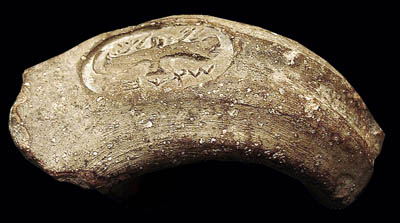
During the time of the Divided Kingdom, pottery jars with handles bearing the Hebrew letters LMLK seem to have been in common use. T. C. Mitchell comments briefly on these handles:

These handles of pottery jars which had been stamped before baking, with seals show symbols, either a four-winged scarab or a two-winged disc, with lmlk, ‘belonging to the king’ written above it in Hebrew script and a place-name below it. Over eight hundred of these stamped handles have been found at over twenty excavated sites in Palestine, nearly all in the territory to which Judah was confined by about 700 BC. (The Bible in the British Museum, page 55).

Tourists who have an interest in archaeology often pick up shards of pottery as they walk across various tells. It is not uncommon to locate a jar handle or the rim of a bowl. Recently a college student found a LMLK handle at Ramat Rahel, a site between Jerusalem and Bethlehem. Several blogs have commented on it. Todd Bolen has a nice photo of the handle here. A newspaper article about the chance find is here.The LMLK web site has a report here.

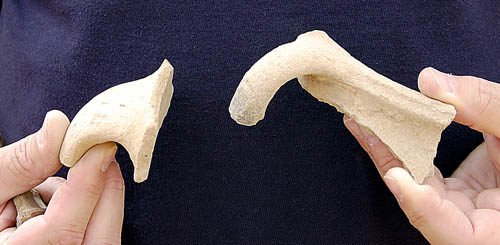
This is a photo of a LMLK jar handle that I made in the British Museum. The handle was found at Lachish. The LMLK handles have the phrase LMLK (“belonging to the king”) and the name of one of the cities that served as a distribution center: HBRN (Hebron), ZP (Ziph), SWKH (Socoh), or MMST. This one has SWKH.

King Hezekiah built “storehouses…for the produce of grain, wine and oil” (2 Chronicles 32:28). Mitchell says that the LMLK vessels “would have been suitable for any of the three staples derived from the land, grain, wine or oil.”

Ramoth in Gilead

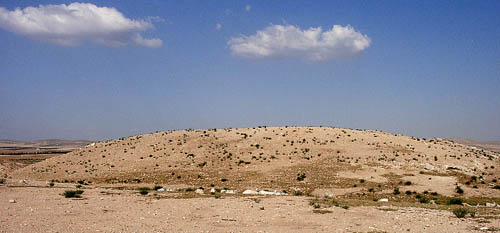
Ramoth in Gilead (or Ramoth-gilead) was a town in Gilead that was included in the territory of the Israelite tribe of Gad in Transjordan (Joshua 20:8). It was one of the Levitical cities of refuge for the Israelites (Joshua 21:38). The most memorable associated with Ramoth-gilead recorded in the Bible is the battle with Aram (Syria) in which Ahab was killed (1 Kings 22). Elijah sent one of the sons of the prophets to Ramoth-gilead to anoint Jehu as king of Israel (2 Kings 9:1).

The identity of Ramoth-gilead is uncertain. Two sites are frequently mentioned by scholars: Tall ar-Rumeith and Ar-Ramtha.

Burton MacDonald, in East of the Jordan, says,

There is also archaeological support for choosing Tall ar-Rumeith, situated in the fertile plain area just to the southeast of the junction of the ‘Amman-Damascus and Irbid-Mafraq highways, as the location for Ramothgilead. (page 200)

Paul Lapp excavated at Tall ar-Rumeith in 1967. Little archaeological work has been done at Ar-Ramtha. I have not gone into the Jordanian city of Ramtha, but understand that the mound is covered by the town, thus making it difficult to conduct an excavation.

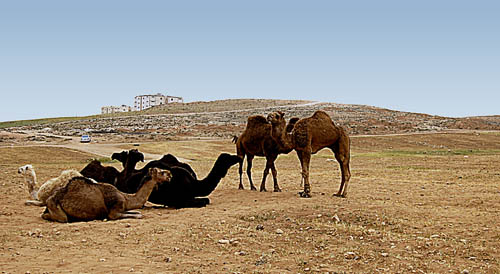
Here is a photo I made at Tall ar-Rumeith in 2002. It is not surprising to see camels here because the desert is near (to the east). From the top of the tell there is a great view looking north across a fertile plain to the border with Syria.

Earlier this year I went back to the site, but found that some modern housing has been built adjacent to the east side of the tell. It appears to be serving as housing for Indian students. I speculate that they attend a nearby university.

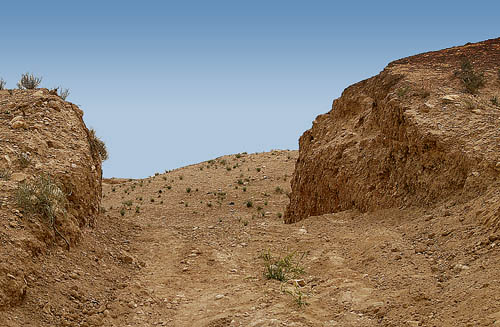
This photo shows a modern trench made to make a road to part of the construction site.

We found some pottery in the road, but can not be certain that it came from the damage to the tell. I did not see any shards along the edge of the cut.

This illustrates a real problem associated with ancient sites in isolated places. In a place like Jordan there are so many sites that it is impossible to excavate, preserve, and guard all of them.

A note on spelling. You may note different spellings of the word describing an archaeological mound. In Israel the term Tel is used. Earlier the term Tell was used throughout the Middle East. In Jordan the term Tall has come into common use.

There is also much variation in the spelling of some of the compound biblical names in scholarly sources, and even in English translation of the Bible. This is illustrated in this post and the previous one on Bethshan.

More on the Jordan church

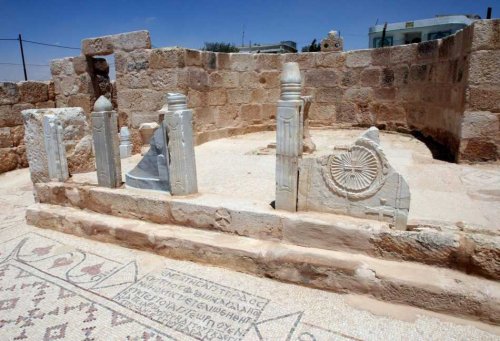
Monster Critic has posted some small photos of the Rehab, Jordan, Byzantine church building, and of the cave under the church. Detailed information is still sketchy. Ruins of Byzantine period church buildings are prevalent in both Jordan and Syria.

I think you will need to click on these thumbnail images a second time to see the largest size.

HT: Calude Mariottini

First century church (building) found?

Several blogs have noted the report of a claim out of Jordan than a first century church has been found. The Jordan Times report by Rula Samain follows:

AMMAN – Lying underneath Saint Georgeous Church in Rihab, Mafraq, is what archaeologists describe as the first Christian church in the world.

“We have uncovered what we believe to be the first church in the world, dating from 33 AD to 70 AD,” said Archaeologist Abdul Qader Hussan, head of the Rihab Centre for Archaeological Studies.

The discovery was “amazing”, Hussan told The Jordan Times.

“We have evidence to believe this church sheltered the early Christians: the 70 disciples of Jesus Christ,” the scholar said.

The early Christians, described in the mosaic inscription on St. Georgeous floor as “the 70 beloved by God and Divine”, are said to have fled from Jerusalem during the persecution of Christians, to the northern part of Jordan, particularly to Rihab, he added.

Citing historical sources, the expert said the 70 lived and practised their rituals in secrecy in this underground church.

We believe that they did not leave the cave and lived until the Christian religion was embraced by Roman rulers.

“It was then when St. Georgeous was built,” said Hussan.

Saint Georgeous is believed to be the oldest “proper” church in the world, built in 230 AD. This status is only challenged by a church unearthed in Aqaba in 1998, also dating back to 3rd century.

The findings in the graveyard near the cave offer valuable clues, according to Hussan.

“We found pottery items that date back from the 3rd to 7th century,” he added. The findings show that the first Christians and their offshoot continued living in the area till the late Roman rule.

“Going down a few steps into the cave, one would see a circle shape area, believed to be the apse, and several stone seats for the ecclesiastics,” he added.

Archimandrite Nektarious, Bishop Deputy of the Greek Orthodox Archdiocese, described the discovery of the cave as an “important milestone for Christians all around the world”.

“The only other cave in the world similar in shape and purpose is in Thessalonica, Greece,” the bishop said in an interview in Amman.

The cave also embraces the living place of the first Christians. “A wall with an entrance is the only partition separating the altar from the living area,” Hussan said.

There is also a deep tunnel, which is believed to have led the 70 Christians to their source of water, the archaeologist added.

Officials in Mafraq say they will capitalise on the discovery to further promote the area.

Governor Zeid Zreiqat, who noted Rihab is rich in unique archaeological sites, said that together with the new discovery, these sites can be invested to attract religious tourism.

“We are working on developing Rihab to become a major tourist attraction in the near future,” he told The Jordan Times.

So far, 30 churches have been discovered in Rihab,” Hussan said. It is also believed that Jesus Christ and the Virgin Mary have passed through this area, he added.

Are you excited about this discovery? Note that the report claims that the St. Geogeous Church “is believed to be the oldest proper church in the world, built in 230 AD.” The new discovery seems to have been a cave under the third century church. We must await further information on the inscription about the 70 disciples of Jesus.

There are several things in this report that arouse suspiction. Who were the 70 disciples? Were they the 70 of Luke 10:1-12? What rituals did they practice in secret? The church dates from 33 AD to 70 AD, yet they stayed in the cave until Christianity was embraced by the Roman government (early 4th century).

The pottery is said to date from the 3rd to the 7th century. Did the first century residents of the cave church leave no pottery? Do you really think a first century church had circular shaped seats for the clergy? (This is stated in the caption under a photo with the article.) We have no historical evidence for this clergy-laity distinction until well into the 2nd century.

We are told that the city of Mafraq will “capitalize on the discovery to further promote the area” and to help it become a major tourist attraction.

An MSNBC report cites Thomas Parker, of the University of North Carolina-Raleigh, as saying that this information should be greeted with a degree of caution. Read it here.

Pseudo Archaeologists

Gordon Govier, editor of Artifax, and producer of The Book & the Spade weekly radio program and podcast, has written about about a group of amateur archaeologists who are now being called Pseudo Archaeologists. These individuals, such as the late Ron Wyatt, Robert Cornuke. The discoveries claimed by these men make Indiana Jones look like a kid playing with his first shovel.

Several times a year someone sends me information about the claim of Ron Wyatt that he found Pharaoh’s chariot wheels in the Red Sea, etc. The ABR (Associates for Biblical Research) web page includes several articles dealing with these subjects. The page has been recently redesigned and you will profit by spending some time there. I also urge you to read Govier’s good article in Christianity Today here.

Some people think I know a lot about archaeology, but they know very little. I have been a student of the subject for more than 50 years, have participated in a dig, and am acquainted with several real archaeologists, but I am not an archaeologist. I frequently presents lessons on Bible History and Archaeology because I think the information can be extremely helpful to Bible students.

Sometimes we expect too much of archaeology. We should remember the old maxim, “If it sounds too good to be true, it probably isn’t true.”

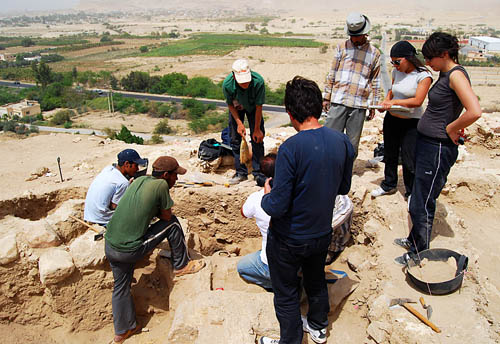
Archaeology is hard work, and often requires many years of diligent work at a single tell. In April I stopped at Tell Kafrein in the Jordan Valley and visited with the staff there for a while. This view shows a group gathered to hear the supervisor explain how to remove a Middle Bronze jar. The excavation at this yet unidentified site is under the direction of Professor Thanasis Papadopoulos of the University of Ioannina in northern Greece. I promised that I would not publish a photo of the jar, but I can tell you that it was beautiful (if you like that sort of thing). Notice that none of the works have a whip or a leather jacket. I don’t even see a fedora.

Unleash your inner Indy

Anything Indiana Jones is the fad now since the release of the fourth movie featuring the adventuresome archaeologist. The USA Today Travel Newsletter (May 27, 2007) lists 10 great places to unleash your inner Indy. One of the places mentioned is Petra in Jordan. The article says,

“Hike or ride donkey-drawn carts through a slot canyon to arrive at this ancient city carved out of the sandstone cliffs,” [National Geographic’s Boyd] Matson says. “Petra offers the chance to hook up with nomadic tribesmen and do either a one-day or multi-day camel safari in the desert.” Now a UNESCO World Heritage Site, this once-vibrant Nabataean city was an oasis where Greeks, Romans and Arabs met for caravan trading. visitjordan.com

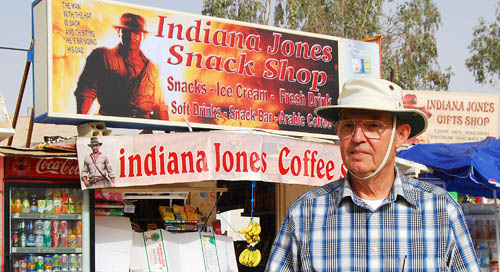
Parts of Indiana Jones and the Last Crusade was filmed at Petra. In this photo we see the snack shop, coffee shop, and gifts shop, all named for Indiana Jones.

The site of Petra is identified as the biblical Sela (rock; 2 Kings 14:7; Isaiah 16:1), and the home of the ancient Edomites (descendants of Esau). From about 300 B.C. the area was inhabited by the Nabataeans from North Africa. G. Ernest Wright once described them as,

one of the most gifted and vigorous peoples in the Near East of Jesus’ time. (Biblical Archaeology, 229).

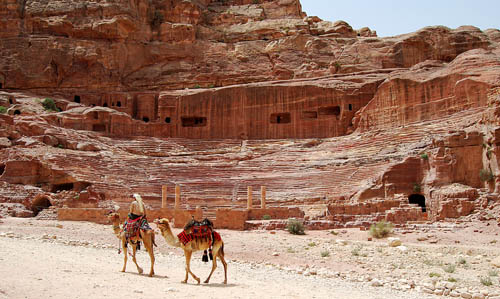
This photo shows the Roman theater at Petra which was cut out of the rock in the 2nd or 3rd century A.D. The theater seated about 3,000.

Several archaeologists have already pointed out that what Indiana Jones does is a far cry from real archaeological work. The real work is sometimes exciting, but always tedious. Bryant Wood is cited here:

“It is rather adventurous in a way, because for the most part, you’re going to some exotic country and delving into their past. But it’s not an adventure with a whip and chasing bad guys and looking for treasure,” said Bryant Wood, an archaeologist with Associates for Biblical Research.

“You’re working at one site tediously, probably for many, many years and spending more time processing the finds and writing reports than you do actually digging at the site. But that wouldn’t make for a very good story, spending 70 percent of the time in a library.”

Athens – Intellectual capital of the ancient world

We arrived at the port of Athens early yesterday morning and was met by our tour operator and guide. Morning sightseeing included highlight of the ancient and modern capital of Greece. This included the Royal Palace, the Stadium and Temple of Zeus, the Theater of Dionysius, Mars Hill (the Areopagus), the Acropolis with the famous Parthenon, the Agora (mar­ket place) and Socrates’ prison (Acts 17:15-34).

Both Athens and Corinth are in biblical Achaia.

I always find the visit to the National Archaeological Museum enjoyable. I have prepared several photos to upload, but have decided to so with the one below.

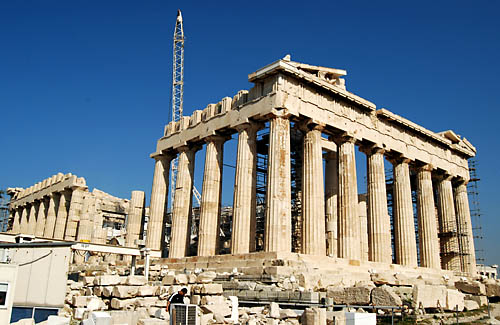
When speaking about archaeology, I am asked often about how people in the ancient world built those marvelous structures that now amaze us. I think I have finally figured out the answer for the Parthenon which was constructed about 2500 years ago. This photo might help you to understand. You have heard the saying, “Pictures don’t lie.” This photo is not retouched.

Ephesus and Miletus

This morning we visited the city of Ephesus, one of the most spectacular excavated sites to be seen anywhere. Austrian archaeologists have worked here for the past 115 years. The city has taken on what Blaiklock calls, an “edited look.” And the work continues.

Items of interest at Ephesus include the single standing column of the Temple of Diana (Artemis), the harbor which is now silted up, the great theater which seated nearly 25,000 (Acts 19:29), the Marble street, the Library of Celsus, the Agora, the Temple of Hadrian, the Temple of Domitian (or the Flavian Emperors), and much more.

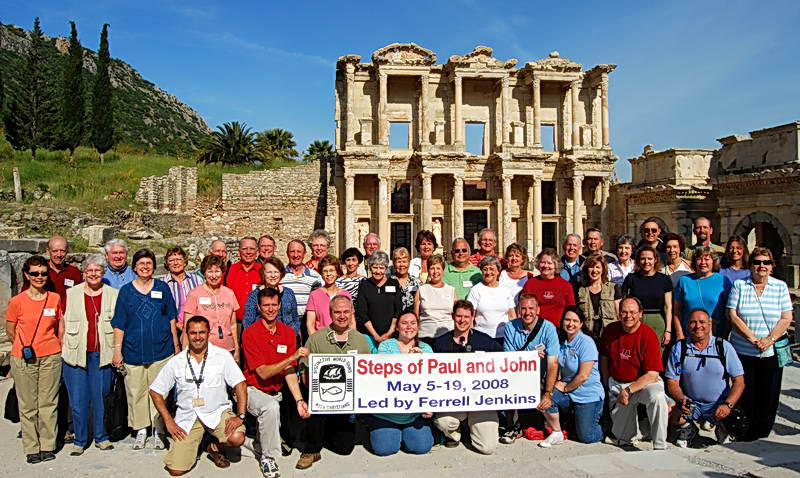
We had a group photo made in front of the Library of Celsus at Ephesus. Here is a small copy of the photo. If you know some of the folks on the tour and would like to see a larger photo, just click on the small one.

Group photo in front of the library of Celsus at Ephesus.

The first instance of believers baptized into Christ at Ephesus is recorded in Acts 19. Many changes took place in the church between the time when Paul spent nearly three years in the city, and the time when John lived there. There are two letters in the New Testament addressed to the church at Ephesus. The first is the letter of Paul to the Ephesians. The other is the letter included in the book of Revelation (Revelation 2:1-7).

The Archaeological Museum in Seljuk contains many items from Ephesus. There are two statues of Diana.

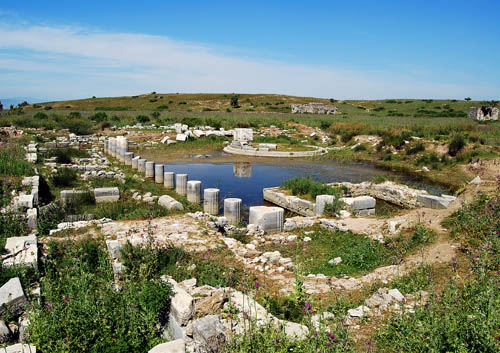
After lunch at a carpet shop we went to Miletus where Paul preached to the Ephesian elders (Acts 20). Construction of the theater began in the fourth century B.C. The Lion harbor was built in 63 B.C. Our photo shows the remnants of the Lion harbor. The entire harbor has silted up over the centuries, but a small amount of water stands in the inner harbor. I think this is likely where Paul docked, and the place from which he departed for Jerusalem.

The biblical account of Paul’s departure is touching. Luke records,

When he had said these things, he knelt down and prayed with them all. And they began to weep aloud and embraced Paul, and repeatedly kissed him, grieving especially over the word which he had spoken, that they would not see his face again. (Acts 20:36-38).

Note especially these final words about the event:

And they were accompanying him to the ship.

Try to envision this scene as you look at the photo.