Category Archives: Archaeology

Longest underground Roman aqueduct

A recent article in Spiegel Online reports on the discovery of “The Ancient World’s Longest Underground Aqueduct.”

Roman engineers chipped an aqueduct through more than 100 kilometers of stone to connect water to cities in the ancient province of Syria. The monumental effort took more than a century, says the German researcher who discovered it.

When the Romans weren’t busy conquering their enemies, they loved to waste massive quantities of water, which gurgled and bubbled throughout their cities. The engineers of the empire invented standardized lead pipes, aqueducts as high as fortresses, and water mains with 15 bars (217 pounds per square inch) of pressure.

In the capital alone there were thousands of fountains, drinking troughs and thermal baths. Rich senators refreshed themselves in private pools and decorated their gardens with cooling grottos. The result was a record daily consumption of over 500 liters of water per capita (Germans today use around 125 liters).

However, when the Roman legions marched into the barren region of Palestine, shortly before the birth of Christ, they had to forgo the usual splashing about, at least temporarily. It was simply too dry.

The article by Matthias Schulz says,

This colossal waterworks project supplied the great cities of the ‘Decapolis’ – a league originally consisting of 10 ancient communities — with spring water. The aqueduct ended in Gadara, a city with a population of approximately 50,000. According to the Bible, this is where Jesus exorcized demons and chased them into a herd of pigs.

The full story may be read here. There are some nice photos and diagrams.

The identification of the “country of the Gadarenes” (Matthew 8:28-34), and the “country of the Gerasenes” (Mark 5:1; Luke 8:26-39), and the exact place where the swine rushed down the steep cliff into the Sea, is a difficult one.  And I don’t have the time to work on it today.
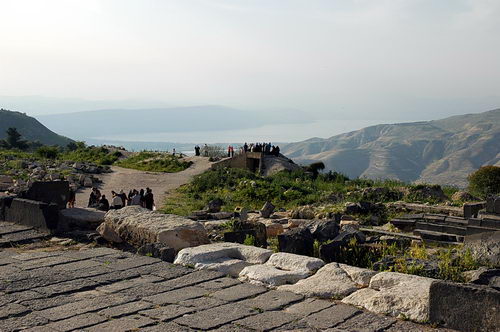
View of Sea of Galilee from Umm Queis. Photo by Ferrell Jenkins.

View of Sea of Galilee from Umm Queis. Photo by Ferrell Jenkins.

We know that Gadara had a port on the Sea of Galilee, and that Roman coins of the city portrayed ships.

Here is a photo of the Roman theater of Umm Queis. The earliest buildings of this city are made of basalt, the volcanic rock common in the area.
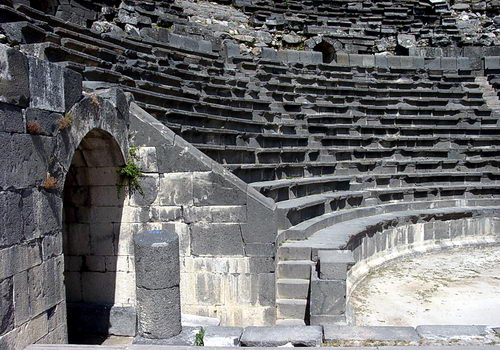
The basalt theater at Umm Queis. Photo by Ferrell Jenkins.

The basalt theater at Umm Queis. Photo by Ferrell Jenkins.

HT: Joe Lauer
Another Byzantine church uncovered

The Israel Antiquities Authority announced today the discovery of a church building dating to the Byzantine period. This one is located near Moshav Nes-Harim, about 3.11 miles east of Beth Shemesh. The full press release may be read here. The Byzantine period in Israel may be dated from about A.D. 325 to the early part of the 7th century.

Christianity grew out of the soil of Judaism. In the early part of the first century Jesus said, “for salvation is from the Jews” (John 4:22).

Max Miller says,

The population of the Holy Land became almost entirely Christian, except for Jewish enclaves primarily in Galilee. moreover, Christian pilgrims flocked to the Holy Land from all over the Roman-Byzantium world and Christian churches were built over virtually every spot which could be imagined to have any connection with a biblical event. (Introducing the Holy Land, 130-131).

He continues to say,

By 640 most of Egypt, the Holy Land and Syria were under Islamic control.

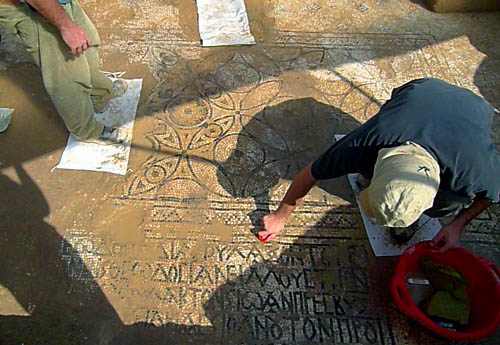
Mosaic dedicatory inscription in Greek. Photo by Daniel Ein Mor, IAA.

Mosaic dedicatory inscription in Greek. Photo by Daniel Ein Mor, IAA.

Evidence for the existence of Jewish and Christian buildings and settlements continues to become known rapidly. It has become common among some Muslim sources to deny the existence of Jews in the land of Palestine before the 20th century. The evidence of archaeology says otherwise. The Old Testament scriptures say otherwise. The New Testament, and the existence of the church in those early centuries, say otherwise.

The sad thing is that buildings are found, not churches composed of Christians. The church had so departed from the New Testament order that it was not able to effectively survive the pressures of  the Muslim invasion. The church of our day appears very weak as it faces the cultural pressures of the postmodern world.

HT: Joseph I. Lauer

Kenyon

Einstein. That all we have to say. When it comes to the archaeology of Palestine the name Kenyon needs no supporting terms. Professor Magen Broshi, an archaeologist and historian, and the former curator of the Shrine of the Book in Jerusalem, wrote a review of Dame Kathleen Kenyon, Digging up the Holy Land, by Miriam C. Davis.

Here are a few interesting statements by Broshi:

She was, however, one of the most important archaeologists ever to dig in the Land of Israel.

That is not a negligible achievement, because more archaeological work has been done in the land between the Mediterranean Sea and the Jordan River, in other words in the State of Israel and the territories, than anywhere else in the world. There is no other country that has been so thoroughly researched, and the number of digs and surveys carried out here is incomparably greater than what has been done in far larger countries. Kenyon is not only one of the most important archaeologists to have worked here (and they number over 1,000), she is also the leading female archaeologist to have worked anywhere (along with the prehistorian Dorothy Garrod).

Kenyon dug at Samaria, Jericho, and Jerusalem. Broshi concludes,

The figure of Kenyon as portrayed in the book is a model of diligence and dedication. The book is based on thorough research, including written and oral testimony. It is well-written and the story is appealing. In my opinion it deserves high praise.

The complete review may be read on the Haaretz web site.

There are several articles on the Associates for Biblical Research web page about the excavations at Jericho. This one by Bryant G. Wood on “The Walls of Jericho” is a non-technical article that is helpful. Wood wrote a doctoral dissertation evaluating the evidence at Jericho. He discovered some oversights in Kenyon’s conclusions. Notice one of the concluding paragraphs of the popular article.

Jericho was once thought to be a “Bible problem” because of the seeming disagreement between archaeology and the Bible. When the archaeology is correctly interpreted, however, the opposite is the case. The archaeological evidence supports the historical accuracy of the Biblical account in every detail. Every aspect of the story that could possibly be verified by the findings of archaeology is, in fact, verified.

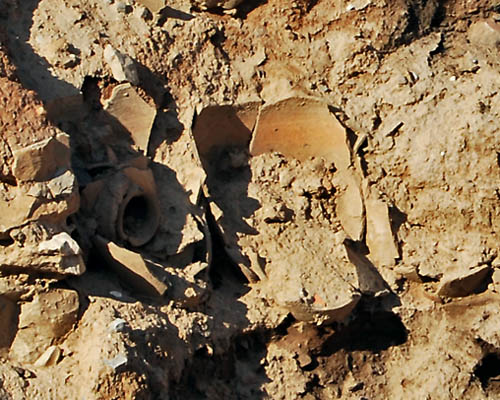
Both Garstang (excavated Jericho between 1930 and 1936) and Kenyon (excavated Jericho between 1952 and 1958) found evidence of pottery jars full of grain in destruction levels. Even with the constant deterioration of the exposed evidence, we still see fragments of jars in the side of the balk.

Pottery in the side of a trench at Jericho. Photo by Ferrell Jenkins.

Pottery in the side of a trench at Jericho. Photo by Ferrell Jenkins.

Wood argues that “this is a unique find in the annals of archaeology.” He says,

Grain was valuable, not only as a source of food, but also as a commodity which could be bartered. Under normal circumstances, valuables such as grain would have been plundered by the conquerors. Why was the grain left to be burned at Jericho?

The Bible says,

The city and all that is in it must be set apart for the LORD, except for Rahab the prostitute and all who are with her in her house, because she hid the spies we sent. But be careful when you are setting apart the riches for the LORD. If you take any of it, you will make the Israelite camp subject to annihilation and cause a disaster. All the silver and gold, as well as bronze and iron items, belong to the LORD. They must go into the LORD’s treasury.” (Joshua 6:17-19 NET)

But they burned the city and all that was in it, except for the silver, gold, and bronze and iron items they put in the treasury of the LORD’s house. (Joshua 6:24 NET)

HT: Joseph I. Lauer

After completing my comments, I see that Todd Bolen has commented on the review of the Kenyon biography here.

Albright – “dean of biblical archaeologists”

The Historical Handbook of Major Biblical Interpreters begins the entry on William F. Albright with these words:

Called the dean of biblical archaeologists in his last decades, William Foxwell Albright was also to become a well-known biblical interpreter.

Todd Bolen  calls attention to a new appreciation of William F. Albright by Thomas Levy and David Noel Freedman at The Bible and Interpretation. You may read Todd’s comments on The Legacy of William F. Albright at his Bible Places Blog. All of this is good reading.

Nineveh in danger of urban sprawl

It is no longer news that the ancient sites of Iraq are in danger of destruction. This has been caused by war, looting, and now urban sprawl. There is an informative article about the threat facing Ninevah (spelled Nineveh in English Bible translations) in The Christian Science Monitor here.

We can be thankful that many of the artifacts of ancient Sumer, Akkad, Assyria, Babylon, et al. are now displayed in the great museums of the world. The reliefs from the palace of the Assyrian king Sennacherib are displayed in the British Museum.

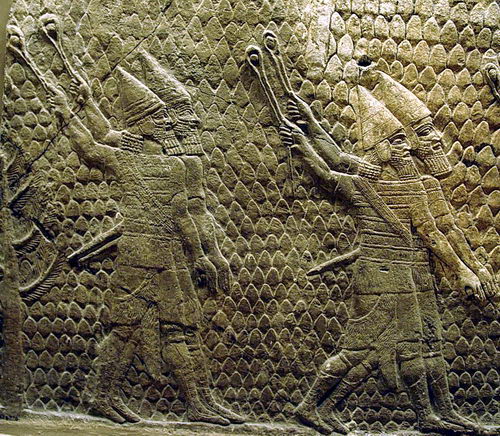
The panel below is a portion showing the Assyrian slingers at Lachish at the end of the 8th century B.C. The Bible says,

Then Sennacherib king of Assyria departed and went home and lived at Nineveh. (2 Kings 19:36)

King Sennacherib had these reliefs carved on his palace walls in Nineveh. Click on the image for a larger one.

Assyrian slingers at Lachish. Photo by Ferrell Jenkins.

Assyrian slingers at Lachish. Photo by Ferrell Jenkins.

The greatness of Nineveh is mentioned in the book of the prophet Jonah.

Arise, go to Nineveh, that great city, and call out against it the message that I tell you. (Jonah 3:1)

It would be nice if world conditions (economic, political, and religious) allowed renewed archaeological excavation of sites such as Nineveh.

HT: Joseph I. Lauer

Epaphras worked hard for the Laodiceans

Laodicea is mentioned only in Paul’s epistle to the Colossians (2:1; 4:13-16) and in the Revelation of John (1:11; 3:14). Paul says that Epaphras worked diligently for the saints in Colossae, Laodicea, and Hierapolis.

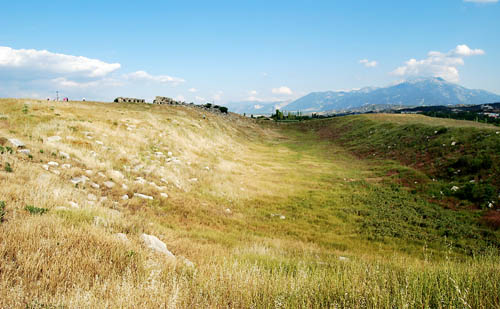
Here is a photo of the ruins of the stadium at Laodicea. Mount Cadmus can be seen in the distance to the east. Colossae was located at the foot of Mount Cadmus. Hierapolis was located to the north of Laodicea.

The stadium at Laodicea. Photo by Ferrell Jenkins.

The stadium at Laodicea. Photo by Ferrell Jenkins.

The stadium was an enclosed structure used for gladiatorial games. An inscription tells that a wealthy family dedicated it to Vespasian and Titus. One still can make our the unexcavated ruins of the 1000 feet long stadium.

Riblah in the land of Hamath

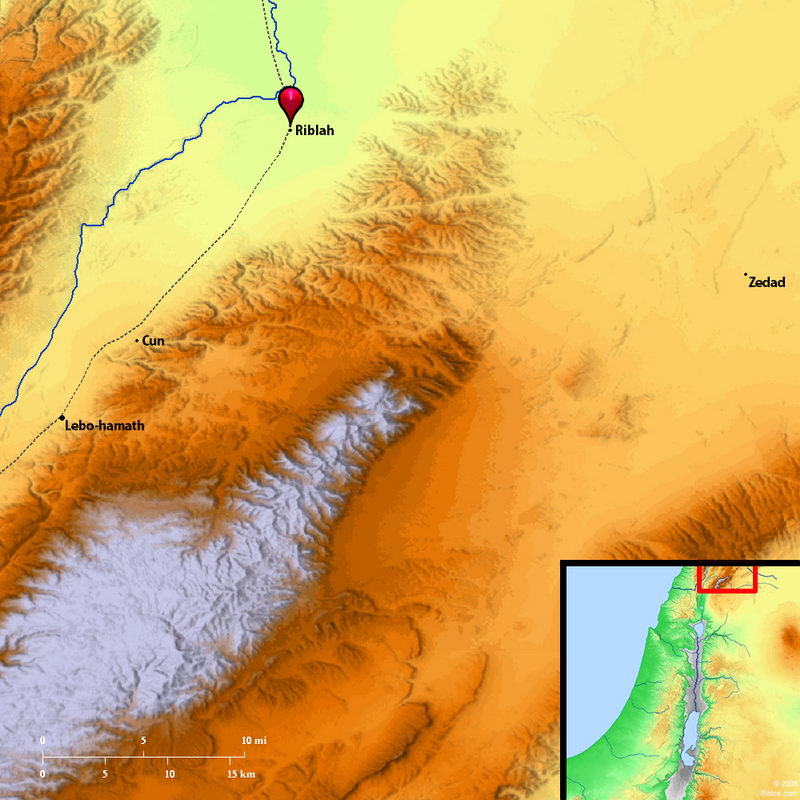
Riblah served as a base of operation for the Egyptian Pharaoh Necho and the Babylonian King Nebuchadnezzar. The city is located on a broad plain about 20 miles south of Hamath (modern Hama in Syria), on the main road between Egypt and Mesopotamia. The Orontes River flows past the site on the west side. On a modern map you will locate Riblah in Syria immediately north of the border with Lebanon.

There is little more than a “country store” at the site today, but the name Riblah is preserved as Ribleh, Syria.

Riblah in the land of Hamath. Courtesy BibleAtlas.org.

Riblah in the land of Hamath. Courtesy BibleAtlas.org.

  • Pharaoh Necho imprisoned Jehoahaz, king of Judah, at Riblah. He later took him to Egypt where he died. The date was about 609 B.C. (2 Kings 23:31-34).
  • Zedekiah, puppet king of Judah, tried to escape capture by the Babylonians. He fled Jerusalem but was captured on the plains of Jericho and brought to Riblah. There Nebuchadnezzar passed sentence on him. His sons were slaughtered in his sight and he was bound with brass fetters and taken to Babylon. The date was 586 B.C. (2 Kings 25:5-7; see also Jeremiah 39:5-6; 52:9-10).
  • The officials of Zedekiah were taken to Riblah where they were put to death (2 Kings 25:19-21; see also Jeremiah 52:26-27).

In 2002 a colleague and I spent several days visiting sites in Syria. Riblah was the most difficult to locate. Most folks, after seeing the site, would probably say, “What’s the big deal?”  Even though Riblah is mentioned only these few times in the Old Testament, it’s location makes it important in all movement between the south (Egypt and Israel) and Mesopotamia.

Riblah in the land of Hamath. Photo by Ferrell Jenkins.

Riblah in the land of Hamath. Photo by Ferrell Jenkins.

The slopes of this tell are now used as a cemetery. We know that this would make it difficult to negotiate rights to excavate.

James B. Pritchard on film in 1967

Last evening I watched The Book and the Spade, a documentary film produced in 1967 by the University Museum of the University of Pennsylvania. The film is about the archaeological work in Jordan. At the time that included Jerusalem, Gibeon, Shechem, Samaria, Bethlehem, Qumran, Amman, Jerash, and Tell es Sadiyeh in the Jordan Valley. Pritchard is seen on the film at Tell es Saidiyeh, east of the Jordan River, giving an account of the discoveries there. He believed the site to be Zarethan. The Bible says that the bronze utensils which Hiram made for King Solomon were made,

In the plain of the Jordan the king cast them, in the clay ground between Succoth and Zarethan. (1 Kings 7:46)

This film is of great historical significance because it features Pritchard and because it shows places that no longer look the way they did in 1967. I suggest you take the time to watch it. Here is the link to The Book and the Spade. The film is about 28 minutes long.

Excavations were resumed in 1985 by Jonathan N. Tubb of the British Museum.

Some scholars have suggested that Zarethan should be located on the west side of the Jordan Valley.

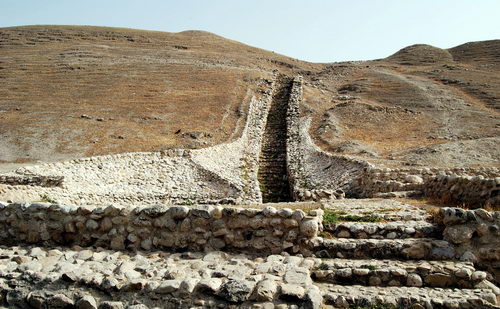
This photo shows the north side of Tell es Saidiyeh with the steps leading to the spring that Pritchard mentions in the film.

Tell es Sadiyeh, excavated by James B. Pritchard. Photo by Ferrell Jenkins.

Tell es Saidiyeh, excavated by James B. Pritchard. Photo by Ferrell Jenkins.

HT: The Book and the Spade blog by Gordon Govier.

Royal seals from the time of Hezekiah

The Israel Antiquities Authority has announced the discovery of several impressive artifacts from Umm Tuba, in the southern hill of Jerusalem. These items include royal seal impressions from the time of Hezekiah, king of Judah (c. 716-687 BC; Schultz, ISBE).

A large building that dates to the time of the First and Second Temples, in which there was an amazing wealth of inscriptions, was discovered in a salvage excavation conducted by Zubair Adawi, on behalf of the Israel Antiquities Authority, in the village of Umm Tuba in southern Jerusalem (between Zur Bahar and the Har Homa quarter), prior to construction work by a private contractor.

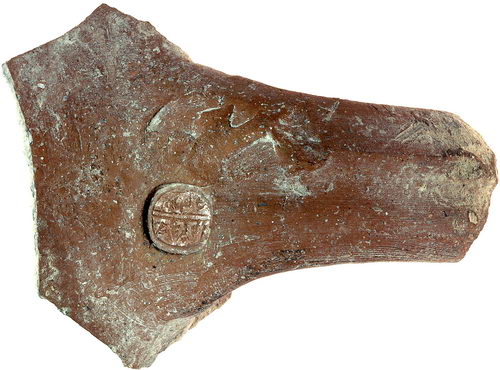
Considering the limited area of the excavation and the rural nature of the structure that was revealed, the excavators were surprised to discover in it so many royal seal impressions that date to the reign of Hezekiah, King of Judah (end of the eighth century BCE). Four “LMLK” type impressions were discovered on handles of large jars that were used to store wine and oil in royal administrative centers. These were found together with the seal impressions of two high ranking officials named Ahimelekh ben Amadyahu and Yehokhil ben Shahar, who served in the kingdom’s government. The Yehokhil seal was stamped on one of the LMLK impressions before the jar was fired in a kiln and this is a very rare instance in which two such impressions appear together on a single handle.

Royal seal from the time of Hezekiah. Photo: Mariana Saltzberger, IAA.

Royal seal from the time of Hezekiah. Photo: Mariana Saltzberger, IAA.

The site of this discovery has been identified as Biblical Netofa (English Netophah). Two of David’s “mighty men” (or warriors) were from Netophah.

Zalmon the Ahohite, Maharai the Netophathite, Heleb the son of Baanah the Netophathite, Ittai the son of Ribai of Gibeah of the sons of Benjamin (2 Samuel 23:28-29).

The full press release may be seen at the IAA site at the bottom of the page.  A ZIP file of the seven pictures is available here for those interested.

HT: Joseph Lauer and several bloggers.

Cinema fire reveals Roman wall in Izmir (Smyrna)

A report from Izmir says that a cinema (movie theater) burned down in Izmir, Turkey, revealing portions of an 11 meter Roman wall and arch.

Archaeologist Akın Ersoy, the leader of a local excavation team, said this new discovery proved the importance of the agora, a meeting place in ancient times. Stating that Izmir had become synonymous with agoras, Ersoy said: “(The excavation) of the agora is the best heritage to leave behind for future generations. With the support of Izmir Metropolitan Municipality, the environment of the Izmir agora, one of the biggest and oldest agoras in the world, has been opened up and can now be seen by people from the Çankaya neighborhood. We have not started work on the wreckage of the cinema building yet but we believe this ancient site is two times bigger than the local agora site.”

The full account is carried in Hurriyet Daily News.

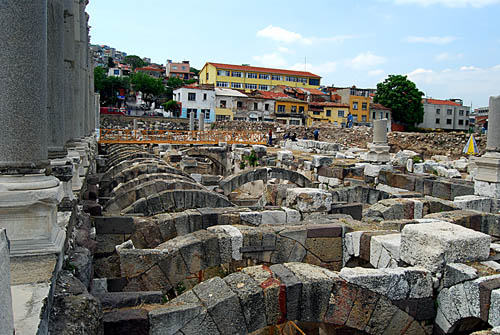
Always a good reason to return to a site. Here is a photo of the lower level of the agora in Izmir. Notice the older buildings along the edge of the agora. If the city of Izmir would clear and excavate this entire area the city would have a real reason for many tourists to visit the city.

Looking over the lower level of the Izmir Agora. Photo by Ferrell Jenkins.

Looking over the lower level of the Izmir Agora. Photo by Ferrell Jenkins.

The Turkish city of Izmir is known as Smyrna in Revelation 1:11, 2:8.

HT: RogueClassicism.