Category Archives: Archaeology

Padfield’s visit to Explorations In Antiquity Center #2

We actually spent two days at the Explorations In Antiquity Center. We visited the Center on a Thursday morning, when they were not busy, so I could photograph the exhibits without other visitors getting in the way. We returned the following day to meet up with Gene and Sandy Taylor so we could have a guided tour of the Center and enjoy an authentic “Biblical meal” together.
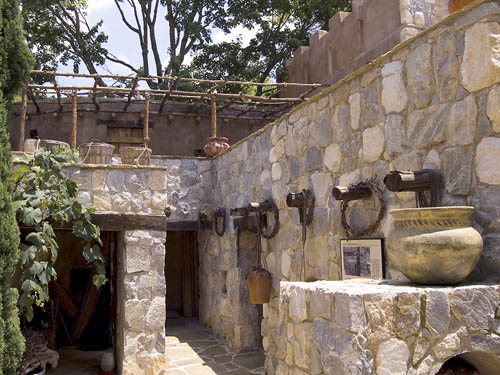
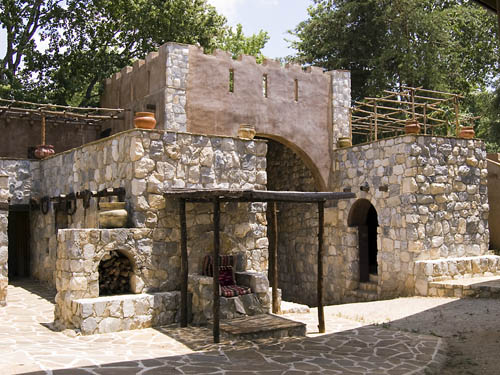
House exterior at Explorations in Antiquity Center. Photo by David Padfield.

House exterior at Explorations In Antiquity Center. Photo by David Padfield.

Our guide for the three-hour tour was Lamar Hamric and he did an excellent job of explaining the exhibits and putting them in a Bible context. The first half of the tour took place in the outside exhibit area and the last half was in a dining area designed to look like a Roman period banquet hall.

In the meal room we enjoyed a four-course meal with fifteen different food items, including unleavened bread, fruit, nuts, hard-boiled eggs, vegetables and bitter herbs. The meal was supposed to represent a Jewish Passover meal, but instead of roasted lamb they served roasted chicken (which, by the way, was excellent).

In the center of the room is a Roman triclinium—a U-shaped table like the one our Lord probably used at the Last Supper (Luke 22:12). During the meal Mr. Hamric discussed the various Passover customs and the social aspects of sharing a meal in the ancient Near East. Hamric gave the best explanation of the events at the Last Supper I have ever heard.
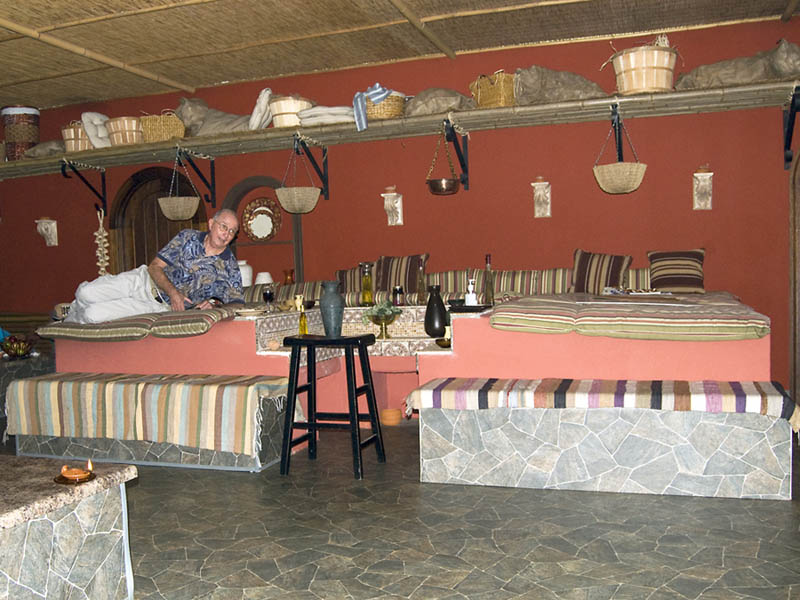
Roman period triclinium. Photo by David Padfield. Click for larger image.

Roman period triclinium. Photo by David Padfield. Click for larger image.

If you are anywhere near LaGrange, Georgia I would highly recommend you visit the Center. In fact, take your whole Bible class! The tour and meal costs $30 per adult and is well worth it. You need to make reservations in advance. They can prepare the Biblical meal for a small group (a minimum of 10) or a larger group of up to 140 people. Reservations can be made by calling the Center at (706) 885-0363.

-o-o-o-o-o-o-

David Padfield has visited the Bible Lands several times and is well qualified to evaluate the Explorations In Antiquity Center. Many of you have used his photographs and other materials that are made available through his web site (padfield.com).

The Explorations In Antiquity Center web site is available here.
The Exploration in Antiquity Center

The Explorations in Antiquity Center at LaGrange, Georgia, is the brainchild of Dr. James Fleming. Fleming has lived and worked in Israel since 1973. Numerous tour groups have visited his Biblical Resources center there. I first met Jim many years ago in the home of Richard Cleave in Jerusalem. Cleave is the author/photographer/publisher of The Holy Land Satellite Atlas and other photographic and geographic materials. In that meeting I saw that the three of us shared a common passion in wanting to use what we had learned about the Bible lands in teaching others.

The Explorations in Antiquity Center web page says,

Dr. Fleming established Biblical Resources in 1975, for the purpose of producing educational materials and aids for teaching the historical, geographical, and archaeological background of the Bible.

It was wonderful to have these resources together at one place in Israel, but it is beneficial to many more to have the resources available in the Southeastern United States.

David Padfield recently visited the Center in LaGrange. At my request he has written a brief review for Ferrell’s Travel Blog. We plan to run the review with photographs during the next few days.

The city gate at Exploration in Antiquities Center. Photo by David Padfield.

The city gate at Exploration in Antiquities Center. Photo by David Padfield.

You may access the Center’s web site here.

David Padfield is well known for his helpful web site, Padfield.com.

I take every step with them

A couple of my friends, Royce and Luke Chandler, are in Israel to participate in the archaeological dig at Khirbet Qeiyafa. The site, overlooking the Valley of Elah, is also called the Elah Fortress. They are spending a few days traveling in Israel prior to joining the dig.

Luke is posting some of his photos and a bit of information about the places on his A Bible, History & Travel Blog. Today he has a great photo of the Jezreel Valley from the Spring of Harod to the Hill of Moreh (Judges 7). Take a look.

More information on Judean exiles in Babylon

Abraham Rabinovich, a long time writer for the The Jerusalem Post, has compiled some fascinating information about the Judeans in Babylonian Exile during the time of Nebuchadnezzar.

King Jehoiachin was only 18 years old and had occupied the throne of Judah barely three months when he was led off into Babylonian captivity in 598 BCE together with his wives, his mother, his servants, his eunuchs and thousands of “the chief men of the land.”

But what happened to them when they reached Babylon? And what happened there to the tens of thousands of others who joined them in exile when the First Temple was destroyed a decade later? The Bible tells us of the return to Judah half a century later but virtually nothing of what the expellees experienced in Babylon itself…

However, scholars have been able to gain a measure of access to these missing years from cuneiform documents unearthed in Iraq in the last century, including a trove illicitly dug up in the final years of Saddam Hussein’s regime and only now nearing publication. The documents are innocuous – business records, land deeds, tax accounts – but together are able to shed light, feeble but suggestive, on this central period in Jewish history.

Rabinovich comments specifically on the fate of Jehoiachin, the young Judean king.

“We have been able to make history out of dry documents,” says Prof. Israel Eph’al of the Hebrew University, an epigrapher and historian of the ancient Near East.

Early last century, archeologists digging in Babylon, the capital of Babylonia, uncovered cuneiform tablets in a vaulted chamber beneath the ruins of an ancient structure believed by some to have been the base of the fabled “Hanging Gardens” of Babylon. These tablets, deciphered in the 1930s by German Assyriologist Ernst Weidner, detailed the storage of oil and other commodities and their distribution. Four of the badly damaged tablets concerned the supply of oil to “Jehoiachin, king of Judah” and his five sons. The date is five years after he was taken captive. The fact that he was being provisioned by the Babylonian authorities and that he retained his royal title suggests that he was being treated with deference even though he had been taken captive because his father, Jehoiakim, had rebelled against Babylon. Favorable treatment is also suggested by the fact that at 23 he already has five sons, indicating that the young royal was not deprived of the wives who had accompanied him.

Read the entire article here.

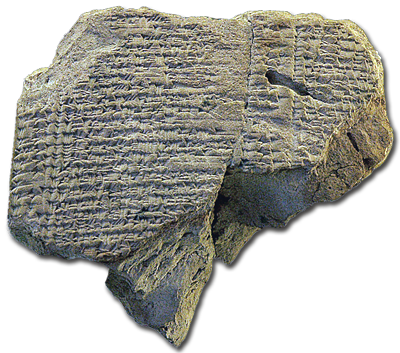
Because German archaeologists worked at Babylon for more than a decade in the early part of the 20th century, the best collection of archaeological artifacts are in the Pergamum Museum in Berlin. Here is a photo of one of the ration tablets mentioned in the article.

Ration tablet from Babylon, now in Berlin. Photo by Ferrell Jenkins.

Ration tablet from Babylon mentioning Jehoiachin, the exiled king of Judah. Photo by Ferrell Jenkins.

This information harmonizes with what we are told in the Bible, under  (2 Kings 25:27-30). This text describes an event some years later under the reign of Evil-merodach. Verse 30 says of Jehoiachin,

He was given daily provisions by the king for the rest of his life until the day he died. (2 Kings 25:30 NET)

Here are the dates I normally follow in the study of this part of Bible history:

  • Nebuchadnezzar takes Daniel and other royal youths to Babylon (605 BC).
  • Jerusalem captured by the Babylonians. Jehoiachin taken to Babylon (597 BC). Zedekiah was made king. Ezekiel was among the prophets taken to Babylon.
  • Zedekiah was blinded and taken to Babylon (586 BC). Jerusalem destroyed. Many exiles taken to Babylon. Jeremiah was left in the land of Judah.
  • Babylon captured by the Medes and Persians (539 BC).
  • Judean exiles allowed to return to Judah (536 BC).
  • A second group of exiles returned in the days of Ezra (458 BC). Some remained in Babylon.

HT: Joseph I. Lauer

The Land of Rameses

Note: Over the past nine years I have contributed nearly 100 articles on Bible places to a magazine published by some of my friends. Normally I do not repeat the material here for several years.  The typesetter made a mistake in the July, 2009, issue of Biblical Insights using the title from the previous issue. Because of this I decided to run the article here with the correct title.

-o-o-o-o-o-o-

For many years scholars identified Rameses with Tanis (San el Hagar). Tanis is often identified with the Zoan which was built seven years after Hebron (Numbers 13:22). As a result of recent excavations in the eastern Nile Delta by Austrian archaeologists under the direction of Manfred Bietak, Rameses is now identified with Tell el-Daba. Tell el-Daba is situated on the eastern side of the ancient Pelusiac branch of the Nile River in the biblical land of Goshen (Gen. 45:10) which is also called the land of Rameses (Genesis 47:11). Rameses was the starting point of the exodus (Ex. 12:37; Num. 33:3,5).

Scholars posit four main proposals for the date of the exodus. (1) Before 2000 B.C. (Anati); (2) 1477 B.C. (Goedicke); (3) about 1450 B.C. (Bimson); (4) 1280 B.C. (popular view). If we believe that 1 Kings 6:1 should be taken seriously, as I do, the date of the exodus would have been about 1446 B.C. Conservative scholars disagree over whether there was a long bondage (430 years), or a short bondage (215 years).

The history of this area should be divided into three periods: pre-Hyksos, Hyksos, and post-Hyksos. The Hyksos were foreign (Canaanite or Asiatic) rulers who lived in the eastern Nile Delta and eventually ruled northern Egypt for some 108 years (c. 1663-1555 B.C.; 15th dynasty). In the pre-Hyksos period the town was known as Rowaty (“the door of the two roads”). During the 15th Dynasty the name was changed to Avaris. The Hyksos made their capital there and retained the name. When the Egyptians ran the Hyksos out of Egypt the name was likely changed to Peru-nefer (“happy journey”). Pharaoh Rameses built a new city at the same location and named it Rameses.

During their stay in the land of Egypt the Israelites built the storage cities of Pithom and Rameses (Exodus 1:11). Pharaoh Rameses II ruled Egypt about 1304 to 1227 B.C. How could the Israelites have built the city of Rameses prior to 1446 B.C. if Pharaoh Rameses was not the ruler of Egypt until nearly 200 years later? Some have suggested that the name Rameses was given to the city by the Hyksos in the 17th century B.C. Perhaps the city was named for a private individual by that name. The most common explanation is that Rameses is the modernization of an obsolete place name. We might say that Caesar crossed the English Channel though it was not known by that name at the time. We say St. Nicholas of Myra was a Turkish bishop, but Turkey did not exist at the time.

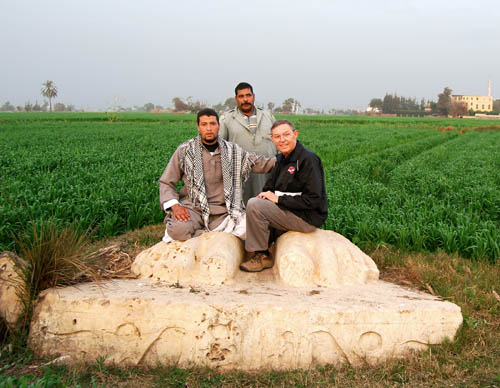
Earlier this year I spent two days in the land of Goshen. My guide gained access to a field in the Tell el-Daba area where we saw remnants of a colossal statue of Pharaoh Rameses II estimated to have been more than 30 feet high. The royal precinct of the city at the time of Moses has also been uncovered at Ezbet Helmi on the bank of the Pelusiac branch of the Nile.

Remnant of a colossal statue of Rameses II at Tell el-Daba in the land of Goshen.

Remnant of a colossal statue of Rameses II at Tell el-Daba in the land of Goshen.

It is incorrect to say that there was no Egyptian building in the delta during the time of Rameses II. The storage city constructed by the Israelites was not known as Rameses when they built it, but by one of the earlier names.

Extraordinary Finds at the Mt Zion Excavation

That the title of the July update after three weeks of digging at the Mt Zion Excavation. The report by James D. Tabor is available here. The location is a beautiful one. It lies between the road and the old city wall on the south side of the Old City of Jerusalem, and it overlooks the Hinnom Valley (Joshua 18:16). There are some nice photos of the site and some of the discoveries.

Discoveries in the past three weeks include:

  1. A stone vessel with an ancient inscription of ten lines in archaic Jewish script.
  2. Murex snail shells with holes drilled in them.
  3. A fire pit dated to just after the Roman destruction of Jerusalem in A.D. 70.
  4. The threshold of a Fatimid period double gate.
  5. An arched doorway with mosaic floor and plastered wall.
  6. Several 2nd temple vaulted chambers that likely contained mikvot (ritual baths).
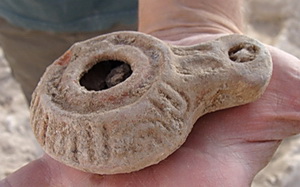
  7. Miscellaneous items such as coins, intact lamps, etc.
Herodian lamp from Mt Zion Excavation. Photo: Tabor Blog.

Herodian lamp from Mt Zion Excavation. Photo: Tabor Blog.

The excavators, Tabor and Gibson, have found evidence in some of these items that causes them to think this might have been an area were priests from the Second Temple period lived. (Second Temple means the Herodian Temple, which was really the Third Temple!).

Archaeology is hard work, but as these little things come to light it is exciting to have a better understanding of the past.

HT: Joseph I. Lauer

Could this be the quarry of Herod the Great?

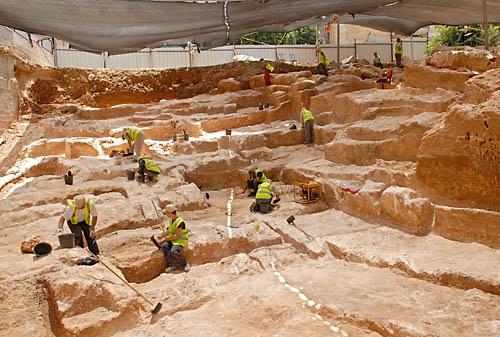
The Israel Antiquities Authority announced Monday the discovery of a large stone quarry dating to the first century B.C. It is suggested by the director of the excavation that this was one of the quarries used by Herod the Great in his building projects in Jerusalem.

First century B.C. quarry on Shmuel HaNavi Street. Photo: Assaf Peretz, courtesy IAA.

First century B.C. quarry on Shmuel HaNavi Street. Photo: Assaf Peretz, courtesy IAA.

Dr. Ofer Sion, the excavation director on behalf of the Israel Antiquities Authority, believes, “The immense size of the stones (maximum dimensions: length 3 m, width 2 m, height 2 m) indicates it was highly likely that the large stones that were quarried at the site were destined for use in the construction of Herod’s magnificent projects in Jerusalem, including the Temple walls. It seems that a vast number of workers labored in the quarry where various size stones were produced: first they quarried small stones and when the bedrock surface was made level they hewed the large stones. The stones were quarried by creating wide detachment channels that were marked by means of a chisel which weighed c. 2.5 kilograms. After the channels were formed the stones were severed from the bedrock using hammers and chisels”.

The full news release may be read here. Similar quarries have been discovered in Jerusalem in the decade. Todd Bolen, at Bible Places Blog, provides some links to the earlier quarries as well as some good photos. One photo shows the Ketef Hinnom quarry that has since been covered by the Menahem Begin Heritage Center. I’m glad Todd was there to capture that one.

HT: Todd Bolen; Joseph Lauer

Herod built a hippodrome at Caesarea Maritima

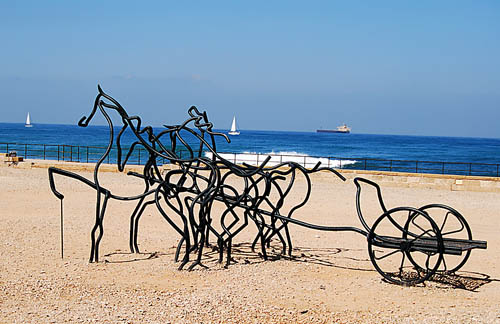
Herod the Great built a hippodrome along the coast at Caesarea Maritima in 10 B.C. to celebrate the opening of the city. In the second century A.D. the south side of the hippodrome was reconstructed as an amphitheater to be used for gladiatorial contests. New sections with beautiful frescoes have been uncovered.

This metal sculpture has been erected on the north end of the hippodrome along the beautiful Mediterranean.

View in the hippodrome at Caesarea Maritima. Photo by Ferrell Jenkins.

View from the hippodrome at Caesarea Maritima. Photo by Ferrell Jenkins.

The theater we showed in the previous post is on the south end of the hippodrome. The harbor built by Herod the Great is a little to the north of the hippodrome. The apostle Paul was in prison at Caesarea for two years between A.D. 58 and 60 (Acts 23:23 – 26:32).

We discussed Paul’s possible use of the charioteer in Philippians 3:12-14 here.

New paintings of the hippodrome mosaics. Photo by Ferrell Jenkins.

New paintings of the hippodrome frescoes. Photo by Ferrell Jenkins.

Caesarea Maritima

Caesarea Maritima was a first century Roman capital and seaport. The gospel was first preached to the Gentiles here when Peter came from Joppa to Caesarea to tell Cornelius words by which he could be saved (Acts 10, 11).

Herod the Great built a city on the site of Strato’s Tower and named it Caesarea in honor of Caesar Augustus. It became a center of Roman provincial government in Judea. The city had a harbor and was located on the main caravan route between Tyre and Egypt. This city is called Caesarea Maritima (on the sea) to distinguish it from Caesarea Philippi.

The theater, now restored, was built originally by Herod the Great. Others added to and modified the theater in later centuries. The seating capacity is about 4000. Between the theater and the Mediterranean Sea is an open area in which numerous building fragments are displayed in a park-like environment. In the foreground we see the base of a column.

The restored theater at Caesarea Maritima. Photo by Ferrell Jenkins.

The restored theater at Caesarea Maritima. Photo by Ferrell Jenkins.

An inscription with the name of Pontius Pilate, the Roman procurator, was found during the reconstruction of the theater June 15, 1961.

The Apostle Paul used the harbor at Caesarea several times. He was imprisoned here for two years before departing for Rome (Acts 24:27; 27:1).

Underground quarry discovered in Jordan Valley

Israeli papers are reporting the discovery of an underground quarry in the Jordan Valley. Prof. Adam Zertal and a team of archaeologists from the University of Haifa are working on the hypothesis that this is the site of biblical Gilgal.
The biblical account in Joshua reads,
Now the people came up from the Jordan on the tenth of the first month and camped at Gilgal on the eastern edge of Jericho. Those twelve stones which they had taken from the Jordan, Joshua set up at Gilgal. (Joshua 4:19-20 NAU)
The report in Ha’aretz gives more information about the discovery.

A spectacular underground quarry has recently been discovered in the Jordan Valley north of Jericho, which archaeologists believe may have marked a biblical site sacred to ancient Christians.

The large cave was discovered by Prof. Adam Zertal and a team from the University of Haifa which has been conducting a survey of the region since 1978. “When we reached the entrance to the cave, two Bedouin approached us and warned us not to go in, because it was cursed and inhabited by wolves and hyenas,” Zertal said yesterday from the site.

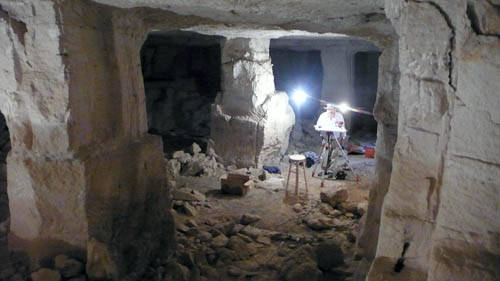
They entered anyway, discovering a ceiling supported by 22 gigantic columns on which various symbols were carved, including 31 crosses, a possible wheel of the Zodiac and a Roman legionary symbol. The columns also had niches for the placement of oil lamps and holes that apparently served as hitching posts.

Jordan Valley cave. Photo courtesy of University of Haifa.

Jordan Valley cave. Photo courtesy of University of Haifa.

The Ha’aretz article continues,

Zertal says their working theory is that the site is Galgala, biblical Gilgal, mentioned on the sixth-century Madaba mosaic map. The cave, buried 10 meters underground, is about 100 meters long, 40 meters wide and 4 meters high, is the largest artificial cave so far discovered in Israel.

Potsherds found in the cave and the carvings on the columns led Zertal to date the first quarrying of the cave to around the beginning of the Common Era. It was used mainly as a quarry for 400 to 500 years, “but other finds give the impression it was used for other purposes, perhaps a monastery or even a hiding place,” Zertal said.

Zertal said scholars wondered why people would dig a quarry underground considering the effort needed just to pull the stones out of the ground.

A possible answer may be in the famous Madaba Map of ancient Palestine, found in Jordan. In it, a place named Galgala is marked and an accompanying Greek word meaning “12 stones.” The map also depicts a church near the site. Archaeologists say they have found two ancient churches near the cave.

According to Zertal, scholars had always assumed that “12 stones” referred to the biblical story of the 12 stones the Israelites set up at Gilgal after they crossed the Jordan. However, the discovery of the quarried cave may mean the reference was to a quarry established where the Byzantines identified Gilgal. Zertal explains that in antiquity sanctuaries were built out of stones from sacred places.

If the Byzantines identified the site as biblical Gilgal, it would have been considered sacred and quarrying would have remained underground to preserve it.

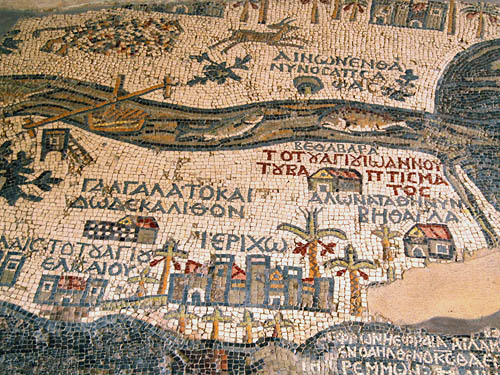
Here is a photo of a portion of the Madaba Map that I made last year.

Madaba Map showing Gilgal, Jericho, Jordan River. Photo by Ferrell Jenkins.

Madaba Map showing Gilgal, Jericho, Jordan River. Photo by Ferrell Jenkins.

This portion of the map shows the northern end of the Dead Sea and the Jordan River. You will notice fish turning around when they reach the Dead Sea. I think everyone can make out the city of palm trees, IERIXW (Jericho, Deuteronomy 34:3). To the north of Jericho, and a little east toward the river, is the site of Gilgal.

The inscription reads “Galgala, also the twelve stones.” Below the inscription is a small church with its entrance hidden by a long structure with 12 white spots on it (two rows of six). The Madaba map is dated to about A.D. 560 to 565. You may read more about the Madaba Mosaic Map here.

HT: Joseph I. Lauer

UPDATE: A short video showing the cave and featuring Dr. Zertal is available from BBC here.