Category Archives: Archaeology

Main E-W Byzantine Road uncovered in Jerusalem

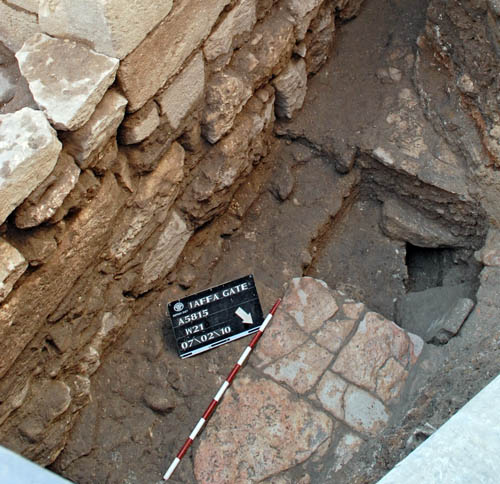
The Israel Antiquities Authority announced today the discovery of the main East-West road of Jerusalem from the Byzantine period. Todd Bolen correctly guessed yesterday, after the IAA sent out a teaser, that this discovery would be the Decumanus of the city.

A portion of the broken flagstone pavement is shown below about 4.5 meters below the present street level. That is 14.76 feet — pretty close to the proverbial one-foot-per-century of debris buildup.

Remains of 1500 year old street. Photo: Assaf Peretz, IAA.

Remains of 1500 year old street. Photo: Assaf Peretz, courtesy IAA.

Below is a photo of the Madaba [Medeba], Jordan, mosaic map of Jerusalem from about A.D. 560-565. I have put red lines on each side of the road that has been discovered. The main north-south road, the Cardo, was discovered in the 1970s.

The original Madaba mosaic map with new discovery marked. Photo by Ferrell Jenkins.

The original Madaba mosaic map with new discovery marked. Photo by Ferrell Jenkins.

The IAA explains how the excavation came about.

Various evidence of the important buildings in Jerusalem that appear on the map has been uncovered over the years or has survived to this day – for example the Church of the Holy Sepulcher – but the large bustling street from the period when Jerusalem became a Christian city has not been discovered until now. The reason for this is that no archaeological excavations took place in the region due to the inconvenience it would cause in stopping traffic in such a busy central location.

Now, because of the need for a thorough treatment of the infrastructure in the region, the Jerusalem Development Authority has initiated rehabilitation work and is renewing the infrastructure in this area in general, and next to the entrance to David Street (known to tourists as the stepped-street with the shops) in particular. Thus it is possible for both archaeologists and the public to catch a rare glimpse of what is going on beneath the flagstone pavement that is so familiar to us all.

The full IAA report is here. The Arutz Sheva article includes a short video featuring an interview with Dr. Ofer Sion, the excavation director.

HT: Joseph Lauer

Those lost books of the Old Testament

Now the rest of the acts of Amaziah, are they not written in the Book of the Chronicles of the Kings of Judah? They conspired against him in Jerusalem, and he fled to Lachish; but they sent after him to Lachish and killed him there. Then they brought him on horses and he was buried at Jerusalem with his fathers in the city of David. (2 Kings 14:18-20 NAU)

A few weeks back Dr. Claude Mariottini posted a list of 33 books mentioned in the Old Testament that have not survived. I suggest you capture this list and save it for use in future studies. The link is here.

Think what we might learn about Amaziah (796-767 BC) and the fortress city of Lachish if we had access to this book. Does this mean that the Bible is not complete for its purpose? I would say, “Absolutely not.” The Bible reveals God’s plan for the salvation of man. An important part of that plan is worked out in the history of His people Israel.

We learn better how to understand the Bible through other historical records, archaeology and the study of the land of the Bible. The aerial photo of Tel Lachish gives an impression of the possibility of the city serving as a place of refuge for King Amaziah.

Aerial view of Tel Lachish. Photo by Ferrell Jenkins.

Aerial view of Tel Lachish. Photo by Ferrell Jenkins.

Prof. Donald Wiseman – 1918-2010

The passing of Professor Donald Wiseman is reported by Rob Bradshaw here.

Wiseman was well known as an Old Testament scholar. The bibliography of his writings is extensive. His Illustrations from Biblical Archaeology, published in 1958, has been one of the most practical and helpful books in my library. Wiseman read the small Babylonian Chronicle for 605-594 B.C. in the British Museum in 1955. He describes the document in these words:

The events described include the Battle of Carchemish and the accession of Nebuchadnezzar II in 605 BC. The fifth paragraph related the capture of Jerusalem on March 16th, 597 BC, the appointment of Zedekiah as king and the removal of Jehoiachin and other prisoners to exile in Babylonia. (Illustrations from Biblical Archaeology 69)

Babylonian Chronicle for 605-594 B.C.

Babylonian Chronicle for 605-594 B.C. Photo by Ferrell Jenkins.

The Biblical account of these events is recorded in 2 Kings 24:10-17.

HT: Bible Places Blog.

Fox News slideshow of recent archaeology

The slide show Digging Up History: The Latest Archaeology News at Fox News includes a several photos of discoveries of interest — including some we have mentioned in previous posts.

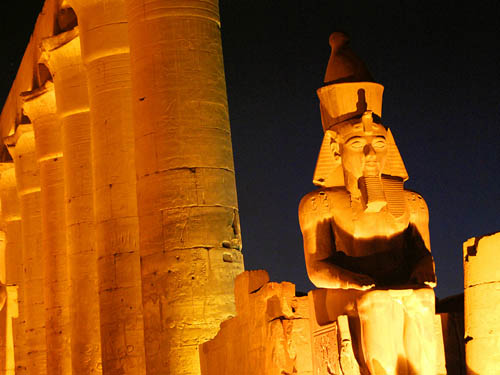
  • The Alley of Sphinxes at Luxor, Egypt, from the 12th century B.C. Work had just begun on this street connecting Karnak Temple with Luxor Temple when we visited in January, 2008.
  • Tombs of the Pyramid builders.
  • Ptolemaic temple of Bastet in Alexandria.
  • Restoration of the Monastery of St. Antony near Suez City, Egypt.
  • Stolen artifacts seized by police in Limassol, Cyprus. The report says the deal is estimated to be worth $15.5 million.

See the full show here.

Court of Rameses II in the Luxor Temple. Photo by Ferrell Jenkins.

Court of Rameses II in the Luxor Temple. Photo by Ferrell Jenkins.

HT: Brooks C.

Sitting in the gate

The practice of “sitting in the gate” may not be as understandable to our generation as it was to people of Bible times. During many biblical periods the gates were constructed of multiple chambers or rooms. The “Solomonic” Gate at Gezer has six chambers — three on each side of the entry. The photo below was made from inside the city of Gezer.  We see a nice bench made of individuals stones in the chamber at the bottom of the photo.

Note the seats (benches) in a gate chamber at Gezer. Photo by Ferrell Jenkins.

The practice of sitting in the gate is mentioned in numerous biblical references. Note a few.

  • Lot was sitting in the gate of Sodom (Genesis 19:1).
  • Abraham went to the gate to make arrangements to buy a burial place for Sarah (Genesis 23:10).
  • Boaz went to the gate of the city to make arrangements to marry Ruth (Ruth 4). One could easily find witnesses in the gate.
  • David sat at the city gate (2 Samuel 19:8).
  • When David was persecuted he said, “Those who sit in the gate talk about me” (Psalm 69:12). It was a good place to find the latest gossip.

What we see in these references is equivalent to what happens in many of our small towns when men of the city sit on benches around the court house or city center to talk about the weather, politics, religion, and whatever.

Ferrell Jenkins sitting in the gate at Gezer. Photo by Leon Mauldin.

Ferrell Jenkins sitting in the gate at Gezer. Photo by Leon Mauldin.

Wisdom is pictured as being beside the gate, at the opening of the city.

Beside the gates, at the opening to the city, At the entrance of the doors, she cries out: (Proverbs 8:3 NAU)

Speaking at Florida College lectures

This is the week for the annual Bible lectures at Florida College in Temple Terrace, FL. Even though I retired from teaching in 2001, I have been invited to speak each year. Most of these have been lectures that do not require writing a manuscript for publication. That is my preference, of course.

Yesterday I spoke in Puckett Auditorium on Roads and Seas Less Traveled. For a 45 to 50 minute presentation I had to be very selective. I explained what I meant by the title. I was speaking of places (roads and seas) that tourists rarely visit. I limited myself to the land of Goshen and Malta.

Using a map, I showed the location of the land of Goshen in the eastern Nile Delta. This is where Jacob’s family settled when they went from Canaan to Egypt (Genesis 45:10), and where they grew to a nation and spent time in bondage. This area was also called the “land of Rameses.”

Then Joseph settled his father and his brothers and gave them a possession in the land of Egypt, in the best of the land, in the land of Rameses, as Pharaoh had commanded. (Genesis 47:11 ESV)

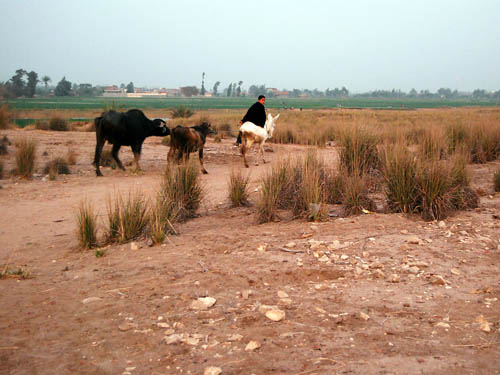
Dr. Manfred Bietek of the Austrian Institute in Cairo has excavated since the mid-1960s at Tell el-Dab’a, Ezbet Helmi, and Qantir. All of these sites are located a few miles north of modern Faqus in the eastern Delta. I have taken my tour group to visit sites in Goshen on two tours, but tourists are not allowed to visit Tell el-Dab’a. In fact we were not allowed to get off the bus to make photographs of the canal that follows the path of the ancient Pelusiac branch of the Nile. I have a friend in Egypt who knows the territory and offered to take me to visit some of these places. We went late in the afternoon. In fact, by the time we arrived at Tell el-Dab’a it was already dark.

Here is the original photo:

Tell el-Dab'a in the Eastern Nile Delta. Photo by Ferrell Jenkins.

Tell el-Dab'a in the Eastern Nile Delta. Original Photo by Ferrell Jenkins.

After a little work in Photoshop, the photo looks as if it were taken during a hazy day.

Tell el-Dab'a in the Eastern Nile Delta. Photo by Ferrell Jenkins.

Tell el-Dab'a in the Eastern Nile Delta. Photo by Ferrell Jenkins.

In the original larger photo it is easy to see shards of pottery scattered in the area.

The children of Israel once lived in this flat, fertile area of Egypt. In fact, if this is indeed the land of Rameses, the Israelites departed from this region for the promised land (Exodus 12:37).

A fuller discussion about the Land of Rameses may be read here.

A scholarly article by Dr. Bryant  G. Wood about New Discoveries at Rameses is available at the Associates for Biblical Research web site here. I also recommend the article on Israel in Egypt by Gary Byers at the same site (here).

William G. Dever on Solomon and the Revisionists

Benjamin Hawkins reports on a recent lecture  by William G. Dever at the Southwest Baptist Theological Seminary. The headline says, “Scholar counters attacks on existence of Solomon’s kingdom.”

Contesting the views of revisionist scholars, world-renowned archaeologist William G. Dever defended the existence of an Israelite state in Palestine during the 10th century B.C., the biblical era of Solomon’s reign.

Dever, a leading figure in biblical archaeology for nearly half a century, was the guest speaker for Southwestern Baptist Theological Seminary’s Biblical Archaeology Lecture sponsored by the seminary’s Charles D. Tandy Archaeology Museum and Tandy Institute of Archaeology.

“Tonight, I want to talk about the age of Solomon, but before I do that, I want to set it up by telling you something about a school of European biblical scholarship,” Dever said. “These people call themselves revisionists because they are rewriting the history of ancient Israel, but when they finish, there is no history. They call themselves revisionists. I call them nihilists.”

According to Dever, the revisionist scholars deny that an Israelite united monarchy, like the biblical kingdom that flourished under Solomon, ever existed. Dever contested this claim, arguing that the archaeological evidence confirms the existence of a centralized Israelite state in 10th century Palestine.

According to a “wonderful, detailed description” in 1 Kings 9:15-17, the Egyptian pharaoh attacked and destroyed the city of Gezer, Dever said. The pharaoh then gave the city as a dowry to his daughter when she married Solomon. The passage then states that Solomon fortified or refortified four sites: Hazor, Megiddo, Gezer and Jerusalem.

“Wouldn’t it be wonderful if we had archaeological evidence from those sites for an early stage? Well, we do,” Dever said. “And what do you suppose the revisionists make of this evidence? They just ignore it, because it is inconvenient for their theories.”

Dever reported that excavations, especially at Hazor, Megiddo and Gezer, have uncovered “monumental architecture” that cannot be explained without reference to a centralized government. The architecture of each of these cities is adapted to topography for strategic military advantage, but all the cities show the same structural patterns, such as six-chambered gates, double or casemate fortification systems, similar palace structures and Phoenician masonry (according to 1 Kings, Solomon utilized Phoenician craftsmen in his building projects).

These architectural structures can be dated to the 10th century B.C., Dever said, with reference to stratigraphy, ceramic typology and ancient Egyptian chronology. This process is aided by the discovery of destruction levels, filled with rubble and showing evidence of fires “so fierce that it melted the limestone and it flowed down like lava.” According to Dever, the destruction can be attributed to the military invasions of the Egyptian Pharaoh Sheshonq, that is, the biblical Shishak (1 Kings 14 and 2 Chronicles 12).

“At one time, there stood a monumental Egyptian inscription at the site of Megiddo celebrating the destruction by Shishak,” Dever said. Shishak was the first pharaoh in the 22nd Egyptian dynasty, and archaeological evidence shows that he raided Palestine in the late 10th century B.C. Amid the rubble of destruction, archaeologists also have discovered the hand-burnished pottery characteristic of the 10th century. According to Dever, this implies that the monumental architecture that Shishak and his army destroyed “must have been built a generation or so earlier — and that places us precisely in the middle of the reign of Solomon.”

Here is another of the aerial photos I made of Gezer in December. This one shows what many archaeologists have called the Solomonic Gate at the bottom of the photo. The new excavation under the direction of Steve Ortiz is Field A. Click for a larger image.
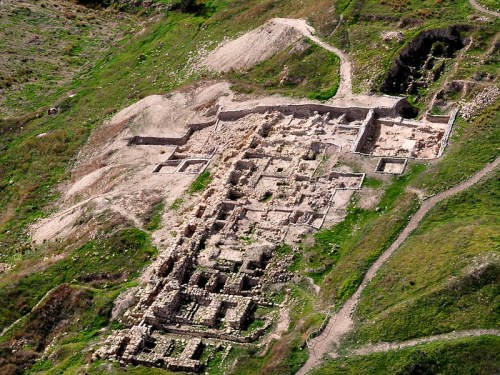
Solomonic Gate and Field A at Gezer. Photo by Ferrell Jenkins 2009.

Solomonic Gate and Field A at Gezer. Photo by Ferrell Jenkins 2009.

Dever explains why there isn’t evidence from the 10th century B.C. in Jerusalem.

“Of course, the revisionists argue that, ‘Well, you’ve never found anything from the 10th century, nothing monumental in Jerusalem.’ That’s true, because we never were able to excavate [in Jerusalem],” Dever said. Jerusalem was the fourth city that Solomon refortified, and it was the center of his kingdom. Despite the lack of access to the archaeological evidence that lies below modern Jerusalem, Dever argued that biblical descriptions of Solomon’s Temple resemble other 10th-century temples in the Middle East.

“All the descriptions in the Hebrew Bible,” Dever said, “make good sense in the light of what we know about ancient architecture.”

Revisionist scholars also contend that a centralized state could not have existed in 10th century Israel because literacy was not widespread, and the knowledge of reading and writing is necessary for the administration of a kingdom. Archaeological evidence like the Gezer calendar, however, has shown that even in rural areas young boys were learning to read during the 10th century and earlier, Dever said.

Encouraging Southwestern to remain involved in biblical archaeology, Dever said the seminary’s ongoing excavations at Tel Gezer would play an important role in affirming the existence of a united Israelite monarchy in 10th-century Palestine. Southwestern Seminary has led excavations at Tel Gezer under the supervision of Steven Ortiz, professor of archaeology and biblical backgrounds, since 2006.

While Dever affirmed the importance of ministerial training in his Nov. 3 lecture, he encouraged students to study archaeology and urged Southwestern to train biblical archaeologists who can challenge the skeptics in the field. Biblical archaeology, especially in the United States, is in “disarray,” he said. Many academic programs are floundering, and some have been shut down or replaced by academic programs emphasizing modern Middle Eastern studies.

“I always say to my Israeli colleagues, ‘The archaeology of Israel is too important to be left to you alone. This is our Holy Land, too.’ So we have to be involved, even though the Israelis dominate the field,” Dever said. “You have a unique opportunity at this particular juncture in time. Step in. There is not a lot of competition. Step in, and do something significant.”

Underscoring the need for rigorous academic training, Dever said, “Don’t ever apologize for your faith, or for the Bible, or for the Western tradition, or for being an American. Fight, and make sure you have the facts on your side.”

To learn more about Southwestern Seminary’s involvement in biblical archaeology, visit swbts.edu or gezerproject.org here.

One may not always agree with Dever, but one can not say that he did not make his point clearly. The gezerproject web site is out of date. I would like to see it updated soon.

The full report may be read here. © Copyright 2010 Baptist Press.

Worship of Bastet extended to the Ptolemaic Period

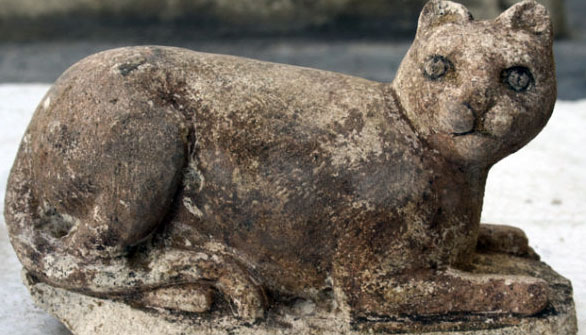
Fox News reported here recently on the discovery of a Greek temple dedicated to the Egyptian cat goddess Bastet.

Egyptian archaeologists unearthed the remains of an ancient Greek temple dedicated to Egyptian cat goddess Bastet in the Mediterranean city of Alexandria, the antiquities department said Tuesday.

The mission, led by Mohamed Abdel Maqsoud, head of Antiquities of Lower Egypt, discovered the remains of a temple of Queen Berenike, the wife of King Ptolemy III who ruled Egypt between 246 and 222 B.C., in the Kom al Dikka area in Alexandria.

“The discovered remains are 196 feet tall and 49 feet in width,” antiquities chief Zahi Hawass said in a statement. He said the temple was “subjected to destruction during later eras when it was used as a quarry, which led to the disappearance of many of its stone blocks.”

A group of 600 Ptolemaic statues were also unearthed during the routine excavations, including a large collection of icons depicting Bastet, goddess of protection and motherhood.

The discovery in Kom al Dikka is the first Ptolemaic temple discovered in Alexandria to be dedicated to the goddess Bastet, Abdel Maqsoud was quoted as saying in the statement.

“It indicates that the worship of the goddess Bastet continued in Egypt after the decline of the ancient Egyptian era,” he said.

The Ptolemaic period marks the Greek rule of Egypt from 305 B.C. until the Roman conquest in 30 B.C.

Alexandria became the capital city of Ptolemaic Egypt and thrived as the center of Greek culture and trade.

Bastet. Discovered at Alexandria. AP photo.

Image of Bastet, the cat goddess of Egypt, discovered at Alexandria. AP.

Egypt was noted for the worship of numerous gods. The plagues of Egypt were a judgment against “all the gods of Egypt” (Exodus 12:12). Later, in the time of the prophet Jeremiah, the LORD again warned of judgment upon the gods of  Egypt (Jeremiah 43:12-13).

Every time I read Paul’s discussion about the condition of the Gentiles I think of the gods of ancient Egypt.

Professing to be wise, they became fools,  and exchanged the glory of the incorruptible God for an image in the form of corruptible man and of birds and four-footed animals and crawling creatures. (Romans 1:22-23 NAU)

Bubastis in ancient Egypt was especially devoted to Bastet. The ruins of the city are now surrounded by the city of Zagazig in the Eastern Delta. It was mentioned by the prophet Ezekiel under the name Pi-beseth (Ezekiel 30:17).

Prof. Christian Tietze and a team of Egyptian archaeologists have been working at Tell Basta (Bubastis).

Prof. Christian Tietze and Ferrell Jenkins at Tell Basta, Egypt, 2005.

Prof. Christian Tietze and Ferrell Jenkins at Tell Basta, Egypt, 2005.

The new discovery from Alexandria in the Ptolemaic period shows that the worship of Bastet continued, and was more wide spread than commonly thought.

No honor among thieves

A headline in Haaretz says, Burglars swipe artifacts from ‘Antiquities Thieves’ exhibit.

Yanir Yagna writes:

In a display of what might be called ironic chutzpah, burglars broke into an Ashdod museum this week and stole silver coins from the Hellenistic period and other archaeological finds that were part of an exhibit called “Antiquities Thieves in Israel.”

The exhibit, at the Korin Maman Museum, displayed artifacts that the Israel Antiquities Authority had previously recovered from antiquities thieves. Now it seems the authority will have to begin its hunt all over again.

The burglars neutralized the alarm system Tuesday night and stole a bronze spear, two gold earrings, some pottery and the silver coins, which feature the image of Alexander the Great.

“It’s one of the weirdest things that ever happened here,” said a museum employee. “Someone actually went and stole the robbers display.”

The full report is here.

HT: Joe Lauer

Pyramids built by free men?

A recent article in Haaretz, and several other sources, says new information indicates that the great pyramids of Egypt were built by free workers, rather than slaves.

Tombs discovered in recent years near the Great Pyramids in Egypt may reveal that the builders of the famed monuments were free workers, rather than slaves, as is commonly thought. The discovery of the tombs also showed that the workers received pay, food and lodging near the construction site, the Egyptian Antiquities Ministry said yesterday.

Egyptian archaeologists said they found evidence of settlements near the pyramids of Khufu and Khare, at Giza near Cairo.

Popular culture has long depicted slaves toiling away in the desert to build the mammoth pyramids only to meet a miserable death at the end of their efforts. The new tombs, which are approximately 4,100 years old, may dispel these myths.

“These tombs were built beside the king’s pyramid, which indicates that these people were not by any means slaves,” Zahi Hawass, the chief archaeologist heading the Egyptian excavation team, said in a statement.

Hawass said evidence had been found showing that farmers in the Delta and Upper Egypt had sent 21 buffalo and 23 sheep to the plateau every day to feed about 10,000 builders.

The builders were rotated every three months and those who died on the job were buried in these tombs.

The full report is here.

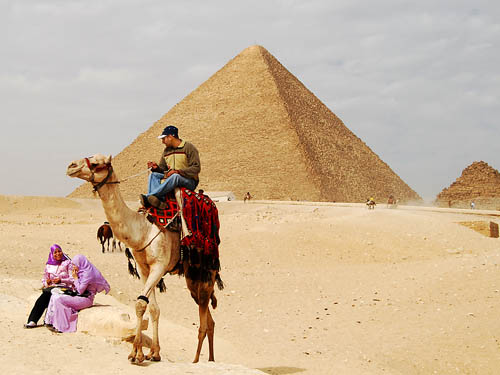
The Giza Pyramids. Photo by Ferrell Jenkins.

The Giza Pyramids. Photo by Ferrell Jenkins.

HT: Biblical Paths.