Category Archives: Archaeology

Hoard of coins from time of Ptolemy III discovered

The Egyptian Supreme Council of Antiquities announced Thursday the discovery of a hoard of 383 bronze coins dating to the time of King Ptolemy III (ruled 246–222 B.C.). The well-preserved coins, found in the Fayoum about 50 miles southwest of Cairo, depict the Egyptian god Amun-Zeus on one side and the words Ptolemy and king in Greek on the other.
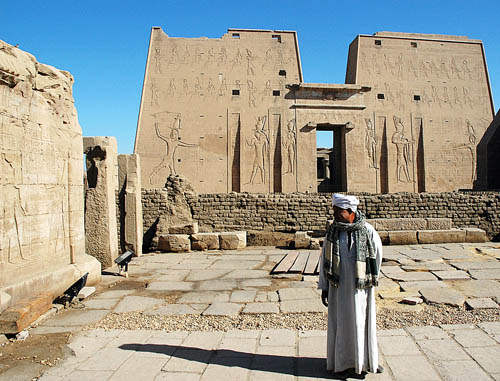
The Edfu Temple begun by Ptolemy III. Photo by Ferrell Jenkins.

The Edfu Temple begun by Ptolemy III. Photo by Ferrell Jenkins.

The famous Alexandria Library was established in the 4th century B.C. by Ptolemy Soter I, or a few years later by his son. The Hebrew scriptures were translated into Greek under the Ptolemaic rulers, beginning about 280 B.C. This Greek version was in common use in the first century. More than half of the quotations from the Old Testament in the New Testament come from the Septuagint (Greek) version. For example, this is the version the man of Ethiopia was reading about the suffering servant:

So Philip ran to him and heard him reading Isaiah the prophet and asked, “Do you understand what you are reading?” (Acts 8:30 ESV)

Philip the evangelist began at that Scripture and preached Jesus to him.

HT: Joseph I. Lauer; various media reports.

Update: Todd Bolen has posted a beautiful photo here of Lake Qarun near the site of the discovery.
Early farming sites uncovered in Syria

The Syrian Department of Archaeology and Museums reports excavations of some farming communities on the Euphrates River in northern Syria dating back to the 10th millennium B.C.

Assistant Director of the Syrian Department of Archaeology and Museums Thaer Yerte said excavations at the site revealed information about the communities that settled on the banks of the Euphrates, uncovering two different areas that include three communal buildings and dozens of circular houses built from limestone and paved with pebbles from the river.

The structures contained various flint tools such as blades, knives, sickles, arrow tips and hatchets, tools used for leatherwork and crafting straw mats, stone mills and pestles, pottery fragments and animal bones and horns, Yerte added.

He pointed out that the first communal building in the site contains a circular hole in the ground 15 meters deep with a diameter of 12 meters, with a clay terrace inside the building containing limestone blocks decorated with engravings of animals, geometrical shapes and the sun. The floor is made of clay tiles painted with lime, while the ceiling is supported by wooden pillars.

The second communal building is circular with a diameter of 7 meters, consisting of five chambers with a square stone support pillar in its center. It contained flint and stone tools, stone pottery, a flint figurine representing a mother goddess, a clay figurine representing a half-human half-animal creature, and ox horns.

The complete article may be read here.

The area in northern Syria and southeastern Turkey along the Euphrates River is known as Paddan-aram in the book of Genesis. This area served as home for several of the biblical patriarchs. See Genesis 25:20; 28:2,5-7; 31:18; 33:18; 35:9,26; 46:15).

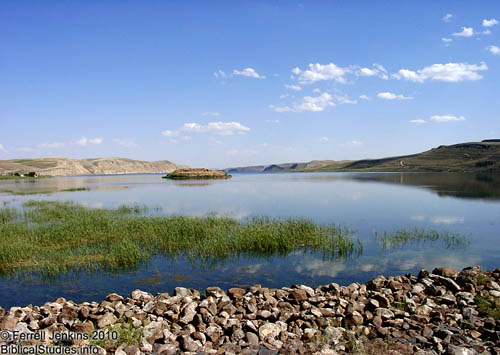
Today’s photo of the Euphrates River was made in northern Syria about 25 miles south of the border with Turkey.

The Euphrates River in northern Syria. Photo by Ferrell Jenkins.

The Euphrates River in northern Syria. Photo by Ferrell Jenkins.

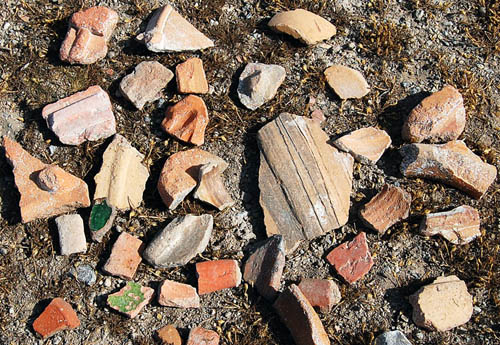
Practical uses of potsherds

Once pottery is broken it appears to be useless. The prophet Jeremiah, prior the Babylonian destruction of Jerusalem, was told by the LORD to buy a piece of pottery. Follow the story:

The LORD told Jeremiah, “Go and buy a clay jar from a potter. Take with you some of the leaders of the people and some of the leaders of the priests. Go out to the part of the Hinnom Valley which is near the entrance of the Potsherd Gate. Announce there what I tell you. (Jeremiah 19:1-2 NET)

Eventually, he was to break the clay jar.

The LORD continued, “Now break the jar in front of those who have come here with you. Tell them the LORD who rules over all says, ‘I will do just as Jeremiah has done. I will smash this nation and this city as though it were a potter’s vessel which is broken beyond repair. The dead will be buried here in Topheth until there is no more room to bury them.’ (Jeremiah 19:10-11 NET)

Broken pottery is clay that has been formed and fired before being broken. David described his weakened condition using an analogy to potsherds:

The roof of my mouth is as dry as a piece of pottery; (NET), or “my strength is dried up like a potsherd” (Psalm 22:15 ESV)

Collected potsherds on the surface of Derbe. Photo by Ferrell Jenkins.

Collected potsherds on the surface of Derbe. Photo by Ferrell Jenkins.

The pottery is now potsherds, sherds, or shards. Is there any practical use for it? Yes.

  • Scraping sores. “Job took a shard of broken pottery to scrape himself with while he was sitting among the ashes.” (Job 2:8 NET)
  • Taking fire from the hearth, or scooping water from a cistern (Isaiah 30:14). This would require a shard from a larger jar.
  • Writing material. When the potsherd is used as a writing surface it is called an ostracon (plural is ostraca). We have some famous examples such as the Lachish Letters, the lots at Masada, the Arad ostraca, Samaritan ostraca, et al.

In Nebuchadnezzar’s vision of the future, the “toes of the feet were partly of iron and partly of clay [pottery, NAU]” (Daniel 2:42). I could have told him this would not work. “Iron does not mix with clay [pottery, NAU]” (Daniel 2:43).

If we move to modern times, there is another practical use for potsherds.

  • Archaeological dating. Potsherds are an indicator of the chronological periods during which a tell was occupied. Flinders Petrie, working at Tell el-Hesi in 1890, observed the relationship between the various layers of the tell and the pottery found in each layer.

Potsherds, sherds, and shards

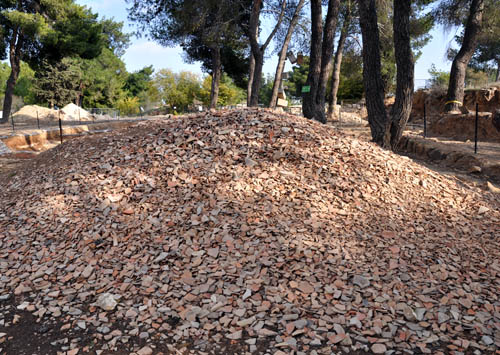
Pottery is the most durable of things discovered during an archaeological dig. Even when the pottery is broken it endures, and can be useful for some purposes. The pieces of broken pottery are called potsherds, sherds, or shards.  Visit any archaeological site and you will see a pile of broken pottery. The largest pile I recall seeing is at Ramat Rachel between Jerusalem and Bethlehem.

A pile of potsherds at Ramat Rachel. Photo by Ferrell Jenkins.

A pile of potsherds at Ramat Rachel. Photo by Ferrell Jenkins.

Cities of biblical times likely had a common place to dump broken pottery. In the days of Jeremiah, Jerusalem had a gate known as the Potsherd Gate.

Go out to the part of the Hinnom Valley which is near the entrance of the Potsherd Gate. Announce there what I tell you. (Jeremiah 19:2 NET)

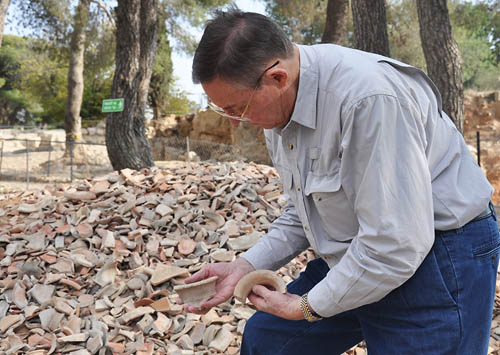
Looking through the pottery shards at Ramat Rachel.

Ferrell Jenkins looking at a rim and a handle at Ramat Rachel. Photo: Leon Mauldin.

Is there any use for this broken pottery? Answer to follow…

Robbers arrested for digging up archaeological site

Illegal digging of archaeological sites is a problem in many countries. Israel reports that at 150 robbers are caught each year. Thievery has been a special problem in Iraq. I have seen archaeological mounds in Turkey with evidence of fresh digging.

Ron Friedman of The Jerusalem Post reports on a recent case in which four men were arrested at a site near Moshav Zechariya. The headline says the men were arrested near Beit Shemesh [Beth-shemesh]. Zechariya is about 6-7 miles south of Beit Shemesh.

The Antiquities Authority revealed on Tuesday that officers from its Unit for the Prevention of Antiquities Robbery arrested four men from Rahat who were allegedly attempting to rob an archeological site near Beit Shemesh on Saturday. The unit’s inspectors caught the men digging a large hole uncovering a network of underground passages in their search for buried treasure they believed to be hidden there.

The men were arrested on the spot and taken by members of the Border Police to the Jerusalem central police station for interrogation. When brought before a judge, the suspects denied the charges and were released on NIS 50,000 bail. The Antiquities Authority spokeswoman said that an indictment charging the men with damaging an archeological site and unlawful digging in an archeological site – offenses that carry five- and three-year sentences, respectively – will be issued in the coming days.

The site where the arrests took place holds the remnants of 3,000 years of habitation, dating back to the days of the First Temple. The site, which was also populated in the Byzantine period 2,000 years ago and during the Crusades 900 years ago, features remains of a fortified wall, various structures, graves and a network of underground caves and tunnels. The alleged robbers destroyed structure walls, and their aggressive digging caused irrecoverable damage to multiple archeological levels.

Amir Ganor, who heads the antiquities robbery prevention unit, was on hand during the arrest and said the damage done by the men was irreversible.

Ganor’s comment about the value of archaeological sites is significant:

Archeological sites belong to the whole public and are human heritage assets. Digging up a site causes irreversible damage. Anything removed from it is taken out of the human inventory. No length of time in prison can make up for or correct the damage that is done to the site. Harming ancient sites is like ripping pages from the cultural history books of the land and its people.

You may read the article in its entirety here.

HT: Joseph I. Laurer

Temples made by man

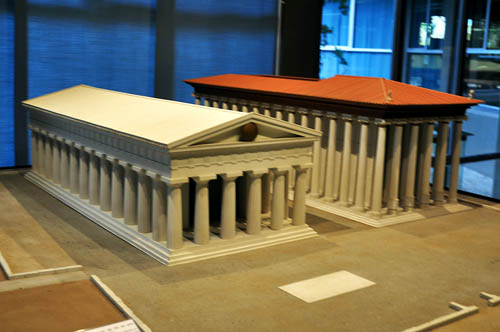
Any Greek or Roman city we visit is surely to have ruins of a theater and a temple. Both Greek and Roman theaters remain at Syracuse (Acts 28:12).The Paoli Orsi Regional Archaeological Museum displays a model of the Temple of Athena (left; 480 B.C.) and the Temple of Artemis (right; 520 B.C.).

Temple models at Syracuse, Sicily, archaeological museum.

Model of Temple Athena and Temple of Artemis. Syracuse. Photo by Ferrell Jenkins.

The Apostle Paul had to contend with this in every Roman city he visited. At Athens he said,

The God who made the world and everything in it, being Lord of heaven and earth, does not live in temples made by man, nor is he served by human hands, as though he needed anything, since he himself gives to all mankind life and breath and everything. (Acts 17:24-25 ESV)

He reminded the Corinthians, who lived in a city filled with temples,

For although there may be so-called gods in heaven or on earth–as indeed there are many “gods” and many “lords”– yet for us there is one God, the Father, from whom are all things and for whom we exist, and one Lord, Jesus Christ, through whom are all things and through whom we exist. (1 Corinthians 8:5-6 ESV)

Solomon’s temple in Jerusalem, as well as the later temples built by Zerubbabel and Herod, were made with hands. Paul certainly knows this. But he also knows what Solomon said about the same subject:

“But will God indeed dwell on the earth? Behold, heaven and the highest heaven cannot contain you; how much less this house that I have built! (1 Kings 8:27 ESV)

Read the full account of the building and dedication of the temple in 1 Kings 6-8. The temple was a place of worship, but it was not to be the object of worship.

Jesus taught His disciples to pray like this: “Our Father in heaven, hallowed be your name” (Matthew 6:9).

Judean Desert scholar Hanan Eshel dead

Word comes of the passing of Professor Hanan Eshel. Aren Maeir, who taught with Eshel says,

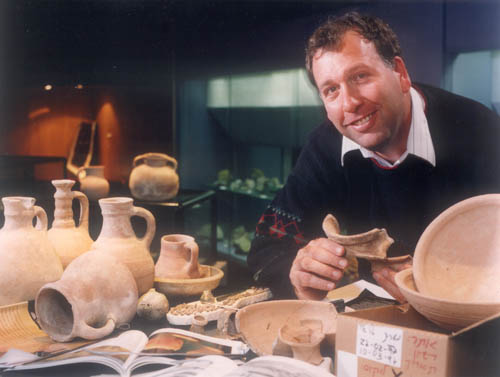
Hanan Eshel, my good friend and colleague from the Department of Land of Israel Studies and Archaeology at Bar-Ilan University, and one of the leading scholars in the field of Dead Sea Scrolls, the Bar Kochba Revolt, and many other issues, passed away last night, after a long illness.

Three field guides (Ein Gedi, Masada, and Qumran) by Hanan Eshel were published by Carta last fall. Todd Bolen provides a report and ordering information here.

The photo is taken here from the Trinity Western University web site here.

Hanan Eshel

HT: Joseph I. Lauer; Aren Maeir

A day of conflict for Jesus

Tuesday of the week of Jesus’ death was a day of great conflict. The tensions between Jesus and the Jewish leaders had been growing for a long time and was about to reach its peak. The Gospel of John records this climax in His ministry.

37 Although Jesus had performed so many miraculous signs before them, they still refused to believe in him, 38 so that the word of Isaiah the prophet would be fulfilled. He said, “Lord, who has believed our message, and to whom has the arm of the Lord been revealed?” 39 For this reason they could not believe, because again Isaiah said, 40 “He has blinded their eyes and hardened their heart, so that they would not see with their eyes and understand with their heart, and turn to me, and I would heal them.” 41 Isaiah said these things because he saw Christ’s glory, and spoke about him. (John 12:37-41 NET)

Not everyone rejected Jesus. John says that many among the rulers believed on Him. Their faith was not strong enough to overcome their fear of being cast out of the synagogue and elicit a confession of Him (John 12:42).

According to the Gospel of Matthew, the chief priests and elders questioned His authority to do the things He was doing. It seems they were especially perturbed that He would dare do these things in the temple courts. That was where they were in control! (Matthew 21:23ff.). The intellectual sparring was followed by His scathing rebuke of them recorded in Matthew 23.

When Jesus and His disciples left the Temple that day to go out to the Mount of Olives, His disciples pointed out the magnificent buildings of the temple that had been constructed by Herod the Great. And the work continued long past the death of Herod in 4 B.C. (John 2:20).

1 Now as Jesus was going out of the temple courts and walking away, his disciples came to show him the temple buildings. 2 And he said to them, “Do you see all these things? I tell you the truth, not one stone will be left on another. All will be torn down!” (Matthew 24:1-2 NET)

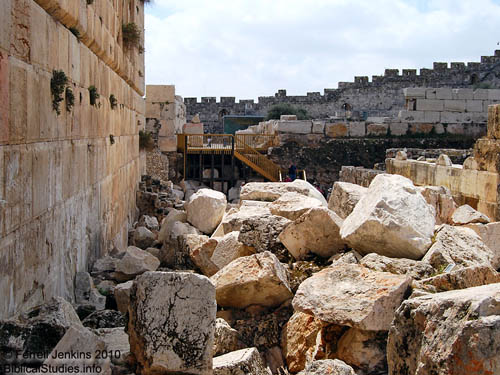
In the Olivet Discourse of Matthew 24 (= Mark 13; Luke 21), Jesus foretold the destruction of Jerusalem by the Roman armies in A.D. 70. The destruction was so complete that only the retaining walls around the Temple precinct were left standing. Archaeological excavations following 1967 have brought to light some of the rubble that was pushed from the platform into the Tyropoeon Valley on the western side. The stones are still impressive.

Broken stones once part of the temple precinct. Photo by Ferrell Jenkins.

Broken stones that once were part of the temple precinct. Photo by Ferrell Jenkins.

Caves where the Dead Sea Scrolls were found

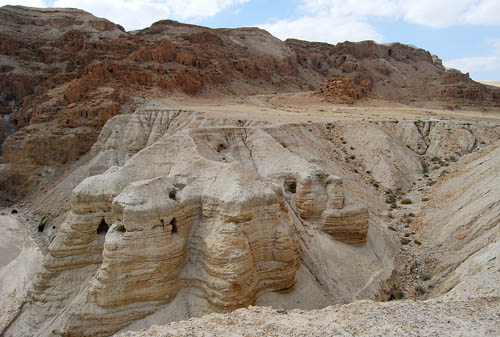
Almost everyone who visits Israel with a tour group makes a stop at Qumran. The guide gets a commission when you buy Ahava beauty products! But that’s o.k. Also, everyone who wishes listens to the story of Qumran and the discovery of the Dead Sea Scrolls. Most folks get a photo of Cave 4 where many of the fragments of biblical books were found.

Qumran Cave 4. Photo by Ferrell Jenkins.

Cave 4 at Qumran. Photo by Ferrell Jenkins.

There are other caves in the area where important scrolls were found. Todd Bolen has written an informative post, especially about how to locate Caves 1 and 2, at the Bible Places Blog here. He even includes a PDF file so you can print the material and carry it with you on your next trip to Israel.

Scholarship or theft?

Someone unknown to me has copied numerous of my posts and posted them at their own site here.

I am delighted for others to use my material with a credit line, but this source includes no indication of the source of the material. It cost me many thousands of dollars to obtain the photos that I use on this page. Gaining permission to use material is not that difficult, and a credit line is certainly required.

You shall not steal. (Exodus 20:15 NAU)

He who steals must steal no longer; but rather he must labor, performing with his own hands what is good, so that he will have something to share with one who has need. (Ephesians 4:28 NAU)

Update Regarding Ethical and Legal Violations (March 27, 2010)

I knew that the person back of the actions mentioned above had done something unethical (sinful, according to the Hebrew Bible and the New Testament). I knew they were in violation of copyright law. After doing a little check, I learned that the practice is an infringement of the agreement made with WordPress, and a violation of the DMCA (Digital Millennium Copyright Act).

After checking the archives of the web site, I learned that this practice has been going on since December, 2009. The owner has used my photos with the same or similar captions, but has removed “Photo by Ferrell Jenkins” or other credits that I included. Outrageous, isn’t it?

Update (March 29, 2010): In response to my letter stating that my material had been plagiarized, WordPress has notified me that the offending web site “has been removed.” Thank you, WordPress. You are a great service.

Update # 2 (March 29, 2010): Soon after the single post that I reported to WordPress was taken down, others were moved to the top of the blog. Later, I reported 40 of my blogs that were copied. Late this afternoon I received this note: “The entire blog has now been removed, as per these multiple reports.”

ArchaeologyExcavations taken down from WordPress.