Category Archives: Archaeology

Useful photo and information sites

Because I maintain the Biblical Studies Info Page, I don’t list a lot of links on this page. I suggest you check the Scholarly page, and then click on the Blogs and Photos. Here are a few sites dealing with archaeology and the Bible World that should be of special interest to readers of this blog. I am not listing the better known sites such as Bible Places Blog, Bible Places, and Holy Land Photos.

  • Through the Land of Israel III. Laju Paul is publishing hundreds of photos from all over Israel.
  • Photographs of Bible Lands. David Padfield, a friend who has traveled with me several times, has a great collection of photos available for download.
  • Leon’s Message Board. Leon Mauldin, a friend who has traveled with me several times, is posting good photos of the Seven Churches of the Book of Revelation and other places he has visited.
  • Bible Walks. Rotem, a young lady who lives in lower Galilee, has posted more than 2500 photos with maps, historical, and biblical information.
  • See the Holy Land. This site, the retirement work of a journalist in New Zealand, intends to serve as a guide to visitors of the Holy Places. (HT: Bible Places Blog)
  • Sacred Destinations. Religious and cultural sites around the world.
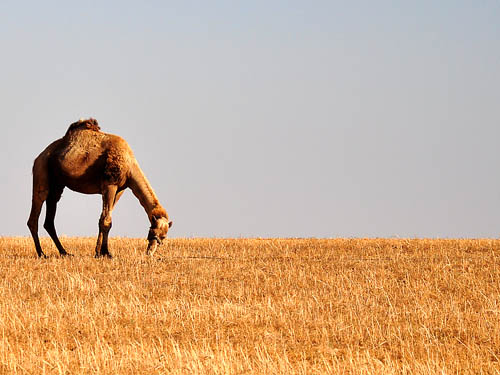
A camel along the road from Beersheba to Arad. Photo by Ferrell Jenkins.

A camel along the road from Beersheba to Arad. Photo by Ferrell Jenkins.

And for her sake he [Pharaoh] dealt well with Abram; and he had sheep, oxen, male donkeys, male servants, female servants, female donkeys, and camels. (Genesis 12:16 ESV)

Israel Museum set to open in two months

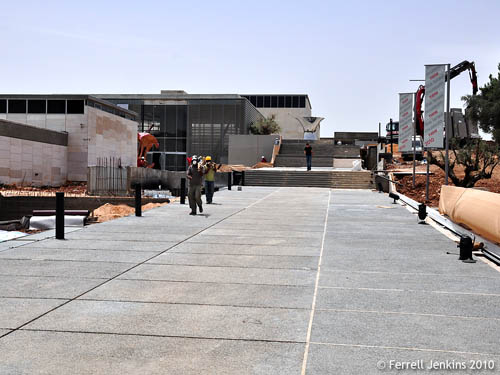
The Bible Places Blog reports here that the Israel Museum, after a lengthy and expensive renovation, is scheduled to reopen July 26. Twice, during the recent trip to Israel, I visited the grounds of the Israel Museum. The last visit to the Second Temple Model was ten days ago. At that time I made a few photos of the work going on outside the museum.

Construction at the Israel Museum - May 17, 2010. Photo by Ferrell Jenkins.

Construction at the Israel Museum - May 17, 2010. Photo by Ferrell Jenkins.

From the outside the Museum looks much the same as before, especially the long, uphill walk to get to the entrance.

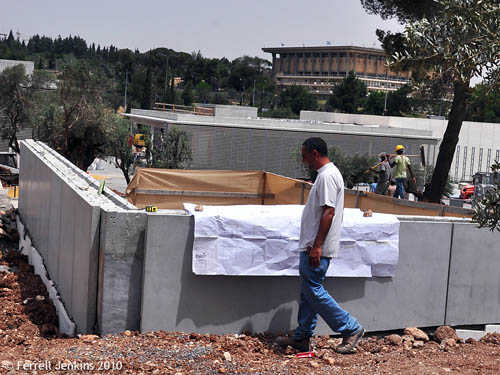
Reading the Blueprint at the Israel Museum - May 17, 2010. Photo by Ferrell Jenkins.

Reading the Blueprint at the Israel Museum - May 17, 2010. Photo by Ferrell Jenkins.

The already impressive location of the Museum campus with the Shrine of the Book, the Second Temple Model and the nearby Israeli Knesset building is sure to be even more impressive.

I look forward to my next visit to Jerusalem when I may again see the wonderful exhibits inside the Museum. The great museums of the world with biblical collections, the British Museum, the Louvre, the Metropolitan in New York, the Istanbul Archaeological Museum, the Oriental Institute of the University of Chicago, the University of Pennsylvania, the National Museum in Athens, and the Pergamum Museum in Berlin, allow photographs of their exhibits. It would be great to see the Israel Museum follow the practice of these outstanding museums. Then, only the museums in Amman, Cairo, and Damascus would be out of step.

HT: Bible Places Blog

Roman altar excavated at Ashkelon

It happens with regularity in Israel. Someone is building. The builder encounter ancient ruins. The Israel Antiquities Authority is called. (I wonder how many times they are not called.) Construction is halted while an emergency excavation is conducted. Amazing discoveries are often uncovered.

This time it happened at Ashkelon during construction of an Emergency Room at the Barzilai Hospital. Here is the account provided by the IAA.

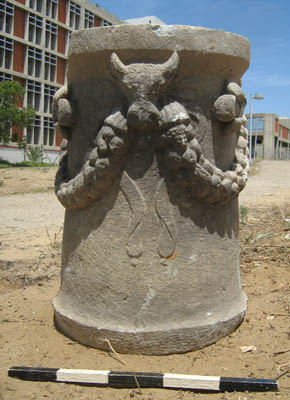
The development work for the construction of a fortified emergency room at Barzilai Hospital, which is being conducted by a contractor carefully supervised by the Israel Antiquities Authority, has unearthed a new and impressive find: a magnificent pagan altar dating to the Roman period (first-second centuries CE) made of granite and adorned with bulls’ heads and a laurel wreaths. The altar stood in the middle of the ancient burial field.

According to Dr. Yigal Israel, Ashkelon District Archaeologist of the Israel Antiquities Authority, “The discovery further corroborates the assertion that we are dealing with a pagan cemetery. It is an impressive find that has survived 2,000 years. The altar is c. 60 centimeters [24 inches] tall and it is decorated with bulls’ heads, from which dangle laurels wreaths. There is a strap in the middle of each floral wreath and bull’s head. The laurel wreaths are decorated with grape clusters and leaves. This kind of altar is known as an “incense altar”. Such altars usually stood in Roman temples and visitors to the temple used to burn incense in them, particularly myrrh and frankincense, while praying to their idols. We can still see the burnt marks on the altar that remain from the fire. The altar was probably donated by one of the families who brought it to the cemetery from the city of Ashkelon”.

Roman altar discovered at Ashkelon. Photo: IAA.

Roman altar discovered at Ashkelon. Photo: IAA.

More information is available from the IAA here.

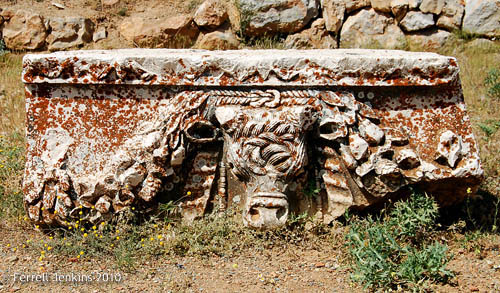
The motif on this altar is common in the Greco-Roman world. The photo below shows a similar bull’s head on what appears to be part of an architectural frieze in the Augustan Imperial Sanctuary at Pisidian Antioch.

From Augustan Imperial Sanctuary at Pisidian Antioch. Photo by Ferrell Jenkins.

From Augustan Imperial Sanctuary at Pisidian Antioch. Photo by Ferrell Jenkins.

The Archaeological Museum in Thessalonica exhibits an altar from the Roman Imperial age (35 B.C.) that, according to the inscription on it, was reused as a pedestal in the temple of Isis in the 2nd century A.D.

Roman Imperial Altar. Thessalonica, Greece, Museum. Photo by Ferrell Jenkins.

Roman Imperial Altar. Thessalonica Museum. Photo: Ferrell Jenkins.

These stones showing garlanded animals remind me of what happened to Paul and Barnabas at Lystra in Lycaonia.

And the priest of Zeus, whose temple was at the entrance to the city, brought oxen and garlands to the gates and wanted to offer sacrifice with the crowds. (Acts 14:13 ESV)

HT: Joseph Lauer and numerous blogs. Note especially the comments on the current religious/political comments by Jim West and Aren Maeir about the Ashkelon altar at Zwinglius Redivivus.

Acco, Akko, Acre, Tell el Fukhar

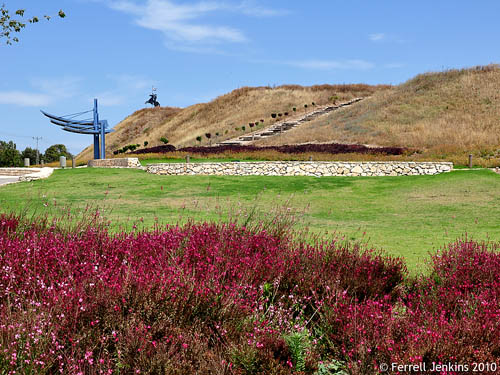
Saterday afternoon we drove from Tiberias to Akko. On my previous tour I failed to get any photos of the ancient tel of Acco (also spelled Akko and Acre). The mound is known as Tell el Fukhar (hill of clay pottery) in Arabic.

Excavations by Prof. Moshe Dothan between 1973-1985 demonstrated that the site was first inhabited in the Early Bronze Age (about 3000 B.C.).

Tel Akko (Acco, Acre). Photo by Ferrell Jenkins.

Tel Akko (Acco, Acre). Photo by Ferrell Jenkins.

Acco is mentioned only once in the Bible. The city is within the territory originally allotted to the tribe of Asher, but the tribe was unable to conquer it.

Asher did not drive out the inhabitants of Acco, or the inhabitants of Sidon or of Ahlab or of Achzib or of Helbah or of Aphik or of Rehob, (Judges 1:31 ESV)

After about 100 B.C. the coastal city was known as Ptolemais (Acts 21:7). Paul spent one day with the brethren here on the return from his third journey.

Friday in lower Galilee

Today we drove from Tiberias past the Horns of Hattin, a site where the Crusaders thought Jesus spoke the beatitudes, through the Bet Netofa Valley to Sepphoris.

Sepphoris is an interesting site with a history dating from the Iron Age to modern times. The site has seen a considerable amount of archaeological excavation. Much of the work has been under the direction of my Temple Terrace neighbor, Dr. James Strange of the University of South Florida.

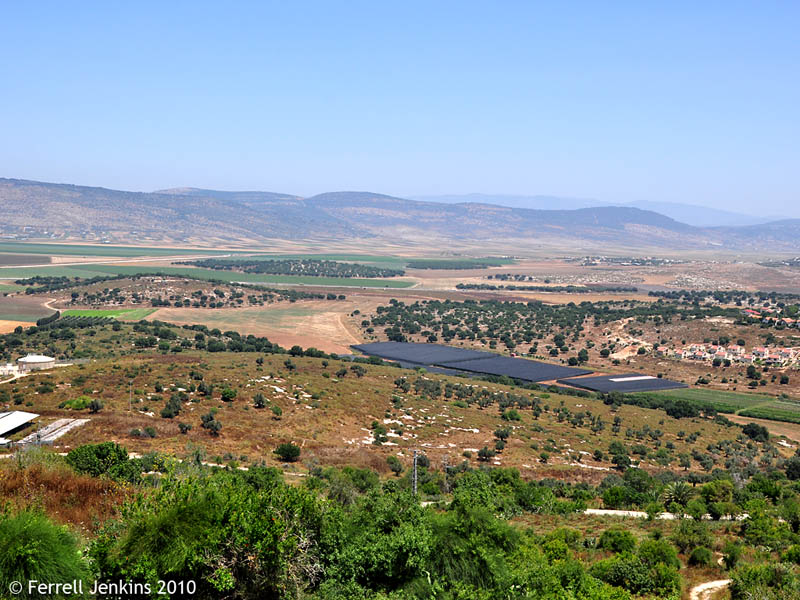
When I asked Elizabeth to select today’s photo, she picked the one I made of the Bet Netofa valley from atop the fortress at Sepphoris. This valley served as a main travel route from Nazareth, Sepphoris, Yodfat, and Cana to the cities around the Sea of Galilee. We think that Jesus must have used this route as he traveled from Nazareth to Capernaum.

And he went down to Capernaum, a city of Galilee.  (Luke 4:31a ESV)

Across the valley to the north is the location of Yodfat, the home of Josephus, and Khirbet Kanna, thought to be the site of Cana of Galilee (John 2). Click on the photo for a larger image.

View of the Bet Notofa Valley north of Zepphoris. Photo by Ferrell Jenkins.

View of the Bet Netofa Valley north of Zepphoris. Photo by Ferrell Jenkins.

We also visited Bethlehem of Galilee, a McDonald’s, and made some photos of Tel Megiddo before returning to our hotel on the shore of the Sea of Gailiee.

After dinner we sat for a while on the deck overlooking the sea. The Sea of Galilee is located in a rift nearly 700 feet below sea level. The heat can be oppressive during the day in this basin. In the evening a pleasant breeze flows in the area; it can even feel cool. I thought of the Biblical text that speaks of Jesus healing the sick and oppressed after sunset.

That evening at sundown they brought to him all who were sick or oppressed by demons. (Mark 1:32 ESV)

The Scriptures are amazing, aren’t they. The Book and the Land blend together to reveal a wonderful harmony and a magnificent Savior.

Ketef Hinnom excavation

In order to reach the Ketef Hinnom excavation one must enter through the Menachem Begin Heritage Center. Jewish Ideas Daily reported May 6th about the neglect of the excavation.

Interestingly, the Heritage Center also hosts an actual biblical site: Ketef Hinnom, or the “Shoulder of Hinnom.” This is a chain of Jewish burial chambers that were carved out of the rock in the 7th century B.C.E.  In 1979, a dig conducted by the archaeologist Gabriel Barkay yielded one of the most significant finds in Israel’s history: tiny rolled-up silver scrolls on whose inner surface is inscribed the Priestly Blessing—”The Lord bless you and keep you . . .” (Numbers 6:24-26)—in ancient Hebrew. These are the oldest surviving texts of the Bible—older than the Dead Sea Scrolls by roughly a half-millennium. Barkay speculates that the scrolls were originally worn “as amulets to give their wearers protection against evil.”

Ketef Hinnom is thus one of the most important sites in the history of biblical archeology. Yet it suffers from serious neglect. The burial chambers lie hidden behind the Heritage Center’s courtyard; you won’t even find a sign pointing you in the right direction. More troublingly, the site is completely exposed to the elements, and in winter months some of the chambers are filled with standing rainwater. Trash is strewn between the graves; unattended foliage grows over the stone.

Read the article in its entirety here.

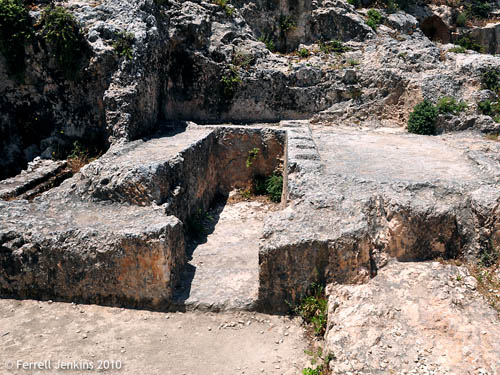
This morning I went to the Begin Heritage Center to visit the Ketef Hinnom excavation. It is true that no signs direct one to the site. In December, and again today, the receptionist pointed me in the right direction.

Ketef Hinnom Iron Age Tomb. Photo by Ferrell Jenkins.

Ketef Hinnom Iron Age Tomb. Photo by Ferrell Jenkins.

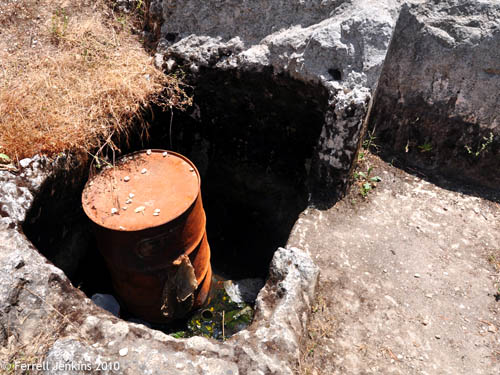
The site was somewhat as described by the Jewish Ideas Daily article.  This photo shows standing water, a rusty drum, and trash only feet from the area shown in the previous photo.

Trash in the Ketef Hinnom Excavation. May 11, 2010. Photo by F. Jenkins.

Trash in the Ketef Hinnom Excavation. May 11, 2010. Photo by F. Jenkins.

HT: PaleoJudaica

A beautiful backdrop for a photo

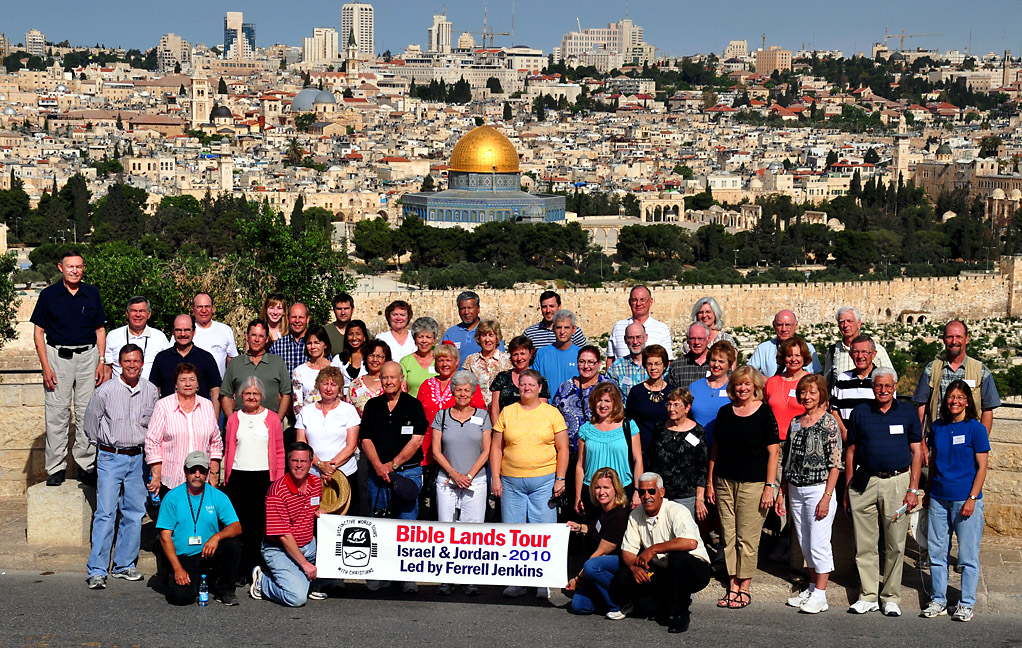
The city of Jerusalem provides a beautiful backdrop for a group photo. We almost always have a photo made of the group from the Mount of Olives with the city of Jerusalem in the background.

Bible Land Tour Group in Jerusalem - May 8, 2010.

Bible Land Tour Group in Jerusalem - May 8, 2010.

At this time of year there are no clouds to be seen, but the sky is clear. Click on the photo of our group of 46 travelers, plus our guide and driver, for a larger image. This will allow you to pick out any of the persons you may know. These folks are from numerous states ranging from the Northwest to Florida and Southern California to the Midwest.

We crossed out of Israel into the region controlled by the Palestinian Authority to visit Bethlehem. There we visited the Church of the Nativity and (one of) the Shepherd’s Fields. Tourists always enjoy shopping in Bethlehem. Specialties include olive wood carvings, mother of pearl, and jewelry. In the past I have enjoyed visiting a store operated by two brothers, but in the years of the Second Intifada they closed the store and moved to the USA where they had gained citizenship.

Today we visited a shop with some history — the Kando Store. One does not have to read very much about the early history of the Dead Sea Scrolls to encounter the name Kando. He was the shopkeeper who bought some of the original scrolls from the bedouin. In those years he operated a store directly across from the American Schools of Oriental Research (now the Albright Institute) in East Jerusalem (then in Jordan). I think it was 1969 (or 1970 or 1971) when Melvin Curry and I went to Kando’s antiquities shop and purchased about $1,000 worth of antiquities for Florida College. Those antiquities are now displayed in the Chatlos Library on the campus in Temple Terrace, FL.  They have been used in the Bible and Archaeology class many times. Today $1,000 would buy only about 4 good Herodian lamps, but we got a nice collection back then.

Kando was a Syrian Christian whose full name was Khalil Iskander Shahin. His name appears many times on the page describing the Dead Sea Scrolls in the Schøyen Collection. His family now operates the Kando Store in Bethlehem. All of the scrolls, and things pertaining to the scrolls, that came to the hands of Kando, have now been disposed of except for the original jar in which the Temple Scrolls was found.

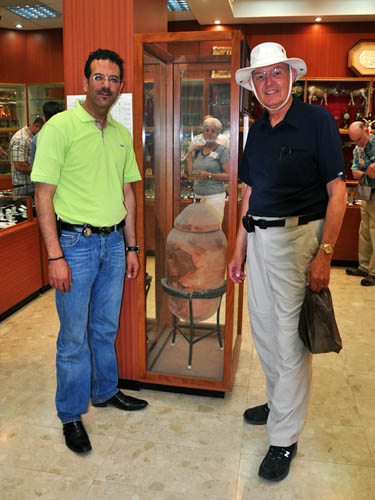
I was pleased to meet Shibly, the grandson of Kando, and have my photo made with him. You can see the original jar in the case between us.

Shibly, grandson of Kando, the Temple Scroll Jar, and Ferrell Jenkins.

Shibly, grandson of Kando, the Temple Scroll Jar, and Ferrell Jenkins.

It was 1956-57 when I began reading about the Dead Sea Scrolls. Being in the Kando Store today was an added excitement to any already great day of touring.

A full day in Jerusalem

Our visits today included the City of David excavations. What a tremendous work has been done here. After visiting the work done by Eilat Mazar, of what she thinks is the palace of David (many think this is an overstatement of the evidence), we visited the work done by Yigal Shiloh from 1978 to 1985, walked through the Canaanite water system, visited the Pool of Siloam, then left the area along steps leading up toward the Temple Mount. At some point along the way we were in the sewer of ancient Jerusalem until exiting on the street. We walked completely around the City of David.

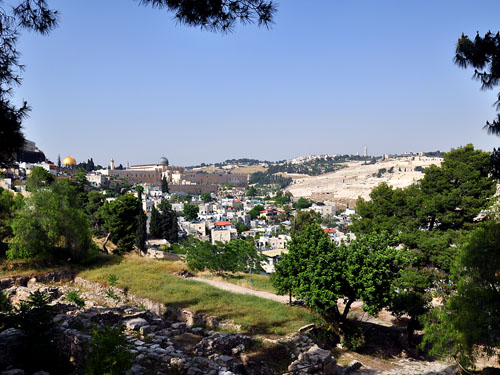
For a photo today I want to share a view of the Temple Mount area to the Mount of Olives. This photo was made from St. Peter in Gallicantu, the supposed house of Caiaphas and Annas.

View of theTemple Mount and Mount of Olives.

View of the Temple Mount and the Mount of Olives. Photo by Ferrell Jenkins.

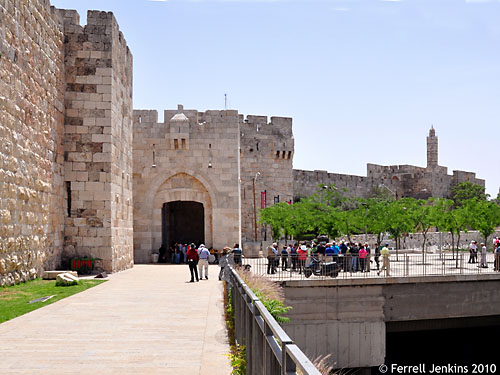
We also visited Jaffa Gate and saw the newly renovated gate.  Here is how it looks today. Nice, I think.

Jaffa Gate - Newly renovated 2010. Photo by Ferrell Jenkins.

Newly renovated Jaffa Gate, 2010. Photo by Ferrell Jenkins.

After visiting the Church of the Holy Sepulcher, the Pool of Bethesda, other sites along the way, and St. Peter in Gallicantu, we returned to the comfort of our hotel.

Things are not always what they seem

Surely I will receive a few links from friends who want to inform me that certain discoveries have been made that should be mentioned on this page. Because I am busy getting ready to leave the country I do not have time to write in detail. Please take a look at the links I suggest for reliable information.

Noah’s Ark Found. Yes, it was reported on major news outlets. See the following links:

Bible Places Blog by Todd Bolen.

Ben Witherington. Be sure to see the Bill Cosby clip, too.

Giant Skeleton Found. Michael Hasel discusses the report of the discovery of skeleton’s of giants in the recent issue of DigSight here. There is also good info on the Khirbet Qeiyafa excavation and ostracon.

Jodanian students work at Umm Qais

Jordanian students from the International Academy Amman spent a week excavating at Umm Qais. The full article may be read in The Jordan Times here.
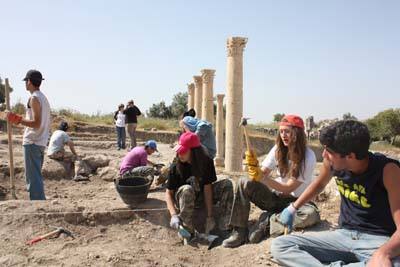
Students from the International Academy in Amman work at Um Qais. Photo by Taylor Luck, Jordan Times.

Students from the International Academy in Amman work at Um Qais. Photo by Taylor Luck, Jordan Times.

Umm Qais (a common spelling) is the site of Gadara, one of the cities of the Decapolis. Mendel Nun discovered 16 ancient ports around the Sea of Galilee, including one for the city of Gadara. He describes Gadara:

Gadara, the most magnificent of the Hellenistic towns that circled the Sea of Galilee, was located on the heights of Gilead above the Yarmuk River. The marine suburb and the city’s harbor were located on the southeastern shore of the lake, at Tel Samra (now Ha-on Holiday Village). In form, Gadara’s harbor resembles that of Sussita—a closed basin with an opening to the south—but it is much larger and more luxurious. The central breakwater is 800 feet long and its base 15 feet wide. The promenade was 650 feet long, built with finely chiseled stones, only one of which remains. The 150-foot-wide basin covered an area of 3 acres.

This harbor is superior to the one at Sussita not only because of its size but also because of its facilities. At the center of the promenade are the remains of a tower. Ruins of a large structure—probably the building of the harbor administration—are scattered on the ground near the harbor gate.

Gadara’s maritime character is attested by its coins, which depicted ships of war for some 250 years. The city’s harbor at Tel Samra was almost certainly not only an anchorage for ships. Second-century coins from Gadara commemorate the Naumachia—naval battle games performed for the inhabitants of Gadara. Until recently, researchers assumed that these games took place on the Yarmuk River, which flows into the Jordan just south of the Sea of Galilee; but this does not seem likely, and no remains of a facility of this kind have been found at this site. The large harbor basin at Tel Samra, however, with its 1,600-foot-long combined promenade and breakwater, would surely have been more suitable to accommodate the throngs of spectators as they arrived. In addition, Gadara’s harbor must have been used by thousands of visitors to the famous baths at Hamat Gader, located 5 miles southeast of the sea. The ancient Roman road connecting Beth Shean and Sussita passed near Tel Samra, and the road to Hamat Gader branched off this road. (Mendel Nun. “Ports of Galilee.” Biblical Archaeology Review 25:04; July/Aug 1999)

From Umm Qais (Gadara) one has a great view of the Sea of Galilee and the Yarmuk River valley. We are told that Jesus visited the region of Decapolis.

Then he returned from the region of Tyre and went through Sidon to the Sea of Galilee, in the region of the Decapolis. (Mark 7:31 ESV)

The Gospel of Matthew informs us about the healing by Jesus of two demon-possessed men in the country of the Gadarenes (Matthew 8:28). Mark puts this event in the country of the Gerasenes (Mark 5:1-20). Luke adds that they “sailed to the country of the Gerasenes, which is opposite Galilee” (Luke 8:26).

The photo below was made in the late afternoon when citizens of the local Jordanian village came out to enjoy the view. The view across the Sea is not clear, but you can see the entire western coast line. In the right foreground you can see a bunker used by the Jordanians in recent wars in the region. The hill directly across from the bunker is the beginning of the Golan Heights. Prior to 1967 this was in Syria. The Yarmuk River flows into the Jordan River south of the Sea of Galilee. All of the significant rivers of Jordan that flow into the Jordan River have dams on them, thus decreasing the amount of water flowing into the Jordan.
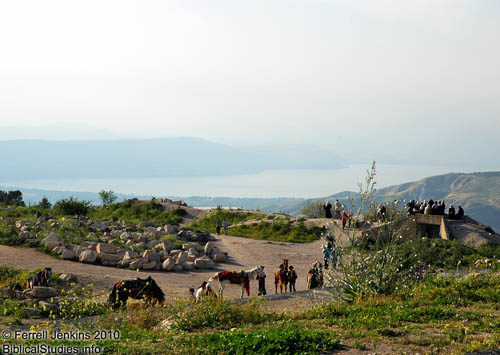
Late afternoon view of the Sea of Galilee from Umm Qais. Photo by Ferrell Jenkins.

The next photo was made in 2002. It shows a portion of the nymphaeum (attractive water fountain) and the Yarmuk Valley.
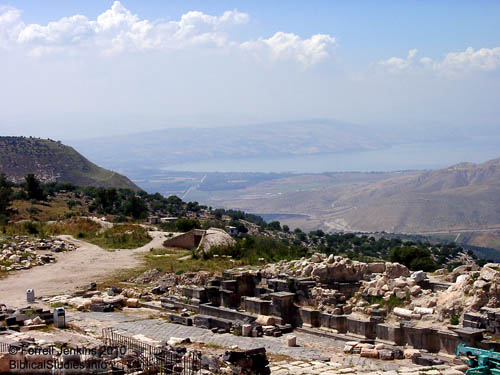
The Sea of Galilee from Umm Qais (Gadara). Photo by Ferrell Jenkins.

The Sea of Galilee from Umm Qais (Gadara). Photo by Ferrell Jenkins.

Todd Bolen posted a beautiful, clear photo that also shows the Yarmuk River valley and the nymphaeum here. Note that the nymphaeum had undergone some reconstruction when his photo was made.

HT: Joseph Lauer