Category Archives: Archaeology

Tired of watching the second hand on your watch?

Well, now your troubles are over. You can watch the Tell es-Safi/Gath Excavation in progress each day (Monday through Friday) at 6 a.m. to 1 p.m., and on Sunday through Thursday from 2:30 p.m. to 4:30 p.m. That is Israel time, which is 7 hours ahead of Eastern time in the USA.

In the Eastern time zone in the USA the live video feed may be seen from 11 p.m. to 6 a.m. (Monday-Friday) and 6:30 a.m. to 8:30 a.m. (Sunday-Thursday). Not the best times for the working American. But, what if it were the World Cup? Same response.

Well, I hope to catch the show beginning tonight at 11 p.m. I will get to watch those young college age volunteers wiping the matter from the corners of their eyes. This all reminds me of the conversations I have with my wife when I travel in Israel and she remains at home. I usually talk at 6 a.m., and she talks at 11 p.m. I say “Good Morning!” and she says “Goood Niighht…”.

Can’t make the show at all? Then go back to other exciting things like watching the second hand on your watch.

Seriously, this is a great thing. I suppose it is a first. Digging into the past streaming live. Dr. Aren Maeir, the director of the Tell es-Safi/Gath dig, keeps us updated on the progress of the dig.

Go to the Bar Ilan University web page and look for the banner about the streaming video here.

The direct URL to the feed is: http://media.motion-stream.com/biulive.

The dig blog may be read here.

Last December I made some aerial photographs above Tell es-Safi. Here is a photo showing a view to the southeast. This ancient Philistine city is located at the point where the coastal plain (to the west) meets the Shephelah (to the east). You should be able to make out the line of the Elah brook along the bottom and right of the photo.

Today we are trying to post these photos in a 1024 x 768 pixel size to make this more usable in PowerPoint presentations. Let us know if this is helpful. It require more time and attention, but we may be able to do this occasionally if you find it useful.

Tell es-Safi - Gath. Aerial SE view by Ferrell Jenkins.

Aerial view of Tell es-Safi/Gath looking SE. Photo by Ferrell Jenkins.

Dr. Maeir posted an aerial view of the tell at the end of the 2009 season here. Our next photo is a close look at Areas E (left) and A (right). Both areas continue to be worked this season.

Tell es-Safi/Gath Areas E and A. Photo by Ferrell Jenkins.

This site is important for those interested in the biblical history of Israel. Gath was one of the five cities of the Philistines, and the home of Goliath (Joshua 13:3; 1 Samuel 6:17; 17:4).
Better photos of “Jerusalem 1”

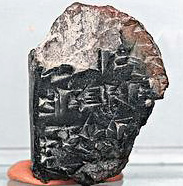
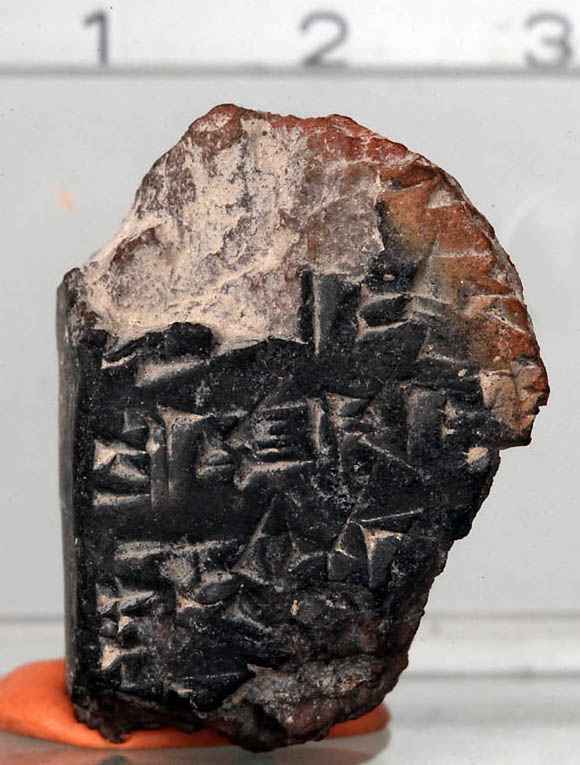
Last week we reported here the announcement of the discovery of a cuneiform fragment dating back to the 14th century B.C. The Hebrew University, Department of Media Relations, has been kind enough to supply me some nice hi-res photos of the cuneiform fragment and the scholars involved in the announcement. Click on each photo for a larger image.

"Jerusalem 1" - the Cuneiform Fragment from the Ophel Excavation.
The Cuneiform Fragment, called Jerusalem 1, from the Ophel Excavation. Photo: Hebrew University/Sasson Tiram.

The fragment found at the Ophel is believed to be contemporary with the some 380 tablets discovered in the 19th century at Amarna in Egypt in the archives of Pharaoh Amenhotep IV (Akhenaten), who lived in the 14th century B.C.E. The archives include tablets sent to Akhenaten by the kings who were subservient to him in Canaan and Syria and include details about the complex relationships between them, covering many facets of governance and society. Among these tablets are six that are addressed from Abdi-Heba, the Canaanite ruler of Jerusalem. The tablet fragment in Jerusalem is most likely part of a message that would have been sent from the king of Jerusalem, possibly Abdi-Heba, back to Egypt, said Mazar.

Examination of the material of the fragment by Prof. Yuval Goren of Tel Aviv University, shows that it is from the soil of the Jerusalem area and not similar to materials from other areas, further testifying to the likelihood that it was part of a tablet from a royal archive in Jerusalem containing copies of tablets sent by the king of Jerusalem to Pharaoh Akhenaten in Egypt.

Mazar says this new discovery, providing solid evidence of the importance of Jerusalem during the Late Bronze Age (the second half of the second century B.C.E.), acts as a counterpoint to some who have used the lack of substantial archeological findings from that period until now to argue that Jerusalem was not a major center during that period. It also lends weight to the importance that accrued to the city in later times, leading up to its conquest by King David in the 10th century B.C.E., she said.

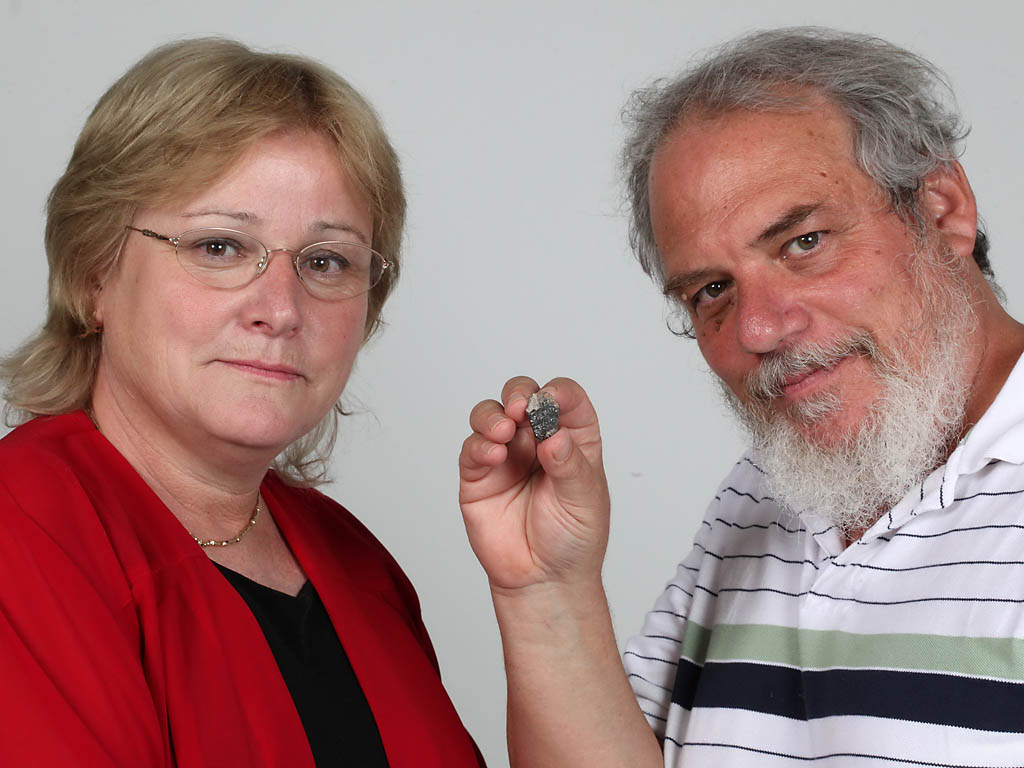
Dr. Eilat Mazar and Prof. Wayne Horowitz with the cuneiform fragment from the Ophel Excavation. Photo: Hebreew University/Sasson Tiram.

Dr. Eilat Mazar and Prof. Wayne Horowitz with the cuneiform fragment from the Ophel Excavation. Photo: Hebrew University/Sasson Tiram.

Note the statement of Dr. Mazar:

The tablet fragment in Jerusalem is most likely part of a message that would have been sent from the king of Jerusalem, possibly Abdi-Heba, back to Egypt, said Mazar.

Several blogs have pointed to the analysis by Professor Christopher Rollston. After an analysis of the fragment, Rollston suggests four possibilities regarding what “Jerusalem 1” could be:

  • Some sort of administrative text.
  • A legal text.
  • An international letter (or a letter from one official to another official in Jerusalem, or to a neighboring city).
  • A literary text of some sort.

He concludes,

Therefore, there are a number of possible options for this tablet.  And, thus, because there is such a dearth of actual preserved text on this tablet, I contend that it is best not to attempt to posit as probable this or that historical context, Sitz im Leben, or genre.  Ultimately, the fact of the matter is that it could be one of various things…e.g., an epistolary text, a legal text, an administrative text, a literary text.

You may read his reflections in their entirety here.

Excitement in the Shephelah

Luke Chandler hands out a teaser about “Fantastic (somewhat secret) new finds at Khirbet Qeiyafa” here. Whether his “Best case scenario” or the “Alternate scenario” turns out to be correct, there are discoveries that date to the Early Iron Age (about 1200 to 900 B.C.).

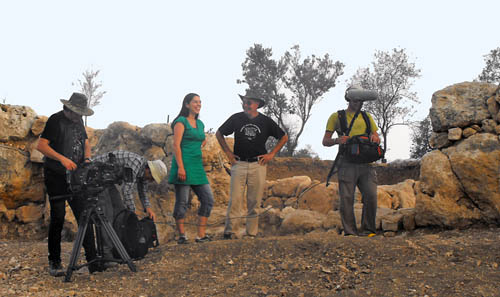
BBC is filming a documentary including Khirbet Qeiyafa and Gath. Luke posts a larger photo showing the BBC team with Dr. Yossi Garfinkel, director of the excavation, at the western gate. I recall that National Geographic did some filming there last year.

BBC filming documentary at Khirbet Qeiyafa. Photo by Luke Chandler.

BBC filming documentary at Khirbet Qeiyafa. Photo by Luke Chandler.

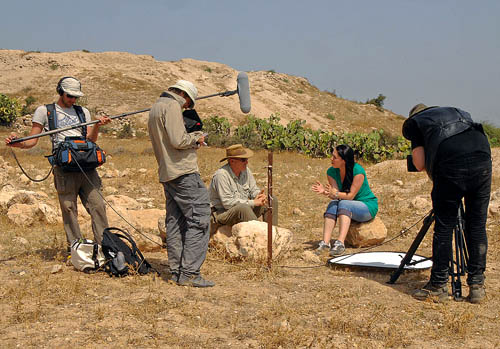
Earlier, the BBC team had been at Tell es-Safi/Gath with Professor Aren Maeir. The interviewer (in green) is Dr. Francesca Stavrakopoulou, a biblical scholar from Exeter University in the U.K. With a doctorate from Oxford, she worked at Tell es-Safi three years ago.

BBC filming documentary at Tell es-Safi/Gath. Photo: dig website.

BBC filming documentary at Tell es-Safi/Gath. Photo: dig website.

Aren describes today at the dig as “Just another fantastic day…” I will leave it for you to check out the other photos and a sketch of some of the discoveries of the day here. One thing that relates to what we posted earlier is about evidence of metallurgy at the site. Maeier says,

Adi and Naama continue to uncover additional evidence of metallurgy, apparently both Iron and Copper production!

Both Khirbet Qeiyafa, overlooking the Valley of Elah, and Gath, have a connection with the account of David and Goliath (1 Samuel 17).

Following current excavations

Prof. Aren Maeir reports the discovery of evidence of Philistine metallurgy at Tell es-Safi/Gath. He says the slag “is definitely copper-based material.” He mentions two experts in ancient metallurgy who came to supervise the excavation of the context of the metallurgical areas.

They found additional evidence of bronze production, including additional fragments of a crucibles, possible tuyeres, and many more small fragments of slag. This definitely is becoming very interesting!

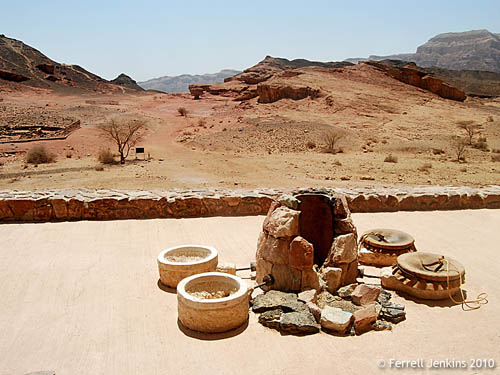
If I correctly understand what I read, the tuyere is the tube through which air is pumped into the crucible to make the heat in the furnace more intense. Perhaps this illustration of the copper mining process at Timna will be helpful. I am talking in an area where I know very little. If this is not correct, I will be pleased to receive a comment with a better explanation.

Copper smelting at Timna. Photo by Ferrell Jenkins.

Copper smelting at Timna. Photo by Ferrell Jenkins.

There are a few references to copper in the Bible. The land promised to the Israelites is described as,

“a land whose stones are iron, and out of whose hills you can dig copper.” (Deuteronomy 8:9 ESV)

The process of smelting is mentioned in the book of Job.

“Iron is taken out of the earth, and copper is smelted from the ore.” (Job 28:2 ESV)

More information is available at the Tell es-Safi/Gath Excavations website here.

Excavations in Jordan resulting in evidence of copper smelting in 10th century B.C. Edom is reported here.

Being able to keep up with some of the excavations by means of the blogs is exciting. Todd Bolen has compiled a list of 2010 Excavation Blogs at the Bible Places Blog here.

Archaeology Illustrated by Balage Balogh

His work has been featured on the Discovery Channel and in many scholarly books. A native Hungarian, Balage now creates images of ancient Israel, Egypt, Babylon, Greece, Rome, and other civilizations. He tell the story in these words:

I began working with archaeologists, scholars and experts in the field in the Department of Archaeology at the Hebrew University of Jerusalem, the Albright Institute, the Israel Museum, and universities throughout the United States.  My archaeological illustrations were published in National Geographic Hebrew edition,  A Guide to Jerusalem, The World of the New Testament, The World of the Old Testament, Excavating Jesus, and The Jesus Dynasty among others and many of my illustrations were part of exhibits at the Israel Museum, the Welcome Center in the City of David, Jerusalem, and permanently displayed in the Archaeology Department at the Hebrew University of Jerusalem.

Balage Balogh contacted me with the request that I offer some of his art free of charge on my web sites in exchange for a permanent link. Since I have more readers of the blog than of the web sites I decided to begin here. As time permits I will post a few more of his illustrations here and at the Biblical Studies Info Page and Bible World.

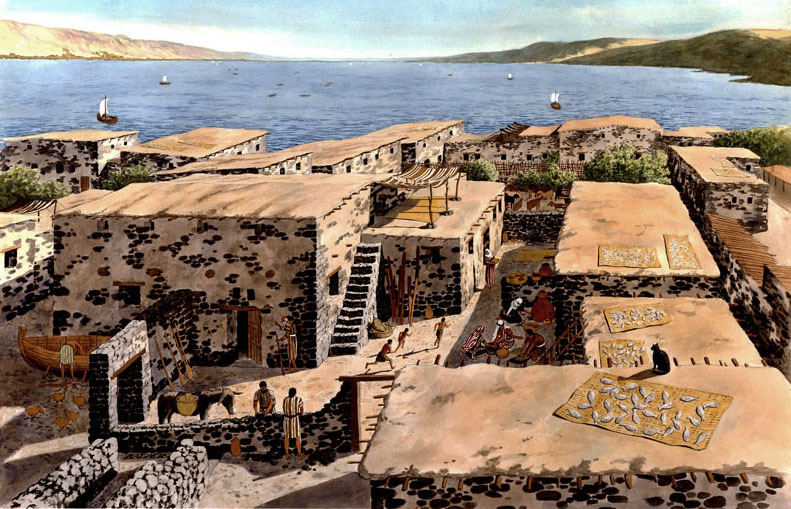
Here is a wonderful drawing of Capernaum at the time of Jesus. One need only know something about the archaeological discoveries of the first century to see the accuracy of this drawing. Notice the basalt stone and the way the roofs are constructed. A larger image is available by clicking on the drawing.

Capernaum at the time of Jesus. Art by Balage Balogh.

Capernaum at the time of Jesus. Art by Balage Balogh.

Take a look at Archaeology Illustrated. Balogh’s work may be purchased for use in presentations or publications. This illustration is © Balage Balogh 2010.

Fragment of Cuneiform tablet found in Jerusalem

The Jerusalem Post reports here the discovery of a fragment of a cuneiform tablet in Jerusalem.

Cuneiform fragment. Photo: Jer.Post.

Cuneiform fragment. Photo: Jerusalem Post.

Hebrew University excavations recently unearthed a clay fragment dating back to the 14th century BCE, said to be the oldest written document ever found in Jerusalem.

The tiny fragment is only 2 cm. by 2.8 cm. in surface area and 1 cm. thick and appears to have once been part of a larger tablet. Researchers say the ancient fragment testifies to Jerusalem’s importance as a major city late in the Bronze Age, long before it was conquered by King David.

The minuscule fragment contains Akkadian words written in ancient cuneiform symbols. Researchers say that while the symbols appear to be insignificant, containing simply the words “you,” “you were,” “them,” “to do,” and “later,” the high quality of the writing indicates that it was written by a highly skilled scribe. Such a revelation would mean that the piece was likely written for tablets that were part of a royal household.

The cuneiform fragment was discovered during wet sifting of the excavation. Prof. Eilat Mazar, director of the dig, said information was not released until last week “because researchers wanted to wait until analysis of the piece was complete so as to be absolutely certain of the details of the find.”

Duane Smith reports that the fragment is published in the current Israel Exploration Journal by Mazar, Horowitz, Oshima, and Goren. The fragment has been dubbed “Jerusalem 1.” The suggestion is made that this fragment may be related to the Amarna tablets sent by rulers of ancient Canaan to the Pharaoh of Egypt in the 14th century B.C.. Smith discusses the fragment in relation to the scribes of the Late Bronze Age Jerusalem here.

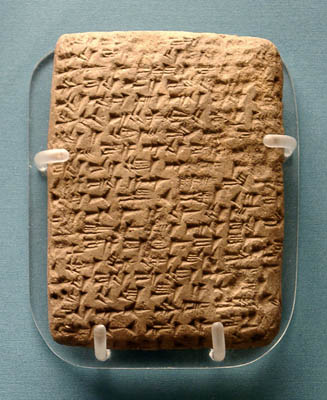
Several museums have examples of the Amarna tablets on display. Here is a photo of the letter from Yapahu, king of Gezer. In it he “begs pharaoh for help in defending his city against raids by the Hapiru.”

Amarna Tablet from Gezer. British Museum. Photo: F. Jenkins.

Amarna Tablet from Gezer. British Museum. Photo: F. Jenkins.

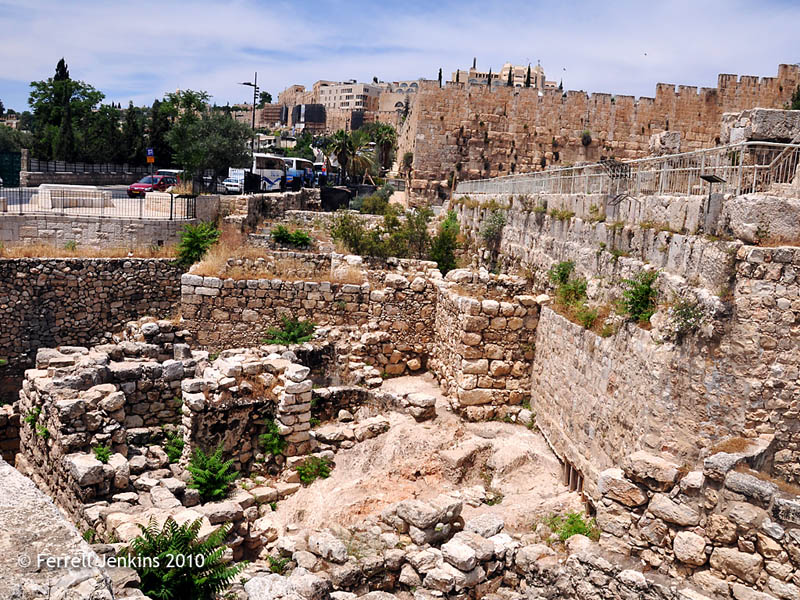
We discussed Mazar’s Ophel Excavation February 23 here. Since that time I have visited Jerusalem and am delighted to share a photo of the area under consideration. Click on the photo for a larger image.

Mazar's Ophel Excavation Area. Photo by Ferrell Jenkins.

Mazar's Ophel Excavation Area. Photo by Ferrell Jenkins.

HT: Joseph I. Lauer; See the Bible Places Blog for more analysis.

Kinneret Regional Project uncovers synagogue

Several weeks ago I added a link to the Kinneret Regional Project on the Bible Places page of the Biblical Studies Info Page. My intention was to write about the project and show a photo of Tel Kinneret (Kinrot; Arabic Tell el-‘Oreme) on the northwestern shore of the Sea of Galilee.

Now word comes of the discovery of a fourth century synagogue at Horvat Kur, about a mile northwest of Tel Kinneret. The press release here says that the discovery “adds new evidence [along with the synagogues at Capernaum, Chorazin, Kh. Hammam, and Magdala] for a very tight net of synagogues in a relatively small area on the Northwestern shores of the Lake of Galilee.”

Todd Bolen created a map using Google Earth to identify Horvat Kur, Tel Chinnereth (Kinneret), Tabgha, Mount of Beatitudes, Cove of the Sower, and Capernaum. This great resource for studying the ministry of Christ may be accessed at the Bible Places Blog.

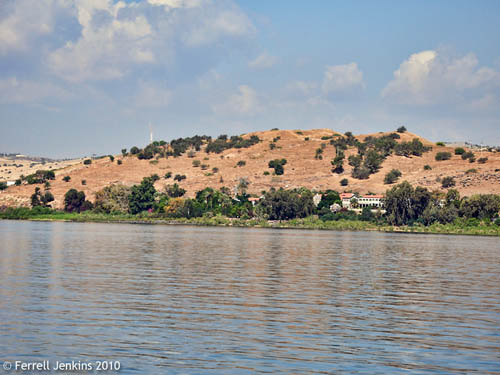
Earlier I mentioned that the day in early May when my group took a boat ride on the Sea of Galilee was a great one for making photos. I caught this wonderful view of Tel Kinneret from the boat. The buildings on the shore below the tel belong to Pilgerhaus Tabgha, a guesthouse operated by the German Association of the Holy Land.

Tel Kinerot from the Sea of Galilee. Photo by Ferrell Jenkins.

Tel Kinneret from the Sea of Galilee. Photo by Ferrell Jenkins.

From the Kinneret Regional Project site you may download several good resources. The 2004 report by Pakkala, et al., begins with this description of Tel Kinneret.

The site boasts remains from the Chalcolithic to the Ottoman period. In its heyday in the Early Iron Age, i.e. the 11th/early 10th century BCE, Kinneret developed into a regional center, controlling the surrounding region and becoming one of the most important urban sites of the country.

The body of water that we commonly call the Sea of Galilee is known as the Sea of Chinnereth in the Old Testament (Numbers 34:11; Joshua 13:27). Chinnereth is listed as one of the fortified cities of the tribe of Naphtali in Joshua 19:35.

I think most tourists to Galilee overlook Tel Kinneret. They are excited about having seen the Roman boat at Nof Ginosaur, and the guide is beginning to tell them about Taghba, Capernaum, or the Mount of Beatitudes. Or it may be because the site is obscured from the highway by the electric power station below it.

HT: Joseph I. Lauer

Headed for the Elah Fortress

Luke Chandler is traveling in Israel in advance of participation in the Khirbet Qeiyafa (the Elah Fortress) Excavation. He is posting some comments and photos of the places he is visiting. Take a look at Luke Chandler’s Blog.

Second century A.D. gold coin found at Bethsaida

“Rare coin bears good tidings for UNO’s Israeli excavations” is the headline for an article by John Keenan in the Omaha World-Herald.

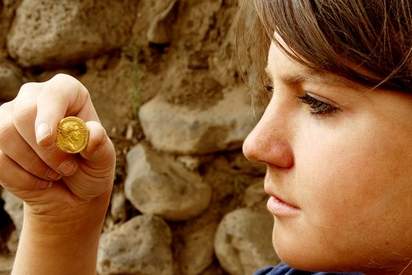
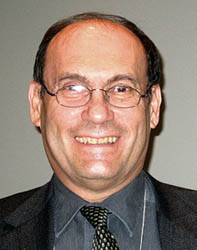
Dr. Rami Arav, of the University of Nebraska Omaha, is the director of the excavation at et-Tell in Galilee. I’m sure it wasn’t necessary for the reporter to say that Arav was excited when Alexis Whitley, one of the volunteers at the dig, found a gold coin dating to the mid-second century A.D.

Alexis Whitley - a volunteer from West Virginia University.

Alexis Whitley - a volunteer from West Virginia University.

The coin, which weighs 7 grams, is 97.6 percent gold, Arav said.

The find was unexpected because Bethsaida primarily was home to humble fishermen, he said. Arav said somebody must have been doing good business a little more than 100 years after the birth of Christ.

The gold coin, about three-quarters of an inch in diameter, carries the image of Antoninus Pius, the 15th Roman emperor, who reigned between A.D. 138 and 161.

“Before newspapers, coins fulfilled the job of disseminating information. In our case, Antoninus wanted to announce that the Senate designated him to the position of a consul for the second time. This position was among the highest at Rome.”

Arav thinks this is the first Antoninus Pius gold coin excavated in Israel. I like the fact that he gave credit to the young volunteer who discovered the coin.

Prof. Rami Arav. Photo by Ferrell Jenkins.

Rami Arav. Photo: F. Jenkins.

“This type of a coin was never sold in the market because it is so rare,” he said. “It may go for as much as people will be able to pay for it.”

For now, the coin — along with the rest of the Bethsaida finds, considered to be the heritage of the State of Israel — will go to the Israel Antiquities Authority. Its ultimate destination probably will be the Israel Museum in Jerusalem, Arav said.

“Bethsaida has already enriched the Israel Museum with a few other outstanding and rare finds.”

The article in its entirety may be read here.

Bethsaida is mentioned in the New Testament as the place where Jesus healed a blind man (Mark 8:22-25). Not everyone agrees with Dr. Arav’s identification of et-Tell as Bethsaida, where he has been working for nearly a quarter of a century. See a previous post about Bethsaida here.

A report of the Bethsaida 2010 excavation is posted here. Photos of coins, including the gold coin, and items associated with fishing are posted under Special Pics. Shai Schwartz has posted 234 photos from the recent excavation in his Picasa album here.

HT: Joseph Lauer, Paleojudaica, Bible Places Blog.

Featured on The Book & The Spade program

“The Sewers of Jerusalem” is featured as the lead to program #1235 on The Book & The Spade radio program. This long-running radio program providing backgrounders on the Bible through Biblical archaeology is hosted by Gordon Govier and Professor Keith Schoville. Govier is the archaeology correspondent for Christianity Today magazine. Professor Schoville is retired professor of Hebrew and Semitic Studies at the University of Wisconsin, Madison. His book, Biblical Archaeology in Focus, has been used by many students of archaeology.

The link to the newly designed blog of The Book & the Spade is here. You may listen to the entire radio broadcast, or download it in MP3 format, here. I think you will need to use Internet Explorer to be able to save the program. The current program remains available for free download for only a few weeks. The programs produced by Govier and Schoville are always interesting and informative. I keep a permanent link to the site at the Biblical Studies Info Page (under Scholarly).

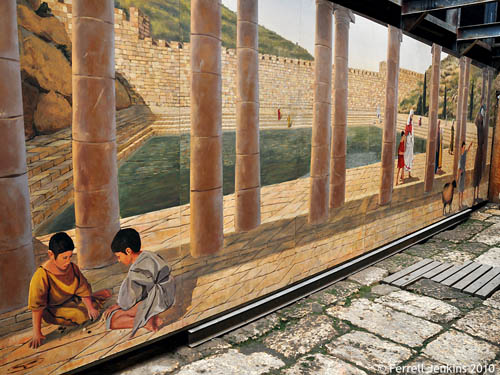
Our post on “The sewers of first century Jerusalem” may be read here. There are four recent photos with the post. Here is a photo of Roman street and mural of the Pool of Siloam as it is thought to have looked. This is where we expected to turn back and leave the area when one of the booksellers told us the sewer was open.

Perhaps the Pool of Siloam looked like this in the time of Jesus. Photo by Ferrell Jenkins.

Perhaps the Pool of Siloam looked like this in the time of Jesus. Photo by Ferrell Jenkins.