Category Archives: Archaeology

Keeping informed

Egyptian Antiquities. Keep up with breaking news about Egyptian antiquities at Andie Byrnes’ the Egyptology News.

Tomb of the Prophet Zechariah at the Madras Ruins. See the report of the Israel Ministry of Foreign Affairs here. James Davila raises lots of questions about this report. See his Feb. 3, 2011, post here.

HT: Paleojudaica

Photos of Turkey and Greece. Mark Hoffman is making available some nice photos of his recent trip in Turkey and Greece. Read, and find the link to the photos here. The photos are geotagged so you may spot the location in Google Earth.

Birdwatching in Israel.

“There were some 25,000 cranes crowded around us this evening,” reports Judith Schwartz, a Kibbutz Ginosar resident. “One night last week there were 42,000. Your eyes can’t quite believe what you’re seeing. They stand in the lake all night, safe from the bobcats in the area. And here they rest, and lift off in their masses at dawn, blackening the sky like a swarm of gigantic locusts, to continue their 5,000 mile trip to their winter home in Africa.”

At least 500 million birds of 200 different species fly across Israel each spring and fall on their way to and from Africa, Europe and Asia, says Dr. Reuven Yosef, director of Eilat’s International Birding and Research Center. And more than 70 native Israeli species head to warmer Africa in winter, such as the cuckoo, Egyptian vulture, short-toed eagle, hobby and lesser kestrel.

See the full article here.

HT: BiblePlaces Blog
Here and there in the Holy City

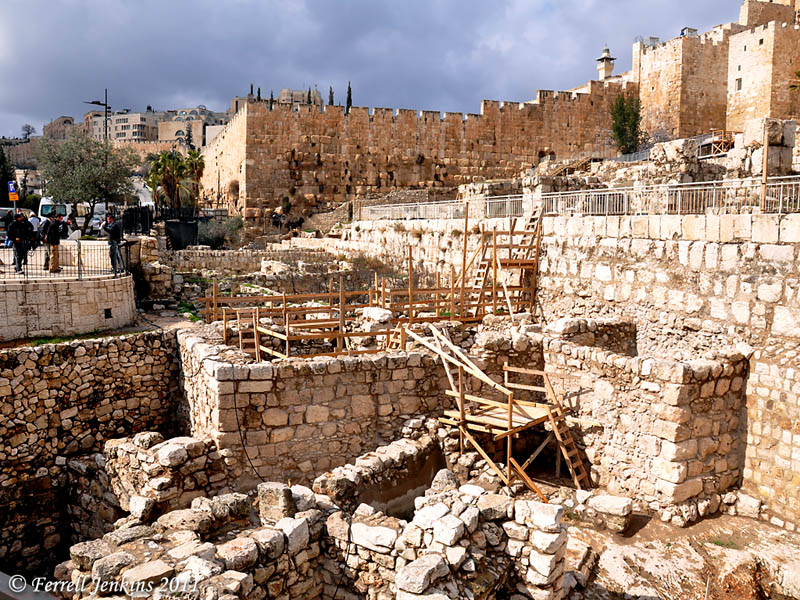
About a year ago we were reporting on the work being done by Dr. Eilat Mazar, of Hebrew University, in the area next to the street that runs along the south side of the Temple Mount. The area is part of what is called the Ophel. Eilat Mazar worked here with her grandfather, Benjamin Mazar, in the 1980s.

It seems uncertain whether this gate belongs to the 8th century B.C., 9th century, or 10th century. Eilat Mazar says it belongs to the 10th century B.C. based on pottery and a comparison of the architecture with that in other excavated cities.

Take a look at our earlier report here.

Jerusalem Ophel Excavations. Photo by Ferrell Jenkins.

Jerusalem Ophel Excavations. Photo by Ferrell Jenkins.

We spent several hours walking the City of David tour. I was disappointed that the new steps leading from the pool of Siloam to the Visitor’s Center and the sewer were closed today due to flooding. I wrote about the sewer, with photos, here.

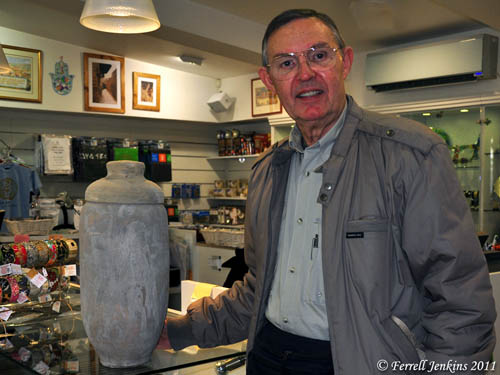
We actually enjoyed a few minutes in the shop. Take our poll.

Ferrell with Qumran Replica Jar

Ferrell with Qumran Replica Jar. Photo by Elizabeth Jenkins.

In the afternoon we went to the Herodium. Another disappointment. The new excavations of Herod’s Tomb are still under cover and fenced off.

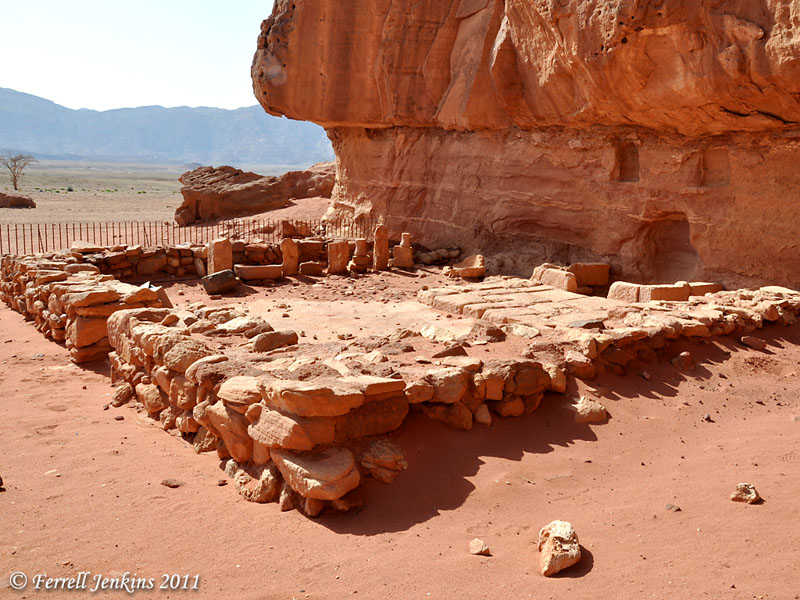
Egyptian miners had a temple at Timna

Timna is located about 20 miles north of Eilat in Israel. The Rothenberg Expedition discovered a cultic temple used by Egyptian miners at a time when the Egyptians were actively mining copper in the region.

One of the main deities worshiped at the site was Hathor. Having recently seen numerous images of Hathor in Egypt, I thought this was an appropriate follow up.

Cultic temple at Timna devoted to Hathor, et al. Photo by Ferrell Jenkins.

Cultic Temple at Timna devoted to Hathor, et al. Photo by Ferrell Jenkins.

Those who have visited Petra will notice a similarity in the color of the rocks and soil.

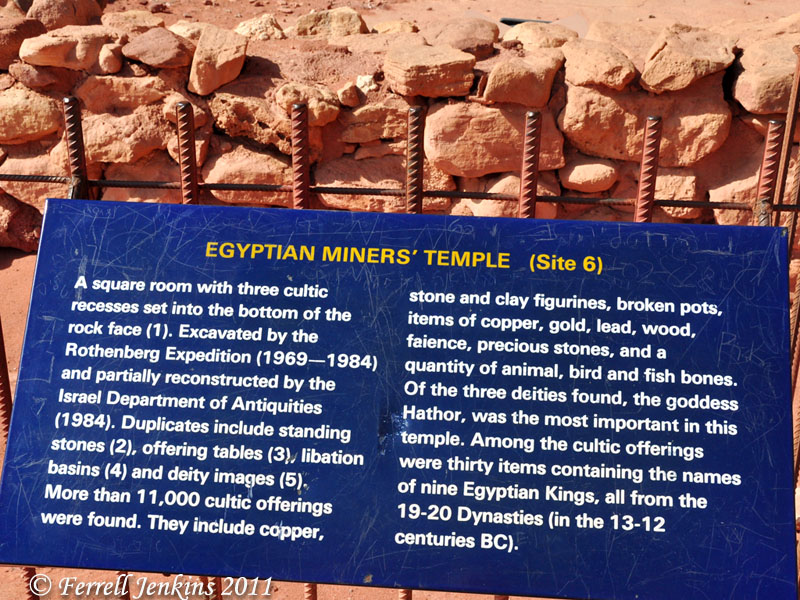
The sign at the site gives a brief summary of the excavation and the items discovered.

Timna Hathor Temple Sign

Sign at Cultic Temple in Timna. Photo by Ferrell Jenkins.

The LORD promised the Israelites that they would dwell in a land that included copper and iron. It is impossible to say whether this is one of those places.

… a land whose stones are iron, and out of whose hills you can dig copper. (Deuteronomy 8:9 ESV)

Free book about the James ossuary trial

Herschel Shanks, editor of Biblical Archaeology Review, reminds us that the trial brought by the Israel Antiquities Authority against Oded Golan and Robert Deutsch is about to come to an end.

If you are interested in this subject you should click here and sign up for the book entitled James, Brother of Jesus: Forged Antiquities and the Trial of Oded Golan and Robert Deutsch.

The book is described this way.

After five years, the “forgery trial of the century” has concluded in a Jerusalem courtroom. Defendants Oded Golan and Robert Deutsch await the judge’s verdict, and so does the rest of the world. Even if the verdict is “not guilty,” the question of authenticity of several ancient artifacts will still remain. In this free e-book, Hershel Shanks explains why he believes the now-famous “James Ossuary” inscription is authentic. Plus, he provides behind-the-scenes analysis of the trial and its key players.

Herschel also promises an English translation of the trial verdict as soon as it is released.

Understand that this is likely a book to be downloaded, and that in signing up for it you indicate that you wish to receive the BAR Companion newsletter. Not a bad trade-off in my judgment.

No photographs in the Valley of the Kings

On the west bank of the Nile River across from Luxor and Karnak lies the Valley of the Kings where the Pharaoh’s of the New Kingdom Period of Egyptian history are buried. There are no pyramids during this periods, but at least sixty four tombs are known in the Valley of the Kings. Our group visited two or three.

Some archaeological work is being done in the West Bank of the Nile, but mostly we observed restoration work by local Egyptians.

One disappointment was that photographs were not allowed in the Valley of the Kings. Two years ago when we were here photography was allowed in the Valley, but not in the tombs. Some of our tour members were fined for using their cameras and cell phones. This year one is not even allowed to enter through the security check with a camera. My older photos from the Valley of the Kings have just become more valuable!

One thing I have learned in traveling to Egypt repeatedly since 1967 is that the rules change frequently. The traveler to foreign countries must always remember that it may be different on a second visit, or from the way a friend told you, or the way the book said.

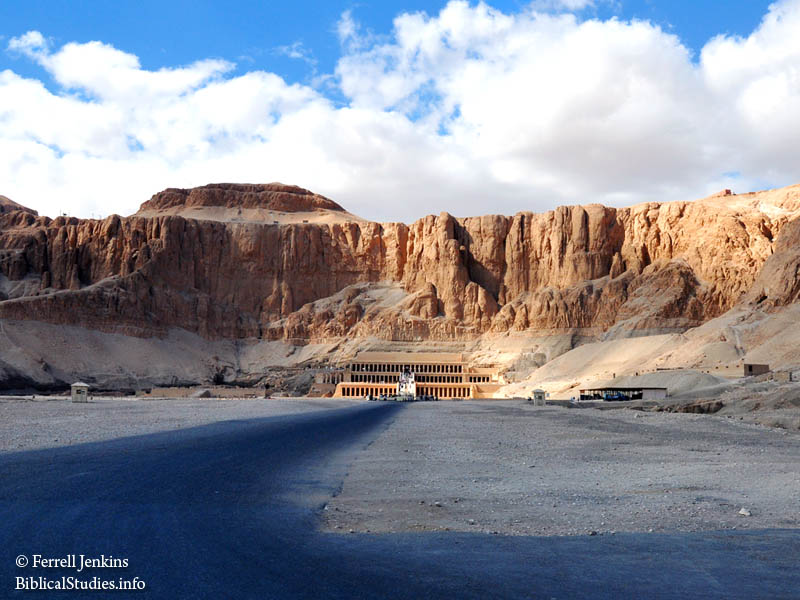
We were allowed to make photographs in the Valley of the Queens. Here is a photo of the Temple of Queen Hatshepsut.

Temple of Queen Hatshepsut. Photo by Ferrell Jenkins.

The Temple of Queen Hatshepsut. Photo by Ferrell Jenkins.

Some conservative scholars identify Hatshepsut with the young daughter of  Pharaoh who drew baby Moses from the Nile. Notice these words from Dr. Bryant Wood:

Moses and the Rulers of Egypt
In order to avoid the death decree. Moses’ mother placed the infant Moses in a watertight basket and “put it among the reeds along the bank of the Nile” (Ex 2:3). Pharaoh’s daughter discovered the three-month-old baby when she “went down to the Nile to bathe” (Ex 2:5). It is possible that this was the later-to-be-famous queen Hatshepsut (see front cover; Hansen 2003). According lo the Bible, then, the Egyptian royal family maintained a residence in Rameses, close to the Nile River, at the time of Moses’ birth in the carry  [sic; early? c. 1504-1483] 18th Dynasty.
After Moses was nursed by his mother (Ex 2:7–9), Pharaoh’s daughter look him into the royal palace and gave him the name Moses, “because I drew him out of the water” (Bible and Spade (2008) Volume 21 (Ephrata, PA: Associates for Biblical Research, 2008). vnp.21.1.20).

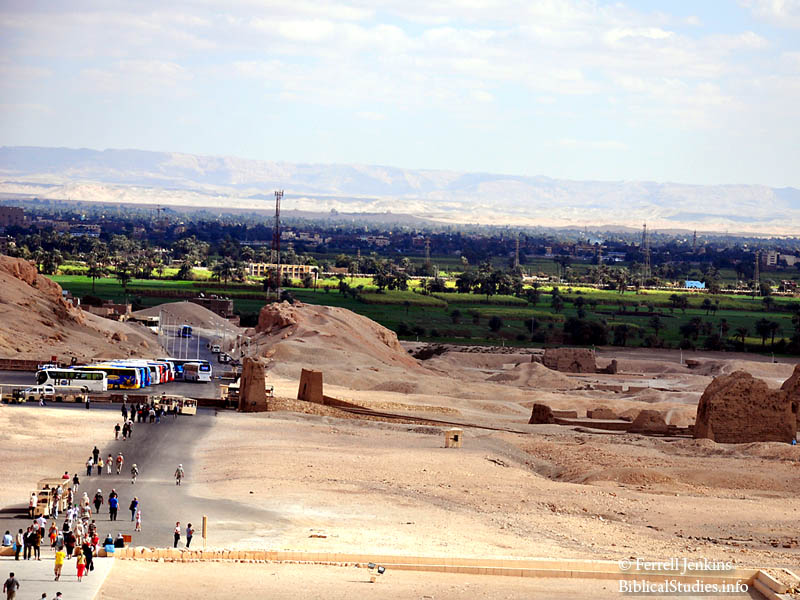
From the temple one has a magnificent view to the east across the Nile Valley. That’s it. The Nile Valley, the fertile land on each side of the Nile River is a narrow strip.

The Nile Valley from the Temple of Queen Hatsheput. Photo by Ferrell Jenkins.

The Nile Valley from the Temple of Queen Hatsheput. Photo by Ferrell Jenkins.

P.S. If you would like to see some photos from the Valley of the Kings, check this earlier post here.

Luxor and the Valley of the Kings

Update. The image did not enlarge. Check it again. I note that the Internet service is better early in the morning (now Tuesday here in Luxor).

This morning we left Cairo early on a flight to Luxor, where we begin a Nile cruise. Lot of good photos today. We visited the Valley of the Kings and Luxor Temple. Perhaps in a day or two I will be able to begin to share a few new photos. Meanwhile, your patience is appreciated.

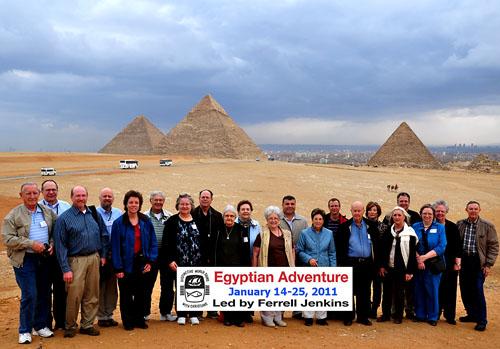
Here is the group photo that I had wanted to upload yesterday. If you know some of the folks in the group you may want to click on the image for a larger copy.

Egyptian Adventure Tour led by Ferrell Jenkins

Egyptian Adventure Tour at the great Pyramids of Giza.

Traveling to Egypt

The first biblical reference to Egypt is in Genesis 12:10.

There was a famine in the land, so Abram went down to Egypt to stay for a while because the famine was severe. (Genesis 12:10 NET)

Untold multitudes of people have traveled to Egypt before and after the time of Abram, and for a variety of reasons — to find food, to find refuge, to conquer, to search for treasures, to study history, to make photographs, naming just a few. Our purpose in going to Egypt is not only to enjoy the culture of Egypt, but to study the history at it relates to biblical history. In the next couple of weeks we will try to highlight some of these things. We hope you will travel with us through this blog.

We may not be able to post every day, and due to the time change, it may be at an unusual time of the day. Our non-stop flight is scheduled to depart from New York in less than two hours. The flight takes about 11 hours.

Repairing the ruins of ancient Babylon

The New York Times ran an article by Steven Lee Myers on the current efforts to save the ruins of Babylon.

On the hillside during one of his many visits to the ruins, Jeff Allen, a conservationist working with the World Monuments Fund, said: “All this is unexcavated. There is great potential at this site. You could excavate the street plan of the entire city.”

That is certainly years away given the realities of today’s Iraq. But for the first time since the American invasion in 2003, after years of neglect and violence, archaeologists and preservationists have once again begun working to protect and even restore parts of Babylon and other ancient ruins of Mesopotamia. And there are new sites being excavated for the first time, mostly in secret to avoid attracting the attention of looters, who remain a scourge here.

The entire article is available here. The article is accompanied by a nice 4:12 minute video of the restoration efforts here. According to the reports the reconstructions made by the Sadaam Hussein regime in the 1980s will probably be torn down.

Jim Davila adds this tip at Paleojudaica:

Related, also in the NYT: A Tour of Iraq’s Ancient Sites. Included are a video about the (traditional) tomb of Ezekiel … and a photo of Hebrew inscriptions at the (traditional) tomb of the prophet Nahum, as well as photos and videos of other sites of biblical and related interest.

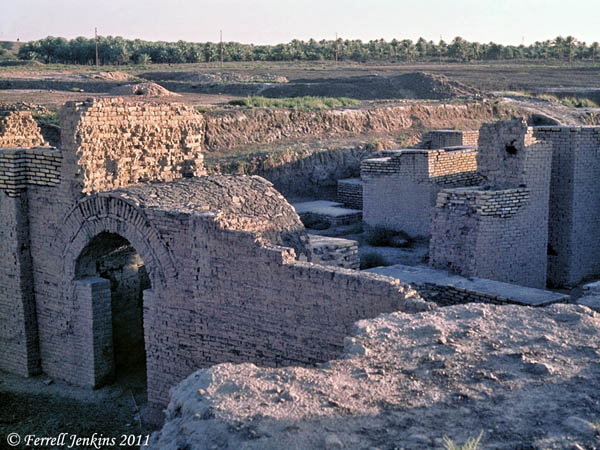
The photo below was made Tuesday, May 12, 1970, and still looks fairly good considering the time lapse and my camera equipment at the time.

Ruins of Ancient Babylon, 1970. Photo by Ferrell Jenkins.

Ruins of Ancient Babylon, 1970. Photo by Ferrell Jenkins.

The prophet Jeremiah spoke about the future of Babylon:

Babylon will become a heap of ruins. Jackals will make their home there. It will become an object of horror and of hissing scorn, a place where no one lives. (Jeremiah 51:37 NET)

We called attention to the UN report of US damage to ancient Babylon here.

HT: Ben Witherington III; Paleojudaica.

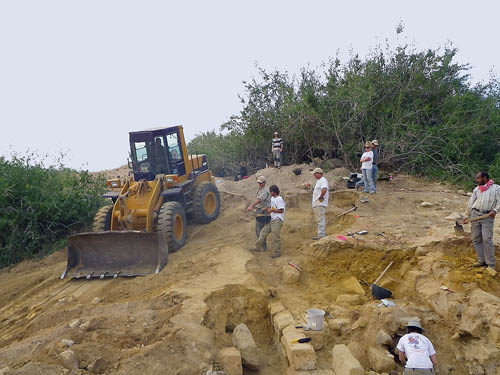
Why use a front end loader at an archaeological dig?

Dr. David Graves reports on the use of a tractor with a front end loader at Tall el Hammam in Jordan. He explains how the tractor is used at the beginning of excavations of a monumental Roman building. See the brief report with a larger photo here. Note especially his reference to “contaminated piles of dirt” and “night diggers.”

David Graves - Roman excavation at Tall el-Hammam

Use of a tractor with front end loader at Tall el-Hammam. Photo by David Graves.

We recently reported on the Tall el-Hammam excavation here.

BiblePlaces List of Top Stories of 2010

Over the past few weeks I have been busy with numerous things other than blogging that I considered important. In the meantime I have followed several blogs to keep up with what’s going on in those areas in which I have interest. I always check Todd Bolen’s BiblePlaces Blog, because it covers the specific areas that we try to cover here.

As the year 2010 comes to an end, Todd has listed what he considered the Top Discoveries of 2010, the Top Technology-Related Stories of 2010, and Losses (deaths). He promises to post other related lists tomorrow.

I suggest you take a look at the lists. We have commented on several of these same stories because we considered them important in assisting Bible students.