Category Archives: Archaeology

Subscribe to the BiblePlaces Newsletter

Perhaps many of our readers already follow Todd Bolen’s BiblePlaces Blog and receive his BiblePlaces Newsletter. But there may be a few who do not receive the Newsletter.

The most recent BiblePlaces Newsletter was distributed Tuesday. It includes some featured BiblePlaces Photos under the title “Never Been There Before!” One would think that Dr. Bolen, who lived and taught ten years or more in Israel, and visited the country other times, would have already visited all of the places where Bible events took place. It doesn’t work that way. In the current BiblePlaces Newsletter he takes us to some places he had never been to…

  • Kerioth, possible hometown of Judas Iscariot
  • …see a Canaanite Wall in Hebron
  • the location of the Praetorium entrance in Jerusalem
  • Ramah, the hometown of the prophet Samuel
  • the tomb of Joseph
  • the Wadi Farah

After fifty years of traveling to Israel half of these are now on my bucket list. With each Newsletter you receive free high resolution photos and a free PowerPoint presentation.

Not on the list to receive the Newsletter, and missed this valuable one? Todd has given me permission to share the link to this Newsletter. Click here. At the bottom of the page you will have an opportunity to sign up to receive it whenever it is published (usually several times a year).

I don’t recall when I first began to use the Pictorial Library of Biblical Lands (PLBL), but I do recall the first time I met Todd Bolen. It was in Jerusalem in 2005. Leon Mauldin and I had made our way from the City of David to Gihon Spring. Todd and his students from the Master’s College IBEX program in Israel were helping clean out some of the area and working on the pottery. We had made prior arrangement to meet. It was about lunch time so Todd took his students on a tour of the area known as the tombs of the kings, down to the place where the Kidron and Hinnom valleys join, and to the site of En Rogel. He invited us to go along and visit as we walked.

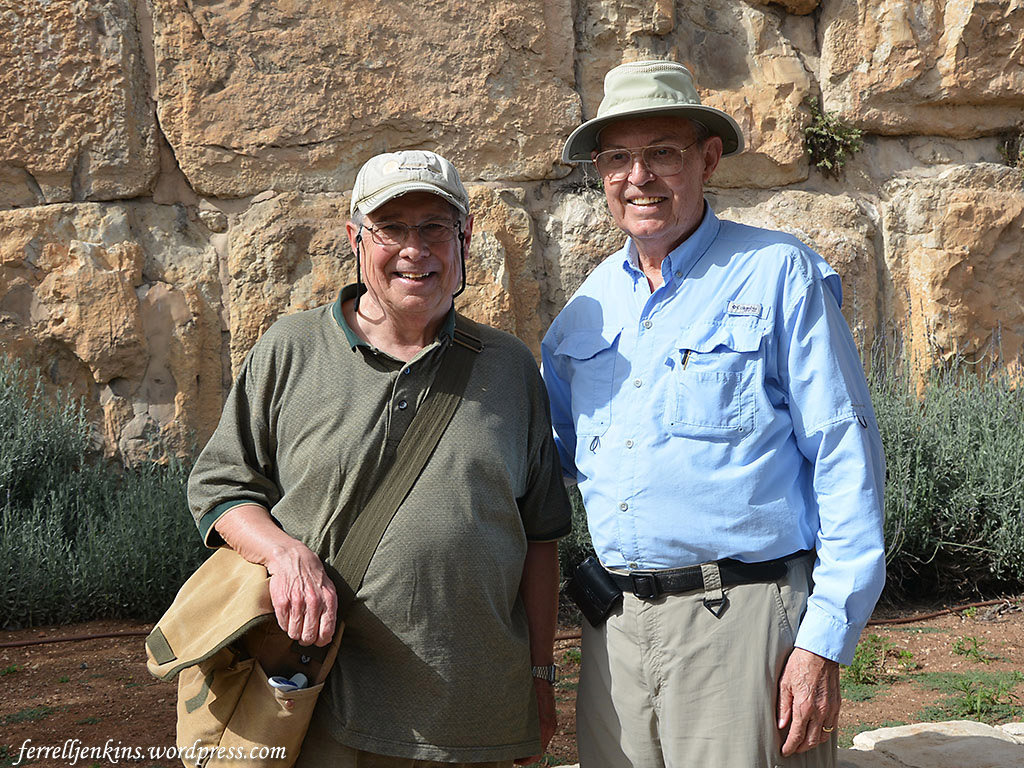
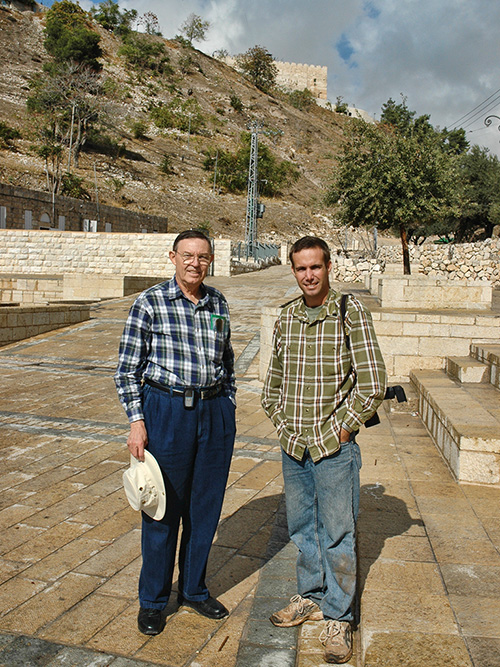
Ferrell Jenkins and Todd Bolen at the plaza in front of Gihon Spring. The "Pinnacle" of the Tempe (the south east corner) may be seen in the distance.

Ferrell Jenkins and Todd Bolen at the plaza in front of Gihon Spring. The “Pinnacle” of the Tempe (the south east corner) may be seen in the distance. Photo by Leon Mauldin.

Leon snapped this photo of us. I see that Todd has aged a bit since then. We have had several occasions for short visits since that time, and I am delighted to say that BiblePlaces licenses my photos for publication.

If you teach the Bible you need the PLBL. You may buy the entire set, or begin with a few volumes covering areas you are now teaching. For complete information visit BiblePlaces.com.

Statue of an Egyptian official found at Hazor

Hebrew University announces this morning the discovery of a statue of an Egyptian official at Tel Hazor.

— “ —

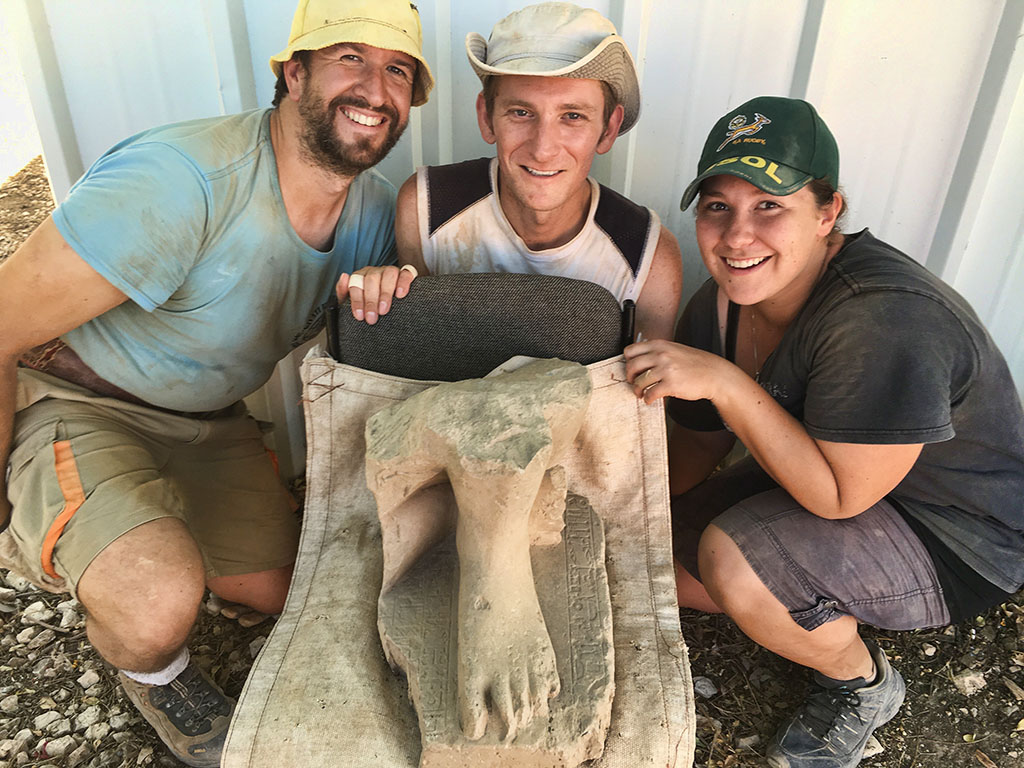
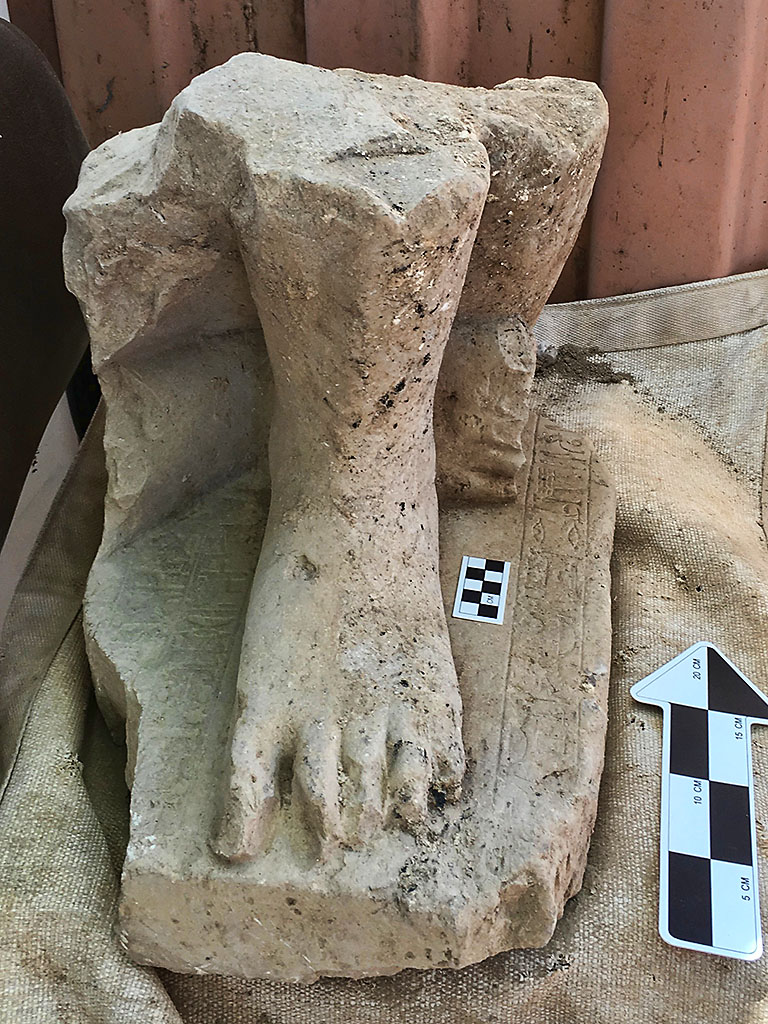
Jerusalem, July 25, 2016 — In a historic find, a large fragment of an Egyptian statue measuring 45 X 40 centimeters [about 18 x 16 inches], made of lime-stone, was discovered in the course of the current season of excavations at Tel-Hazor, north of the Sea of Galilee in Israel. Only the lower part of the statue survived, depicting the crouching feet of a male figure, seated on a square base on which a few lines in the Egyptian hieroglyphic script are inscribed.

The archaeologists estimate that the complete statue would equal the size of a fully-grown man. At present only a preliminary reading of the inscriptions has been attempted, and the title and name of the Egyptian official who originally owned the statue, are not yet entirely clear.

The statue was originally placed either in the official’s tomb or in a temple – most probably a temple of the Egyptian god Ptah – and most of the texts inscribed on the statue’s base include words of praise to the official who may have served and most probably practiced his duties in the region of Memphis, the primary cult center of the god Ptah. They also include the customary Egyptian funerary formula ensuring eternal supply of offerings for the statue’s owner.

The monumental Egyptian statute of a high official from the Middle Kingdom in Egypt, found in the administrative palace at Hazor, north of the Sea of Galilee in Israel. (Photo credit: Shlomit Bechar)

The monumental Egyptian statute of a high official from the Middle Kingdom in Egypt, found in the administrative palace at Hazor, north of the Sea of Galilee in Israel. (Photo credit: Shlomit Bechar)

This statue, found this year, together with the sphinx fragment of the Egyptian king Mycerinus (who ruled Egypt in the 25th century B.C.E.) discovered at the site by the research team three years ago, are the only monumental Egyptian statues found so far in second millennium contexts in the entire Levant.

The discovery of these two statues in the same building currently being excavated by the research team, indicates the special importance of the building (probably the administrative palace of the ruler of the city), as well as that of the entire city of Hazor.
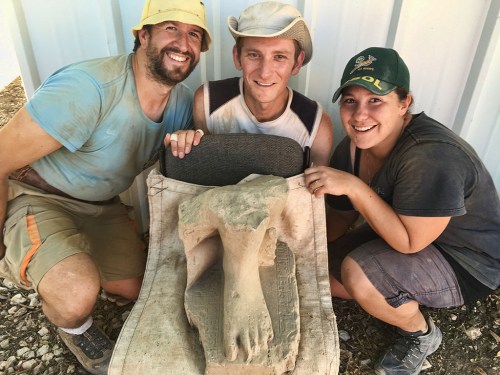
The three volunteer excavators who found the statue, from left to right: Valentin Sama-Rojo from Spain, Bryan Kovach from the United States, and Elanji Swart from South Africa. (Photo credit: Shlomit Bechar)

The three volunteer excavators who found the statue, from left to right: Valentin Sama-Rojo from Spain, Bryan Kovach from the United States, and Elanji Swart from South Africa. (Photo credit: Shlomit Bechar)

According to Prof. Amnon Ben-Tor of the Institute of Archaeology at the Hebrew University of Jerusalem, who has been conducting excavations at Tel-Hazor for over 27 years, Hazor is the most important site from the Biblical period. Shlomit Bechar, a doctoral student at the Institute of Archaeology who has been excavating at Hazor for a decade, is co-director of the Hazor excavations and director of the main excavation area.

In the course of close to 30 years of excavation, fragments of 18 different Egyptian statues, both royal and private, dedicated to Egyptian kings and officials, including two sphinxes, were discovered at Hazor. Most of these statues were found in layers dated to the Late Bronze Age (15th-13th centuries B.C.E.) – corresponding to the New Kingdom in Egypt. This is the largest number of Egyptian statues found so far in any site in the Land of Israel, although there is no indication that Hazor was one of the Egyptian strongholds in Southern Canaan nor of the presence of an Egyptian official at Hazor during the Late Bronze Age.

Interestingly, most Egyptian statues found at Hazor so far date to Egypt’s “Middle Kingdom” (19th-18th centuries B.C.E), a time when Hazor did not yet exist. It thus seems that the statues were sent by an Egyptian king in the “New Kingdom” as official gifts to the king of Hazor, or as dedications to a local temple (regardless of their being already “antiques”). This is not surprising considering the special status of the king of Hazor who was the most important king in Southern Canaan at the time. The extraordinary importance of Hazor in the 15th-13th centuries B.C.E. is indicated also by the Biblical reference to Hazor as “the head of all those kingdoms” (Joshua 11:10).

All the statues at the site were found broken to pieces and scattered over a large area. Clear signs of mutilation indicate that most of them were deliberately and violently smashed, most probably in the course of the city’s final conquest and destruction sometime in the 13th century B.C.E. The deliberate mutilation of statues of kings and dignitaries accompanying the conquest of towns, is a well-known practice in ancient times (I Samuel 5:1-4; Isaiah 11:9) as well as in our time.

The Hazor excavations, which began in the mid 1950 (under the direction of the late Prof. Yigael Yadin), are carried out on behalf of the Hebrew University of Jerusalem. The excavations were resumed in 1990 – still on behalf of the Hebrew University, and the Israel Exploration Society, and are named “The Selz Foundation Hazor Excavations in Memory of Yigael Yadin”. The excavation takes place within the Hazor National Park, in full support and cooperation with the National Parks Authority.

Hazor is the largest biblical-era site in Israel, covering some 200 acres, and has been recognized as a World Heritage Site by UNESCO. The population of Hazor in the second millennium BCE is estimated to have been about 20,000, making it the largest and most important city in the entire region. Its size and strategic location on the route connecting Egypt and Babylon made it “the head of all those kingdoms” according to the biblical book of Joshua (Joshua 11:10). Hazor’s conquest by the Israelites opened the way to the conquest and settlement of the Israelites in Canaan. The city was rebuilt and fortified by King Solomon and prospered in the days of Ahab and Jeroboam II, until its final destruction by the Assyrians in 732 BCE.

Documents discovered at Hazor and at sites in Egypt and Iraq attest that Hazor maintained cultural and trade relations with both Egypt and Babylon. Artistic artifacts, including those imported to Hazor from near and far, have been unearthed at the site. Hazor is currently one of Israel’s national parks.

—”—

The archaeological season for the major excavations is closing down and interesting reports are coming in almost daily.
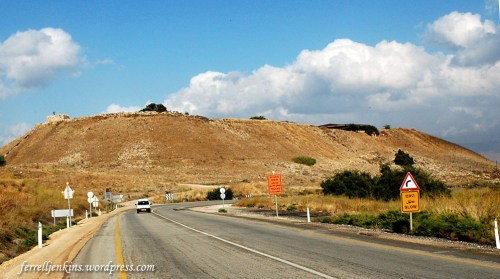
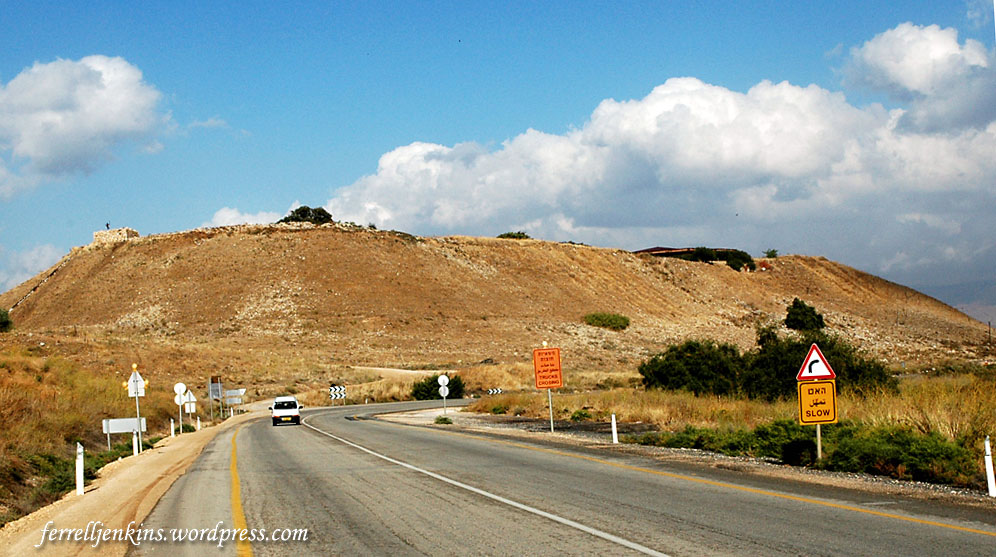
Tel Hazor (upper mound) from the south. Photo by Ferrell Jenkins.

Tel Hazor (upper mound) from the south. Photo by Ferrell Jenkins.
Meeting Professor Carl Rasmussen in Jerusalem

holylandphotos, aka Prof. Carl Rasmussen, left a helpful comment on our recent post, “A crown of thorns and a reed.”

Great article! Some of your readers might be interested in the “crown of thorns” that I have posted on my web site.

He left a link to a beautiful example of a crown of thorns posted at holylandphotos here. This photo, along with those we posted, will certainly enrich any lesson on the subject.

And this gives me the opportunity of share a Jerusalem experience from this spring.

Our group had just finished a visit to the Old City of Jerusalem, including the Western Wall. We exited through Dung Gate on the south-east corner of the Old City to meet our bus. I got on the bus and sat down as a good example to my tour members who are sometimes distracted by peddlers. A man stuck his head in the front door of the bus and said, “I’m Carl Rasmussen.”

It was the first time Carl and I had met in person, but we had exchanged several emails and assisted each other in locating some significant places in the Bible world over the past few years. Carl was on his first outing with a new class of students at the Jerusalem University College. We didn’t have much time to talk, but enough to pose for a photo beside the south wall of the Old City.

Carl Rasmussen and Ferrell Jenkins in Jerusalem. April 5, 2016.

Carl Rasmussen and Ferrell Jenkins in Jerusalem. April 5, 2016.

Prof. Carl Rasmussen is known for his academic teaching, his tours, and his Bible atlas, his Holy Land Photos’ blog, and his large collection of photos at holylandphotos.

We have called attention to the Zondervan Atlas of the Bible several times. I recommend this book for home study, and the Zondervan Essential Atlas of the Bible to use when traveling to Bible lands, or to take to Bible class. I see that Kindle currently has this book for $12.96.
The Holy Land Photos site now has a database of more than 4700 photos available for use by teachers.

I have developed friendships with several individuals who are recognized for their interest and knowledge in Bible lands as a result of this blog. A wonderful side benefit to this work.

The 2016 excavations at Gath

Tell es-Safi/Gath. Prof. Aren Maeir continues to report almost daily about progress in the excavation at Tell es-Safi/Gath. Staff and volunteers are working in at least five areas and Maeir continues to give a brief summary of finds of the dig with multiple photos here. The photos are not labeled, but if you know something about the site you may be able to determine which area is pictured.

Since the announcement at the close of last season (2015) about a possible Iron Age gate, and the teaser post with 1 Samuel 21:13 as a title, I have been following this. I am not expecting they will find David’s spittle or a hair from his beard, but as a believer of the Biblical account I do draw a connection between the text and the factual reality that seems to be coming to light on the tell.

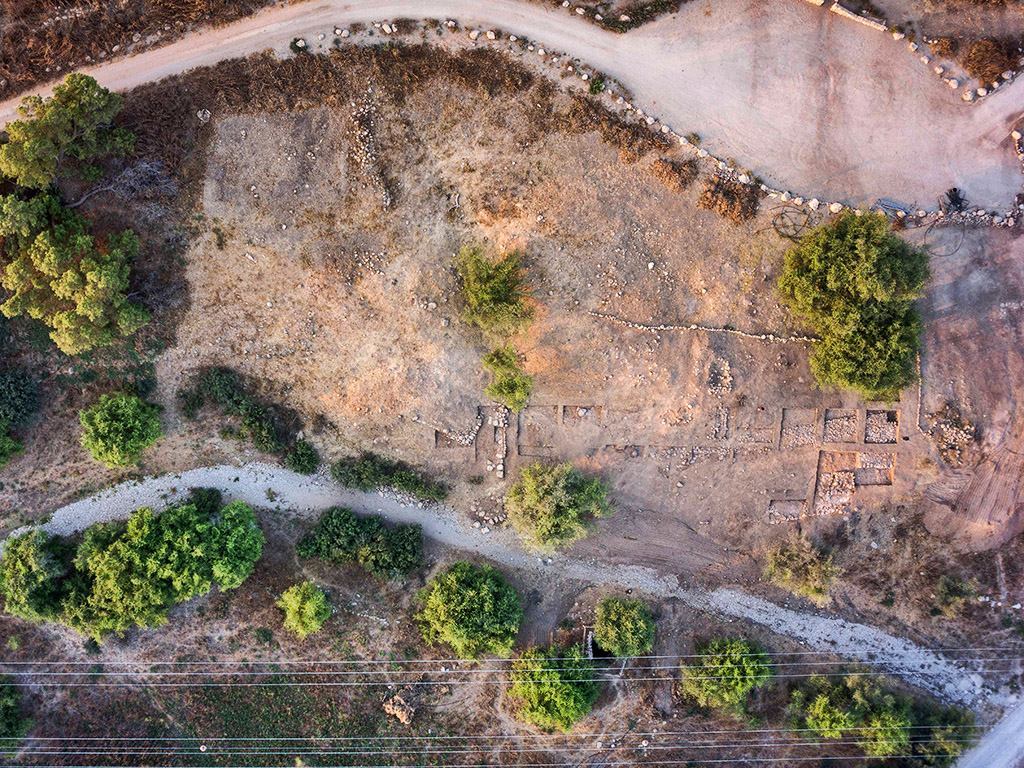
Below is an aerial photo published last year showing the gate area of Gath. For a larger photo go to the Gath website here.

Aerial general view of area D fortifications at Gath.

Aerial general view of area D fortifications at Gath.

Area D, with the gate and fortifications, is located below the parking area visible in the lower right quarter of the photo.

Aerial view of Gath showing the area where the gate has been uncovered. Photo by Ferrell Jenkins.

Aerial view of Gath showing the area where the gate has been uncovered. Photo by Ferrell Jenkins.

Earlier this year when my group visited the site in April, some of the tour members enjoyed examining the stone walls. I am looking forward to seeing new photos at the end of this season (in about a week). It only takes a short time after the rains for new growth to begin to cover the excavations.

Members of my group looking at the walls uncovered in 2015. Photo by Ferrell Jenkins.

Members of my group looking at the walls uncovered in 2015. Photo by Ferrell Jenkins.

David’s relationship with the Philistines is fascinating. At the Valley of Elah, a few miles away, he killed the giant Goliath who was from Gath (1 Samuel 17), but later, when fleeing from King Saul he sought refuge from Achish king of Gath. It was at that time that David “pretended to be insane” at the gate of Gath.

 10 And David rose and fled that day from Saul and went to Achish the king of Gath.  11 And the servants of Achish said to him, “Is not this David the king of the land? Did they not sing to one another of him in dances, ‘Saul has struck down his thousands, and David his ten thousands’?”  12 And David took these words to heart and was much afraid of Achish the king of Gath.  13 So he changed his behavior before them and pretended to be insane in their hands and made marks on the doors of the gate and let his spittle run down his beard.  14 Then Achish said to his servants, “Behold, you see the man is mad. Why then have you brought him to me?  15 Do I lack madmen, that you have brought this fellow to behave as a madman in my presence? Shall this fellow come into my house?” (1 Samuel 21:10-15 ESV).

Read here for my more detailed post about Gath and the possible gate from last year.

Thanks to Aren Maeir for the good updates and photos from Gath. Follow his blog to read more about it.

Philistine cemetery uncovered at Ashkelon

Friends Trent and Rebekah Dutton alerted me last evening that there would be a significant press release today about the excavation of a Philistine cemetery at Ashkelon over the past three years. All of this information has been kept secret until today with an announcement to coincide with the opening of a permanent Ashkelon exhibit at the Rockefeller Museum in Jerusalem. Trent and Rebekah have been working with the Leon Levy Expedition to Ashkelon during this time in connection with others from Wheaton College, Harvard, and other educational institutions. They both have earned the Master’s degree in Archaeology from Wheaton.

Sign at Ashkelon reminding visitors that the Philistines once lived here.

Sign at Ashkelon reminding visitors that the Philistines once lived here.

Certain news outlets have been given an advance notice of this discovery and have already broken the news. I am directing you to some of the better reports thus far. What you learn may surprise you.

Trust you will enjoy some of these reports this afternoon.

Biblical History Center – LaGrange, Georgia

The Explorations in Antiquity Center, in LaGrange, Georgia, now in its tenth year, has changed the name to Biblical History Center. The new website with detailed information is available here.

New Logo for the Biblical History Center, LaGrange, Georgia.

New Logo for the Biblical History Center, LaGrange, Georgia.

The Biblical History Center is the brainchild of Dr. James (Jim) Fleming, well-known for his teaching in Israel.

Dr. Fleming established Biblical Resources in 1975, for the purpose of producing educational materials and aids for teaching the historical, geographical, and archaeological background of the Bible.

It was wonderful to have these resources together at one place in Israel, but it is beneficial to many more to have the resources available in the Southeastern United States.

We have mentioned the Center prominently here, here, and here.

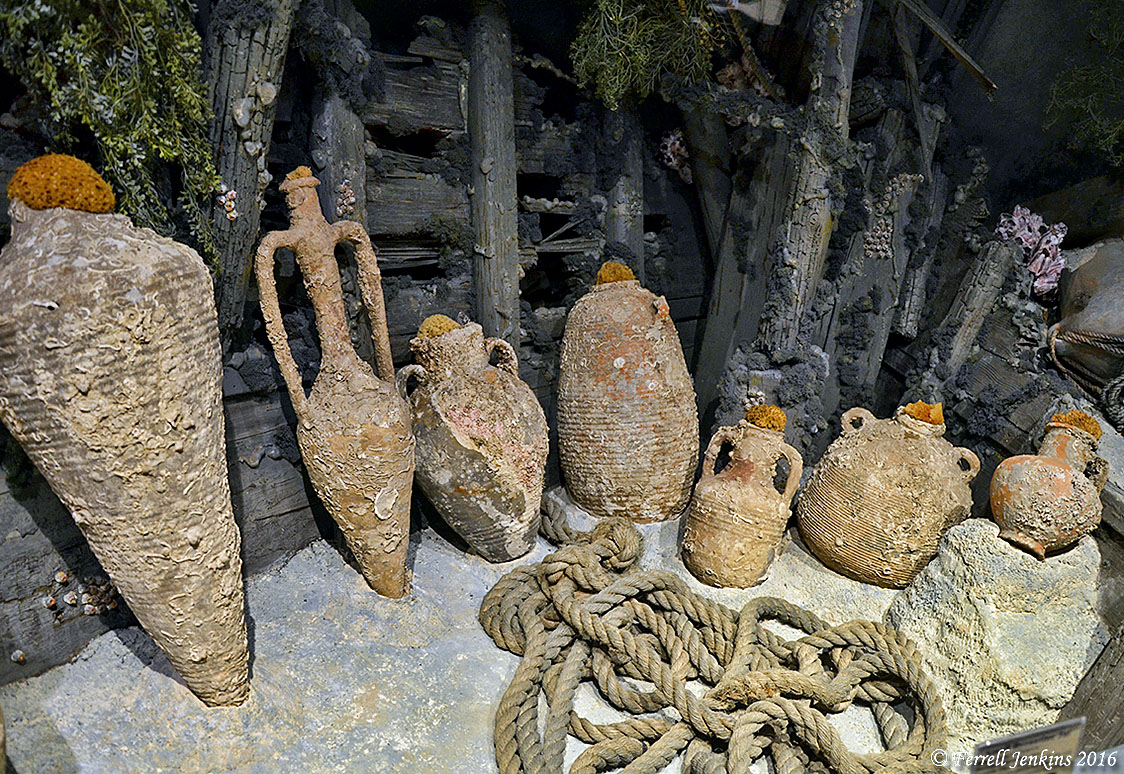
My wife and I had the opportunity to stop by the Biblical History Center last November. Several significant changes have taken places since our earlier reports. The BHC now has a Biblical Life Artifacts Gallery displaying 250 artifacts from the National Treasures of Israel. Instead of having these items displayed in cases with a sign telling what they are, they are exhibited in life-like settings.

Genuine artifacts from a shipwreck off the coast of Israel displayed in a life-like setting. Photo by Ferrell Jenkins.

Genuine artifacts from a shipwreck off the coast of Israel displayed in a life-like setting. Photo by Ferrell Jenkins.

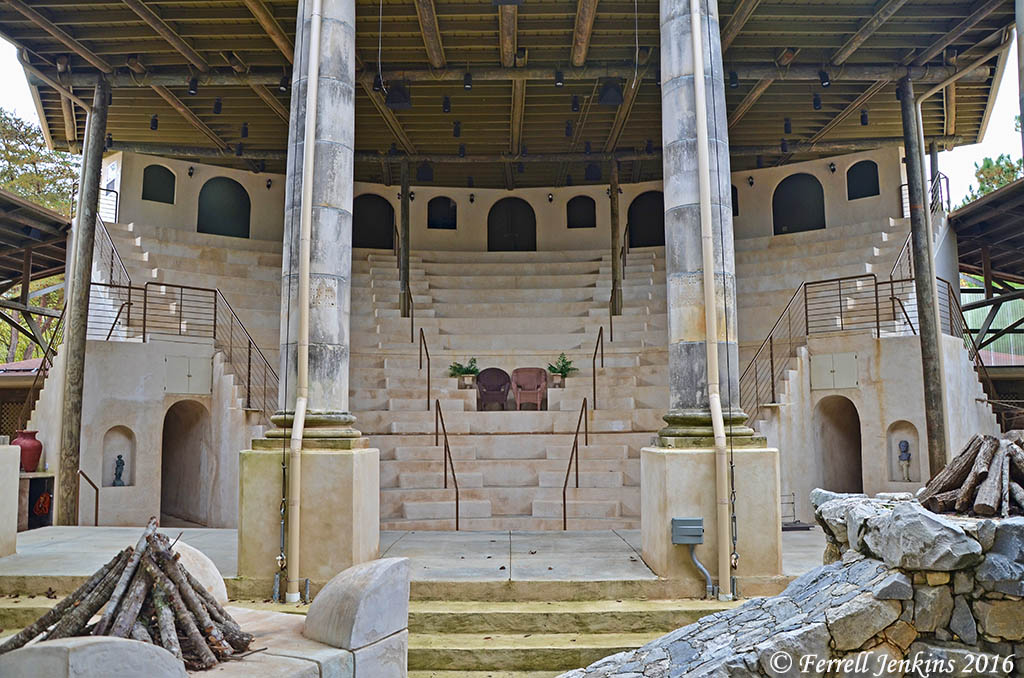
The new Biblical Life Artifacts Gallery is housed underneath the seating of the Roman theater.

Roman theater at Biblical History Center.

Roman theater at the Biblical History Center. Photo by Ferrell Jenkins.

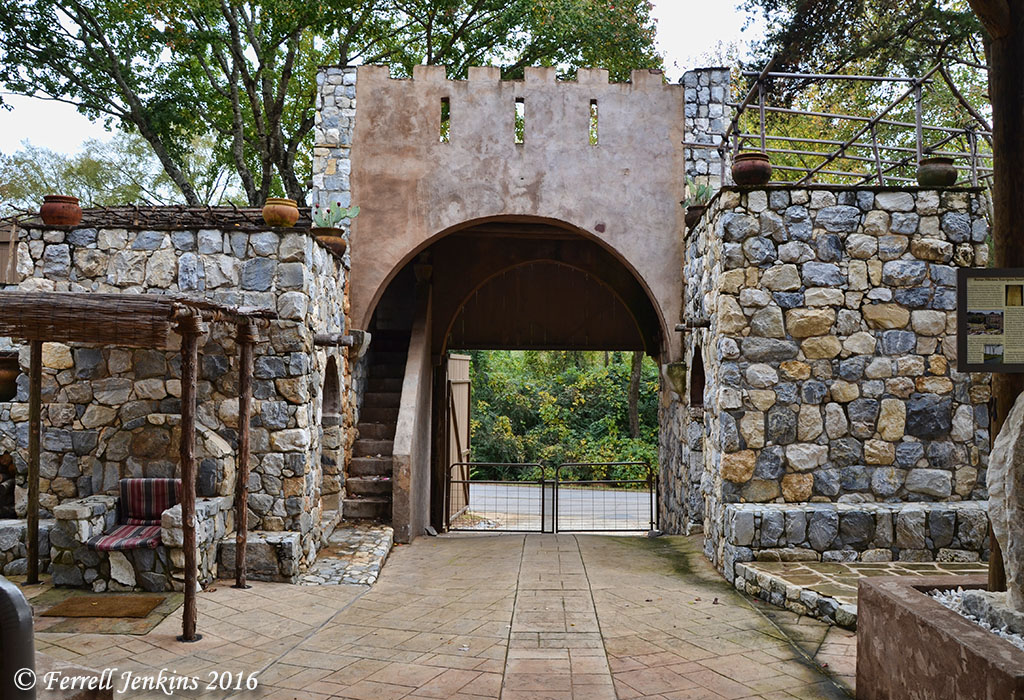
Of course, there are other important things at BHC. The photo below might remind one of the Middle Bronze Age gate at Tel Dan, and the canopy to the left of the gate recalls the Iron Age gate at the same city. This is where the king or judge sat in the gate to receive the people (2 Samuel 19:8). Other features of housing from biblical times are also shown in this structure.

The gate at the Biblical History Center. Photo by Ferrell Jenkins.

The gate at the Biblical History Center. Photo by Ferrell Jenkins.

Other artifact pertains to farming, shepherding, fishing, the process of dying and weaving cloth, storage, glass production, coins, foods, games – to name a few.

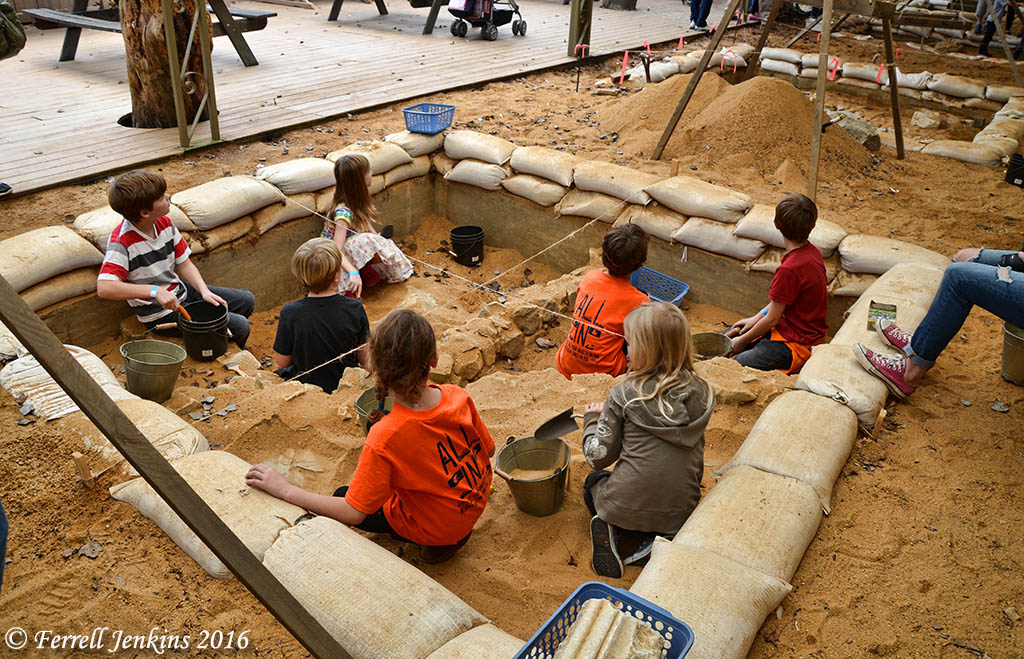
The Biblical History Center is a family place with guided tours. They even have a place where kids can participate in an archaeological dig. And you can arrange for a biblical meal and learn what it means to “recline at table” (Matthew 26:7).

Kids learning about archaeology at the Biblical History Center.

Kids learning about archaeology at the Biblical History Center.

Check the BHC web site for complete information about the various exhibits and hours of operation. If you live close enough, this is a wonderful place to take an entire Bible class or church group. The teachers of the children’s Bible classes at one church I know about went as a group to learn more about Bible times and customs.

Want to see the types of altars mentioned in the Bible? What about crosses or tombs, wine presses or threshing floors? It’s all there.

When I walked into the BHC ticket office I handed my card to Mrs. Crenshaw. She said, “You have written about our Center.” I explained that I had recommended the Center because I knew of the work of Dr. Fleming in Israel. I had met him there and at Professional meetings, but had never been to the Center. In the earlier reviews I used photos made by David Padfield and Jane Britnell. She sold me a ticket for my wife and said, “There will be no charge for you.” Later we had an opportunity to speak with Jim Fleming for a few minutes.

This is a great facility that I highly recommend.

“It is the Land of Honey” – Tel Rehov discoveries on display at Eretz Israel Museum

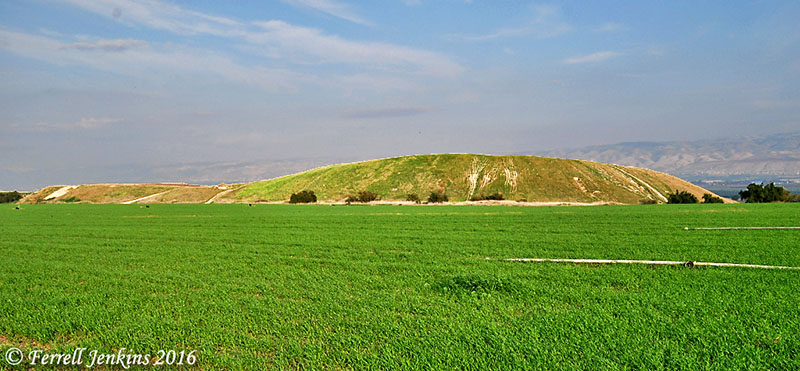
Tel Rehov is located about three miles south of Beth-Shean (Beth-Shan) on the east side of Highway 90. Rehov is not mentioned in the Old Testament, but it is known from Pharaoh Shishak’s city list on the wall of the temple of Amun in the Karnak Temple at Luxor, Egypt. This campaign is also mentioned in the pages of the Bible (1 Kings 14:25-28; 2 Chronicles 12:2-9).

Tel Rehov was occupied during the Bronze Age and the Iron Age. The city may be one of those not captured by Israel when they entered the Land under the leadership of Joshua.

The men of Manasseh did not conquer Beth Shan, Taanach, or their surrounding towns. Nor did they conquer the people living in Dor, Ibleam, Megiddo or their surrounding towns. The Canaanites managed to remain in those areas. Whenever Israel was strong militarily, they forced the Canaanites to do hard labor, but they never totally conquered them. (Judges 1:27-28 NET; cf. Joshua 17:12)

The city was destroyed by the Assyrians in the eighth century B.C. as they made their steady trek south.

Archaeological excavations were conducted at Tel Rehov from 1997 to 2012 under the direction of Prof. Amihai Mazar and Dr. Nava Panitz-Cohen of the Hebrew University of Jerusalem. For information and photos see the excavation website here.

View east of Tel Rehov in the Beth Shean Valley. Photo by Ferrell Jenkins.

Tel Rehov in the Beth-Shean Valley to the east of Highway 90. The mountains of Gilead are visible in the distance. Photo by Ferrell Jenkins.

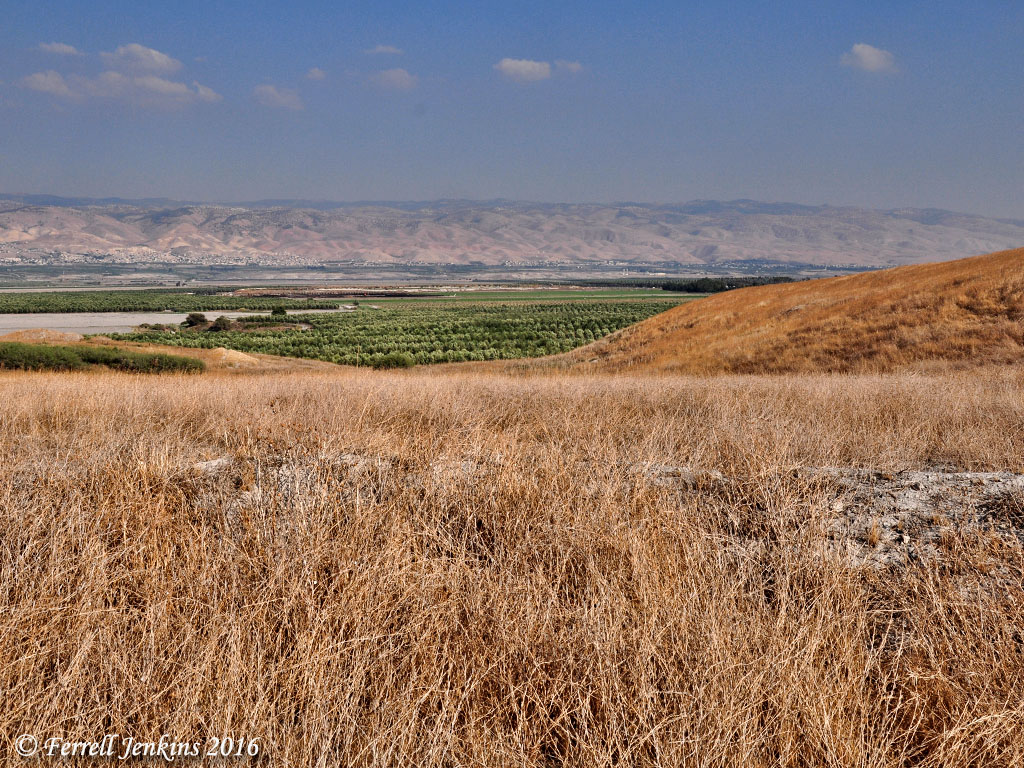
The next view takes us to the top of the mound. From there we see the Jordan Valley and a nice view of the Gilead mountains in modern Jordan.

View east from atop Tel Rehov. We see the Jordan Valley and the Gilead mountains. Photo by Ferrell Jenkins.

View east from atop the north end of Tel Rehov. We see the Jordan Valley and the Gilead mountains in the distance. Photo by Ferrell Jenkins.

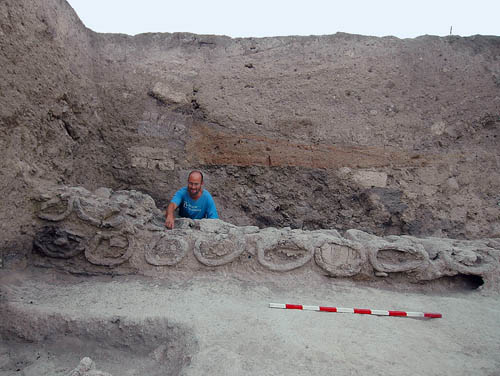
Many artifacts, including numerous household and cult objects, were uncovered at Tel Rehov. Perhaps the most unusual find was an industrial apiary. The small photo below from the excavation web site shows some of the beehives made of clay.

 Apiary at Tel Rehov, the eastern row of hives © Copyright - The Beth-Valley Archaeological Project, Hebrew University of Jerusalem,

Apiary at Tel Rehov, the eastern row of hives. © Copyright – The Beth-Shean Valley Archaeological Project, Hebrew University of Jerusalem,

From January 12 to October 31, 2016, items from Tel Rehov are exhibited at the Eretz Israel Museum in Tel Aviv under the title It Is the Land of Honey. I had the opportunity to visit this exhibition in April. The Museum website provides detailed information about the exhibition and a few small photos here.

The houses at Tel Rehov during Iron Age IIA differed from the typical houses found in known Israelite cities. According to the Museum website,

A salient feature of the Iron Age IIA city was the exclusive use of mudbrick to construct all buildings, incorporating wooden beams in walls and floors. Each building was unique in its architectural plan, and did not resemble any of the common blueprints of the Iron Age II, such as four-room houses or pillared buildings.

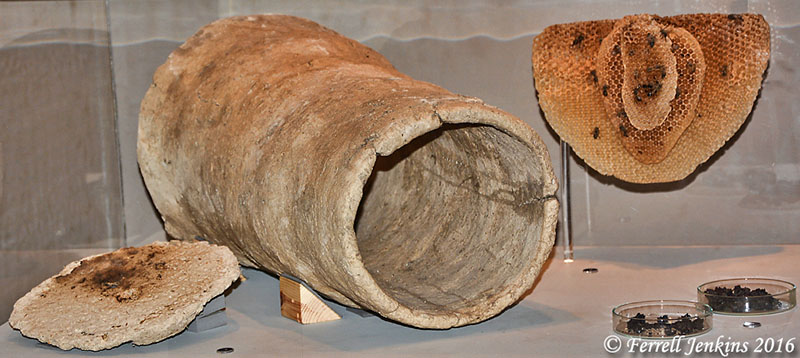
The photo below shows one of the clay beehives. A reconstruction of a honeycomb is visible on the right. Some of the bees found in the hives were determined to be from Anatolia, modern central Turkey. This adds one more piece of evidence showing how interconnected the nations of the ancient Middle East were. Some of the bees found in charred honeycombs are in the petri dishes in the front right of the photo. The lid of the beehive, with a hole in the center, is to the left of the hive. Click on the photo for a larger image.

One of the beehives from the Tel Rehov apiary. Eretz Israel exhibit. Photo by Ferrell Jenkins.

One of the beehives from the Tel Rehov apiary. Eretz Israel exhibition. Photo by Ferrell Jenkins.

The exhibition includes a large display of items from Tel Rehov. I will list just a few.

  • Several four horned altars made of clay.
  • A wide variety of household pottery, including an oven of the period.
  • One of the mud bricks of which the houses were constructed.
  • A reconstructed loom with weights found during the dig. Several others items from the “House of Elisha” are on display. The ostracon with the name of Elisha written on it in red ink is not displayed, but there is information about it in the exhibition book. There were several altars in this house.
  • A storage jar had the name Nimshi inscribed on it – the name identical to that of King Jehu’s grandfather (1 Kings 19:16; 2 Kings 9:2).
  • Some iron blades, arrow heads, and possibly a sickle.
  • Some typical Canaanite clay fertility goddesses.
  • Stamped jar handles unique to Tel Rehov.
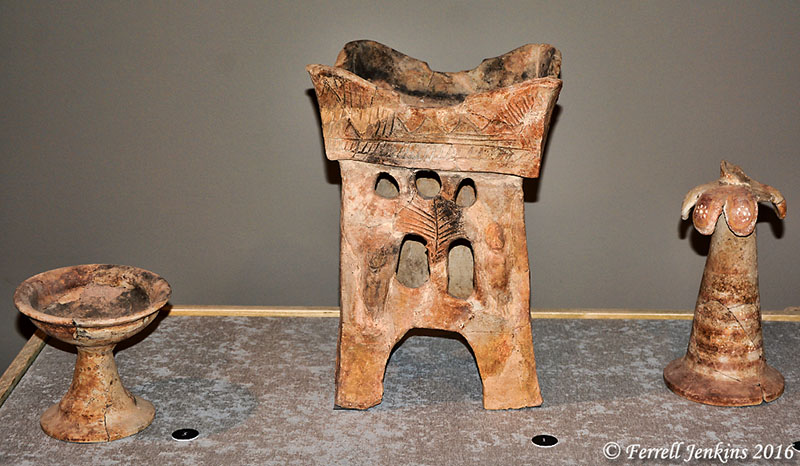
Horned altar and chalices from Tel Rehov. Photo by Ferrell Jenkins.

Tower shaped horned altar and chalices from Tel Rehov found in the area of the apiary. This altar is listed as being on loan from the Israel Museum in the exhibition book. If you miss the exhibition in Tel Aviv, perhaps you can see it later in the Israel Museum. Photo by Ferrell Jenkins.

The Museum has produced a nice 256-page book in Hebrew and English about Tel Rehov and the exhibition. I don’t see it listed at Amazon, but if you visit the exhibition you will probably wish to purchase a copy at the Museum shop.

Mazar and Panitz-Cohen published a brief article, with several photos of Tel Rehov artifacts, under the title “To What God? Altars and a House Shrine from Tel Rehov Puzzle Archaeologists” in the July/August 2008 Biblical Archaeology Review.

Cache of coins from Hasmonean Period discovered at Modi‘in

An excavation at Modi‘in under the direction of the Israel Antiquities Authority has uncovered a hoard of silver coins dating to the Hasmonean period (126 B.C.). The coins were found within an agricultural estate already uncovered at the site of a new neighborhood. Here are some excerpts and photos from the  IAA news release.

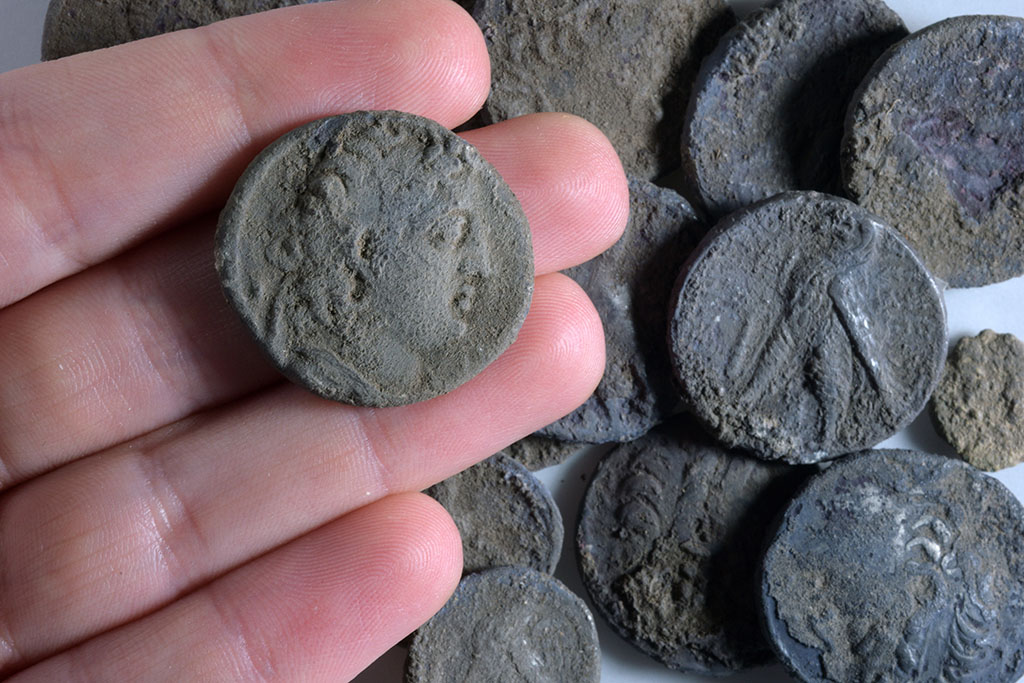
According to Avraham Tendler, director of the excavation on behalf of the Israel Antiquities Authority, “This is a rare cache of silver coins from the Hasmonean period comprised of shekels and half-shekels (tetradrachms and didrachms) that were minted in the city of Tyre and bear the images of the king, Antiochus VII and his brother Demetrius II. The cache that we found is compelling evidence that one of the members of the estate who had saved his income for months needed to leave the house for some unknown reason. He buried his money in the hope of coming back and collecting it, but was apparently unfortunate and never returned. It is exciting to think that the coin hoard was waiting here 2,140 years until we exposed it”.

A coin of Antiochus VII against the background of the rest of the coins that were exposed – studio photograph: Clara Amit.

A coin of Antiochus VII against the background of the rest of the coins that were exposed – studio photograph: Clara Amit.

Dr. Donald Tzvi Ariel, head of the Coin Department at the IAA,

“The cache, which consists of 16 coins, contains one or two coins from every year between 135–126 BCE, and a total of nine consecutive years are represented. It seems that some thought went into collecting the coins, and it is possible that the person who buried the cache was a coin collector. He acted in just the same way as stamp and coin collectors manage collections today”.

Tendler added,

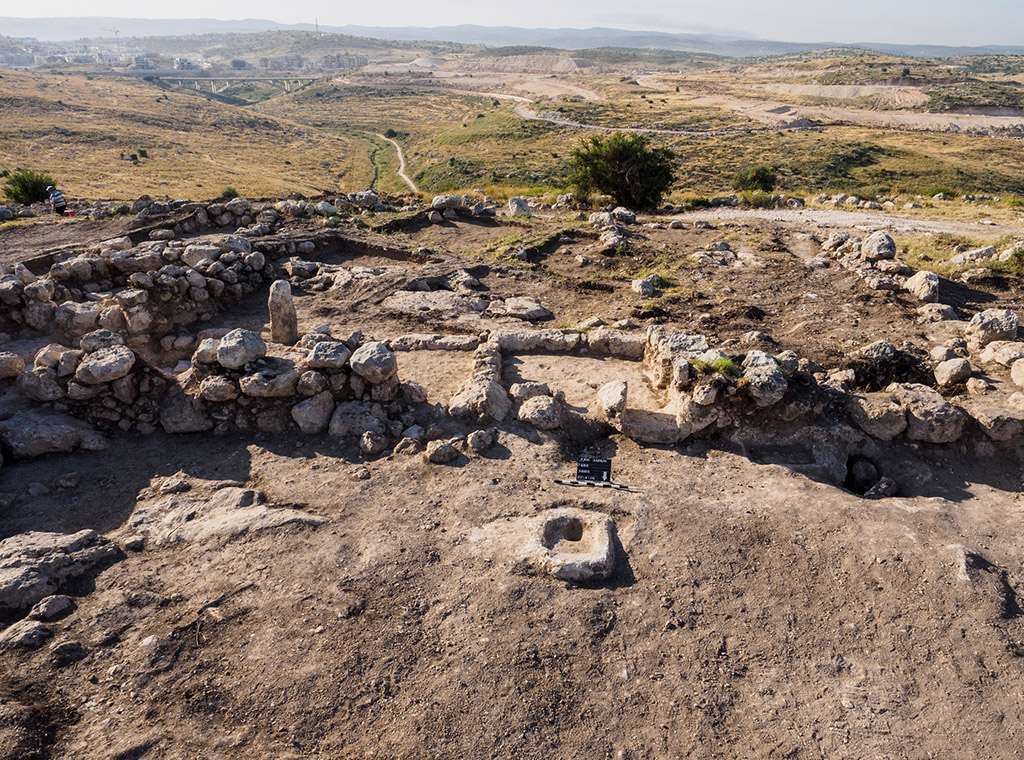
“The findings from our excavation show that a Jewish family established an agricultural estate on this hill during the Hasmonean period. The family members planted olive trees and vineyards on the neighboring hills and grew grain in valleys. An industrial area that includes an olive press and storehouses where the olive oil was kept is currently being uncovered next to the estate. Dozens of rock-hewn winepresses that reflect the importance of viticulture and the wine industry in the area were exposed in the cultivation plots next to the estate. The estate house was built of massive walls in order to provide security from the attacks of marauding bandits.

Aerial photograph of the Hasmonean estate house. Photographic credit: Griffin Aerial Photography, courtesy of the Israel Antiquities Authority.

Aerial photograph of the Hasmonean estate house. Photographic credit: Griffin Aerial Photography, courtesy of the Israel Antiquities Authority.

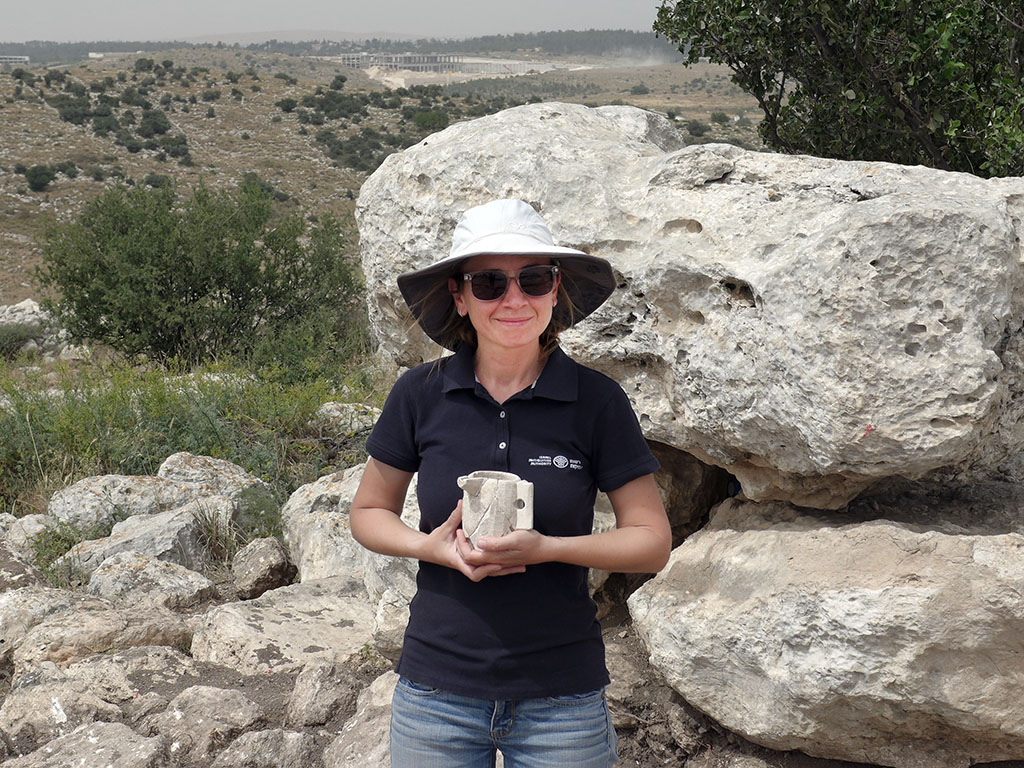
Numerous bronze coins minted by the Hasmonean kings were also discovered in the excavation. They bear the names of the kings such as Yehohanan, Judah, Jonathan or Mattathias and his title: High Priest and Head of the Council of the Jews. The finds indicate that the estate continued to operate throughout the Early Roman period. The Jewish inhabitants of the estate meticulously adhered to the laws of ritual purity and impurity: they installed ritual baths (miqwe’ot) in their settlement and used vessels made of chalk, which according to Jewish law cannot become ritually unclean.

. IAA archaeologist Jenny Marcus holding a chalk cup from the time of the Second Temple period which was discovered in the estate house. Photographic credit: Avraham Tendler.

. IAA archaeologist Jenny Marcus holding a chalk cup from the time of the Second Temple period which was discovered in the estate house. Photographic credit: Avraham Tendler.

Evidence was discovered at the site suggesting that the residents of the estate also participated in the first revolt against the Romans that broke out in 66 CE: the coins that were exposed from this period are stamped with the date “Year Two” of the revolt and the slogan “Freedom of Zion”. The estate continued to operate even after the destruction of the Temple in 70 CE. “It seems that local residents did not give up hope of gaining their independence from Rome, and they were well-prepared to fight the enemy during the Bar Kokhba uprising”, said Tendler. “During the excavation we saw how prior to the uprising the inhabitants of the estate filled the living rooms next to the outer wall of the building with large stones, thus creating a fortified barrier. In addition, we discovered hiding refuges that were hewn in the bedrock beneath the floors of the estate house. These refuge complexes were connected by means of tunnels between water cisterns, storage pits and hidden rooms. In one of the adjacent excavation areas a miqwe [mikveh] of impressive beauty was exposed; when we excavated deeper in the bath we discovered an opening inside it that led to an extensive hiding refuge in which numerous artifacts were found that date to the time of the Bar Kokhba uprising”.

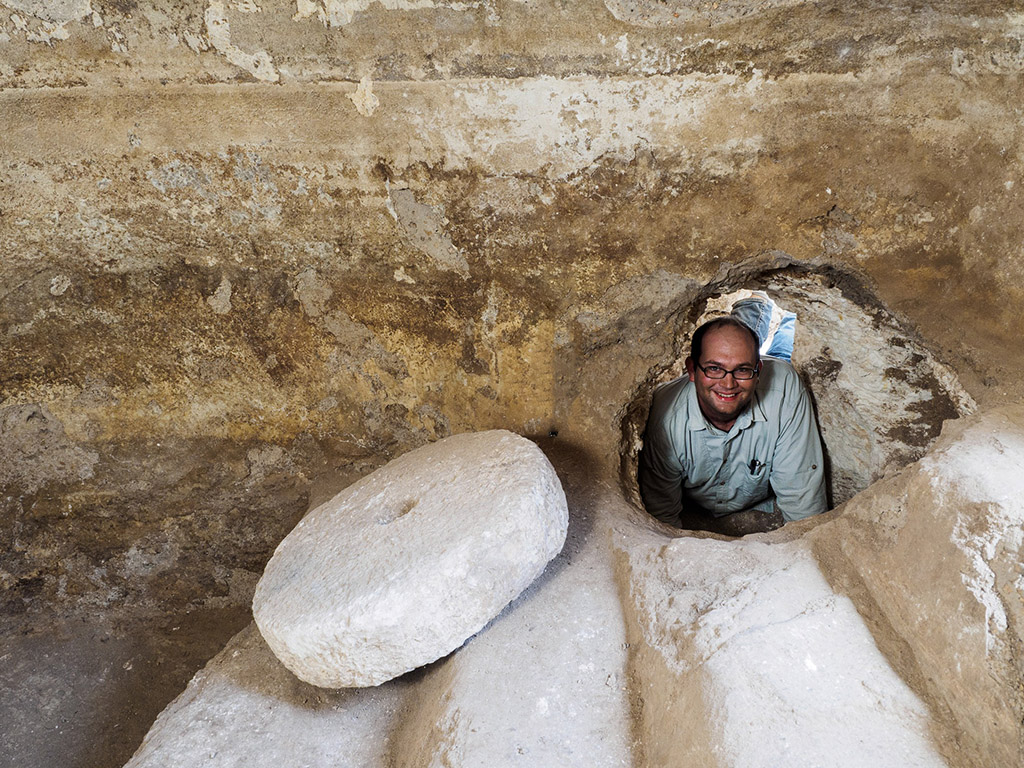
Abraham Tendler, the excavation director, inside a hiding refuge that was connected to a ritual bath (miqwe) during the Bar Kokhba uprising. Photographic credit: Assaf Peretz, courtesy of the Israel Antiquities Authority.

Abraham Tendler, the excavation director, inside a hiding refuge that was connected to a ritual bath (miqwe) during the Bar Kokhba uprising. Photographic credit: Assaf Peretz, courtesy of the Israel Antiquities Authority.

And here is a short film clip in English made by EYECON, courtesy of the Israel Antiquities Authority.

Discoveries such as these provide insight into the period between the Old Testament and the New Testament, as well as background for the Jewish struggle against the Roman occupation we know from the New Testament and the writings of Josephus.

HT: Joseph Lauer

Learn by looking and listening

The Internet has provided information from all types of sources to satisfy the needs of almost every type of interest. Some of us might dismiss most of it as useless and time-wasting. On the other hand, we find it helpful in many ways.

A person with a basic education can become informed in many areas through the use of the Internet. The problem is that most have no guidance when it comes to vetting the material that is online. In college, through lectures, text books, and selected readings the student become familiar with reliable tools and learns how to avoid the unreliable ones.

Recently I have been looking at some materials that can be extremely helpful to those who wish to come to a better understanding of the Bible through an understanding of the Land of the Bible. At our Biblical Studies Info Page (under Scholarly, then Blogs) we keep links to some very helpful blogs. We have a few great links on this page also.

Today I wish to share a few links that should be helpful.

The Lanier Theological Library in Houston presents several top-notch lecturers each year, and the videos remain online for those not able to attend. The lecture I wish to point you to today is Dr John Monson – Physical Theology: The Bible in its Land, Time and Culture. Monson lived in Israel as a child and learned the importance of the land in understanding the Biblical text. Plan to spend a few hours in listening, pausing to take notes, or to listen again to one of his points. I had the pleasure of hearing this lecture a few years ago at a professional meeting. Monson current teaches at Trinity International University.

Now, here is a brief view. David Pettegrew, at Corinthian Matters, calls attention to Ancient Corinth via Drone. Those who have visited Corinth will find this video extremely interesting. It also includes some identifying captions.

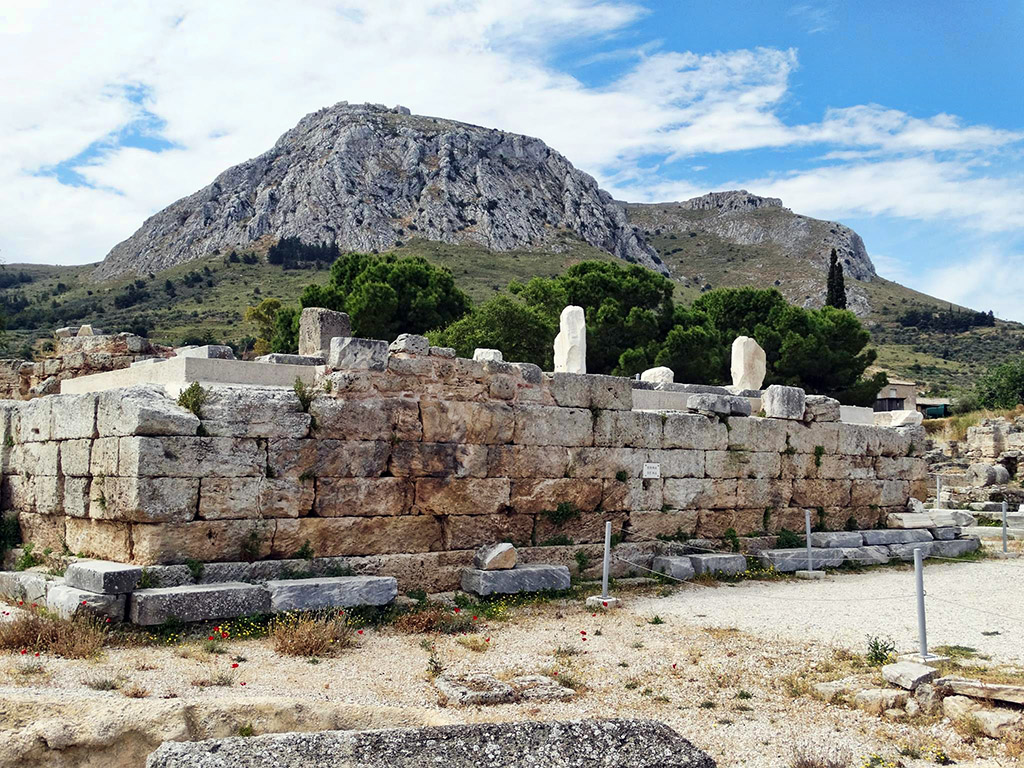
I was getting ready to post this blog and noticed that Charles Savelle (Bible X) was posting some pictures on FB of his current trip in Greece. He has granted permission for me to share this beautiful photo of the Bema in the Agora at Corinth, with the Acrocorinth in the background. This is where the Apostle Paul stood before Gallio (Acts 18). If you do not frequent Bible X, do so now. Lot’s of helpful information, especially for students, teachers, and ministers.

The Bema (judgment seat) in the Corinth agora, with the Acrocorinth in the distance. Photo by Charles Savelle.

The Bema (judgment seat) in the Corinth agora, with the Acrocorinth in the distance. Photo by Charles Savelle.

Bill Schlegel, author of Satellite Bible Atlas (available here), has been making short drone videos of various portions of Israel to be used with his atlas. So far he has posted 13 videos on YouTube here. Bill is Associate Professor of Bible at The Master’s College, Israel Bible Extension (IBEX) and he uses some of his students to add explanatory notes to the videos. When you purchase the Satellite Bible Atlas you receive access to all of the maps in .jpg format, and 70 photos made from the drone. These include several places rarely included in photo collections. This atlas can be very helpful for anyone visiting Israel, or studying the Bible at home.

Divers make spectacular discovery in Caesarea harbor

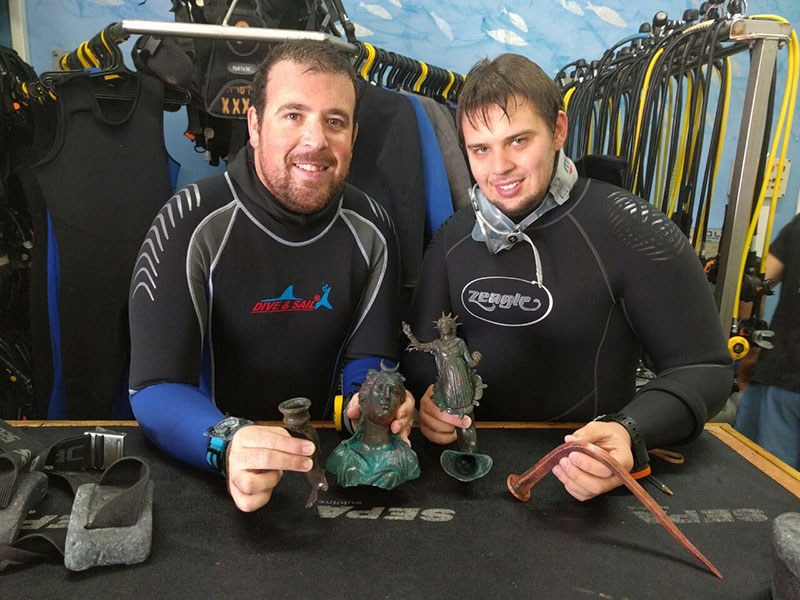
Divers Ran Feinstein (R) and Ofer Ra'anan after discovery. Credit: The Old Caesarea Diving Center.

Divers Ran Feinstein (R) and Ofer Ra’anan after discovery. Credit: The Old Caesarea Diving Center.

The Israeli papers are ablaze today with photos of a discovery made by two divers in the ancient port of Caesarea in the Caesarea National Park. The official news release of the Israel Antiquities Authority reads in part:

As soon as they emerged from the water divers Ran Feinstein and Ofer Ra‘anan of Ra‘anana contacted the Israel Antiquities Authority and reported the discovery and removal of several ancient items from the sea.

A joint dive at the site together with IAA archaeologists revealed that an extensive portion of the seabed had been cleared of sand and the remains of a ship were left uncovered on the sea bottom: iron anchors, remains of wooden anchors and items that were used in the construction and running of the sailing vessel. An underwater salvage survey conducted in recent weeks with the assistance of many divers from the Israel Antiquities Authority and volunteers using advanced equipment discovered numerous items that were part of the ship’s cargo.

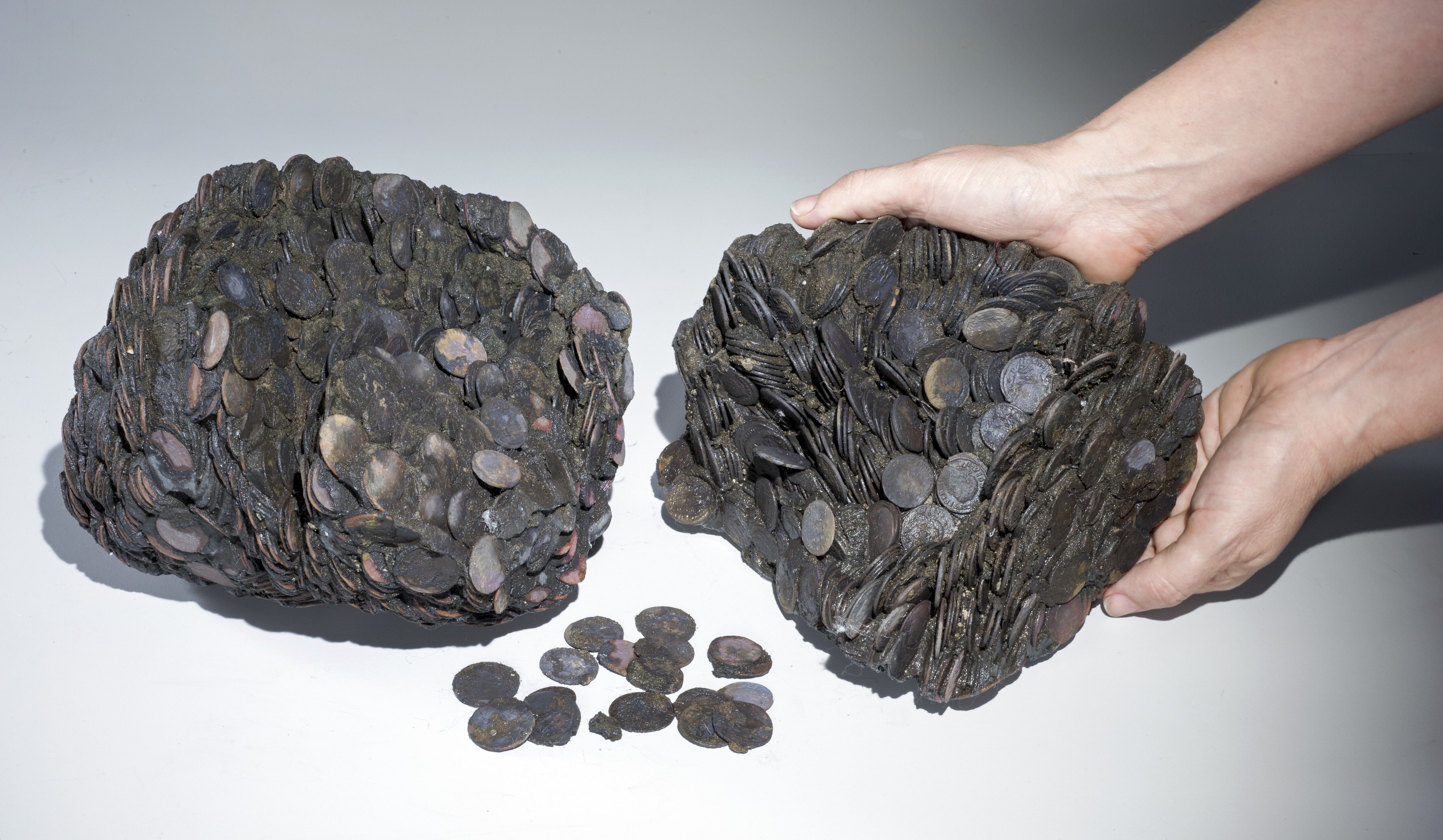
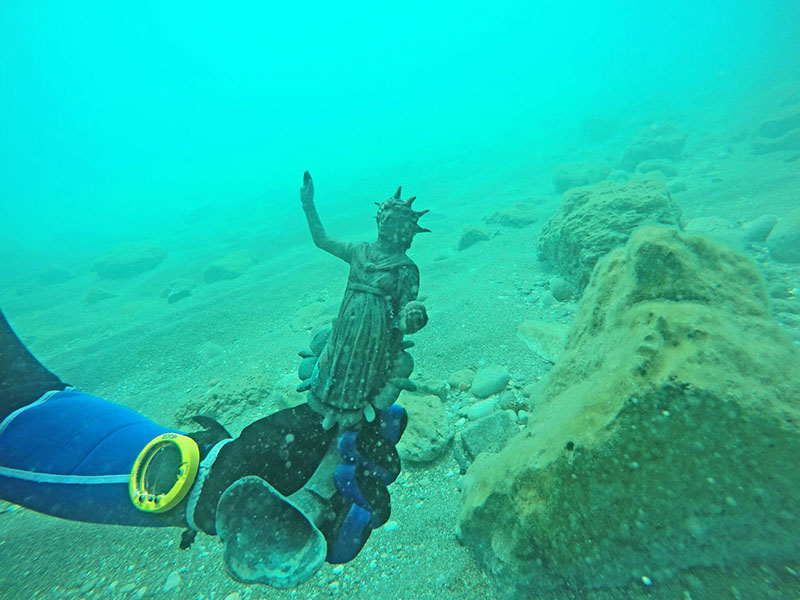
Many of the artifacts are bronze and in an extraordinary state of preservation: a bronze lamp depicting the image of the sun god Sol, a figurine of the moon goddess Luna, a lamp in the image of the head of an African slave, fragments of three life-size bronze cast statues, objects fashioned in the shape of animals such as a whale, a bronze faucet in the form of a wild boar with a swan on its head, etc. In addition, fragments of large jars were found that were used for carrying drinking water for the crew in the ship and for transportation at sea. One of the biggest surprises in particular was the discovery of two metallic lumps composed of thousands of coins weighing c. 20 kilograms which was in the form of the pottery vessel in which they were transported.

Jacob Sharvit, director of the Marine Archaeology Unit of the IAA, and Dror Planer, deputy director of the Unit, comment:

“These are extremely exciting finds, which apart from their extraordinary beauty, are of historical significance. The location and distribution of the ancient finds on the seabed indicate that a large merchant ship was carrying a cargo of metal slated recycling, which apparently encountered a storm at the entrance to the harbor and drifted until it smashed into the seawall and the rocks”. A preliminary study of the iron anchors suggests there was an attempt to stop the drifting vessel before it reached shore by casting anchors into the sea; however, these broke – evidence of the power of the waves and the wind which the ship was caught up in”.

Sharvit and Planer stress, “A marine assemblage such as this has not been found in Israel in the past thirty years. Metal statues are rare archaeological finds because they were always melted down and recycled in antiquity. When we find bronze artifacts it usually occurs at sea. Because these statues were wrecked together with the ship, they sank in the water and were thus ‘saved’ from the recycling process”. Sharvit and Planer added, “In the many marine excavations that have been carried out in Caesarea only very small number of bronze statues have been found, whereas in the current cargo a wealth of spectacular statues were found that were in the city and were removed from it by way of sea. The sand protected the statues; consequently they are in an amazing state of preservation – as though they were cast yesterday rather than 1,600 years ago”. The coins that were discovered bear the image of the emperor Constantine who ruled the Western Roman Empire (312–324 CE) and was later known as Constantine the Great, ruler of the Roman Empire (324–337 CE), and of Licinius, an emperor who ruled the eastern part of the Roman Empire and was a rival of Constantine, until his downfall in a battle that was waged between the two rulers.

The harbor at Caesarea. The Apostle Paul used this harbor many times during his preaching tour, and from here was taken to Rome to stand trial before Caesar. Photo by Ferrell Jenkins.

The harbor at Caesarea. The Apostle Paul used this harbor many times during his preaching tours, and from here was taken to Rome to stand trial before Caesar. Photo by Ferrell Jenkins.

Eusebius of Caesarea (c. A.D. 265–c.339), often designated “The Father of Church History,” was active at Caesarea at the time this ship sank.

Here are photos of some of the items discovered.

A figurine of Dionysus, the god of wine. Photo: courtesy of the Israel Antiquities Authority.

A figurine of Dionysus, the god of wine. Photo: courtesy of the Israel Antiquities Authority.

And, a new way to preserve your money.

Lumps of coins that were discovered at sea, weighing a total of c. 20 kilograms. Photographic credit: Clara Amit, courtesy of the Israel Antiquities Authority.

Lumps of coins that were discovered at sea, weighing a total of c. 20 kilograms. Photographic credit: Clara Amit, courtesy of the Israel Antiquities Authority.

Decorated lamps with twice the light.

A bronze lamp decorated with the image of the sun god Sol. Photographic credit: Clara Amit, courtesy of the Israel Antiquities Authority.

A bronze lamp decorated with the image of the sun god Sol. Photographic credit: Clara Amit, courtesy of the Israel Antiquities Authority.

The view under water.

Fragment of a bronze lamp decorated with the image of the sun god Sol, as discovered on the seabed. Photo: Ran Feinstein.

Fragment of a bronze lamp decorated with the image of the sun god Sol, as discovered on the seabed. Photo: Ran Feinstein.

And the nicest thing about all of this…  According to the release, the two divers will be invited to tour the storerooms of the National Treasures. I may take up diving.

HT: Joseph I. Lauer