Author Archives: Ferrell Jenkins

Another view from Babylon

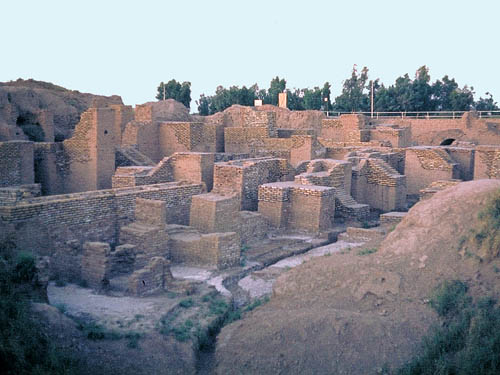
The early part of the week finds me traveling in Alabama, but I brought along another old slide scan of a photo I made at Babylon in 1970. When I compare the quality of the camera I used that year with the one I use today it is amazing that the old photo is this good. Slides fade even under the best home conditions.

This site is identified as Nebuchaznezzar’s Principal Palace. You will notice that even then, long before Saddam Hussein, some reconstruction had been carried out at the site. The lighter colored bricks at the top of the walls are part of the reconstruction to give the viewer some idea of what was original. It also helps one to visualize the size of the rooms, etc. This is the sort of thing we see at Masada, Megiddo, and other sites in Israel where the black line distinguishes the original from the reconstructed.

Nebuchadnezzar's Principal Palace in 1970. Photo by Ferrell Jenkins.

Nebuchadnezzar's Principal Palace in 1970. Photo by Ferrell Jenkins.

I understand the white on the ground to be salt residue.

The prophet Isaiah predicted the overthrow of the Neo-Babylonian Empire.

And Babylon, the glory of kingdoms, the splendor and pomp of the Chaldeans, will be like Sodom and Gomorrah when God overthrew them. (Isaiah 13:19 ESV)

God spoke, and it happened.

Colonial archaeologists and the Ishtar Gate

Recently we called attention to an article in The New York Times about Babylon. Writer Steven Lee Myers says,

Colonial archaeologists packed off its treasures to Europe a century ago.

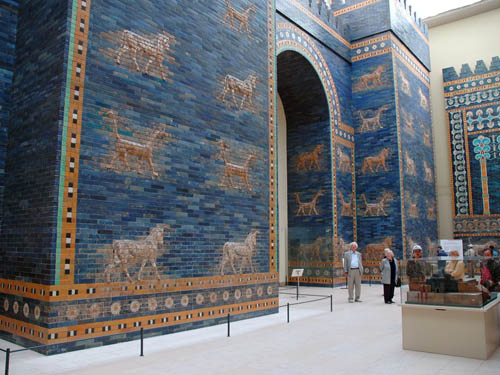
This statement seemed significant enough to be repeated under the photo of the miniaturized Ishtar Gate at the site. My immediate reaction to the statement is, “Well, aren’t we glad!” Anyone who has visited the Pergamum Museum in Berlin has seen the reconstructed Ishtar Gate. It looks like this.

Ishtar Gate in the Pergamum Museum of Berlin. Photo by Ferrell Jenkins.

Ishtar Gate in the Pergamum Museum of Berlin. Photo by Ferrell Jenkins.

Now, it’s not that the German archaeologists, under the direction of Robert Koldewey, “packed off” what you see here. All of these lions, bulls, and dragons were excavated from the mound of ancient Babylon between 1899 and 1912. Eventually they were taken to Berlin in 1926. Even under the Communist government of East Germany this gate was preserved. I saw it a few times before the Berlin Wall came down. Anyone able to travel to Berlin may see the Ishtar Gate as well as the reconstructed Procession Street. Can one say as much for the ruins of Babylon and the museum in Baghdad?

Babylon was once the greatest city of the world when the Neo-Babylonian Empire reigned supreme in the Ancient Near East (626-539 B.C.). The prophet Daniel was active in Babylon from 605 B.C. until after the fall of the city to the Persians (Daniel).  I can not imagine that he failed to see this gate.

Nebuchadnezzar was a megalomaniac. His pride is evident in the statement recorded by the prophet Daniel.

The king uttered these words: “Is this not the great Babylon that I have built for a royal residence by my own mighty strength and for my majestic honor?” (Daniel 4:30 NET Bible)

Babylon ruins reopen to tourists

The New York Times recently carried an article about the reopening of Babylon to tourists. Most of the attention is given to locals getting a chance to see Saddam Husein’s former palace built to overlook the ruins of the ancient city. Some of the photos are nice. (HT: Todd Bolen, BiblePlaces Blog)

Here is an article I published in Biblical Insights several years back.

– – – – – –

The site of Babylon is located about 55 miles southwest of Baghdad near Hillah in Iraq. The city was located on the River Euphrates, but is now a few miles east of the river on one of the canals. The rivers of Mesopotamia have frequently changed their course.

The earliest ancient name for Babylon, given in the table of nations, was Babel (Gen. 10:10). Babylon was ruled by Hammurabi, best known for his law code, in the 18th century B.C.

The city reached its peak during the Neo-Babylonian empire (626-539 B.C.). The Bible refers to Babylon as “the beauty of kingdoms, the glory of the Chaldeans’ pride” (Isaiah 13:19).

The greatest king of the Neo-Babylonian empire was Nebuchadnezzar (605-562 B.C.). There is abundant evidence of the activities of his reign. The best collections of artifacts are to be found in the British Museum in London and the Museum of the Near East (part of the Pergamon Museum) in Berlin. In Berlin one may see the reconstructed Procession Street, the Ishtar Gate, and the decorated facade of the Throne Room of Nebuchadnezzar from Babylon.

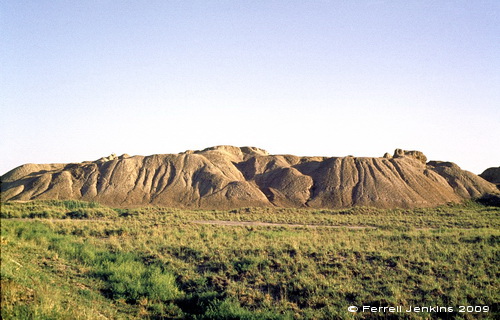
The photo below shows my first view of the site of ancient Babylon in 1970. Jeremiah 51:37 provides a wonderful caption: “And Babylon will become a heap of ruins.”

My first view of Babylon in 1970. Photo by Ferrell Jenkins.

My first view of Babylon in 1970. Photo by Ferrell Jenkins.

The kingdom of Judea had much contact with the Babylonians. Daniel was in the first group of Judean royal youths taken into Babylonian exile in 605 B.C., and was educated in the literature and language of Babylon (Daniel 1:1-6). Jerusalem fell to Nebuchadnezzar’s army March 15/16, 597 B.C. At that time Jehoiachin and 10,000 captives were taken as prisoners to Babylon (2 Kings 24:8-16). The prophet Ezekiel was among that group of captives. His prophetic call came in the fifth year of his exile by the river Chebar, a tributary of the Euphrates (Ezekiel 1:1-3).

The Judean captives remained in Babylon until the time of the Medes and Persians (Jeremiah 25:11-12). Cyrus, according to a clay cylinder now in the British Museum, allowed captives to return to their home land, build their temples and serve their own gods. This is in harmony with the biblical account in 2 Chronicles 36 and Ezra 1.

Excavations were conducted at Babylon by German archaeologists between 1899 and 1917. Discoveries included the main palace of Nebuchadnezzar, the procession street, some temples, and the Ishtar gate. The most fabulous of the items to be found have been reconstructed in the Museum of the Near East in Berlin. I have been able to visit Babylon only once in 1970.

Robert Jackson – Gospel Preacher

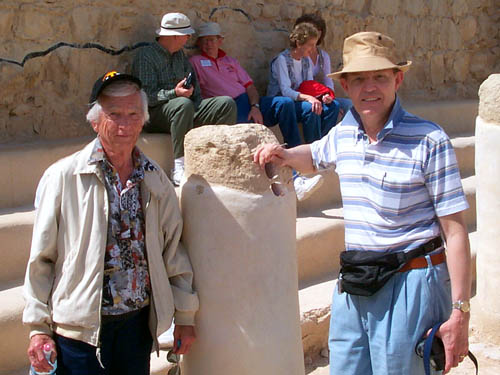
Word has come today of the passing of Robert Jackson, long-time minister of the gospel. I have many fond memories of time spent with Robert. He strengthened and encouraged me in one very difficult time in gospel work. I was especially pleased when he was able to join one of my tours in 2000. Phil Cavender made this photo in the synagogue at Masada.

Robert Jackson and Ferrell Jenkins at Masada in 2000.

Robert Jackson and Ferrell Jenkins at Masada in 2000.

Our deepest condolences go to Robert’s family. May the Lord raise up others like him!

Jacob’s Well — from Jacob to Jesus

Jesus came to Sychar, a city of Samaria, near the piece of land Jacob had owned (John 4:5; Genesis 33:19). The territory was apportioned to the descendants of Joseph, and Joseph was buried there at Shechem (Joshua 24:32). It was a place of great historic importance.

We are not able to speak with certainty regarding the location of Sychar. Some scholars associate the site with Shechem; others think it should be identified with the village of Askar which is located a short distance north. The traditional Jacob’s Well is located at Shechem in the valley between Mount Gerizim and Mount Ebal. The modern town of Nablus now fills this valley.

André Parrot says,

“Of all the ‘holy places’ of Palestine, none has more reason to be considered authentic than Jacob’s well. Indeed, there is no reason why its authenticity should be questioned” (Land of Christ 65).

Parrot describes the water as “cool and pleasant-tasting…drawn from a depth of 128 feet.” I have drunk the water several times, but in the past couple of decades my guides have advised against it due to pollution in the area.

The Samaritan woman said, “the well is deep” (John 4:11). Parrot reports the well is 128 feet deep. Murphy-O’Connor says it is 22.5 meters deep (about 74 feet). McGarvey cites several measurements mentioned in 19th century writers and reminds us that the well became filled with stones cast in by travelers trying to hear how long it would take a stone to hit the bottom (Lands of the Bible 283). He reports that the well was often dry.

There are numerous springs in the area of Shechem. Jacob, as a late-comer to the region, might have found it necessary to dig a well to assure water for his family and cattle.

A church was erected over the well about A.D. 380. The Crusaders built another church on the site in the 12th century. The property came under the control of the Greek Orthodox church in 1860. By the end of the 19th century the Greeks began a new church, but construction was halted during World War I. The last time I was at Jacob’s well (2000) construction had resumed and Murphy-O’Connor reports completion in 2007.

It has been difficult for groups to visit Jacob’s Well in recent years due to the situation in Nablus.

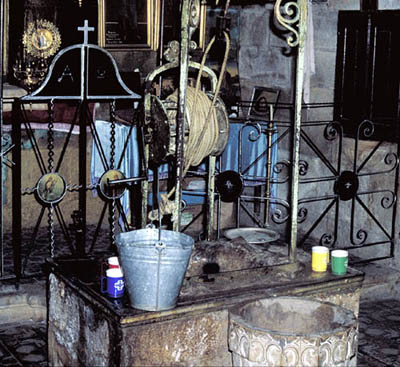
Jacob's Well. Most likely the well where Jesus met the woman of Samaria (John 4). Photo by Ferrell Jenkins.

Jacob's Well. Most likely the well where Jesus met the woman of Samaria (John 4). Photo by Ferrell Jenkins.

With this information, I leave it to you to study the great lessons of John 4. They are deep, too.

He had to pass through Samaria

The Gospel of John informs us that Jesus had to pass through Samaria (4:4). The most direct travel route between Judea and Galilee was through Samaria. Josephus says, “it was the custom of the Galileans, when they came to the holy city at the festivals, to take their journeys through the country of the Samaritans….” (Ant. XX.118). He also informs us that the trip took three days (Life of Flavius Josephus 1.269). This route ran along the central mountain range, sometimes called the water-parting route.

Carson says geography determined that Jesus had to go through Samaria, but some scholars believe the term had indicates necessity. The following conversation with the woman of Samaria and the visit with the people of Sychar may explain why He had to go through Samaria.

We know that Jesus and His disciples encountered problems when traveling through Samaria (Luke 9:51-56). When Jesus sent out the twelve He told them not to enter any city of the Samaritans (Matthew 10:5).

The Jews, on their way from Galilee to Judea, could travel through Transjordan (Perea). It seems that Jesus took this route when He traveled through Jericho up to Jerusalem (Luke 19).

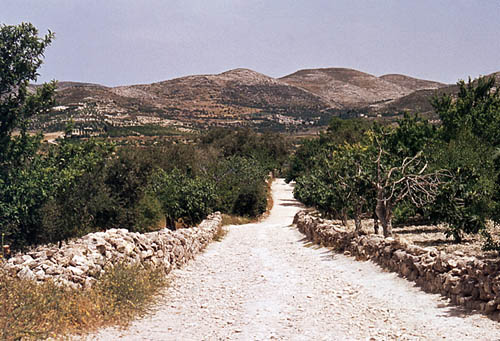
This photo was made in 1981 from the hill of Samaria with a view of the surrounding “mountains of Samaria” (Amos 3:9). One can easily imagine Jesus and His disciples traveling paths such as this.

samaria_path_mountains_1981-t

Internet router down

My Internet router is down. It will likely be Tuesday before I have the new replacement. How did we ever get by with dial-up?

One sows and another reaps

Jesus took advantage of the opportunity to teach the woman of Samaria at the well where they met (John 4). She went into the city and told the men about Jesus (John 4:28-29). When the disciples of Jesus returned from the city where they had gone to buy food they encouraged Jesus to eat. He said, “I have food to eat that you do not know about.” The disciples misunderstood this, thinking He had reference to material food. This conversation led Jesus to say,

Do you not say, ‘There are yet four months, then comes the harvest’? Look, I tell you, lift up your eyes, and see that the fields are white for harvest. Already the one who reaps is receiving wages and gathering fruit for eternal life, so that sower and reaper may rejoice together. For here the saying holds true, ‘One sows and another reaps.’ I sent you to reap that for which you did not labor. Others have labored, and you have entered into their labor.” (John 4:35-38 ESV)

The disciples apparently did not know that Jesus had been teaching the woman, and that she had gone into the city to tell others about Him. Jesus is reminding the disciples of a common thing in the agricultural practices of that time. One sows and another reaps. It may have been sowing time, but some were ready to be reaped. The fields were ready to be harvested.

The words of the prophet Amos provide insight into this episode. He said,

“Behold, days are coming,” declares the LORD, “When the plowman will overtake the reaper And the treader of grapes him who sows seed; When the mountains will drip sweet wine And all the hills will be dissolved. (Amos 9:13 ESV)

In modern times, with the use of some mechanical farm equipment, it is becoming difficult to find scenes exactly like the practices of the time of Jesus. But we still see things that remind us of these teachings. The photo below shows a field in Jordan just above the Jordan valley floor near Deir Allah. On a clear day one could see the valley.
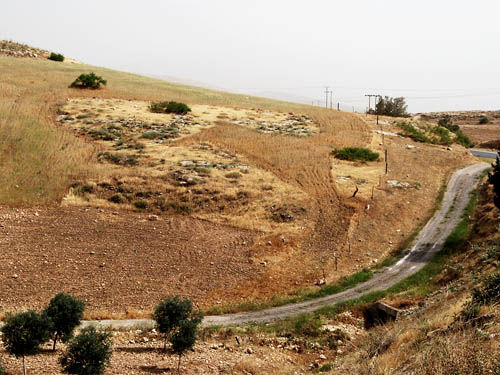
The field has been plowed while grain grows nearby. Photo by F. Jenkins.

The field has been plowed while grain grows nearby. Photo by F. Jenkins.

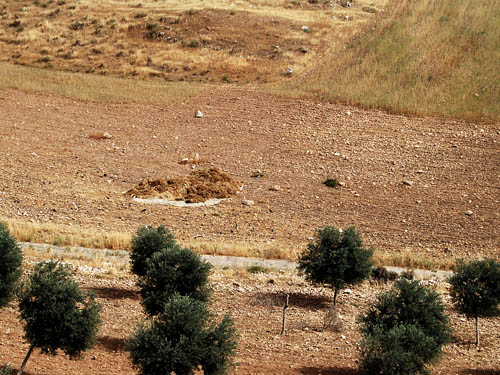
Notice the rocks in the field. The plowman has worked around them. In the days of broadcast sowing, like in the parable of the sower (Luke 8), this scene has all of the elements. Good soil, rocky soil, road, and certainly thorns.

Extend our view to the left in the photo above. You will see, in the photo below, sheaves in the field that has been plowed. Indeed, the plowman overtakes the reaper.
Harvested grain in a field already plowed for sowing. Photo by Ferrell Jenkins.

Harvested grain in a field already plowed for sowing. Photo by Ferrell Jenkins.

It is true today in the preaching of the gospel. One plows and another reaps. Paul says, “I planted, Apollos watered, but God was causing the growth” (1 Corinthians 3:6).

If we had more sowing, there would be more reaping.

Shebna – Presumptuous Steward

The May/June issue of Biblical Archaeology Review carries an article by Robert Deutsch about how an artifact bought on the antiquities market helped to solve a 42-year-old excavation puzzle.

Back in 1870 Charles Clermont-Ganneau excavated a tomb on a cliff overlooking the Kidron Valley in Silwan, but he was unable to read the inscription over the tomb. He cut the inscription from the rock and sent it to the British Museum.

In 1953 Nahman Avigad translated the inscription:

This is [the sepulcher of…] -yahu who is over the house. There is no silver and gold here but [his bones] and the bones of his slave-wife with him. Cursed be the man who will open this.

Numerous scholars have identified this Shebna with the person by the same name who was the secretary and head steward of King Hezekiah. This was the view taken by Avigad in 1953.

Inscription from the tomb of Shebna. Photo by Ferrell Jenkins in the British Museum.

Inscription from the tomb of Shebna. Photo by Ferrell Jenkins in the British Museum.

The LORD spoke out against the arrogance of Shebna through the prophet Isaiah.

Thus says the Lord GOD of hosts, “Come, go to this steward, to Shebna, who is over the household, and say to him: What have you to do here, and whom have you here, that you have cut out here a tomb for yourself, you who cut out a tomb on the height and carve a dwelling for yourself in the rock? (Isaiah 22:15-16 ESV)

Avigad says that Shebna’s sepulcher “stands in the midst of the necropolis where persons of rank and high distinction were laid to rest” (Israel Exploration Journal 3 (1953): 152)

Deutsch picks up on this discovery and continues with the saga of a bulla [impression of a seal] found at Lachish in the 1960s. One of the small pieces of clay had the name of Shebnayahu on it. The bulla was broken and the archaeologists were uncertain whether one of the words read son of the king or servant of the king.

Deutsch says,

The puzzle remained unsolved for 42 years. Aharoni has long since passed away. Then in 2007, another bulla stamped with the same seal surfaced on the Jerusalem antiquities market. A simple examination leaves no doubt that it is an impression of the same seal as the Lachish bulla. It, too, is broken off at the right edge. But on this bulla, part of an additional letter to the right of ha-melekh, “the king,” has survived: a dalet! The word before ha-melekh ended in a dalet. The word was eved, “servant.” The seal that made this impression belonged to “the servant of the king”!

You may read Deutsch’s full article with photos and drawings online here.

Churning produces butter

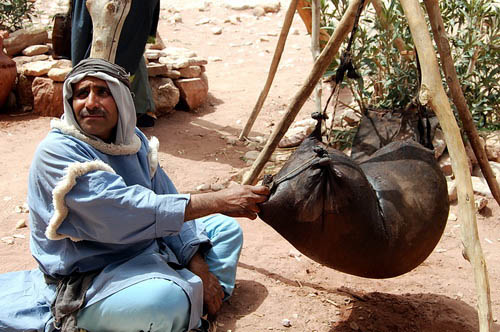
One of the new things I noticed in a visit to Petra last year was the Bedouin actors demonstrating various aspects of daily life. Many of these customs are similar to those we read about in the Bible. This photo shows a man using an animal skin as a churn.

Using an animal skin for producing butter. Photo by Ferrell Jenkins.

Using an animal skin for producing butter. Photo by Ferrell Jenkins.

The writer of Proverbs speaks of churning in giving advice about those who stir up strife.

If you have been foolish in exalting yourself Or if you have plotted evil, put your hand on your mouth. For the churning of milk produces butter, And pressing the nose brings forth blood; So the churning of anger produces strife. (Proverbs 30:32-33 NAS)

When the three men came to the Patriarch Abraham to announce the birth of Isaac, Abraham showed hospitality to them. He provided water so they could wash their feet. He told Sarah to prepare bread. He took a young calf from the herd and had the servants prepare it. Then the text says,

He took curds and milk and the calf which he had prepared, and placed it before them; and he was standing by them under the tree as they ate. (Genesis 18:8 NAS)

Read Genesis 18 for the complete account.