Author Archives: Ferrell Jenkins

Could this be the quarry of Herod the Great?

The Israel Antiquities Authority announced Monday the discovery of a large stone quarry dating to the first century B.C. It is suggested by the director of the excavation that this was one of the quarries used by Herod the Great in his building projects in Jerusalem.
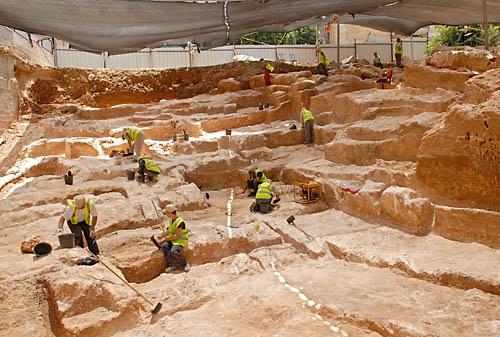
First century B.C. quarry on Shmuel HaNavi Street. Photo: Assaf Peretz, courtesy IAA.

First century B.C. quarry on Shmuel HaNavi Street. Photo: Assaf Peretz, courtesy IAA.

Dr. Ofer Sion, the excavation director on behalf of the Israel Antiquities Authority, believes, “The immense size of the stones (maximum dimensions: length 3 m, width 2 m, height 2 m) indicates it was highly likely that the large stones that were quarried at the site were destined for use in the construction of Herod’s magnificent projects in Jerusalem, including the Temple walls. It seems that a vast number of workers labored in the quarry where various size stones were produced: first they quarried small stones and when the bedrock surface was made level they hewed the large stones. The stones were quarried by creating wide detachment channels that were marked by means of a chisel which weighed c. 2.5 kilograms. After the channels were formed the stones were severed from the bedrock using hammers and chisels”.

The full news release may be read here. Similar quarries have been discovered in Jerusalem in the decade. Todd Bolen, at Bible Places Blog, provides some links to the earlier quarries as well as some good photos. One photo shows the Ketef Hinnom quarry that has since been covered by the Menahem Begin Heritage Center. I’m glad Todd was there to capture that one.

HT: Todd Bolen; Joseph Lauer
Codex Sinaiticus now online

According to a BBC report, the 4th century Codex Sinaiticus is now available online. More information about the project is available in this report by Reuthers. The link to Codex Sinaiticus is here.

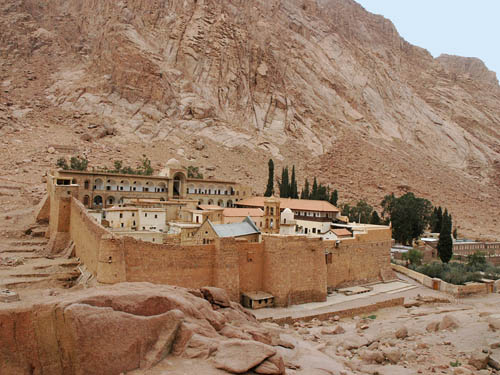
Here is a photo of Saint Catherine’s monastery, at the foot of Jebel Musa, the traditional Mount Sinai, where the manuscript was discovered in the 19th century.

St. Catherine's Monastery at Jebel Musa. Photo by Ferrell Jenkins.

St. Catherine's Monastery at Jebel Musa. Photo by Ferrell Jenkins.

HT: Paleojudaica; Frank Walton

USA sends ambassador back to Syria

For whatever reason(s) the media seems to have overlooked the decision of the Obama administration to send an ambassador back to Syria. Read a little about the decision at CNN.

Syria is an important country historically and politically. The capital city of Damascus is mentioned as early as the time of Abraham (Genesis 14:15), and there is indication that Abraham had considerable contact with the city. He suggests that Eliezer of Damascus might become his heir in the absence of a natural son (Genesis 15:2).

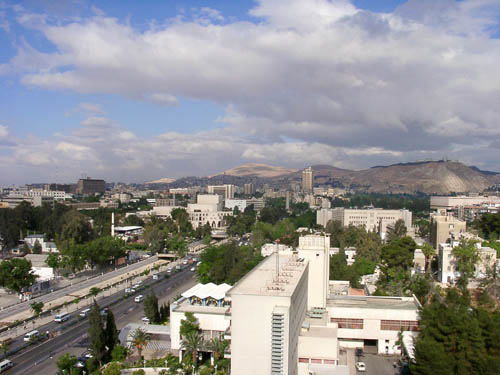
Damascus is situated immediately east of the Anti-Lebanon mountain range on what Rainey calls “the Damascus tableland” (The Sacred Bridge, 32). The River Barada (probably the Abanah of 2 Kings 5:12) runs east from the Anti-Lebanon range through the city of Damascus. The Syrian Desert stretches east of Damascus to the Euphrates River valley. The photo below was made looking west from my hotel balcony to the mountain range. The main part of the city is to the right (north). Go south a few miles and you have a clear view of Mount Hermon.

View of Damascus looking west. Photo by Ferrell Jenkins 2002.

View of Damascus looking west. Photo by Ferrell Jenkins 2002.

The only references to Damascus in the New Testament are those associated with the conversion of Saul of Tarsus (the Apostle Paul). All but two of these are in Acts 9, 22, and 26. The others are in 2 Corinthians 11:32 and Galatians 1:17.

The Syria of today is not the same political entity we read about in the Bible; only the name is the same.

Flag faux pas

We have been flying our flag since a few days before Memorial Day.

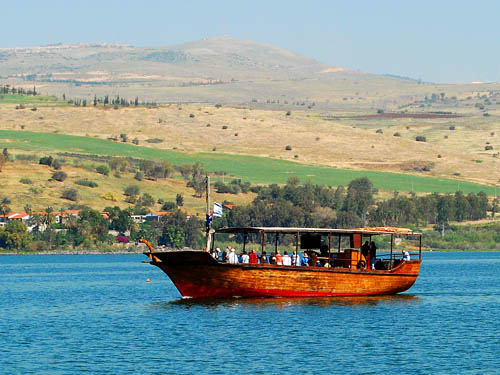
When traveling outside the United States it is fairly common to see the flag of the USA displayed in front of hotels that cater to citizens of the USA. Dozens of boats carry tourists across the Sea of Galilee from one port to another. This is an important part of our tours to give the travelers some sense of the elevation of the sea, and of the quietness of its water.

Tourist boat on Sea of Galilee. View to East. Photo by Ferrell Jenkins.

Tourist boat on Sea of Galilee. View to East. Photo by Ferrell Jenkins.

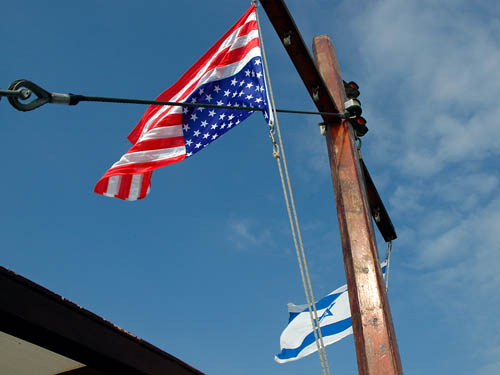
It is fairly typical of these boats to hoist a flag of the country from which its passengers come. In 2006 the boat we were on had inadvertently hoisted the USA flag upside down. The rules of etiquette for the display of the flag say that the flag should be flown upside down only as a distress signal. Fortunately we did not have a storm like the one mentioned in the gospels. Such storms still occur when the strong winds come down upon the sea from the surrounding mountains. In that case I suppose a distress signal might have been helpful.

But as they were sailing along He fell asleep; and a fierce gale of wind descended on the lake, and they began to be swamped and to be in danger. They came to Jesus and woke Him up, saying, “Master, Master, we are perishing!” And He got up and rebuked the wind and the surging waves, and they stopped, and it became calm. (Luke 8:23-24 NAU)

United States flag upside down on Israeli boat. Photo by Ferrell Jenkins.

United States flag upside down on Israeli boat. Photo by Ferrell Jenkins.

Happy fourth of July to my USA friends. Fly your flag proudly, but don’t turn it upside down!

The Hasankef Dam on the Tigris River halted

The Biblical Archaeology Review Daily News for June 26, 2009, reports a halt in the building of the dam on the Tigris River in southeastern Turkey. BAR calls attention to an report by the BBC about the halting of the project. Note this portion of the report:

Insurers have suspended their support for a controversial dam project in southeastern Turkey amid concern about its environmental and cultural impact.Export credit insurers in Austria, Germany and Switzerland said on Tuesday they had told suppliers to suspend work on the Ilisu dam on the Tigris river.

They are giving Ankara 180 days to meet standards set by the World Bank. The ancient Hasankeyf fortress is in the area that would be flooded and more than 50,000 people would have to move.

The hydroelectric project near Turkey’s borders with Syria and Iraq is part of a scheme to develop the mainly Kurdish region, which has suffered for decades from poverty, neglect and conflict.

Environmentalists say the dam would destroy archaeological treasures, including Roman remains. The dam consortium plans to create a culture park on the edge of the reservoir and transfer key monuments from Hasankeyf there.

The full (brief) report may be read here. See information about the history of the site here.

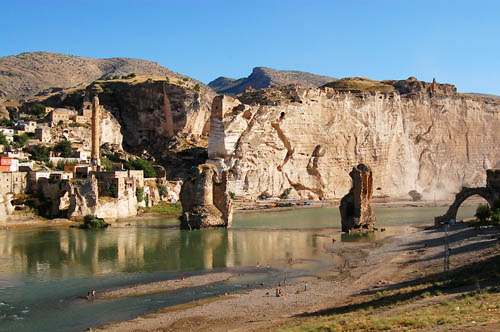
I had the opportunity to visit this area in June, 2007. This is one of the most fascinating places I have visited. The site of ancient Nineveh is less than 125 miles south of Hasankef on the Tigris.

Tigris River at Hasankief. Ruins of Roman bridge. Photo by Ferrell Jenkins.

Tigris River at Hasankef. Note ruins of Roman bridge. Photo by Ferrell Jenkins.

The Tigris River formed the eastern border of Mesopotamia, the land between the rivers (Tigris and Euphrates). It is mentioned by name only twice in the Bible.

  • The Tigris was the third of the rivers flowing from the Garden of Eden. It is said to be east of Assyria (Genesis 2:14). Was this in the north near the source of the river in the mountains of Ararat? Or was it in the south near the Persian Gulf? I don’t know.
  • The prophet Daniel was by the bank of the great river, the Tigris (Daniel 10:4). This would have been further south in present Iraq.

The Sea of Galilee

A boat ride on the Sea of Galilee is one of the highlights of a trip to Israel for most Christian tourists. They enjoy seeing the lake and recognizing the places they have read about so much in their Bible study: Tiberias, Magdala, the Mount of Beatitudes, Capernaum. They reflect on the accounts of Jesus walking on the water and stilling the tempest, etc.

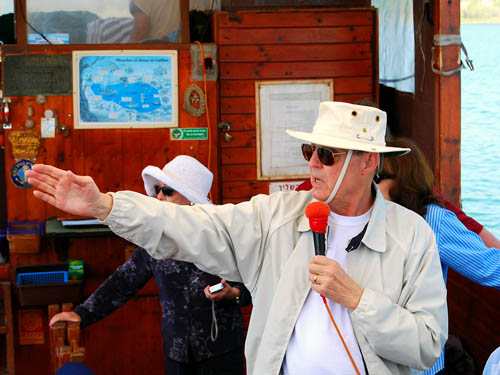
My wife had someone shooting photos while I was pointing out sites of interest along the shores of Galilee. I think I was pointing out the possible location of the account of the swine rushing down the steep bank into the sea (Matthew 8:28 – 9:1).

Ferrell Jenkins pointing out sites of interest on the shore of Galilee.

Ferrell Jenkins pointing out sites of interest along the shore of Galilee.

Luke calls the Sea of Galilee a lake (Luke 5:1-2; 8:22-23,33).

Now Jesus was standing by the Lake of Gennesaret, and the crowd was pressing around him to hear the word of God. (Luke 5:1 NET)

Did Paul visit Samos?

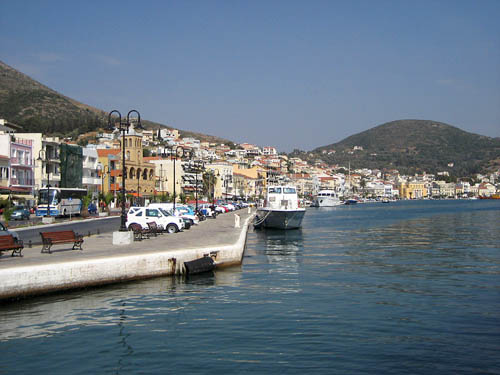
Samos is a mountainous island in the SE part of the Aegean Sea off the coast of Asia Minor. It is 27 miles long (E-W) and about 14 miles wide. The island is separated from the mainland by a strait of one mile.

The port of Samos on the island of Samos. Photo by Ferrell Jenkins.

Paul and his companions stopped at, or passed near, Samos on the return from his third journey.

Sailing from there [Mitylene], we arrived the following day opposite Chios; and the next day we crossed over to Samos; and the day following we came to Miletus. (Act 20:15 NAU)

English versions do not make it clear whether Paul stopped at Samos or came within sight of the island. These comments by Floyd Filson might be helpful.

Paul’s ship…either ‘touched at’ and anchored overnight at Samos (so RSV, though this is an unusual meaning for parebalomen) or ‘came near’ to Samos and passed by it on the E or the W to anchor for the night at Trogyllium. (Interpreter’s Dictionary of the Bible. IV:197)

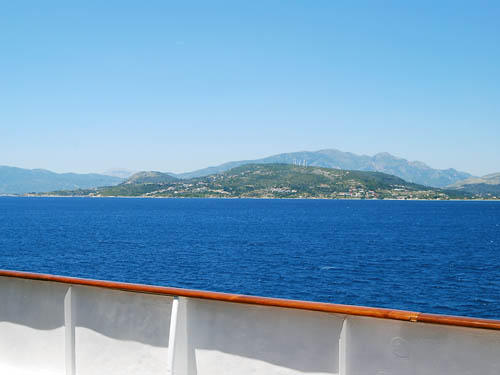
Here is a view of the eastern end of Samos as a ship passes through the most narrow part of the strait between the island and the Turkish mainland.

View of Samos from a ship in the strait between island and mainland. Photo by F. Jenkins.
Samos from a ship in the strait between island & mainland. Photo: F. Jenkins.

Paul may not have visited Samos, but it is clear that he came very close.

Sunset on the Aegean

This photo was made from one of the resort hotels overlooking the Aegean Sea at Kusadasi, Turkey, near the ancient city of Ephesus.

Sunset on the Aegean near Ephesus. Photo by Ferrell Jenkins.

Sunset on the Aegean near Ephesus. Photo by Ferrell Jenkins.

The Aegean is not mentioned by name in the New Testament, but it plays a prominent role in the journeys of the Apostle Paul. Perhaps in a few days I will pull together some of this information and share it with you.

Apollos, the eloquent man of Alexandria, learned the way of the way of God more accurately at Ephesus. When he heard of the work in Achaia (Corinth) he wanted to go there. He likely sailed west from Ephesus to Cenchrea, a port of Corinth.

But when Priscilla and Aquila heard him, they took him aside and explained to him the way of God more accurately. And when he wanted to go across to Achaia, the brethren encouraged him and wrote to the disciples to welcome him; and when he had arrived, he greatly helped those who had believed through grace, for he powerfully refuted the Jews in public, demonstrating by the Scriptures that Jesus was the Christ. (Act 18:26-28 NAU)

Euphrates River in northern Syria

The photos we post of the Euphrates River are always popular. I suppose this is because of the historic events associated with the river, and because so few people have seen the river. The Euphrates begins in the mountains of eastern Turkey (ancient Urartu/Ararat), flows south through Syria and Iraq before ending at the Persian Gulf.

Some of the great Bible characters are associated with the River, even when it is not named. We can be sure that Abraham crossed the Euphrates when he left Haran and headed south to Canaan (Genesis 11:32 – 12:1-9). I like the account of Jacob fleeing from Laban.

He left with all he owned. He quickly crossed the Euphrates River and headed for the hill country of Gilead. (Genesis 31:21 NET)

This photo was made in northern Syria, northeast of Aleppo in 2002. Here the river is wide because of a series of dams built by the Syrians. This can not be far from the place where the biblical patriarchs crossed the river.

The Euphrates River in northern Syria. Photo by Ferrell Jenkins.

The Euphrates River in northern Syria. Photo by Ferrell Jenkins.

Herod built a hippodrome at Caesarea Maritima

Herod the Great built a hippodrome along the coast at Caesarea Maritima in 10 B.C. to celebrate the opening of the city. In the second century A.D. the south side of the hippodrome was reconstructed as an amphitheater to be used for gladiatorial contests. New sections with beautiful frescoes have been uncovered.

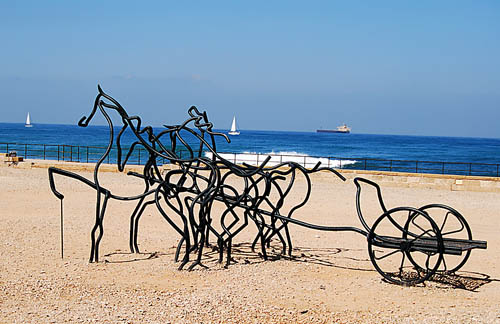
This metal sculpture has been erected on the north end of the hippodrome along the beautiful Mediterranean.

View in the hippodrome at Caesarea Maritima. Photo by Ferrell Jenkins.

View from the hippodrome at Caesarea Maritima. Photo by Ferrell Jenkins.

The theater we showed in the previous post is on the south end of the hippodrome. The harbor built by Herod the Great is a little to the north of the hippodrome. The apostle Paul was in prison at Caesarea for two years between A.D. 58 and 60 (Acts 23:23 – 26:32).

We discussed Paul’s possible use of the charioteer in Philippians 3:12-14 here.

New paintings of the hippodrome mosaics. Photo by Ferrell Jenkins.

New paintings of the hippodrome frescoes. Photo by Ferrell Jenkins.