Author Archives: Ferrell Jenkins

Persecution of Christians in Thessalonica

Earlier we posted information about the Arch of Galerius. Galerius was the Roman Emperor from 305 to 311 A.D. The arch was erected in Thessalonica to commemorate his victory over the Persians in 297 A.D. The reliefs on the arch are about this victory.

The most interesting portion of the relief to me is the one showing Galerius offering a sacrifice. The relief has been somewhat defaced, but it appears to me that he is pouring a libation on the altar. To the left, as we view the scene, is the Emperor Diocletian, the father in law of Galerius. The lady on the right is the wife of Galerius, daughter of Diocletian. Note the animal, awaiting his turn to be offered on a larger altar. The altar scene reminds us of the Emperor worship which was prevalent from the close of the first century onward.
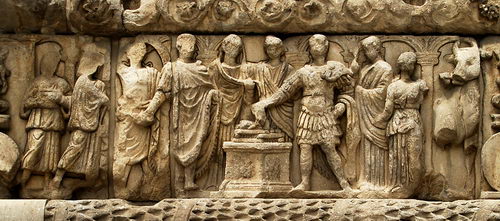
Sacrifice scene on the Arch of Galerius in Thessaloniki. Photo by Ferrell Jenkins.

Sacrifice scene on the Arch of Galerius in Thessaloniki. Photo by Ferrell Jenkins.

Diocletian is noted for his decree in 303 A.D. that ordered the burning of all Bibles and church records. This is one reason we have so few manuscripts before the fourth century A.D. Some credit Galerius as the brain back of this decision. He was responsible for considerable persecution of Christians during his reign. This persecution would be that spoken of in the Book of Revelation that we associate with Emperor worship.

The Danish archaeologist Dyggve excavated a Palace, Hippodrome, and Mausoleum belonging to Galerius. He also was able to show that the Arch was part of the complex of buildings (Blue Guide Greece).
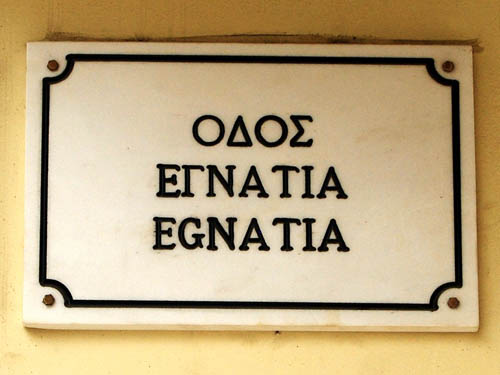
The Via Egnatia in Thessalonica

The Egnatian Way was one of the famous Roman roads used by the Apostle Paul in his travels to preach the gospel of Christ (Acts 16-17). F. F. Bruce gives a little history about the ancient road.

When Macedonia became a Roman province in 148 b.c., the Via Egnatia was constructed, running east from Dyrrhachium (modern Durres) and Apollonia (modern Poyani) on the Adriatic to Thessalonica, from which existing roads ran to the main Greek cities. The Via Egnatia was later extended farther to Neapolis (modern Kavalla), the port of Philippi, and later still to Byzantium on the Bosporus. When the Roman province of Asia was formed in 133 b.c., the Via Egnatia (with a short sea-crossing at either end) provided easy communication between Rome and the new province. (The Anchor Bible Dictionary, 6:649).

Very few remains from the first century have been exposed in Thessaloniki. Remember that the second largest city of Greece is built over the ancient city. One of the important streets running through the city is named Odos Egnatia (the Egnatian Way). The small street signs in Thessaloniki are located on building rather than on the corner of the street. This makes it difficult for a stranger to drive and read the street signs.

Street marker in Thessaloniki. Photo by Ferrell Jenkins.

Street marker in Thessaloniki. Photo by Ferrell Jenkins.

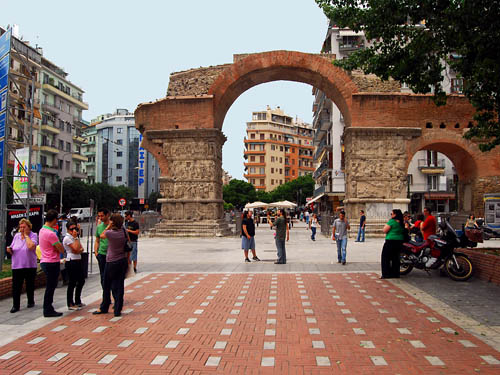
The Via Egnatia runs beside the monumental Arch of Galerius. This arch was built in A.D. 304 to commemorate the emperor’s victory over the Persians in A.D. 297 (Reddish & Fant 136).

Arch of Galerius (early 4th century A.D.). Photo by Ferrell Jenkins.

Arch of Galerius (early 4th century A.D.). Photo by Ferrell Jenkins.

Paul visited Thessalonica during his second journey

Paul came to Thessalonica on his second journey (A.D. 50-53; Acts 17). Paul describes the reception the Thessalonians gave to the gospel in these words:

For they themselves report about us what kind of a reception we had with you, and how you turned to God from idols to serve a living and true God, and to wait for His Son from heaven, whom He raised from the dead, that is Jesus, who rescues us from the wrath to come. (1 Thessalonians 1:9-10 NAU)

The church of the Thessalonians had many questions about the second coming of Christ. Paul addressed these questions in the two letters he wrote to the church from Corinth.

We know little of individuals associated with the church. Jason seems to be one of the earliest converts in Thessalonica (Acts 17:5-9). Aristarchus, a Macedonian of Thessalonica accompanied Paul on the voyage to Rome (Acts 27:2). He was one of the messengers who went with Paul on the return from the third journey (Acts 20:4). When Demas forsook Paul he went to Thessalonica (2 Timothy 4:10).

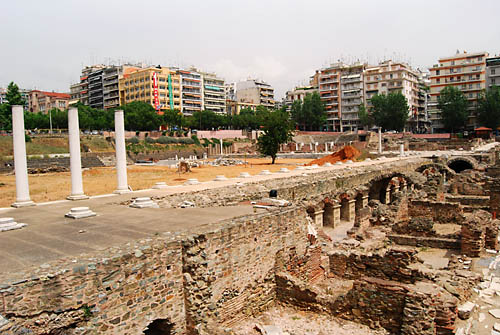
The photo below shows ruins of the Roman Forum in Thessaloniki, the second largest city of Greece. This area of the city was destroyed by a fire in 1917. During preparations for constructing new buildings these ruins were discovered. They date to the second and third century A.D. (See Fant and Reddish, A Guide to Biblical Sites in Greece and Turkey, 137). Perhaps there are older ruins below these. Notice how the modern city is built around the ancient ruins on a higher level. Can you imagine what might be underneath all of those buildings?

Roman Forum at Thessalonica. Photo by Ferrell Jenkins.

Roman Forum at Thessalonica. Photo by Ferrell Jenkins.

A view from Qumran

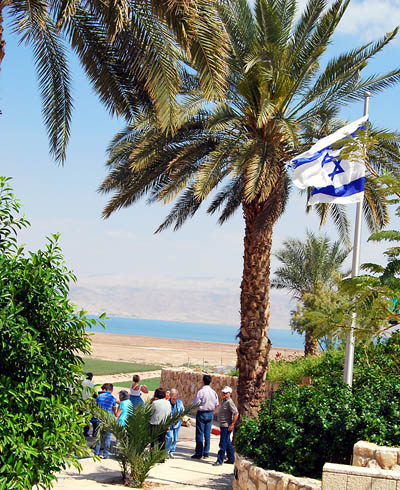
This morning I wanted to share a photo made from Qumran on the western shore of the Dead Sea. Weather conditions were fairly good that day. You can see across the Dead Sea to the mountains of Moab.

View east to the Dead Sea from Quman. Photo by Ferrell Jenkins.

View east across the Dead Sea to Moab. Photo by Ferrell Jenkins.

We associate the land of Moab with Ruth the grandmother of King David.

So Naomi returned, and with her Ruth the Moabitess, her daughter-in-law, who returned from the land of Moab. And they came to Bethlehem at the beginning of barley harvest. (Ruth 1:22)

Luke Chandler on Israel National Radio

We have had several things to say about Luke Chandler and his participation in the archaeological dig at Khirbet Qeiyafa (the Elah Fortress) a few weeks ago. This is because Luke is a friend and a former student. Luke has been interviewed by Gordon Govier on The Book and the Spade program. That interview emphasized the role of volunteers in archaeology.

Willner & Selevan

Willner & Selevan

Now he has been interviewed for the Judean Eve program on Israel National Radio to discuss the use of blogs in reporting on archaeological work. To hear this interview you must look for the program entitled Tell Me About Digs. Click on Part 2 to listen or download the mp3 file. Follow this link for the interview. Luke’s blog may be found at lukechandler.wordpress.com.

There is another interview on the same program with some guy named Herschel Shanks.

Khirbet Qeiyafa is an important site historically because of the part it plays in the account of the conflict between Israel and the Philistines (David and Goliath). See 1 Samuel 17 for the full story.

Dropbox is a nifty tool for those who travel

dropbox_referral_ill_1 Dropbox allows you to store files at their site, but the best feature is the ability to sync the files on your desktop computer with those on your laptop. Before I leave home I put some of the files I am working with in my Dropbox. They are available online or on my laptop whenever I need them. If I make a change in one of the files on the laptop, the change is made on my desktop. If I add a new file in my Dropbox on the laptop that file will be in my Dropbox at home when I return. This program is really user friendly.

It is possible to create a share folder in your Dropbox that enables you to easily share files with a friend.

Here is how the features of Dropbox are described at their website.

  • Sync files across computers
  • Access files online from anywhere
  • Share and collaborate with others

You can get 2 Gb of space free by downloading Dropbox.

If you use the link below you will get an additional .25 Gb of space. Click this link to get Dropbox plus the bonus space.

I am enjoying this program and am pleased to inform my readers about it.

HT: Tyndale Tech.

Mount Hermon is a source of water

The land captured by Joshua and the Israelites included “Baal Gad in the valley of Lebanon at the foot of Mount Hermon” (Joshua 11:17). Today we call this valley to the east of Mount Hermon the Beka Valley. Some have suggested that Baal Gad might be the site later known as Paneas (now Banias), and later Caesarea Philippi. Dan is another important biblical town located at the foothills of Mount Hermon.

Source of the Jordan River at Caesarea Philippi. Photo by Ferrell Jenkins.

Source of the Jordan River at Caesarea Philippi. Photo by Ferrell Jenkins.

Brethren dwelling together in unity is said to be “like the dew of Hermon Coming down upon the mountains of Zion” (Psalm 133:3). Mount Hermon receives an annual average of about 60 inches of precipitation. In the winter the mountain is usually fully covered with snow.

The proximity of Mount Hermon to Caesarea Philippi, where Jesus was confessed to be the Christ, and where he promised to build the church, causes many scholars to suggest it as the “high mountain” of the transfiguration (Matthew 16:13 – 17:1-9).

Good deal on Bible study CD

From time to time I order Bible software from Rejoice Christian Software. I have no stock in the company, but am delighted to recommend some of their deals to others.

zondervant0310274486Rejoice has Zondervan’s Understanding the Bible Library 6.0 available as a special for only $35.95, less than the price of two volumes in print. You may read about the program details here, but you must go to a special link which I received by Email for the low price. Click here. The Email says it is o.k. to email it to a friend. This is my Email to you.

This program is published by Zondervan. Therefore it uses the Pradis format. This is the only way to get some of the Zondervan titles in digital format.

Here are a few of the significant titles in this program.

  • New International Bible Dictionary. Ed. F. F. Bruce.
  • New International Bible Dictionary. Ed. J. D. Douglas.
  • New International Dictionary of Biblical Archaeology. Ed. Blaiklock and Harrison.
  • New International Encyclopedia of Bible Difficulties. Archer.
  • New International Encyclopedia of Bible Words. Richards.
  • Asbury Bible Commentary.
  • Five Bible versions.

It is unfortunate that I have to open my Libronix program and my Pradis program when I am researching something, but that’s the way it is. Yes, I already have most of these in print, but I love being able to search the entire book on the computer.

The offer is valid through August 22, 2009.

The Meeting of the Waters

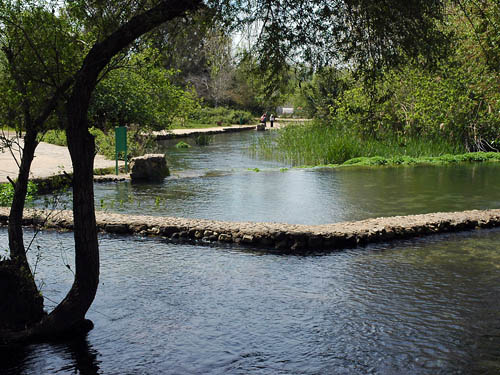
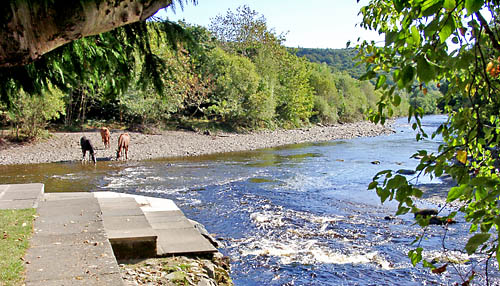
Thomas Moore (1779-1852) is known as one of Ireland’s best writers. A little south of Dublin, in Wicklow County, the Avonmore and Avonberg rivers meet. Moore made this spot famous in his poem The Meeting of the Waters.

Where the Sweet Waters Meet. Photo by Ferrell Jenkins.

Where the Sweet Waters Meet. Photo by Ferrell Jenkins.

The Meeting of the Waters

There is not in the wide world a valley so sweet
As that vale in whose bosom the bright waters meet
Oh the last rays of feeling and life must depart
Ere the bloom of that valley shall fade from my heart

Yet it was not that nature had shed o’er the scene
Her purest of crystal and brightest of green
‘Twas not her soft magic of streamlet or hill
Oh No ’twas something more exquisite still

‘Twas that friends, the belov’d of my bosom were near
Who made every scene of enchantment more dear
And who felt how the best charms of nature improve
When we see them reflected from looks that we love

Sweet vale of Avoca! How calm could I rest
In thy bosom of shade, with the friends I love best
Where the storms that we feel in this cold world should cease
And our hearts, like thy waters, be mingled in peace

How fortunate is any person to have a special place to recall as a place of peace. I have enjoyed several of these places through the years. First, there is home. My study, when my desk is clean and it’s raining outside, is another. I think also of the Sea of Galilee at sunrise, or sunset. Spiritually we find peace in Christ.

Be anxious for nothing, but in everything by prayer and supplication with thanksgiving let your requests be made known to God. And the peace of God, which surpasses all comprehension, will guard your hearts and your minds in Christ Jesus. (Philippians 4:6-7 NAU)

Great source for periodical articles

Rob Bradshaw, over in the UK, has a passion for making available good, scholarly articles from old periodicals. This isn’t as easy as it may sound. He must know the literature, be able to locate a copy of the journal, obtain permission from the author or publisher, scan it, OCR, put into Word format, put it into a portable format such as PDF, post it online, etc.

Most recently I have downloaded J. A. Thompson’s 1964 booklet, The Ancient Near Eastern Treaties and the Old Testament. It is true that I have a copy of this booklet in my library, but I like having the material on my computer for easy searching. A couple of evenings ago I noticed that John R. W. Stott’s The Preacher’s Portrait. Some New Testament Word Studies was available. Now I have a copy on my computer. Did I mention that Rob sometimes scans books? Recently he has made available Carl F. H. Henry’s Revelation and the Bible. There are some great chapters in that book.

Use the search box to locate authors in which you may be interested. There is material by Edward J. Young, F. F. Bruce, et al.

Follow the link to this treasure of significant material: BiblicalStudies.org.uk. Thanks Rob.