Author Archives: Ferrell Jenkins

Pressing on toward the goal

Paul’s admonition to the brethren at Philippi is often used in sermons.

Not that I have already obtained it or have already become perfect, but I press on so that I may lay hold of that for which also I was laid hold of by Christ Jesus. Brethren, I do not regard myself as having laid hold of it yet; but one thing I do: forgetting what lies behind and reaching forward to what lies ahead, I press on toward the goal for the prize of the upward call of God in Christ Jesus. (Philippians 3:12-14)

Most often we hear speakers compare what Paul said to the effort put forth by individuals running in a race. This is certainly not inappropriate. However, many years back I ran across a statement by E. M. Blaiklock that changed my thinking. Blaiklock was a noted classicist. This particular comment comes from Cities of the New Testament.

One mark of the Roman colony is perhaps to be detected in the letter which Paul wrote, over ten years later, to the Macedonian church which he had come to love. It is a hidden metaphor from the chariot race. Exhorting his Philippians to effort and single-minded endurance, Paul writes: ‘This one thing I do-forgetting the things behind, and stretching out to those before, I make for the mark, the prize of the upward calling’.

Commentators generally have not marked the fact that Paul appears to have in mind, not the athletic contests of the Greeks, from which he commonly drew illustration, but the chariot racing of Rome. He was writing to a Roman colony. He was writing also from Rome itself, and never was there such rivalry of racing colours, and circus fever than at that time. The common talk of the soldiers of the soldiers was of the chariot racing, and Paul would gain a vivid impression of this most perilous of sports.

Such a race as that which forms the substance of Paul’s figure is described well in Ben HUR. The charioteer stood on a tiny platform over sturdy wheels and axle. His knees were pressed against the curved rail, and his thighs flexed. He bent forward at the waist, stretching out hands and head over the horses’ backs. This is surely what he means by ’stretching out to the things before’. The reins were wound round the body, and braced on the reins the body formed a taut spring. It can easily be seen how completely the charioteer was at the mercy of his team’s sure feet and his own fine driving skill. Euripides, in his Hippolytus, tells how the hero fell and was killed in such conditions. Ovid describes the same disaster in Book XV of his Metamorphoses. In his intense preoccupation the driver dare not cast a glance at ‘the things behind’. The roaring crowd, crying praise or blame, the racing of his rivals, all else had perforce to be forgotten. One object only could fill the driver’s eye, the point to which he drove at the end of each lap.

Here is a photo that might help to illustrate what Blaiklock said. It was made at the RACE show (Romy Army and Chariot Experience) at Jerash, Jordan.
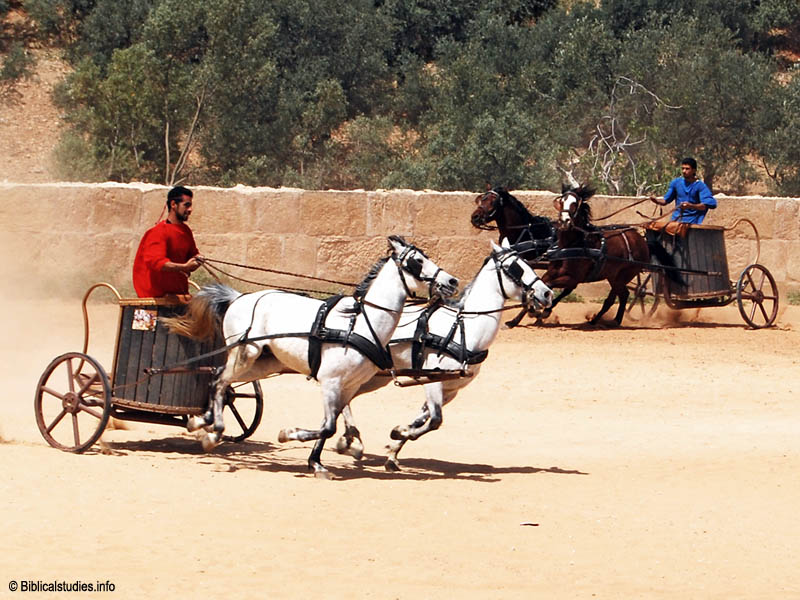
Chariot race at the RACE show in Jerash, Jordan. Photo by Ferrell Jenkins.

Chariot race at the RACE show in Jerash, Jordan. Photo by Ferrell Jenkins.

This is a reprint from April 30, 2008, but with a different photo suitable for use in presentations. Click on the image for the larger photo.
Paul’s burial in Rome

The apostle Peter gets the most attention in Rome, but Paul also has his share of shrines. Paul was taken to Rome in the custody of the Roman Empire (Acts 27-28).

I appeal to Caesar. (Act 25:11)

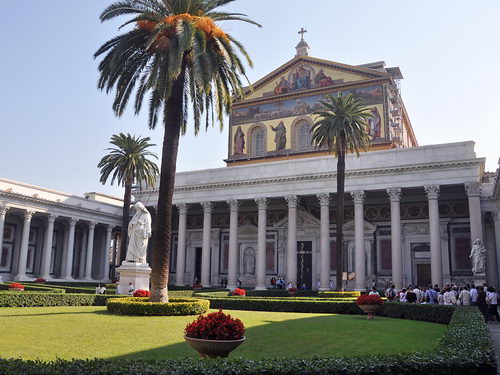
Tradition has it that Paul was buried outside the walls of Rome where we now find the Basilica of St. Paul Outside the Walls.

The basilica of St. Paul Outside the Walls in Rome. Photo by Ferrell Jenkins.

The basilica of St. Paul Outside the Walls in Rome. Photo by Ferrell Jenkins.

The statue in front of the church shows Paul with a drawn sword and a book. The inscription reads PREDICATORI VERITATIS and DOCTORI GENEIUM. Paul was a preacher of truth and a teacher of the Gentiles.

For this I was appointed a preacher and an apostle (I am telling the truth, I am not lying) as a teacher of the Gentiles in faith and truth. (1Timothy 2:7 NAU; see also 2 Timothy 1:11)

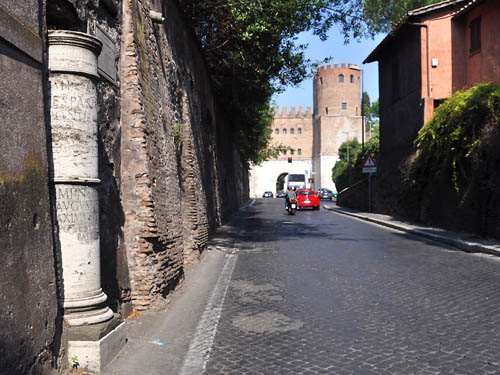
Appian Way mile marker

Mile markers were commonly used in the Roman world. Over the past forty years I have seen several in Israel and Jordan. Many of them have disappeared or have been taken to a secure place.

The marker here is the first one south of the city wall in Rome. Just as we have markers on our highways to indicate distances, so did the Romans.

Mile marker on the Appian Way in Rome. Photo by Ferrell Jenkins.

Mile marker on the Appian Way in Rome. Photo by Ferrell Jenkins.

Tomb of Caecilia Metella on the Appian Way

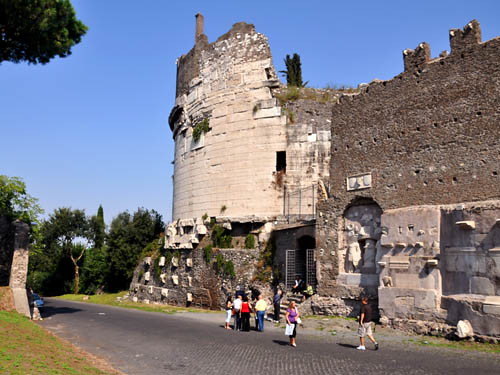
Several ancient structures may be seen along the Appian Way south of Rome. One of the most impressive is the Tomb of Caecilia Metella. The woman for whom this tomb is named was the wife of a certain M. Crassus who shared power in Rome with Julius Caesar and Pompey.

The decorations on the tomb seem to date it to the beginning of the Augustan period (Wycliffe Historical Geography 538). I think we can safely conclude that Paul passed this structure on his way to Rome (Acts 28:13-14).

The Tomb of Caecilia Metella on the Appian Way. Photo by Ferrell Jenkins.

The Tomb of Caecilia Metella on the Appian Way. Photo by Ferrell Jenkins.

Thebes in Bible Prophecy

Luxor was known as Thebes in Old Testament times. Both Jeremiah and Ezekiel prophesied the Lord’s judgment of the city. Jeremiah says,

“The LORD of hosts, the God of Israel, says, ‘Behold, I am going to punish Amon of Thebes, and Pharaoh, and Egypt along with her gods and her kings, even Pharaoh and those who trust in him’” (Jeremiah 46:25; see also Ezekiel 30:14-16)

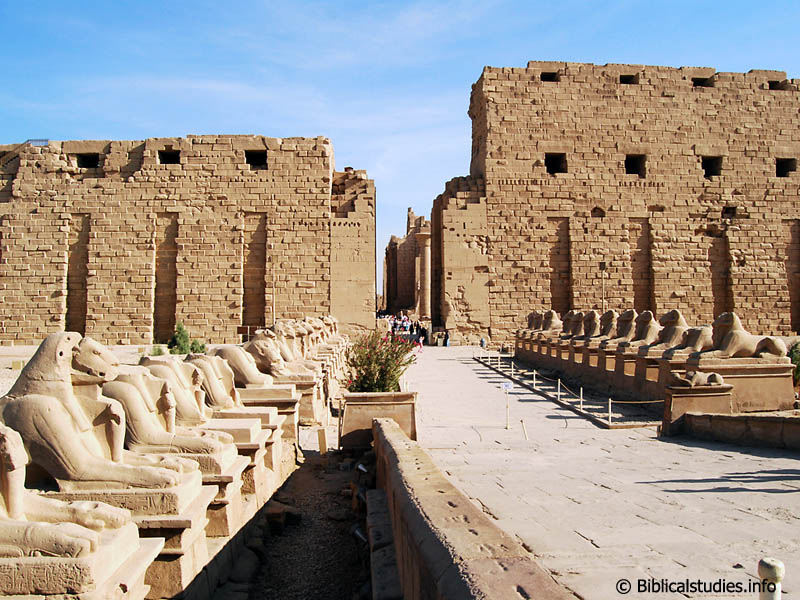
A visit to the ruined and unoccupied temples of Karnak and Luxor, where Amon (or Amun) was worshiped as a great god, illustrates the fulfillment of this prophecy. Shortly after the time of Jeremiah (c. 586 BC), Egypt and Thebes began to decline as a world power.

This photo of the avenue of the ram-headed sphinxes leads to the first pylon of the great temple of the god Amon (or Amun). The first pylon was the last part of the temple constructed (about 700 BC) and remains unfinished. This photo is large enough to be used in teaching presentations. Click on the photo for a larger image. I hope you will enjoy using it.

The avenue of ram-headed sphinxes and the first pylon at Karnak. Photo by Ferrell Jenkins.

The avenue of ram-headed sphinxes and the first pylon of the great temple of Amun at Karnak. Photo by Ferrell Jenkins.

In 663 BC the Assyrian king Ashurbanipal had already conquered Thebes (Hebrew, No Amon). The prophet Nahum, in prophesying the fall of Nineveh, calls attention to this event (3:8ff.).

Visiting the Bible Lands with Mother

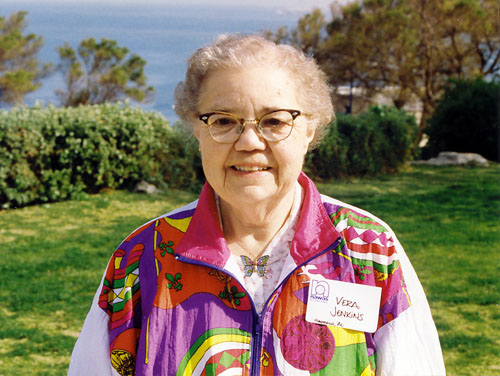
I regretted that my Father never was able to visit the Bible lands with me, but Mother made two trips. The first in 1980, a year after my father died, and the second in 1993. I enjoyed having her as part of the group. She could walk faster and longer than anyone in the group, I think.

Vera Jenkins at Joppa in 1993. Photo by Ferrell Jenkins.

Vera Jenkins at Joppa in 1993. Photo by Ferrell Jenkins.

This has been one of my favorite pictures of Mother. I made it at ancient Joppa in Israel, March 13, 1993, with the Great Sea in the background.

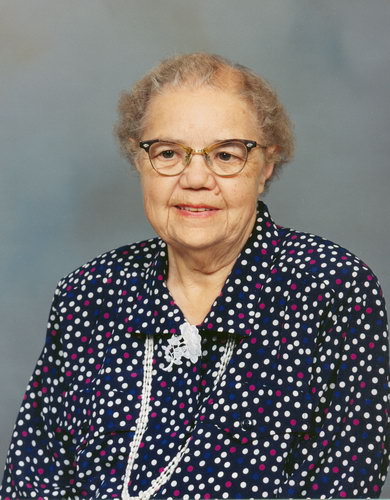
Vera Mann Jenkins – 1913-2009

Vera Mann Jenkins -- 1913-2009

Vera Mann Jenkins -- 1913-2009

My mother passed from this life to be with the Lord this evening in Huntsville (AL) Hospital. The photo I am sharing with you was made in 1993 when she was 80 years of age. She was a wonderful woman, a good mother, and a faithful Christian. I am thankful for the influence she had on my life.

At a later time I will share some remembrances of her.

Charles Darwin – Galapagos Finches

HT: Defend the Word

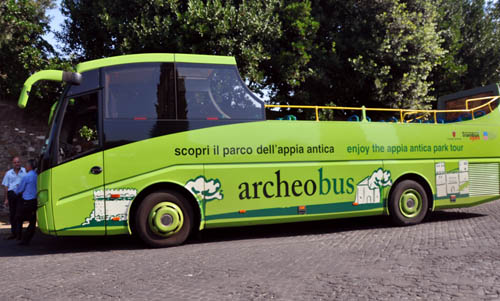
Archeobus Tour on the Appian Way

While visiting the Appian Way in Rome I noticed the archeobus. I assume there may have been a guide with the group at the Tomb of Caecilia Metella. That is a neat idea on a dry day.

The Archeobus Tour on the Appian Way. Photo by Ferrell Jenkins.

The Archeobus Tour on the Appian Way. Photo by Ferrell Jenkins.

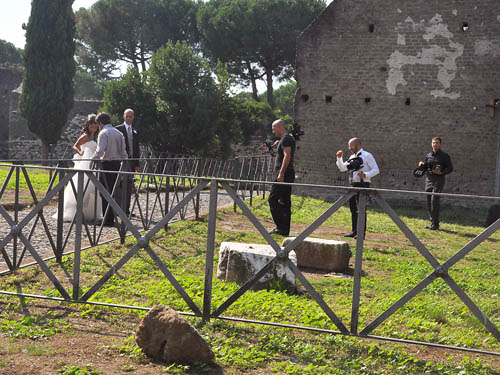
Perhaps the next time I am in Rome I will look into this tour. Photographers were utilizing the beautiful sunny day and the ancient ruins to photograph some newly weds (to be?).

Wedding photography on the Appian Way. Photo by Ferrell Jenkins.

Wedding photography on the Appian Way. Photo by Ferrell Jenkins.

I wondered if they knew that the Apostle Paul once passed this way (Acts 28).

The Arch of Constantine

The Arch of Constantine was dedicated to the Emperor by the Senate and the People of Rome in A.D. 315. Constantine served as Emperor from A.D. 306 to 337. By the time of Constantine the church had made major departures from the New Testament pattern of church organization. The Emperor attended the Council of Nicea, but allowed the eastern bishops to preside over the meeting.

Grant comments on the question of Constantine’s conversion:

The question as to whether he was a “genuine” Christian or not depends on somewhat subjective definitions. (Encyclopedia of Early Christianity, 227).

The Arch of Constantine and the Colosseum. Photo by Ferrell Jenkins.

The Arch of Constantine and the Colosseum. Photo by Ferrell Jenkins.

Helena, the mother of Constantine, was responsible for the construction of many of the well-known churches of the Holy Land. Rosenberg says,

Her role in church history was due to her partnership in Constantine’s program of church building at Bethlehem and Jerusalem and to her discovery of what she believed to be the true cross, both of which led to the revival of Jerusalem and the encouragement of pilgrimage to the Holy Land. (Encyclopedia of Early Christianity 417).