Author Archives: Ferrell Jenkins

Traveling ancient roads together

Fifty six years ago today I married a wonderful young lady who has been by my side all this time. She wasn’t always able to travel with me, especially when our children were young, but she has shared many trips with me. She often comments about how important it is for couples to travel when they are young. That, of course, is the most difficult time for those with children. We still enjoy the memories we made on our first trip to Rome, Athens/Corinth, Egypt, Lebanon, Damascus, Jordan, and Israel in 1967.

How can you stay together for fifty six years? We made a commitment to each other and to God when we exchanged our vows. That’s it.

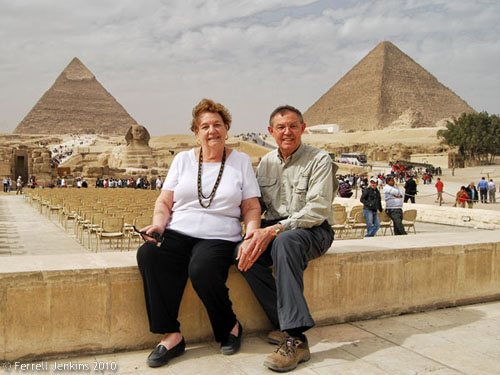
Ferrell and Elizabeth Jenkins at the Giza Pyramids.

Ferrell and Elizabeth Jenkins at the Giza Pyramids in 2009.

Photos of the Ashkelon statue

London’s Daily Mail Online has posted some great photos of the recovery of the Ashkelon Roman-era statue uncovered by the recent storm which we wrote about here. I see now that the discovery was made a short distance north of the ancient tel. In fact, I recognize the building in the background as the Holiday Inn, 9 Yekutiel Adam Street, Ashkelon.

HT: David Padfield

Caesarea National Park closed due to storm damage

The recent storm in the eastern Mediterranean caused damage to the breakwater at Caesarea and led Israeli authorities to temporarily close the Caesarea National Park. Haaretz reports here.

The head of the Israel Antiquities Authority, Shuka Dorfman, yesterday toured Caesarea National Park to take stock of the damage to the antiquities by last weekend’s storm.

Calling the damage “a national disaster,” Dorfman noted that the breakwater, which was broken in three areas by high waves during the storm, now leaves the antiquities exposed to damage from any future high waves.

Dorfman expressed concern that the storm expected this weekend could further damage the antiquities.

“The damage from the storm is huge all along the coast, from Ashkelon in the south the Acre in the north,” Dorfman said adding that if the situation is not remedied immediately through extensive conservation efforts, erosion of the cliff along the beach would continue until it collapses, leading to “the destruction of many ancient cultural treasures of Israel.”

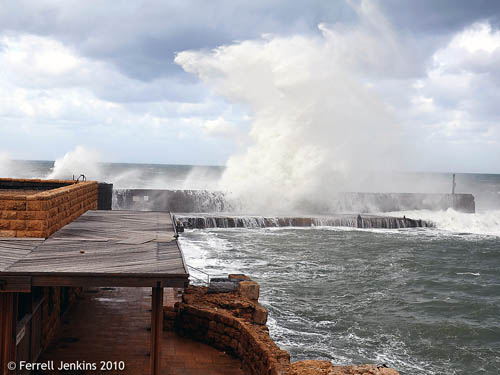
A year ago I wrote about a stormy day at Caesarea Maritima here. I think you might enjoy the photos there. Here is a new one.

High waves at Caesarea Maritima - 12/12/09 - Photo by Ferrell Jenkins.

High waves at Caesarea Maritima - December 12, 2009 - Photo by Ferrell Jenkins.

Caesarea Maritima was a first century Roman capital and seaport. The gospel was first preached to the Gentiles here when Peter came from Joppa to Caesarea to tell Cornelius words by which he could be saved (Acts 10, 11).

Herod the Great built a city on the site of Strato’s Tower and named it Caesarea in honor of Caesar Augustus. It became a center of Roman provincial government in Judea. The city had a harbor and was located on the main caravan route between Tyre and Egypt. This city is called Caesarea Maritima (on the sea) to distinguish it from Caesarea Philippi.

The Apostle Paul used the harbor at Caesarea several times. He was imprisoned here for two years before departing for Rome (Acts 24:27; 27:1).

Storm uncovers beautiful sculpture

The recent storms in the eastern Mediterranean have caused considerable damage along the coast. At Ashkelon, located on Israel’s southern Mediterranean coast, the high waves uncovered a Roman-era statue.
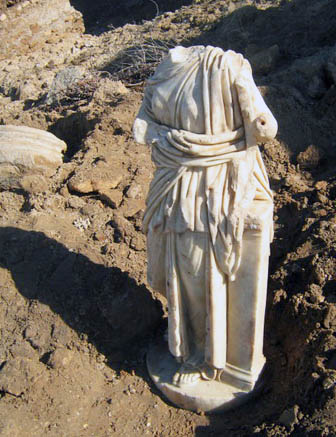
Roman-era statue uncovered by storm at Ashkelon. Photo: IAA.

Roman-era statue uncovered by storm at Ashkelon. Photo courtesy of Israel Antiquities Authority.

France 24 International News reports here,

A massive storm that battered the eastern Mediterranean caused the collapse of a cliff in the southern Israeli city of Ashkelon, revealing a rare Roman-era marble statue, officials said on Tuesday.

“The big storm earlier this week caused the cliff to collapse and a statue from Roman times was found by a passer-by,” said Yoli Schwartz, spokeswoman for the Israel Antiquities Authority.

The white marble statue of a woman, which weighs about 200 kilogrammes (440 pounds) and stands 1.2 metres (nearly four feet) tall, has been removed from the site by the authority, which is studying it, she said.

The statue was missing its head and arms, apparently from earlier damage, but had “delicately carved sandals,” Schwartz told AFP.

The storm that hit the eastern Mediterranean earlier in the week with winds of over more than 100 kilometres per hour (62 miles per hour) whipped up enormous waves, some as high as 12 metres (40 feet), that caused widespread damage.

While the collapse of the cliff in Ashkelon led to the discovery of the statue, the storm also endangered other important archaeological sites along the coast.

The reports I have read do not make it clear if this discovery was made at Tel Ashkelon. The port is mentioned. Damage to archaeological sites, both natural and man-made, are not uncommon. In fact Tel Ashkelon has been severely eroded by the wind and the waves over the years. This photo shows the location of the tel as we look north. Some of the buildings of modern Ashkelon may be seen in the distance.
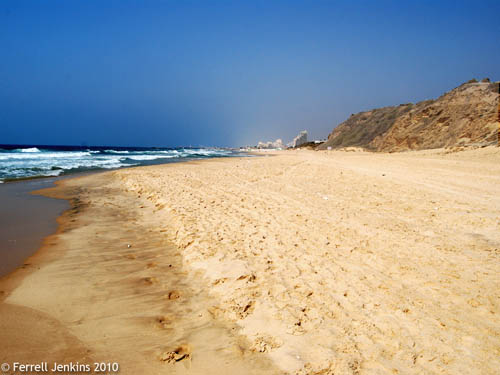
Tel Ashkelon and the Mediterranean Sea. Photo by Ferrell Jenkins.

Ashkelon and the Mediterranean Sea. Photo by Ferrell Jenkins.

Take a look at the erosion in the west side of the tel. Shards of pottery may be seen in the exposed portion of the tel and along the beach. Some shards show evidence of having been repeatedly washed out and in.
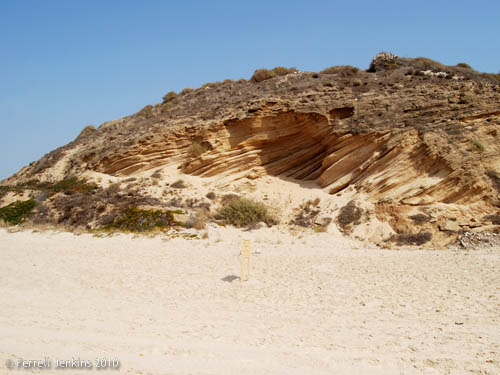
Erosion visible in Tel Ashkelon. Photo by Ferrell Jenkins.

Erosion visible in Ashkelon. Photo by Ferrell Jenkins.

Ashkelon was one of the main cities of the Philistines. The LORD spoke against the Philistine cities through the prophet Jeremiah (ch. 47). These verses caught my attention.

How long will you cry out, ‘Oh, sword of the LORD, how long will it be before you stop killing? Go back into your sheath! Stay there and rest!’ But how can it rest when I, the LORD, have given it orders? I have ordered it to attack the people of Ashkelon and the seacoast. (Jeremiah 47:6-7 NET)

HT: Joseph I. Lauer

Palestine Exploration Fund’s photostream

The Palestine Exploration Fund has posted some fascinating historical photos from the nineteenth and early twentieth-century that will be of interest to students of historical geography and archaeology. The link is here.

Once you get there scroll down to the second line of photos where you will see a photo made sometime between 1930 and 1936 of John Garstang working at Jericho. He is making photos of the abundance of pottery found at that spot.

Working through this collection is going to be fun.

The photos are marked “© All rights reserved.” Those who wish to use them for educational purposes should be able to do so under the copyright Fair Use provision.

HT: Paleojudaica and Biblical Paths.

Extreme weather in the Middle East

Most parts of the United States have severely cold weather tonight. Even here in Florida we are expecting record cold tonight and tomorrow night. One of the cruise ships was unable to enter the Tampa port today due to strong winds.

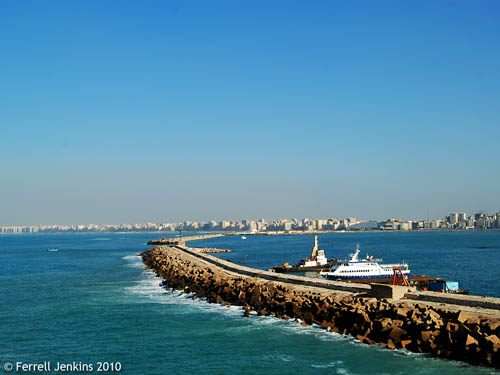
All of that reminded me about the extreme weather in the eastern Mediterranean and various parts of the Middle East. The network news showed conditions on the cruise ship that was unable to enter the harbor at Alexandria. The photo below show the breakwater at the entrance to the Alexandria harbor. The flat looking building to the right on the shore is the famous new library of Alexandria.

Breakwater at entrance to Alexandria harbor. Photo by Ferrell Jenkins.

Breakwater at entrance to Alexandria harbor. Photo by Ferrell Jenkins.

RFIenglish has the following summary:

Twenty-six ships were barred from entering the Suez Canal and 29 vessels delayed for three hours. The waterway was hit by poor visibility and winds of up to 40 knots an hour, said an official at the canal, which is Egypt’s third-largest source of foreign revenue after tourism and remittances from expatriate workers.

Red Sea and Mediterranean ports were closed for a second day on Sunday, while an Italian container ship, Jolly Amaranto, was stranded off the north-western coast after its engines broke down.

Visibility at Cairo airport was reduced to 300 metres.

As a long drought that affected the region came to an end, temperatures plummeted and storms hit Lebanon, Syria, Jordan, the Palestinian territories and Israel:

* In Lebanon seaside roads and ports have been closed after a 45-year-old woman was killed by a falling tree hitting her car – the year’s first snowstorm hit the country’s mountains;
* Off Israel a Moldovan freighter went down near the port of Ashdod but its crew of 11 Ukrainians was rescued.
* Syria’s capital Damascus was hit by snowstorms;
* Jordan suffered sandstorms and was braced for heavy rain and snow, which could lead to flooding.

Forecasters expect the bad weather to continue on Monday and have advised people to stay indoors due to a sandstorm that has blanketed the Egyptian capital.

Read also the BBC report here, or the Breitbart coverage which Todd Bolen mentioned here.

The Israel National News reports on snow in the Jerusalem area. Haaretz says the precipitation is a boon to the Sea of Galilee which has been extremely low in recent months.

Scholar claims evidence for Toi king of Hamath

King Toi of Hamath is mentioned in two Biblical texts.

Now when Toi king of Hamath heard that David had defeated all the army of Hadadezer, Toi sent Joram his son to King David to greet him and bless him, because he had fought against Hadadezer and defeated him; for Hadadezer had been at war with Toi. And Joram brought with him articles of silver, of gold and of bronze. (2 Samuel 8:9-10 NAU)

See also 1 Chronicles 18:9-10 where he is mentioned under the name Tou.

Prof. Aren Maeir reports on his Gath blog that Prof. Itamar Singer called his attention to an article by “C. Steitler (“The Biblical King Toi of Hamath and the Late Hittite State of ‘P/Walas(a)tin’”. Biblische Notizen 146 [2010]: 81-99) in which the author claims that one can identify the recently identified King Tatais, king of P/Walas(a)tin (from new inscriptions in Syria), with Toi, king of Hamath, mentioned in II Sam 8, 9-10; I Chr 18, 9-10.”

Maeir gives this brief summary of the article:

“David’s alliance with Toi, king of Hamath (2Sam 8,9-10) can be anchored in the historical context of Syria. Recent archaeological and philological studies have demonstrated the continuity between the Hittite Great Empire and the late Hittite kingdom, P/Walas(a)tin, to which Hamath belonged. Based on historical and onomastic analyses, the biblical Toi should be identified with a king of P/Walas(a)tin, Taitas.”

Take a look at Prof. Maeir’s observations here. This will be a great story to follow.

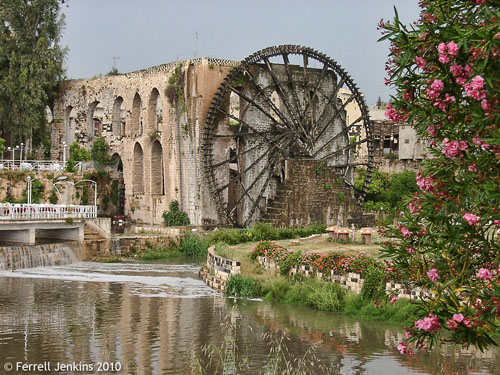
Hamath is associated with the modern city of Hama on the Orontes River in Syria. The city is noted for its norias. These waterwheels were used for several centuries to divert water from the river for agricultural purposes. Today those that remain are mostly decorative.

One of the Norias on the Orontes River at Hama, Syria. Photo by Ferrell Jenkins.

One of the norias on the Orontes River at Hama, Syria. Photo by Ferrell Jenkins.

Kindle users should act quickly

My wife uses the Kindle reader and enjoys it, especially when traveling. Books may be downloaded as less cost than the bound volumes in advance.

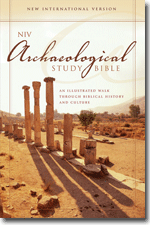
First, I want to mention to current Kindle users that the NIV Archaeological Study Bible is available for the Kindle for $3.99. Yes, that was what I paid for it this morning. The cheapest hard cover edition is available for $31.49 at Amazon. Use this link:
NIV Archaeological Study Bible: An Illustrated Walk Through Biblical History and Culture

If you have a Kindle you just order in the usual way for your device. This may be a limited time offer. I suggest you act quickly. The archaeological and historical notes in this Bible are extremely helpful. I have been using the hard back edition for a few years.

NIV Archaeological Study BibleKindle has two devices now. The Kindle Wi-Fi reader is only $139. Order from this link:
Kindle Wireless Reading Device, Wi-Fi, Graphite, 6″ Display with New E Ink Pearl Technology

The Kindle DX Wireless reading device may be ordered from this link for $189:
Kindle 3G Wireless Reading Device, Free 3G + Wi-Fi, 3G Works Globally, Graphite, 6″ Display with New E Ink Pearl Technology

The NIV Archaeological Study Bible has its own web site here. Check the Gallery. Many of the photos are too small to be useful in presentations, many of the MAPS are nice. I look forward to using the NIV Archaeological Study Bible on my tours to Egypt and Israel next year — assuming my wife will loan her Kindle to me!

Many thanks to Todd Bolen for calling this to our attention. He says,

You don’t need to have a Kindle to read it, as software is now available for the PC, Mac, BlackBerry, iPad, and iPhone.

Please don’t ask me how to do this. I do not have time to do it for you, and I do not have an office in India.

HT: Bible Places Blog.

Vessels of honor and dishonor

In explaining to Timothy the importance of right living, Paul says,

Now in a great house there are not only vessels of gold and silver but also of wood and clay, some for honorable use, some for dishonorable. Therefore, if anyone cleanses himself from what is dishonorable, he will be a vessel for honorable use, set apart as holy, useful to the master of the house, ready for every good work. (2 Timothy 2:20-21 ESV)

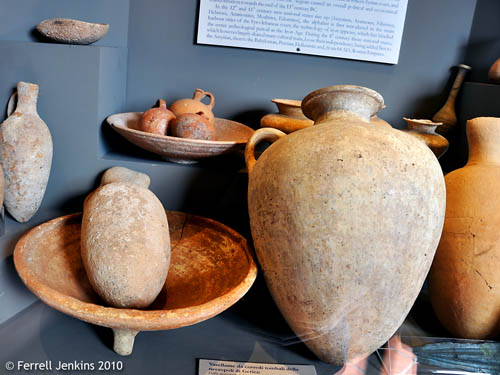
The term vessel (Greek, skeuos) is used of literal vessels made of clay, gold, silver, or wood. It is also used by analogy of individuals as a vessel. I have chosen two photos to illustrate vessels of different value. The first shows vessels from Middle Bronze II Jericho made of clay. Vessels of this type were used throughout Bible times.

Middle Bronze II pottery from Jericho. Vatican Museum. Photo by Ferrell Jenkins.

Middle Bronze II pottery from Jericho. Vatican Museum. Photo by Ferrell Jenkins.

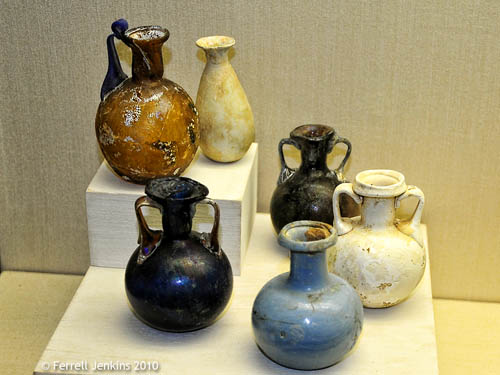
The next photo shows several pieces of “mold-blown perfume vessels decorated with stylized motifs” on display at the Eretz Israel Museum, Tel Aviv, Israel. These vessels are obviously more delicate and require more care than the ordinary clay vessels. For our time we might compare Melmac (if you are too young  to know, look it up!) and fine china.

Mold-blown perfume vessels. Erezt Israel Museum. Photo by Ferrell Jenkins.

Mold-blown perfume vessels. Erezt Israel Museum. Photo by Ferrell Jenkins.

Paul says to Timothy, and to us, “be a vessel for honorable use, set apart as holy, useful to the master of the house.”

Peter uses a similar analogy in speaking of the husband’s responsibility to his wife.

Likewise, husbands, live with your wives in an understanding way, showing honor to the woman as the weaker vessel, since they are heirs with you of the grace of life, so that your prayers may not be hindered. (1 Peter 3:7 ESV)

Sunset on the Nile

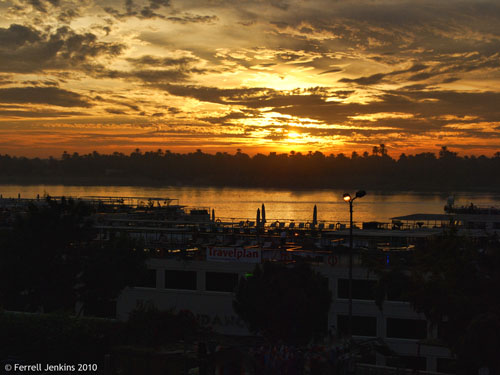
Our photo today was made from the temple at Kom Ombo overlooking the Nile River. The temple here was built by the Ptolemies in the 4th century B.C.

Sunset on the Nile at Kom Ombo. Photo by Ferrell Jenkins.

Sunset on the Nile at Kom Ombo. Photo by Ferrell Jenkins.

The biblical prophets warned that ancient Egypt would come to an end. By the time of the Ptolemies, successors to Alexander the Great, the power of the ancient empire was slowly slipping away.

This is what the Lord God says: I will destroy the idols and put an end to the false gods in Memphis. There will no longer be a prince from the land of Egypt. So I will instill fear in that land. (Ezekiel 30:13 CSB)