
Cornelius, a Roman centurion, was the first Gentile convert to the faith. He was stationed at Caesarea on the Mediterranean coast at the time when the apostle Peter was actively working in the spread of the Gospel.
A centurion in the Roman army normally had charge of 100 men (= to an Army captain). A regular cohort was one tenth of a legion and had a paper strength of 600 men. An auxiliary cohort was usually comprised of 1,000 men. Cornelius was of the Italian cohort. There is inscriptional evidence for the “Italian cohort” from Syria (See Bruce, 215).
When Paul set sail from Caesarea for Rome he was accompanied by a centurion of the Augustan cohort named Julius (Acts 27:1). All of the centurions mentioned in the New Testament make favorable impressions. This was not true of soldiers generally (Luke 3: 14). Note these examples:
- The centurion at Capernaum (Matthew 8:5-13; Luke 7:2-10).
-
The centurion at the crucifixion of Jesus (Luke 23:47).
F. F. Bruce (The Book of Acts, NICNT) cites Polybius (History vi.24) saying,
“Centurions are required not to be bold and adventurous so much as good leaders, of steady and prudent mind not prone to take the offensive or start fighting wantonly, but able when overwhelmed and hard-pressed to stand fast and die at their post.”
There is a wonderful performance in the early second century A.D. hippodrome at Jerash, Jordan. The RACE show (Roman Army Chariot Experience) shows actors dressed as Roman soldiers performing various activities of the early soldiers. Our photo shows a Roman centurion from that show.
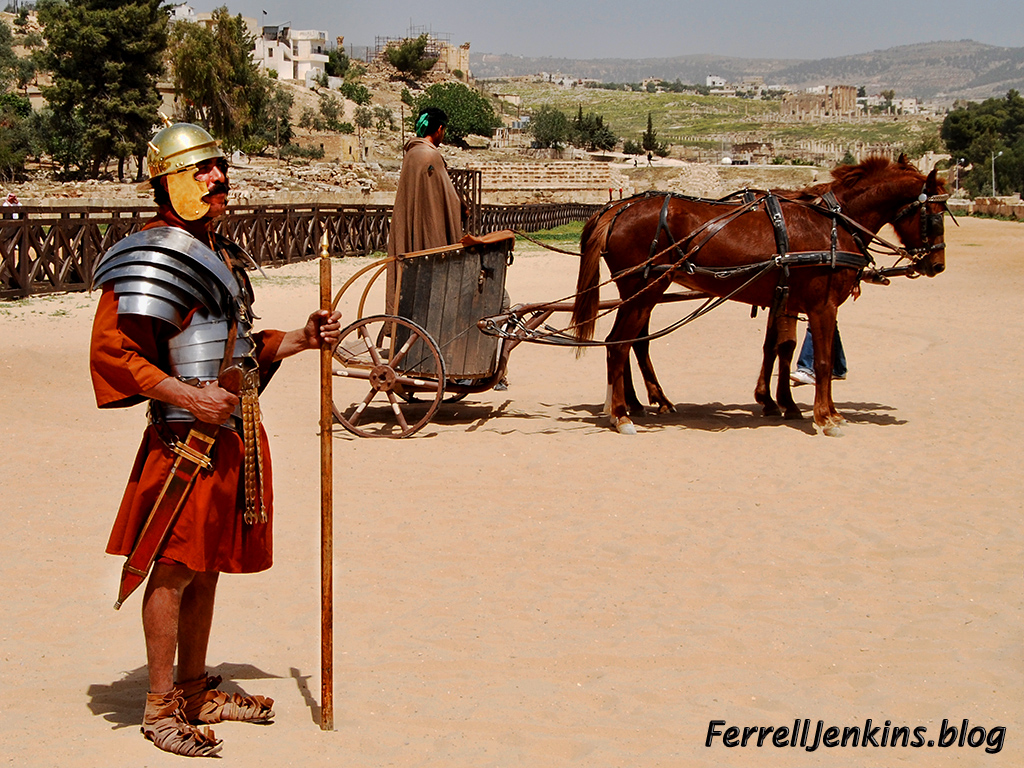
in the RACE show at Jerash, Jordan.
 Ferrell's Travel Blog
Thank you for this fascinating exploration of Roman centurions in the New Testament and their pivotal roles in biblical narratives. Your detailed insights into figures like Cornelius and Julius shed light on their significance beyond mere military roles, highlighting their pivotal roles in spreading and protecting the early Christian faith.
The comparisons drawn between various centurions in the New Testament, from the compassionate centurion at Capernaum to the one at the crucifixion of Jesus, illustrate the nuanced portrayal of these figures in biblical texts. I appreciate how you connect historical context with biblical narratives, emphasizing the positive impressions these centurions left compared to the general perception of soldiers during their time.
For those eager to delve deeper into Roman history and its intersections with biblical accounts, platforms like YouTube https://www.youtube.com/channel/UCXIUMnKlX_Vx8Rw9lAThtpg can offer engaging visual experiences and scholarly discussions. Such resources can complement the historical perspectives you’ve eloquently presented here. Thank you again for sharing your expertise and enriching our understanding of this intriguing aspect of biblical history.