Monthly Archives: September 2023

Moses’ View of the Promised Land

The past few days I have been looking through my photos of Mount Nebo in Jordan. My first visit to the site was in 1967 when the Old City of Jerusalem was in Jordan. Our group got up early on Tuesday May 2 and packed into some of the larger American cars for the ride to Mount Nebo and other sites in the area. For my first two tours the tour operator used cars to transport the group from place to place. We had 19 tour members on that first tour. The tour operator used Mercedes autos on the second tour. When we arrived at the site the tour members would gather to listen to the guide make his presentation.

I recall the guides for the early tours making comments about the view from Mount Nebo when they were younger. Several said they used to be able to see Mount Hermon from the site, before there was so much haze from pollution. I can recall a time or two that we might have had a fairly decent glimpse of Jericho.

Most times we could see only the wilderness of Judea on the west side of the Dead Sea. We might see a little bit of the northern end of the Dead Sea.

Because of the sin of Moses in failing to give credit to God for the water he provide in the wilderness Moses was not permitted to enter the promised land (Numbers 20:1-13).

Mount Nebo is the place from which Moses viewed the land that the LORD had promised to Abraham’s seed (Deuteronomy 34:1-8).

He could see the land but he was not permitting to lead the people across the Jordan into the land. This responsibility would fall to his successor Joshua.

The reconstructed Byzantine church built on Mount Nebo to commemorate the Biblical event.
The approach to Mount Nebo in the Biblical land of Moab

The building on Mount Nebo is a reconstructed Byzantine church built at the site to commemorate the event of Moses viewing the promised land before his death and burial in the vicinity.

The next photo show the typical view we have today when we look to the west from Mount Nebo.

Typical view from Mount Nebo to the West.
Typical View from Mount Nebo to the West.

Here is a map showing Mount Nebo in the time of Moses.
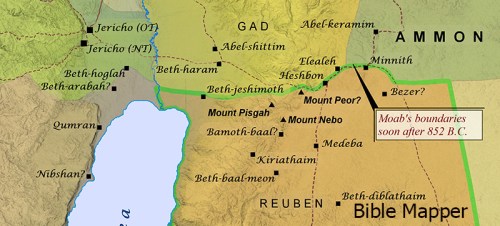
Map showing the area near the Biblical site of Mount Nebo. Credit: BibleMpper.com.
The map is a portion of one of the outstanding maps available at BibleMapper.com. Highly recommended.

Centurions of the New Testament

Cornelius, a Roman centurion, was the first Gentile convert to the faith. He was stationed at Caesarea on the Mediterranean coast at the time when the apostle Peter was actively working in the spread of the Gospel.

A centurion in the Roman army normally had charge of 100 men (= to an Army captain). A regular cohort was one tenth of a legion and had a paper strength of 600 men. An auxiliary cohort was usually comprised of 1,000 men. Cornelius was of the Italian cohort. There is inscriptional evidence for the “Italian cohort” from Syria (See Bruce, 215).

When Paul set sail from Caesarea for Rome he was accompanied by a centurion of the Augustan cohort named Julius (Acts 27:1). All of the centurions mentioned in the New Testament make favorable impressions. This was not true of soldiers generally (Luke 3: 14). Note these examples:

  • The centurion at Capernaum (Matthew 8:5-13; Luke 7:2-10).
  • The centurion at the crucifixion of Jesus (Luke 23:47).

F. F. Bruce (The Book of Acts, NICNT) cites Polybius (History vi.24) saying,

“Centurions are required not to be bold and adventurous so much as good leaders, of steady and prudent mind not prone to take the offensive or start fighting wantonly, but able when overwhelmed and hard-pressed to stand fast and die at their post.”

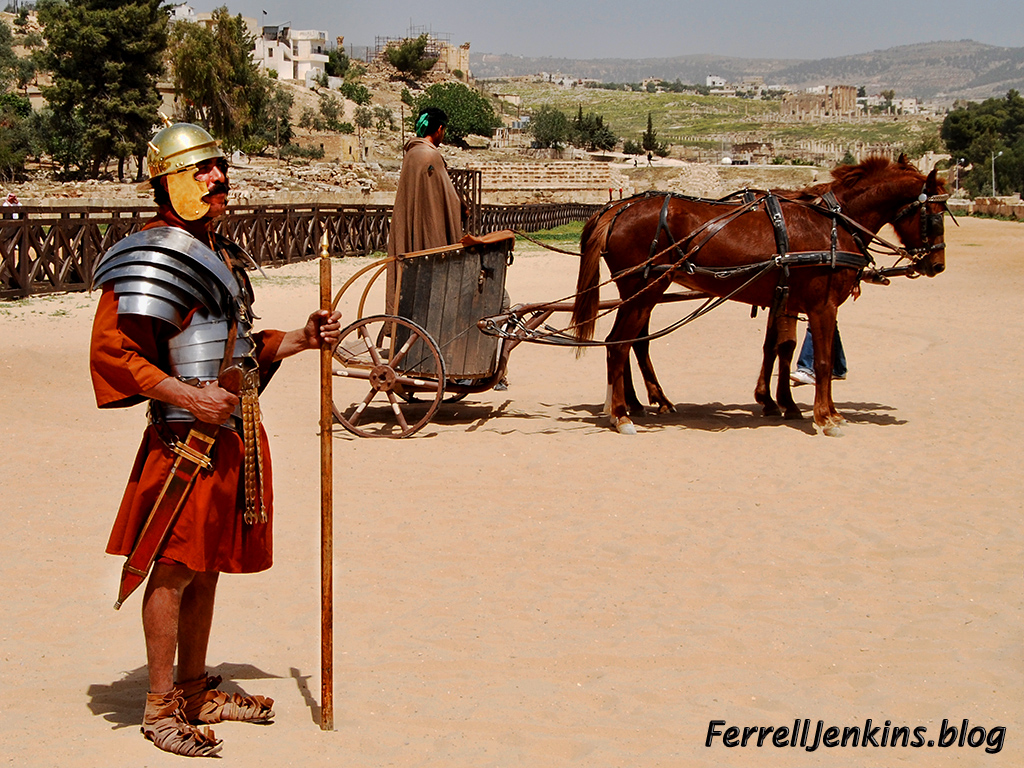
There is a wonderful performance in the early second century A.D. hippodrome at Jerash, Jordan. The RACE show (Roman Army Chariot Experience) shows actors dressed as Roman soldiers performing various activities of the early soldiers. Our photo shows a Roman centurion from that show.

Roman Centurion, with his chariot waiting,
in the RACE show at Jerash, Jordan.