The Israel Antiquities Authority announced today the discovery of a “3,300 year old coffin” at Tel Shadud on the north side of the Jezreel Valley.
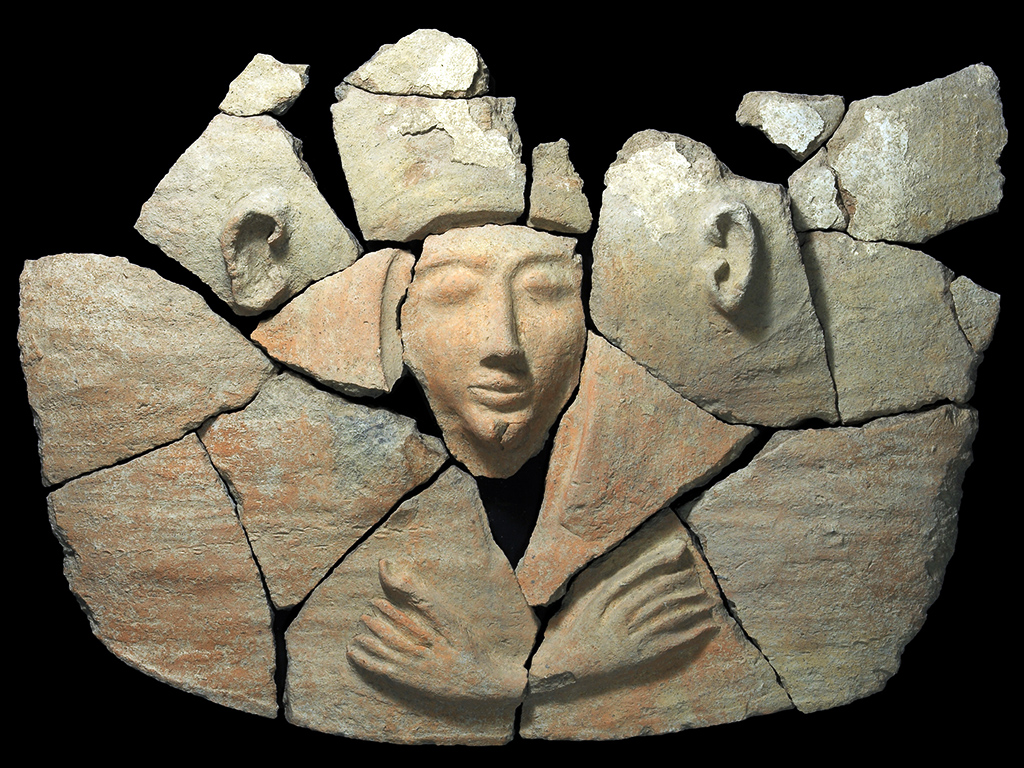
Part of a burial site dating to the Late Bronze Age (thirteenth century BCE) was exposed in an excavation at the foot of Tel Shadud. According to the excavation directors, Dr. Edwin van den Brink, Dan Kirzner and Dr. Ron Be’eri of the Israel Antiquities Authority, “During the excavation we discovered a unique and rare find: a cylindrical clay coffin with an anthropoidal lid (a cover fashioned in the image of a person) surrounded by a variety of pottery consisting mainly of storage vessels for food, tableware, cultic vessels and animal bones. As was the custom, it seems these were used as offerings for the gods, and were also meant to provide the dead with sustenance in the afterlife.” The skeleton of an adult was found inside the clay coffin and next to it were buried pottery, a bronze dagger, bronze bowl and hammered pieces of bronze. “Since the vessels interred with the individual were produced locally”, the researchers say, “We assume the deceased was an official of Canaanite origin who was engaged in the service of the Egyptian government”. Another possibility is that the coffin belonged to a wealthy individual who imitated Egyptian funerary customs. The researchers add that so far only several anthropoidal coffins have been uncovered in the country. The last ones discovered were found at Deir el-Balah some fifty years ago. According to the archaeologists, “An ordinary person could not afford the purchase of such a coffin. It is obvious the deceased was a member of the local elite”.
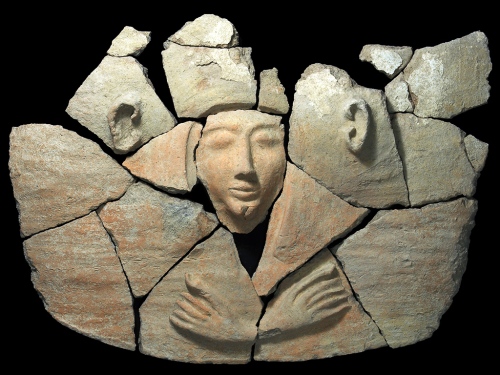
Anthropoid coffin lid from Tel Shadud. Photograph: Clara Amit, courtesy of the Israel Antiquities Authority.
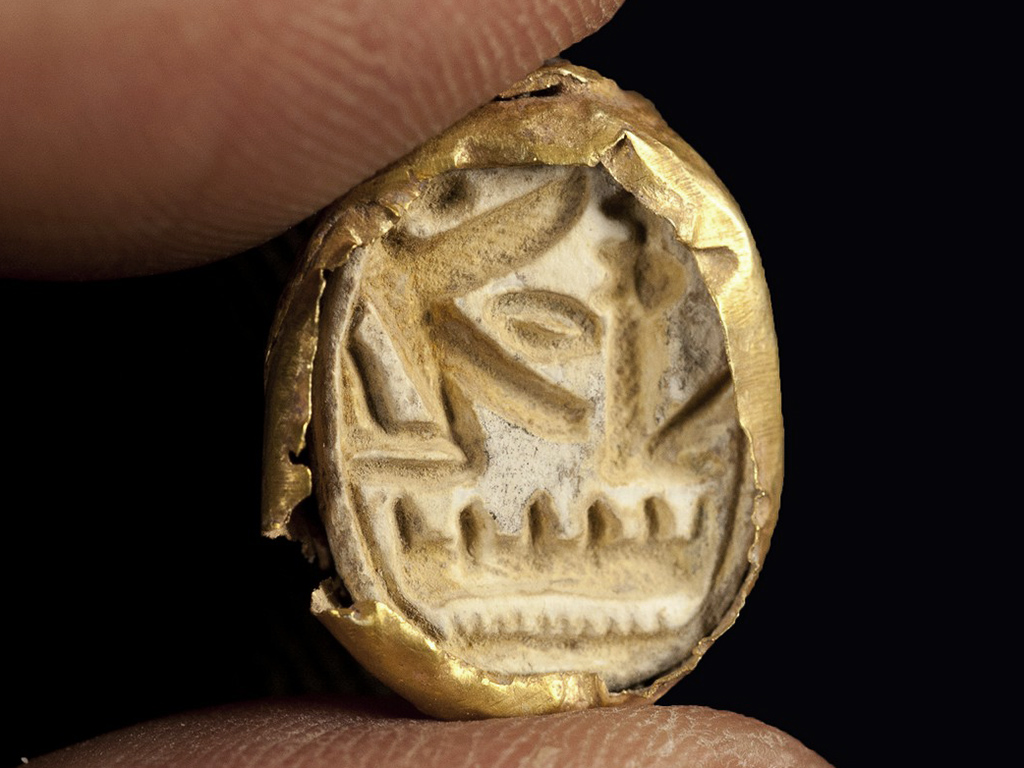
The graves of two men and two women who may have been members of his family were also located near the coffin. The discovery of the coffin at Tel Shadud is evidence of Egyptian control of the Jezreel Valley in the Late Bronze Age (thirteenth century BCE). During the period when the pharaohs governed the country, Egyptian culture greatly influenced the local Canaanite upper class. Signs of Egyptian influence are occasionally discovered in different regions and this time they were revealed at Tel Shadud and in the special tomb of the wealthy Canaanite. A rare artifact that was found next to the skeleton is an Egyptian scarab seal, encased in gold and affixed to a ring. The scarab was used to seal documents and objects. The name of the crown of Pharaoh Seti I, who ruled ancient Egypt in the thirteenth century BCE, appears on the seal. Seti I was the father of Ramses II, identified by some scholars as the pharaoh mentioned in the biblical story of the Israelites’ exodus from Egypt.§ Already in the first year of his reign (1294 BCE) a revolt broke out against Seti I in the Bet Shean Valley. Seti conquered that region and established Egyptian rule in Canaan. Seti’s name on the seal symbolizes power and protection, or the strength of the god Ra – the Sun God – one of the most important deities in the Egyptian pantheon. The winged Uraeus (cobra), protector of the pharaoh’s name or of the sovereign himself, is clearly visible on the seal. The reference to the pharaoh Seti on the scarab found in the coffin aided the archaeologists in dating the time of the burial to the thirteenth century BCE – similar to the burials that were exposed at Deir el-Balah and Bet She‘an, which were Egyptian administrative centers.
§ Other scholars date the exodus from Egypt about two centuries earlier than Ramses II.
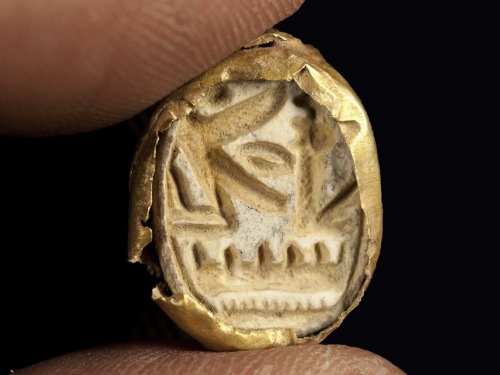
Gold Scarab of Egyptian Pharaoh Seti I. Photograph: Clara Amit, courtesy of the Israel Antiquities Authority.
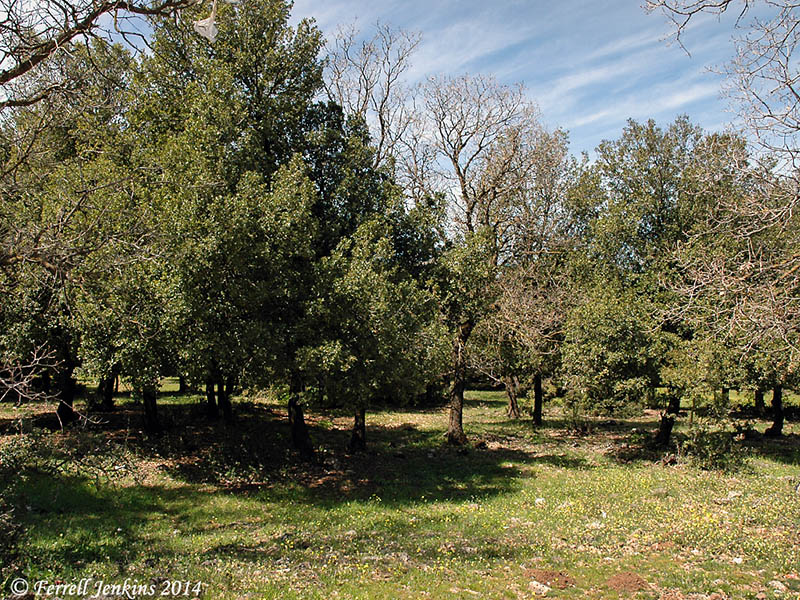
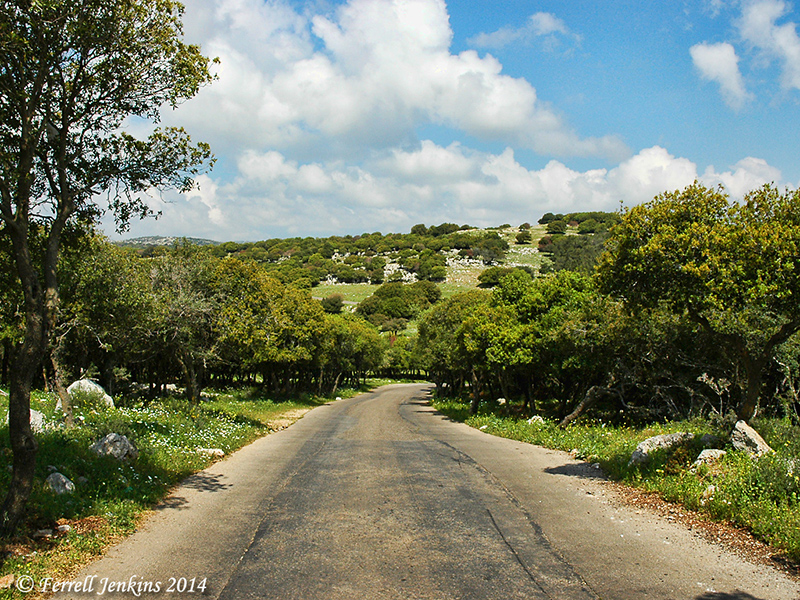
Tel Shadud, often called Tel Sarid, is identified with the Biblical site of Sarid included within the territory of Zebulun.
The third lot came up for the people of Zebulun, according to their clans. And the territory of their inheritance reached as far as Sarid. Then their boundary goes up westward and on to Mareal and touches Dabbesheth, then the brook that is east of Jokneam. From Sarid it goes in the other direction eastward toward the sunrise to the boundary of Chisloth-tabor. From there it goes to Daberath, then up to Japhia. (Joshua 19:10-12 ESV)
The offspring of Abraham were given the land of the Canaanite.
You found his heart faithful before you, and made with him the covenant to give to his offspring the land of the Canaanite, the Hittite, the Amorite, the Perizzite, the Jebusite, and the Girgashite. And you have kept your promise, for you are righteous. (Nehemiah 9:8 ESV)
The IAA news release, with more photos, is currently available here. See the report in Arutz Sheva, the Israel National News, here.
HT: Joseph Lauer, traveling in Israel.



 Ferrell's Travel Blog
Good reading for the weekend
Noah
There has been much discussion in the past few weeks about the Noah movie. In last Saturday’s roundup, Todd Bolen called attention to the blog of Dr. Brian Mattson. In a post entitled “Sympathy for the Devil” Mattson comments about the movie. He reminds us of the following important point: The Bible is not the text for this movie. Several writers, and speakers, have pointed out that about the only things in common between the Noah movie and the Noah/Flood story of the Bible are a man named Noah, an ark, and water.
Mattson claims and documents the philosophical background of the director of the movie in Gnosticism and Kabbalah. I am certain that many people will see the movie and have no awareness of that, just as many ready Paul’s epistle to the Colossians, and John’s epistles without understanding how they are responding to early Gnostic doctrines.
Here is the link to Mattson’s articles:
The Wife of Jesus, again.
It is almost Easter, so we can expect a rerun on various strange views about Jesus. I first called attention to this speculation about the wife of Jesus back in September, 2012, here. Todd Bolen recently commented on the same material that is now getting new attention. Here, he provides links to the article in the New York Times, and the Harvard Theological Review article by Dr. Karen King (available for download). The Times of Israel article is available here.
The GJW (Gospel of Jesus Wife) papyrus fragment possibly claiming that Jesus had a wife. Photo: Harvard University, Dr. Karen L. King.
Bolen summarizes the pertinent material, showing that the document tells us nothing about 1st century events:
Larry Hurtado has written three posts about the papyrus document. Begin here and then scroll back for the other two.
Wild Boar at Caesarea Philippi
Carl Rasmussen’s recent Israel student group encountered a herd of about 15 wild boar at Caesarea Philippi. He provides some nice photos to back up his claim, and discusses the various Biblical references about swine. Access the HolyLandPhotos’ Blog here.
Using Google Books
Rob Bradshaw is making many books and journals available in PDF format. I check his BiblicalStudies.org.uk site regularly for materials that might be helpful in my study. Recently he called attention to a short video by Tim Bulkeley on how to access Bible commentaries without a library. The helpful, brief video is here.
2 Comments
Posted in Bible Lands, Bible Study, Biblical Studies, blog, Books, Culture, Israel, New Testament, Old Testament, Photography, Travel
Tagged Commentaries, Noah, Todd Bolen, Wife of Jesus