Yearly Archives: 2010

David … saw from the roof a beautiful woman bathing

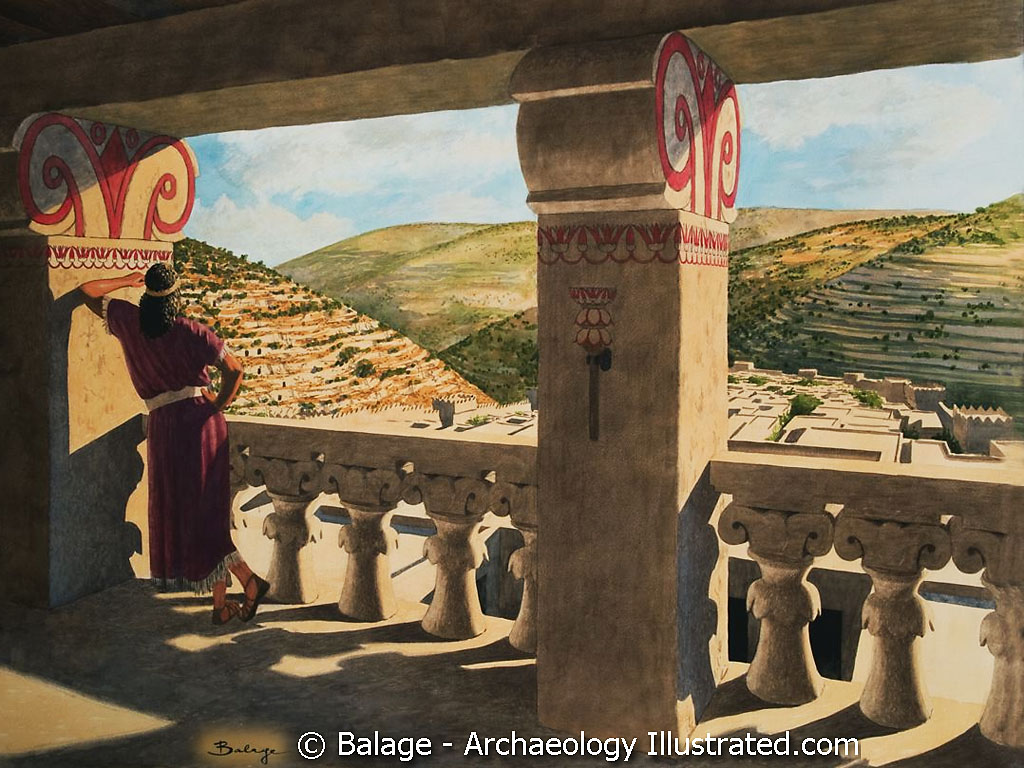
Well, I suppose everyone who reads this blog knows the story. It is the story of David and Bathsheba. Perhaps some wonder how this could be possible. The terrain of Jerusalem tells the story. This photo shows the location of the City of David where the railing is at the top. One can easily envision King David looking down from his roof to houses below.

City of David from below. Photo by Ferrell Jenkins.

The City of David from below. Photo by Ferrell Jenkins.

In the spring of the year, the time when kings go out to battle, David sent Joab, and his servants with him, and all Israel. And they ravaged the Ammonites and besieged Rabbah. But David remained at Jerusalem. It happened, late one afternoon, when David arose from his couch and was walking on the roof of the king’s house, that he saw from the roof a woman bathing; and the woman was very beautiful. (2 Samuel 11:1-2 ESV)

Read the full account in 2 Samuel 11. A hi-res image is available by clicking on the photo.

Artist Balage Balogh has illustrated this biblical story for us in the image below. Take a look at his work at Archaeology Illustrated.

King David on his balcony. Illustration by Balage Balogh.

King David on his balcony. Illustration by Balage Balogh.

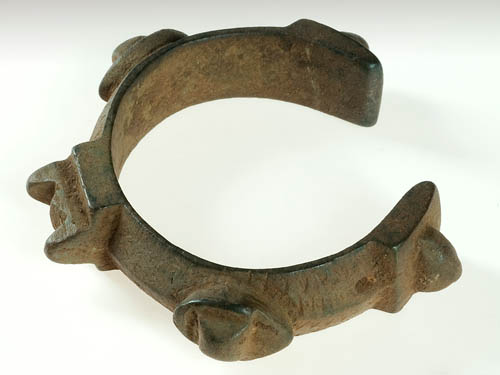
3,500 year old bracelet found in upper Galilee

A bronze bracelet dating to the Late Bronze Age (ca. 1550–1200 BC) has been found during an excavation at Ramat Razim in the vicinity of Zefat (Tsefat, Safad). Karen Covello-Paran, director of the excavation, says,

“We discovered a wide rare bracelet made of bronze. The ancient bracelet, which is extraordinarily well preserved, is decorated with engravings and the top of it is adorned with a horned structure. At that time horns were the symbol of the storm-god and they represented power, fertility and law. The person who could afford such a bracelet was apparently very well off financially, and it probably belonged to the village ruler. It is interesting to note that in the artwork of neighboring lands gods and rulers were depicted wearing horned crowns; however, such a bracelet, and from an archaeological excavation at that, has never been found here.”

Rare bronze 3,500 year old bracelet. Photo: Clara Amit, courtesty IAA.

Rare bronze 3,500 year old bracelet. Photo: Clara Amit, courtesy of the Israel Antiquities Authority.

Large Canaanite cities, such as Megiddo and Hazor, have been excavated, but this is the first time a village of the Late Bronze Age has been excavated in the north of Israel. This site, Ramat Razim, is located southeast of Zefat, and is thought to have “constituted part of the periphery of Tel Hazor,” according to Covello-Paran.

The Late Bronze Age is the period of Moses, the Exodus, and the Conquest in biblical history.

The IAA news release may be read in its entirety here. A hi-res image is available here.

HT: Joseph I. Lauer

Video about Gath earthquake

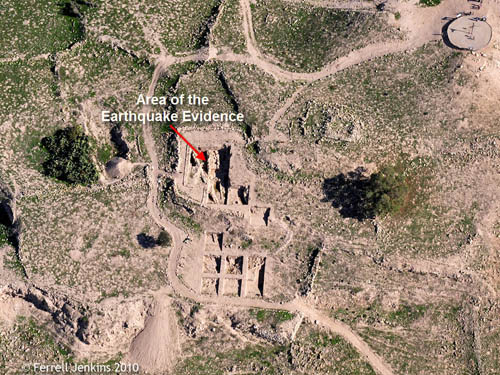
Prof. Aren Maeir has posted a short video clip describing the evidence for the earthquake in Area F at Gath. View it here. We wrote about it earlier here.

Our photo shows Area F near the summit of the tell with the area he describes in the video. A larger image is available here.

Where the earthquake evidence was found in Area F. Photo by Ferrell Jenkins.

Where the earthquake evidence was found in Area F. Photo by Ferrell Jenkins.

Thanks to Prof. Maeir for identifying the location on my photo.

The tabernacle at Shiloh

During the midst of the allocation of the land to the various tribes of Israel, all of them gathered at Shiloh (Shilo) and set up the tent of meeting or tabernacle (Joshua 18:1), which is also called the house of God in Joshua 18:31. Here they made the final division of the land (Joshua 18:8-10).

Then the whole congregation of the people of Israel assembled at Shiloh and set up the tent of meeting there. The land lay subdued before them. (Joshua 18:1 ESV)

The book of Joshua describes the location of Shiloh in specific terms.

However, there is an annual festival to the LORD in Shiloh, which is north of Bethel (east of the main road that goes up from Bethel to Shechem) and south of Lebonah.” (Judges 21:19 NET)

Shiloh in Old Testament times.

The location of Shiloh in Old Testament times. Map: BibleAtlas.org.

The Israelites decided to take the ark of the covenant down to the battle field near the coastal plain. The Israelites were camped beside Ebenezer and the Philistines were camped at Aphek (1 Samuel 4). This was a bad decision. The Philistines defeated the Israelites on that occasion and captured the ark of the covenant. In the same conflict two sons of the judge Eli, Hophni and Phenhas, died. When word reached the old man at the gate of Shiloh he died. It was especially the message that the ark had been taken that most affected Eli.

As soon as he mentioned the ark of God, Eli fell over backward from his seat by the side of the gate, and his neck was broken and he died, for the man was old and heavy. He had judged Israel forty years. (1 Samuel 4:18 ESV)

The ark never returned to Shiloh. Eventually, after the Philistines sent it back to the Israelites, David took it to Jerusalem (2 Samuel 6).

The first photo shows a view of the tell toward the east. Notice the roof of a tower that allows a view of the general area. A hi-res image is available here.
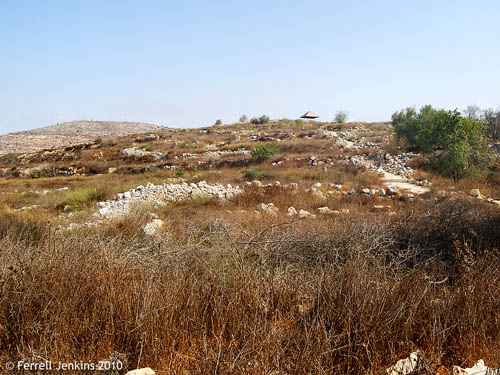
Tel Shiloh where the tabernacle once stood. Photo by Ferrell Jenkins.

Tel Shiloh where the tabernacle once stood. Photo by Ferrell Jenkins.

From that tower we look north at the view of the hill country of Ephraim. The tell is now overgrown, but the rocks in the foreground are the outline of excavated building at the site. Hi-res here.
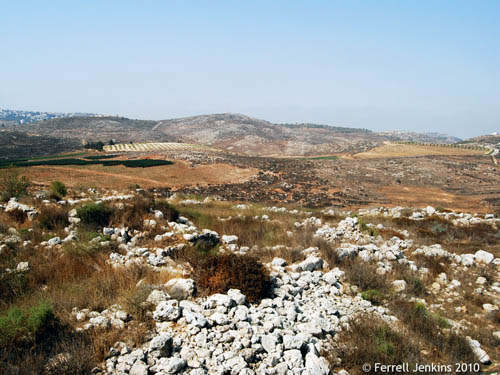
The view north from Tel Shiloh. Photo by Ferrell Jenkins.

The view north, and perhaps a bit east, from Tel Shiloh. Photo by Ferrell Jenkins.

Shiloh was the home of Samuel. The biblical account of the intriguing story of Hannah who had no children is told in the early chapters of 1 Samuel. When Samuel was old enough to be away from home, his mother took him to live with Eli at the tabernacle in Shiloh (1 Samuel 1:24). God’s prophetic call came to Samuel at Shiloh (1 Samuel 3).

Shiloh is identified with Tell Seilun, a site located about 30 miles north of Jerusalem. Israel Finkelstein conducted an excavation of the tell between 1981 and 1984. He found eight strata from MB II to the Middle Ages.

The evidence for sacred continuity at the site from MB III–Iron I is instructive for the history of Israel. Surveys done by Finkelstein in the region of the central hills established that Shiloh was indeed in the heart of a settlement landscape that had greatly expanded in Iron I. The area surrounding Shiloh was perhaps three times as densely populated as any other region in the hills. Given that the top of the tell was long ago exposed, the nature of the shrine constructed by the Israelites is not ascertainable, whether it was a permanent building (cf. 1 Sam. 3:15) or a portable shrine (cf. 2 Sam. 7:6f). — Encyclopedia Jusaica.

Arutz Sheva (Israel National News) reports here that some new excavations are underway at Shiloh, but few details are given (HT: Joseph I. Lauer).

French to train Bethlehem museum staff

Ma’an News Agency reports here,

France and the Palestinian Authority Ministry of Tourism and Antiquities signed an agreement to build a museum in the city of Bethlehem, under a heritage preservation and promotion project.

The agreement, for some 700,000 Euro ($915,460 US), was signed on Wednesday in Bethlehem, and will finance the establishment of a national museum in the Old City of Bethlehem, the training of museographers in cooperation with French institutions including The Louvre and the French National Heritage Institution, as well as fund long-term planning and management.

The two year project is expected to begin this fall.

It has become difficult for tourists to visit Bethlehem. There are several reasons I can think of at the moment.

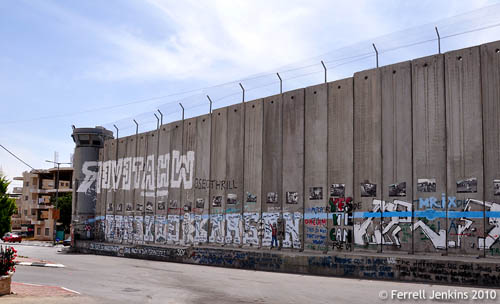
  • The security wall that Israel has built around Bethlehem. In order to visit Bethlehem the tour bus must pass from Israel into the Palestinian Authority controlled Bethlehem. Going in is often easier than coming out. Most of the time tourists are not required to leave the bus, but sometimes we must leave the bus and walk through the check point. Tourists probably only do this once or twice in their life, but honorable citizens of the PA must go through this every day they work in Israel.
  • The Palestinian Authority has not made it easy, either. Buses formerly parked in Manger Square near the Church of Nativity. I think it is good that they  now must park in a new parking garage. Drivers should be allowed to drive closer to the center of town to drop off passengers. Some older tourists find it difficult to climb the steep hill to visit the center.

Before I die I would like to see the wall that separates Bethlehem and Jerusalem dismantled and a portion of it placed in the Bethlehem museum as a reminder of the past. This requires an improvement in conditions now existing in the Middle East.

The Wall as seen in Bethlehem. Photo by Ferrell Jenkins.

The Security Wall as seen in Bethlehem. Photo by Ferrell Jenkins.

HT: Museum note, Joseph Lauer.

Italy seeks sponsors for Colosseum repair

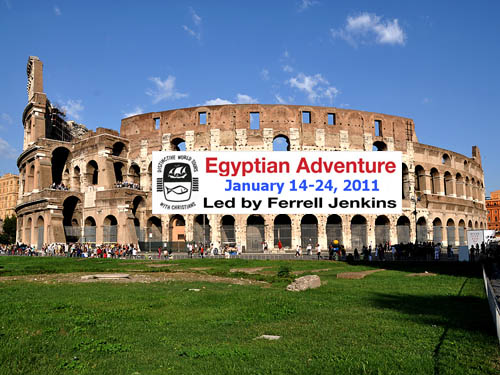
The news sources are reporting that Italian officials are seeking $32 million in funds to repair the crumbling Colosseum. This is in exchange for advertising rights. I have been trying to envision how it might look.

Thinking about how it would look with advertising.

This is how the Colosseum might look with advertising. Photo by Ferrell Jenkins.

Magnitude 8 earthquake hits Gath

Tell es-Safi/Gath is a Philistine city currently being excavation under the direction of Prof. Aren Maeir of Bar Ilan University. The 2010 excavation season is over and we are learning more information about some of the discoveries this year.

The second image is of the very impressive collapse of a large brick wall that was found in Area F (near the summit of the tell). This wall, which appears to be over 20 m in length, was moved laterally about 2 meters, and then toppled. Based on the tight stratigraphic context, this can be dated to the mid-8th cent. BCE (above the 9th cent. destruction level, followed by level of wind-blown sediment, then the collapse and then 2, late 8th cent. levels). After discussing this with seismologists, it has been agreed upon that this in fact could have only have been caused by an earthquake, perhaps one of major force (ca. 8 on the Richter scale). Based on the dating of this event to the early/mid eighth century, it may very likely be evidence of the earthquake mentioned in Amos 1:1 (and perhaps also in Isaiah 6:4). Here is a picture of the collapse. Notice how bricks were moved off the stone foundation and then toppled over as a “deck of cards”.

Read the entire report, along with a hi-res image, here. Scroll back through the blog to see other discoveries this year.

tell-es-saf/Gath brick wall destroyed in earthquake

Brick wall at Gath destroyed by earthquake. Photo: Bar Ilan University.

The earthquake revealed here may be the one mentioned by the prophet Amos. The earthquake was so significant that the prophet dated the reception of his prophecy “two years before the earthquake.”

The words of Amos, who was among the shepherds of Tekoa, which he saw concerning Israel in the days of Uzziah king of Judah and in the days of Jeroboam the son of Joash, king of Israel, two years before the earthquake. (Amos 1:1 ESV)

After considering some of the evidence for the date of the work of Amos, Hubbard says,

“For Amos’ ministry, then, a date between 760 and 755 BC seems to have gained almost unanimous support among scholars. (Joel & Amos, Tyndale Old Testament Commentaries, 90).

Philistine temple found at Tell es-Safi/Gath

We have commented several times about discoveries from the Tell es-Safi/Gath project. One reason for this is that Prof. Aren Maeir keeps us informed about significant developments  during the excavation season. He also posts good photos suitable for use in teaching.

Gath is important because of several significant biblical accounts.

  • The ark of the covenant was taken to this place by the Philistines – 1 Samuel 5:8.
  • It, along with Ashdod, Gaza, Ashkelon, and Ekron, was one of the five major cities of the Philistines – 1 Samuel 6:17.
  • Goliath was from Gath – 1 Samuel 17:4.

Prof. Maeir is now confident that he has found a Philistine temple. Let him tell the story:

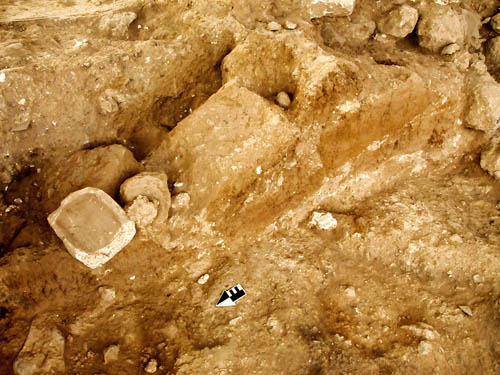
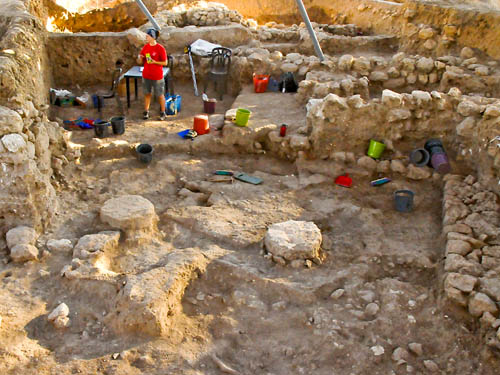
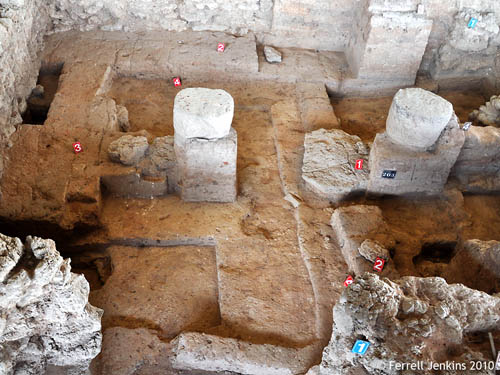
The first [photo] is a working view of the structure which I believe we can now firmly claim to be a temple! The structure, which has at its center two large pillar bases, and some of the exterior walls, had various cult related objects found in its vicinity. In addition, a metallurgical working area was found right next to it. It should be noted that it is located right under a cultic “corner” of St. A3 (9th cent. BCE). Of interest of course is the similarity to the Philistine temple at Qasile, St. X, with the two pillars in the center of the structure. As noted in the past, this floor plan might be reflected in the Samson story, where the architectural imagery of an Iron Age Philistine temple with two pillars might have served as the background for narrative of Samson standing between two pillars etc. And just to make sure that this is not mis-understood: 1) This does not mean that this story occurred here (in the Bible it occurs in Gaza); 2) And this in itself is not proof that the story happened! Rather, this might reflect a cultural awareness on the part of the biblical story of what a Philistine temple of the early Iron Age might have looked like.

I am including a small photo from the Tell es-Safi/Gath Excavation weblog. You may read the full report and find a hi-res photo here.

Tell es-Safi/Gath Philistine temple with pillar bases. Photo: Bar Ilan U.

The Philistine temple with pillar bases at Tell es-Safi/Gath. Photo: Bar Ilan University.

Perhaps, for the benefit of those who do not read much about archaeology, I should explain that the “St.” above refers to the stratum or layer in which the discovery was made. Stratum A3 is dated to the 9th century B.C.

The discovery of a Philistine temple is exciting because it may provide another illustration to help with a better understanding of the biblical account of Samson in the temple of Dagon at Gaza (Judges 16:23-31). Note these verses:

Samson took hold of the two middle pillars that supported the temple and he leaned against them, with his right hand on one and his left hand on the other. Samson said, “Let me die with the Philistines!” He pushed hard and the temple collapsed on the rulers and all the people in it. He killed many more people in his death than he had killed during his life. (Judges 16:29-30 NET)

We already have one illustration from Tel Qasile where three Philistine temples were found in the first excavation after the founding of the state of Israel. Tel Qasile is situated on the north side of the Yarkon River in Tel Aviv. These temple are said to belong to the 12th-11th centuries B.C. Here is a photo of a portion of the Philistine temple at Tel Qasile.

Philistine Temple at Tel Qasile - Eretz Israel Museum at Tel Aviv U.

Philistine Temple at Tel Qasile. Photo by Ferrell Jenkins.

This temple at Tel Qasile is located on the grounds of the Eretz Israel Museum at Tel Aviv University. More about Tel Qasile at a later time. A photo suitable for teaching is available here.

Jezreel Valley panorama

The header I am currently using is a panorama composed of three photos I made from the tell of Megiddo. The Jezreel Valley lies before us to the north (and slightly east). Nazareth is located in the mountains of lower Galilee. The valley continues east between the Hill of Moreh and Mount Gilboa to Beth-Shean, the Jordan Valley, and the mountains of Gilead. The valley was known by the Greek name Esdraelon in New Testament times.

Panorama of Jezreel Valley from Megiddo. Photo by Ferrell Jenkins.

Panorama of Jezreel Valley from Megiddo. Photo by Ferrell Jenkins.

Click on the photo for a hi-res image of this great plain for use in teaching. If you prefer a photo without labels, click here.

The vicinity of the Valley of Megiddo (Jezreel/Esdraelon) was the scene of many significant historical battles.

  • Thutmose III of Egypt fought Syrian forces – 1468 B.C.
  • Joshua defeated the King of Megiddo – Joshua 12:21.
  • Deborah and Barak defeated the Kings of Canaan – Judges 5:19.
  • Gideon defeated the Midianites – Judges 7.
  • Saul was defeated by the Philistines – 1 Samuel 28-31.
  • Ahaziah, king of Judah, died there – 2 Kings 9:27.
  • King Josiah was slain in a battle against Pharaoh Neco of Egypt – 2 Kings 23:29-30; 2 Chronicles 35:20-27.

Megiddo, the tell overlooking the valley, became typical of national grief and a symbol of decisive battles, similar to modern Waterloo, the Alamo, or Pearl Harbor. No wonder it provides the symbolism for the decisive battle in Revelation 16.  John’s Greek Har-Magedon becomes the English Armageddon.

The NAU transliterates harmagedon as Har-Magedon. Other English versions use something similar to the ESV.

And they gathered them together to the place which in Hebrew is called Har-Magedon. (Revelation 16:16 NAU)

And they assembled them at the place that in Hebrew is called Armageddon. (Revelation 16:16 ESV)

This valley has been significant even in modern times.

  • Napoleon advanced against the Turks in 1799.
  • General Allenby and the British defeated the German-Turkish coalition in 1918.
  • British officer Orde Wingate trained Jewish defense forces in this valley in the 1930s. Later leaders of the War of Independence (1948-1949), including Moshe Dayan and Yigal Alon, were trained by Wingate.

General Allenby read the historical survey about the importance of the valley in G. A. Smith’s Historical Geography prior to his battle against the German-Turkish coalition in 1918. Smith included that battle in later editions of his book.

The Writing of the Dead Sea Scrolls

The Writing of the Dead Sea Scrolls is scheduled for tonight on the National Geographic Channel. More information is available here.

This promises to be a better than usual program, featuring Dr. Robert R. Cargill and other well known scholars.

HT: Joseph Lauer