Tag Archives: Sea of Galilee

Roman Roads and Milestones

A new website devoted to Roman Roads and Milestones in Judaea/Palaestina has recently come to our attention. This site is co-sponsored by the Kinneret College on the Sea of Galilee Department of Holy Land Studies and Tel Aviv University IMC-Israeli Milestone Committee. Most readers will know that Kinneret is the Hebrew name for the Sea of Galilee. The website includes articles by the late Israel Roll and others, as well as maps showing the location of the roads. Many of the articles are in Hebrew or another language other than English. The maps, however, should be useful to those who do not read Hebrew.

The English website is available here. (If it links to the Hebrew page look in the upper left hand corner and click on EN.)

Good Bible atlases include a map of the known roadways. See, for example, the following:

  • Rasmussen, Zondervan Atlas of the Bible. Rasmussen includes a map showing the Natural Routes/Roads, and a discussion of International Routes.
  • Beitzel, The New Moody Atlas of the Bible. Beitzel includes a map showing The Roads of Palestine and a discussion of the principles back of making decisions about the roads.
  • Schlegel, Satellite Bible Atlas. The second map in this atlas shows the Regions and Routes of the Land of Israel.

Our photo below shows remains of the Roman road that Jesus might have taken from near Nazareth to the Sea of Galilee. These roads are often in danger of destruction by careless builders and farmers.

The Roman Road near Golani Junction in Galilee. This road collected Diocaesarea (Zephoris) and Tiberias. Photo by Ferrell Jenkins.

The Roman Road near Golani Junction in Galilee. This road connected Diocaesarea (Zephoris) and Tiberias. Photo by Ferrell Jenkins.

Jesus taught His disciples about the attitude they should have toward the Roman authorities.

And if anyone forces you to go one mile, go with him two miles.(Matthew 5:41 ESV)

New Testament writers gave distances in their descriptions of travel from one city to another. Luke says that Emmaus was about seven miles from Jerusalem (Luke 24:13). John says that Bethany was about two miles from Jerusalem (John 11:18).

Milestones were common in Roman times and numerous ones have been found throughout the land of Israel. I understand that the milestone below is from the Jezreel Valley. It is one of many displayed on the grounds of the Beit-Sturman Museum near En Harod.

Roman Milestone from the Jezreel Valley. Photo by Ferrell Jenkins.

Roman Milestone from the Jezreel Valley. Photo by Ferrell Jenkins.

HT: Jack Sasson
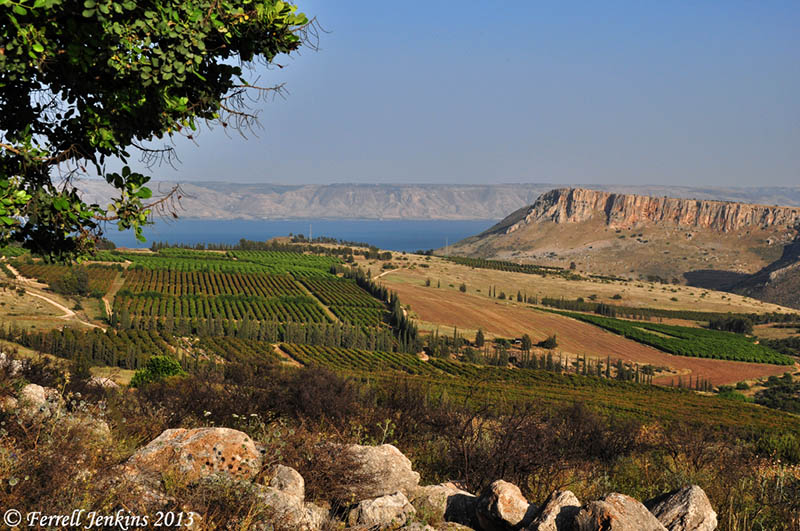
The Sea of Galilee and Mount Arbel from the NW

This photograph of the Sea of Galilee and Mount Arbel was made from highway 807.

Sea of Galilee and Mount Arbel from the NW. Photo by Ferrell Jenkins.

The Sea of Galilee and Mount Arbel from the NW. Photo by Ferrell Jenkins.

From this point we can see the east side of the Sea of Galilee. Today we know it as the Golan Heights. In Old Testament times it was known as Bashan (Joshua 21:27). Golan was one of the cities of Refuge located in the area. In New Testament times this was the area of the Decapolis (Mark 7:31), and probably the country of the Gadarenes (Matthew 8:28).

Below Mount Arbel runs the Via Maris, the main road leading from the Turan Valley to Capernaum. This road allowed travel and commerce between Capernaum, Magdala, and Tiberias with the cities of Nazareth, Cana, Sepphoris, and Jotapata.

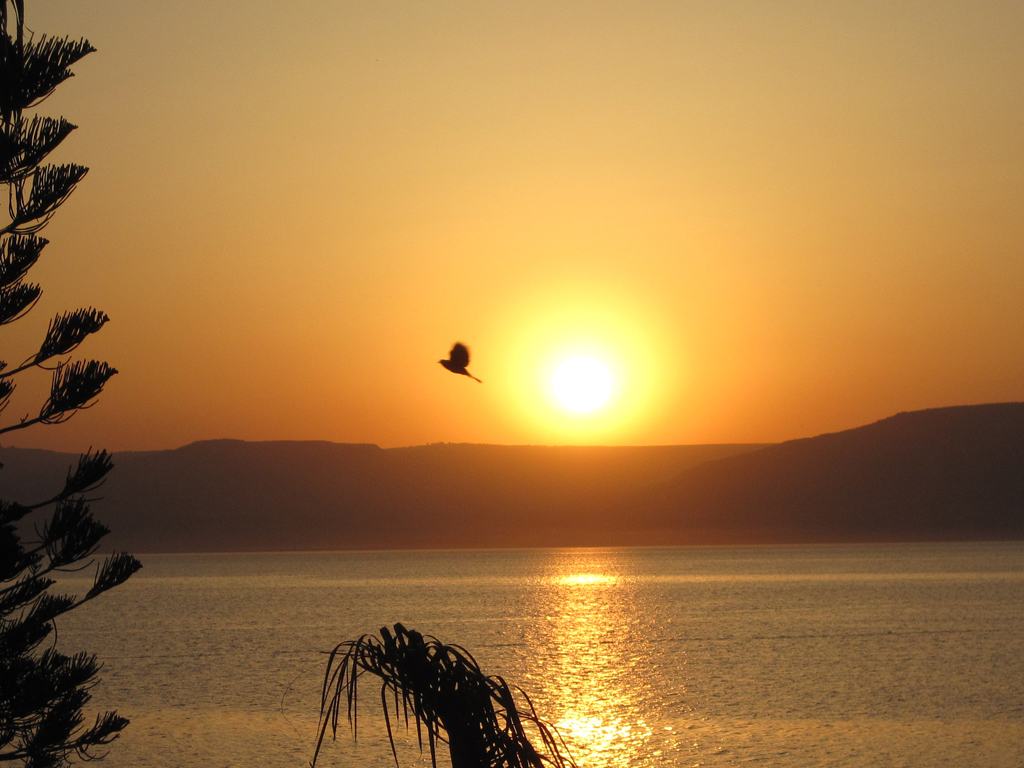
Morning has broken in Galilee

Sunrise on the Sea of Galilee. Photo by Ferrell Jenkins.

Sunrise on the Sea of Galilee. Photo by Ferrell Jenkins.

Rainy days in Galilee

We visited the area north of the Sea of Galilee today. Gentle rain was still falling when I first looked out at the Sea of Galilee this morning. By the time we reached Hazor the weather had cleared and we had a bright and sunny visit. A light rain fell at Dan, but at Caesarea Philippi there was a downpour like I have never seen during one of my tours.

After lunch there was clearing and we returned to the site for a more complete visit.

The right amount of rain is a wonderful blessing from the LORD. He promised His people that he would send the early rains and the late rain. The late rain comes about this time of year, and we are expecting more the next two days.

“It shall come about, if you listen obediently to my commandments which I am commanding you today, to love the LORD your God and to serve Him with all your heart and all your soul, that He will give the rain for your land in its season, the early and late rain, that you may gather in your grain and your new wine and your oil. “He will give grass in your fields for your cattle, and you will eat and be satisfied.  (Deuteronomy 11:13-15 NAU)

The rain is a good thing to help correct a long-term drought that has afflicted Israel in recent years. Nowhere have we seen this more clearly than at the Sea of Galilee.

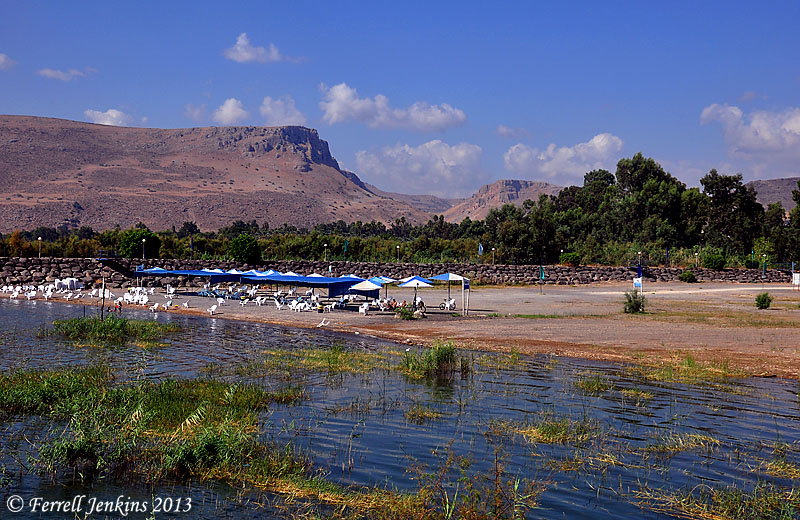
Here is a photo I made yesterday at Nof Ginosaur in the Biblical Gennesaret (Matthew 14:34). I walked out to the end of the pier that has been built to allow boats to drop off passengers.

Sea of Galilee at Nof Ginosaur, April 18, 2913. Photo by Ferrell Jenkins

Sea of Galilee at Nof Ginosaur, April 18, 2913. Photo by Ferrell Jenkins

And here is the same area in September, 2012.

The Sea of Galilee at Nof Ginosar, September, 2012. Photo by Ferrell Jenkins.

The Sea of Galilee at Nof Ginosar, September, 2012. Photo by Ferrell Jenkins.

Kinneret Bot reports for April 18 that the Sea of Galilee is –209.94 meters below sea level. Americans typically translate that as –688.78 feet. A year ago the level was –693.44 feet (211.36 meters) bsl.

Mysterious structure in the Sea of Galilee

Scientists report the discovery of a mysterious structure in the Sea of Galilee on the SW “corner” near the site of Bet Yerah.

According to Live Science here, this structure is made of large basalt blocks. These volcanic stones are common in the region.

A giant “monumental” stone structure discovered beneath the waters of the Sea of Galilee in Israel has archaeologists puzzled as to its purpose and even how long ago it was built.

The mysterious structure is cone shaped, made of “unhewn basalt cobbles and boulders,” and weighs an estimated 60,000 tons the researchers said. That makes it heavier than most modern-day warships.

Rising nearly 32 feet (10 meters) high, it has a diameter of about 230 feet (70 meters). To put that in perspective, the outer stone circle of Stonehenge has a diameter just half that with its tallest stones not reaching that height.

You will need to check the Live Science report, or the original scholarly article from International Journal of Nautical Archaeology (Vol. 42: Issue 1; March 2013) here or here (pdf). There you will find a map, photos and drawings of the structure.

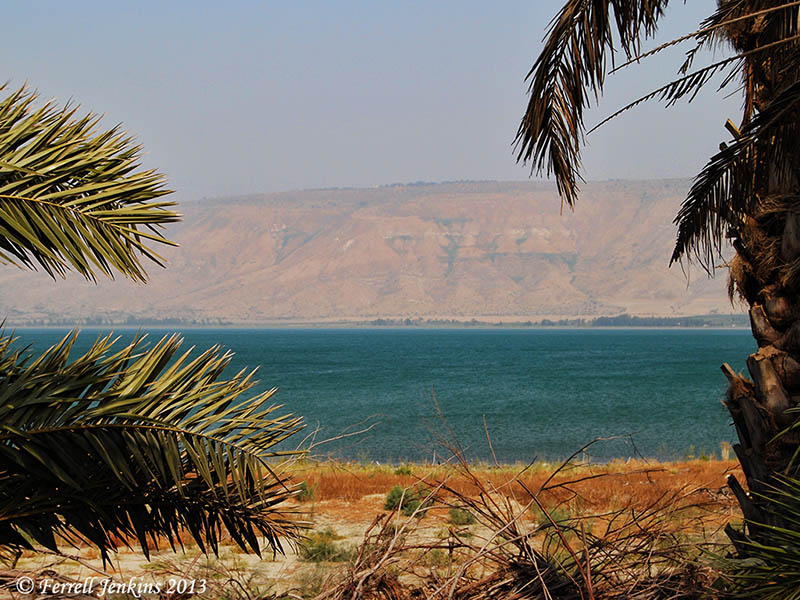
I stopped very near the spot of the structure to make some photos of ripe date palms a few years ago.

The Sea of Galilee near Bet Yerah. The view is to the east across this narrow southern end of the lake. Photo by Ferrell Jenkins.

The Sea of Galilee near Bet Yerah. The view is to the east across this narrow southern end of the lake. Photo by Ferrell Jenkins.

Whatever this structure and it purpose, it seems to have existed long before any of the biblical activity recorded in the region.

HT: Joseph I. Lauer

Peeking into the Great Rift Valley

The natural depression that runs from northern Syria, through Lebanon, Israel/Jordan, continuing into the Gulf of Eilat/Aqaba, into eastern Africa, is known as the Great Rift. This rift has an important effect on travel and the life of the people of the area — perhaps more in ancient times than now.

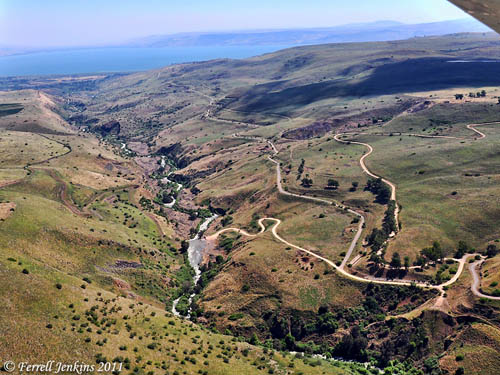
This aerial view was made south of Lake Huleh, looking south toward the Sea of Galilee. You can see the Jordan River descending from north to south. Glueck calls this the Jordan Rift.

Jordan Valley north of the Sea of Galilee. Photo by Ferrell Jenkins.

The Jordan Valley north of the Sea of Galilee. Photo by Ferrell Jenkins.

The elevation at Lake Huleh is 230 feet above sea level. By the time the Jordan River flows into the Sea of Galilee, ten miles south, the elevation of about 700 feet below sea level. This is the area of most rapid descent.

Nelson Glueck describes this portion of the Jordan River.

…it tears out on a run that, for some distance, brooks no restraint. It tumbles and cascades almost continuously through a forbidding, black basalt gorge. Foaming and muddy, it bursts out of the ravine. Then, collecting itself somewhat, it wriggles its way for about another mile through a small plain and a delta of its own making into the clear waters of the Lake of Galilee. (The Jordan River, 35)

“An amazing experience”

An Associated Press report by Anne Gearan is headlined “Bush Visits Biblical Holy Sites.” You may read the entire article here. The article says,

Bush retraced the steps of Jesus and his disciples in the ancient town of Capernaum and gazed out on the nearby Sea of Galilee, where the Bible says Jesus walked on water and calmed a sudden storm by commanding the wind and waves to cease. The waters were crystal blue and calm when Bush visited, leaning in to listen as a brown-robed friar narrated his tour with New Testament passages.

“An amazing experience,” Bush happily said later.

It is an amazing experience for anyone with an interest in the Bible and Jesus. Bush is reported to have said, “I came as a pilgrim.” Many people make pilgrimages to worship at a particular holy site. There is, perhaps, a higher purpose for visiting these sites. On our tours we seek to demonstrate the accuracy of the Bible in describing the Bible land. This involves learning about the geography and topography of the land that help one to better understand the important events that transpired there.

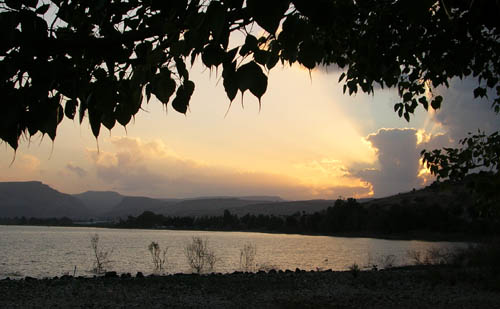
Sunset at Dalmanutha (Mark 8:10) at the northwest corner of the Sea of Galilee. Photo by Ferrell Jenkins.

Sunset at Dalmanutha

The photo above was made at sunset from the site known as Dalmanutha, near the Mount of Beatitudes. Dalmanutha is mentioned only once in the New Testament. After the feeding of the 4000, Mark records that Jesus immediately “entered the boat with His disciples and came to the district of Dalmanutha” (Mark 8:10). In the distance, on the left, you can see the silhouette of Mount Arbel. Then, just to the right of that is the Via Maris (the way to the Mediterranean Sea) from Galilee. The saddle-shaped hill is an extinct volcano known as the Horns of Hattin.

It is “an amazing experience” to visit this land and contemplate these great events.