Tag Archives: Paul

Cenchrea – A Busy Harbor Near Corinth

by Ferrell Jenkins

Corinth is located on the Isthmus that connects the mainland of Greece with the Peloponnese, making it an important center for commerce and travel. Murphy-O’Connor says “Strabo put it very succinctly” with these words: “It is situated on the Isthmus and is master of two harbours, of which the one [Cenchreae] leads straight to Asia, and the other [Lechaeum] to Italy” (Geography 6.8.20; BA 47:3).

              Lechaeum was the western port located on the Corinthian Gulf where ships sailed to and from Europe. Cenchrea was the eastern port located on the Saronic Gulf where ships sailed to and from Asia and Egypt.

              There are numerous spellings of Cenchrea. In Greek the name is Kenchreai (with a variety of spellings). Cenchrea is mentioned by name only twice in the New Testament. When Paul completed 18 months of work at Corinth, he, along with Priscilla and Aquila “put out to sea for [the Roman province of] Syria” (Acts 18:18). The first stop named is Ephesus, where Priscilla and Aquila remained, but Paul continued his voyage to Caesarea (Acts 18:21-22). Before leaving Cenchrea Paul (or Aquila) got a hair cut because he had made a vow. The traditional view is that this reference is to Paul, but the Greek text makes it impossible to know for certain.

              The second reference to Cenchrea is in Romans 16:1-2, where Paul commends Phoebe, “a servant (diakonon) of the church which is at Cenchrea.” He urges the saints at Rome to receive her and to help her. He says, “for she herself has also been a helper of many, and of myself as well.” We think Paul wrote Romans from Corinth during his three month stay in Greece on the third journey (Acts 20:2-3), and that Phoebe carried the letter to Rome.

              Paul was ready to sail for Syria but because of a plot against him by the Jews he decided to return through Macedonia (Acts 20:3). Cenchrea is not named, but is implied in this text.

              Cenchrea continued as a city until the sixth century A.D., but no buildings remain around the harbor today. In addition to the artificial breakwaters which “are now submerged because of subsidence and/or a relative sea level rise of about 2 meters since their construction, the Roman harbor was distinguished by various warehouses and support buildings, monumental statues, and several temples…” (Hohlfelder in ABD). Ruins of the Sanctuary of Aphrodite, the Temple of Isis, a Byzantine church, warehouses, and commercial fish tanks have been discovered.

              Our photo is made from the south pier looking across the harbor to the north. From here Paul, Aquila, Priscilla, and likely the brethren who took the contribution from Macedonia and Achaia, sailed. Phoebe lived, and the church gathered, somewhere nearby.

Photo © Ferrell Jenkins 2006. First published in Biblical Insights.
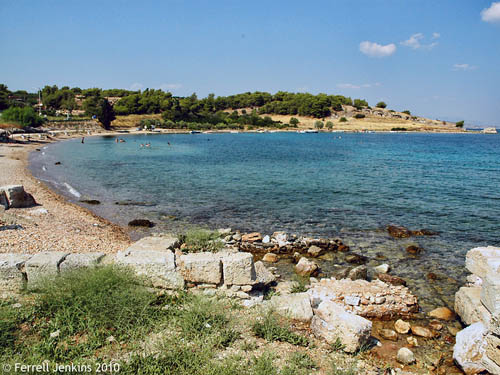
The port of Cenchrea with view toward the northern breakwater. Photo by Ferrell Jenkins.
Ruins of The port of Cenchchrea with a view toward the northern breakwater. Photo by Ferrell Jenkins.

The Lord had many people at Corinth

Corinth is located about two miles south of the narrow isthmus which forms the land bridge, and controlled access, between the main land mass of Greece and the Peloponnesus. Corinth seemed to have flourished from the 8th to the 5th centuries B.C., and there are signs of habitation much earlier. In 146 B.C. the Greek history of Corinth was terminated when the Roman consul Mummius destroyed it. All that remains today of the old Greek city are the seven columns of the Temple of Apollo. Julius Caesar rebuilt Corinth in about 46 /4 4 B.C. as a Roman colony and settled many Roman soldiers there. Corinth became the capital of the Roman province of Achaia and had direct communications with Rome. There were enough Jews in the city to account for a synagogue (Acts 18). Perhaps the two most noticeable sites at Corinth today are the ruins of the temple of Apollo and the Acrocorinth (the mountain or high point of Corinth). The temple of Apollo was built in the 6th century B.C., but only seven of the original 38 Doric monolith columns are standing. There were numerous other pagan temples in the city including one dedicated to Asklepios, the god of healing.

Ruins of the Temple of Apollo at Corinth, a city where Apostle Paul preached (Acts 18).
The ruins of the Temple of Apollo at Corinth with the Acro Corinth in the background.

The judgment-seat (Greek, bema) was a speaker’s platform on which the judge sat or stood for the trial of one against whom an accusation had been made. In the excavations a t Corinth which have been conducted since 1896 the bema has been exposed in the agora. It is likely that Paul stood before Gallio at this place (Acts 1 8:12). The bema is dated to A.D. 44, but could be as early as the time of Augustus. The gospel was successful in this pagan city. Paul preached “Christ and Him crucified” (1 Cor. 2:2; 15:1-4). Paul was fearful but the Lord told him, “Do not be afraid any longer, but go on speaking and do not be silent; for I am with you, and no man will attack you in order to harm you, for I have many people in this ci ty” (Acts 18:9-10 ). Paul remained in Corinth for a year and six months.

Erastus inscription at Corinth. Photo by Ferrell Jenkins.
A portion of the Erastus inscription at Corinth.

Inscribed in a limestone pavement near the theater at Corinth is a phrase which reads in Latin: ERASTVS PRO AEDILITATE S P STRAVIT. The translation goes something like this: Erastus , in return for the aedileship, laid the pavement at his own expense. It is possible, but not certain, that this Erastus was the friend of Paul (Rom. 16:2-3; 2 Tim 4:20). If so, then Erastus may have been one of the few (contrast, not many) of the socially elite at Corinth who accepted the gospel (1 Cor 1:26).

The Lord had many people at Corinth

The church as a solid bulwark

The apostle Paul wrote these words to the saints at Colossae:

For though I am absent in body, yet I am with you in spirit, rejoicing to see your good order and the firmness of your faith in Christ. (Colossians 2:5 ESV)

J. B. Lightfoot suggested that the term stereoma [firmness] was a military metaphor. He says that Paul’s companionship with soldiers of the praetorian guard (Philippians 1:13) might have suggested the image.

I always enjoy William Barclay’s comments on words. He makes the following comments on order and firmness.

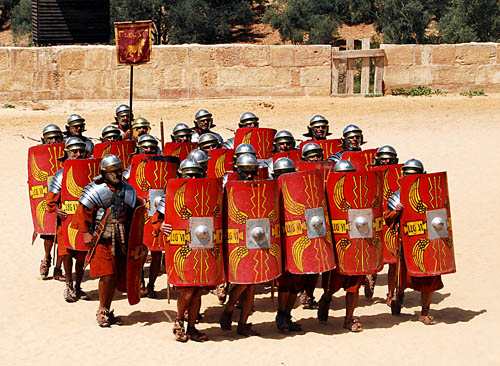
These two words present a vivid picture, for they are both military words. The word translated order is taxis, which means a rank or an ordered arrangement. The Church should be like an ordered army, with every man in his appointed place, ready and willing to obey the word of command. The word translated firmness is stereoma, which means a solid bulwark, an immovable phalanx. It describes an army set out in an unbreakable square, solidly immovable against the shock of the enemy’s charge. Within the Church there should be disciplined order and strong steadiness, like the order and steadiness of a trained and disciplined body of troops.

These soldiers from the Roman Army and Chariot Experience at Jerash, Jordan, demonstrate what is meant by the term firmness (stereoma).

Soldiers in formation as a solid bulwark. Photo by Ferrell Jenkins.

Soldiers in formation as a solid bulwark. Photo by Ferrell Jenkins.

Paul showed me Fair Havens in Crete

Thursday our ship docked at Heraklion, Crete. Crete is associated with Paul’s voyage to Rome. The biblical account is found in Acts 27:7-15. Note verses 7 and 8.

When we had sailed slowly for a good many days, and with difficulty had arrived off Cnidus, since the wind did not permit us to go farther, we sailed under the shelter of Crete, off Salmone; and with difficulty sailing past it we came to a place called Fair Havens, near which was the city of Lasea.

The ship sailed under the shelter of Crete and came to Kali Limenes (Fair Havens) near the city of Lasea. Because Fair Havens was not a suitable harbor for wintering, the pilot and captain of the ship decided to sail on in hopes of reaching “Phoenix, a harbor of Crete, facing southwest and northwest,” and spend the winter there. Because of a severe wind, called Euraquilo, which came down from the land, they were driven by the wind and eventually wrecked on the island of Malta.

Fair Havens was not a stop on our tour because the ship was docked at Heraklion for only five hours. The distance would make it impossible to take a group on a coach (bus) to Fair Havens. I have wanted to return since my first visit in 1984, and determined that I would try it this time even if it meant taking some other transportation to catch the ship. But, I figured that we could do it in four hours by taxi. One gospel preacher and his wife asked me earlier if it could be arranged. I also invited the other three preachers on the tour to join us. We took two taxis and made our way across the mountains to the south side of Crete. The drive itself was rewarding. There were some small patches of snow still on the highest mountain of the country. The beautiful mountain sides and valleys were filled with vineyards, and olive and fruit groves.

Paul showed you Fair Havens?, you are asking. Yes, my taxi driver was named Paul!

Here is one of the photos I made of the harbor at Fair Havens.