Tag Archives: Ministry of Jesus

Samaritan Passover is today

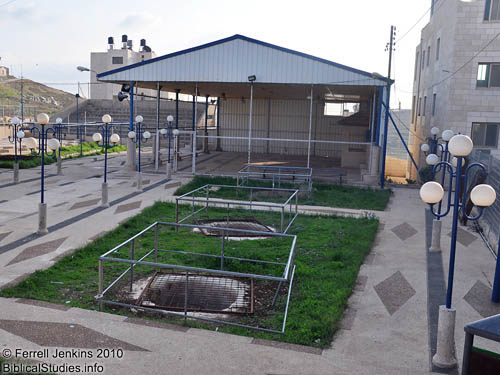
The Samaritans celebrate passover today, April 28, 2010. Lambs will be sacrificed and roasted in the pits seen here on Mount Gerizim.

Pits used by Samaritans on Mt. Gerizim at Passover. Photo by Ferrell Jenkins.

Pits used by Samaritans on Mt. Gerizim at Passover. Photo by Ferrell Jenkins.

See old photos at Life in the Holy Land here. Todd Bolen has some nice photos and explanations at Bible Places here, and another article here. A website provided by the Samaritans is available here.

Passover is a celebration that originated as the Israelites prepared to depart from Egypt.

And when your children say to you, ‘What do you mean by this service?’ you shall say, ‘It is the sacrifice of the LORD’s Passover, for he passed over the houses of the people of Israel in Egypt, when he struck the Egyptians but spared our houses.’” And the people bowed their heads and worshiped. (Exodus 12:26-27 ESV)

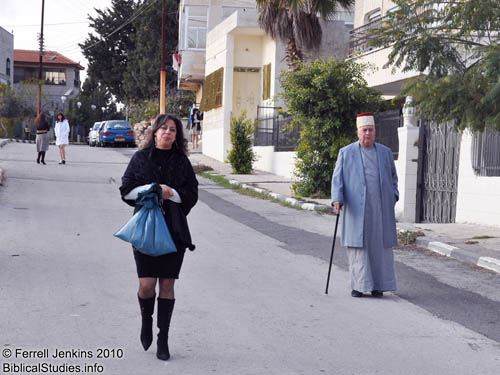
The Samaritans are a curiosity in the modern world. The men and boys wear a dress-like robe, while many of the women dress in modern fashions. We have written more about the Samaritans here.

Samaritan man and woman on Mount Gerizim. Photo by Ferrell  Jenkins.

Samaritan man and woman on Mount Gerizim. Photo by Ferrell Jenkins.

Jesus paused in the valley below Mount Gerizim at Jacob’s well. He discussed the issue of worship in “this mountain” with the woman of Samaria (John 4:1-42).

Our fathers worshiped on this mountain, but you say that in Jerusalem is the place where people ought to worship.” Jesus said to her, “Woman, believe me, the hour is coming when neither on this mountain nor in Jerusalem will you worship the Father. You worship what you do not know; we worship what we know, for salvation is from the Jews. But the hour is coming, and is now here, when the true worshipers will worship the Father in spirit and truth, for the Father is seeking such people to worship him.  God is spirit, and those who worship him must worship in spirit and truth.” (John 4:20-24 ESV)

Jodanian students work at Umm Qais

Jordanian students from the International Academy Amman spent a week excavating at Umm Qais. The full article may be read in The Jordan Times here.
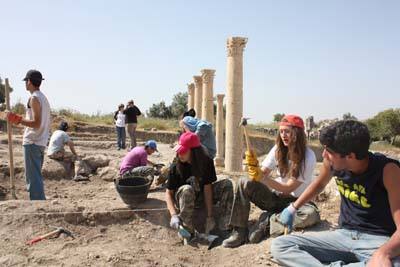
Students from the International Academy in Amman work at Um Qais. Photo by Taylor Luck, Jordan Times.

Students from the International Academy in Amman work at Um Qais. Photo by Taylor Luck, Jordan Times.

Umm Qais (a common spelling) is the site of Gadara, one of the cities of the Decapolis. Mendel Nun discovered 16 ancient ports around the Sea of Galilee, including one for the city of Gadara. He describes Gadara:

Gadara, the most magnificent of the Hellenistic towns that circled the Sea of Galilee, was located on the heights of Gilead above the Yarmuk River. The marine suburb and the city’s harbor were located on the southeastern shore of the lake, at Tel Samra (now Ha-on Holiday Village). In form, Gadara’s harbor resembles that of Sussita—a closed basin with an opening to the south—but it is much larger and more luxurious. The central breakwater is 800 feet long and its base 15 feet wide. The promenade was 650 feet long, built with finely chiseled stones, only one of which remains. The 150-foot-wide basin covered an area of 3 acres.

This harbor is superior to the one at Sussita not only because of its size but also because of its facilities. At the center of the promenade are the remains of a tower. Ruins of a large structure—probably the building of the harbor administration—are scattered on the ground near the harbor gate.

Gadara’s maritime character is attested by its coins, which depicted ships of war for some 250 years. The city’s harbor at Tel Samra was almost certainly not only an anchorage for ships. Second-century coins from Gadara commemorate the Naumachia—naval battle games performed for the inhabitants of Gadara. Until recently, researchers assumed that these games took place on the Yarmuk River, which flows into the Jordan just south of the Sea of Galilee; but this does not seem likely, and no remains of a facility of this kind have been found at this site. The large harbor basin at Tel Samra, however, with its 1,600-foot-long combined promenade and breakwater, would surely have been more suitable to accommodate the throngs of spectators as they arrived. In addition, Gadara’s harbor must have been used by thousands of visitors to the famous baths at Hamat Gader, located 5 miles southeast of the sea. The ancient Roman road connecting Beth Shean and Sussita passed near Tel Samra, and the road to Hamat Gader branched off this road. (Mendel Nun. “Ports of Galilee.” Biblical Archaeology Review 25:04; July/Aug 1999)

From Umm Qais (Gadara) one has a great view of the Sea of Galilee and the Yarmuk River valley. We are told that Jesus visited the region of Decapolis.

Then he returned from the region of Tyre and went through Sidon to the Sea of Galilee, in the region of the Decapolis. (Mark 7:31 ESV)

The Gospel of Matthew informs us about the healing by Jesus of two demon-possessed men in the country of the Gadarenes (Matthew 8:28). Mark puts this event in the country of the Gerasenes (Mark 5:1-20). Luke adds that they “sailed to the country of the Gerasenes, which is opposite Galilee” (Luke 8:26).

The photo below was made in the late afternoon when citizens of the local Jordanian village came out to enjoy the view. The view across the Sea is not clear, but you can see the entire western coast line. In the right foreground you can see a bunker used by the Jordanians in recent wars in the region. The hill directly across from the bunker is the beginning of the Golan Heights. Prior to 1967 this was in Syria. The Yarmuk River flows into the Jordan River south of the Sea of Galilee. All of the significant rivers of Jordan that flow into the Jordan River have dams on them, thus decreasing the amount of water flowing into the Jordan.
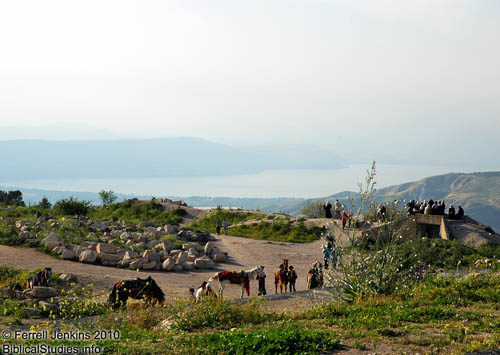
Late afternoon view of the Sea of Galilee from Umm Qais. Photo by Ferrell Jenkins.

The next photo was made in 2002. It shows a portion of the nymphaeum (attractive water fountain) and the Yarmuk Valley.
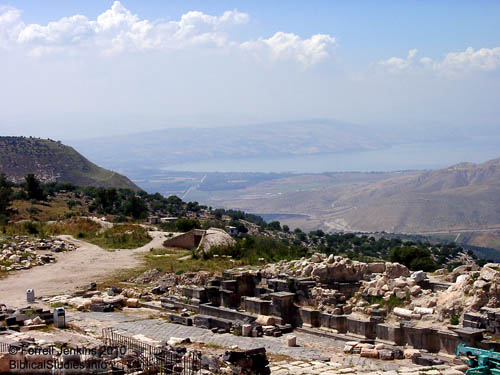
The Sea of Galilee from Umm Qais (Gadara). Photo by Ferrell Jenkins.

The Sea of Galilee from Umm Qais (Gadara). Photo by Ferrell Jenkins.

Todd Bolen posted a beautiful, clear photo that also shows the Yarmuk River valley and the nymphaeum here. Note that the nymphaeum had undergone some reconstruction when his photo was made.

HT: Joseph Lauer

The Good Shepherd

When the Pharisees and scribes complained that Jesus received sinners and ate with them, He told them a parable that we call the parable of the lost sheep (Luke 15:1-7).

“What man among you, if he has a hundred sheep and has lost one of them, does not leave the ninety-nine in the open pasture and go after the one which is lost until he finds it? “When he has found it, he lays it on his shoulders, rejoicing. “And when he comes home, he calls together his friends and his neighbors, saying to them, ‘Rejoice with me, for I have found my sheep which was lost!’  “I tell you that in the same way, there will be more joy in heaven over one sinner who repents than over ninety-nine righteous persons who need no repentance. (Luke 15:4-7 NAU)

“When he has found it, he lays it on his shoulder, rejoicing.” This describes the work of good shepherds and a practice that was well known to those who heard Jesus. On another occasion Jesus called Himself the good shepherd (John 10:11, 14).

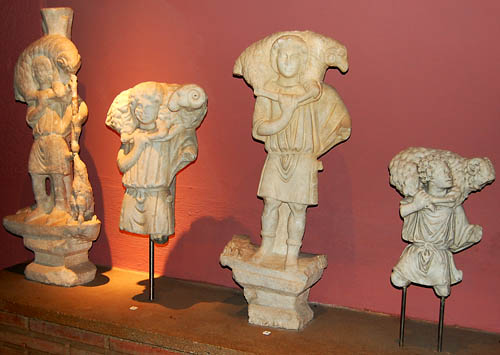
The motif of the good shepherd with the sheep on his shoulder became common in later Christian iconography. Similar drawings are known from the catacombs in Rome. The four statuettes shown below date from the 4th century A.D., and are displayed in the Istanbul Archaeological Museum.

Good shepherd statues. Istanbul Archaeological Museum. Photo by Ferrell Jenkins.

Good shepherd statues. Istanbul Archaeological Museum. Photo by Ferrell Jenkins.

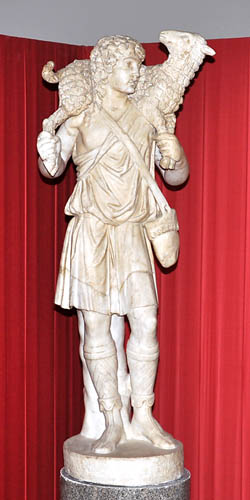
Last September I saw a special exhibit of early Christian artifacts in the Vatican Museum. The photo below shows a wonderful early 4th century statuette of the Good Shepherd.

The Good Shepherd in the Vatican Museum. Photo by Ferrell Jenkins.

The Good Shepherd in the Vatican Museum. Photo by Ferrell Jenkins.

Perfume of pure nard

Shortly before His death, Jesus went to Bethany. The event we are considering today took place at the home of Simon the Leper, but Mary, Martha, and Lazarus, His friends, were present.  On this occasion Mary anointed the feet of Jesus with perfume of pure nard.

Mary therefore took a pound of expensive ointment made from pure nard, and anointed the feet of Jesus and wiped his feet with her hair. The house was filled with the fragrance of the perfume. (John 12:3 ESV)

The Greek word for perfume is muron, and the word for nard is nardos. Our word myrrh comes from muron. While it might be used of a specific type of fragrance, in this place it is probably used in the general sense of perfume. Nard (or spikenard) is “a fragant oil derived from the root and spike (hair stem) of the nard plant which grows in the mountains of northern India” (Brown, Anchor Bible, I:448). Mary anointed His feet. The parallel accounts are Matthew 26:6-13 and Mark 14:3-9. This act is to be told wherever the gospel is preached. This took place in the house of Simon the leper. The account in Luke 7:36-50 took place in Galilee and is different.

The Eretz Israel Museum at Tel Aviv University has one entire building devoted to glassware. I was especially interested in a large collection of perfume bottles from the first century A.D.

Perfume Bottles at Eretz Israel Museum at Tel Aviv University

First Century A.D. Perfume Bottles at Eretz Israel Museum. Photo by Ferrell Jenkins.

The museum sign associated with this collection identifies these bottles as “Free-blown vessels of colored opaque and translucent glass, probably produced in the same centers.”

“He is not here, for He has risen”

The women who came to the tomb of Jesus on the first day of the week found the stone rolled away from the tomb. When they entered the tomb the body was not there (Luke 24:1-3).

The angel said to the women,

He is not here, for he has risen, as he said.  (Matthew 28:6a ESV)

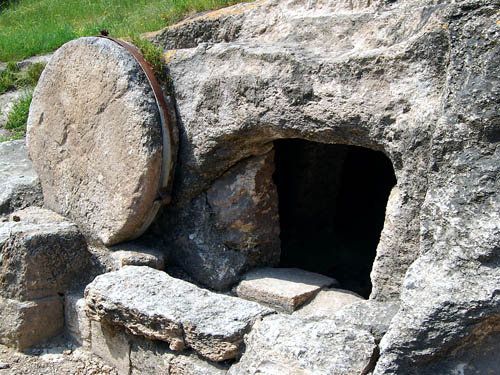
Several tombs of the type in which Jesus was buried have survived the centuries. This one was discovered during road construction a few years ago near Mount Carmel.

A Roman Period tomb with a rolling stone. Photo by Ferrell Jenkins.

A Roman Period tomb with a rolling stone. Photo by Ferrell Jenkins.

Paul says that Jesus was “delivered up for our trespasses and raised for our justification.” (Romans 4:25 ESV).

Last year I wrote about “The empty tomb” here, and “The Tomb of Jesus” here. Use the search box to locate other posts about tomb.

The Via Dolorosa – the Way of the Cross

An incredible day in history. Early in the morning Jesus was transferred from Caiaphas, the Jewish High Priest, to Pontius Pilate, the Roman military governor. When Pilate learned that Jesus was from Galilee, he sent Him to Herod Antipas. Herod quickly sent Him back to Pilate. Under pressure from the religious leaders, Pilate delivered Jesus to be crucified. The numerous events from the last day prior to the crucifixion of Jesus are recorded in the New Testament (Matthew 26-27; Mark 14-15; Luke 22-23; John 18-19).

As early as Byzantine times Christians began to follow the final steps of Jesus on specified days. Over the centuries many changes were made in the route and the stops. The traditional Via Dolorosa, as known today, was fixed in the 18th century.

Jerome Murphy-O’Connor says,

The Via Dolorosa is defined by faith, not by history. (The Holy Land, 5th edition, 37)

He continues,

The present Way of the Cross has little chance of corresponding to historical reality… (38)

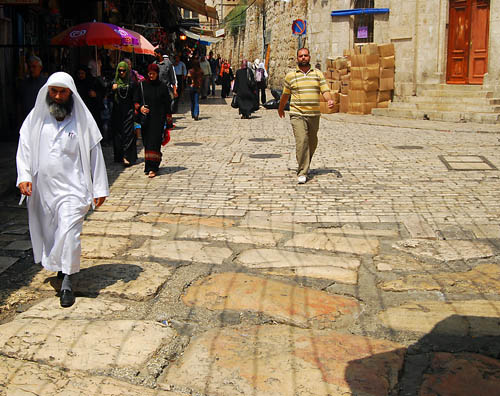
According to tradition, the third station of the cross is where Jesus falls the first time under His cross. It sounds reasonable, but the Gospels make no specific mention of this.

Roman period street near 3rd station of the cross. Photo by F. Jenkins.

Roman period street near 3rd station of the cross. Photo by F.  Jenkins.

This photo shows the street in front of the third station. The plaque in Hebrew, Arabic and English provides the following information about the street.

Paving stones, apparently from the Second Temple Period (ca. 100 B.C.E. – 100 C.E.). The street was found in its entirety 3 meters below the existing level and was partially restored by the Municipality of Jerusalem … 1980-1981.

This means that the street Jesus might have walked is at least 10 feet below the present street level.

[A portion of this post is repeated from April 8, 2009.]

Peter’s denial of Jesus

Thursday was another activity-filled day for Jesus, but we pick up on the activity late in the day. The Gospel of John fills in a lot of information not contained in the other accounts of His life. Here is what John records:

  • The passover meal (John 13:1-38). John includes no account of the institution of the Lord’s Supper which took place at the time of this meal (Matthew 26:26-29; Mark 14:22-25; Luke 22:17-20). Only John records the washing of the disciples’ feet.
  • His farewell discourses (John 14-16).
  • His priestly prayer for His disciples and those who believe on Him through their word (John 17).
  • His betrayal and arrest (John 18). Note that it would have been fairly late in the evening before He was arrested.
  • He is taken to the house of Annas (John 18:12-14), where he was delivered over to Caiaphas (John 18:24-28). I think the text indicates that Jesus remained there throughout the night.
  • The denial by Peter (John 18:15-18).

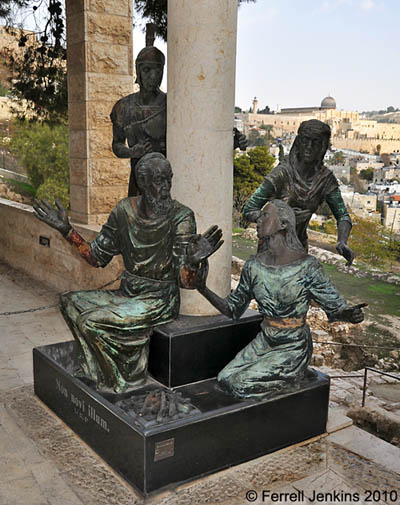
The traditional location for the house of Caiaphas is known as St. Peter in Gallicantu (St. Peter of the Cock Crowing). We have written about the site here, and I will not discuss the authenticity of the place now. The site has a nice statue of Peter saying, “mulier non novi illum.”

Peter denies knowing Jesus. Photo by Ferrell Jenkins at St. Peter in Galicantu.

Peter denies knowing Jesus. Photo by Ferrell Jenkins.

Having arrested Him, they led Him away and brought Him to the house of the high priest; but Peter was following at a distance. After they had kindled a fire in the middle of the courtyard and had sat down together, Peter was sitting among them. And a servant-girl, seeing him as he sat in the firelight and looking intently at him, said, “This man was with Him too.” But he denied it, saying, “Woman, I do not know Him.” (Luke 22:54-57 NAU)

This must have been one of the most hurtful things to Jesus. It is one thing to have acknowledged enemies mistreat you, but when it is done by a supposed friend it is doubly hurtful.

A quiet day for Jesus

The Gospel accounts indicate no activity  for Jesus on Wednesday of the final week. After all of the conflict on Tuesday, one can imagine He needed a time for seclusion. We should consider another possibility. Had He continued the intense conflict with the religious leaders it might have affected the time of His death.

Jesus carefully orchestrated His death. From the beginning He spoke of His hour. After the raising of Lazarus he withdrew to a place northwest of Jerusalem on the edge of the wilderness at Ephraim.

Jesus therefore no longer walked openly among the Jews, but went from there to the region near the wilderness, to a town called Ephraim, and there he stayed with the disciples. (John 11:54 ESV)

Jesus would offer Himself as the sacrificial lamb at the time of the Passover meal. This took intricate planning.

The crowds of pilgrims who had come to Jerusalem for Passover overloaded the system. Many of them likely slept in the open on the Mount of Olives and other places near the city. On Monday evening,

And he entered Jerusalem and went into the temple. And when he had looked around at everything, as it was already late, he went out to Bethany with the twelve. (Mark 11:11 ESV)

Luke tells us that it was His custom to do so.

And he came out and went, as was his custom, to the Mount of Olives, and the disciples followed him. (Luke 22:39 ESV)

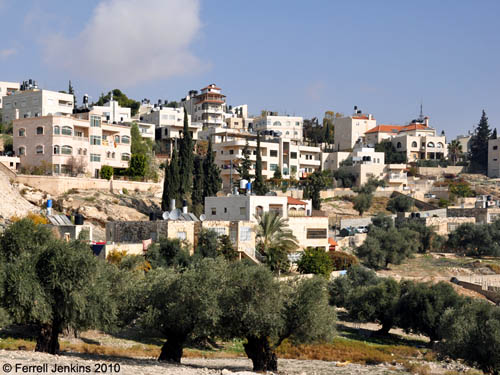
Bethany, the village of Mary, Martha and Lazarus (John 11:1), was located on the eastern slope of the Mount of Olives about two miles from Jerusalem (John 11:1, 18). The photo below of the eastern slope of Olivet was made from near the traditional tomb of Lazarus at Bethany. In the time of Jesus the mountain was likely filled with olive trees. Today we see modern housing. Jerusalem may be seen only after one reaches the crest of the mountain.

Eastern slope of Mount of Olives near Bethany. Photo by Ferrell Jenkins.

Eastern slope of Mount of Olives near Bethany. Photo by Ferrell Jenkins.

A day of conflict for Jesus

Tuesday of the week of Jesus’ death was a day of great conflict. The tensions between Jesus and the Jewish leaders had been growing for a long time and was about to reach its peak. The Gospel of John records this climax in His ministry.

37 Although Jesus had performed so many miraculous signs before them, they still refused to believe in him, 38 so that the word of Isaiah the prophet would be fulfilled. He said, “Lord, who has believed our message, and to whom has the arm of the Lord been revealed?” 39 For this reason they could not believe, because again Isaiah said, 40 “He has blinded their eyes and hardened their heart, so that they would not see with their eyes and understand with their heart, and turn to me, and I would heal them.” 41 Isaiah said these things because he saw Christ’s glory, and spoke about him. (John 12:37-41 NET)

Not everyone rejected Jesus. John says that many among the rulers believed on Him. Their faith was not strong enough to overcome their fear of being cast out of the synagogue and elicit a confession of Him (John 12:42).

According to the Gospel of Matthew, the chief priests and elders questioned His authority to do the things He was doing. It seems they were especially perturbed that He would dare do these things in the temple courts. That was where they were in control! (Matthew 21:23ff.). The intellectual sparring was followed by His scathing rebuke of them recorded in Matthew 23.

When Jesus and His disciples left the Temple that day to go out to the Mount of Olives, His disciples pointed out the magnificent buildings of the temple that had been constructed by Herod the Great. And the work continued long past the death of Herod in 4 B.C. (John 2:20).

1 Now as Jesus was going out of the temple courts and walking away, his disciples came to show him the temple buildings. 2 And he said to them, “Do you see all these things? I tell you the truth, not one stone will be left on another. All will be torn down!” (Matthew 24:1-2 NET)

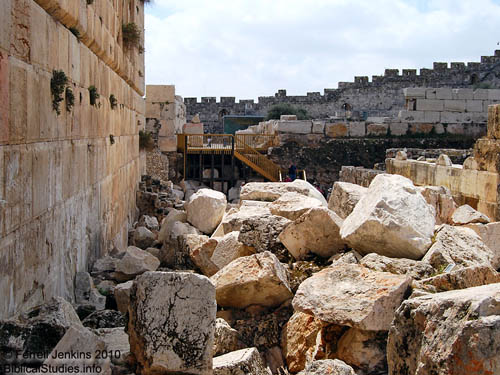
In the Olivet Discourse of Matthew 24 (= Mark 13; Luke 21), Jesus foretold the destruction of Jerusalem by the Roman armies in A.D. 70. The destruction was so complete that only the retaining walls around the Temple precinct were left standing. Archaeological excavations following 1967 have brought to light some of the rubble that was pushed from the platform into the Tyropoeon Valley on the western side. The stones are still impressive.

Broken stones once part of the temple precinct. Photo by Ferrell Jenkins.

Broken stones that once were part of the temple precinct. Photo by Ferrell Jenkins.

Jesus cleanses the Temple

On two separate occasions, perhaps separated by at least three years, Jesus cast out the money changers and merchants from the temple precinct. The first account, early in His ministry, is recorded in John 2:13-17. The second cleansing took place during the final week of His earthly ministry on Monday (Matthew 21:12-16; Mark 11:15-18; Luke 19:45-47).

Then Jesus entered the temple area and drove out all those who were selling and buying in the temple courts, and turned over the tables of the money changers and the chairs of those selling doves. And he said to them, “It is written, ‘My house will be called a house of prayer,’ but you are turning it into a den of robbers!” (Matthew 21:12-13 NET)

The photo below shows the Temple as it is envisioned from the time of Jesus. This wonderful model was displayed for many years on the grounds of the Holyland Hotel, but is now displayed at the Israel Museum in Jerusalem. Money changing and selling of sacrificial animals was an appropriate function. Then why did Jesus react as He did? The merchants were in the wrong place. They were in the temple precinct (hieros), the large area surrounding the temple proper (the sanctuary where the priests were allowed; naos).

Second Temple Model at the Israel Museum. Photo by Ferrell Jenkins.

Second Temple Model at the Israel Museum. Photo by Ferrell Jenkins.