Tag Archives: Ministry of Jesus

Acts 4 — Photo Illustrations

In Acts 4 we have several public characters mentioned who had a part in the trial of Jesus or in the opposition to the new movement of believers in Jesus as Lord and Christ (Acts 2:36). I will call attention to two of them. The first is a religious leader, and the second is one of the Roman procurators or prefects.

Caiaphas. Caiaphas was the son-in-law of Annas. He was appointed high priest by Valerius Gratus, procurator of Judea, in A.D. 18 and deposed by Vitellius, legate of Syria, in A.D. 36 at the same time Pilate was removed as procurator of Judea. Caiaphas was the Jewish high priest before whom Jesus was tried (John 18:13-14, 24).

In November, 1990, a burial cave was found accidentally during construction of a water park at a promenade overlooking the Peace Forest just south of the old city of Jerusalem. The cave contained 12 ossuaries, two of which contained the name of the well-known family of the high priest Caiaphas. One ossuary bore the inscription Qafa, and the other bore the name Yehosef bar Qayafa (Joseph, son of Caiaphas) and Yehosef bar Qafa (Joseph, son of Caiaphas). Inside this beautiful ossuary was found the bones of six different people: 2 infants, a child between 2 and 5, a young boy between 13 and 18, an adult woman and “a male of about 60 years!”

According to Josephus, Caiaphas was named Joseph Caiaphas (Ant. 18.2.2).

The Caiaphas ossuary is on display in the Israel Museum. (See articles: Zvi Greenhut, “Burial Cave of the Caiaphas Family,” BAR 18.5 (1992): 29-36. Ronny Reich, “Caiaphas Name Inscribed on Bone Boxes,” BAR 18.5 (1992): 38-44.)
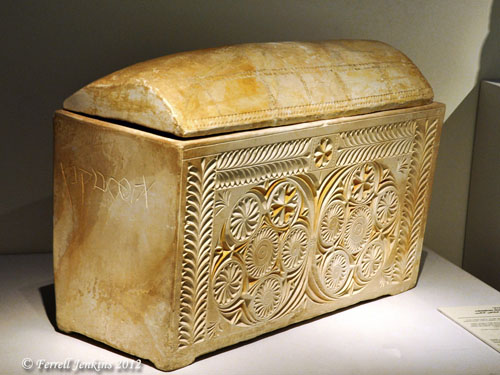
Decorated ossuary bearing the name of Caiaphas. Israel Museum. Photo by Ferrell Jenkins.

Ossuary bearing the name of Caiaphas. Israel Museum. Photo by Ferrell Jenkins.

Pontius Pilate. Pilate was the Roman procurator of Judea when Jesus was crucified (A.D. 26-36). An inscription bearing the name of Pilate was discovered at Caesarea, the residence of the procurator, in 1961. The stone is thought to have been used in the dedication of a statue or some public building. The original is in the Israel Museum but a replica is displayed at Caesarea.

Murphy-O’Connor suggests the following translation of the Latin inscription: “Pontius Pilate, Prefect of Judaea, made and dedicated the Tiberieum to the Divine Augustus” (The Holy Land, 3rd ed., 215).
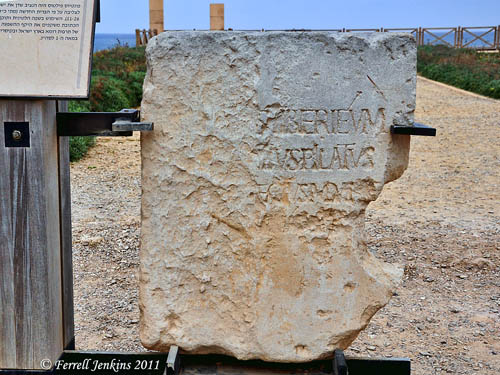
Pilate Inscription (Replica) at Caesarea Maritima. Photo by Ferrell Jenkins.

Pilate Inscription (Replica) at Caesarea Maritima. Photo by Ferrell Jenkins.

The Roman historian Tacitus (A.D. 55-117) writes about the persecution of a group commonly called Christians. He says the originator or author of the group,

Christ, was put to death by the procurator, Pontius Pilate, while Tiberius was emperor…

See John 18:28ff.
Mount Gerizim archaeological excavation site now open

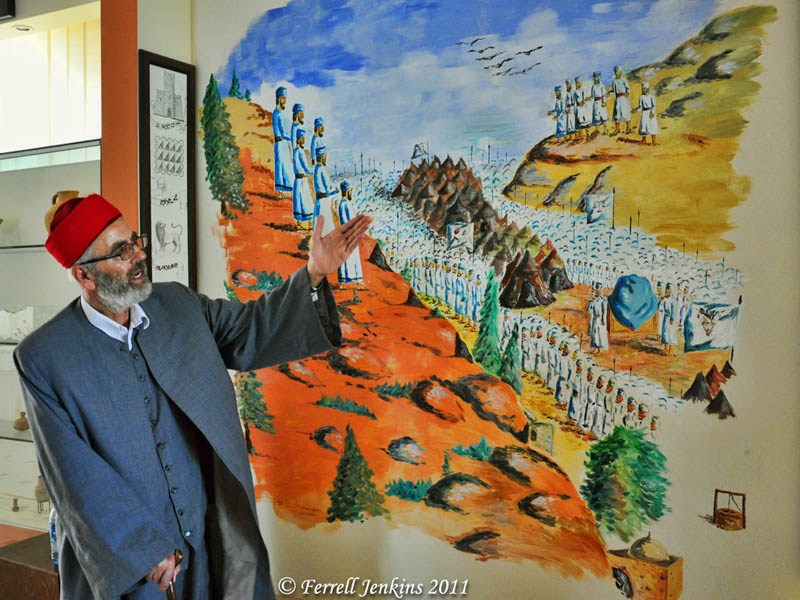
Last year I visited Mount Gerizim and the Samaritan Museum. Husney W. Cohen, a priest and director of the Museum, explained the Samaritan viewpoint about several biblical events. Samaritans believe the temple was to be built on Mount Gerizim rather than Jerusalem. They think Abraham offered Isaac on the mountain. They accept only the first five books (the Pentateuch) of the Old Testament.

Cohen used a large mural to explain the Biblical account of the blessing and the curse.

“It shall come about, when the LORD your God brings you into the land where you are entering to possess it, that you shall place the blessing on Mount Gerizim and the curse on Mount Ebal.” (Deuteronomy 11:29 NAU) cf. Joshua 8:33-35.

Notice Jacob’s well in the lower right hand corner of the mural (John 4:5-6).

Samaritan priest explains the Samaritan view of the reading of the blessings and curses of the Law. Photo by Ferrell Jenkins.

Samaritan priest, Husney W. Cohen, explains the Samaritan view of the reading of the blessing and curse of the Law. Photo by Ferrell Jenkins.

At one point during the visit the priest, who said he was third in line to become high priest, took us to an open window where we could see Mount Ebal across the valley to the north.

View of Mount Ebal from a window of the Samaritan Museum on Mount Gerizim. Photo by Ferrell Jenkins.

View of Mount Ebal from a window of the Samaritan Museum on Mount Gerizim. Photo by Ferrell Jenkins.

Robert J. Bull of Drew University excavated a site called Tell er Ras on Mount Gerizim between 1964 and 1968 when it was under the control of the Hashemite Kingdom of Jordan. His work uncovered evidence of Hadrian’s temple in the early second century A.D. In more recent excavations Y. Magen claims to have discovered the Samaritan temple destroyed by John Hyrcanus.

In 1982 I visited the archaeological site on Mount Gerizim. In 2011 the road to the site was closed. In 2009 it was possible to drive to the site, but it was closed to visitors. Here is a photo I made of some of the excavation and a Samaritan village on Mount Gerizim.

Archaeological site and Samaritan village on Mount Gerizim. Photo by Ferrell Jenkins.

Archaeological site and Samaritan village on Mount Gerizim. Photo by Ferrell Jenkins.

Two years ago we reported that the Samaritans wanted the archaeological site opened. See here. Now comes word that the site has been opened. No hours are given. See the Arutz Sheva article here.

This whole area is of great significance to students of the New Testament. The conversation between Jesus and the woman of Samaria dealt with this issue.

“Our fathers worshiped in this mountain, and you people say that in Jerusalem is the place where men ought to worship.” (John 4:20).

Information about the Samaritan Passover may be found here, and here.

HT: Joseph Lauer.

Acts 2 — Photo Illustrations

Acts 2 is one of those highly significant chapters of the Bible. It is a pivotal point, or as the late James D. Bales called it in one of his books, “The Hub of the Bible.” The reason is because so many Old Testament prophecies looked forward to their fulfillment in the events of Acts 2 (e.g., Isaiah 2, Joel 2, Daniel 2), and because many New Testament texts look back to the beginning of the gospel in that chapter (e.g., Ephesians 2). In fact, Peter refers to the events of Pentecost as “the beginning” (Acts 11:15).

The prophet Isaiah said,

Now it will come about that In the last days The mountain of the house of the LORD Will be established as the chief of the mountains, And will be raised above the hills; And all the nations will stream to it. And many peoples will come and say, “Come, let us go up to the mountain of the LORD, To the house of the God of Jacob; That He may teach us concerning His ways And that we may walk in His paths.” For the law will go forth from Zion And the word of the LORD from Jerusalem. (Isaiah 2:2-3 NAU)

From the beginning of His ministry, Jesus spoke of the establishment of the kingdom during the lifetime of some of those who heard him (Mark 1:14-15; 9:1).

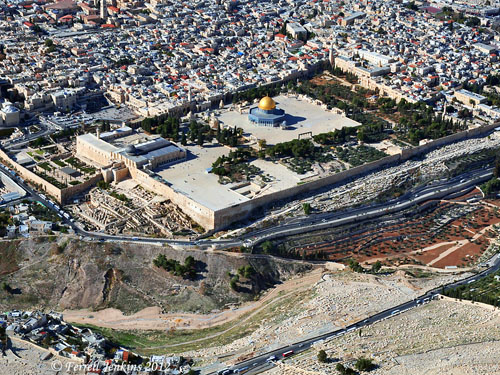
Our aerial photo shows the enclosed Islamic sanctuary area that is commonly called the Haram es-Sherif. Benjamin Mazar says that this area is about 40 acres. He points out that Josephus and the Mishna give smaller dimensions, and says that they apparently refer to “the Soreg or sacred enclosure” (The Mountain of the Lord, 119-120). Other writers say the area is 36 acres in size. Certainly large enough for the crowds who came to Jerusalem for festivals such as the Passover and Pentecost.

Solomon’s temple stood on Mount Moriah (2 Chronicles 3:1). Centuries later Herod the Great built the large platform and enclosure walls. Stones from that wall can still be seen in many places around this vast enclosure. The picture shows the southern wall and the eastern wall (the long one). The Kidron Valley and a portion of the slope of the Mount of Olives is visible in the bottom of the photo.

Aerial view of the temple precinct from the time of Herod the Great. Today the area is occupied by Moslem shrines, Al Aksa Mosque and the Mosque of Omar (Dome of the Rock). Photo by Ferrell Jenkins.

Aerial view of the temple precinct from the time of Herod the Great. Today the area is occupied by Moslem shrines, Al Aksa Mosque and the Mosque of Omar (Dome of the Rock). Photo by Ferrell Jenkins.

Click on the photo for an image suitable for use in teaching.

The New Testament (Greek) makes a distinction between the entire temple precinct, courts and all (Greek, hieron), and the sanctuary where only the priests were allowed (Greek, naos). John 2:14-15 uses hieron. John 2:19-21 uses naos.

Hieron is the term used in Acts 2:46. The new converts met in the temple precinct. They most likely assembled in one of the large porticoes built around the inside of the enclosure wall (cf. Acts 3:11; 5:12).

Day by day continuing with one mind in the temple, and breaking bread from house to house, they were taking their meals together with gladness and sincerity of heart,  praising God and having favor with all the people. And the Lord was adding to their number day by day those who were being saved. (Acts 2:46-47 NAU)

It also was within this precinct that the large crowd of devout Jews “from every nation under heaven” assembled on Pentecost. Here, Peter preached the gospel of the death, burial, and resurrection of Jesus for the first time.

Leeches in Sea of Galilee; Palestinian Village; Jericho

Sea of Galilee invaded by leeches. For the second time in 7 years the lake has an explosion of leeches. The article in Haaretz says,

Standing in the water for as little as two minutes will cause your legs to be covered in hundreds of leeches. These particular types are not blood-suckers, making them relatively easy to remove once one is out of the water

Causes for the large number of leeches include “human activity, including pollution, poisoning and overpumping.”

Read the full article here.

The Sea of Galilee was central to much of the ministry of Jesus.

While walking by the Sea of Galilee, he saw two brothers, Simon (who is called Peter) and Andrew his brother, casting a net into the sea, for they were fishermen. (Matthew 4:18 ESV)

Palestinian Village uses Roman irrigation system to continue terraced farming near Bethlehem. Read the story, with beautiful photo, in The New York Times here.

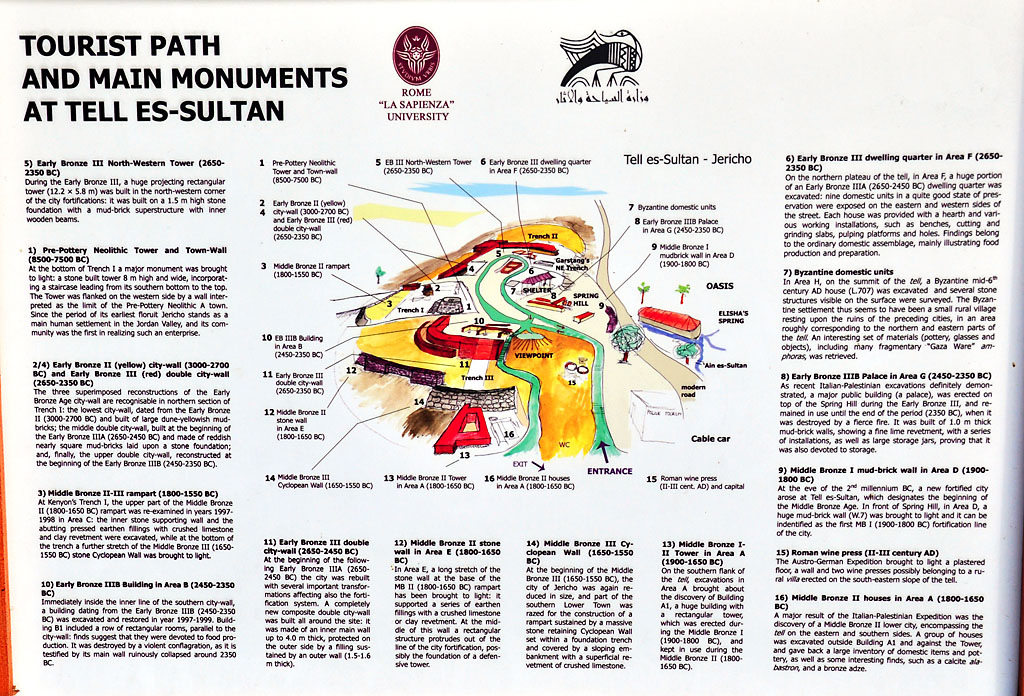
Tell es-Sultan/Jericho. Sepienza University in Rome, in cooperation with the Palestinian General Directorate of Antiquities, has published a Palestine Archaeological Databank and Information System. Check here for maps and other information. Our readers will likely be interested in the excavation reports on Tell es-Sultan/Jericho here. Click on the Results 2012 photo for the most recent work by the Italian-Palestinian Expedition at Jericho. Every visitor to the site will welcome is the new paths, identifying signs, and general clean-up of the site.

I was especially pleased to see the Digital Visit plan of the site. Click on it was a colorful, readable plan of the site like the central portion of the one shown below. Prof. Lorenzo Nigro is the director of the excavation.

Tourist Path and Main Monuments at Tell es-Sultan/Jericho. Photo by Ferrell Jenkins.

Tourist Path and Main Monuments at Tell es-Sultan/Jericho. Photo by Ferrell Jenkins.

Jericho is important in Old Testament history (Joshua 6).

HT: Bible Places Blog; Jack Sasson; Barry Britnell; “La Sapienza” Expedition to Palestine.

BiblePlaces giveaway of the PLBL Israel Collection

Between now and Friday at 10 am Pacific time you have an opportunity to enter a significant giveaway worth $149. Todd Bolen announces how you can win one of two copies of the 5 volumes of Israel photos in the Pictorial Library of Bible Lands.

For full details click here. If you don’t win one of the sets you can always purchase it.

For my opinion about the full 18 volume Pictorial Library of Bible Lands see the review here.

— • —

Peter’s Epistles and Pontus. I have been busy with other matters and unable to write more about the Black Sea coast. Hopefully tomorrow.

Free Kindle book on the Sermon on the Mount

DeWard Publishing Company is offering a free Father’s Day Kindle download for a limited time.

Invitation to a Spiritual Revolution (Studies in the Sermon on the Mount) by Paul Earnhart is available for free download from this link.

Paul Earnhart has served as minister at the Douglass Hills Church of Christ, Louisville, Kentucky, for many years. He is recognized for both his scholarly and practical approach to Biblical subjects.

The Sermon on the Mount (Matthew 5-7) is the seminal announcement of the teaching of Jesus.

This is a great book for any father, or anyone else interested in spiritual matters.

Thanks to DeWard Publishing Company for this gracious gift. Take a look at their other publications.

The Man of Galilee available in Kindle format for 99¢

DeWard Publishing Company announces today that Atticus G. Haygood’s The Man of Galilee in available in Kindle format for 99¢. This, in my judgment, is one of the finest books written, apart from the Bible, to direct people to a proper understanding of Jesus..

The Man of Galilee by Atticus G. Haygood.
I don’t know how long it will be available for this incredibly low price, but I suggest you get it now from this link.

More camel humor

In The Humor of Christ (1964), the late Evangelical philosopher Elton Trueblood discusses “The Preposterous” in the teaching of Christ. He says we should,

recognize that Christ used deliberately preposterous statements to get His point across.

Trueblood comments on the rich man and the needle’s eye (see yesterday’s post).

Taken literally, of course, the necessary conclusion is that no one who is not in absolute poverty can enter the Kingdom, because most people have some riches, and it is impossible for a body as large as that of a camel, hump and all, to go through an aperture as small as the eye of a needle. For humorous purposes this is evidently the same camel swallowed by the Pharisee when he carefully rejected the gnat. That the listeners failed to see the epigram about the needle’s eye as a violent metaphor is shown by their question, “Then who can be saved?” (Mark 10:26). (47)

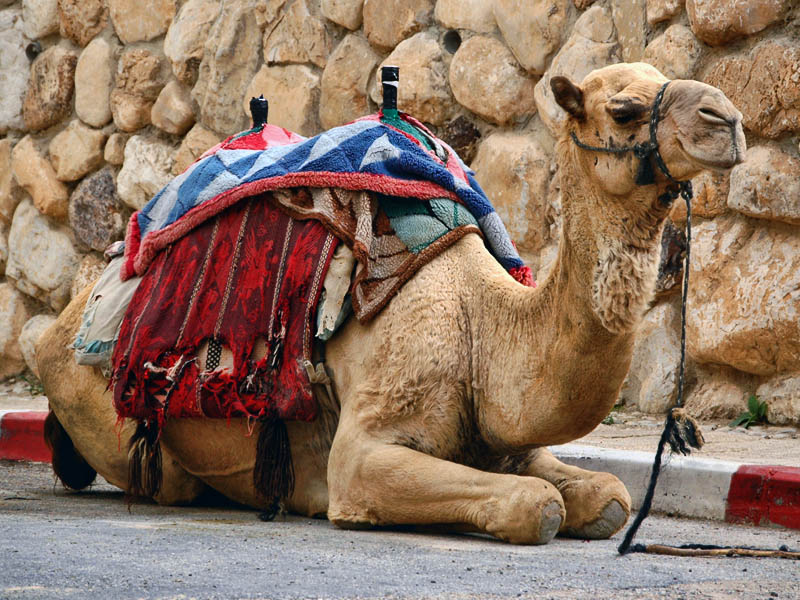
Camel at Qumran near the Dead Sea. Photo by Ferrell Jenkins.

Camel at Qumran near the Dead Sea. Photo by Ferrell Jenkins.

Had you thought about the humor of this statement?

You blind guides, straining out a gnat and swallowing a camel! (Matthew 23:24 ESV)

There are the self righteous leaders straining their wine through a cloth. They eliminate every gnat, but then swallow the whole camel — head first, then front legs, then hump (and even second hump). After that, I suppose the rest would be easy.

Of camels and needles

Jesus warned His disciples about the danger of riches. On one occasion He said,

In fact, it is easier for a camel to go through the eye of a needle than for a rich person to enter the kingdom of God.”  Those who heard this said, “Then who can be saved?”  He replied, “What is impossible for mere humans is possible for God.”  (Luke 18:25-27 NET; cf. Matthew 19:24-26; Mark 10:25-27)

I suppose in the time of Jesus almost everyone had seen a camel and understand what Jesus was talking about. And most of them also had seen a needle.

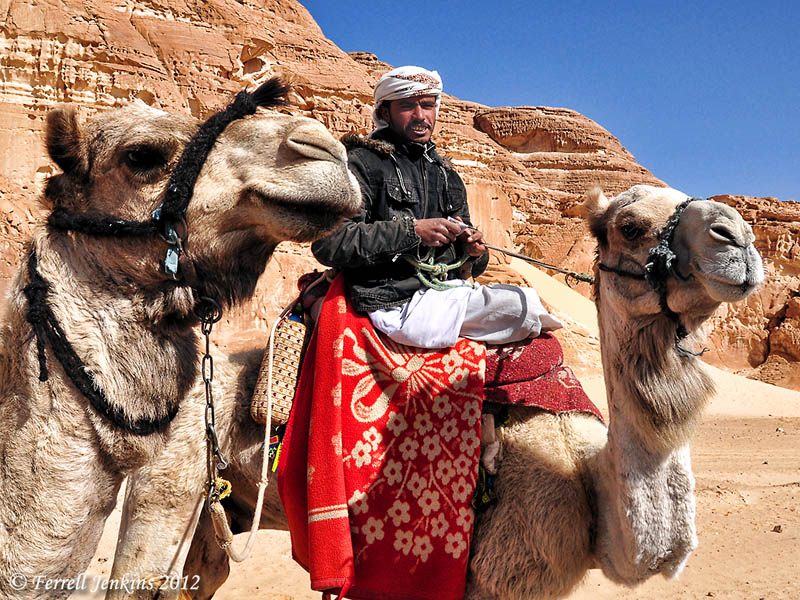
Camels and rider in the Sinai Peninsula. Photo by Ferrell Jenkins.

Camels and rider in the Sinai Peninsula. Photo by Ferrell Jenkins.

The bronze needle below is displayed in the British Museum. The camel above is greatly reduced, and the needle below is greatly enlarged.

Bronze needle from the Roman period. British Museum. Photo by Ferrell Jenkins.

Bronze needle from the Roman period. British Museum. Photo by Ferrell Jenkins.

What did Jesus mean? There is a popular theory that there was a gate in Jerusalem with a smaller gate called the eye of the needle. It is said that the camel could go through the small gate when the burden was unloaded.

Sounds good doesn’t it? But it destroys the teaching of Jesus. Jesus spoke of something that was impossible for mere humans, but possible for God.

Many of the medieval gates we know of in ancient cities had a small gate within the larger gate. There was no need to open a huge gate just for any individual to pass.

Authors of Hard Sayings of the Bible, after mentioning this legend, say,

But this charming explanation is of relatively recent date; there is no evidence that such a subsidiary entrance was called the eye of a needle in biblical times. (438)

They also warn of the temptation to tone down the teaching of Jesus.

There is probably no saying of Jesus which is harder in the Western mind today than the saying about the camel and the needle’s eye, none which carries with it such a strong temptation to tone it down. (439).

The IVP Bible Background Commentary: New Testament comments on the eye of the needle at Mark 10:25.

This image reflects a Jewish figure of speech for doing something impossible (a large animal going through a needle’s eye). The saying, a hyperbole, refers to a literal needle. (Those who think Jesus refers here to a gate in Jerusalem called the “eye of a needle” are mistaken, because that gate was built in medieval times.) A wealthy person could relinquish wealth only by God’s grace (10:26–27).

The Empty Tomb

The Gospel of Mark provides a brief account of the events of the first day of the week after the crucifixion of Jesus. The women went to the tomb of Jesus to anoint his body. The approach of the Sabbath did not allow this on Friday.

1 When the Sabbath was past, Mary Magdalene, Mary the mother of James, and Salome bought spices, so that they might go and anoint him.
2 And very early on the first day of the week, when the sun had risen, they went to the tomb.

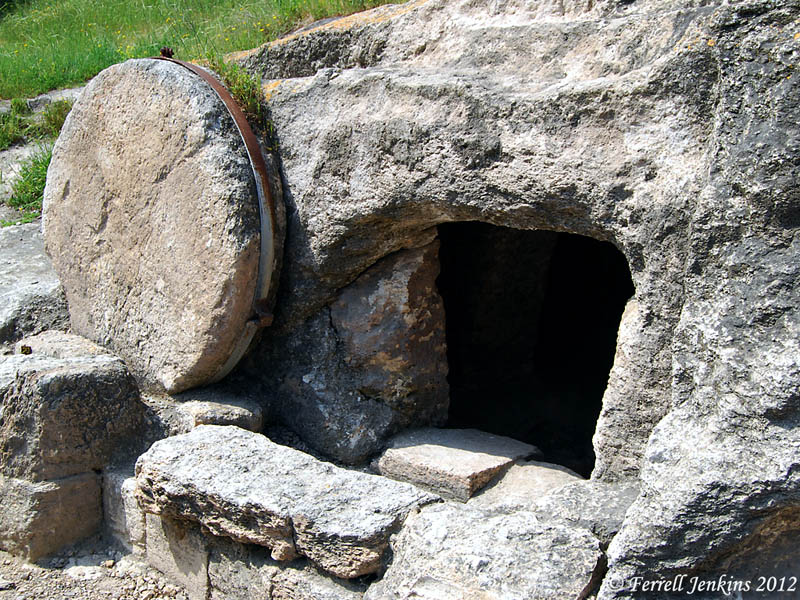
These grieving women were concerned about the removal of the large stone that had been rolled over the tomb opening and sealed by the Roman authorities. They were surprised when they discovered that the stone had already been removed.

3 And they were saying to one another, “Who will roll away the stone for us from the entrance of the tomb?”
4 And looking up, they saw that the stone had been rolled back–it was very large.

Perhaps they thought that some others, unknown to them, had come to provide the same service. They were alarmed to see the young man in a white robe.

5 And entering the tomb, they saw a young man sitting on the right side, dressed in a white robe, and they were alarmed.

The message was an unexpected one, but one that they were to share with his disciples and Peter and to tell them to update their appointment calendar to include a meeting with Jesus in Galilee.

6 And he said to them, “Do not be alarmed. You seek Jesus of Nazareth, who was crucified. He has risen; he is not here. See the place where they laid him.
7 But go, tell his disciples and Peter that he is going before you to Galilee. There you will see him, just as he told you.”
8 And they went out and fled from the tomb, for trembling and astonishment had seized them, and they said nothing to anyone, for they were afraid. (Mark 16:1-8 ESV)

The message that these women took with them was that the tomb was empty and that Jesus had risen from the grave. From this time forward He would be acknowledged by believers as Lord and Christ (Acts 2:36).

An empty Roman period tomb with a rolling stone. Photo by Ferrell Jenkins.