Prof. Aren Maeir shares this video on Jerusalem: Filmed in 3D. We probably have a few readers who do not regularly visit his Tel es-Safi/Gath blog. Lots of good stuff there.
Jerusalem | Filmed in Imax 3D from JerusalemGiantScreen on Vimeo.

Prof. Aren Maeir shares this video on Jerusalem: Filmed in 3D. We probably have a few readers who do not regularly visit his Tel es-Safi/Gath blog. Lots of good stuff there.
Jerusalem | Filmed in Imax 3D from JerusalemGiantScreen on Vimeo.
Arutz Sheva (Israel National News.com) reports that archaeologists have “discovered a rare gold bell with a small hook at its end.”
The directors of the excavation on behalf of the Antiquities Authority, archaeologists Eli Shukron and Professor Ronny Reich of Haifa University, said after the finding, “The bell looked as if it was sewn on the garment worn by a man of high authority in Jerusalem at the end of the Second Temple period.
“The bell was exposed in the city’s main drainage channel of that period, between the layers of dirt that had been piled on the floor of the channel,” they continued. “This drainage channel was built and hewn west to the Western Wall of the Temple Mount and drained the rainfall in the different parts of the city, through the City of David and the Shiloah Pool to the Kidron valley.”
The excavation area, above the drain, is located in the main street of Jerusalem which rose from the Shiloah Pool in the City of David. In this street an interchange was built through which people entered the Temple Mount. The remains of this interchange are what is known today as Robinson’s Arch. Archaeologists believe that the eminent man walked the streets of Jerusalem in the area of Robinson’s Arch and lost the golden bell which fell off his outfit into the drain beneath the street.
The full news report may be read here.
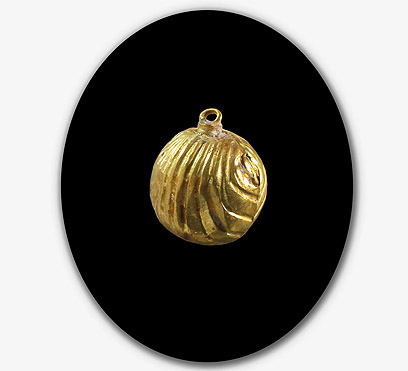
Golden bell found in Jerusalem drain. Photo: IAA.
The best I can tell from the description of the location is that it is near the area of Robinson’s Arch. We saw workmen at the northern end of the drainage channel about which we have reported earlier (here) during our visit to the area in May. I understand that eventually the channel will be open all the way from the A.D. 70 street below Robinson’s Arch to the Pool of Siloam. I have lightened the area under the grill so you can see the workman’s arm.
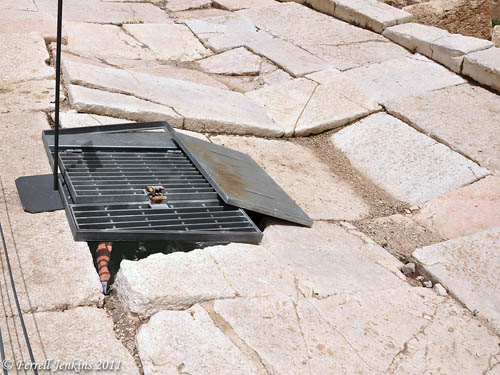
Opening in A.D. 70 street below Robinson's Arch. Photo by Ferrell Jenkins.
I note in the news report that the archaeologists did not rule out the possibility that this bell might have belonged to one of the high priests. Actually, one can not rule out much of anything with so little information. My first thought almost simultaneously was the bells on the garments of the high priest and a woman’s jewelry. Note the earlier discovery of jewelry here.
The adornment of the priestly garment is described in Exodus.
“You shall make on its hem pomegranates of blue and purple and scarlet material, all around on its hem, and bells of gold between them all around: a golden bell and a pomegranate, a golden bell and a pomegranate, all around on the hem of the robe. (Exodus 28:33-34 NAU)
Jim Davila, at Paleojudaica, comments wisely on the suggestion that this bell might have belonged to a priest or a man of high authority:
Well, maybe. On the one hand it is true that the only references to golden bells in the Hebrew Bible are to bells on the vestments of the high priest (Exodus 28:33-34; 39:25-26). On the other hand, first, the only other mention of bells (a different Hebrew word) refers to horses’ trappings (Zechariah 14:20). Presumably, bells were used in many other contexts, so our sample of cultural allusions is limited. But, you say, what about golden bells? Well, second, Isaiah 3:16-18 refers to bangles that the rich women of Jerusalem wore on their ankles and which “tinkled” or made some kind of bangle noise. These ladies clearly had lots of jewelery and finery (cf. also vv. 19-23), so it seems entirely likely that they sometimes wore bells as jewelry and that some of those bells might well have been made of gold. And we know that Second-Temple-era ladies in Jerusalem had very nice gold earrings. So this bell need not have come from “a man of high authority.”
The Christian Standard Bible translation of Isaiah 3:16 is vivid:
The LORD also says: Because the daughters of Zion are haughty, walking with heads held high and seductive eyes, going along with prancing steps, jingling their ankle bracelets, (Isaiah 3:16 CSB)
HT: Joseph Lauer
Posted in Archaeology, Bible Places, Bible Study, Culture, Israel, Old Testament, Photography, Travel
Prof. Aren Maeir, director of the Tel es-Safi/Gath archaeological excavation, explains why some of his team is not working today.
Today, part of the team was not working in the field, since it is the Jewish fast day of the 17th of Tammuz, which commemorates the breaching of the walls of Jerusalem by the Romans, prior to the destruction of Jerusalem in 70 CE (and according to some traditions, during the Babylonian siege of Jerusalem in 586 BCE as well). Others though were in the field and had a very good day.
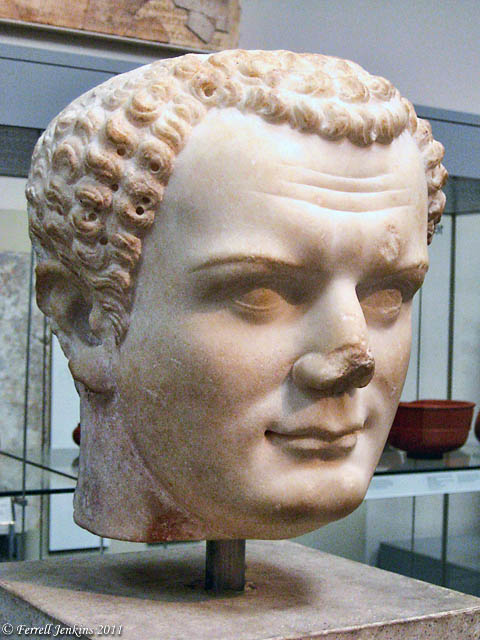
Titus, Roman commander at the time of the destruction of Jerusalem, was later Emperor (A.D. 79-81). Bust in British Museum. Photo by Ferrell Jenkins.
Whatever the exact day of the event, the siege and destruction of Jerusalem by the Romans was a traumatic event. Christians, and perhaps others, understand it as a judgment upon the corrupt nation at that time (Matthew 24, Mark 13, Luke 21). I use judgment in the sense of repeated judgments upon cities and nations as we see it used in the Old Testament prophets. We believe that Jesus predicted the destruction of the city of Jerusalem about 40 years prior the the actual destruction by the Romans.
But when you see Jerusalem surrounded by armies, then know that its desolation has come near. (Luke 21:20 ESV)
There is much archaeological evidence in Jerusalem of the Roman occupation of the city and of the destruction in A.D. 70. In the excavations conducted in the Jewish Quarter of Jerusalem following 1967, archaeologists uncovered evidence of the destruction and burning of the city. The Herodian Mansion and the Burnt House are two places that are especially interesting to Bible students who visit the Old City. Here is a photo of the exhibit at the Burnt House. The Burnt House is known to be the priestly House of Kathros.
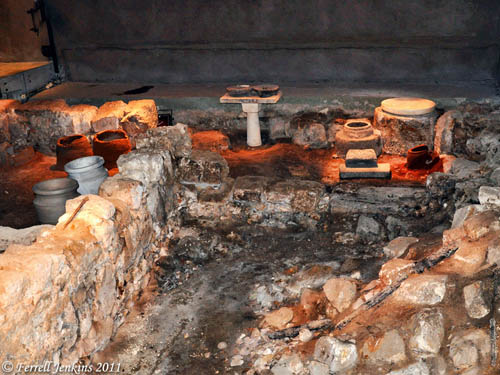
The Burnt House in the Jewish Quarter of Jerusalem. Photo by Ferrell Jenkins.
In this photo you see furniture, stone vessels, and clear evidence of the burning of the building in A.D. 70. A larger image, suitable for use in teaching, is available by clicking on the photo.
Posted in Archaeology, Bible Places, Bible Study, Israel, New Testament, Photography
Tagged Jerusalem, Old Testament prophets, Roman Army, Roman Emperor, walls of jerusalem
A couple of days ago we wrote about the pinnacle of the temple (Mark 11:11; Luke 4:9). We followed the common suggestion that the reference was to the southeast corner of the temple mount precinct.
We mentioned that the late Benjamin Mazar, The Mountain of the Lord (page 149), shows a photo of the southeast corner of the wall with the comment that this “is known as the ‘pinnacle of the Temple’ (Mark 11:11; Luke 4:9).”
Leen Ritmeyer left us a comment to say that “Mazar actually had a different idea,” and called attention to his own post at ritmeyer.com.
Dr. Ritmeyer, author of The Quest: Revealing the Temple Mount in Jerusalem, provided some insight into the subject that is helpful and appreciated. He says,
Although this statement does appear in the book, I remember discussing this problem with him and he said that he actually saw the southwest corner of the Temple Mount as a more likely candidate for the pinnacle of the Temple. One needs to determine what was the most important element in the temptation of Jesus to throw himself down from the pinnacle. Was it the height of the corner above what lay below or did the temptation lie in impressing as many people as possible with that jump?
As the southwest corner was a busy junction between the major north-south street running through Jerusalem and the Plaza in front of the Southern Wall of the Temple Mount, there would have been many more people to impress here than on the much quieter southeast corner.
It is in a setting such as this that we can visualise the dramatic scene that would have taken place had not Jesus challenged the temptation with the power of God’s Word.
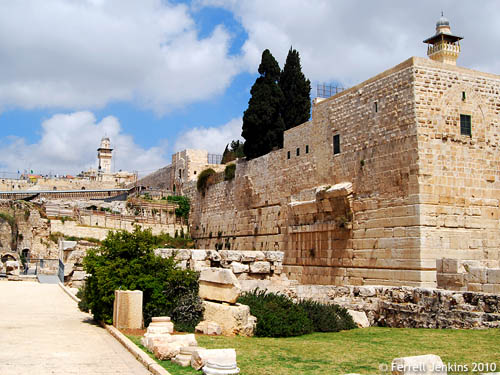
The western side of the Temple Mount enclosure ran along the Tyrophean Valley from north to south. A few years ago archaeologists found the first century street level at the southwest corner. The stones you see protruding from the wall are known as “Robinson’s Arch”, named for 19th century explorer Edward Robinson. When I first visited Jerusalem in 1967 it was commonly thought that the arch was the beginning of a bridge across the Tyrophean Valley, similar to Wilson’s Arch which is north of the Western Wall plaza. Now we know that the arch was the beginning of a winding staircase that allowed access to the Royal Stoa on the temple platform. (You will see a nice drawing of this staircase in Ritmeyer’s post.)
In my original post I said, “In a post to follow I will mention another view.” The other view I had in mind was the southwest corner.
Richard M. Mackowski, Jerusalem City of Jesus, says this corner “may be identified with the biblical Pinnacle of the Temple” (page 122). This is the comment I intended to use in today’s post. I am delighted that Dr. Ritmeyer calls attention to the discussion he had with Benjamin Mazar. We expect scholars to change their minds as they gain new information. It is also possible that an editor added the note in the book.
My bottom line is that we do not know for certain where the pinnacle of the temple is located. Either of these views suggest a good possibility.
Posted in Archaeology, Bible Places, Bible Study, blog, Israel, New Testament, Photography
Tagged Jerusalem, Ministry of Jesus
In this aerial view of Jerusalem you can see the Temple Mount enclosure and most of the Old City of Jerusalem. The Kidron Valley and the western slope of the Mount of Olives is visible on the right of the photo.
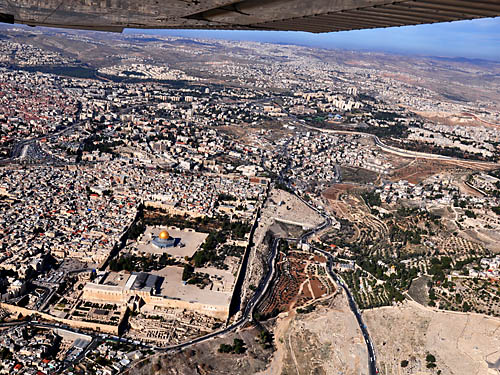
Aerial view of Jerusalem looking NE. Photo by Ferrell Jenkins.
The photo below is a cropped portion of the image with emphasis on the Temple Mount.

A closer view of the Temple Mount enclosure from the south. Photo by Ferrell Jenkins.
Herod the Great began to rebuild the existing postexilic temple on a grander scale about 20 B.C. Work had been going on for 46 years in the early days of the ministry of Jesus.
Then the Jewish leaders said to him, “This temple has been under construction for forty-six years, and are you going to raise it up in three days?” (John 2:20 NET)
Posted in Bible Places, Bible Study, Israel, New Testament, Old Testament, Photography
Tagged Jerusalem, The Temple
After David’s sin in the the matter of taking a census of the people of Israel, and his acknowledgment of the sin, he was told by Gad to build an altar (2 Samuel 24:1-10). The instructions are specific.
And Gad came that day to David and said to him, “Go up, raise an altar to the LORD on the threshing floor of Araunah the Jebusite.” So David went up at Gad’s word, as the LORD commanded. (2 Samuel 24:18-19 ESV)
Araunah was gracious in his offer to allow David to take any of his property needed — the oxen, the threshing sledge, and the yokes of the oxen for the wood. He said, “All this, O king, Araunah gives to the king.”
David’s reply is one of those memorable statements of Scripture.
But the king said to Araunah, “No, but I will buy it from you for a price. I will not offer burnt offerings to the LORD my God that cost me nothing.” So David bought the threshing floor and the oxen for fifty shekels of silver. (2 Samuel 24:24 ESV)
Artist Balage Balogh has provided us a beautiful illustration of the threshing floor of Araunah on what we later know to be Mount Moriah. See more of his work at Archaeology Illustrated.

Araunah's Threshing Floor. Illustrated by Balage.
It is generally understood that this is the place where Abraham came to offer Isaac, in the mount of the LORD three days from Beersheba (Genesis 22:4, 14). It is where Solomon began to build the temple in 966 B.C.
Then Solomon began to build the house of the LORD in Jerusalem on Mount Moriah, where the LORD had appeared to David his father, at the place that David had appointed, on the threshing floor of Ornan the Jebusite. (2 Chronicles 3:1 ESV)
The temple was destroyed by the Babylonians in 586 B.C., but rebuilt under the leadership of Joshua and Zerubbabel after the return from Babylonian exile (520-516 B.C.). Herod the Great basically built a new temple during his reign.
The Romans destroyed Jerusalem, including the temple, in A.D. 70. Centuries later, between 687 and 691, the Qubbet es Sakhra, (Dome of the Rock) was built on the orders of the Ommayad caliph, Abd el Malik. The building has been restored numerous times, but “the monument has preserved its original majestic proportions and harmonious design” (The Middle East, Hachette, 1966).
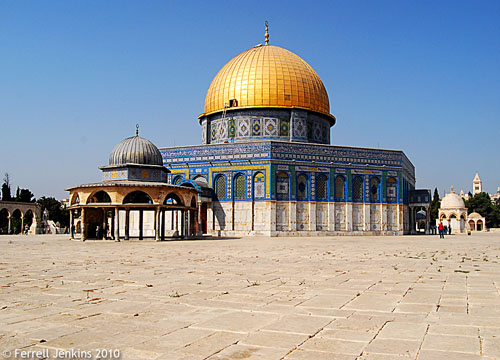
Dome of the Rock. Original site of Solomon's Temple. Photo by Ferrell Jenkins.
The association of this site with both Abraham and David ties together two of the great texts of the Old Testament (Genesis 12; 2 Samuel 7) and makes it especially significant for those who believe the Bible.
Last week we reported here the announcement of the discovery of a cuneiform fragment dating back to the 14th century B.C. The Hebrew University, Department of Media Relations, has been kind enough to supply me some nice hi-res photos of the cuneiform fragment and the scholars involved in the announcement. Click on each photo for a larger image.
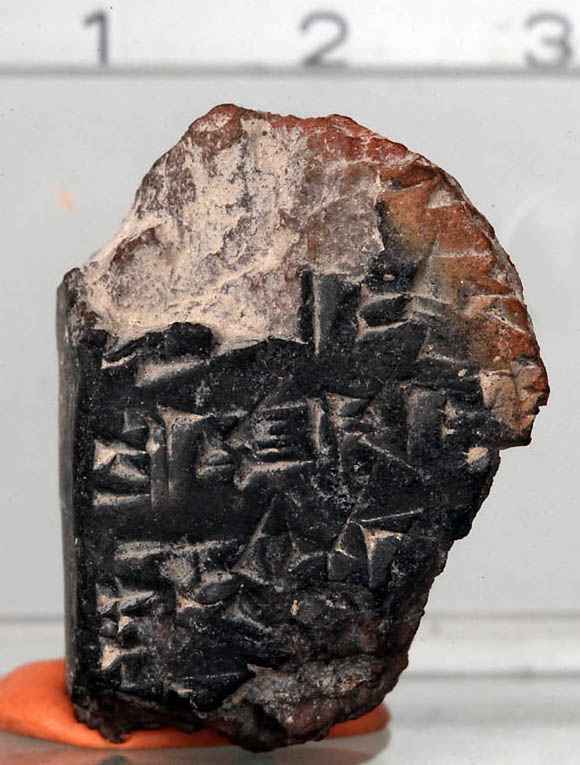
The fragment found at the Ophel is believed to be contemporary with the some 380 tablets discovered in the 19th century at Amarna in Egypt in the archives of Pharaoh Amenhotep IV (Akhenaten), who lived in the 14th century B.C.E. The archives include tablets sent to Akhenaten by the kings who were subservient to him in Canaan and Syria and include details about the complex relationships between them, covering many facets of governance and society. Among these tablets are six that are addressed from Abdi-Heba, the Canaanite ruler of Jerusalem. The tablet fragment in Jerusalem is most likely part of a message that would have been sent from the king of Jerusalem, possibly Abdi-Heba, back to Egypt, said Mazar.
Examination of the material of the fragment by Prof. Yuval Goren of Tel Aviv University, shows that it is from the soil of the Jerusalem area and not similar to materials from other areas, further testifying to the likelihood that it was part of a tablet from a royal archive in Jerusalem containing copies of tablets sent by the king of Jerusalem to Pharaoh Akhenaten in Egypt.
Mazar says this new discovery, providing solid evidence of the importance of Jerusalem during the Late Bronze Age (the second half of the second century B.C.E.), acts as a counterpoint to some who have used the lack of substantial archeological findings from that period until now to argue that Jerusalem was not a major center during that period. It also lends weight to the importance that accrued to the city in later times, leading up to its conquest by King David in the 10th century B.C.E., she said.
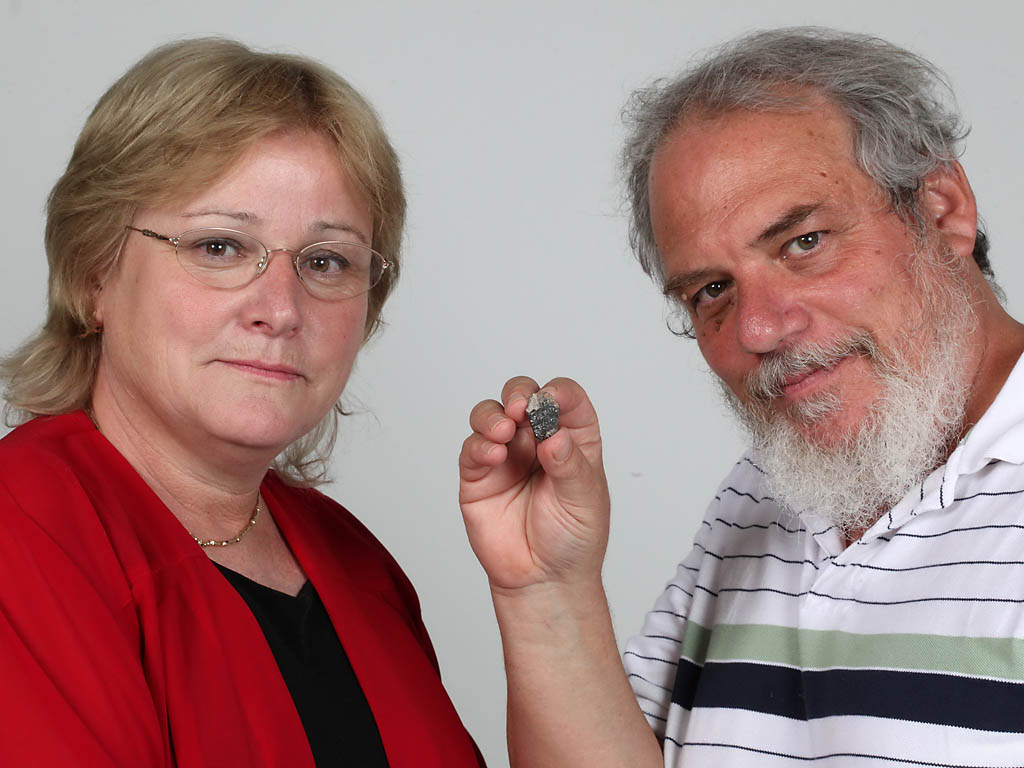
Dr. Eilat Mazar and Prof. Wayne Horowitz with the cuneiform fragment from the Ophel Excavation. Photo: Hebrew University/Sasson Tiram.
Note the statement of Dr. Mazar:
The tablet fragment in Jerusalem is most likely part of a message that would have been sent from the king of Jerusalem, possibly Abdi-Heba, back to Egypt, said Mazar.
Several blogs have pointed to the analysis by Professor Christopher Rollston. After an analysis of the fragment, Rollston suggests four possibilities regarding what “Jerusalem 1” could be:
He concludes,
Therefore, there are a number of possible options for this tablet. And, thus, because there is such a dearth of actual preserved text on this tablet, I contend that it is best not to attempt to posit as probable this or that historical context, Sitz im Leben, or genre. Ultimately, the fact of the matter is that it could be one of various things…e.g., an epistolary text, a legal text, an administrative text, a literary text.
You may read his reflections in their entirety here.
The Israel Antiquities Authority announced September 10, 2007 the discovery of a channel that is thought to run from the Temple Mount to the Pool of Siloam, or further.
In excavations the Israel Antiquities Authority is conducting in the City of David in order to expose the main road of Jerusalem from the time of the Second Temple period, the city’s main drainage channel was discovered. According to the writings of Josephus Flavius, the residents of the city fled to this channel at the time of the revolt in order to hide from the Romans.
In excavations the Israel Antiquities Authority is jointly carrying out with the Elad Association in the Walls around Jerusalem National Park, approximately 70 meters of Jerusalem’s main drainage channel from the time of the Second Temple period have been exposed so far. The channel is located along the route from the Temple Mount to the Shiloah Pool. The channel, which passes beneath the main road of the city and apparently continues to Nahal Kidron on its way to the Dead Sea, drained the rainfall of ancient Jerusalem; the Jewish quarter, the western region of the City of David and the Temple Mount.
The complete report may be read here.
Old news, you say. Here is what is new. My group had the opportunity May 7, 2010, to walk through the channel. Twice before I had walked along a portion of the steps leading uphill from the Pool of Siloam, but this was my first time to walk in through the channel (sewer). It was the first time my local guide had walked through the channel.
Ronnie Reich and Eli Shukron, the excavators, are quoted as saying,
“There is evidence in the writings of Josephus Flavius, the historian who described the revolt, the conquest and the destruction of Jerusalem, that numerous people took shelter in the channel and even lived in it for a period until they succeeded to flee the city through its southern end.”
In some of the media reports this comment includes a reference to The Jewish War. I admit to not being a great Josephus scholar, but I have been unable to locate a specific reference like this in Josephus. He does speak of the citizens of Jerusalem hiding in subterranean caverns of the temple (under the platform, I assume) (5:102), and he mentions secret passages (JW 5:497). If a reader has located the reference to the channel I would be pleased to have it. This does sound like a reasonable suggestion.
This first photo was made closer to the Pool of Siloam.
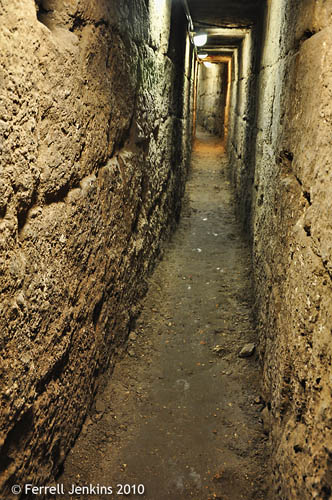
Roman Period Sewer in Jerusalem. Photo: F. Jenkins.
The next one is closer to the northern end of the current excavation. I would say this is a about half way from the Pool to the Temple Mount. At this point the channel begins to have the smell of a sewer.
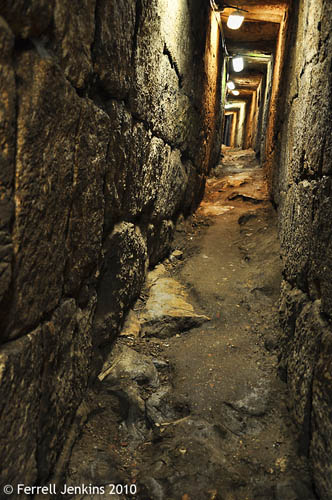
Roman Period Sewer in Jerusalem. Photo: F. Jenkins.
The current channel exits on the west side of the street.
This photo was made as I walked up toward the Temple Mount. You can see the southern wall of the Temple Mount. The building on the right, past the flags, is the entrance to the City of David operated by the Ir David Foundation.
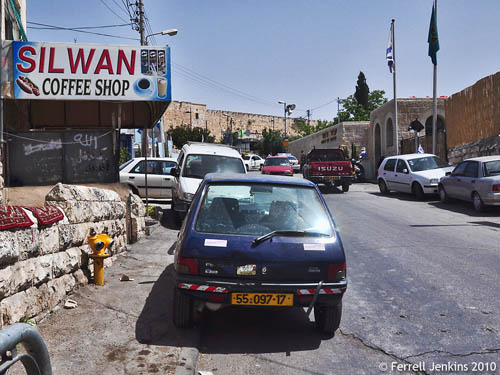
View north toward Temple Mount. Photo by Ferrell Jenkins.
The next photo shows the view to the south toward the Pool of Siloam, and eventually the point at which the Tyropean, Hinnom, and Kidron valleys come together.

View south toward Pool of Siloam. Photo by Ferrell Jenkins.
Update: Be sure to read the comment by Tom Powers in which he mentions other possible references from Josephus. You may also find Tom’s articles helpful. See his israelpalestineguide.wordpress.com blog here.
How? When we were looking at the mural showing a reconstruction of the Pool of Siloam, our guide (Elie) started to go back the way we entered. An elderly gentlemen who was selling booklets said we could now go through the channel. Fortunately he was correct!
Today we visited the Temple Mount, presently the site of the Dome of the Rock and the Al-Aksa Mosque. This site is thought to be the place where Abraham made preparations to offer Isaac.
He said, “Take your son, your only son Isaac, whom you love, and go to the land of Moriah, and offer him there as a burnt offering on one of the mountains of which I shall tell you.” (Genesis 22:2 ESV)
The temple of the LORD was constructed by Solomon on Mount Moriah.
Then Solomon began to build the house of the LORD in Jerusalem on Mount Moriah, where the LORD had appeared to David his father, at the place that David had appointed, on the threshing floor of Ornan the Jebusite. (2 Chronicles 3:1 ESV)
The Babylonians destroyed Solomon’s temple in 586 B.C. After the Jews returned from Babylonian Exile, the temple was rebuilt. In the days of Herod the Great the temple was virtually reconstructed beginning in about 20 B.C. (John 2:20). The temple was destroyed by the Romans in 70 A.D.
The photo today shows the Western Wall which served as the retaining wall built by Herod the Great around the Temple Mount. On the temple platform you will see the Dome of the Rock and the Al-Aksa Mosque. The Mount of Olives is in the distance to the east of Jerusalem.
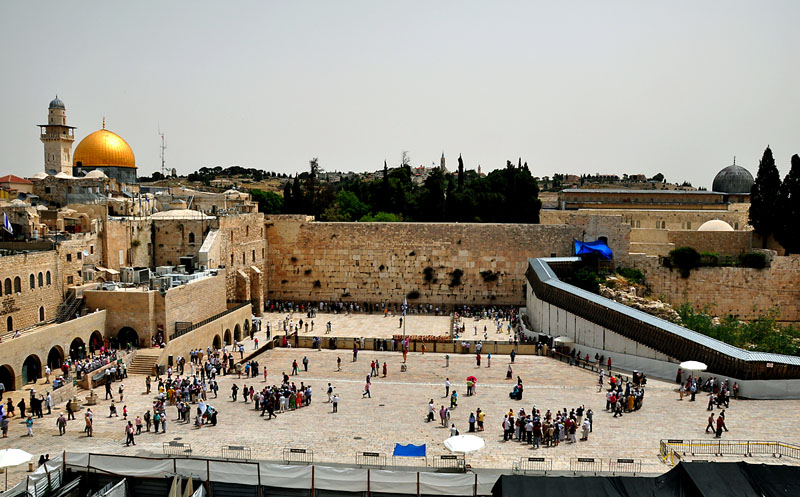
Western Wall Plaza. Photo by Ferrell Jenkins.
Click on the photo for a larger image.
We visited several other sites in the Old City of Jerusalem, the Shrine of the Book and the Second Temple Model at the Israel Museum.
Posted in Bible Places, Bible Study, Biblical Studies, Israel, New Testament, Travel
Tagged Jerusalem
The Jerusalem Post reports the reopening of Jaffa Gate after two months of renovation.
A large black cloth that has shrouded Jaffa Gate in both darkness and mystery over the past two months was removed Wednesday morning during a special ceremony to rededicate the famous Jerusalem landmark, revealing the extensive “face-lift” recently given to one of the Old City’s most important and well-known points of entry.
The gate’s freshly-cleaned Jerusalem stones, a completely refurbished white ceiling inside its entryway, and other aesthetic fruits of the renovation labor were immediately apparent after the cloth came down.
The complete report is available here.
Here is an aerial photo of the Jaffa Gate (in the bottom of the photo) and the Christian Quarter of the Old City of Jerusalem in December.
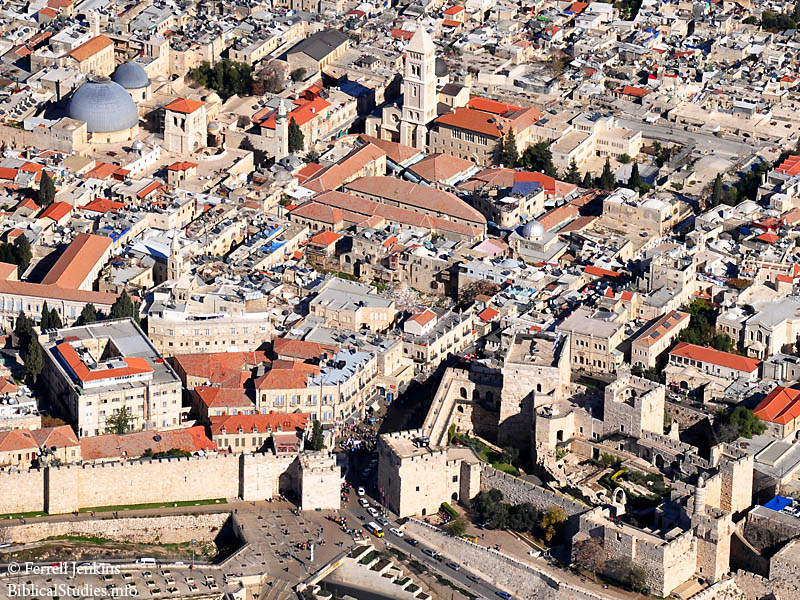
Aerial view of Jaffa Gate and the Christian Quarter. Photo by Ferrell Jenkins.
 Ferrell's Travel Blog
You must be logged in to post a comment.